Pordenone diary – day four

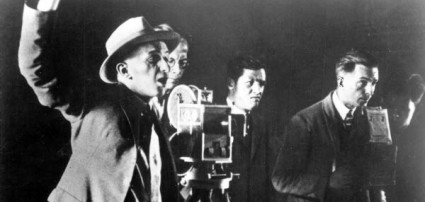
E.A. Dupont filming Das Alte Gesetz

E.A. Dupont directing Das Alte Gesetz, from http://www.juedischesmuseum.de

Every Pordenone Silent Film Festival has the one outstanding title, a feature generally previously neglected or unknown, whose exhibition here revives its reputation and gets everyone talking. This year the palm d’or undoubtedly went to E.A. Dupont’s Das Alte Gesetz (1923). Ewald André Dupont has had a revival in reputation of late, owing to the visibility of his late British silents Moulin Rouge (1928) and especially Piccadilly (1929), and in the reference books he always gets a warm mention for Varieté (1925), one of the cast-iron classic silents, and a shake of the head in sorrow for the sharp dip in his career that occured with the arrival of sound.

Das Alte Gesetz has been more listed in filmographies than seen, but it is close to a masterpiece. Set in the mid-nineteenth century, it tells the tale of a young Jew, Baruch (Ernst Deutsch), who breaks away from his Orthodox village background and stern rabbi father to become an actor in Vienna. So it is reminiscent of The Jazz Singer in theme, but it is the technique and style that distinguish the film. Dupont knows how place people within the frame, how they move within that space, how to capture the tensions between people, how to film intensity. With the help of superb sets by Alfred Junge, he deftly contrasts the humble, ritualised Jewish life with the elegant, no less ritualised Viennese society, personnified by Henny Porten poignantly playing an archduchess attracted to Baruch. The portrait of theatrical life, from ramshackle touring theatre with its wobbly sets to the formalities of the Burgtheater are beautifully drawn, and Deutsch (excellent) ably persuades us of an adolescent enthusiasm for performance which gradually reveals real dramatic talent. It is the resolution of his new world with his past that forms the core of the film, and his stern father’s painful acceptance of his son’s new life is memorably drawn by Avrom Morewsky. Most touching is the scene where he apprehensively picks up a book of Shakespeare’s plays (we see Baruch in Romeo and Juliet and Hamlet), which he tries to open back-to-front (i.e. as though a Jewish religous text) before reading it and discovering that the truths that his son understands are not so far from those that govern his life. The film looks superb (photography by Theodor Sparkuhl) and ought eventually to find a DVD release. It certainly merits screenings at other festivals.

Annie Bos

Annie Bos, from http://www.stadstheater.nl

Das Alte Gesetz was heady stuff for 9.00am. It was followed by four titles featuring the great star of Dutch silent cinema, Annie Bos. No, I hadn’t heard of her either. She was popular through the teens in Holland, graduating from slight social comedies to melodramatic diva roles in imitation of the Italian actresses Lyda Borelli and Francesca Bertini. She started out in comedies about two naive Dutch girls, Mijntje and Trijntje. In Twee Zeeuwsche Meisjes in Zaanvoort (1913) we see a somewhat plump Annie as one of the duo who go to the seaside and… well, that’s about it, they go to the seaside, and they improvise some comedy, and passers-by in the background stare on in amusement. Boerenidylle (c.1914) is similarly unencumbered by narrative. Annie is courted by her farmhand boyfriend, nothing dramatic happens at all, and the scenery is beautiful. Full-on drama comes with the delirious De Wraak van het Visschersmeisje (The Revenge of the Fisherman’s Girl) (1914). Exploiting the availability of an exotic dancer who employed snakes in her act, this impressively ludicruous mini-drama has two characters savaged by a quite sizeable python, which brightened up the audience no end. The feature-length Toen ‘t Licht Verdween (1918) showed a slimmed-down Annie in full diva mode, as a woman whose growing blindness causes her the loss of her composer husband, while a hunchback organist who truly loves her tries to save her, only for her life to end in suicide.

We should turn to René Clair for some light relief, but alas in the 1920s he was still finding his way as a filmmaker, and Le Fantôme du Moulin Rouge (1925) was disappointingly conventional and ponderous. It tried to introduce fantasy elements – the hero is able to float disembodied through Paris, viewing events but unable to affect them – but it was uncertain whether to adopt a light or serious tone. Starewitch also seemed a little off-form with Liliya (1915), a curious attempt to illustrate the invasion of Belgium in 1914 with insects, and Dans les Griffes de l’Araignée (1920), a rather confusing drama involving spiders.

Wifi at Pordenone

To round off the day, here’s a telling scene taken in the early morning, before the festival office had been opened, but with the wifi service switched on. From right to left, Dennis Doros of Milestone Films, Thomas Christensen, curator at the Danish Film Archive, and Minnie Hu, a student at the University of Washington and journalist for the Seattle China Times.

Pordenone diary – day three

Queue outside the Verdi

Queue outside the Teatro Verdi

It was during the Pordenone festival that Peter Greenaway announced the death of cinema. He wasn’t at the festival himself, but rather in Korea at the Pusan International Film Festival, giving a masterclass, but his words went round the world, as words will these days. Now, the unfortunate demise of cinema is commonly reported – Pordenone stalwart Paolo Cherchi Usai has written a book on the subject – and still the corpse keeps dancing around on our many and various screens, but Greenaway had an interesting specific point to make:

Cinema’s death date was in 1983, when the remote control was introduced to the living room … Bill Viola is worth ten Martin Scorseses. Scorsese is old-fashioned and is making the same films that D.W. Griffith was making early last century … Every medium has to be redeveloped, otherwise we would still be looking at cave paintings … My desire to tell you stories is very strong but it’s difficult because I am looking for cinema that is non-narrative.

Well, aside from the irony that Scorcese wrote the foreword to Cherchi Usai’s book (which admittedly is on the preservation of cinema rather than the present and future reception of cinema), is he still making films like Griffith, and what have we been doing these past few years at Pordenone sitting through the entire works of Griffith, the arch-master of narrative cinema? And why aren’t the art works of Bill Viola on show at this silent film festival?

Pordenone serves both an academic-historical and a sentimental function. It displays the films of the first thirty years or so of cinema with full archival and scholarly rigour – intelligently selected titles presented as products of national, artistic or thematic output, with credits, sources, informative writing, all backed up with the best-available prints shown in the best-possible conditions. It also caters to the nostalgic, with conventional, albeit brilliantly played and usually improvised, music rich in themes from the early twentieth century, and an abiding fondness for the stars of that era. On day three (October 8th), for instance, we were treated to a visit from Jean Darling, one-time star of the ‘Our Gang’ shorts, and the day before we spoke on the phone to Hungarian actress and singer Márta Eggerth to thank her for the film of her that we had just seen. Some acknowledgment of modern silents is made at Pordenone, such as the ingenious pastiches of the Wisconsin Bioscope, but Bill Viola would look sadly out of place. This is a festival which looks back – to the roots of cinema, and to a lost past.

And, however scholarly, this is an audience that likes its stories. Non-fiction does begrudgingly receive its due at Pordenone, but many choose the opportunity of such screenings to visit the restaurants and cafés. Narrative cinema reigns supreme, and much of the academic enquiry seems in any case rooted in the ways in which silent cinema discovered how to tell a story. It’s a fundamental need. Martin Scorcese is still making films in the way D.W. Griffith made them, because the audience still wants to identify people, their personalities, their predicaments, and what happens to them under crisis. I suspect that he would be rather flattered by Peter Greenaway’s comparison of him with D.W. Griffith. But I also suspect that Greenaway would be dismayed by Pordenone’s faith in a cinema held in amber.

D.W. Griffith

D.W. Griffith

But enough of such speculation – what of the immediate reality of sitting through another Griffith turkey, One Exciting Night (1922)? Word went round that this unfamiliar title was even worse than Dream Street, and at 136 mins it was going to be a grim ordeal. The film is a murder mystery set in an old dark house – a theme that is all too familiar now, but was fresh then. Griffith had tried to secure the rights to The Bat, a hugely popular play about a mysterious house with money hidden in it and many suspicious characters after it. Unable to afford the rights, Griffith simply rewote the story himself (using the pseudonym Irene Sinclair). The plot concerns an inheritance, an orphan (Carol Dempster), bootleggers’ loot, and a host of characters in the obligatory multi-roomed house, one of whom is a murderer. Title cards warn us of the mysteries that are to follow and how we should not reveal the identity of the murderer to those who might want to see the film after us. However, the identity of the murderer is glaringly obvious from the start, the plot is incomprehensible, and the handling of it inept. Griffith simply could not apply the necessary techniques for the mystery genre, filming in a flat, obvious style, failing to bring any clarity to a complex, incoherent plot, and leaving the audience both bored and bewildered.

And yet, and yet… Three quarters of the way through the film changes. The plot becomes so incoherent, the rushing between rooms of the increasingly panicky characters so manic, that all narrative coherence disappears and a kind of insane magnificence takes over. It’s at this point that a hurricane is introduced into the proceedings. There’s nothing to announce it – it has just built up in the background, and suddenly the characters are all outside and at the mercy of the wild elements. The expensive hurricane sequence was added on as an afterthought (clearly hoping to recreate the excitement of the final scenes of Way Down East), and has been much criticised as an illogical irrelevance. But to me it seemed to have a mad logic to it, and the pianist John Sweeney (on top form throughout the festival) certainly responded with gusto. One Exciting Night is a bad film by any conventional standard, but the way in which it tries to hold up a narrative, gives up, then welcomes in chaos, might have found it some favour with Peter Greenaway after all. Even Carol Dempster is not that bad. What is dreadful is more eye-rolling blackface ‘comedy’ from Porter Strong, which critics at the time shamefully found among the film’s best features.

OK, so what else did we have on day three? More of Starewitch’s stop-motion animations, from his Russian period: Strekoza i Muravei (The Grasshopper and the Ant) (1911) and Veselye Stsenki iz Zhizni Zhivotnykh (Amusing Scenes from the Life of Insects) (1912); and from his French period: L’Épouvantail (1921) and Le Mariage de Babylas (1921). L’Épouvantail mixes live action (Starewitch himself as a yokel, plus his daughter Nina) with puppet animation in a very effective mixture of film trickery and slapstick, while Le Mariage de Babylas is a delightful tale of a spoiled wedding among a child’s toys, which shows Starewitch’s agreeable lack of sentimentality – he is the Roald Dahl of animators, showing meanness and mischievousness as well as wide-eyed wonder in his childhood tales.

Posta

The Teatro Verdi and the Posta café, Pordenone

The main place for conversations and future plans is the Posta café, immediately across the street from the Verdi, and here I spent some time discusing with others the ongoing Women and Film History International project, co-ordinated by Jane Gaines, which is investigating women film pioneers from the silent era worldwide, in an ambitious programme of investigation and publication. The aim is not only to bring some unfamiliar names to the fore, but to challenge received ideas about the creative filmmaking process. Hopefully some major screen retrospectives will follow as well, and that we keep up this process of continually reinvestigating film history.

Georges Melies

Georges Méliès, from http://www.victorian-cinema.net

I kept ducking out of the German feature films to engage in such chats, alas, but it just isn’t possible to see everything and stay sane. I ducked out of Jean Darling and the ‘Our Gang’ shorts for reasons of taste, but it was back to the Verdi for four newly discovered Georges Méliès titles. How wonderful it is that new Méliès titles keep turning up, and that Pordenone always makes a special presentation of them. This year, the Filmoteca de Catalunya delighted us with Évocation Spirite (1899), La Pyramide de Triboulet (1899), L’Artiste et le Mannequin (1900) and especially Éruption Volcanique à la Martinique (1902), a spectactular recreation of the eruption of Mount Pelée and the destruction of St Pierre on 8 May 1902 with vivid hand-coloured explosions. It’s high time we had an up-to-date list of extant Georges Méliès films published.

I saw about fifteen minutes of the Soviet-Armenian comedy feature Shor I Shorshor (1926). Fascinating as its peasant comedy might have been, and intriguing as it was that such a picture of ‘backward’ rural lifestyles should be issued by a Soviet studio, I do object to being made witness to a comic routine which involved a live chicken being pulled apart by our two heroes. Animals overall had a hard time of it at the Giornate. I walked out.

The day for me was rounded off in happy style by René Clair’s Paris Qui Dort (1923-25), which I’d not seen before. It’s an odd film really – Paris is frozen by a mysterious ray, and only a few characters who were in a plane plus a man who lives at the top of the Eiffel Tower remain active because they were above the ray when it shot out. There is ample opportunity for satire, when the comic group discover that normal social rules no longer apply, but little is done with the concept. Instead it is the lightness of spirit which carries the film. It was surprising however to see such clunking continuity errors – several people could be seen walking around in the supposedly sleep-bound streets of Paris. Lastly we had a generally very funny Louis Feuillade comedy, Séraphin ou les Jambes Nués (1921), starring Georges Biscot. We cannot now of course make films about the social embarassment caused by someone losing his trousers, for today no one would blink an eye at Séraphin’s dilemma. Happily, we can still laugh at such films, because we understand the time and place. Imaginative sympathy – that’s what Pordenone audiences do best.

Pordenone diary – day one

Teatro Verdi

The new Teatro Verdi, Pordenone

The Giornate del Cinema Muto, or Pordenone Silent Film Festival, has been running since 1981, and has long since grown into the world’s premier silent film festival. Its scholarly tone, and multiplicity of languages owing to prints from archives worldwide may not be to everyone’s taste, but but for sheer variety, passion and principle, Pordenone stands alone. After a number of years in exile at nearby Sacile, while its old home, the Teatro Verdi, was being rebuilt, the festival returned to Pordenone in 2007. The Bioscope was there for five days, and reports for each days will now follow.

Pordenone is a relatively small, prosperous town in the Friuli region of north east Italy, an hour’s train journey out of Venice. The prosperity comes in part from Zanussi, the producers of assorted beloved electrical goods, being based nearby. The town seldom features in any tourist guides, but it is an attractive mixture of ancient and modern, replete with cafés and restaurants which for eight days in October heave with silent film fans, academics and film archivists. It is a pleasant place to be, and few complain of having to come back here year after year (and many take a day’s break over the eight days of the festival for that essential visit to Venice).

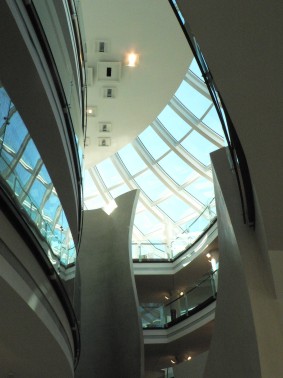
The new Verdi was naturally the focal point of this year’s festival and of many a cafe conversation. The old warhorse of a building could fit in a great many people and had a certain rough charm, but it was no surprise that the town wanted to revamp the building. And revamp it they have – the result is startling modernistic yet sympathetic to the surrounding buildings, with white stone and glass, eye-catching curves, and inside an ingenious use of space for public areas on four levels, including an exhibition gallery.

Teatro Verdi (interior)

Teatro Verdi, interior

Well, that’s the exterior and the immediate interior, but the auditorium itself got mixed reviews. Grand it may be for the shows and concerts which are the prime reason for the theatre’s existence, but for silent films it has its limitations. There were muttering about inadequate sight lines, and rather ludicrously the projection beam shone just above the first tier of seats, requiring the central portion to be kept clear by ropes, which however did not prevent the occasional shadow of a head appearing on the screen when someone got up. Hardly ideal for the world’s premier silent film event. The poorly-lit steps were another problem – several people fell over in the dark, including most unfortunately the most distinguished American archivist and historian Eileen Bowser, who had a bad fall on the first day and spent the remainder of the festival in hospital.

But enough of the venue, what about the films? Having registered, and equipped myself with festival bag, literature, name badge, catalogue and programme guide, I went straight in to catch most of Dream Street (1921). The programming at Pordenone is in themes, which this year included The Other Weimar, Ladislas Starewitch, René Clair, and Early Cinema, more of which in due course.

Dream Street

Charles Emmett Mack and Carol Dempster in Dream Street (1921), from http://www.silentladies.com

A theme which returns every year is the Griffith Project, which is a chronological survey of all surviving D.W. Griffith films, a gargantuan undertaking now reaching the years 1921-1924. This was the period where Griffith’s star began seriously to wane, and in Dream Street we have him at his very worst. Based on Thomas Burke material, as had been Broken Blossoms, it is set in a never-never London Limehouse, where Carol Dempster is a sadly less-than-adequate replacement for Lillian Gish, albeit playing a rather less down-trodden character. She plays Gypsy Fair (argh), loved by two brothers, unappealingly played by Ralph Graves (bullying but then having a religious conversion) and Ralph Emmett Mack (wimpish but psychotic). The film, in a way, is fascinating for being such a personal project – its sentimentality, high moralism, good-versus-evil symbolic characters, fear of violence, and lead female character representing all that is pure are all typical of Griffith at his most intense – but a combination of unsympathetic characters, heavy reliance on coincidence, general implausbility, and nauseating racism destroy the film. That, and Dempster, whose attempts to mimic the winsomeness and playfulness of Griffith’s Biograph heroines is painful to witness. The racism comes through the ‘evil’ Chinese figure, Sway Wan (Edward Peil), whose capture after an attempted assault on Dempster leads to her regrettable line, “That will teach you to leave white girls alone”, and a truly wretched blackface caricature from Porter Strong.

But more than story, character and theme, Dream Street is technically awful (i.e. from a directing point of view – photographically it is competent enough). Continuity shots are ineptly executed, the pacing is all wrong, nothing connects. The pianist, Gabriel Thibaudeau, got sympathetic applause after the screening for his valiant, if ultimately failed attempt to impose some sort of shape on a film that just did not know where it was going. I can’t believe that I’ve now seen Dream Street twice in my life…

The opening Saturday has just a few films, headed by an opening orchestral spectacular, which this year was Orphans of the Storm, amazingly made by Griffith the same year as Dream Street. But, having a certain aversion to spectacular musical presentation of silents, and wanting a quiet evening in any case, I returned to my hotel to gird myself for the rigours of the days to come. Which you’ll learn all about tomorrow…

The Cameraman’s Revenge

I’ve written before of those points where my interests in silents and modern jazz/avant garde music match. One particular hero is the American guitarist Gary Lucas, whose extraordinary accompaniment to a scene from Der Golem has already appeared on The Bioscope.

I’ve just found on his website another silent film with his accompaniment. He had a touring show, Sounds of the Surreal, which presents his live accompaniment to Rene Clair’s Entr’acte (1924), Fernand Leger’s Ballet Mecanique (1924), and Ladislaw Starewicz’s The Cameraman’s Revenge (1912), which available as a QuickTime file on his site.

The Cameraman’s Revenge

The Cameraman’s Revenge, from http://www.garylucas.com

Ladislaw Starewicz (1882-1965) is one of cinema’s true originals. His passion was entomology. He was taken on by the Russian company Khanzhonkov as a designer, and turned to directing model animation in 1912. His extraordinary idea was to build on his hobby by animating insects with stop-motion photography, in parodies of human activity. The Cameraman’s Revenge (or Mest’ kinematografičeskogo operatora) is his best-known film from this period, where a bettle and a grasshopper both pursue a dragonfly dancer, and the envious grasshopper captures evidence of a romantic tryst between the pair on his motion picture camera. It is one of the damnednest things you ever saw.

He made several other such stop-motion and animated films, including The Ant and the Grasshopper, Insects’ Aviation Week and Voyage to the Moon. In the 1920 Starewicz moved to France, where he won increased fame for animated films such as La voix du rossignol (1923), Amour noir et amour blanc (1928) and the feature-length Le roman de Renard (1928-39), all produced with dogged independence.

To be honest, the Gary Lucas score, with National steel guitar, doesn’t connect much with the action, and the version online is incomplete, missing the conclusion where the grasshopper’s film is shown. Nevertheless, it’s worth checking out just for being so odd, and selections of Starewicz’s films happily are available on DVD.

100 years of wildlife films, maybe

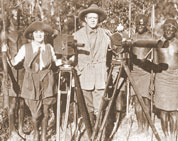
Martin and Osa Johnson

Martin and Osa Johnson, from http://www.wildfilmhistory.org

Starting this Saturday (August 25th), BBC4 has a wildlife season, marking 100 years of wildlife films. One might protest straight away that wildlife films were made before 1907, but the argument is that Oliver Pike’s In Birdland (1907) was the first true natural history film, as opposed to scientific analysis films, actualities or entertainment films featuring animals. I think F. Martin Duncan‘s work (from 1904 onwards) ought to be acknowledged, even if he mostly filmed in London Zoo, but it’s a bit late now. Ironically or not, In Birdland is believed to be a lost film.

The centrepiece of the season is the programme 100 Years of Wildlife Films, presented by Bill Oddie. Presumably there will be some acknowledgment of the considerable work done in the silent era in this field, by Oliver Pike, Percy Smith, Cherry Kearton, Paul Rainey, Herbert Ponting, C.W.R. Knight, Carl Akeley, Martin and Osa Johnson, and many more.

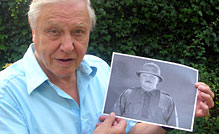
David Attenborough

David Attenborough with a picture of Cherry Kearton, from http://www.open2.net

There is a programme on Cherry Kearton, in the Nation on Film series, showing on 29 August, called Kearton’s Wildlife (though it’s actually a repeat). The Royal Geographical Society still awards a Cherry Kearton medal for achievements in photographing natural history (David Attenborough is a recipient), and his pioneering work (often with brother Richard) in still and motion picture photography of animals deserves to be far better known. The BBC4 site provides a full list of programmes in the series.

All of this activity coincides with plans by the Wildscreen Trust to develop a centralised collection of films and information on 100 years of wildlife filmmaking, with support from the Heritage Lottery Fund. There’s a website, wildfilmhistory.org, which promises a full launch at the end of 2007. There’s a book in the offing as well. Such is the power of centenaries.

The Invention of Hugo Cabret

Méliès shop

http://www.theinventionofhugocabret.com

The Invention of Hugo Cabret is a children’s book (designed for 9-12 year-olds), written and illustrated by Brian Selznick and published this year. Set in Paris in 1931, it tells of a young orphan boy, Hugo Cabret, who is reduced to stealing to find food to eat, but then rescues an automaton from a museum fire. Seeking pieces to repair the figure, he steals pieces from a toy store by a railway station. Then he is caught. Now read on…

Our interest is that the toy store keeper is Georges Méliès. The illustration above from the book echoes the famous photograph of Méliès at his kiosk on the Gare Montparnasse, years after he had lost his film business and disappeared into obscurity, and just at the point of his re-discovery by film historians. Méliès becomes a leading character in the story, introducing Hugo to the world of early film. The book is a graphic-novel-with-text, and incorporates images from Méliès’ films.

There’s a website, www.theinventionofhugocabret.com, which has information on the ideas behind the book, including a page on Méliès, and a Flash slide show of some of the book’s illustrations.

There’s a video interview with Selznick, emphasizing his fascination for the Méliès story, on the ExpandedBooks.com site. It shows many illustrations from the book, from which we learn that Selznick makes a particular point of depicting shoe-heels in his drawings (Méliès’ film library was notoriously melted down to make, amongst other things, shoe-heels).

Rumour has it that Martin Scorsese is considering making a film based on the novel, or at least that John Logan, scriptwriter for The Aviator, is writing a screenplay.

RIP Ingmar Bergman

Rest in peace, Ingmar Bergman (1918-2007), almost the last filmmaker to have experienced the silent era and to have it influence his own work. (Ronald Neame, who worked on Hitchcock’s silent/sound Blackmail is still with us. Eric Rohmer. Michaelangelo Antonioni. Anyone else?) As well as so much of his work being imbued with the look and feel of silent cinema, he of course gave the great silent director Victor Sjöström the key role in Wild Strawberries, and his autobiography looked further back in having the title Magic Lantern. A magic lantern also features in Fanny and Alexander. Magic lantern, silent cinema, sound cinema, theatre, opera, television – all a part of his career, all ways of seeing.

No sale for Chaplin

The much-trailed auction at Christies of a Bell & Howell 2709 camera used by Charlie Chaplin resulted in no sale. The price had been put at £70,000-£90,000. The camera was one of four 2709 models used at the Chaplin studios. It was purchased in 1918 and used by Chaplin throughout the 1920s.

Despite the no sale, The Bioscope had one of its reporters on the spot, who returned with some fine pictures. Here’s a close view of the camera mechanism:

Chaplin camera

And here’s a marvellous Chaplin’s-point-of-view shot of the eyepiece:

Chaplin camera

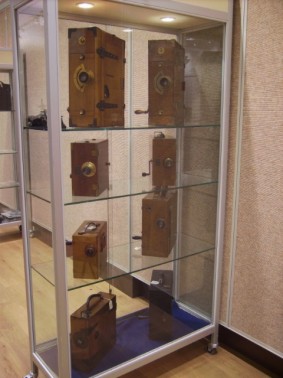
As already reported, the camera sale of which the Chaplin camera was a part is rumoured to have been Christie’s last, the collector’s market not being what it once was. Which is sad, if it means that their glamour is fading. Not that I can usually tell one box from another – I can just about manage to spot a Bell & Howell, given the ‘Mickey Mouse ears’ look of the twin magazines, but thereafter I tend to get a bit stumped. So, don’t ask me which is which among this selection of boxes, which is one for the cognoscenti:

Cinematographs

And, finally, something I can recognise, even without its box, though only because the name is somewhat prominently displayed – an Urban Bioscope, such as graces the header of this blog:

Urban Bioscope

With many thanks to Christian Hayes for the photographs.

When the Movies Began…

Kinetoscope

The latest feature to be added to the Who’s Who of Victorian Cinema web site is When the Movies Began. This is a chronology of the world’s film productions and film shows before May 1896. It was originally compiled by Stephen Herbert and published as a booklet by The Projection Box in 1994. This updated and redesigned version incorporates new research, in particular the work of Deac Rossell, and it will be regularly revised and updated. There is also a full introduction and list of references.

Who’s Who of Victorian Cinema is a biographical reference guide to 300 or so people involved in the production of motion pictures before 1901, both behind and in front of the camera. It includes a wealth of supporting resources on the subject of Victorian film (i.e. film during the time of Queen Victoria’s reign), with a growing number of special features, such as When the Movies Began.

Jackeydawra Melford

Jackeydawra Melford

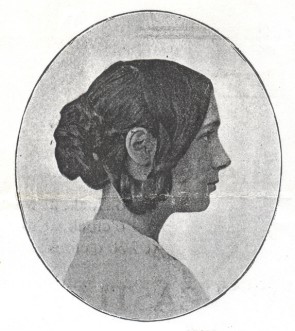
Continuing with the subject of British women filmmakers of the silent era, one remarkable name – literally – is Jackeydawra Melford. She was almost but not quite the first first women to direct a fiction film in Britain (that honour usually goes to Ethyle Batley). She produced and performed in The Herncrake Witch (1912), The Land of Nursery Rhymes (1912) and The Inn on the Heath (1914), the latter of which she also scripted and directed. None is known to survive. [Update (December 2011): a copy of at least part of The Herncrake Witch exists – see comments]

She was the daughter of actor and author Mark Melford (c.1851-1914), who towards the end of his stage career turned to film production. His daughter Jackeydawra was born around 1890 (I haven’t been able to find a birth record), possibly getting her extraordinary name from a comedy opera Jackeydora, or The Last Witch, which toured Britain in 1890. Her name seems to be written differently in every source: Jakidawdra, Jackeydawra, Jackeydora, Jackiedora. She acted in her father’s stage productions from a young age, sometimes billed just under first name. She married Wallace Colegate in London in 1915, and then slips out of history. But we have the above picture of her which accompanied this short profile from The Cinema, 19 March 1913, p. 37:

This young lady, but just out of her teens, is the only daughter of Mark Melford, and, developing an ambition to master the mysteries of the camera, she has acquired that technical knowledge of the art of film-making that, coupled with her artistic gifts in dress, colour, light, &c., has rendered her an invaluable assistant to her able chief. Her clear-cut features and pathetic face are indispensable to the pictures, and her experience of acting from an early age has given her that ease, repose, grace, and power of expression so necessary to ensure good results in this department of her profession.

Miss Jackeydawra Melford has played all the principal parts in her father’s plays and sketches throughout the United Kingdom, and will prove an invaluable addition to the acting staff of this enterprising firm – nay, more, Miss Melford is so admirably adapted to picture work that she will, we think, make a name in the cinema world as she has upon the stage, and Jackeydawra will become a household word.

How much might we want to pursue someone none of whose films are known to survive? Or is the story of lost films and those who made them a special kind of history? Who needs films to write film history anyway?