Cinefest 2009

Cinefest, the annual collectors’ film festival held in Syracuse, NY, takes place 19-22 March 2009. The films on show are combination of silents and early talkies, with these being the silent choices (subject to any last minute changes):

On 16mm

LESS THAN THE DUST (1916) with Mary Pickford, David Powell
LOVE NEVER DIES (1921) Dir. King Vidor, with Lloyd Hughes, Madge Bellamy, Lillian Leighton
THEY SHALL PAY (1921) with Lottie Pickford, Allan Forrest, Paul Weigel
WHITE GOLD (1927) with Jetta Goudal, Kenneth Thomson, George Bancroft, George Nichols, Clyde Cook
WOMAN (1918) Dir. Maurice Tourneur with Warren Cook, Florence Billings

On 35mm

EVERYBODY’S SWEETHEART (1920) with Olive Thomas, William Collier Jr.
TWENTY DOLLARS A WEEK (1924) with George Arliss, Ronald Colman
A MILLION BID (1927) with Dolores Costello, Warner Oland, William Demarest
BEGGAR ON HORSEBACK (1925) with Edward Everett Horton, Betty Compson, Esther Ralston
THE SHOPWORN ANGEL (1928) with Gary Cooper, Nancy Caroll, Roscoe Karns, Paul Lukas
BACK PAY (1922) Dir: Frank Borzage, with Seena Owen, Matt Moore

Musical accompaniment comes from a star-studded line-up of Philip Carli, Makia Matsumura, Donald Sosin, and Ben Model, and there are other goodies on offer (aside from the sound features), include rare shorts, Joan Crawford’s home movies, and the auction hosted by Leonard Matlin.

Full details, including registration and accommodation, from the festival website.

The amazing Mr Jeffs

jeffs

http://www.flatpackfestival.org

Coming up soon is Flatpack Festival, an inventive film extravaganza organised by 7 Inch Cinema, taking place in Birmingham (UK) 11-16 March. Most of the festival is devoted to present day cinema, but it’s worth out taking note of because its dedicatee is Waller Jeffs (1861-1941). His is a name that you won’t find in many film histories, because he was a showman rather than a producer, but he was one of the major figures bringing films to British audiences (alongside a whole panoply of variety acts that he also handled) in the era before cinemas arrived, particularly in the Midlands region. As the festival blog puts it:

Between 1901 and 1912 Mr Jeffs introduced hundreds of thousands of Brummies to the delights of cinema through his annual seasons at the Curzon Hall, Suffolk Street, with light opera, military bands, live sound effects and intriguing novelty acts like ‘Unthan the Armless Wonder’ presented alongside the films. Towards the end of this period the first proper cinemas started to arrive in the city – including the Electric – and Jeffs’ audience rapidly disappeared. He ended up in slightly less elevated circumstances, managing the Picturehouse in Stratford-on-Avon.

There’s a little-known history of British film, John H. Bird’s Cinema Parade, which is centred upon Waller Jeffs, showing us the development of film in Britain from the showman’s point of view, and with a salutory change of emphasis from the usual London bias.

As well as naming Jeffs its ‘patron saint’, on March 11th the festival is putting on Curzonora, an evening of early film in the spirit of Waller Jeff’s programmes, with “fifteen-piece ‘musical whirlwind’ The Destroyers” who will be “exploring the full spectrum of 1900s filmmaking ingenuity from actualities and travelogue to sci-fi and melodrama”. And on March 12th it is hosting ‘The Amazing Mr Jeffs: Birmingham’s premier film exhibitor‘, an illustrated talk by the practically ubiquitous Professor Vanessa Toulmin,covering Jeff’s working relationship the famed producers Mitchell and Kenyon.

More information, as ever, on the festival website.

Pordenone and the rest

merrywidow

http://www.cinetecadelfriuli.org/gcm

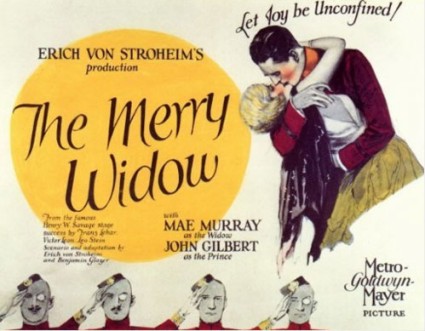
Well, it’s a little way off as yet, but the first outlines of the Giornate del Cinema Muto aka Pordenone silent film festival have been publicised. The festival will run 3-10 October 2009, and the opening film/musical event will be Erich von Stroheim’s The Merry Widow (US, 1925), with score by Maud Nelissen performed by the Orchestra Sinfonica del Friuli Venezia Giulia.

Also promised is a strand on Sherlock Holmes “and beyond”, curated by Jay Weissberg; a retropsective of Films Albatros from the Cinémathèque française; part three of the Corrick Collection of early films found in Australia; an intriguing-sounding Screen Decades; and the traditional Rediscoveries and Restorations.

We’ll add more as we learn more, of course, but do also keep an eye on the Festivals section of this site for other silent film festivals occuring this year. So far we have dates for the Kansas Silent Film Festival (27-28 February), Cinefest in Syracuse NY (19-22 March), an unnamed festival of silent cinema at the Electric Palace, Harwich, Essex (7-10 May), the Festival d’Anères in France (27-31 May), Bologna’s Il Cinema Ritrovato (27 June-4 July), the San Francisco Silent Film Festival (10-12 July), central New York’s Capitolfest (7-9 August), Germany’s Bonner Sommerkino (13-23 August), and Ohio’s Cinesation (24-27 September).

And finally, look out very soon for news (at last) of the British silent cinema festival, lately of Nottingham and now destined for a new home.

Vamps and Vixens

vamps

http://www.birds-eye-view.co.uk

The Bird’s Eye View festival, celebrating women filmmakers and performers, returns to the BFI Southbank and the ICA in London 5-13 March. As with last year, there is a silent film strand, which comes as part of an archive retrospective given the title Screen Seductresses: Vamps, Vixens & Femmes Fatales. The are six silents featured, under Vamps, and I can do no better than give the festival’s own hyper-enthusiastic words about the delights on offer:

Sexy, iconic and controversial: classic cinema, contemporary live music and gorgeous, godless women, in partnership with BFI Southbank.

From Eve to Cleopatra, Salome to Sharon Stone, women have always been able to win men over with their sexual powers. Obviously this is naughty, and a thinly disguised evil plot to render quivering (and probably kill) all otherwise fine upstanding gentlemen.

But BEV is feeling a little rebellious this year. We’re celebrating transgressive women in film, strong and complex seductresses, with razor-sharp wit and unrestrained sexuality. Some say it’s all a product of post-war male anxiety about the changing roles of women, but let’s not forget the crucial role women played in producing and writing these films. And, of course, the stunning talent a host of actresses brought to cinema – so radical for their time and still startlingly good.

We begin with THE VAMP, a fabulous and alluring figure of silent cinema. Louise Brooks, Theda Bara, Greta Garbo and Alla Nazimova shine like the stars they are in six stunning and rarely-screened films, with specially commissioned live music from cutting edge female artists including Bishi, Natalie Clein and The Broken Hearts.

And then to a month-long season of FEMMES FATALES – the (anti-) heroine of Hollywood’s film noir from the 1940s to the present day, including Billy Wilder’s Double Indemnity, Kim Novak in Hitchcock’s Vertigo, and Chinatown from Roman Polanksi, with Faye Dunaway. This is the largest ever collection of this kind screened at the BFI Southbank – so enjoy devouring its delights!

Salome with music from Bishi

7 March 2009

Marvel at mesmeric lesbian Hollywood icon Alla Nazimova, whilst listening to the vamped up sound of award-winning singer, multi-instrumentalist and DJ: Bishi.

A Fool There Was + The Vampire with Broken Hearts DJs and Jane Gardner

9 March 2009

Theda Bara and Alice Hollister fight over the title of cinema’s first sex symbol in this double-bill of bewitching vampires. With new music from Broken Hearts DJs and pianist Jane Gardner.

The Temptress with music from Natalie Clein

10 March 2009

Greta Garbo stars as a melancholy vamp in an emotional rollercoaster with live musical accompaniment from Classical Brit Award Winning cellist Natalie Clein.

Pandora’s Box with music from The Monroe Transfer

11 March 2009

Iconic and capricious Louise Brooks leads this silent classic, accompanied for the first time by 7 piece band The Monroe Transfer.

Alraune with music from Alison Blunt, with Hanna Marshal and Javier Carmon

12 March 2009

Star of Metropolis Bridgitte Helm stars as a lab-manufactured wonder seeking revenge against her creator. With original music from improvisation-based violinist and vocalist, Alison Blunt.

More details from the festival website.

A festival of silent cinema

harwichelectricpalace

Interior of the Harwich Electric Palace, from http://www.electricpalace.com

News of an introductory festival of silent cinema being held 7-10 May in Harwich, Essex at the Electric Palace, one of the oldest cinemas in Britain still to be showing films, indeed with its original screen from the silent period, original projection room and ornamental frontage still intact.

A Festival of Silent Cinema
Thursday 7th May – Sunday 10th May 2009

A four day programme of silent films aiming to show exactly what these first films looked like and what the audience were seeing between 1896 and the late 1920s.

The Programme Curator is David Cleveland, founder and now retired director of the East Anglian Film Archive in Norwich. Presentations and commentary contributions will also be given by other film archivists and film historians.

Over the four day festival in May, 2009, there will be a unique opportunity to experience an array of original silent films. The programme will include many rare films; some will not have been shown since first distributed almost a century ago. The Electric Palace will be host to films typical of the period 1896 -1929: comedies, dramas, animations, features, topicals and shorts. These will have authentic accompaniment as well as specially composed music. The programme will also include live re-creations of music hall acts. which would have been common for the time. What audiences were seeing before motion pictures, will be illustrated by Magic Lantern Shows. In addition, there will be an exhibition of early cinema technology as well as a display of pre-cinema media.

Films will be shown on the Electric Palace’s Kalee 35mm projectors and, in the case of some very early films, on a specially installed Gaumont Chrono projector. All films will be projected onto the cinema’s original hand-painted screen.

The Festival will open on Thursday May 7th, with a special reception and screening of the Alfred Hitchcock film ‘The Ring’ (cert U), 1927. At its close, on Sunday 10th May, there will be a guest presentation and feature to be confirmed.

A full programme hasn’t been published as yet, but is promised soon. You can read more about the history of the Electric Palace, and other pre-1914 cinemas in Britain, here.

There’s no business like show business

The programme from the 2009 StummFilmMusikTage (the German festival of silent film and music) has been announced. The theme for this year’s festival, which takes place on 24 January (apparently just the one day – it was a three-day festival last year) at Erlangen, is There’s no Business Like Showbusiness:

16 Uhr / 4 pm
Filmens Helte (Pat und Patachon, die Filmhelden / Film Heroes)
Dänemark/Denmark 1928, 68 min
Regie/Director: Lau Lauritzen, Sr.
mit/with: Carl Schenstrøm, Harald Madsen, Holger Reenberg, Eli Lehmann
Musik und Ausführung: Miller the Killer con Conny Corretto

18 Uhr / 6 pm
Lesung: Der ewige Tramp /Reading: The Eternal Tramp
Eintritt frei / free entrance

19 Uhr / 7 pm
The Circus (Der Zirkus)
USA 1928, 71 min
Regie/Director: Charles Chaplin
mit/with: Charles Chaplin, Merna Kennedy, Al Ernest Garcia
Musik: Charles Chaplin
Ausführung: Ensemble Kontraste
Leitung: Christian Schumann

21 Uhr / 9 pm
When Silence Sings: Der Filmkomponist Aljoscha Zimmermann im Gespräch/ A Conversation with film composer Aljoscha Zimmermann
Eintritt frei / free entrance

22 Uhr / 10 pm
Varieté (Variety)
D 1925, 112 min
Regie/Director: E.A. Dupont
mit/with: Emil Jannings, Maly Delschaft, Lya De Putti, Warwick Ward
Musik und Ausführung: Aljoscha und Sabrina Zimmermann

Pre-sale tickets are now available (the organisers advise that if you are considering acquiring tickets from outside Germany, please to write to asynchron@stummfilmmusiktage.de to check about reserving tickets).

Footnotes to the Festival

filmcans_banner5

With the festival now over (a little sooner than intended), acknowledgment is due to the various sources used, aside from the standard filmographies and reference guides.

War Brides was the easiest to research, as the best known film among the films. Useful sources included Kevin Brownlow’s The War the West and the Wilderness and Ivan Butler’s Silent Magic, the latter the source of the main image. Maria Craig Wentworth’s original play, with production photos, is on the Internet Archive. Contemporary film reviews were also used. For the accompanying short, Kiddies in the Ruins, see the director George Pearson’s autobiography, Flashback.

The Land of Mystery is the most obscure among the titles selected. The two main sources are Kevin Browlow’s Behind the Mask of Innocence (which has the only known photograph connected with the production) and John M. East’s ‘Neath the Mask, a marvellous account of lesser British theatre and film in the early years of the twentieth century through the life of the author’s grandfather, John East. East was an actor in the film and had vivid memories of the trip to Lithuania. Acknowledgment is also due to the researches of Nicholas Hiley into the British secret service, some of which fed into Brownlow’s work. The information about Lenin seeing the film comes from an essay by the late Rashit Yangirov in Derek Spring and Richard Taylor, Stalinism and Soviet Cinema. A detailed review in The Bioscope (8 July 1920) supplied much information, including a plot summary. The accompanying film, Meyerhold’s The Portrait of Dorian Gray, has been much written about. The main source used was Jay Leyda’s history of Russian and Sovet cinema, Kino.

The essential source for The Jeffries-Sharkey Fight is Dan Streible’s new history of early fight films, Fight Pictures. Also useful is Charles Musser’s The Emergence of Cinema. Information on the fight additionally came from Nat Fleischer and Sam Andre’s absolutely essential A Pictorial History of Boxing. Also used were Fleischer’s The Heavyweight Championship and the International Boxing Hall of Fame’s The Boxing Register. Some images came from the Library of Congress Prints and Photographs Online Catalog.

Das Mirakel took up the most time because of a lack of information in secondary sources, and huge errors in most online sources. I relied chiefly on British film trade press coverage over 1912-13, particularly The Bioscope. The German film database Filmportal is comprehensive and generally very reliable, and supplied most of what I could find on the rival Das Mirakel. Information also came from Charles Graves, The Cochran Story and John Glanfield’s excellent Earls Court and Olympia, which was the source of the illustration from the Olympia stage production of The Miracle.

Information on the cinemas used came from The London Project database, with the descriptions of the cinemas from some of my own researches, augmented by Allen Eyes and Keith Skone’s London’s West End Cinemas.

Grateful acknowledgment to all sources – even to the Internet Movie Database…

With apologies…

filmcans_banner4

It is with humble apologies that I have to report that tonight’s screening at the Bioscope Festival of Lost Films is not going ahead. There have been problems with the film chosen for our last screening, from the sudden likelihood that part of it had survived (which subsequently proved not to be the case), but more seriously that its sober subject matter did not quite suit the air of ironic whimsicality which is the hallmark (we think) of this Festival.

There was a film in reserve (there are many lost silent films, as we know), but your programmer is leading a busy life at the moment and both time and energy have run out. Thought was given to postponing the festival for a day, but the cinema manager has been awkward, and the organist we had hired (a certain Dr Sargent) was demanding ruinous expenses for being kept on for a second evening. All in all, the wiser course of action is to call it a day at four shows, and to return to lost films (perhaps as an occasional series) another time.

To all festivalgoers, you may of course obtain refunds from the festival office, and I hope that no one was put to too great an expense over costume hire. There is just enough left in the kitty (once the organist has been paid off) for us to have our promised end of festival soirée at the Cafe Royal (itself soon to be no more), where we may toast lost films and consider that not only is vita brevis, but sometimes ars is brevis too.

caferoyal

William Orpen, ‘Café Royal London 1912’

Das Mirakel

filmcans_banner21

Germany 1912

Screen adaptation: Michel Carré
Production Company: Ingenieur Jos. Menchen (Berlin)
Producer of stage production: Max Reinhardt
Producer: Joseph Menchen
Author of stage production: Karl Vollmöller
Cinematographers: William Jeapes, Harold Jeapes
Composer of accompanying music: Engelbert Humperdink

Cast: Maria Carmi (The Madonna), Douglas Payne (The Knight), Florence Winston (The Nun), Ernst Matray (Spielmann/The Minstrel), Josef Klein (The King), Agathe Barescu (The Abbess), Theodor Rocholl (The King’s son), Ernst Benzinger (The Robber Count), Marie Von Radgy (The Old Sacristan ), Alfred König (The Lame Man), Ernst Lubitsch

Distributed by Joseph Menchen
1,459 metres (four reels)

It is day four of the Bioscope Festival of Lost Films, and this evening we find ourselves in Oxford Street. We hope that the message got through to festivalgoers that we have had to move from the scheduled Pyke House (which will serve as our venue tomorrow) further down Oxford Street to the larger venue, the Picture House at 161-167. This fine new building seats 760, and some may remember that it was one this spot in 1906 that Hale’s Tours of the World (films exhibited in a mock railway carriage) was first seen in this fair city. Opened in January 1913, the Picture House is held to be one of the most delightful cinemas in London, exquisitely lit and upholstered, with a perfect view guaranteed for every attendee. We needed the extra space to fit in an orchestra and choir, with a most notable conductor – but first we must tell you a little about what you are to see.

max_reinhardt1

Our film this evening was a legend before it was even a film, so to speak. It is Das Mirakel, to give its German title, or The Miracle as every one of you will know it from the sensational exhibition of the stage version at Olympia in 1911. The producer of that epic piece of dumbshow theatre was Max Reinhardt (left), the Austrian theatrical genius, whose inspired use of lighting, mechanical effects and spectacle (particularly crowds) has so startled audiences across Europe. Like Vselovod Meyerhold, whose work we saw two days ago – but with very different results – Reinhardt’s great desire is to free theatre from the confines of literature and to revel in the space that it offers. The Miracle, a play written by Karl Vollmöller, is extraordinary in the first instance for being silent, told only through dumbshow and the music of the great composer Engelbert Humperdink – and, yes, it is maestro Humperdink who, at extraordinary expense, the festival has brought over from Germany to conduct the orchestra for us tonight, together with a chorus of eighty.

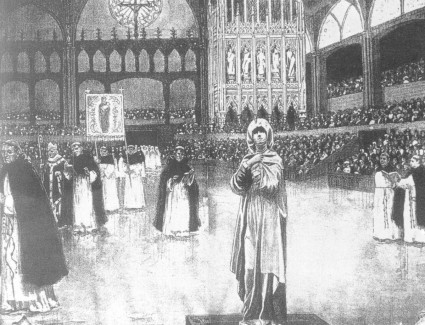
The Miracle retells a medieval legend of a nun who dreams of temptations to be found in the outside world and flees from her convent with a knight. She suffers various adventures and privations, eventually finding herself accused of witchcraft. While she is absent from the convent, her place is taken by a statue of the Virgin Mary, which comes to life and undertakes the nun’s various duties. Upon the penitent nun’s return, the Virgin becomes a statue once more. That we saw the play in London was thanks to that most enterprising of theatrical entrepreneurs, C.B. Cochran, who was looking for an entertainment to fill the vasty space of Olympia. Enthralled by seeing Reinhardt’s Oedipus Rex in Germany, he invited him to come up with an epic production which would make best use of Olympia. Reinhardt’s idea (after toying with the possibility of recreating the Delhi Durbar) was to stage a medieval tale with a cathedral setting. Vollmöller then came up with the play. The huge space at Olympia made it essential that the story be told without words, simply because the audience would be unable to hear them. 1,000 performers and 500 choristers filled out the epic drama, supported by a wonderful array of stage machinery, ingenious theatrical effects and uplifting music.

miracle

Newspaper illustration of the The Miracle at Olympia

The success of that production needs no re-telling here – simply to say that for many it was a theatrical event like no other. What concerns us is the film that followed. A spectacle in dumbshow was an obvious choice for Herr Reinhardt’s first foray into cinema. News that a film was to be made, and that it would be produced in London, first appeared in May 1912. Then there was silence for quite a time, until we learned that the film was to be produced in Austria while the theatre company (including, it is believed, one Ernst Lubitsch, a comic actor of notable promise, we are assured) was based in Vienna. Filming took place in three weeks over September and October. The great surprise to all in the industry was that the film was photographed by a British newsreel manager, William Cecil Jeapes and his brother and fellow newsreel expert, Harold. Now Billy Jeapes is well known in Wardour Street, and manages that popular newsreel Topical Budget. He would be the first person one would call for should a speedy news report be required, but he is not known for his work with dramatic films. And yet, as an interview for The Bioscope that Mr Jeapes kindly provided just a few days ago, he was the person who, as they say, ‘got the call’:

[TB] So, Mr. Jeapes, how was ‘The Miracle’ taken?

[WJ] Well, it’s a rather long story, but I’ll do my best to give you the main points as briefly as possible. In the first place, I may say that my own connection with the undertaking commenced just about twenty-four hours before I actually entered upon it, so you can imagine that there wasn’t much time for preparation. I received and accepted the request that I should take on the business, grabbed camera, films and baggage; caught the first train that was available, and, in almost less time than it takes to tell (as the novelists say) I was starting on the first preliminaries with Professor Reinhardt and M. Michel Carré (who adapted the play for the camera), near Vienna.

I left London on September 21st, and I returned on October 15th. During that time we were working regularly from the early morning until about 3 o’clock in the afternoon, at which hour it was necessary for the company to start back for Vienna, where ‘The Miracle’ was being played nightly – at the Rotunda. We did nothing on Sundays.

[TB] And how, Mr. Jeapes, does the film compare with the original production, as we saw it in London?

[WJ] Favourably, I think I may say, in every particular. It is obvious, of course, that the enormous scenic advantages of the cinematograph have made it possible to present in realistic detail all sorts of incidents which could scarcely be more than hinted at in the arena at Olympia. The character of the production, as a ‘wordless play’, obviates any loss through the absence of speech, and, since the film is being coloured by hand in Paris, the wonderful effects in this respect will be quite as striking as they were when seen in actuality.

You will probably be struck by the continuity of the play in its film version as compared with its episodic nature at Olympia. It will not be necessary to keep our audiences waiting while we ‘change the scenes’ and we have, also, been able to fill up the gaps. Naturally, too, the superior possibilities of the cinematograph in illusion-making have allowed us to treat supernatural incidents with the greatest freedom.

From Mr. Jeapes we learn further that the exteriors were photographed in the grounds of Kreuzenstein Castle and at the cathedral of Perchtoldsdorf, Vienna. It is unclear from his account to what degree, if any, Max Reinhardt actually directed the film, or whether he simply supplied some instructions, and it was Michel Carré (a French film director)who took most responsibility. That Mr. Jeapes had some unusual influence over the production can be deduced from the fact that the part of the Nun is not played by the actress from the theatre company (all other parts are filled that way) but by one Florence Winston, not a known actress at all, but who just happens to be Mrs William Jeapes. It is all very curious.

But what of the film itself? Opinions are mixed on what is being billed as a ‘Lyricscope Play’, to a quite fascinating degree. That normally level-headed American journal Variety has gone into absolute raptures:

The ‘Miracle’, reproduced from the wonderful Reinhardt pantomime of the same name presented at the London Olympia, is probably the finest exhibition of the “Celluloid drama” ever conceived. In some respects it is superior to the original pantomime spectacle, in that the paths of the performers – or characters – may be followed more minutely and with greater detail than is possible in the original, due to the possibility of showing the scenic progression with the unfolding of the plot … The whole presentment is remarkably impressive in general effect, the pictures so beautifully to resemble natural colors, the scenes so plentifully interspersed with captions announcing the progress of the tale, and finally the awakening to a realization that it was all a ghastly, enervating “dream”, is extraordinarily vivid. No spoken play could be more so.

Variety‘s critic was possibly a little overwhelmed by the presentation of the film, which we are emulating today – a cathedral frontage over the proscenium arch, with doors opening to reveal the screen within; incense wafting into the auditorium; the choir entering in vestments and coming upon stage; the use of sound effects; the heavenly music. We hope you will be similarly transported, but we must note a soberer verdict from the British paper, The Bioscope, reviewing the film’s UK premiere in this very cinema. The Bioscope looks beyond the siren charms of theatrical presentation to what is actually presented on the screen:

The whole play seems to have been adapted for the camera with only the most cursory regard for the latter’s possibilities and limitations. It has been forgotten that a scene viewed through an artifical glass lens is a very different thing from the same scene viewed in actuality by the naked eye.

The reviewer chastises the film for failing to adjust the drama to the demands of the camera, and finds the staging maladroit, sometimes to ridiculous effect:

In the scenes showing the cathedral’s interior the stage is too deep, with the result that the players are constantly out of proportion with each other, and swell from midgets to giants in a fashion which is almost ludicrous as they move “down stage”.

Again, how much did Max Reinhardt have to do with the film itself? The Bioscope is uncertain, and we must confess to being unsure ourselves. Herr Reinhardt has not answered our telegrams, and Mr Jeapes has been curiously evasive. At any rate, you must be the judges of what you see on the screen. It is a film that is perhaps more an act of faith than a conventional cinema offering. The incense is not separate from it; it is an essential part of the experience. Also, it is a film that has to live in the imagination: not only is it a lost film, but there is not a single image from the film that we can produce for you. Our researcher recalls seeing some frame stills once, and recalls vasty spaces and isolated figures. But those images too, are now gone…

And then there is the matter of the second Miracle. For a great headache for Reinhardt, Vollmöller, Carré and the film’s American producer Joseph Menchen has been the existence of a rival film, which we are bravely (and uniquely) programming to accompany our main feature. The second Das Mirakel was made in Germany by Continental-Kunstfilm GmbH in 1912. It was written and directed by Mime Misu, a Romanian who came to prominence in German cinema recently following the success of his dramatisation of the tragic storyof the sinking of the ‘Titanic’, In Nacht und Eis (1912). Misu has not only directed the film, but acts in it as well, alongside Lore Giesen and Anton Ernst Rückert.

Its existence has caused much confusion. A court injunction was applied for in this country to prevent the exhibition of the Misu Mirakel (it was registered under that title in Germany) by the Elite Sales Agency when it was announced as opening at the London Pavilion in December 1912, but it seems Elite subverted any charges of copyright infringement by averring that the story was based on legend, not on Vollmöller’s play. Nevertheless, they appear to have been playing things safe by taking the advice of the judge and exhibiting the film under a different title: Sister Beatrix (in Germany it has been exhibited as Alte Legende – Eine Das Marienwunder or Marienwunder – Das Eine alte Legende). Under this title it has been sold to many cinemas across Britain, who have sometimes advertised it as The Miracle, to the great dismay of the ‘true’ film’s producers.

We have not seen the film, and information on its contents is hard to find. The film is 4,000 feet, which means a long evening for you, but such an opportunity to compare these two films in the same venue is unlikely to occur again. Particularly if you also want the orchestra, choir, organ music, sound effects, special effects, cathedral gates opening onto the screen, hand-coloured images, or indeed the incense. This has been a unique evening.

Please join us tomorrow night for our final screening at Pyke House Cinematograph Theatre. It is a sobering and controversial production that we have programmed for our last show, but we hope that all festivalgoers will join us afterwards for an end-of-festival libation or two. A room has been hired at the Café Royal. Never let it be said that we do things by halves here at the Bioscope Festival of Lost Films.

Update (June 2011): There is good news for film, and bad news for a lost film festival – Das Mirakel is no longer a lost film. A print is held by the French CNC film archive at Bois d’Arcy. See the comments below for more information.

The Jeffries-Sharkey Fight

filmcans_banner2

USA 1899

Production Company: American Mutoscope and Biograph Company
Cinematographers: Arthur E. Johnstone, Wallace McCutcheon, F.J. Marion

Distributed by American Mutoscope and Biograph Company
37,000 feet

jeffriessharkey

Welcome to Wonderland! The venue for our screening this evening is something special, and possibly the kind of place outside the experience of some of the gentler members of our festival attendees. We are in Whitechapel, in the heart of London’s East End, and Wonderland is where the working man goes to seek out entertainments after his own heart. Those with long memories may recall when this place was the East London Theatre and put on Yiddish plays for the Russians and Poles newly come to London. Rough were the entertainments and rough the audiences who enjoyed them. Then the place turned to boxing, and under the careful management of Mr Jonas Woolf it became Wonderland, home to boxing bouts, amusement shows, so-called freak shows, and cinematograph entertainments. Up to 2,000 people will squeeze themselves into Wonderland on a boxing night, and it is boxing that we have for you tonight, in this most appropriate of venues.

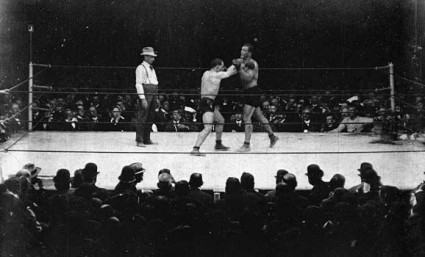
For tonight we bring you The Jeffries-Sharkey Fight. Yes, all twenty-five rounds of the world heavyweight championship bout held at Coney Island on 3 November 1899. But the fight lasted for some two hours you cry, it is not possible for a cinematograph to be so long in 1899. Ah, but it is, though the struggle to achieve so stupendous a record of pugilistic endeavour on the cinematograph was scarcely less tumultuous than the bloody struggle that was the fight itself.

The film is a production of the American Mutoscope and Biograph Company, whose products you may have seen a large-screen entertainments in variety theatres, or as Mutoscopes, those peepshows with cards rotated by a handle that are so popular in some amusement parlours. The company employs a unique 70mm film system, which can only be exhibited by its own projectors, a policy which has encouraged the pirates, as you will learn. However, the quality of the image achieved is extraordinary, and with none of the tiresome flicker that sadly drives some people away from the cinematograph shows. Following the great commercial success enjoyed by the Veriscope Company in filming the world heavyweight championship bout between James J. Corbett and Robert Fitzsimmons in 1897, Biograph secured the rights to film this match between Fitzsimmons’ conqueror, James J. Jeffries, and the challenger Tom Sharkey, a deal secured by Jeffries’ wily manager William Brady – a man acutely aware of the value of a motion picture deal to the boxer of today.

jeffries_sharkey

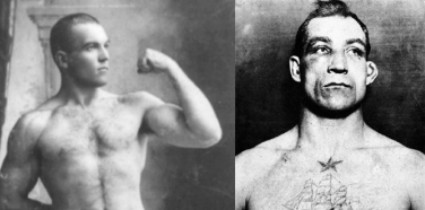
Jim Jeffries (left) and Tom Sharkey

Yes, Boilermaker Jim versus Sailor Tom, 215lbs and 6′ 2″ against 183lbs and 5′ 8″, a contest that has gone down as one of the most grueling fistic encounters of modern times. Twenty-five rounds would be enough to test the stamina of anyone, but what made this encounter all the tougher was the presence of the motion picture cameras. The fight took place in the Coney Island pavilion, and once a decision was made not to remove the roof (to allow in daylight), it was necessary to film under artificial lights. Mr Dan Streible, the festival’s special consultant, informs us that the Biograph company boasts of employing eleven electricians to operate 400 specially built arc lights and associated feed wires, dynamos etc., while a it was boasted a dozen operators were required to man the four cameras. Over seven miles of cinematograph film were to be taken by the operators (we rather think that there were three of them) who worked in rotation, with the cameras in parallel so that one was operating at any one time while the others were loaded in readiness and a fourth stood by in case of breakdowns.

All those arc lights generated colossal heat. We are reliably informed that the scalps of the fighters were singed, and each suffered from great weight loss as the fight progressed. Add to this the brutality of the fight itself – Sailor Tom suffered two broken ribs – and one realises that one is to experience something extraordinary, a sporting endeavour which the cinematograph did not only record but in doing so affected its outcome. We fondly imagine that the cameras are passive witnesses of what parades before them, but maybe the camera being there necessarily changes what we see, so what kind of reality is it that the cinematograph is recording?

jeffriessharkey_loc

Poster advertising the fight film, from the Library of Congress collection

But enough of such philosophising, we must return to the fight. The result you will know. As tough and able as Sharkey undoubtedly was, able to withstand terrific punishment, Jeffries countered his every sally with fierce left hooks to the jaw and thunderous blows with the right over the heart. All was level, however, until the final five rounds, when the champion began to dominate and the strength had gone out of Sailor Tom’s punches. With an energising glass of champagne offered to him by his trainer before the final round, the Boilermaker entered the ring with renewed vigour comprehensively outbox his opponent and make the judges’ decision an easy one.

Thanks to the effort, expense and ingenuity of the Biograph company, you will be able to see all twenty-five rounds of this unsurpassed sporting encounter, with George Siler, referee for the contest, brought over at notable expense to serve as expert lecturer. He will guide you through the finer points of the scientific display that you will be witnessing. Now some may have heard rumours that the Biograph company were not able to film every second of the fight. Indeed, that is the case. Though the cameras themselves never failed, most unfortunately a fuse blew just as the twenty-fifth and final round was coming to a close. Exasperatingly for the filmmakers, they missed the crucial moment where Jeffries’ glove came off, Sharkey tried to take advantage, the bell rang, and Mr Siler held up Jeffries’ arm in victory. What exactly happened? How greatly we would value seeing the cinematographic record at this very point. It is unclear how the film company has got around this unfortunate lacuna. Some say that a judicious edit has smoothed over the gap; other claim that a re-enactment has been filmed. Mr Siler is saying nothing, and Mr Brady has been equally evasive. We will only be able to judge when we have seen the film ourselves.

biographteam

The American Mutoscope and Biograph Company’s camera team on its special platform

You may also have heard tales of other films made of this fight. Sadly, this is so. Despite the American Mutoscope and Biograph Company’s exclusive agreement with the promoters, other unscrupulous filmmakers who put not a penny towards the filming of the event yet are all to eager to benefit from the struggles of those who did are promoting films of the Jeffries-Sharkey fight. One company, Lubin, as you may know, has specialised in producing dramatised reconstructions of boxing matches, and having copyrighted their re-enactment of Jeffries-Sharkey ahead of Biograph, even had the cheek to sue the legitmate film producers for infringement!

But the greater crime has come from some renegade operators, among them Albert Smith of the Vitagraph company and James H. White of Edison, who smuggled cameras into the crowd, eluding the attentions of the Pinkerton men hired specifically to prevent such piracy, taking full advantage of Biograph’s lighting to produce short films of the bout. Vitagraph’s film is a wretched record of only a small portion of the fight (we have heard that they have attempted to put the film into a loop with the intention of fooling the gullible into thinking them are seeing multiple rounds) with the heads of the crowd obscuring the view. With what great irony is it for a festival of lost films that this pirate film survives, yet all posterity has of the Biograph film – the epic of its age – is a Mutoscope card or two, representing a few inches of a record that, as we know, could be measured in miles. And so, breaking all of the festival’s rules, our accompanying short is a film that does exist. Here is The Battle of Jeffries and Sharkey for Championship of the World (1899), produced by Vitagraph.

An extract from the pirated film of Jeffries-Sharkey taken by Vitagraph (the stills, commentary and music are all obviously later interpolations)

Despite the simulation and piracy, the Biograph company has enjoyed considerable success with The Jeffries-Sharkey Fight. Some say that it has brought in $200,000 at the box office, and if that is probably an exaggeration, it has undoubtedly further cemented the close relationship between the ring and the screen. However, commentators have noted fewer women attending screenings of the film that was the case for the Corbett-Fitzsimmons fight two years ago. Perhaps the novelty value has worn off. In the future, boxing films will be for fight fans only, and we suspect that they will become increasingly marginalised, after having played such a crucial role in building up an audience for motion pictures when they first appeared.

Join us tomorrow night, when we will be in Oxford Street to see a magical tale in dumbshow … or is it two magical tales in dumbshow?