Charlie in the Heartland

charlies

The 120-year-old Charlie Chaplin (as of two days ago) is the subject of a conference taking place 28-30 October 2010 at Ohio University Zanesville, Zanesville, Ohio. Charlie in the Heartland: An International Charlie Chaplin Conference is inevitably at the early planning stage, but confirmed speakers include keynote speaker and honoree Charles J. Maland, professor and head of the University of Tennessee English Department and author of Chaplin and American Culture: The Evolution of a Star Image; David Robinson, author of Chaplin: His Life and Art; Kate Guyonvarch, director of Roy Export S.A.S. and the Association Chaplin office, Paris; Cecilia Cenciarelli, archivist and head of Progetto Chaplin, Cineteca di Bologna, Bologna, Italy; and Frank Scheide, Professor of Communications at the University of Arkansas and co-editor of The Chaplin Review.

The call for papers reads as follows:

In keeping with the theme of the conference, “Charlie in the Heartland,” which was chosen to commemorate Chaplin’s first trip to the United States with Fred Karno’s comedians in October, 1910, we are seeking papers in a wide range of areas, all to do with Chaplin, his relationship with, influence on, or evocation of America, either during or after his long residence here.

The following topics are meant to generate ideas for presentations, not limit creativity or exclude participation:

  • Maland’s Chaplin and American Culture 30 Years later
  • Reconsidering “Chaplinitis”
  • From Karno to Keystone: eliding the music hall stage and the silent screen
  • American vaudeville audiences of the 1910s – a herald of silent film popularity?
  • Chaplin’s company: who were Charlie’s character actors and what were their influences?
  • Vulgar film comedy as high art
  • Chaplin and public appearance: a reconsideration of the Liberty Bond tour
  • The Chaplin imitator phenomenon
  • Film audience reception in the Heartland
  • The Heartland rebels: Chaplin and the American Legion
  • Brother Sydney Chaplin: what was the magnitude of his impact?
  • The representation of America or Americans in the films of Charlie Chaplin
  • Chaplin’s little tramp and the Beat Generation in America

Individual papers or full panels are welcome to submit proposals.

Please send a 500-word abstract, a short bio and your contact information to Lisa Stein, Assistant Professor of English, OU-Zanesville, 1425 Newark Road, Zanesville, OH 43701 or via email by February 1, 2010. Graduate and undergraduate students are welcome to submit.

N.B. We have tried to make this an accessible conference for young scholars by offering several low-cost housing options, as well as a reduced registration rate. We will also have a student travel grant available for applicants. Check back in early 2010.

Attendees are also promised a Chaplin feature film plus shorts, outtakes and oddities; a Chaplin film parody competition; a Chaplin lookalike contest (is it to held among the attendees? This sounds to be a highly promising development for academic conferences); and a ‘juried art show: “America in 1910”.

More details are promised on the conference website in due course.
Early sounds

The programme for the Sounds of Early Cinema in Britain conference has been announced. Organised by the Institute of Musical Research, the conference takes places 7-9 June 2009 at Senate House and the Barbican Centre, London. The conference is intended to complement the British Silent Film Festival, which is taking place at the Barbican 4-6 June and has the theme of music and British silent film.

This is the provisional programme for the conference:

PROGRAMME

Sunday 7 June 2009: Barbican Centre, Cinema 1

3–3.15 Introduction to conference: Julie Brown
Introduction to D.W.Griffith and Way Down East: Professor David Mayer

3.15–6.15 Way Down East: original score by William Frederick Peters and Horace Silvers, reconstructed and conducted by Gillian Anderson (prog. includes short interval)

6.30–7 Gillian Anderson in conversation with Professor Ian Christie

7pm Depart for dinner

Monday 8 June 2009: Institute of Musicological Research

9am Registration

9.15 Welcome

9.30–10.45 Film Lecturers

  • Film Lecturers in the UK, pre-1907, Dr Joe Kember, University of Exeter
  • ‘Sound’ and silent cinema in Scotland, Dr Trevor Griffiths, University of Edinburgh

Coffee

11.15–1 Early musical practices

  • ’Motivated Music’: the evidence for accompaniment practice in London cinemas, 1896–1913, Prof Ian Christie, Birkbeck College, University of London
  • Music in Mitchell and Kenyon shows, Dr Vanessa Toulmin, National Fairground Archive, University of Sheffield
  • Music for A Trip to the Moon? A Probable English Film Score for a French Film Fantasy, Prof Martin Miller Marks, Mass. Institute of Technology

Lunch

2–3.45 The 1910s: UK and US practices

  • Entertainment licensing in the UK during the ‘silent’ film era, Dr Jon Burrows, University of Warwick
  • The Sound of the City: Music, The Show, and the Picture Palace, Dr Jim Buhler, University of Texas at Austin
  • “The efforts of the wretched pianist”: Fiction as Historical Resource, Prof Andrew Higson, University of York

Coffee

4.15–5.15 Resources 1: Film and Documents
Dr Phil Wickham, The Bill Douglas Centre, University of Exeter
Luke McKernan, Curator, Moving Image, British Library
Bryony Dixon, Curator, Silent Film, British Film Institute
Prof David Sanjek, University of Salford

End of day discussion, followed by Buffet (at IMR)

8pm Barbican Centre, Cinema 1
The Flag Lieutenant: original score by Albert Cazabon. Arranged and performed by Philip Carli (pno.) with Gunter Buchwald (vln.) and Paul Clarvis (perc.)

Tuesday 9 June 2009: Institute of Musicological Research

9.30 -10.45 Music and/as transition practice

  • Another mystery from the pen of Mr. Edgar Wallace? The case of the vanishing part-talkie, The Crimson Circle (British Talking Pictures, 1929), Fiona Ford, University of Nottingham
  • Live music and the transition to sound in Britain, Dr Julie Brown, Royal Holloway, University of London

Coffee

11.15-12.30 Retrospective Research: Early Sound Films and Silent Practice

  • Scores in early sound film as sources for silent film accompaniment practices, Dr Ian Gardiner, Goldsmiths College, University of London
  • The Development of Dialogue Underscoring in Sound Films in the Early 1930s, Prof David Neumeyer, University of Texas at Austin

Lunch

1.30-2.45 Resources 2: Technology and Ephemera
Phil Wickham, Curator, The Bill Douglas Centre, University of Exeter
Dr Mike Allen, Birkbeck College, University of London
Len Rawle, Cinema Organ Society
Other panel members tbc.

Coffee

3.15 – 4.30 Musical Performance on Film

  • Silent Mancunians: Overcoming Silence in Silent Operas, Dr Chris P. Lee, University of Salford
  • Variety Performance as Captured in Early Film, Prof Derek B Scott, University of Leeds

The conference closes at 5.30 pm after a short open forum.

The Sounds of Early Cinema in Britain research network is funded by the Arts and Humanities Research Council, under their Beyond Text programme. The research team is Dr Julie Brown (Royal Holloway, University of London), Principal Investigator, and Dr Annette Davison (University of Edinburgh), Co-investigator. They describe the conference aims thus:

The aim of this interdisciplinary conference is to bring together researchers from widely divergent fields to share perspectives on the sonic practices associated with early film exhibition, particularly in Britain. The first decades of film exhibition in the UK were characterized by flux and experimentation. Musical and sonic practices were often improvisatory, but always contingent upon the resources available, their stage of technological development, and the exhibition venue itself, which might have been a music hall, fairground, theatre, or purpose-built venue. Elements of performativity and contingency continued well into the sound era; live musical performance long remained a key part of film exhibition in many cinemas. This conference is the first of four events organised by the AHRC-Funded Beyond Text Network “The Sounds of Early Cinema in Britain” to enable, encourage, and consolidate research and practical activity in this field, and is particularly concerned with the nature, limitations and potentialities of the sources available for studying these practices.

Programme and booking form can be found on the Institute of Musical Research site. Information on the British Silent Film Festival can be sound at http://britishsilent.wordpress.com.

Monstrosities

peppersghost

http://www.monstrous-media.com

Monstrous Media/Spectral Subjects is the enticing title of the Ninth Biennial Conference of the International Gothic Association. The conference takes place 21-24 July 2009 at Lancaster University, and it touches pre-cinema and early cinema themes, with much else besides, as the conference description explains:

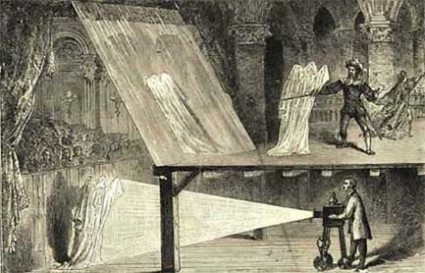
Gothic forms and figures have long been bound up with different media, from the machinery of Walpole’s modern romance to Robertson’s phantasmagorical shows in the eighteenth century; from uncanny automata to ghostly photographs and monstrous kinetograms in the nineteenth; from cinematic shocks to digital disembodiments in the twentieth. More than merely exploiting new technical developments in cultural production and consumption, the Gothic mode, in adopting and adapting new media, engages with excitements and anxieties attendant on social and technological change.

Examining conjunctions of literary, visual, spatial and digital texts in relation to spectral and visceral effects and affects, the conference aims to stimulate discussions of the relationship between the Gothic novel and other cultural forms, media and technologies. Doubling the monstrous with the spectral, it sets out to explore the cultural production and consumption of monsters and ghosts from the eighteenth century to the present.

Topics expected to feature in the conference include:

  • Early visual technologies (phantasmagoria/ magic lantern shows/spirit photography)
  • Gothic embodiments (staging, smoke and mirrors, automata and mechanical curiosities)
  • Gothic on screen
  • Digital Gothic (web, video games, hypertext)
  • Visualising Gothic narrative (graphic novels, comics and illustration)
  • Monstrosities (subjects, texts, bodies, forms)
  • Media monsters
  • Spectralities (subjects, spaces, environments, images)
  • Transgeneric crossings (cyborgs, science, fictions)

The call for papers has passed, and they report an overwhelming response which is making the selection of papers take longer than expected, so no programme as yet. However, the plenary speakers will be Elisabeth Bronfen, Tanya Krzywinska, Marina Warner and Christoph Grunenberg.

More information now, and later, from the conference website.

Faded glory

micheaux1

Oscar Micheaux directing (possibly Within Our Gates), from the magazine film Screen Snapshots (1920), held by the BFI National Archive

News, a little late in the day, of a conference taking place 6-7 February 2009 on the key African-American filmmaker of the silent era, Oscar Micheaux. Faded Glory: Oscar Micheaux and the Pre-War Black Independent Cinema is being presented by the Columbia University School of the Arts Film Programme and Film Society of Lincoln Center. It is, they say, fifteen years since the last conference took place on Micheaux’s work, and undoubtedly a great deal of work on Micheaux has appeared since then, as well as re-discovered film titles.

The conference site gives this useful background information on the rise in Micheaux studies, showing how important it is for film studies in any period to have films to study (not always the option when it comes to silent cinema – but what survives generally determines what is understood, and written about):

In 1991, American film history was radically transformed when the U.S. Library of Congress acquired a 35mm print of a silent film titled La Negra (1920) from the Filmoteca in Madrid in a swap for a print of Dracula (1932). La Negra, as historian of African American history, Thomas Cripps, discovered, was the lost film, Within Our Gates (1920), one of twelve silent era films produced, directed, and written by African American director Oscar Micheaux. Soon after, the Museum of Modern Art acquired a print of Symbol of the Unconquered (1920), this time from the Cinémathèque Royale in Brussels, with intertitles still in Flemish and French. Suddenly, these two films opened up a radical new angle on the prolific filmmaker who had been known primarily through his controversial sound films. Paired with Body and Soul (1924), in which Paul Robeson plays a double role, the three silent Micheaux films became a trilogy that brought scholars of African American culture into silent era film history (1895 – 1929). The teaching of D.W. Griffith’s The Birth of a Nation (1915) was transformed as now it could be countered with Micheaux’s Within Our Gates (1920), the film that grew from opposition to Griffith and Thomas W. Dixon’s offensive epic.

More importantly, the Micheaux silent trilogy allowed teachers and scholars to raise sensitive cultural issues because of the filmmaker’s bold approach to the question of what it meant to be a black American. It is not only that Within Our Gates contains a sequence in which a black man and woman are lynched and white Southerners gleefully cheer. In Symbol of the Unconquered, a black man passing as white rides with the Ku Klux Klan against a black oil prospector, and in Body and Soul, a black preacher rapes a loyal churchgoer’s daughter. From the position of Micheaux’s films, 1918 – 1948, which take the political pulse of the pre-civil rights era, one is led to ask about voting rights, property ownership, educational inequity, black entrepreneurialism, urbanization and black-white intermarriage.

It has been nearly fifteen years since the first serious Micheaux conference. Held at the Yale University Whitney Humanities Center in January of 1995, “Oscar Micheaux and His Circle,” was structured as the second generation of Micheaux scholarship, a reconsideration of the definitive 1970s Black Film as Genre by Thomas Cripps. The films screened at Yale had an immediate second life on the program of the Giornate del Cinema Muto international festival in Pordenone, Italy, in October, 2001, and a collection, Oscar Micheaux and His Circle, edited by Pearl Bowser, Jane Gaines, and Charles Musser followed. Soon, a number of other scholarly works on race theory, black audiences, black musicals, and early African American cinema appeared. In 2007, the first comprehensive biography, Oscar Micheaux: The Great and Only by Patrick McGilligan was published.

The consensus among Micheaux scholars is that a third generation of scholarship is now emerging, fueled by the fact that Micheaux remains a mystery and therefore a high priority research challenge. Some scholars have attempted to fit him into the Harlem Renaissance, others have argued that black literary Harlem was elite and Micheaux was a popularizer; some have defined him as a conservative, others as a radical, but Oscar Micheaux as an historical figure still remains elusive. Micheaux, however, is symbolic of the historical difficulty of retrieving the consciousness of another era. The fact that some of his motion pictures have survived him, however, makes the challenge of understanding his moment all the more alluring. Thus a defining feature of this conference weekend will be the Lincoln Center public exhibition of Micheaux films never screened together.

Now, in 2008, there are additional motion picture titles, some newly restored, that fill out the cultural territory of what was then called the “race movie” circuit. Both fragmentary footage and still images from the “lost” titles and the public 35mm and 16mm film exhibition of relatively complete work will bring to life the productions of these companies: The Richard Norman Company (Florida), the Lincoln Motion Picture Company (Los Angeles and Omaha, Nebraska), the Ebony Company, Richard Maurice Film Company (Detroit); other directors: Spencer Williams (Blood of Jesus, Dirty Gertie from Harlem, Juke Joint), and important actors: Paul Robeson, Bert Williams, Charles S. Gilpin, Evelyn Preer, Noble Johnson, and black film genres: (Harlem, western, detective, comedy).

Further information, including a full conference schedule, is available from the conference site. For background information on Micheaux, as well as the books cited above, see the Micheaux Society website and the Oscar Micheaux Home Page.

The Volta in Trieste

voltaexhibition

Exhibition on James Joyce, the Volta Cinematograph and Trieste, on show in Trieste

Well, it’s good to be home again. I’ve spent the past week or so in Italy, mostly in the fair city of Trieste for a conference on James Joyce and the cinema. And an excellent conference it was too, with some fine papers identifying the several ways in which Joyce’s work (particularly Ulysses) has affinities with early cinema.

There was yours truly, speaking about Joyce’s brief time as a cinema manager in Dublin; Marco Camerani, Philip Sicker, Carla Marengo Vaglio and Maria di Battista each speaking on aspects of early cinema in Joyce’s work, especially the ‘Circe’ episode in Ulysses, with references to Georges Méliès, Segundo de Chomon, Leopoldo Fregoli and more; and Katy Mullin on the relationship between the erotic in early Edison and Biograph actuality and comedy films and Joyce. Other speakers covered film adaptations of Joyce’s work, making it a very rounded event. I found the arguments convincing and illuminating, particularly regarding the debt Joyce (an avid filmgoer from 1904 onwards as well as a cinema manager, albeit briefly and somewhat ineptly) shows to early cinema in his fiction. The promised book of essays coming out of the conference will be something to look out for.

There was also (and continues to be) an exhibition on Joyce, the Volta and Trieste, entitled ‘Trieste, James Joyce e il Cinema: Storia di Mondi Possibili’, curated by Erik Schneider, who also spoke at the conference on the discoveries he made in the archives about Joyce’s brief foray into cinema management and cinema in Trieste generally. The reason for the Trieste connection is that Joyce – who was living in the city in 1909 as a language teacher – joined up with some local businessmen who ran cinemas in Trieste and Bucharest and offered to help extend their circuit to Ireland by setting up the Volta Cinematograph at 45 Mary Street, Dublin, in December 1909.

Report (in Italian) on the Joyce exhibition and screening of Volta films, from the Trieste Film Festival’s YouTube channel

Joyce was manager on the cinema for a few weeks only before handing over to Lorenzo Novak (the cinema was sold at a loss in June 1910), but enough exists in the archives to reveal a rich history. The above video, from the Trieste Film Festival (which housed a complementary Joyce film season), shows the exhibition, with contributions from assorted brainy Joyceans, plus scenes from an evening of films taken from the BFI National Archive which were known to have been shown at the Volta. You can see me, mercifully briefly, introducing the show (with much habitual hand-waving), Carlo Moser at the piano, and Paolo Venier heroically hand-cranking a Pathé projector for the whole show (with gaps in between each reel as the films were changed, giving the full house a taste of the authentic 1909 cinema experience).

The films shown were:

  • Une Pouponiere a Paris (France 1909) (first shown at the Volta 20 Dec 1909)
  • Francesca da Rimini, or the two brothers (USA 1907) (6-7 Jan 1910)
  • Come Cretinetti paga I debiti (Italy 1909) (17-19 Jan 1910)
  • Il signor Testardo (Italy 1909) (17-19 Jan 1910)
  • A glass of goat’s milk (GB 1909) (3-5 Feb 1910)
  • The Way of the Cross (USA 1909) (14-16 Feb 1910)
  • (Der Kleine Schlaumeier) [original title not known] (France c.1909) (21-23 Feb 1910)
  • (Hunting Crocodiles) (France 1909) (7-9 Mar 1910)
  • Une Conquete (France 1909) (10-12 March 1910)

(Note – some of the films are possibily those shown at the Volta, and are not definite identifications. Le Huguenot (France 1909), which was advertised for the festival, wasn’t shown)

Also shown was Georges Mendel’s 1908 opera film of the sextet from Lucia di Lammermoor (with Enrico Caruso’s voice) as an example of the synchronised sound film Joyce wanted to show at the Volta, but never did.

For me, the most remarkable discovery in the exhibition was Joyce’s own hand-written list of expenses at the Volta for its first three or four weeks, from the collection of Cornell University Library, accompanied by a letter from Pathé in Britain advising him on the choice of projector, lenses, light source and so forth. Joyce’s venture into cinema, though short-lived, generated a significant amount of information on cinema in 1909 to make it worthy of study for those interested in general cinema history. We know the identity many of the films shown, thanks to extensive advertising in the Dublin press; we have the contracts drawn up; we know the initial expenses; we know about the background business in Trieste; we know how the cinema was decorated; we have the names of three or four of the staff (such as Lennie Collinge, the projectionist who lived long into a ripe old age and was interviewed by film historian Liam O’Leary, who first uncovered the Volta history). What we don’t have, alas, is a contemporary photograph of the cinema, interior or exterior.

There is much in the exhibition on early cinema in Trieste itself, which had a remarkable twenty-one cinemas in 1909. There is a history of cinema in Trieste, 1896-1918, written by Dejan Kosanovic, though in Italian only. Another gem from the archives was the advertised programme for Lifka’s Bioscope, a travelling film show which visited Pola in December 1904, when James and Nora Joyce attended the show. Joyce wrote to his brother Stanislaus: “The other evening we went to a bioscope. There were a series of pictures about betrayed Gretchen … Lothario throws her into the river and rushes off, followed by rabble. Nora said ‘O, policeman, catch him'”. I’m working on trying to identify which film moved Nora so. Would you believe Lifka’s Bioscope mostly got its film from Charles Urban…?

Anyway, a stimulating conference, a fine exhibition, and bright winter’s sunshine to delight us all.

james1

Statue of James Joyce by the Canal Grande, Trieste

Off to sunny Italy

flyer-joyce-1

Well, I hope it’s sunny at any rate. The Bioscope is heading for Trieste, Italy for a few days, to speak at a conference on James Joyce and cinema. Then it’s a few days more in Florence. So, as I’m under stern instructions not to go anywhere near a computer for the period, normal service will have to be resumed on January 22nd.

Meanwhile, for your amusement, I’ve included a few frame stills from films that are known to have been shown at the Volta Cinematograph in Dublin, between December 1909 and January 1910, the period when Joyce was either managing the cinema or immediately afterwards (he left Dublin on 2 January). So they are likely to have been films that he saw, indeed programmed. All images are from prints held by the BFI National Archive (via a DVD copy).

pouponniere_a_paris

Une Pouponnière à Paris (Éclair 1909), an interest film about a Paris nursery. The only surviving film from the inaugural programme of the Volta Cinematograph, 20 December 1909.

farman

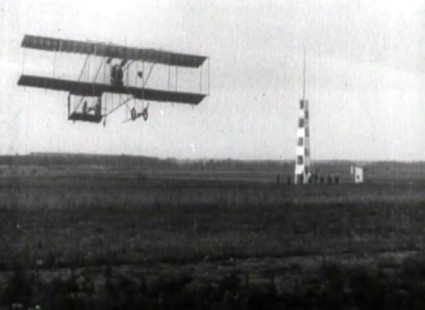
Aviation Week at Rheims (Pathé 1909), newsfilm about the world’s first aviation meeting (the aviator is Henry Farman). Shown at the Volta 3-5 January 1910.

francesca_de_rimini1

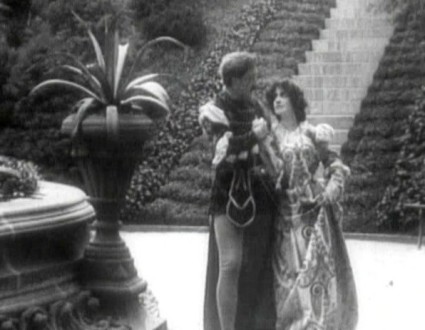
Francesca da Rimini, or The Two Brothers (Vitagraph 1907), classical drama based on Dante, with Florence Turner and Paul Panzer. Shown at the Volta 6-8 January 1910.

come_cretinetti

Come Cretinetti paga i debiti (Itala 1909), special effects comedy starring André Deed as Cretinetti, ingeniously avoiding those to whom he owes money. Shown at the Volta 17-19 January 1910.

signor_testardi

Il signor Testardo (Itala 1909), bizarre comedy about a grotesquely stubborn man, shown at the Volta 17-19 January 1910.

Arrivederci!

Roll away the reel world

joyce

http://www.jamesjoyce.ie

2009 sees the centenary of one of the odder corners of early film history. In December 1909, the then unknown James Joyce, future author of Dubliners, Ulysses and Finnegans Wake, opened a cinema in Dublin. This was through no particular passion for film; Joyce was merely seeking the means to get rich quick, and like a good many other people at the time, he saw the new cinema business as the way to do so. Cinemas were springing up all over Europe, and in Trieste – where Joyce was based – he had fallen in with a group of cinema owners, to whom he sold the idea of a city in Europe which had a half a million inhabitants, and yet not a single cinema. That city was Dublin, and although recent research indicates that there probably were one or two cinemas in Dublin at that time (and numerous film shows not in cinemas as such), Joyce’s business partners were interested enough to send him across to Dublin to establish the Volta Cinematograph.

Happily for literature, Joyce turned out to be a hopeless cinema manager, or rather he left the business all too quickly in other hands, only to see the hoped-for source of his fortune rapidly fail. The Volta (which was located at 45 Mary Street) floundered, as much through competition from other film entertainments as its own mismanagement, and it was sold at a loss in June 1910. Joyce’s own specific involvement with the cinema was brief, but intense. He spent several weeks setting up the business, staffing and equipping, promoting it, obtaining a cinematograph licence, and – it is to be assumed – selecting the films.

It is this last element that continues to attract scholarly interest. What films were shown at the Volta, what role did Joyce play in their selection, what did he think of such films, and what traces of the cinema can be uncovered in his art? These questions are all to be covered in in a two-day conference organised by the Trieste Joyce School and the Alpe Adria Film Festival, entitled ‘Roll away the reel world’: James Joyce e il Cinema, to be held 15-16 January 2009 at the Sala Tessitori of the “Consiglio della Regione Friuli Venezia Giulia, piazza Oberdan, 5, Trieste, Italy.

huguenot

Le Huguenot (Gaumont 1909 d. Louis Feuillade), shown at the Volta 24-26 January 1910

Speakers include Luke McKernan (yours truly), who will introduce a programme of films known to have been shown at the Volta and give a talk, ‘James Joyce and the Volta Programme’, Eric Schneider (‘Dedalus among the film folk’), Maria di Battista (‘The Ghost Walks: Joyce and the spectres of silent cinema’), Louis Armand (‘Joyce and Godard’), Jesse Meyers (‘James Joyce, Contemporary Screenwriter?’), Cleo Hannaway (‘”See ourselves as others see us”: Cinematic Ways of Seeing and Being in Ulysses’), Marco Camerani (‘Circe, Fregoli and Cinema’), Carla Marengo Vaglio (‘Joyce, between futurist music-hall and cinema’), Philip Sicker (‘Mirages in the Lampglow: Joyce’s “Circe” and Méliès’s Dream Cinema’), Katy Mullin (‘Joyce, Early Cinema and the Erotics of Everyday Life’), Davide Maschio (‘On Bute’s Finnegans Wake’), and Keith Williams (‘Odysseys of Sound and Image: “Cinematicity” and the Ulysses Adaptations’).

Added to all that, the Alpe Adria Film Festival, or Trieste Film Festival, is hosting a retrospective on Joyce and cinema, running 15-22 January, co-ordinated by Elisabetta D’Erme; and there is to be an exhibition, entitled Trieste, Joyce and Cinema: A History of Possible Worlds curated by Erik Schneider, tracing the connections between Joyce’s imaginative world, the city, and the cinema. For further information on the conference, which is free of charge and open to all, contact Professor John McCourt at mccourt [at] units.it, or visit the Trieste Joyce School site for the programme details.

Popular Italian cinema

All call for papers has gone out for Popular Italian Cinema: an international conference, to be held at King’s College, University of London, 27-29 May 2009. Proposals are invited for papers which deal with any aspect of popular Italian film culture from early silent film to contemporary cinema. Here’s the conference blurb:

This conference seeks to establish the importance of the study of popular Italian cinema. From the origins of the silent feature film and the creation of the star system, Italy has been at the forefront of cinema as a mass cultural phenomenon. The formal incorporation of music, melodrama, and comedy, and the development of the Italian genre system, are integral aspects of Italy’s domestic cultural heritage, responsive to and influential on film internationally.

Research into Italian cinema still needs to shift the paradigms beyond neo-realism and the canonical post-war auteurs. Furthermore, realism and auteurism in Italy can only be fully understood through their position within the rich vein of the wider film culture from which they arose. This conference will provide an opportunity for examining what is meant by the popular in Italian cinema, and for resituating the turning points in world cinema of silent spectacle and neo-realism.

Titles and abstracts (350 words) for proposed papers should be sent in English to the conference organizers by 15 February 2009. Keynote speakers are Richard Dyer (King’s College, London), Rosalind Galt (Sussex), Elena Mosconi (Cattolica, Milan), Federica Villa (Turin), Christopher Wagstaff (Reading).

Sounds and silents

A call for papers has now been issued for The Sounds of Early Cinema in Britain: Textual, Material and Technological Sources, a conference being held 7-9 June 2009 at the Barbican, London. The conference is being organised as part of the Sounds of Early Cinema in Britain project, which is one of a network of project organised under the Arts & Humanities Research Council‘s Beyond Text programme.

CALL FOR PAPERS

AHRC-Funded Beyond Text Network “The Sounds of Early Cinema in Britain”

The Sounds of Early Cinema in Britain: Textual, Material, Technological Sources

Sunday 7th-Tuesday 9th June 2009

Institute of Musical Research and the Barbican, London, UK

We invite papers from interested parties from all related disciplines to participate in this, the first of four events to establish and develop a research network concerned with the variety of sonic and musical practices of “silent” film exhibition in Britain, interpreted in the broadest possible sense. Explorations of “sources” – of whatever kind – are particularly welcome, as are presentations by archivists, curators, and performers.

Potential topics might include:

  • Sonic and musical practices used alongside the exhibition of early film in Britain
  • The potential sources for understanding these practices
  • Their problems. How we might excavate them
  • The challenges that Britain faces in preserving the existing historical legacy of these sonic and musical practices, instruments, equipment, and spaces
  • Relationship between these practices and those of cinema’s antecedent forms in Britain
  • Distinctive musical practices pursued in Britain, compared to other countries
  • Perspectives from other disciplines, other countries
  • Use of eye-witness memory

Preference will be given to papers with a British focus, though we may be able to accommodate papers that explore the same issues in other national contexts.

Individual Papers: Abstracts of 250 words for individual papers of up to 25-30 minutes should be e-mailed, as a Word attachment, to Mrs Valerie James at music [at] sas.ac.uk. We will also consider shorter presentations of around 15 minutes on specific issues relating to sources. Please include your name and title, institutional affiliation (if any), email address, and postal address.

Round tables: Round table organizers should provide an abstract of 700 words introducing the discussion topic for a 90 minute/2 hour presentation. All panel members must be listed (names and affiliations). The round table organizer is the chairperson and acts as moderator. Proposals should be e-mailed to Mrs Valerie James at music [at] sas.ac.uk as a Word attachment, along with your name and title, institutional affiliation (if any), email address, and postal address.

The deadline for all proposals is 9th January 2009.

Postgraduate scholarships: Postgraduate students working in this, and/or related areas may apply for one of two scholarships (to include basic travel and accommodation, and conference fee and refreshments). Applicants should send the following information to Mrs Valerie James music [at] sas.ac.uk: name, institution where studying, and an outline of their (related) research project.

Should be fun. Start excavating.

The sounds of early cinema in Britain

A conference has been announced by the AHRC-funded ‘Beyond Text’ Network, “The Sounds of Early Cinema in Britain” (the AHRC is the UK’s funding council for research into the arts and humanities; ‘Beyond Text’ is an AHRC programme looking at areas of research beyond the printed word):

The AHRC-Funded Beyond Text Network “The Sounds of Early Cinema in Britain” is delighted to announce the dates of the first event:

The Sounds of Early Cinema in Britain: Textual, Material and Technological Sources

Institute of Musical Research and the Barbican, London, UK
Sunday 7th to Tuesday 9th June 2009

The first decades of film exhibition in the UK were characterized by flux and experimentation. Musical and sonic practices were often improvisatory, but always contingent upon the resources available, their stage of technological development, and the exhibition venue itself, which might have been a music hall, fairground, theatre, or purpose-built venue. Elements of performativity and contingency continued well into the sound era; live musical performance long remained a key part of film exhibition in many cinemas.

This conference is the first of four events organised to enable, encourage, and consolidate inter-/cross-/trans-disciplinary research and practical activity in this field. We invite interested parties from all related disciplines to participate. We anticipate that such parties may include early cinema and film researchers, curators and archivists, musicologists, sociologists, historians and theorists of popular culture. As a network event, we are able to offer a substantial number of grants to subsidise travel and accommodation costs for event participants, and will offer two postgraduate student scholarships (UK) to enable attendance. We will send out a call for papers shortly.

As the conference title suggests, the focus of the event is “sources”:

  • What sonic and musical practices existed alongside the exhibition of early film in Britain?
  • What sources are available to assist our understanding of these practices?
  • What are their problems?
  • How may we excavate them?
  • What challenges does Britain face in the preservation of the existing historical legacy of these practices, instruments, equipment, and spaces, and what should take priority?
  • Were distinctive musical practices pursued in Britain, compared to other countries?

Preference will be given to papers with a British focus, though we may be able to accommodate papers that explore the same issues in other national contexts.

Features:

  • Key-note speakers
  • Screenings of silent films with live accompaniment

About the Network:

Through 2009 and 2010, the project will hold two conferences and two workshops as a means of consolidating research and practical activity on sound’s and music’s roles as practiced in the exhibition of early and ‘silent’ cinema in Britain. The second conference will focus more strongly on questions of performance and reception. The two workshops will focus on sound practices in the “silent” era, and on live accompaniment, however conceived (whether improvised and/or historically-informed and/or contemporary).

Principal investigator: Dr Julie Brown (RHUL, UK)
Co-investigator: Dr Annette Davison (Edinburgh, UK)

No conference web address as yet, but beyond the academic-speak (why was the profoundly ugly word ‘performativity’ ever allowed?) this sounds to be a worthwhile event which is certain to attract a good range of interested parties. I’ll publish the call for papers just as soon as it is made.