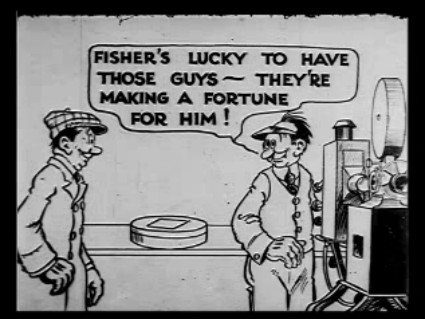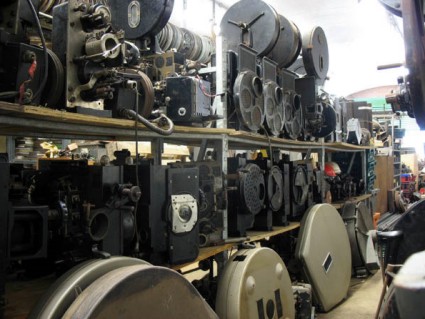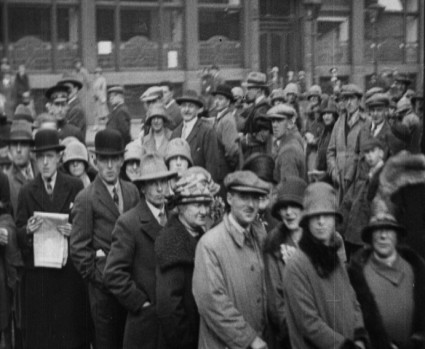
Come to the bazaar

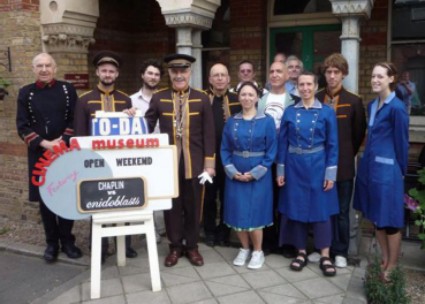
Helpers at the Cinema Museum (the museum’s owner Ronald Grant is on the left)

The Cinema Museum in London is hosting a film bazaar. Billed as the first of its kind, the intention is to help raise funds for this privately-owned institution which precariously holds on to so much precious British film heritage. The event takes place over the weekend of 27-28 February 2010, 10:00-17:00 each day. Here’s the what the publicty says about it:

The Film Bazaar, the first of its type to raise funds for the only museum of the cinema in the country, will be opened by famous British film director Michael Winner.

With dealers and visitors coming from all over the country and abroad, this will be one of the largest collections of film related collectables that has ever been seen in one sale room. Classic original posters from Hollywood to Bollywood, famous original film stills, films of all ages and gauges, cameras and projectors of all shapes and sizes and related film equipment, film books of all types and hundreds of mouthwatering DVD’s etc. etc.

Many will be on sale at bargain prices. An ideal opportunity to search for that ‘Fellini’ or ‘James Bond’ poster you always wanted, or to find that rare film or projector that has so far eluded you.

A Bring and Buy stall for visitors to sell their unwanted film related goods, and a top prize raffle draw.

Film Guests for the weekend – with most giving talks – will include; actress Fenella Fielding, famous for her distinctive voice; Caroline Munro, Bond girl and pinup of many British films of the 60’s and 70’s; Muriel Pavlow, who started as a child actress in 1934 and famously played in ‘Reach For the Sky’ and ‘Malta Story’.

From the world of film history; Kevin Brownlow, internationally renowned British leading silent film historian talking about finding an amazing collection of Charlie Chaplin’s original outtakes, and David Cleveland, founder of the East Anglian film archive talking about the fascinating history of home movie formats.

The Cinema Museum is a treasure-trove of original examples of Cinema, ranging from items relating to film production through to film exhibition and the experience of cinema going. It represents cinema’s rich history from the earliest days to the present.

Admission on the day is £5 and £3 on the second day with first day ticket.

Well that’s the first time – and let’s hope it’s not the last – that Michael Winner has got a mention in the Bioscope, and good on him for helping support the Cinema Museum’s work. If you’ve not been there before, the address is The Cinema Museum, The Masters House, 2 Dugard Way, Kennington, London, SE11 4TH (link to Multimap).

For further details, articles and pictures contact Martin Humphries, email martin [at] cinemamuseum.org.uk, tel 020 7840 2200. And tell your friends.

The great Londoner

Yesterday an exhibition opened at the London Film Museum, Charlie Chaplin – The Great Londoner. The exhibition promises “insights into the life and career of Charles Chaplin, the boy from the London slums who won universal fame with his screen character of the Tramp, and went on to become a Knight of the British Empire”. Produced by Jonathan Sands and devised by Leslie Hardcastle in collaboration with David Robinson, Chaplin’s biographer, the exhibition is in six sections, described thus:

A London Boyhood
Charles Chaplin was born in 1889 in East Street, Lambeth, and his early years were spent, often in acute poverty, in this square mile to the South and East of the present London Film Museum. This section evokes the life of the poor in late Victorian Lambeth, and the escape provided by the light, colour and fun of the music halls, in which his parents were performers.

A Child of the Theatre
At the age of 10 the young Chaplin found work in a juvenile music hall troupe, and his future was decided. As a boy actor he made his mark as the comic page-boy in Sherlock Holmes, and even played the role in the West End. But his greatest success came in the music hall, and at 20 he was already a star of the Karno comedy companies. This section sets out to recall the atmosphere and the stars of the music halls, with memorabilia relating to Chaplin’s own stage career.

America and the movies
Between 1910 and 1913 Chaplin twice toured the American vaudeville circuits as a star of the Karno company, and was greatly excited by his encounter with the New World. At the end of 1913 he yielded to an offer from the Keystone Comedy Company, ruled by Mack Sennett and arrived in Hollywood. At first disoriented by the new medium, he learned rapidly, and within weeks was directing his own films. The exhibition evokes the buccaneering atmosphere of early Hollywood, its primitive studios, and its rapid evolution towards an international industry.

The Tramp
Searching for a character for his second film, Chaplin put together a costume from elements found in the Keystone wardrobe shed. The result – the Tramp – achieved instant popularity and within a year or two was known and loved across the world. Chaplin’s creation remains to this day the screen’s iconic and most universally recognised character.

Citizen of the World
When Chaplin finally took a rest and visited Europe in 1921, he was astonished to find himself a world celebrity, mobbed by crowds everywhere he went, and sought out by the great men of the day. Increasingly he used his comedy to comment on the fundamental problems of humanity. Modern Times is a broad-ranging social critique; and in The Great Dictator, having finally abandoned his character of the Tramp, he pillories Adolf Hitler, fascinated by the physical resemblance between the best-loved man in the world and the most hated.

The Happy Exile
In the paranoia of the Cold War years, Chaplin became an object of suspicion to the Communist-obsessed American political right. His anti-war statements in Monsieur Verdoux and his friendships with liberal intellectuals led to increasingly virulent attacks and accusations of Communist sympathies. In 1952 he came to England for the premiere of his last American film, Limelight (a recollection of the London music halls of his youth) never permanently to return to the United States. His final years were spent contentedly in Switzerland, surrounded by his growing family and still planning films, two of which, A King In New York and A Countess from Hong Kong, were made in Britain.

This is good news, and the exhibition will also become part of the permanent museum display. But what’s the London Film Museum, eh? Last time I looked there wasn’t one. The Museum of the Moving Image (MOMI) sadly closed in 1999, and in 2008 an odd and seemingly short-term attraction with the ungainly title of The Movieum appeared on the South Bank as part of the popular attractions based in the former County Hall complex. It didn’t look like it would last long or offer much.

Bu the Movieum has turned out to have more staying power and ambition towards being a genuine commemoration and repository for moving image heritage than one might have supposed. It has been rebranded as the London Film Museum (strictly speaking, the London Film Museum now incorporates the Movieum), at the same location, and the first expression of its new status is the Chaplin exhibition. And, as some will know, Leslie Hardcastle was one of the presiding geniuses behind MOMI, so to have his approval of the new venture is significant indeed. We shall watch these developments with interest.

Losing films

Production still for 4 Devils, from http://www.lost-films.eu

The keen-eyed among you may have noticed that there has been no announcement for the Bioscope Festival of Lost Films. I’ve decided not to pursue the festival any further. It ran for two years, and attracted quite a bit of interest, but I was never quite happy with the way it worked, and then there were the various people who contacted me subsequently who wanted to know where these long-lost films were, and who couldn’t grasp what was going on. And then there was the embarrassment of one of the films that I wrote about not being lost at all – or so I understand (I’ll identify it and report on its happy rediscovery when more concrete information emerges). All in all, it’s time to move on to other things.

But while we’re on the subject of lost films, it would be handy to summarise where things are these days, in particular to reassess the Lost Films site created by the Deutsche Kinemathek. Established in 2007, the ‘Lost Films’ project set out to gather information on films believed to be lost, with archivists and historians invited to add information, documents etc. What started out as a wiki with a strong emphasis on lost German films has grown into a fully-fledged portal, “aimed at collecting and documenting film titles, which are believed or have been declared ‘lost'”. 3,500 titles are now listed, many of them described in detail and illustrated by photographs and documents, and while the emphasis remains with German cinema the range has extended greatly to include lost films from around the world. Not all are silent films, but given the biases of time, the great majority comes from the pre-1930 era.

As an example of what one can now find on the site, take a look at one of the most keenly sought of all lost films, F.W. Murnau’s 4 Devils (US 1927). Starring Janet Gaynor, Charles Morton, Barry Norton and Nancy Drexel, this circus drama was Murnau’s second American film, and it was issued both as a silent as with a Movietone score (not with Murnau’s co-operation) with synchronised sound effects, music and dialogue sequences.

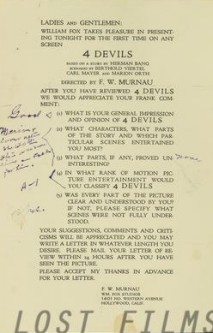
Lost Films gives us a synopsis (including different versions of the ending), cast and credits for both silent and sound versions, release information including length and censorship details, premiere dates, and this commentary by the Deutsche Kinemathek’s Martin Koerber on the film’s ‘lost status:

A print of this was last seen in the 1940s in the Fox warehouse in Los Angeles. According to the files on this title in the Fox papers at UCLA, the print was given to Mary Duncan, lead actress. Legend has it that she either burned it or drowned it in her swimming pool. We can still hope this is an urban legend. No one has traced Mary Duncan’s things, she died only in the 1990s, and there may be heirs. Janet Bergstrom’s video essay about this lost film is a fascinating story, presenting all the surviving stills and sketches and other evidence. This is a bonus on the SUNRISE DVD (or on some of them, anyway.)

Attached to this record are a mouth-watering 172 digitised documents:stills, programmes, advertisements, audience questionnaires (see above), censorship documents, drawings, screenplay (just a sample page, alas), distribution documents and more. The documents come from the Deutsche Kinemathek’s F.W. Murnau collection, and obviosuly not every lost film will be so richly documented, but nevertheless Lost Films has become a rich research resource, not just for specific lost films but for silent film history in general.

There are various ways in which you can search for films – by title, director, country, or year. One needs to be aware of the bias towards German production, and that the numbers of lost films per country is not a measure of overall loss – so, for example, there are currently 1,931 German films listed, but only 42 Japanese, yet the survival rate for Japanese silent film is catastrophic – at least 95% of all production is estimated to be lost (more on such figures in a moment). There are 752 American films listed, and 174 from the UK. Not all are silents, do note. Many of the American and British titles come from the Presumed Lost section of Carl Bennett’s Silent Era site.

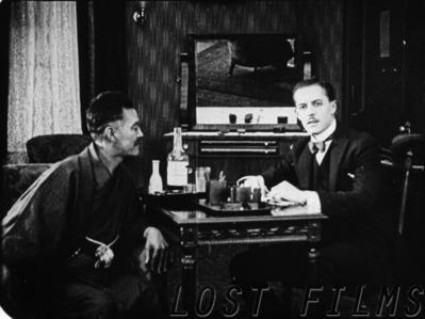
Unidentified film no. 145 from Lost Films, a drama of Europeans in Japan, thought to date c.1925, possibly American

Lost Films invites you to register and then contribute information, including adding your own digital materials. It has a helpful links section (though I wish they’d spell my name right), which covers not only lost films but report on films which have been re-discovered. There are different kinds of lost film – those which we know about but no longer exist; those which exist in incomplete form or some non-original version only; those which exist but are hard to find (or see); and those which exist but are effectively lost because they are unidentified. So Lost Films has a section on films that require identification, all illustrated with stills, and a number (chiefly American) happily now identified.

A number of the stills has been contributed by the Nitrate Film Interest Group, and off-shoot of the Association of Moving Image Archivists (AMIA), which is using Flickr to host images of unidentified films in the hope that someone somewhere can identify a name, place or film company logo. There are some highly knowledgeable folk out there who can, and there is pleasure to be had simply in witnessing how sharp-eyed some people are. Do have a go, becuase if you don’t recognise the performers you may be able to spot a location, or a form of dress, and a piece of décor which may provide the vital clue.

There are other lost film resources out there, either aimed at the film history enthusiasts or the archivist looking to identify the mysterious or to help complete a national collection.

  • Moving Image Collections – Lost Films
    The AMIA and Library of Congress-support film archives portal includes a lost films section (all American), and a complementary found films section too.
  • The Silent Era – Presumed Lost
    The aforementioned Silent Era service list hundreds of lost silents from around the world, with credits, references and technical information, plus updated information on films previously listed as lost which survive complete or incomplete somewhere.
  • Recherche des films perdus
    Listing (in French) of films which were listed as lost in 1996 but which have been discovered in archives around Europe by the LUMIERE project (the list is arranged by country of archive, then by country of production).
  • Der Stummfilm in Lateinamerika
    This handy site on Latin America silent cinema (it’s in German) includes a listing of key lost films from Argentina, Brazil, Mexico etc.
  • Wikipedia
    Wikipedia has a selective list of lost films, arranged by decade, which many of the most sought-after titles. It also provides lists of incomplete or partially lost films and rediscovered films. (Much of the information derives from The Silent Era).

  • For the rest, check out Lost Filmslinks page.

To review all of the Bioscope Festival of Lost Films entries, visit the Series section of this site which has all the links – and see if you can guess which one now survives. While you’re there, you can also follow the links for the Lost & Found series, which tells the stories of the discovery of lost film collections.

There are some books on the subject too: Harry Waldman, Missing Reels: Lost Films of American and European Cinema; David Meeker and Allen Eyles, Missing believed Lost: The Great British Film Search; Frank T. Thompson, Lost Films: Important Movies that Disappeared. Note also Anthony Slide’s Nitrate Won’t Wait: a history of film preservation in the United States (2000); David Pierce’s essay, ‘The Legion of the Condemned: Why American Films Perished’, Film History vol. 9 no. 1 (1997), a revised version of which appears in Roger Smither (ed.), This Film is Dangerous: A Celebration of Nitrate Film (2002); and Gian Luca Farinelli and Vitorio Martinelli, ‘The Search for Lost Films’, in Catherine A. Surowiec, The LUMIERE Project: The European Film Archives at the Crossroads (1996).

There are different kinds of lost film, and different degrees of loss. Indeed, some argue that no film can be described as being definitively lost, since by the very nature of the medium multiple copies were produced, so there is always the chance that one may be squirreled away somewhere. Lost films are found in archives, in private collections, on distributors’ shelves, in projection rooms, in people’s basements, attics or garden sheds, in auction sales, and in some romantic cases among a collection of old radios (The 1895 Derby), hoarded by a Swiss school (the Joseph Joye collection), in a Chinese flea market (The Case of Lena Smith), at the bottom of the sea in the wreck of the Lusitania (The Carpet from Bagdad), buried underneath a Canadian swimming pool (the Dawson City collection), or on eBay (Zepped).

Nitrate films in an advanced state of decomposition, from http://www.archives.gov

But just how many silent films are lost? The figure generally bandied about is 80% of all films from the pre-1930 era, this was put together quite a few years ago (I believe it was at the behest of the Federation of Film Archives, or FIAF), and it hasn’t been challenged much since. It may be correct, but it was estimated by matching titles held in national film archives with the titles recorded in national filmographies. But national film archives don’t hold everything (as any proud collector will tell you) and national filmographies have tended until recently to restrict themselves to the fiction film. Nowadays there seems to be a less blinkered approach, but as the Film Foundation says, while “a mere 10 percent of the [fiction] films produced in the United States before 1929 are still in existence … for shorts, documentaries, newsreels, and other independently produced, ‘orphan’ films, there is simply no way of knowing how many have been lost”. Where did that 10% figure come from? The American Film Institute calculated in the mid-1970s that 25% of American silent era films were lost, a much-quoted figure, but as Anthony Slide points out, “such figures, as archivists admit in private, were thought up on the spur of the moment, without statistical information to back them up”.

Solid information for other countries is hard to find, and is certainly not gathered together in any one place that I know of. Here’s a start, however:

  • Australia – 50 out of 250 feature films made between 1906 and 1930 survive in whole or in part (source: National Library of Australia)
  • Brazil – around 10% of silent feature films survives, though many only in a fragmentary state (interview with Carlos Roberto de Sousa)
  • China – 5% of 1,100 productions made 1905-1937 survive (source: Griffithiana no. 54, 1995)
  • Germany – No overall figure, but of 700 films made in 1916 just 60 survive, while one fifth of films made in 1925 are held by the Bundesarchiv (source: Bundesarchiv, ‘Lost Films’)
  • India – of around 1,330 silent fiction films made, thirteen survive, all incomplete (India Profile)
  • Japan – 95-99% of all silents are estimated to be lost (Le Giornate del Cinema Muto catalogue, 2001)
  • Russia – 286 films, out of an estimated 1,716 films produced 1907-1917, or one sixth of production, is preserved by Gosfilmofond (Silent Witnesses: Russian Films 1908-1919, 1989)
  • United Kingdom – “a huge proportion of Britain’s early film heritage is believed lost” (BFI Collecting Policy document)
  • USA – a survival rate of 7-12% for each year of the teens (feature films only), moving to 15-25% for the 1920s (Library of Congress figures from 1993, cited by David Pierce)

(Anyone who has a source for figures from other countries, or better figures, please let me know)

We need an up-to-date international set of figures, one which takes into account the most authoritative filmographic work and which makes it clear the proportion of fiction and non-fiction, professional and amateur film that we should be considering. It would need to make clearer the national differences in survival rates, and what survives in public institutions, commercial concerns, and privately (however much of a guess the latter would have to be). Where certain figures cannot be computed, we need formulae that give an indication. The methodology needs to be made clear. We need the same for the talkie era, for the television era, and now all over again for the digital era, when user-generated content is rewriting the rules for what can be produced. Only then will we know with accuracy just how shamefully we have treated the medium that supposedly is the great mark of the modern age. And we will treasure what survives all the more.

Silents on the National Film Registry

The Great Train Robbery (1903), as featured in Precious Images (1986), one of the twenty-five films added to the National Film Registry

As is traditional at this time of year, the announcement has been made of twenty-five further films being added to the National Film Registry. Each year the Librarian of Congress (James H. Billington), with advice from the National Film Preservation Board (and with recommendations made by the public), names twenty-five American films deemed “culturally, historically or aesthetically” significant that are to be added to the National Film Registry, “to be preserved for all time”. The idea is that such films are not selected as the “best” American films of all time, but rather as “works of enduring significance to American culture”.

Six silent or silent-related films are among the titles chosen for 2009: Winsor MacCay and J. Stuart Blackton’s early animation classic Little Nemo; the slapstick gem Mabel’s Blunder; a Red Cross film on wounded WWI veterans, Heroes All; Karl Brown’s remarkable anthropological drama of mountain people, Stark Love; a compilation of actuality and fictional film concerning the Mexican revolution, The Revenge of Pancho Villa; and Chuck Workman’s dazzling compilation Precious Images, which brings together iconic images from American cinema 1903-1985, so therefore includes many silent film sequences. The National Film Registry supplies these descriptions for the silent choices:

Heroes All (1920)
The Red Cross Bureau of Pictures produced more than 100 films, including “Heroes All,” from 1917-1921, which are invaluable historical and visual records of the era with footage from World War I and its aftermath. “Heroes All” examines returning wounded WWI veterans and their treatment at Walter Reed Hospital, along with visits to iconic Washington, D.C., landmarks. Several Red Cross cinematographers achieved notable film careers, including Ernest Schoedsack and A. Farciot Edouart.

Little Nemo (1911)
This classic work, a mix of live action and animation, was adapted from Winsor McCay’s famed 1905 comic strip “Little Nemo in Slumberland.” Its fluidity, graphics and story-telling was light years beyond other films made during that time. A seminal figure in both animation and comic art, McCay profoundly influenced many generations of future animators, including Walt Disney.

Mabel’s Blunder (1914)
Mabel Normand, who wrote, directed and starred in “Mabel’s Blunder,” was the most successful of the early silent screen comediennes. The film tells the tale of a young woman who is secretly engaged to the boss’ son. When a new employee catches the young man’s eye, a jealous Mabel dresses up as a chauffeur to spy on them, which leads to a series of mistaken identities. The film showcases Normand’s spontaneous and intuitive playfulness and her ability to be both romantically appealing and boisterously funny.

Precious Images (1986)
Chuck Workman’s legendary compilation film to commemorate the 50th anniversary of the Directors Guild of America is also a dazzling celebration of the first near-century of American cinema. The pioneer of rapid-fire film history montages, “Precious Images” contains in the space of seven short minutes nearly 500 clips from classic films spanning the years 1903-1985. It became the most influential and widely shown short film in history. Workman is known for creating the montages shown during the annual Academy Awards broadcast.

The Revenge of Pancho Villa (1930-36)
This extraordinary compilation film was made by the Padilla family in El Paso, Texas, from dozens of fact-based and fictional films about Pancho Villa. The films were stitched together with original bilingual title cards and dramatic reenactments of Villa’s assassination were added to the revised print. “The Revenge of Pancho Villa” provides stirring evidence of a vital Mexican-American film presence during the 1910-30s.

Stark Love (1927)
A maverick production in both design and concept, “Stark Love” is a beautifully photographed mix of lyrical anthropology and action melodrama from director Karl Brown. “Man is absolute ruler. Woman is working slave.” Such are the rigid attitudes framing this tale of a country boy’s beliefs about chivalry that lead him to try to escape a brutal father with the girl he loves. “Stark Love,” cast exclusively with amateur actors and filmed entirely in the Great Smoky Mountains, is an illuminating portrayal of the Appalachian people.

The other twenty-two titles nominated are: Dog Day Afternoon (1975), The Exiles (1961), Hot Dogs for Gauguin (1972), The Incredible Shrinking Man (1957), Jezebel (1938), The Jungle (1967), The Lead Shoes (1949), The Mark of Zorro (1940), Mrs. Miniver (1942), The Muppet Movie (1979), Once Upon a Time in the West (1968), Pillow Talk (1959), Quasi at the Quackadero (1975), The Red Book (1994), Scratch and Crow (1995), The Story of G.I. Joe (1945), A Study in Reds (1932), Thriller (1983), Under Western Stars (1938).

The full list of films entered on the National Film Registry since 1989 can be found here, while this is the list of all silents on the Registry 1989-2008:

Ben-Hur (1926)
Big Business (1929)
The Big Parade (1925)
The Birth of a Nation (1915)
The Black Pirate (1926)
Blacksmith Scene (1893)
The Blue Bird (1918)
Broken Blossoms (1919)
The Cameraman (1928)
The Cheat (1915)
The Chechahcos (1924)
Civilization (1916)
Clash of the Wolves (1925)
Cops (1922)
A Corner in Wheat (1909)
The Crowd (1928)
The Curse of Quon Gwon (1916-17)
Dickson Experimental Sound Film (1894-95)
The Docks of New York (1928)
Evidence of the Film (1913)
The Exploits of Elaine (1914)
Fall of the House of Usher (1928)
Fatty’s Tintype Tangle (1915)
Flesh and the Devil (1927)
Foolish Wives (1920)
The Four Horsemen of the Apocalypse (1921)
The Freshman (1925)
From the Manger to the Cross (1912)
The General (1927)
Gertie the Dinosaur (1914)
The Gold Rush (1925)
Grass (1925)
The Great Train Robbery (1903)
Greed (1924)
H20 (1929)
Hands Up (1926)
Hell’s Hinges (1926)
The Immigrant (1917)
In the Land of the Head Hunters (1914)
Intolerance (1916)
It (1927)
The Italian (1915)
Jeffries-Johnson World’s Championship Boxing Contest (1910)
The Kiss (1896)
Lady Helen’s Escapade (1909)
Lady Windermere’s Fan (1925)
Land Beyond the Sunset (1912)
The Last Command (1928)
The Last of the Mohicans (1920)
The Life and Death of 9413 – A Hollywood Extra (1927)
The Lost World (1925)
Making of an American (1920)
Manhatta (1921)
Matrimony’s Speed Limit (1913)
Mighty Like a Moose (1926)
Miss Lulu Bett (1922)
Nanook of the North (1922)
One Week (1920)
Pass the Gravy (1928)
Peter Pan (1924)
The Perils of Pauline (1914)
Phantom of the Opera (1925)
The Poor Little Rich Girl (1917)
Power of the Press (1928)
President McKinley Inauguration Footage (1901)
Princess Nicotine; or The Smoke Fairy (1909)
Regeneration (1915)
Rip Van Winkle (1896)
Safety Last (1923)
Salome (1922)
San Francisco Earthquake and Fire, April 18, 1906 (1906)
Seventh Heaven (1927)
Sherlock Jr. (1924)
Show People (1928)
Sky High (1922)
The Son of the Sheik (1926)
Star Theatre (1901)
The Strong Man (1926)
Sunrise (1927)
Tess of the Storm Country (1914)
There it is (1928)
The Thief of Bagdad (1924)
Tol’able David (1921)
Traffic in Souls (1913)
The Wedding March (1928)
Westinghouse Works, 1904 (1904)
Where Are My Children? (1916)
Wild and Wooly (1917)
The Wind (1928)
Wings (1927)
Within our Gates (1920)

The world of local topicals

Sir Harry Lauder Visits the Regent Picture House (1928), from the Scottish Screen Archive

I am pleased to be able to offer for you a piece written especially for The Bioscope by Janet McBain, Curator of the Scottish Screen Archive at the National Library of Scotland. Janet’s subject is the local topical. You will have to search very hard in the film history literature to find anything written on the local topical, but go to any UK film archive and you’ll find them in abundance. For the local topical was a local newsreel – filmed locally (often by a cinema’s projectionist) and shown locally. Such films, which flourished in particular in the 1910s and 20s, showed parades, civic marches, works’ outings, visits of dignitaries, or often simply people miling about in the street, filmed by a touring showman who would then tell you to turn up at the ton hall that evening, where you would be guaranteed to see yourself on the screen.

Just such films have become known to more than archivists of late, thanks to the sterling work done by the British Film Institute and the National Fairground Archive to promote the Mitchell & Kenyon collection of films predominantly showing working class life in English northern towns in the 1900-1910 period. M&K were commissioned to film local parades, galas, football matches and such like, and would indeed film people in the streets to encourage them to see the film show in the evening. Mitchell & Kenyon have achieved modern fame, through books, a television series and DVDs. But there were many other such films, as Janet McBain’s piece informs us.


The world of local topicals: observations on life after Mitchell and Kenyon through local films made for the Regent Cinema, Glasgow in the 1920’s

As we have seen with the Mitchell and Kenyon film collection early independent exhibitors, in the first decades of the moving picture, clearly understood the appeal and the business value of ‘ local films for local people’. With marketing slogans such as ‘Come and see yourselves as others see you’ they understood their audiences and what they wanted to see and exploited this with flair and showmanship learned out on the road with the travelling fairground shows.

Still very much in the shadow of these Edwardian films and ripe, I would suggest, for re-discovery are local topicals from succeeding decades. Still presented and marketed as ‘see yourself on the silver screen’, but offered by exhibitors running permanent, fixed site shows from 1911/12 onwards.

There are literally hundreds of these post-M&K films in the UK’s moving image archives dating from just before the Great War to the decades after World War 2. (Scottish Screen Archive has over 500 titles in its collection alone). They are classified inconsistently as topicals, local topicals or local newsreels. The fact that we in the archive community still do not have a standardised genre or classification term is indicative of the lack of understanding of, or attention to, this material.

When talkies came along in the late 20’s the local topical continued – but remained silent. Due in part to shortage of film stock during the Second World War they disappear, only to re-emerge in the post-war era – still mostly silent. But by the end of the 1950’s, with changes in cinema-going habits and the demise of many of the independently owned cinemas the local topical all but disappeared.

Typical of the content of these films are crowd pulling events: gala days, parades, local festivals and holidays, unveiling of war memorials, sports meetings – events that would get local people out onto the streets and in front of the camera lens.

We still know relatively little about audience reception, means of production or how the exhibitors financed and publicised these films. There is evidence that some exhibitors and cinema managers shot the films themselves, other times that they engaged newsreel and production professionals to make them.

Whatever and whoever he was the cameraman would be instructed by the exhibitor to get in as many close-ups of faces in the crowd as possible. Hence the frequent use of the panning shot, very much the hallmark of the local topical, to maximise your audience who would be enticed into the picture hall a few nights later with the prospect of seeing themselves on the big screen.

Local topicals sit somewhat uncomfortably between news reportage and actuality. They can be seen as both … and neither. They are not hard news per se, but they cover newsworthy events within a local sphere. They are intended as promotional tools and this influences content, which in turn robs them to a degree of the objectivity of the actuality. Perhaps the local topical could be described as a discrete genre in its own right.

Two examples of local topicals discovered recently by Scottish Screen Archive illustrate the fudged line between news and actuality – the grey zone in which sits the local cinema newsreel.

They have a consistent theme. Both were commissioned by William McGaw, manager of the Regent Picture House in Renfield Street in Glasgow, one of the first purpose built cinemas in the city centre. McGaw was a enthusiastic publicist and won many trade awards for showmanship during his career.

Both films were shot on the occasion of special screenings at the Regent with the personal appearance of a film star, illustrating another fascinating feature of the local topical, that of recording the history of cinema-going itself.

Both films were intended to serve as local topicals – to be shown in the picture house, and to engage the audience through recognition, of themselves and their friends, on the screen. The Minute Books for the Regent’s proprietary company give accounts of the manager’s application to the Directors’ to approve this advertising strategy.

The two films differ, however, in editorial approach.
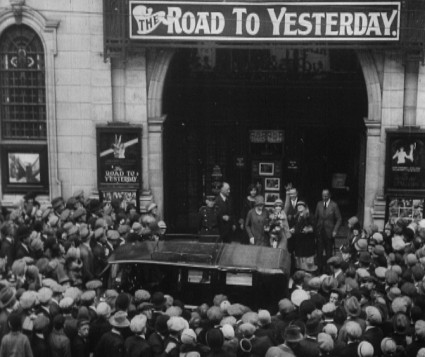
Vera Reynolds Visits Regent Picture House (1926)

The first one records Vera Reynolds, young American actress, making a personal appearance at the cinema in September 1926 for the Scottish premiere of The Road to Yesterday. It looks like a newsreel item. The focus is on the celebrity, it is a two-camera shoot suggesting it was made by a professional unit, possibly local stringers from Gaumont’s or Pathe’s Glasgow office. Reynolds herself is very camera aware and is the star of the film in every sense.

The second title comes two years later on 5th October 1928 with Sir Harry Lauder’s personal appearance at the cinema for the premiere of Huntingtower, George Pearson’s adaptation of the novel by John Buchan and in which Lauder took the leading role as Glasgow grocer Dickson McCunn. We know from reports in the trade press that the topical was shot by James Hart, projectionist at the Grosvenor Cinema, a small picture house in the west end of the city. At the time Hart made this film for McGaw and the Regent his own locals, under the banner Grosvenor Topical News, were appearing on screen on an almost weekly basis. Lauder travelled specially from Edinburgh on a Friday morning to see Huntingtower for himself for the first time. Hart’s topical was screened at the first house on that same evening and before every performance of the big picture during the weeks thereafter.
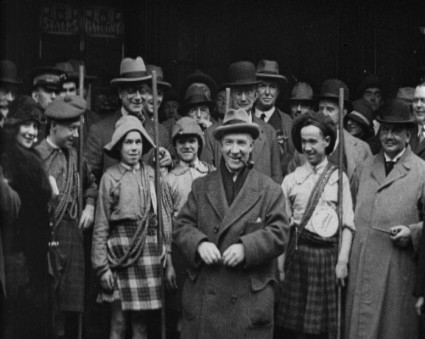
Sir Harry Lauder Visits the Regent Picture House (1928), Lauder himself in the centre

Of the two films Hart’s footage is more quintessentially recognisable as a local topical. He foregrounds the future audience with long tracking shots and pans of the cinemagoers and the crowds waiting on the street outside the picture house, almost overshadowing the appearance of the star. Lauder and four boys from the cast of Huntingower posed in the entrance of the cinema are on screen for maybe a third of the film. Hart gives us intertitles identifying the participants, including McGaw the cinema manager. He understood the rationale for the film, arguably more so than the professional newsreel maker who assembled the earlier Reynolds film. In this one she is undoubtedly the star taking up all the screen time. There are no identifiable shots in this film of the local people – they are not visible on camera as individuals.

Both films have been preserved by Scottish Screen Archive and can now be viewed along with other local topicals online at www.nls.uk/ssa.

Also another of the writer’s favourites – illuminating aspects of cinema history – is also now available online:

There are hundreds more local topicals awaiting re-discovery in the nation’s archives – come and find them!

Janet McBain
Curator
Scottish Screen Archive,
Glasgow

December 2009


As pointed out, you can see the two Regent films at the Scottish Screen Archive’s excellent site (where there are over 1,000 film clips freely available to view), the subject of a Bioscope post a year or so ago. Other UK film archives with local topicals can be found via the Film Archive Forum site, or you can see examples on Moving History, a sampler site of films from archives around the UK. For example, check out the North West Film Archive’s Milnrow and Newhey Gazette (1913) or the Media Archive of Central England’s The Meet of the Quorn Hounds 1912, each of which is accompanied by a mini-history of the local topical genre..

If by chance you haven’t come across Mitchell & Kenyon as yet, the BFI provides a handy guide which gives an overview of the collection, the history of their production, images, and links to DVDs and books, particularly Vanessa Toulmin, Simon Popple and Patrick Russell (eds.), The Lost World of Mitchell and Kenyon: Edwardian Britain on Film (2004). And there are numerous examples of M&K films available to videw for free on the BFI’s YouTube channel.
Lakeland

wastdale

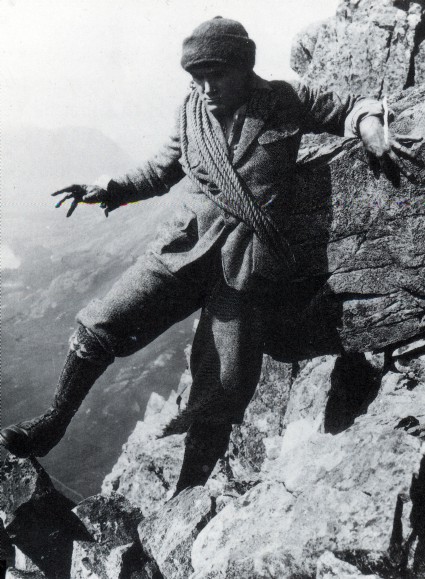
Milton Rosmer in A Romance of Wastdale (1921), from Ivan Butler, Silent Magic (1987)

Well I’m back from all too brief a sojourn in the Lake District, where my mind was on hills and dales and becks and crags, and not much on silent films. But the medium can pursue you wherever you may be, and though you might think the Lake District is the last place where you could expect silent cinema associations, they are there. To begin with, there’s the splendid still reproduced above, which comes from the only silent drama set in the area (so far as I know). A Romance of Wastdale (1921) was a British film, directed by Maurice Elvey for Stoll and starring Milton Rosmer and Valya Venitskaya (aka Valia). The film no longer exists, but Ivan Butler in his superlative book Silent Magic recalled seeing it:

Another adaptation from a well-known author, A.E.W. Mason’s A Romance of Wastdale (directed by Maurice Elvey), a grim tale of jealousy and revenge among the Lakeland mountains, was weakened by having the events turned into a dream; but it generated enough tension between the small group of characters to make certain scenes stick in the memory. The photography has a grey, gritty quality which admirably suits the circumstances, preserved in a fine still featuring Milton Rosmer.

Would that he had told which scenes impressed him so, and would that the film survived. It would be good to know more about its production. Jack Cox was the man responsible for the gritty cinematography. Wastdale (or Wasdale) is the area between Scafell Pike and Wast Water lake, by the way.

And then there’s Stan Laurel. OK, so the birthplace of Stanley Jefferson, Ulverston, is south of the Lake District, but not by much, and Ulverston is now home to the renowned Laurel & Hardy Museum. In the heart of the Lake District, in the town of Keswick, there is the cheerfully named The Cars of the Stars, a museum dedicated to famous vehicles from film and television. If you fell the urge to get up close to Chitty Chitty Bang Bang or Herbie, this is the place to go, and the exhibits include a Laurel and Hardy Model T and the sort-of-silent Mr Bean’s Mini.

keswick

The Alhambra, Keswick (in the rain)

Keswick is a small town (about 5,000 population), but it does boast a cinema, and one that has been in operation since 1913. The Lonsdale Alhambra, in St John’s Street, is a delight. It opened in 1913 and from its Edwardian facade it doesn’t look like it has changed much since then. The cinema provides a handy leaflet on its history, from which we learn that the Keswick Alhambra Theatre Co. Limited as registered with £2,000 capital on 27 May 1913. It was able to seat 595 people and showed one programme a day,with two changes of programme per week. Prices ranged from 4d to 1/3d. It had music, dancing and cinematograph licences, and variety acts performed alongside the films.

By 1916 it had a local rival, the gloriously named Queen of the Lakes Pavilion, around the corner in Station Street. In the 1920s it changed its name from the Alhambra Picture Theatre to simply the Alhambra, and converted for sound. It continued, taking over its rival the Pavilion in the 1940s, and enjoyed something of a boom with the arrival of holidaymakers in the 1950s discovering the Lake District for the first time. But hard times came, as they did across the cinema industry, and by the 1980s the Pavilion had closed and the Alhambra was shut during winter months. But it has survived, and hearteningly in 2006 it was leased to R.J. Towers & partners of Gretna, a business formed by former silent film pianist Towers.

keswick2

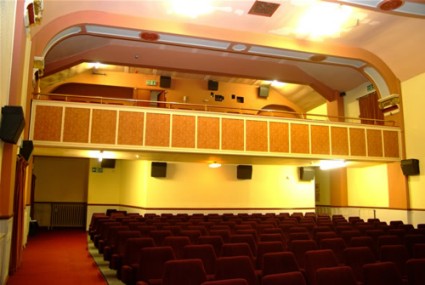
Interior of the Lonsdale Alhambra. For more images, visit www.keswick-alhambra.co.uk/gallery

Today the cinema seats 270, has Dolby stereo sound, and has an ambience that adroitly combines its past with the present. It has one or two screenings per day, and hosts the Keswick Film Club with its imaginative programme of world cinema titles. I saw District 9 (a proficient B-movie) in thoroughly comfortable circumstances and warmly recommend the place (though they should let the film credits roll through to the end, please). It also serves as an introduction for what is going to be cinema month here at the Bioscope. Alongside the usual reports and idle speculations, throughout October we will have a number of posts focussing on cinemas and the silent era, including publications, web resources, exhibitions and projects. Take your seats, and keep watching the screen.

(One last Lakeland connection – the Old Laundry Theatre at Bowness-on-Windermere has occasional silent film screenings, and on 21 November Neil Brand will be there accompanying a programme of Laurel and Hardy and Buster Keaton shorts)

London on the move

underground

Underground

The programme for the London Film Festival has been announced, and though there’s not much in the way of silents on offer, it’s well worth noting what there is.

For the past two years the LFF has featured a programme of archive films on London, plus a London-themed silent feature, for exhibition in Trafalgar Square. This year the feature film is Anthony Asquith’s Underground (1928), an expressionist brew of love, treachery and murder set in and around London’s underground railways, starring Brian Aherne and Elissa Landi. That screens on Friday 23 October, while on Thursday 22 there is London Moves Me, a programme of archive film on the theme of London and transport. The programme includes cycling in 1896, trams in 1901, boats in 1905, canoes in 1922, barges in 1924, underground trains in 1929, and much more. The indispensible Neil Brand will accompany on piano. The Trafalgar Square shows are free, and just the sight of seeing crowds of commuters, tourists, the curious and the dedicated gathered on the steps to witness silent films beneath Nelson’s Column is an experience to savour.

(Correction: Underground is screening at the Queen Elizabeth’s Hall. Shame.)

laila2

Laila

The LFF has an archive film section, which features the pick of the restorations and star selections from recent archive film festivals. The silent to look out for is the Norwegian Laila (1929), which was the hit of the Pordenone festival in 2008, enthusiatically reviewed by the Bioscope at the time. I warmly recommend this engrossing, dramatic, human and beautifully photographed masterpiece, screening on October 29. It is everything that a silent film can be.

The other silent offering is J’Accuse (1919), a new, colour-tinted restoration by the Nederlands Film Museum, in collaboration with Lobster Films, of Abel Gance’s epic anti-war statement.

The Australian connection

muttandjeff

Mutt and Jeff: On Strike (1920), from The Film Connection

News of the successful outcome of an archival repatriation project. The Film Connection is a joint project between the National Film Preservation Foundation in America and the National Film and Sound Archive of Australia to bring American films no longer held in America back to American audiences. Through this collaboration, a number of short American silents that survive only in Australia have been preserved, digitised, and six of them made available online. The six are:

  • The Prospector (Essanay 1912)
  • U.S. Navy Documentary (1915?)
  • A Trip through Japan with the YWCA (The Benjamin Brodsky Moving Picture Co. c.1919)
  • Mutt and Jeff: On Strike (Bud Fisher Films Corporation 1920)
  • The Sin Woman Trailer (George Backer Film 1922?) [trailer for 1917 film]
  • Pathé News, No. 15? (Pathé News 1922)

The six films can be viewed and downloaded from the National Film Preservation Foundation site here, together with useful background information on each title, and you can read all about the project here. One of the films, the Mutt and Jeff cartoon On Strike, will feature at this year’s Pordenone silent film festival.

From the regions

scrapofpaper

The over-the-top sequence from A Scrap of Paper, from http://www.yfaonline.com

If most people think of film archives, then they think of the national collections such as the BFI National Archive, Cinémathèque Française, Library of Congress etc, or else broadcasters such as the BBC. What few consider, even within the film business, is the next tier down of collection, the regional film archives which represent a particular and special part of a country’s moving image heritage. In the UK we are fortunate in having a vibrant regional film archive network, operating (with measly funding) within the public sector, each representing one or other of the English political regions. So there is the East Anglian Film Archive, the Northern Region Film and Television Archive, the South West Film and Television Archive, the North West Film Archive, and so on. What is also seldom appreciated is that these archives generally have unique silent film holdings.

One of these archives, the Yorkshire Film Archive, is the immediate reason for this post, because it has just launched Yorkshire Film Archive Online, a really first-rate showcase of regional film. There are documentaries, amateur films, industrials, newsreels, advertising films, educational films, and dramas, all devoted to the Yorkshire region, all freely available and contained within an expertly designed site brim for of background information, all the search options you could wish for, options to add comments, and a really fine selection of films. This includes a number of silents (aside from those amateur films of later decades which were shot silent). The earliest shows Queen Victoria visiting Sheffield in 1897, the truly heroic Egg Harvest – Cliff Climbing at Flamborough (1908), the joyous local celebration that is Easter at Shipley Glen (1912) and a touching and surprisingly downbeat A Scrap of Paper, made in Hull to support those who had lost loved ones during the War,or who had been disabled. The film shows a father writing his last letter home, before he goes over the top and is seen lying dead in no-man’s land in the film’s final shot. (The site dates the film as 1914-18 but the tone of the titles suggest it was made just after the war).

Yorkshire Film Archive Online demonstrates what a dynamic film culture existed from the earliest years outside London. It is a model resource, but the YFA is not the only English regional archive with silent film on show. The Media Archive for Central England, based in Leicester, lists sixty-three titles between 1899 and 1930 in its catalogue, starting with an Anglo-Boer War recreation, and continuing with a rich variety of mostly local newsreels, some with online clips, such as The Meet of the Quorn Hounds, at Kirby Gate (1912) and Leicester Poor Boys’ and Girls’ Summer Camp at Mablethorpe (c.1920).

littledorrit

Joan Morgan and Langhorn Burton in Little Dorrit (1920), from http://sasesearch.brighton.ac.uk

Screen Archive South East, based in Brighton, is strongly aware of the part its region played in the early years of filmmaking in Britain. Its Screen Search catalogue describes over 900 films, many of them viewable online, and several from the silent era. under the theme ‘Early film in the South East‘ you can find Speer Films’ dynamic bank robbery thriller, The Motor Bandits (1912), a clip from the twenty minutes that survive of the Progress Film Company of Shoreham’s Little Dorrit (1920), starring the late Joan Morgan, and the illustrator and occasional filmmaker Harry Furniss in Winchelsea and its Surroundings. A Day with Harry Furniss and his Sketchbook (c.1920).

Screen Search also has travel films, home movies, documentaries, newsreels and productions by local cine-clubs. Look out too for films made in the 1930s by the twins John and William Barnes, the former of whom went on to become the author of the five-volume The Beginnings of the Cinema in England series of film histories.

The Wessex Film and Sound Archive, a partner archive to Screen Archive South East, cover the middle southern region of England. It has an online catalogue and a few sample clips, notably a 1905 example from Portsmouth filmmaker Alfred West‘s famous patriotic programme, Our Navy.

matinee

Children’s Matinee, showing children outside the Vaudeville cinema in Colchester, 3 October 1914, part of the East Anglian Film Archive collection, from http://www.movinghistory.ac.uk

There is more to be seen and learned about the regional archives on the Moving History site, which is a guide to the national and regional public sector film archives of the UK, and has a wide selection of sample clips, arranged by theme and by archive. Films from the English regional archives can also be found as part of the BBC’s Nation on Film website. There is a lot more to these archives than silents, of course, and the majority of clips to be found on their sites will be of later periods, particularly from when the home movie boom took off in the 1930s.

Finally, if you want to learn more about the operations and ethos of the RFAs, visit the Film Archive Forum site, the body that represents the interests of the UK’s public sector moving image archives (see its map of the UK’s archives here). Film is so much more than many think it is – beyond the entertainment cinema there is a whole culture of films made locally, for reasons both personal and professional, which document twentieth century lives in uniquely resonant form. What the films sometimes lack in polish they gain in their powerful connection to the people, for in seeing them we see ourselves. Do explore.

Open weekend at the Cinema Museum

cmprojectors

http://www.cinemamuseum.org.uk

London’s Cinema Museum, whose good news about the renewal of its release was reported here recently, is having an open weekend. The Cinema Museum is a private institution, supported by its stills business, and it is not normally open to the general public, so this is a marvellous opportunity to discover one of London’s hidden gems, certainly if you have any interest in motion picture history. The collection represents cinema’s rich history from the earliest days to the present, containing every sort of item relating to film production, film exhibition and the experience of cinemagoing.

The open weekend runs 27-28 June June 2009. During the weekend you may enjoy any of the following:

  • Recipes to the Stars! – an edible talk with Jenny Hammerton
  • Rescuing Home Movies – a guide by David Cleveland
  • Classic Silent Comedy Shorts – a film screening with piano accompainment by Tom Bell
  • Guided tours of the Museum Collection
  • Chaplin and the Workhouse exhibition (the museum is located in the Lambeth workshouse which once housed Chaplin’s mother)

The weekend will also feature an exhibition of new artwork by Cnidoblasts and Anna Odrich, reconfiguring artefacts from the collection and exploring the mechanics and gestures of silent comedy through sculpture.

More information will appear on the Cinema Museum website in due course. And just to whet your appetite, there’s this delightful tour of the place hosted by the Museum’s founder Ronald Grant. We’ve featured it on The Bioscope before, but in the very early days of this blog, and it more than merits being screened again.

(The film was made in 2000 by Guy Edmonds and Anna Odrich)