Eloquent gestures

eloquent_gestures

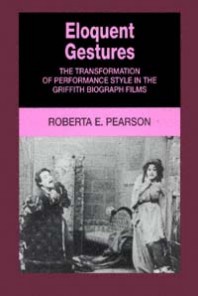
It’s been a while since we added anything new to the Bioscope Library. A new wing has been added to the tottering edifice that is Bioscope Towers, and first on the fresh new set of shelves therein is Roberta E. Pearson’s Eloquent Gestures: The Transformation of Performance Style in the Griffith Biograph Films, published by the University of California Press in 1992. This is one of the titles that the enlightened UCP has made available for free online as one of its eScholarship Editions offerings. It is a model ebook presentation, as well as being one of the most interesting and stimulating books written on the films of David Wark Griffith.

The book’s subject is the changes in the style of the actors’ performances in the films of D.W. Griffith, particularly between 1909 and 1912. Pearson sets this up in a delightful introduction in which she imagines Josiah Evans, “a man with a civic conscience who belongs to several progressive reform organizations”, attending a Broadway storefront picture show in 1909 in which he sees a film entitled The Drunkard’s Reformation, which he rather enjoys because it reminds him of the blood-and-thunder stage melodramas of his youth.

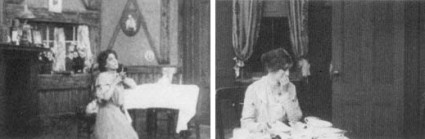
The acting of the young wife as she depicts her misery and desperation particularly affects him. She collapses into her chair and rests her head on her arms, which are extended straight out in front of her on the table. Then, in an agony of despair, she sinks to her knees and prays, her arms fully extended upward at about a forty-five degree angle.

Three years later he visit the Rialto Theatre on 14th Street, a considerably classier venue than that 1909 nickelodeon, and is struck in particular by a film entitled Brutality. It is similar in theme to the earlier film…

… but this moving picture does not remind him of the blood-and-thunder melodramas of his youth. The acting is the equal of Mr. Gillette’s in Sherlock Holmes or even of that in the Belasco play he and Lydia had attended last night. Particularly impressive is the young wife’s despairing reaction to her husband’s harsh treatment and abandonment. After he leaves for the saloon, the wife walks back to the dining-room table covered with the debris of their evening meal. She sits down, bows her head, and begins to collect the dishes. She looks up, compresses her lips, pauses, then begins to gather the dishes once again. Once more she pauses, raises her hand to her mouth, glances down to her side, and slumps a little in her chair. Slumping a little more, she begins to cry. How differently this actress portrays her grief from her counterpart in A Drunkard’s Reformation. A lot has changed in those three-and-a-half years since his first visit to a nickelodeon.
drunkard&brutality

A Drunkard’s Reformation (left) and Brutality, from Eloquent Gestures

How the films of D.W. Griffith moved on from the one style to the next is the subject of Pearson’s book. It traces in meticulous detail the transformation from an acting style inherited from the stage meodramas of an earlier era, to a nuanced style that benefitted from ‘realist’ developments in literature and theatre. It wasn’t there in 1909; it was there in 1912, and by examining closely the films made in that intervening period and being attuned to contemporary cultural developments, the path from the one to the other can be drawn. This is what Pearson does.

It is a very detailed study, one grounded a theoretical language which may not be to everyone’s taste, but the author needs to negotiate the pitfalls that terms such as “naturalism”, “realism” and “melodrama” can lead to. She wants to be precise about the meaning of words which are used all too loosely in general critical discussion (“melodrama” in particular), and to ground what one sees in these films, and what one sees in changing, in a close understanding of what was going on at the time. As she says:

The study of cinematic performance demands that we not depend upon our own aesthetic judgments, which we tacitly deem eternal and unchanging. Rather, we must acknowledge history by attempting to understand the aesthetic standards of another time and place, of a culture very different from our own.

The rest you must read for yourselves, and I warmly recommend that you do so. Though this is very much a thesis turned into a book, with all of the formal argument structures that one recognises (such as having an introduction which rubbishes the opposition), it illuminates understanding – not just of Biograph films, but of any cultural artefact from any period which we may be tempted to interpret from our personal aesthetic experience but which needs to be seen, first and foremost, as the product of its own times.

The ebook presentation is excellent. The book is divided up into hyperlinked chapters, and page breaks are indicated where they occur in the original, which is good for accurate citation. Notes in the text are hyperlinked to a notes section at the end, the index has hyperlinks so you can go directly from term back to the text, and the illustrations are available in small and full size versions. Finally there is a search box enabling to search the entire text of the book. Excellent all round. Into the Bioscope Library it goes.
Comedy! Melodrama! Schmaltz!

opotiki

http://www.silentfilmfest.org.nz

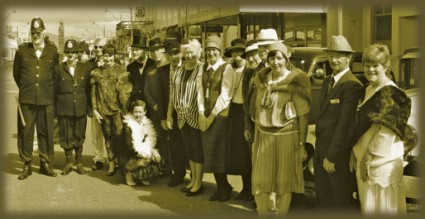
Another day, another festival. This time we’re in New Zealand, for the homely delights of the Opotiki Silent Film Festival. Organised by the Opotiki Community Arts Council, and held in Opotiki’s art deco De Luxe Theatre, the festival is noteworthy for encouraging its audiences to dress up in period costume, something that you can’t quite imagine happening in Pordenone (more’s the pity).

This year’s festival takes place 4-5 September. Financial constraints have led them to bill this year’s offering as a Mini Silent Festival, but it’s a fine programme for all that (all with live piano accompaniment):

1. COMEDY CLASSIC The Three Ages ~ Buster Keaton
4pm Friday 4th ~ 1923 ~ 63mins

In his first independently produced feature film Buster tells of love and romance through the Stone Age, the Roman Age, and the Modern Age.

2. MELODRAMA ~ The Show-Off
5.30pm Friday 4th ~ 1926 ~ 82mins

A show-off clerk posing as a railroad executive catches a young bride and then drives her family’s finances to the brink of ruin.

3. CHAPLIN COLLECTION
7.30pm Friday 4th ~ 4 films ~ 95 mins

* Kid Auto Races in Venice 1914 – The very first time we see Chaplin as ‘the Tramp’, hogging the camera at a real event.
* The Vagabond 1916 – An impoverished violinist falls for a beautiful gypsy girl. His love appears to be thwarted but he wins out in the end.
* The Fireman 1916 – Charlie is a fireman who always does everything wrong. Group slapstick at its very best.
* One A.M. 1916 – After a night on the town, Charlie comes home drunk and unable to find his key… A raucous one-man show.

4. ROMANTIC COMEDY ~ Steamboat Bill Jr. ~ Buster Keaton
2pm Saturday 5th ~ 1928 ~ 71mins

Willie is the effete son of riverboat captain ‘Steamboat Bill’, visiting his dad after years away. Bill tries to turn his son into a man without apparent success. Bill has a dispute with a powerful banker while Willie falls for Kitty, the banker’s daughter. When a hurricane hits, Willie leaps to the rescue and saves the day.

5. SCHMALTZ! ~ The Plastic Age ~ Clara Bow
3.30pm Saturday 5th ~ 1925 ~ 73mins

Featuring our favourite Clara Bow. A promising student is diverted by the ‘flaming youth in rebellion’ of the twenties who danced to wild jazz and had petting parties!

6. SHORTS SELECTION ~ A Symphony of Shorts
5pm Saturday 5th ~ 73mins

An amazing selection of European and US shorts providing a fascinating insight into life before the Talkies.

* Those Awful Hats
* For Her Mother’s Day
* Folies-Bergère Fireman (features nudity!)
* Monkey Chase ~ Titanic
* The Mystery of the Leaping Fish

7. SWASHBUCKLER ~ The Thief of Bagdad ~ Douglas Fairbanks
7.30pm Saturday 5th ~ 1924 ~ 155mins

A thief (Douglas Fairbanks Snr) falls in love with the Caliph of Bagdad’s daughter who will give her hand to the suitor who brings back the rarest treasure. The thief embarks on a magical journey, fraught with danger…

I like those helpful headings. A bit at a loss as to what Monkey Chase ~ Titanic might be, but all in all a great line-up. Further information, including booking form, and a delightful selection of photos from past festivals, showing how much the audiences gets into the swing of things, can be found on the festival site. The site also promises that “the foyer will be decorated in style, and tea with Lamingtons or shortbread will be available at the Nibblenook”. Perfect.

The Australian connection

muttandjeff

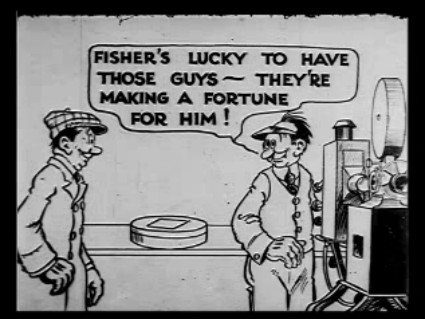
Mutt and Jeff: On Strike (1920), from The Film Connection

News of the successful outcome of an archival repatriation project. The Film Connection is a joint project between the National Film Preservation Foundation in America and the National Film and Sound Archive of Australia to bring American films no longer held in America back to American audiences. Through this collaboration, a number of short American silents that survive only in Australia have been preserved, digitised, and six of them made available online. The six are:

  • The Prospector (Essanay 1912)
  • U.S. Navy Documentary (1915?)
  • A Trip through Japan with the YWCA (The Benjamin Brodsky Moving Picture Co. c.1919)
  • Mutt and Jeff: On Strike (Bud Fisher Films Corporation 1920)
  • The Sin Woman Trailer (George Backer Film 1922?) [trailer for 1917 film]
  • Pathé News, No. 15? (Pathé News 1922)

The six films can be viewed and downloaded from the National Film Preservation Foundation site here, together with useful background information on each title, and you can read all about the project here. One of the films, the Mutt and Jeff cartoon On Strike, will feature at this year’s Pordenone silent film festival.

Jornada Brasileira de Cinema Silencioso

jornada

http://www.cinemateca.gov.br/jornada

Having told you a short while ago about Brazilian silent film journals available online, now it’s time to let you know (courtesy of the Pordenone film festival site) of the Cinemateca Brasileira’s third annual festival of silent film, Jornada Brasileira de Cinema Silencioso. The festival runs 7-16 August 2009, at the Cinemateca in São Paulo, and through the modern miracle that is Google Translate, I can tell you something about it.

The main strand of the festival is dedicated to French silent cinema, and features films from Les Archive du Film CNC, the Cinémathèque Française and (familiar to regular Bioscopists) the Musée Albert-Kahn. The programme includes shorts by the Lumière brothers, documentaries on Corsica, Tunisia and Abyssinia, and assorted feature films from the 1920s, including Marcel L’Herbier’s L’homme du large (1920), Pierre Marodon’s Salammbô (1925), Alfred Machin’s Le manoir de la peur (1927), Berthe Dagmar and Jean Durand’s L’île d’amour (1928) and Jean Grémillon’s Maldone (1928). André Sauvage’s Études sur Paris (1928) will be shown with orchestral score by Brazilian composer José Antônio de Almeida Prado. There will be a selection of early shorts directed by Alice Guy, and a special presentation by Isabelle Marinone on the relationship between anarchism and cinema in France, including films made by French film collective Cinéma du Peuple: La Commune (Armand Guerra, 1914), Les misères de l’aiguille (Raphael Clamour, 1914) and fragments from Le Vieux dock (Armand Guerra, 1914).

Silent films set in Brazil are also featured. There will be documentaries on Amazonian travel and ethnography by Luiz Thomaz Reis and Silvino Santos, including The River of Doubt (1928?) on a 1914 expedition headed by Theodore Roosevelt. There is more Latin American cinema with Chile’s El Husar de la muerte (Pedro Sienna, 1925), and a touch of modern fantasy with the Wisconsin Bioscope’s A expedição brasileira de 1916 (2006).

The festival has a section dedicated to notable titles previously featured at the Giornate del Cinema Muto in Pordenone. This year it is showing Marion Davies in The Patsy (King Vidor, 1928), Beatrice Lillie in Exit Smiling (Sam Taylor, 1926), Nell Shipman in Back to God’s country (David Hartford, 1919), and Li Lili in that great Bioscope favourite, Tianming/Daybreak (Sun Yu, 1933), plus Alfred Machin’s anti-war Maudite soit la guerre! (1914). And there’s a special programme devoted to the trick and fantasy films of Segundo de Chomón.

In short, it’s a fabulous-looking programme. Full details of the films can be found on the site, divided up by day and theme, along with contact details and other festival information, all in Portuguese.

Strade del cinema 2009

chaplin_strade

http://www.stradedelcinema.it

Apologies for being a little in the day with news of Strade del Cinema, Italy’s less-heralded international festival of silent cinema and music. The festival takes place in Aosta (near Turin), at the Aosta Roman Theatre, and this year runs 6-13 August. The festival is organized by the Strade del Cinema Cultural Association and the City of Aosta, in collaboration with the Turin National Museum of Cinema/Fondazione Maria Adriana Prolo and the support of the UNESCO Italian National Commission. This year’s festival is dedicated to Charlie Chaplin, and is free to all. Its distinctive feature is the emphasis on music by young musicians, participants in the festival’s Young European Musicians Contest.

Here’s the festival programme:

AUGUST 6
ROMAN THEATRE – 21h30
Opening Event in collaboration with AOSTACLASSICA
Tribute to Stanley Kubrick through Gyorgy Ligeti’s music
Orchestra Laboratorio SFOM diected by Mauro Gino

AUGUST 7
ROMAN THEATRE – 21h30
YOUNG EUROPEAN MUSICIANS CONTEST

Retrospective Charlie Chaplin 2

The Fireman, music by Chirichiello e i casi a parte
producer: Charles Chaplin for Lone Star Mutual; director: Charles Chaplin; photography: Frank D. Williams and Roland Totheroh; with: Charles Chaplin, Edna Purviance, Eric Campbell, Lloyd Bacon, Albert Austin; release date: 12 June 1916.

The Vagabond, music by Yati Durant Ensemble
producer: Charles Chaplin for Lone Star Mutual; director: Charles Chaplin; photography: Frank D. Williams; photography assistant: Roland Totheroh; with: Charles Chaplin, Edna Purviance, Eric Campbell, Lloyd Bacon, Albert Austin; release date: 10 July 1916.

AUGUST 8
ROMAN THEATRE – 21h30
YOUNG EUROPEAN MUSICIANS CONTEST

Retrospective Charlie Chaplin 2

The Adventurer, music by Parallelo Dramma
producer: Charles Chaplin for Lone Star Mutual; director: Charles Chaplin; photography: Roland Totheroh; with: Charles Chaplin, Henri Bergman, Edna Purviance, Martha Golden, Eric Campbell; release date: 22 October 1917

The Floorwalker, music by Simone Maggio
producer: Charles Chaplin for Lone Star Mutual; director: Charles Chaplin; photography: Frank D. Williams; photography assistant: Roland Totheroh; with: Charles Chaplin, Eric Campbell, Edna Purviance, Lloyd Bacon, Albert Austin; release date: 15 May 1916

AUGUST 9
ROMAN THEATRE – 19h00
YOUNG EUROPEAN MUSICIANS CONTEST

Retrospective Charlie Chaplin 2

The Tramp, music by Lili Refrain
producer: Jess Robbins for The Essanay Films; director: Charles Chaplin; photography: Henri Ensign; with: Charles Chaplin, Edna Purviance, Fred Goodwins, Lloyd Bacon; release date: 11 April 1915

Shangaied, music by Magus
producer: Jess Robbins for The Essanay Films; director: Charles Chaplin; photography: Henri Ensign; with: Charles Chaplin, Edna Purviance, Wesley Ruggles, Lawrence A. Bowes; release date: 21 June 1915

AUGUST 10
ROMAN THEATRE – 21h30
YOUNG EUROPEAN MUSICIANS CONTEST

Retrospective Charlie Chaplin 2

Easy Street, music by Illya Amar
producer: Charles Chaplin for Lone Star Mutual; director: Charles Chaplin; photography: Roland Totheroh; with: Charles Chaplin, Henri Bergman, Edna Purviance, Albert Austin; release date: 5 February 1917

Work, music by Elia Casu/Antonio Pinna Duo
producer: Jess Robbins for The Essanay Films; director: Charles Chaplin; photography: Henri Ensign; with: Charles Chaplin, Billy Armstrong, Edna Purviance; release date: 21 June 1915

AUGUST 11
ROMAN THEATRE – 21h30
YOUNG EUROPEAN MUSICIANS CONTEST

Retrospective Charlie Chaplin 2

The Pawnshop, music by PanGea Orchestra
producer: Charles Chaplin for Lone Star Mutual; director: Charles Chaplin; photography: Roland Totheroh; with: Charles Chaplin, Henri Bergman, Edna Purviance, John Rand; release date: 2 October 1916

The Rink, music by Federico Missio Movie Kit
producer: Charles Chaplin pour Lone Star Mutual; director: Charles Chaplin; photography: Roland Totheroh; with: Charles Chaplin, Edna Purviance, Eric Campbell, Lloyd Bacon, Albert Austin; release date: 2 October 1916

AUGUST 12
ROMAN THEATRE – 21h30 – EVENTS
IN COLLABORATION WITH THE TURIN NATIONAL MUSEUM OF CINEMA
Events: Tigre Reale (Italy, 1916)

Music by Paolo Angeli, Gavino Murgia and Antonello Salis

Tigre Reale (ITALY, 1916)
director: Giovanni Pastrone; writer : Giovanni Vergada (1873); photography: Giovanni Tomatis, Segundo de Chomón; producer: Itala Film, Turin; original length: 1742 m; copy length: 1600 m ; titles: italian; censor certificate: 11662 du 20/6/1916; release date in Rome: 9/11/1916; preview: Turin, “Salone Ghersi”, July 1916; Rome, 9 november 1916 With: Pina Menichelli (Countess Natka), Alberto Nipoti (Giorgio la Ferita), Febo Mari (Dolsi), Valentina Frascaroli (Erminia), Gabriel Moreau (Count De Rancy), Ernesto Vaser, Enrico Gemelli;
restored copy: 35mm bn col, 1592 mt., 69′ a 20 ft/s

AUGUST 13
ROMAN THEATRE – 21h30 – EVENTS
Events: Safety Last (USA, 1923)

Music by Neil Brand

Safety Last (USA, 1923)
production: Hal Roach pour Hal Roach Studios; director: Fred Newmeyer and Sam Taylor; writers: Hal Roach, Sam Taylor, Tim Whelan; photography: Walter Lundin; artistic direction: Fred Guiol; with: Harold Lloyd, Mildred Davis, Bill Strother, Noah Young, Westcott B. Clarke; release date : 1 April 1923.

More information on the festival website (which seems to tell you a lot about the music but not much about how to get there, where to stay, and so forth).

Pordenone countdown

Les-Petits-Pifferari

Les Petits Pifferari (1909), part of the Corrick Collection, to be screened at Le Giornate del Cinema Muto

Time has slipped by, as time inevitably will, and those for whom the world of silent film tends to revolve around a small town in north-eastern Italy will be thinking that it’s about time they looked up what’s on offer at this year’s Giornate del Cinema Muto a.k.a. the Pordenone Silent Film Festival.

For those not in the know, Le Giornate del Cinema Muto is the world’s premiere silent film festival, hosted by La Cineteca del Friuli, and visited every year by hundreds of film buffs, historians, academics and archivists, who are treated to eight days of silent films of astonishingly diverse content and style, from countries all around the world, artfully presented in assorted themes, and accompanied by the leading names in silent film music. It takes place in Pordenone, an unassuming town an hour’s train ride from Venice, with main screenings held in the commodious Verdi theatre. It is never less than a marvellous way to spend the time, whether you are one of those who sit through every title (notebook in hand) from 9.00am to past midnight, or one of those who frequent the pavement cafes, convincing your neighbour of the importance of your next project or conspiratorially discussing archive politics.

This year’s festival takes place 3-10 October, and a large part of the programme has been advertised already, of which this is the summary:

Special Events
The Merry Widow (Erich von Stroheim, US 1925)

Sherlock and Beyond
The Amazing Partnership; Bobby the Boy Scout or the Boy Detective; Inscrutable Drew, Investigator: The Moon Diamond; Lord John’s Journal: A Bargain with Chance; The Peril of the Fleet; The Sign of Four

Albatros
A presentation curated by the Cinémathèque française, who are in process of restoring their large holding of Albatros Films
Carmen (Jacques Feyder, 1926), Ce cochon de Morin (Victor Tourjansky, 1924), Le chant de l’amour triomphant (Victor Tourjansky, 1923), Le chasseur de chez Maxim’s (Nikolai Rimsky, 1927), La dame masquée (Victor Tourjansky, 1924), L’heureuse mort (Serge Nadejdine, 1924), Justice d’abord (Jacob Protazanov, 1921), La nuit du 11 septembre (Bernard Deschamps, 1919), Le quinzième prélude de Chopin (Victor Tourjansky, 1922); Shorts: Harmonies de Paris (Lucie Derain, 1928), Nocturne (Marcel Silver, 1926)

The Canon Revisited
Dom na Trubnoy; Du skal aere din hustru; Der Golem; Gunnar Hedes saga; J’accuse; Rotaie; The Ten Commandments

The Screen Decades Project
Broncho Billy’s Christmas Dinner; The Dream of a Rarebit Fiend; The Perils of Pauline: The Aerial Wire; The Sinking of the Lusitania; The “Teddy” Bears

The Corrick Collection, 3
And a Little Child Shall Lead Them; A Baby’s Shoe; La Belle au bois dormant; Comedy Cartoons; The Day-Postle Match; Les Débuts d’un chauffeur; Down on the Farm; Her First Cake; How Jones Lost His Roll; J’ai perdu mon lorgnon; La Métallurgie au Creusot; Niagara in Winter 1909; Les Petits pifferari; La Poule aux oeufs d’or; Reception on, and Inspection of, H.M.S. “Dreadnought”; The Short Sighted Cyclist; Le Tour du monde d’un policier; Who Stole Casey’s Wood?

Divas
– Francesca Bertini (Mariute)
– Asta Nielsen (Asta Nielsen Mannequin; Die Geliebte Roswolskys; Steuermann Holk)

British Silents
Battling Bruisers: Some Boxing Buffoonery

Rediscoveries and Restorations
– Bois d’Arcy 40 – Le bonheur conjugal (Robert Saidreau, FR 1920), Graziella (Marcel Vandal, FR 1925), L’île enchantée (Henri Roussell, FR 1926), La vie merveilleuse de Bernadette (Georges Pallu, FR 1929), Études sur Paris (André Sauvage, FR 1928)
– Giuseppe Pacchioni
Die Gezeichneten (Carl Theodor Dreyer, DE 1922)
Kurotegumi Sukeroku (Shochiku Shimokamo Studio, JP 1929)
The Letter from Hollywood (US, c. 1926. Compilation film including the only known footage from the 1925 D.W. Griffith feature That Royle Girl, starring Carol Dempster and W.C. Fields)
Monkey’s Moon (Kenneth Macpherson, US 1929)
On Strike (Bud Fisher Films Corporation, US 1920)
The Three Kings/Ein Mädel und 3 Clowns (Hans Steinhoff, GB/DE 1928)
Haghefilm/Selznick School Fellowship 2009:
Kodachrome Two-Color Test Shots No. III (Eastman Kodak Company, US 1922)

Portraits
Helsinki, ikuisesti (Peter von Bagh, FI 2008)
Heppy’s Daughter (Film Friends Productions, GB 2009)

serenading

Donald Sosin, Joanna Seaton and Jean Darling performing 2008’s Serenading the Silents

If you’ve been to Pordenone before, you’ll be doing your best to go again. If you’ve not been before, here’s the drill. The registration fee is 30 euros – thereafter, every screening is free, except for the opening and closing gala events. You should fill out the registration request form (available on the site) in the first place. If you attended the festival last year, or have recently contacted them by email, then they will have you on the mailing list, and this year’s registration details should have been sent to you by now.

Pordenone has several hotels of the plain but entirely suitable type, and the festival site provides a list of links and a map. The two airports that best serve Pordenone are Venice Marco Polo and Treviso (it’s a long journey from the third airport, Trieste, though having done it once I can recommend the dazzling views over the Adriatic from the coach that takes you from airport to Trieste train station). There is a regular bus service from Marco Polo to Pordenone, the Marco Polo Shuttle, or else catch the bus from the airport to Mestre train station and then it’s direct to Pordenone. An airport bus takes you from Treviso airport to Treviso station, on the same railway line to Pordenone.

Films are shown from 9.00am to midnight or so, with breaks around 13.00-14.30 and 18.30-20.30. All are presented by live music (chiefly piano, but with some specialist presentations, plus orchestral accompaniment for the gala screenings). The films – which are chiefly on 35mm – come from archives all around the world, and computer-generated subtitle translations are now replacing the traditional translation through headphones. There is also a Film Fair (books, posters, stills, DVDs etc), the Collegium for film studies students, masterclasses, and assorted special events, presentations and notable guests. And then there are the publications, the catalogue that’s a scholar’s treasure trove, and so many leaflets advertising events, publications and projects around the world that you’ll need a spare suitcase to carry them all.

All the relevant information can be found on the festival site. Pordenone can sometimes seem a little too much directed towards the specialised end of silent films, with completist retrospectives of people or studios you might struggle to find in the reference books, but there is no better place for discovering the depth and breadth of the genre. And the food’s great.

Revisiting Pathé

nouvelleluttes

Georges Méliès’ Nouvelle Luttes Extravagantes (1900), from http://www.britishpathe.com

In the early, far-off days of the Bioscope I wrote two posts on the British Pathe collection of newsreels, 3,500 hours of freely-available digitised newsreels covering the period 1896-1970. One post was on the newsreels, the other on the early silent fiction films which lurk on the site, if you know where to look.

The site is still very much active, but after British Pathe was bought by private equity interests recently (the previous owner was the Daily Mail and General Trust) the site has undergone a revamp and has become that much easier for researchers to use. Previously you had to register to use the site, and to view any film you had to fill in personal details and then you could download a low resolution version. It was a somewhat laborious business, and in the new version (for which British Pathé has regained the acute accent on the e) the films are no longer downloadable Window Media files but are instantly accessible streaming files in Flash, without any of the form filling-in. Of course, it’s a little disappointing to not be able to take copies away, and it is disappointing also that the frame stills library has been removed, but the ease of access is a real boon.

The site is a marvellous resource for discovering silent film, and the life and times of the silent era. To remind you about what you can expect to find on the site, I’m going to reproduce some of my original 2007 posts. So, firstly, there’s searching for non-fiction material:

In 2002 British Pathe, owners of the Pathé newsreel library, put up the whole of its collection, thanks to a grant from the New Opportunities Fund’s NOF-Digitise programme. It was a controversial decision, because a commercial company was being given public money to do what some felt the company might have done for itself, but others welcomed a new kind of public-private initiative. The result for the public was 3,500 hours of newsreel footage from 1896 to 1970, available for free as low resolution downloads. Later 12,000,000 still images were added, key frames generated as part of the digitisation process. It was, and remains, one of the most remarkable resources on the net, and a major source for those interested in silent film.

Charles Pathé established the Société Pathé Frères, for the manufacture of phonographs and cinematographs, in 1896. A British agency was formed in 1902, and its first newsreel (which was the first in Britain), Pathé’s Animated Gazette, was launched in June 1910. This soon became Pathé Gazette, a name it retained until 1946, when it was renamed Pathé News, which continued until 1970. These newsreels were issued twice a week, every week, in British cinemas, and were a standard feature of the cinema programme in silent and sound eras.

Pathé also issued other films. It created the cinemagazine Pathé Pictorial in 1918, which ran until 1969. Eve’s Film Review, a cinemagazine for women, was established in 1921 and ran to 1933, while Pathétone Weekly ran 1930-1941. There were other film series and one-off documentaries.

All of this and more is on the site. Pathé were distributors of others’ films, some of which turn up unexpectedly on the site. For example, there are some of the delightful Secrets of Nature natural history films made by Percy Smith in the 1920s. There are also actuality films from before 1910 which Pathé seems to have picked up along the way, though not all of them are Pathé productions by any means – for example, assorted films from the Anglo-Boer War of 1899-1902.

For the silent period, researchers should note that the collection is not complete. For the First World War and before (what British Pathe calls Old Negatives) the surviving archive is patchy, and the cataloguing records less certain with dates. For the 1920s, the record is substantially complete – indeed, there is unissued and unused material as well as the standard newsreels. These of course show events great and small throughout the decade, with an emphasis on sport, celebrity, spectacle and human interest. Look out in particular for the women’s magazine Eve’s Film Review, a delightful series with an emphasis on “fashion, fun and fancy”. For silent film fans, there are newsreels of Chaplin, Valentino, Pickford, Fairbanks etc. There are all sorts of surprise film history discoveries to be made, such as a Pathé Pictorial on feature film production in Japan in the 1920s.

Then there are the fiction films:

Pathé somehow picked up assorted pre-First World War films, some though not all made by its French parent company, and these got digitised alongside the newsreels and are available on the site. There is no index to these fiction films, so below is a list of some of the ones that I have been able to find, with descriptions and some attempts at identifying them, as few are given correct titles or dates:

(the first title given is that on the British Pathe database – enter this in the search box to find the film)

THE FATAL SNEEZE = comedy in which a man suffers from an increasingly violent sneeze. This is That Fatal Sneeze (GB Hepworth 1907).

THE RUNAWAY HORSE = comedy in which a runaway horse causes chaos. This is a famous comedy of its time, Le Cheval Emballé (FR Pathé 1907).

FLYPAPER COMEDY = This is a French comedy with Max Linder, in which Max has flypaper sticking to him which he then finds sticks to everything else.

THE FANTASTIC DIVER = early trick film in which a man dives into a river fully clothed then returns by reverse action in a swimsuit.

THE RUNAWAY GLOBE = Italian? comedy in which a giant globe intended for a restaurant runs away down a street and is chased by a group of people before being sucked up by the sun, only to be spat out again.

THE MAGIC SAC [sic] = French trick film in which an old man hits people with a sack and makes them disappear.

MYSTERIOUS WRESTLERS = French trick film where two wrestlers pull one another to bits. This is a brilliant George Méliès trick film, Nouvelle Luttes Extravagantes (FR Star-Film 1900).

ATTEMPTED NOBBLING OF THE DERBY FAVOURITE = section from a British racing drama, made by Cricks and Sharp in 1905.

THE POCKET BOXERS = trick film in which two men place two miniature boxers on a table and watch them fight.

ESCAPED PRISONER RETURNS HOME = guards wait while prisoner bids a tearful farewell to his sick wife. This must be a James Williamson film, perhaps The Deserter (GB 1904).

LETTER TO HER PARENTS = extract from a drama at which elderly parents are upset at a message they receive.

ASKING FATHER FOR DAUGHTER’S HAND = scenes from a film where a fiancée has to prove himself to the father.

HAVING FUN WITH POLICEMEN = British comedy in which two legs stick out of a hole in an ice-covered pond, placed there by boys to trick a policeman.

POINT DUTY = a policeman is run over by a car and put back together again. This is How to Stop a Motor Car (GB Hepworth 1902).

THE MOTOR SKATER = comedy where man buys a pair of motorised skates and causes chaos.

RUNAWAY CYCLIST = comedy where man buys a bicycle and causes chaos (as can be seen, this was a common theme for comedies of the period).

FIRE = mixture of actuality film of a fire brigade and a dramatised fire rescue. This is Fire! (GB Williamson 1901).

HAMLET = scene with Hamlet and his father’s ghost, using trick photography, from Sir Johnston Forbes-Robertson’s production of Hamlet, a feature-length film (GB Hepworth 1913).

THE DECOY LETTER = early, rudimentary Western, where a soldier lures away an innkeeper with a decoy letter and attempts to assault his wife.

THE VILLAGE FIRE = comedy fire brigade film. This is The Village Fire Brigade (GB Williamson 1907).

THE RUNAWAY CAR = French comedy in which three men try to ride a bicycle and then a car.

RESCUED BY ROVER = a dog finds a kidnapped baby. This is of course the famous Rescued by Rover (GB Hepworth 1905).

One other point. British Pathe used to be managed by ITN Source and available from that company’s website as well, but the licensing deal has come to an end and all of the Pathé films have been removed from the ITN site.

The Bioscope Bibliography of Silent Cinema

bookshelf1

I’d like to invite you to take part in an interesting project. For some while now I’ve been thinking about using the Bioscope, and the collective knowledge of its readers, to produce a research resource of some kind that would benefit the silent film studies community.

And so I’m announcing the creation of the Bioscope Bibliography of Silent Cinema. The aim is to create as comprehensive a bibliography as possible for early and silent cinema, using the catalogue of the British Library. The Library (my esteemed employer) recently published an experimental version of its online catalogue which allows registered users to tag, comment upon and sort records, and export data to annotation programmes. The aspect that interests me in particular is the tagging. This enables you to mark any titles in the catalogue with a keyword of your choosing. This facility hasn’t been used much as yet, but to me it seems a marvellous opportunity for creating catalogues. All one needs to do is to establish a keyword, assign it to every title that comes under that category, and you have your own catalogue. If it is a major subject, such as silent cinema, then you could make it a collective endeavour, benefitting from the shared wisdom of an intelligent crowd. Hence this project.

This is only open to those with British Library reader’s passes. The test catalogue can be consulted by all, but only those who sign in (with your reader number and password) can add tags. The tag I have created is “silent cinema”. All you have to do is select a book title from the catalogue; on the right-hand side of the record (see example below), under Tagging, you will see the instruction Assign/Remove Tags. Click on this and a box pops up inviting you to add a tag. You type in “silent cinema”, click on Save, and it’s done ((once you have done so, for the next title you click on, the tag will appear as a check-box automatically). The beauty of the system is that anyone can use the same keyword, so a team of people can be involved.

searchbetabluk

http://searchbeta.bl.uk

The British Library doesn’t have every book on silent film, but it has most. Moreover, this new version of the catalogue includes journals and newspapers (titles, that is, not individual issues), theses and music scores, with other media to follow in due course, such as manuscripts and sound recordings. I’ve no idea how long this bibliography might be eventually (a few thousand titles, certainly), but what the catalogue programme does is to break down the titles under any subject (such as “silent cinema”) by author, publisher, decade, material type, language or narrower subject, which aids searching and encourages discovery.

I have tagged some 430 records already, and you can see the results here: silent cinema.

Now I hope there may be some of you out there who will be willing to take part. Obviously some management is required. I have started to tag all the books indexed under ‘silent film’, but there are a great many that are not traceable that way. The books of the silent era themselves were not titled or classified as ‘silent film ‘ or ‘silent cinema’, and for the earlier years they may have been classified under photography, or theatre. Hidden or obscure titles can be brought to the surface in this way. One can select titles that one knows; one can select by author, or keyword. What I suggest is that anyone who is interested should get in touch, either via the comments to this post or through www.lukemckernan.com, and say which area you’d like to cover. It could be an author, a sub-subject area, a language of publication, a country, or whatever. I can then keep a record of what has been done.

Some rules to follow: make sure you tag every example of a title (the BL sometimes has more than one copy of a book); in choosing titles you should make sure they are relevant to silent cinema (and its antecedents), but you can include works that are not wholly about silent cinema (e.g. cinema histories); you must keep to the tag exactly as written (“silent cinema”); don’t interfere with anyone else’s tags. You can include novels (how useful it will be just to have a list of the literature of silent cinema), indeed anything that relates to silent cinema in one form another, published at any time. I haven’t attempted to define what silent cinema is. If in doubt, include it.

bookshelf2

And then what will be do with such a work? Well, it will become – if enough people contribute to it – an invaluable research tool for all of us. It won’t just list all of the silent cinema books we can identify, but it will classify and sub-divide them. It will enable easy searching of themes. It will reveal titles that won’t turn up in conventional catalogues. It will open up new areas of study as different media that cover silent cinema are brought together. It will grow as new titles are published. And additional features and means to manipulate the data will emerge as the British Library further develops the functionality of its catalogue. One could even imagine other libraries, when have have similar catalogue functions, also being mined for silent cinema subjects and some glorious joint catalogue being created.

This will be a long job. I’ll be taking on the bulk of it, and I’m not expecting anyone to volunteer for a massive amount of tagging. You could simply select a dozen or so titles. Just let me know that you are interested, so that the project can be monitored. Remember, only those British Library reader passes can take part – but everyone can benefit from the results.

Let me know what you think.

Kermode on silents

http://www.bbc.co.uk/markkermode

Mark Kermode, the BBC’s amusingly opiniated film critic, has a second life as bassist with retro band the Dodge Brothers (another member is film professor Mike Hammond). At the recent British Silent Film Festival the Dodge Brothers accompanied the William S. Hart western White Oak (1921) and here Kermode talks about the experience. Once we have got past the unfunny silent pastiche at the start, Kermode typically enough has some sharp points to make, comparing the CGI-dominated summer blockbusters to the artistry of the silent film, and arguing that “we have lost the ability to tell stories through facial gestures… we have lost the melody of melodrama, we have lost the tunes that used to make cinema work”. Discuss.

3rd International Silent Film Festival

3rdinternational

http://www.goethe.de/ins/ph/map/en4721033v.htm

Next week sees the start of the Philippines’ 3rd International Silent Film Festival, the festival of classic silent films from around the world accompanied by Philippine music. The festival runs 30 July to 27 August, with screenings every Thursday at the Shang Cineplex Cinema 1, Shangri-la Plaza, Mandaluyong City. The festival is organised by the Goethe-Institut, Instituto Cervantes, Japan Foundation and the embassies of France and Italy in partnership with the Shangri-la Plaza.

Here is this year’s screening schedule:

July 30
JAPAN: JIROKICHI THE RAT (Oatsurae Jirokichi Koshi)
directed by Daisuke Ito, 1931
Music by Kalayo

The story was adapted by Ito from a novel written by Furukawa Eiji based on the life of Nezumi Kozo (The Rat), a notorious burglar active during the early 1800’s (the end of the Edo Period). Nezumi Kozo won great fame for his daring adventures stealing from the homes of wealthy people late at night. Eventually he was captured and executed in 1835.

The film follows Jirokichi as he leaves Edo for Osaka to get away from the police. Along the way he meets Osen, a young woman forced into prostitution by her older brother. Although Osen falls for Jirokichi, his heart goes out to Okino, a poor girl from a fallen samurai family. Jirokichi learns that it was he himself who brought about the collapse of Okino’s family when he robbed a rich feudal lord back in Edo. Nikichi, Osen’s older brother, has got his own plans for Okino.

August 6
ITALY: THE MECHANICAL MAN (L’uomo meccanico)
directed by Andre Deed, 1921
Music by Caliph8 with Kalila Agilos, Malek Lopez, Pasta Groove and Tad Ermitaño

A city is gripped in terror as a colossal robot runs rampant in an unstoppable crime spree. The police are powerless in the face of the frightening carnage and destruction, but the remotely controlled menace may soon meet its match – a second mechanical man is sent to confront it in a horrific showdown at the local opera house.

This ultra-rare, nearly forgotten silent horror epic from the dawn of Italian cinema was long considered lost. Some reels of the Portuguese release version were discovered in Brazil. The discovered film amounted to 740 meters which is believed to be approximately 40% of the complete film. Though missing much of its original footage, this historic work is still a striking and powerful piece of early fantasy film-making featuring one of the few directorial efforts by André Deed, a protégé of Georges Melies, the godfather of cinema magic.

August 13
GERMANY: PEOPLE ON SUNDAY (Menschen am Sonntag)
directed by Robert Siodmak, 1929/30
Music by Nyko Maca + Playground

A summer day in Berlin, 1929: With unpretentious humor this astonishing first film by artists who were soon to become Berlin exiles deals with how the working class spends its precious leisure time. Berlin is as empty as a ghost town, everyone flees to the countryside, the train stations are packed. Erwin, a taxi driver, meets up with a young traveling salesman and his female companions, who are on their way to a nearby lake for a day of swimming, snoozing, and flirting, leaving the cabbie’s wife to sleep away her Sunday.

Billed as a ‘film without actors’, each of the on-screen participants effectively played themselves and returned to their day jobs once production had concluded. The film is the early collaboration of five young Berlin-based filmmakers – Robert and Curt Siodmak, Billy Wilder, Edgar G Ulmer, Eugen Schuefftan and Fred Zinneman – who would all go on to great international success. Produced with little financial assistance, it made film history as the avant garde precursor of poetic realism.

August 20
SPAIN: THE CURSED VILLAGE (La aldea maldita)
directed by Florián Rey, 1930
Music by Johnny Alegre AFFINITY

A story about poverty, honor and forgiveness in a small Castilian village, during a time when women had no rights at all to live their own life without the protection of men. It depicts a dramatic experience of the capabilities of the human mind in a time that the concept of honour was completely determined by the grade of submission of your wife.

Juan Castilla lives with his wife Acacia and their child, and with the boy’s blind grandfather, Martin. Juan got imprisoned for quarrelling with the local political tyrant and usurer, Lucas, during a crisis. Magdalena, the neighbour, convinces Acacia to leave the impoverished town that seemed to have a curse on it. Three years later, Juan finds his wife working in a pub. He obliged her to return home and to serve the family until the death of the sick grandfather Martin.

August 27
FRANCE: FANTOMAS: UNDER THE SHADOW OF THE GUILLOTINE (Fantomas: A l’ombre de la guillotine)
directed by Louis Feuillade, 1913
Music by Corporate Lo-fi

Feuillade presents to us the character of Fantomas through a series of dramatic episodes: the robbery of the Royal palace Hotel, the successive transformations of Fantomas, and the substitution of the actor Valgrand. The masked hero is presented as a cruel being. We discover the mistress, Lady Beltham, accomplice and victim of Fantomas, then the obsessive inspector Juve introduced as her best enemy.