Stagestruck

stagestruck

D.W. Griffith, premier filmmaker of the early cinema period, was a man of the theatre. He was an actor and a playwright before, in desperate straights, he found himself having to stoop so low as to act in a film – and then discovered his true vocation, behind the camera. But through all his films Griffith had his eye on the theatre, drawing on its themes, its properties and its particular craft.

However, this crucial element of Griffith’s artistic make-up has been curiously neglected. The films are seen as pure films in themselves, whereas in fact they owed a huge amount to a richly various theatrical inheritance, and indeed can be looked on (by the trained eye) as records of theatrical practice that would otherwise be lost.

This, roughly, is the subject of David Mayer’s Stagestruck Filmmaker: D.W.Griffith and the American Theatre, recently published by University of Iowa Press. Mayer is a historian of nineteenth century theatre, and he brings to his study of Griffith (and to his studies of early film in general) an understanding of the filmmaker’s roots in theatrical practice that is illuminating, and salutary. Simply watching the films in isolation gives you too narrow an idea of how they came to be and what their significance was for audiences at the time. You have to know from where they came, socially and culturally.

Here’s the blurb from the University of Iowa Press site:

An actor, a vaudevillian, and a dramatist before he became a filmmaker, D. W. Griffith used the resources of theatre to great purpose and to great ends. In pioneering the quintessentially modern medium of film from the 1890s to the 1930s, he drew from older, more broadly appealing stage forms of melodrama, comedy, vaudeville, and variety. In Stagestruck Filmmaker, David Mayer brings Griffith’s process vividly to life, offering detailed and valuable insights into the racial, ethnic, class, and gender issues of these transitional decades.

Combining the raw materials of theatre, circus, minstrelsy, and dance with the newer visual codes of motion pictures, Griffith became the first acknowledged artist of American film. Birth of a Nation in particular demonstrates the degree to which he was influenced by the racist justifications and distorting interpretations of the Civil War and the Reconstruction era. Moving through the major phases of Griffith’s career in chapters organized around key films or groups of films, Mayer provides a mesmerizing account of the American stage and cinema in the final years of the nineteenth century and the first three decades of the twentieth century.

Griffith’s relationship to the theatre was intricate, complex, and enduring. Long recognized as the dominant creative figure of American motion pictures, throughout twenty-six years of making more than five hundred films he pillaged, adapted, reshaped, revitalized, preserved, and extolled. By historicizing his representations of race, ethnicity, and otherness, Mayer places Griffith within an overall template of American life in the years when film rivaled and then surpassed the theatre in popularity.

The book comes with playlist and well as filmography, and ought to do a lot to reposition Griffith as a man of his times, and his films as mirrors of those times.

Cruel and unusual comedy

hauntedspooks

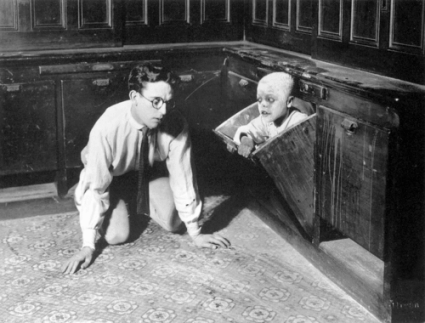
Haunted Spooks (1920), directed by Hal Roach, starring Harold Lloyd and Sunshine Sammy, from http://www.moma.org

Slapstick was more than just getting knocked about for the amusement of others. As Cruel and Unusual Comedy: Social Commentary in the American Slapstick Film, a series of silent film comedy screenings taking place at MOMA in New York 20 May-1 June demonstrates, slapstick comedy of the silent era took on social, cultural and poltical themes that we can still recognise today. As the blurb for the season puts it:

Rude forms of comedy have long used incendiary subjects like industrialization, race, ethnicity, sexual orientation, violence, and substance abuse as vital source material – and enjoyed great success with mass audiences.

The exhibition draws on the strong MOMA collection of silent film, and because the films touch on “a number of potentially sensitive issues” each is preceded by a contextual introduction. To help you with your contextulisation needs, there is an exhibition blog with film notes, Cruel and Unusual Comedy, put together by Steve Massa and Ben Model, the latter of whom also supplies the piano accompaniment to the season.

The featured screenings are:

Drag Shows: Cross-Dressing the Sexes
Wednesday, May 20, 2009, 4:00 p.m.
Getting Rid of Trouble (1912) with Charlie Murray
Sweedie Learns to Swim (1914) with Wallace Beery
Chasing the Chaser (1925) with James Finlayson
Get ‘Em Young (1926) with Stan Laurel
Good Night Nurse (1917) with Roscoe Arbuckle, Buster Keaton

Race Riots: Beyond Black and White
Wednesday, May 27, 2009, 4:00 p.m.
Black and White (1913) with David Morris
A Change of Complexion (1914) with Henry Bergman.
Haunted Spooks (1920) with Harold Lloyd, Sunshine Sammy
Below Zero (1925) with Lige Conley, Spencer Bell
A Natural Born Gambler (1916) with Bert Williams

Gratuitous Violence: No Turn Unstoned
Wednesday, May 27, 2009, 7:00 p.m.
Their First Execution (1913) with Ford Sterling
The Phoney Cannibal (1915) with Lloyd Hamilton, Bud Duncan
The Counter Jumper (1922) with Larry Semon, Oliver Hardy
A Deep Sea Panic (1924) with James Parrott
Cold Hearts and Hot Flames (1916) with Billie Ritchie

Animals and Children: No Harm Done
Friday, May 29, 2009, 4:00 p.m.
An Elephant on His Hands (1912) with George Ober
Cat, Dog, and Co. (1929) with Our Gang
Mind the Baby (1924) with Pal the dog
The Knockout (1923) with the Dippy-Doo-Dads
When Summer Comes (1922) With Billy Bevan

The Machine Age: Mack Sennett vs. Henry Ford
Monday, June 1, 2009, 4:00 p.m.
Lizzies of the Field (1924) with Billy Bevan
His Bread and Butter (1916) with Hank Mann, Slim Summerville
Get Out and Get Under (1920) with Harold Lloyd
Squeaks and Squawks (1920) with Jimmy Aubrey, Oliver Hardy
Neck and Neck (1924) with Lige Conley

Sunnyside up

sunnyside

Ah me, too much happening – if only any of it was of any consequence. Anyway, apologies for the service from the Bioscope being a bit on the intermittent side of late, but there’s just time to note the publication this month of Glen David Gold’s novel, Sunnyside. Gold gained fame a few years back with his fantastical novel of warring magicians in the 1920s, Carter Beats the Devil, and he seems to have pulled off a similar trick with Sunnyside, this time by taking as his subject the cinema of roughly the same period.

Sunnyside is, of course, the title of a 1919 Charlie Chaplin film (a minor film where Chaplin experimented with rural comedy but lost his comic touch). The novel sounds like a rich feast, using Chaplin and the American movie industry as the means to illuminate a wildly variegated decade and the encroachment of modernity. Amid multiple storylines (there are three main plot lines, covering Chaplin in Hollywood, another character in the battlefields of France, and a third caught up in the little-known Allied invasion of Russia), real-life and imaginary characters intermingle – among the former, readers will find Mary Pickford, Douglas Fairbanks, Adolph Zukor, film theorist Hugo Munsterberg, Rin Tin Tin, and of course Chaplin. There’s an enticing review of the book from the LA Times which describes Chaplin’s portrayal thus:

Scores of novels have tried and failed to depict movie stars and stardom or genius. Yet here Gold conjures a nuanced character who springs to life. Chaplin comes across as witty, charming, insecure. He dresses with a dandy’s care, suffers depressions and wears a perfume that smells like citrus with “base notes of money.” He woos women and conducts a book-length joust with Pickford, whose air of certainty and business smarts confuses and almost terrifies him. Chaplin’s doubts center on his sense of being not good enough, an uncertainty that he knows he must somehow allow to filter through his art.

“He had the easy capacity for seeing kinetic actions first, then creating character and emotion to fill them up, like ladling sand into a sack. This was too easy — everyone did it,” Gold writes. “Where was the small moment, the flirtatious smile not returned, the cuckold discovering a cuff link and saying nothing, the smile of a baby that somehow chills the bones? That was the hardest way to make things.”

Gold places the center of Chaplin’s ache in his longing for love — and his fear of the same — in his relationships with women. Chaplin’s mother, Hannah, was a music hall singer whose career was ruined and who went mad, leaving the young Chaplin destitute, and the whole Chaplin-arc of “Sunnyside” is aimed at the moment, dreaded and longed-for, when Hannah arrives in Los Angeles. “He could meet her eyes, but only as though they were tapping his fingers against a hot stove. They were still a deep hazel, cloudy and merry, for now,” Gold writes. “It’s okay if you don’t love your mother,” Hannah says, as “Sunnyside” speeds at last toward its conclusion with a sequence of scenes that amaze, startle and move.

As someone who found Carter Beats the Devil hugely disappointing, I shall reserve judgement until I read Sunnyside. But I will have to read it (all 559 pages of it), and the book is certain to do well, and to draw people anew to Chaplin and the richly metaphoric world of silent cinema.

Good news for the Cinema Museum

cinemamuseum

http://www.cinemamuseum.org.uk

Those who have been following the saga of the Cinema Museum, the Aladdin’s cave of cine-memorabilia managed by Ronald Grant, based in Lambeth, south London, will know that it has been under serious threat of closing down, because the lease was up and they were unable to find a new home. Happily the news has come through that they have successfully negotiated a new three-year lease with the landlord, and can now go ahead with fundraising plans with new confidence. Let’s hope a long-term home for the Museum is eventually found.

Universal Signs

This month sees the premiere of a new silent film (albeit one that seems to have been made in 2007), which is always a cause for rejoicing here at Bioscope Towers. The film is question is Universal Signs, a silent film for the deaf, presented what the official site describes as “mesmerizing American Sign Language with English subtitles”. The film looks to be one of those heartwarming tales of human relationships which tend to be a matter of taste, but here’s how the site describes the film’s appeal:

After the death of his fiancée’s daughter while in his care, Andrew (Anthony Natale, Mr. Holland’s Opus), a Deaf artist, becomes a prisoner of his own mind. Tormented day and night by memories and self-blame, Andrew falls in a downward spiral of depression and anger that alienates everyone around him. It is only through a serendipitous friendship and new love with Mary (Sabrina Lloyd, Sports Night) that Andrew is able to sense the life around him – forgive himself, rediscover his muse, and experience the transformative power of love.

An original score by Academy Award® winner Joseph Renzetti propels the story along with stellar supporting performances from Margot Kidder (Superman), Robert Picardo (Star Trek: Voyager), Deanne Bray (Sue Thomas: FBEye) and Ashlyn Sanchez (Crash).

Elsewhere they claim that the film “has the unique distinction of being the first feature film that embraces sign language in the storytelling of a film, rendering it a foreign language film for the hearing audience”. I don’t know enough about deaf cinema to know if this is a credible claim, but it will be a notable achievement if the film communicates equally to both kinds of audience. All of the deaf characters are played by deaf actors, and the film is wholly silent, with music score, bar a few snatches of audible dialogue. Hearing audiences are provided with captions to explain the dialogue.

There seems to be a certain amount of religious impetus – the site stresses its inter-denominational appeal, there’s a central character who’s a priest, and promotional blurb includes such lines as “by promoting UNIVERSAL SIGNS you send a message that TRANSFORMATION and CHANGE is happening. All we need is each other and FAITH in the possible and freedom to FORGIVE”. A Roman Catholic in Philadelphia which holds masses in American Sign Language features in the film.

universalsigns

http://www.universalsignsmovie.com

There’s plenty more information on the site. There you can find out about sign language, deaf cinema, captioning, and how to help promote the film. You can also buy T-shirts, mugs and postcards, download screensavers, and pre-order the film on DVD. It is screening at the Toronto International Deaf Film and Arts Festival on 21 May, and it has had earlier festival screenings in 2008, though what is described as the world premiere takes place on 30 May at the Keswick Theatre, Glenside, PA.

Finally, there’s a review of the film from a “sign-impaired” Erik Childress of the Chicago Film Society, which has this passage on its allegiance to the silent cinema:

There’s also something magical that occurs without calling obvious attention to itself when Universal Signs actually gets around to embracing its roots in the history of silent film. Developments in the plotting may give you the occasional eye roll for either their contrivance. But when you discover the big reveal during an Easter dinner scene, those versed in the schools of Chaplin or clavical-themed westerns will recognize the subtle shift in Renzetti’s score and provide new light on the direct convenience of an early antagonist and the second one it spawns. It’s not a far trip to imagine this dinner sequence with full title cards and speeded-up film in a full-on homage to the beginnings of motion pictures before we could all hear Al Jolson.

It’s disappointing to see that mistaken reference to “speeded-up film”, but otherwise this sounds like a film that deserves to make its mark.

Return to the ancient world

viedejesus

Vie de Jésus

A while back you may recall we reported on The Ancient World, a marvellous afternoon and evening of screenings of early films set in Ancient Greece and Rome, organised by the Department of Greek and Latin at University College London, as part its The Ancient World in Silent Cinema research project.

They promised a second show, and it’s just been announced. The Ancient World in Silent Cinema 2 will present an afternoon and evening of silent film screenings with piano accompaniment and related talks, this time featuring films with settings in Biblical or Near Eastern Antiquity. The event is open to the public and admission is free. It takes place Monday 22 June at UCL Bloomsbury Theatre, 15 Gordon Street, London.

This is the programme:

AFTERNOON SCREENINGS (2-4 PM):

PHARAONIC EGYPT, BABYLON & OLD TESTAMENT

* Wanted a Mummy (UK 1910) 4 mins
* Sposa del Nilo / The Bride of the Nile (IT 1911) 11 mins
* Vergine di Babilonia / The Virgin of Babylon (IT 1910) 9 mins
* Caïn et Abel / Cain and Abel (FR 1911) 5 mins
* Sacra Bibbia / The Sacred Bible (IT 1920), episode of ‘The Story of Joseph in Egypt’ 9 mins.
* Moïse sauvé des eaux / Moses Saved from the River (Fr 1910) 8 mins
* L’exode (FR 1910) 13 mins
* La vie de Moïse (FR 1910) interspersed with Life of Moses (US 1909-10) 13 mins
* Jephthah’s Daughter (US 1909) 6 mins
* Jephthah’s Daughter (US 1913) 25 mins

TEA/COFFEE BREAK (4-4.30PM)

SPEAKERS (4.30-6PM)

David Mayer (University of Manchester), Margaret Malamud (State University of New Mexico), and Judith Buchanan (University of York)

EVENING SCREENINGS (7-9 PM):

OLD & NEW TESTAMENT

* Samson et Dalila (FR 1902) 3 mins
* Samson (FR 1908) 11 mins
* David et Goliath (FR 1910) 8 mins
* Reine de Saba / Queen of Sheba (FR 1913) 19 mins
* Giuditta e Oloferne (IT 1908) 6 mins
* Judith (FR 1910) 8 mins
* Aveugle de Jérusalem / The Blind Man of Jerusalem (FR 1909) 8 mins
* Vie de Jésus (FR 1905-14) 8 mins, episodes from childhood to transfiguration
* Vie de Jésus (FR 1905-14) 18 mins, episodes from annunciation to ascension

Films of the ancient world, and particularly films on biblical themes, were of huge importance to the early cinema, capturing audiences with familiar stories and iconography, frequently augmented by the use of colour (stencil colour was regularly used for costume dramas and subjects with classical themes). Such films helped establish the early cinema’s pretensions, and its morality. Among the several gems in the programme, I recommend in particular Aveugle de Jérusalem, a Gaumont drama directed by Louis Feuillade which features a non-Biblical miracle story – a blind man has his sight restored by Christ, only to discover that his daughter has a lover and that his servants have been robbing him. He angrily throws them out of his house, only to learn forgiveness when he sees Christ on his way to Calvary. It is the model early film, in form and imagination.

The Ancient World in Silent Cinema project is doing admirable work in looking at early films from contexts other than film history, introducing them to a scholarly audience familiar with the histories and cultural contexts of the ancient world in general. In truth, those other contexts have always been a part of film history, because films can only be a reflection of the cultures that produce them. We just need them to be seen not only by those who value their film history, but by everyone who may learn from them.

The first Ancient World screening day was an inspiring and genuinely illuminating event, bolstered by an enthusiastic audience, a fine venue and some superb music. Programme two is going to be well worth attending.

Anyone interested in the research project or the screenings should contact Maria Wyke (m.wyke [at] ucl.ac.uk).

Programme for British Silent Film Festival

manxman2

Anny Ondra in The Manxman, from 1000 Frames of Hitchcock

The programme for this year’s British Silent Film Festival has been published. This year’s festival takes as its theme the use of sound and music in British silent cinema and celebrates the art of the silent film musician, past and present. It is taking place 4-6 June at the Barbican in London, and is being run alongisde the Sounds of Early Cinema in Britain conference, which takes place at the same venue 7-9 June.

Here are the programme details:

Thurs June 4
9.00 Registration / Barbican / Screen 1 Foyer
10.30 -11.00 Break
11.00 The Runaway Princess (1929) 79 mins
Music by John Sweeney
12.30 – 14.00 Lunch
14.00 Knowing the Score: case studies in musical accompaniment. Presented by Neil Brand, Philip Carli, Stephen Horne & John Sweeney
15.30 – 16.00 Break
16.00 The Battle of the Ancre and the Advance of the Tanks
Toby Haggith from the Imperial War Museum on different approaches to reconstructing the original score for this film with Laura Rossi and Stephen Horne
17.30 – 18.00 Break
18.00 Shooting Stars (1928) 81 mins
Music by Phil Carli
19.30 Dinner
21.00 The Dodge Brothers
Go West with White Oak (1921) 71mins
Programme 90 mins

Fri June 5
9.00 Sound Film Before 1930
Presented by Tony Fletcher with John Sweeney
10.30 -11.00 Break
11.00 The Wheels of Chance (1922) 71 mins
Music by Philip Carli
12.30 – 14.00 Lunch
14.00 Under the Greenwood Tree (1929) 87mins (Sound)
15.30 – 16.00 Break
16.00 W.K.L. Dickson in London
Paul Spehr on this pioneering film maker. Includes screenings of Biograph films
17.30 – 18.00 Break
18.00 The Third Annual Rachael Low Lecture Given by David Robinson
19.30 Dinner
20.30 Palais de Danse (1928) 95mins
With the Barbican Palais Orchestra

Sat June 6
9.00 The Vortex (1927) 73 mins
Intro by Jo Botting
Music by Stephen Horne
10.30 – 11.00 Break
11.00 Family Film Club – A Canine Concoction: First Film Dogs 90 mins
Music by Neil Brand
12.30 – 14.00 Lunch
14.00 The Manxman (1929) 90mins
Music by John Sweeney
15.30 – 16.00 Break
16.00 The Lost Musicians: the art of the cinema musician. With Neil Brand & colleagues
Music in Cinemas: a case study by Gerry Turvey
The Last Adventures of Sherlock Holmes; The Mazarin Stone (1923) 23mins
Music by Neil Brand
18.30 Break
20.30 BFI Southbank
The Ukulele Orchestra of Great Britain in ‘Ukulelescope’ (tickets required ) (also earlier performance at BFI Southbank at 16.15)

Sun June 7

11.00 SOCIAL EVENT
Silent Cinema Walk led by Ian Christie/org by Kelly Robinson
12.30 – 14.00 Lunch

15.00 Way Down East (1920)
Intro by David Mayer – score arranged and performed by Gillian Anderson
(separate tickets required)
Sounds of Early Cinema in Britain conference

Well, a fine selection of screenings and presentations (though I may have to have words with the organisers about that use of First Film Dogs…). Two of my very favourite silents are being screened, Anthony Asquith’s Shooting Stars and Alfred Hitchcock’s The Manxman, and Paul Spehr’s illustrated talk on W.K-L. Dickson’s Biograph films from the late 1890s comes strongly recommended.

Timetable and other details are available from the British Silent Film Festival site, and there are booking details on the Barbican site, including festival passes.

An excellent dumb discourse

ruggero

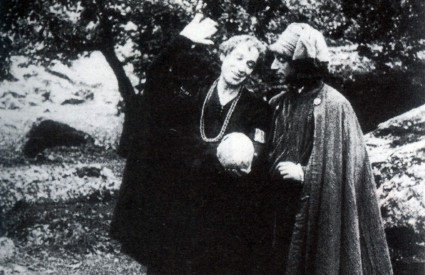
Ruggero Ruggeri as Hamlet in Amleto (1917)

It was the fervent belief of many in the early years of cinema that justification for the medium lay in how it interpeted stage drama. At a time when censorious authorities looked down upon the dubious cinema (with its low class audiences) and cinema was reaching out for respectability (and properties that were out of copyright), Pathé with its Film d’Art and Film d’Arte Italiana companies, and Adolph Zukor’s policy of ‘Famous Players in Famous Plays’ showed that there was financial good sense in bringing high-class drama to the cinema screen, however mutely.

The pinnacle of stage drama was, of course, William Shakespeare, and film companies in the silent film era took on the Bard with enthusiasm. The numbers are extraordinary. Some two hundred films, most of them one-reelers of the pre-war period, were produced that closely or loosely owed something to one or other of Shakespeare’s plays. Some film companies showed a particular interest: Vitagraph filmed Antony and Cleopatra, Julius Caesar, Macbeth, Othello, Richard III, Romeo and Juliet (all 1908), King Lear, A Midsummer Night’s Dream (1909), Twelfth Night (1910) and As You Like It (1912). Thanhouser made A Winter’s Tale (1910), The Tempest (1911), The Merchant of Venice (1912), Cymbeline (1913) and King Lear (1916). Cines, Kalem, Biograph, Ambrosio, Gaumont, Eclair, Nordisk, Milano and several others filmed the plays.

This was more than enthusiasm for high culture; it was good business. Shakespeare films appealed to an audience which found costume dramas in general to be a treat, and which was accustomed to boiled-down Bard from school texts and stage productions which concentrated on the highlights from the plays (such as the Crummles’ hectic production of Romeo and Juliet portrayed in Charles Dickens’ Nicholas Nickelby). Of course, not everyone wanted to see high culture quite as much as the cinema sometimes wanted to be associated with such culture (see the cartoon at the end of this post), but more than enough were impressed, and entranced.

Once films became longer – ironically as the cinema became closer in form to the theatre – the number of Shakespeare films fell, because longer productions were more of a challenge to audiences. But even then there was a burst of activity in 1916 (the tercentenary of Shakespeare’s death), with half-a-dozen or more productions in that year alone, and versions of the plays continued in silent form throughout the 1920s, with four key titles coming from Germany – Hamlet (1920, with Asta Nielsen as the Dane), Othello (1922, with Emil Jannings and Werner Krauss), Der Kaufman von Venedig (The Merchant of Venice) (1923, with Henny Porten) and Ein Sommernachtstraum (A Midsummer Night’s Dream) (1925, Werner Krauss again).

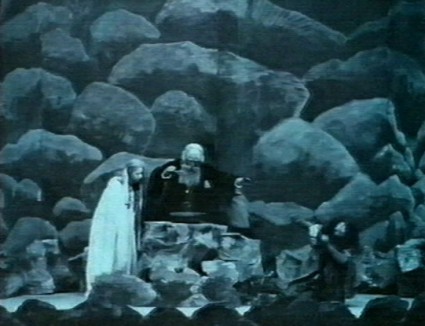
thetempest

Prospero in his cave, from The Tempest (Clarendon 1908)

So where is the literature to back up this self-evidently significant corner of silent film history? Sadly, until recently, there has been very little. The silent film enthusiasts and film scholars have shied away from Shakespeare as being falsely worthy and far too uncinematic, while the Shakespeareans looked down on cinema per se, while finding the very notion of silent Shakespeare an absurdity. Jack J. Jorgens, a noted scholar, went so far as to write these dreadful words in his Shakespeare on Film (1977):

First came scores of silent Shakespeare films,one- and two-reelers struggling to render great poetic drama in dumb-show. Mercifully, most of them are lost.

Oh dear, oh dear. However, there was one work which almost eccentrically fought against the tide. Robert Hamilton Ball’s Shakespeare on Silent Film: A Strange Eventual History (1968) is one of the most remarkable books ever produced on silent cinema. It is a passionately-pursued archaeological investigation into every kind of Shakespeare film made during the silent era, encomapssing parodies, allusions, plot borrowing as well as ‘conventional’ adaptations, with Ball diggedly tracking down every obscure reference, every hidden print, every list of intertitles, with abundant fervour and an infectious interest in the people involved. This magnum opus has been cherished by the dedicated few for four decades, and for most of that time its discoveries and assertions have been taken as gospel. Yet even Ball ended his investigations with these disappointing words:

Silent Shakespeare film could not be art, a new art. The aesthetic problem is how to make good film which is good Shakespeare. It could not be good Shakespeare because too much was missing.

It is has been the task of a few of us (and I’ve been involved) to prove those words wrong. Silent Shakespeare was good Shakespeare, not because of what was missing, but because of what was there to be seen – a new medium expressing itself imaginatively while asserting its social worthiness and cultural relevance. To study silent Shakespeare films is to see films discovering what they could do. Yes there are histrionics at times, and yes there is some aburdity involved when complex plots are crammed into a ten-minute reel, but equally there is artistry, feeling and subtlety of interpretation. Have you ever seen a ballet of Romeo and Juliet and complained that the words were missing? Of course not. Shakespeare without the words is not a lesser form, but simply a form that requires its own special understanding. It expresses the significance of its subject within its specific constraints – which is precisely what art is.

The tide started to turn with the release of the British Film Institute’s video compilation Silent Shakespeare (1999), a work that was a revelation to many. Even hardened theatricals could see the special virtues in the Clarendon Film Company’s delightful reworking of The Tempest (1908) or the elemental passion evident in Ermete Novelli’s stunning performance in Re Lear (1910). The DVD has found its way onto many a university library shelf, while a number of scholars have begun to take on the silent Shakespeare film with fresh eyes – among them Jon Burrows, Roberta Pearson, Anthony Guneratne and Kenneth Rothwell.

buchanan

The leading champion, however, has been Judith Buchanan, whose quite marvellous Shakespeare on Silent Film: An Excellent Dumb Discourse is published this month by Cambridge University Press. This is the sympathetic, understanding account of a phenomenon that we have been waiting for. It is not a comprehensive history of the silent Shakespeare film – Buchanan defers to Ball in that respect – instead it concentrates on exemplary films and on uncovering the social, cultural and economic contexts. So it is that an opening chapter details a nineteenth-century legacy of performance, with particular attention to Shakespeare and the magic lantern, showing that the silent Shakespeare film was part of an established tradition. Chapters then follow on the first Shakespeare film, King John (1899), featuring Herbert Beerbohm Tree (also on the BFI DVD); Shakespeare films of the ‘transitional era’ between the early and late 1900s, with close, engrossing readings of Clarendon’s The Tempest and Film d’Arte Italiana’s Othello (1909); the ‘corporate authorship’ of Vitagraph’s productions; the contrasting interpretations of Hamlet by Hepworth (a renowned British 1913 production with theatrical great Sir Johnston Forbes Robertson) and Amleto, a 1917 Italian film starring Ruggero Ruggeri, little-known but perhaps the most accomplished extant realisation on Shakespeare on silent film (it’s crying out for the two Hamlets to be released jointly on DVD); the several films of the tercentary year, including the rival Romeo and Juliets starring Francis X. Bushman/Beverley Bayne and Theda Bara/Harry Hilliard, both films alas lost; the German productions of the 1920s; and wordless Shakespeare today (there are some stage productions experimenting with silence, notably Paata Tsikurishvili’s Synetic Theatre).

It’s written for a literary studies audience, but it is grounded in exemplary original research (Buchanan has toured the world to track down the relevant prints) and it is a pleasure to read. There is much here to detain anyone keen to extend their knowledge of film history. She knows her films as well as her plays – a rare and most welcome combination. Above all, Buchanan opens up the subject in all its richness of theme, inviting others to explore further, illuminating the films that we are so fortunate have survived. We will still turn to Robert Hamilton Ball for his extensive documentary evidence, but to Buchanan for her sophisticated understanding.


romeocartoon

A 1913 cartoon from London Opinion, speaking for anyone resistant to the cinema’s occasional urge to impress Shakespeare upon us. Taken from Stephen Bottomore, I Want to See this Annie Mattygraph: A Cartoon History of the Coming of the Movies

If you are keen to seek out silent Shakespeare films for yourself (and you should, you really should) this is what’s currently available on DVD:

  • Silent Shakespeare: includes King John (Biograph 1899), The Tempest (Clarendon 1908), A Midsummer Night’s Dream (Vitagraph 1909), Re Lear (Film d’Arte Italiana 1910), Twelfth Night (Vitagraph 1910), Il Mercante di Venezia (Film d’Arte Italiana 1910), Richard III (Co-operative 1911) [BFI] [Milestone]
  • Thanhouser Presents Shakespeare [Thanhouser series vol.7]: includes The Winter’s Tale (1910), Cymbeline (1913), King Lear (1916) [Thanhouser]
  • Richard III (Shakespeare Film Company 1912) [Kino]
  • Othello (Wörner-Filmgesellschaft 1922): also includes Duel Scene from Macbeth (Biograph 1905), The Taming of the Shrew (Biograph 1908), Roméo se fait bandit (Pathé 1910), Desdemona (Nordisk 1911) [Kino]

The International Database of Shakespeare on Film, Radio and Television, an online filmographic database not yet officially released but available in a test version, hopes to be comprehensive for the silent Shakespeare film. Buchanan herself provides a filmography (restricted to films mentioned in her text), including the location of archive prints. Around forty silent Shakespeare films survive today, mercifully.

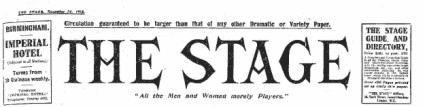
The Stage

thestage

New (at least to me) among the digitised historical journals now available online by subscription is The Stage. This is well worth taking note of. The Stage Directory (A London and Provincial Theatrical Advertiser) was founded in February 1880 as a monthly newspaper, and continues (as a weekly) to this day. Its entire archive 1880-2007 has been digitised and put online, covering over 6,500 issues or above 170,000 individual pages reporting on the goings on of the British stage and beyond.

The importance for us is that The Stage has always kept an eye on the motion picture business, and for the silent era it was assiduous in recording the activities of this new strand of showbusiness. A series of articles from 1907 entitled “Cinematograph Notes” records new businesses, film releases, licensing issues and so forth, “Latest Films” is very handy in giving titles of new releases, and another series “Film Facts & Fancies” starting in 1919, written by ‘Figaro’, reports on the cinema world with a knowing eye.

The Stage documented the engagements of actors, and one can trace their travels across the British provincial theatres, seeing also where the variety shows were starting to introduce the cinematograph. Here one can spot names that were later to be famous: in a notice from 30 July 1903 of a performance of Sherlock Holmes at the London Pavilion, the writer notes:

A faithful portrait of Billy is given by Master Charles Chaplin, who shows considerable ability, and bids fair to develop into a clever and capable actor.

Once can follow Chaplin many performances as Billy, and then later with the Karno troupe, up and down the country, before he found his fortune on the screen.

The Stage Archive is available by subscription. There is a timed pass system, with twenty-four hours’ access costing £5, one week £15, one month £30, three months £60, six months £100 and one year £150. Once you have subscribed, you have options to browse by date, so you can scroll through an entire issue (I recommend this to start with, as it gives you an idea of layout and the contents of the regular sections), or you can search by word (or phrase in quotation marks) across all types of ‘clippings’ (i.e. sections), or by article, picture or advertisement. You can search by the time periods 1880-1900, 1901-1950 or 1914-1918 (and later periods, of course), and can order search results chronologically or by relevance.

Those familiar with digitised newspaper collections will soon recognise that The Stage Archive has been produced by Olive Software‘s ActivePaper system. Search results give you the date and page number of the issue and a snippet of the article itself (usually a headline), which you click on to open up the full article. This can be a little frustrating when you have many search results, as there is little way of telling one article from another (many of the Chaplin notices are simply titled ‘Provinces’, for instance), so it may be a little laborious investigating the more popular subjects. You get the full article in facsimile form, with your search term highlighted, and you can print these or file them away in a ‘My Collection’ facility, but there is no way to get at the underlying OCR text, unfortunately.

If you don’t subscribe, you can still use The Stage Archive to search material, you just won’t have access to the articles themselves. But there is more from The Stage that you can access without paying any subscription. The Stage produced an annual yearbook which for the silent era is another rich source of information, particularly for its directory listing of film associations, its advertisements, and especially its reports on legal cases, always fascinating for the realism they provide behind the tinsel of so much cinema reportage. The Internet Archive has the volumes for 1908-1919. The PDFs are a large size (30-50MB), but don’t forget that they are word-searchable. Look out in particular for Arthur Coles Armstrong’s long article in the 1914 volume, “My Lady Kinema – The Eleventh Muse”. And from the 1916 volume, this report on a court case caught my eye:

ELINOR GLYN v. WESTERN FEATURE FILM CO. AND G. BLACK.- ALLEGED CINEMATOGRAPHIC INFRINGEMENT OF NOVEL.

In the Chancery Division, before Mr. Justice Younger, Mrs. Elinor Glyn, the author of and owner of the copyright in “Three Weeks,” brought an action against the defendants for an injunction restraining the defendants from making or authorising the public exhibition of kinematograph films under the title of Pimple’s Three Weeks (without the option).

The defendants pleaded that their film Pimple’s Three Weeks (without the option) was an original dramatic work within the meaning of the Copyright Act, 1911, and that they were entitled to use their film.

The action against the defendant George Black was settled before the case came into Court.

And the reason it was settled is that the judge decided that Three Weeks was an immoral work, and so did not merit any copyright protection, irrespective of whether a parody could be seen as infringing in the first case.

Plenty to discover, whether paid for or free (and acknowledgments to Bioscope regular Penfold for bringing The Stage Archive to my attention).

Silent Screen Slots

http://www.onlinecasinoreports.com

So far in our investigations of the worlds of silent cinema past and present, somehow we have managed to avoid the online betting phenomenon. No more! For William Hill Casino have just announced the creation of Silent Screen Slots, a new video slot game based on silent cinema, “a tasteful and exciting window into the cinema of yesteryear”.

As you can see from the above preview, generic images of your favourite silent screen cliches are accompanied by the inevitably tinkly piano music. The full experience reportedly brings you “many big movie stars such as Charlie Chaplin” and, they promise, “fitting tributes to many classic films”. We could have a certain amount of fun imagining what such fitting tributes could have been (The Gold Rush, Pay Day), but the major features are an unidentifiable actress as the wild symbol (offering you the “top-line winning of 5,000 coins”) and “the Scatter symbols that also provide excitement, with 5 scattered cameras paying some 200 times a player’s bet, or 5,000 coins if 25 coins per line are wagered”. Finally there’s a “Movie Mayhem” jackpot feature, with golden movie tickets hidden in the concession stand (which looks decidely not from the silent era), with four “generous progressive jackpots” to aim for. “Overall, there’s excitement and top-class Silent Screen entertainment awaiting players at this video slots game”.

Exciting, entertaining and tasteful – what better way could there be for you to lose your money?