Countdown to the festival

Bioscope Festival of Lost Films

Just eight days remain until we start The Bioscope Festival of Lost Films – a world first, I believe. The festival runs 14-18 January, and all of the films to be shown (one feature and one short per day) will be guaranteed not to exist. Once they did, and one reason why the titles are not being announced in advance, is that exhaustive researches are being undertaken in archives around the world to ensure that the selected films do not still exist somewhere.

However, we can give you some incidental details. The festival will of course be taking place in lost venues. Those selected – a different one each night, all in London – are:

The West End Cinema Theatre, Coventry Street
The Court Electric Theatre, Tottenham Court Road
The Casino de Paris, Oxford Street
The Cambridge Circus Cinematograph Theatre, Charing Cross Road
The Circle in the Square, Leicester Square

All are no longer cinemas. The West End Cinema Theatre, which opened in 1913, later became the Rialto and closed in 1982. It is a Grade II listed building but remains disused. The Court Electric Theatre, which closed in 1928, does not exist as a building, but the space it occupied is now the foyer of the Dominion Theatre. The Casino de Paris (opened 1909) is now a McDonald’s. The Cambridge Circus Cinematograph Theatre (opened 1911) is now the Montagu Pyke bar. And the Circle in the Square (originally called the Bioscopic Tea Rooms, opened 1909) is now an Angus Steak House. But we can dream.

And we have musicians. We have gone for the best, and can promise three names once renowned for their accompaniment of silents at the National Film Theatre: Arthur Dulay, Ena Baga and her sister Florence de Jong playing the organ. You will be transported. Book now!

The Bioscope Festival of Lost Films is dedicated to the anonymous person who visited this blog using the search term “lost films download”. We must all continue to live with such hope.
Projection Box essay competition

Just a reminder for anyone with an unpublished essay on early cinema tucked in the desk or on the hard drive somewhere that the deadline for the Projection Box essay award is January 18th. The aims of the award are to encourage new research and new thinking into any historical, artistic or technical aspect of projected and moving images up to 1915; and to promote engaging, accessible, and imaginative work. The first prize of £250 is for an essay of between 5000 and 8000 words (including notes).See the earlier post on the award (which is being awarded for the first time) for details of how to enter, or visit the Award site.

Bach releases DeMille

Bach Films

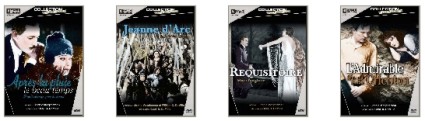
Cecil B. DeMille DVDs, from http://www.bachfilms.com

My thanks to Herr Graf Ferdinand Von Galitzien for the information that the French company Bach Films have released ten Cecil B. DeMille silents on DVD. The titles are:

The Cheat (1915) – with Sessue Hayakawa, Fannie Ward
Carmen (1915) – with Geraldine Farrar, Wallace Reid
Joan the Woman (1917) – Geraldine Farrar and Raymond Hatton
The Whispering Chorus (1918) – with Raymond Hatton and Kathlyn Williams
Old Wives for New (1918) – with Elliott Dexter and Florence Vidor
Don’t Change Your Husband (1919) – with Elliott Dexter and Gloria Swanson
Male and Female (1919) – with Thomas Meighan and Gloria Swanson
Why Change Your Wife (1920) – with Thomas Meighan and Gloria Swanson
The Affairs of Anatol (1921) – Gloria Swanson and Wallace Reid
Manslaughter (1922) – with Leatrice Joy and Thomas Meighan

All are retailing at 7.00€. All are Region 2, and appear to have French titles only. I can’t find any information about the music. At any rate, it’s a remarkable selection, with perhaps Joan the Woman, starring the opera singer Geraldine Farrar (who enjoyed a surprisingly successful career in silent films, given that her chief asset – her voice – was absent), the outstanding classic if you had to go for just one.

I’d not heard of Bach Films before now. Other silent DVDs on their list are D.W. Griffith’s Way Down East (1920), Orphans of the Storm (1922), Broken Blossoms (1919), Intolerance (1916) and Sally of the Sawdust (1925), all of them accompanied by assorted Griffith Biograph shorts; Douglas Fairbanks in The Three Musketeers (1921), Robin Hood (1922), Don Q, Son of Zorro (1925), The Black Pirate (1926) and The Iron Mask (1929); and Tod Browning’s Shadows (1922).

I don’t attempt to keep up with all silent film DVD releases here on The Bioscope, because there are other well-established sources that provide such a service very well. Check out the Silent Films on DVD section on Silent Era, or the impressively-extensive Silent Films on DVD site.

Don’t give up the day job, William

William Friese-Greene’s hat

William Friese-Greene’s advertising hat, from http://www.google.com/patents

While working on some patent records for the forthcoming colour series, I came across some would-be inventions which never took off. It’s interesting, for example, to see how someone like William Friese-Greene was a serial patenter, not only patenting early cinematographic devices (and colour cinematography systems) but applying for patents for such wildly varying subjects as means to measure electricity, paper manufacture, and even airships. George Albert Smith, a rather more successful inventor of a colour system, certainly thought beyond film. His huge range of patent submissions over twenty years (1895-1918) includes cycle cranks, spinning mules, means to extract corks from bottles, garden ploughs, golf bags, means to preserve fish, and bacon slicers.

But the Friese-Greene invention above is my favourite wrong turning, and I had to share it with you. Dating from 1898, Means or apparatus for producing and exhibiting animated or changing pictures on advertising appliances &c. is, essentially, a system for displaying motion pictures on your hat. As you can see, the motion picture band goes around the hat, a crank handle is operated by the right hand, and batteries in a jacket pocket are connected to an illuminant in the hat. But let the patent application itself describe what’s going on:

The invention chiefly consists in the combination of a transparent or translucent screen, means for attaching it to the person, a film or sheet bearing a series of successive pictures, preferably such as are adapted to produce what are generally called “animated” pictures, means whereby the said film or sheet is caused to travel opposite the screen, so that the pictures are thrown upon or exhibited through it, and a lighting or illuminating device for lighting up the pictures and screen.

Friese-Greene offers us two versions of the invention. Above is the hat version (the hat is meant to be translucent). Below is the alternative, marginally less hazardous if not less improbable version where the man carries a screen above his head.

William Friese-Greene’s screen

Needless to say, the human motion picture advertising did not make it to reality. Brighter minds than mine could tell you whether it could be built, and whether the wearer would soon burst into flames or not. But you do want to imagine just what the effect would have been of a Victorian gentleman confidently striding down Oxford Street with motion pictures (how would anyway one actually see them?) playing across his headgear.

I wrote a post some while ago on how to locate early motion picture patents online. The above is a US patent (no. 623,242), which was filed 7 July 1898 and patented 18 April 1899. It comes from Google Patents, which is very easy to use, and quite addictive. Maybe there’s a mini-series here, on wildly wrong early cinematograph patents. I’ll see what I can find…

Update (February 2008): Astonishingly, it seems that William Friese-Greene was a man ahead of his time. A company, Wearable Video Inc., has come up with a ‘vest’ with a screen for showing “full motion video with stereo sound”, with the idea of using the same as a promotional tool at trade shows, city events etc. William, I’m sorry to have wronged you – you were a visionary after all.

Wearable Video

(Patent Pending)

Far, far away

Further information has been made about about Stummfilmmusiktage, the German festival of silent film and music, which takes place in the Markgrafentheater, Erlangen, 24-27 January. This email has just been sent out by the festival:

Dear friends of the silent screen,

It’s been a while since you heard from us, but the 2008 programme of StummFilmMusikTage Erlangen is finally rock solid and pre-sale tickets are available (please note: If you are considering acquiring tickets from outside Germany, please write to asynchron@stummfilmmusiktage.de and we will help you reserve the tickets you want). Our main theme for the 2008 festival will be Far, Far Away with films focussing on the rich silent film heritage of Asia, but also on Western conceptions of Asia and the exotic.

Please note that there have been a few changes in our programme since we first published it in October. This year’s films will take you to the South Seas, Japan, Mongolia, Siam, India, Chinatown L.A., the Limehouse district in London, and… to the moon.

The programme now goes like this:

Thursday, January 24, 2008

7 p.m.
Vernissage
Japanese Film Actresses in Silent Era

in cooperation with The National Film Center, Tokyo

Introduction: Mariann Lewinsky
Autor of the book Die verrückte Seite

Venue: SiemensForum Erlangen
Werner-von-Siemens-Str. 50

20:30 p.m.
What Made Her Do It? (Nani ga kanojo o sô saseta ka)
Japan 1930, 83 min
directed by: Shigeyoshi Suzuki
score: Günter Buchwald
performed by: Erlanger Musikinstitut

Venue: Vortragssaal der Siemens AG
Werner-von-Siemens-Str. 50

Friday, January 25, 2008

6 p.m.
Introduction: Storm Over Asia
with Nina Goslar (ZDF/ARTE), Bernd Schultheis (composer), Vera Zvetajeva (Cine-Club, Vladimir)

7 p.m.
Storm Over Asia (Potomok Chengiskhan)
Soviet Union 1925, 130 min
directed by: Wsewolod Pudowkin
score (world premiere): Bernd Schultheis
performed by: Ensemble Kontraste
conductor: Frank Strobel

coporoduction with
ZDF/ARTE and Ensemble Kontraste

9 p.m.
Introduction: Silent Film in Japan
Günter Buchwald

10 p.m.
Express 300 Miles (Tokkyu Sanbyaku Ri)
Japan 1929, 84 min
directed by: Genjiro Saegusa
score and performance: Günter Buchwald

Saturday, January 26, 2008

4 p.m.
Georges Méliès Short Film Programme
France 1896-1911, 60 min
directed by: Georges Méliès
score and performance:
Yogo Pausch

6 p.m.
Introduction Tabu: film and score
Violeta Dinescu (composer)

7 p.m.
Tabu
USA 1925, 84 min
directed by: F.W. Murnau
score: Violeta Dinescu
performed by: Ensemble Kontraste
conductor: Frank Strobel

9 p.m.
Merian C. Cooper – Life as Adventure
A conversation with Kevin Brownlow

10 p.m.
Chang
USA 1927, 69 min
directed by: Merian C. Cooper
score and performance:
Hildegard Pohl (piano), Yogo Pausch (percussion)

Sunday, January 27, 2008

11 p.m.
The Light of Asia
India/D 1925, 97 min
directed by: Franz Osten
score and performance: Om Prakash Pandey (Tabla), Henning Kirmse (Sitar)

13 p.m.
Slapstick-Lunch
Enjoy a delicious three-course Asian lunch. We’ll serve slapstick highlights on the side.
A reduced combi ticket for the screening of The Light of Asia and the three-course lunch is available.

4 p.m.
The Cameraman
USA 1925, 75 min
directed by: Buster Keaton
score and performance: Helmut Nieberle Quartet

6 p.m.
Anna May Wong
A reading by actors Heike Thiem-Schneider and Thomas Lang

7 p.m.
Piccadilly
GB 1928, 110 min
directed by: E.A. Dupont
Score: Frieder Egri, Roman Rothen
performed by: Frieder Egri & Ensemble

I like the idea of a slapstick lunch. Presumably custard pies for dessert. Further details as always from the festival web site.

50,000 and counting

After eleven months of posting to the day, the Bioscope has just chalked up 50,000 views. It took five months to reach the first 10,000, so clearly we’ve been on quite an upward curve recently. According to Technorati, the Bioscope is at number 224,227 in its list of blog popularity, so the curve will have to go upwards a little more before we reach the giddy heights of Boing Boing or Engadget, but what do they tell you about early colour systems, freemasonry lodges, digitised newspaper collections, silent film pianists, British film distributors of the 1890s, where to download books that tell you how to write silent screenplays, or how to participate in lost film festivals? This is the place to be.

The origins of Kung Fu cinema

Ren Pengnian

Ren Pengnian, from Kung Fu Cinema

I’ve just come across Electric Shadows, a blog on the history of the Hong Kong film industry and Chinese martial arts films. The blog, written by Jean Lukitsh, started a year ago, but has just started up again from scratch by re-posting its original posts (on the Kung Fu Cinema site). These feature a series, ‘The Origins of Kung Fu Cinema’, a genre which goes back rather further than you might think. Part 1, Shanghai Dawn, takes us back to the first years of the Chinese film industry and says that Robbery on a Train, directed by Ren Pengnian in 1919, may well qualify as the first Kung Fu movie. By 1925 there were around forty to sixty small studios making martial arts films in Shanghai. Part 2, Butterfly and Oriole, continues the history, focussing on the actresses Hu Die (Butterfly Wu) and Chin Tsi-ang (Chen Zhigong). Part 3, The Oriental Female Fairbanks, has more on Ren Pengnian and his actress wife Wu Lizhu (Wu Lai-chu) and their films of the 1920s and early ’30s (Chinese films continued silent for longer than in the West).

It’s a fascinating account of the kind of popular cinema from an earlier era which seldom makes it into film histories, with links to YouTube clips of silent Kung Fu films (none of Pengnian or Wu Lizhu’s films survives, alas).

Update: The series continues, still in the silent era, with part 4, Ambush on all Sides.

2008 Man with a Movie Camera

2008 Man with a Movie Camera

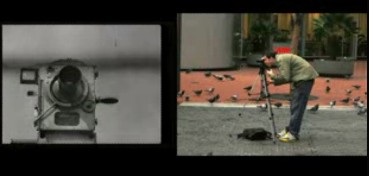
1929 and 2008 Man with a Movie Camera, from http://dziga.perrybard.net

You may remember the posts on video artist Perry Bard’s remarkable project in ‘database cinema’ to create a modern version of Dziga Vertov’s avant garde documentary classic, Man with a Movie Camera, by inviting anyone interested to upload modern equivalent shots to those in the original. You can find all about the ongoing project on Bard’s website, at http://dziga.perrybard.net, but she got in touch to correct an earlier post about the project with this information:

There was an initial deadline which may have led to some confusion however the project is open and ongoing.The reason for the deadline is that people tend to like the excitement of doing things at the zero hour and we wanted as much material as we could get for the launch in Manchester October 11. It continued screening there for two weeks, then screened in Norwich during the Aurora Festival, in Leeds during the Leeds Film Festival. There are links to photos of these events on the site.The site now contains a full length version of the remake which plays as a split screen with the original. We don’t have the server capacity to keep updating the remake but with each screening event it works through a daily download meaning that the film is different each time it screens as more than one person has uploaded entire scenes and shots. The possibilities are infinite. Please participate by logging on to http://dziga.perrybard.net.

There’s also a two-minute trailer available, and the full-length split-screen film (in its current version) is available from Google Video.

2008 – The Year of Colour

Kinemacolor poster

A happy new year to one and all!

2007 was a productive year for The Bioscope, from small beginnings, and I hope that the coming year will see the service continue to gow and for the archive of useful content to build up. In 2008 I’ll be continuing to provide news on events, festivals, conferences, screenings, DVD releases and online resources for early and silent cinema. The Library of freely-available digitised documents will continue to grow (there is quite a backlog of titles to be added in due course), and I hope to add new features and maybe indulge in a redesign somewhere along the line.

However, the major theme running through 2008 will be colour cinematography in the silent era. 2008 sees the centenary of the first public exhibition of Kinemacolor, the world’s first natural colour motion picture system. Pedants may say that the centenary of Kinemacolor might have been 1906/2006 (when it was patented), 1907/2007 (when it was exhibited in a preliminary form to an audience of film professionals) or 1909/2009 (when it was first called Kinemacolor and was first exhibited to a paying public). But 1 May 1908 was when the system was first shown to a startled general audience at Urbanora House, Wardour Street, London – and that’s good enough for me.

So throughout 2008 there will be posts on colour cinematography to 1930. Not just Kinemacolor (though there will be plenty on that), but the experimental efforts that preceded it, hand-painted and stencil colour, tinting and toning, Biocolour, Cinechrome, Chronochrome, Kodachrome, Prizmacolor, Technicolor, Polychromide, Kodacolor, and more. There will be potted histories, archive documents, illustrations and (if I can find them) film clips. It’ll all build up into a year-long series to cherish and keep.

Lastly, here’s a checklist of some of the silent film events taking place over the year (all of which and more will be recorded in the Calendar section):

14-18 January – The Bioscope Festival of Lost Films
17-20 January – Slapstick 2008 silent comedy festival, Bristol
24-27 January – StummFilmMusikTage festival, Erlangen
9 February – Border Crossings: Rethinking Early Cinema conference, Berkeley
22-23 February – Kansas Silent Film Festival
13-16 March – Cinefest, Syracuse
26-28 March – City in Film conference, Liverpool
3-6 April – British Silent Cinema Festival, Nottingham
11-13 June – The Fifth International Women and the Silent Screen conference, Stockholm
17-21 June – Domitor conference, Peripheral Early Cinemas, Perpignan and Girona
28 June-5 July – Il Cinema Ritrovato, Bologna
11-13 July – San Francisco Silent Film Festival
8-10 August – Capitolfest, New York
28 August-1 September – Cinecon festival, Hollywood
25-28 September – Cinesation festival
4-11 October – Giornate del Cinema Muto, Pordenone

Keep reading, keep commenting, and tell your friends.