Off to Pordenone

Giornate del Cinema Muto

http://www.cinetecadelfriuli.org/gcm

The Bioscope is off to the Giornate del Cinema Muto – that is, the Pordenone Silent Film Festival – for five days. Being unsure of what computer access I’ll have when I’m there, I’m not expecting to be posting anything during the festival, but you will be treated to some special reports and features when I get back.

The programme, with detailed descriptions from the printed catalogue, is available on the festival site. The 166-page bi-lingual catalogue itself is downloadable as a PDF (2.94MB). And what treasures lie within…

The Wisconsin Bioscope

Urban Bioscope

Urban Bioscope Model D, from http://www.wisconsinbioscope.com

The Wisconsin Bioscope is, as its own proud boast has it, “the leading silent film production company in the Midwestern United States, if not the world, today”. It is the brainchild of Dan Fuller, of the University of Wisconsin-Madison department of communication arts, who every year takes a group of students on a seminar, “Making the Early Silent Film”, with the result being a genuine silent film production.

The company takes its name from an Urban Bioscope Model D of 1907, with which their first two films, Plan B (1999) and Winner Takes All (2000) were filmed. Since then they have used a more accommodating Universal newsreel camera, circa 1923. The films are made in imitation of silent films of the 1907-1912 period, with loving attention paid to sets, performance, titles, developing, printing and music. The Wisconsin Bioscope website (recently revised), goes into fascinating detail about the technology employed, and the whole exercise is a delightful mixture of authentic investigation and tongue-in-cheek pastiche, as these introductory words from the website’s front page indicate:

All our productions are photographed with a hand-cranked motion picture camera on black & white 35 millimeter film, almost always at the rate of 16 frames per second. To crank faster is simply wasteful.

All our productions are developed, printed, toned, and edited by ourselves, following the motto:

If you want it done right, do it yourself.

Whenever possible, we film using daylight. Why pay for something that the sun freely provides?

We understand that other companies have experimented with motion pictures that, to some extent, duplicate color and sound.

This is a grave error.

If the public were to want color, it would visit a picture gallery or, better still, a botanical garden in the full bloom of spring!

If it were to want sound, it would attend the theatre or concert hall!

Although it may be temporarily seduced by kinemacolor, talking pictures, or even tele-vision, we know the great mass of the public has a deep desire for high-quality motion pictures produced and exhibited in the tried-and-true manner:

Pantomime accompanied by Live Music.

When false attractions grow tiresome, as they always do, the public will again demand the product pioneered by Mr. Edison and the frères Lumiére.

The Wisconsin Bioscope stands ready for that day!

Well, it’s hard to argue with any of that, but are the films any good? You bet they are – remarkably so. Technically excellent, but also wittily and sympathetically constructed. They’ve been good enough to feature regularly at the Pordenone Silent Film Festival, where three new titles will be showing next week. The revised website now has QuickTime examples of several of them: A Expedição Brasileira de 1916 (2006), Cosmo’s Magical Melt-A-Ways (2006), Rent Party (2006), A Day’s Work (2006), The Rivals (2005), Daddy Don’t (2005), The Dancer (2004), The Starving Artist (2004), The Sick Child (2004), Cadtastrophe (2003), The Magic Tree (2003) and Winner Takes All (2000). All of them are worth a peek. Or else take a look on YouTube at A Visit with Grandmother (2005), with piano by David Drazin.

The website is rich in information, including production stills. All in all, a project done in absolutely the right spirit. and named after just the right piece of equipment, of course.

The Turner Prize

Deadpan

Steve McQueen’s Deadpan, from http://www.bbc.co.uk/news

I visited Tate Britain today and saw the Turner Prize retrospective exhibition. There are exhibits there which relate to silent film. Best known probably is Steve McQueen’s Deadpan (1997), where the artist recreates Buster Keaton’s legendary stunt from Steamboat Bill Jr, with a similar wooden frontage of a house seen falling around McQueen from assorted angles. But you can also see Gillian Wearing’s 60 Minutes’ Silence (1996), a hilarious work in which a group of twenty-six police officers pose for a photograph in rows but have to stay still for sixty minutes. The more you look, the more they wobble, and the more hypnotic it becomes. And equally hypnotic is Douglas Gordon’s video installation Confessions of a Justified Sinner (1995), which shows blown-up sequences from the 1931 Dr Jekyll and Mr Hyde, with Fredric March, one positive and one negative side-by-side, eerily run slowly (and silently) as though digging inside the agony.

All this and the usual cows split in half, elephant dung and light bulbs switching on and off. Well worth seeing.

From 1896 to 1926 – part 3

High Divers at Milan

Les Bains de Diane à Milan (1896)

We return to Edward G. Turner’s 1926 reminiscences of the early days of the film business in Britain. We are still in the 1890s, and changes in the business are already necessary. Turner and colleagues discover that they have pitched their product too highly…

The Crash

We soon found out, however, that we were altogether too scientific in our entertainment. The average person could not promounce the word “kinematograph,” and, if they could, it conveyed nothing to them in the way of entertainment. They all thought it was something educational, and in those days, as to-day, the public would not pay to be educated when they wanted to be amused, and so, after three months’ touring, we returned to London sadder but wiser men, and in the process of gaining wisdom, we lost our entire capital.

On the last day of the old year 1896, three unhappy men met to discuss ways and means for carrying on or closing down – the three men being J.D. Walker, J. Mackie and E.G. Turner. Mackie was demonstrator or operator, Walker was lecturer, and myself manager and treasurer – the latter office being a mere sinecure, as there were no funds to treasure, and I had to draw upon private means to pay our way.

As the bells announced the birth of a New Year (1897), we closed the books of the North American Animated Picture Company [and] reorganised our finances by my agreeing to provide £100 (which I hoped to borrow and which I succeeded in doing). Walker agreed to take half-share, and pay for his share as and when the business permitted, and Mackie withdrew as it looked an almost hopeless proposition.

Playing to the Gallery

Our policy was now altered: instead of spending a large amount of money in circularising all the best people in the towns and villages, by means of very good stationery, excellent printing and sending and sealing our letters with a penny stamp so as to attract the attention of the recipient, we went for the working classes. The results of our fresh policy was that, when the performance began, we had two or three people only in the stalls, our chief patronage came from the cheaper seats. So we decided to stop playing to the stalls, and in future to play to the gallery. From this date we were known as Walker and Turner.

On January 1, 1897, we visited the Central Working Men’s Club and Institute in Clerkenwell Road – had an interview with the entertainment secretary, who gave us an engagement for the following Saturday night, provided we gave a show of one hour’s duration for the magnificent sum of 30s.

As we had to find two cylinders of gas, and get our apparatus to and from the hall, also take two men to do the job, one will understand that it was not a profitable transaction, but the secretary personally promised us that he would send round a letter to secretaries of all the clubs in London, invite them to be present, and if our show was all we claimed it to be, there were prospects of good bookings to be obtained.

The secretary carried out his promise, and on Saturday night, when we arrived to do our show, the hall was packed to suffocation. The pictures projected were most enthusiatically received, and after the show was over we had the satisfaction of booking up dates amounting to over £200.

As we executed these dates, which were all close, others rolled in upon us from all parts of the country, principally from working men’s clubs, and that was the first step towards success; in three months our business had grown to such an extent that we had two machines operating.

Turner now moves on to some of the strategies of exhibition in the 1890s, interestingly revealing that gaps in the programme and the common practice of running films backwards were employed to spin out meagre, expensive films. He then describes the innovation in film business practice that he was central in introducing – renting, or film distribution.

A Shilling a Foot

In those days we were paying 1s. per foot for our films, the average length being 500 feet. It will, therefore, be understood that the cost of running an hour’s programme was very expensive.

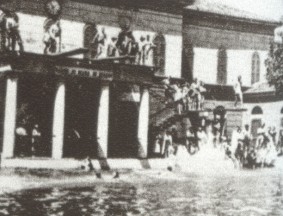
It is true that to eke out our meagre supply of films we used to take a minute or two between the change, and further, we had what was known as a reversing prism, and, after we had shown a film through, e.g., “The High Divers at Milan” (which was a very effective subject for the purpose), we would then rewind the film, put it through the machine backwards, and, by means of the prism, instead of the man diving into the water from the high diving boards, there would be a splash of water, out of which the man, feet foremost, would come and go back on to the diving board – in fact, the whole subject being reversed. This used to create not only great amusement but wonder as to how it was done, and used to help us very considerably in making our programme last out the necessary time. And if they applauded, well, on went the film a second time.

The Beginning of Renting

The price of films quickly dropped from 1s. to 8d. per foot, and then became standard at 6d. a foot; this allowed us to increase our store, but it soon became evident that to have to provide new films every time we took a repeat engagement was too expensive. So we conceived the idea, first of all, of an interchange of films with other exhibitors, who experienced the same difficulties in regard to new supplies. From this we eventually evolved the renting of films to other people, because we found that we had by far a larger stock than any of the other men. By buying films regularly we could use them ourselves and hire them to the other people, and so in such small beginning was evolved the great renting system as known to-day.

The First Woman Operator

At the end of 1897 we had three machines working. Walker operated one, myself the second, and the third was handled by Mrs. J.D. Walker, though a man went with her to fit up and do the donkey work. Mrs. Walker handled the mixed gas jet and operated, and she can claim without fear of contradiction to be the first woman operator in the world. She is still in business as managing director of the Empire cinema, Watford.

Was the redoubtable Mrs Walker the ‘first women operator in the world’? The evidence of the 1901 census, as reported in a recent post, shows that there were certainly other women operators around at the same time. More investigation is needed. ‘The High Divers of Milan’ is Les Bains de Diane à Milan (1896), Lumière catalogue no. 277, and is illustrated above. Reversing prisms, which were fitted onto the lens, were available from equipment suppliers at the time. They were used when film could not simply be reversed by cranking in the opposite direction i.e. the film had to be re-threaded in reverse, with the prism necessary to turn the image the correct way round. Is that a correct explanation, you experts out there?

Rats, ruffians and radicals

Ivor Novello

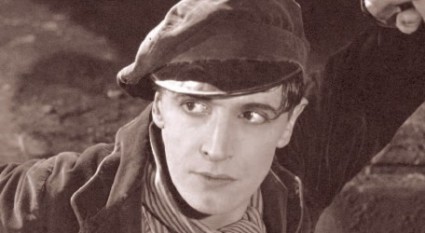
Ivor Novello in The Rat (1925), from http://www.britishsilentcinema.com

The 11th British Silent Cinema Festival will take place 3-6 April 2008 at the Broadway, Nottingham. The festival goes under the eye-catching title of Rats, Ruffians and Radicals: The globalisation of crime and the British silent film, and builds further on last year’s theme of crime by looking at international influences. A call for presentations has just been issued, and here it is:

In the second part of our examination of crime in the British silent film the 2008 British Silent Cinema Festival will branch out into the international arena of criminal influences. From the classic figure of the British detective, epitomised by Sherlock Holmes, to the prevalence of British actors as arch villains in US films, or the use of our cities as sites of criminal activity – British film and crime fiction have been widely exported, adapted and used by European and American cinemas. We will also be screening comparative crime films from the major film producing countries as context for British productions.

We particularly invite contributions on the classic, mythological and popular villains such as Sherlock Homes and Fu Manchu and the development of the detective as protagonist. Themes could include political crime, espionage, the White Slave Trade and drug trafficking, international anarchism and terrorist activity, crimes of passion, crimes of the street, domestic crime and criminal typologies. We will examine the film record for evidence of the import and export of crime through the migration of people from the late 19th Century onwards and the increasing globalisation of criminality.

Proposals are sought for 20-minute presentations on areas relevant to the main theme or any new research in the field of British silent film. All presentations should be illustrated and presenters are encouraged to contact Bryony Dixon at the BFI National Archive, to arrange viewing and selection of material at bryony.dixon [at] bfi.org.uk.

Deadline for submissions: January 31st 2008 to: laraine [at] broadway.org.uk

The British Silent Cinema Festival exists to promote the exhibition and study of British Cinema before 1930. It features screenings with live music, illustrated presentations, talks, debates, educational seminars and social events. Anyone is welcome to attend and to make a proposal for a contribution.

For more information or to be placed on our email or postal list please contact

Laraine Porter 00 44 (0) 115 952 6600, Broadway, 14-18 Broad St, Nottingham, UK, NG1 3AL,
laraine [at] broadway.org.uk.

The Festival is programmed and organised by Laraine Porter at Broadway, Nottingham and Bryony Dixon at the BFI National Archive.