Organized dreaming

One of the plans behind The Bioscope is to develop themes, or strands, one of which is memoir evidence of filmgoing in the silent era. There are still people around who can be intervciewed about cinema in the 1930s, and assorted oral history programmes exist, but for the earlier period, if we want to recover what the experience of going to the cinema was like, we must have recourse to memoirs, oral history recordings, or contemporary interviews.

I have collected a large number of quotations from memoirs of life in London before 1914 which have references to the cinema. One marvellous passage that I was not able to use in my research, simply because it comes from the north of England, is in Jack Common’s autobiographical novel Kiddar’s Luck (Turnstile Press, 1951). This is a classic memoir in any case, but his recollections of going to see films pre-World War One in Heaton, near Newcastle-on-Tyne, are observant and richly informative:

He [his father] still took me about with him on occasion. We had a more or less established practice on a mid-week night of the day-shift of going to a new entertainment called ‘the pictures’, or in older dialect, ‘the pictors’. This was a cheap night out for him. The pictures cost no more than a copper or two, and my presence preserved him from extensive drinking if he ran into any of his mates. He always did. The two of them would disappear into a pub, leaving me outside …

Because I was outside, my father had an excuse for the curtailing of good cheer which his economics as a raiser of young on a working-man’s wage was asking for. Soon we made our way from pub to picture-hall to be followed all in good time, by many millions born and unborn who were to find themselves propelled by the same reasons that moved us toward this organized dreaming in semi-darkness and drought.

We then get a vivid picture of the reality of the cinema performance, with the important observation about the transitional nature of the audience from the conviviality and sense of ownership inherited from music hall, to the future ‘threat’ of the Art of Cinema:

It wasn’t so very organized for us, of course. The hall was in fact, a shabby affair which must have been a mission at some time. It had no electric signs or elaborate foyers. There might have been a couple of posters, and there was an old woman sitting by the kerb selling little hard pears out of a soap-box on wheels. Inside, there was no ramp to the floor. The seating was forms or hard chairs linked in fives by planking. If you couldn’t see at the back, you stood up; if the people in front of you stood up, you climbed in to your seat. This happened in moments of culminating excitement when on the screen – but it had ceased to be a screen; it was events we all saw with our own eyes – the faithful dog panted over the last ridge with the message that meant reprieve in its collar, or the blood of the wounded hussar dripped through the trap-door on to the table at which his enemies stood. I yelled and stamped on my feet, and was often in danger of falling into the next row or knocking somebody’s hat off, all of which amused my father immensely. Most of the audience made some noise or other. You see, they were recruited from the music-hall and the melodrama; they had not yet learnt the separate and introverted enjoyment so proper to the Art of the Cinema. The fact that the pictures were silent gave everyone a natural right to comment as and when and how. They weren’t taking the mike out of the show, by any means, no. Films were still far too real for anybody to be cynical about them. It was the utterly convincing reality of these scenes which compelled us to behave as though we were at the point of joining in upon them.

Rare for memoirs of cinema-going at this time, he puts in something about the musical interludes that were a common feature of the first shows:

Half-way through there was a musical interlude during which patrons had time to withdraw for refreshment to the nearby boozer. The lights went up on a shallow stage behind a row of artificial flowers and ferns. At the side of that, a gramophone began playing. There was a great deal of shuffling in the rows as stout matrons in cloth caps and shawls and heavily moustached blokes in mufflers or celluloid dickies pushed their way out. Quite a lot of these worthies never returned. When that became apparent without a doubt there would be a scramble for better seats on the part of those who reckoned themselves unsuited. But for the while we waited until the slides came on. The gramophone struck up ‘When the Fields are White with Daisies, I’ll Return’, and the first slide showed on the screen as half the lights were dimmed. It showed a sailor taking leave of his sweetheart – upside-down because the operator had gone out for a drink, too, and his boy had taken over. As the gramophone scratched and hooted its way through the immortal ballad, we waited to cheer each new slide.

When the fields are white with daisies
And the roses bloom again –
Let the lovelight in your heart
brightly burn.

For I’ll love you, sweetheart, always,
So remember when you’re lonely –
When the fields are white with daisies,
I’ll return.

He concludes with some delightful memories of the ramshackle nature of the cinema show, and a reminder that not evertyone was totally in thrall to the silver screen:

At last, there was Jack with his kit-bag at the girl’s feet and very truly the fields were white with daisies. We all joined in the final chorus and cheered its conclusion. Yes, but where was the operator? Very likely, after an interval of general unease and peering about, that last slide would wriggle across the screen and be held through a complete repeat of the song. The second half of the programme was often bulked out with films we had seen before, or with old news-reel material rather grossly re-edited in the projection box. A popular item such as King Edward’s funeral got dished up in some very queer shapes as the continued ripping of sprocket-holes made more and more cuts necessary.We were well-satisfied. I used to describe the whole show to my mother afterwards, and it always annoyed me that she couldn’t be made to understand the magic of it. She thought it was some trick business, manifestly inferior to the theatre, that’s why it was so cheap.

Marvellous stuff. Look out for more in future posts – and hopefully not just from Britain.

Ford Sterling biography

Ford Sterling

http://www.amazon.co.uk

Ford Sterling is one of the forgotten comedians of the silent era, known if at all as the Keystone comedian whose brief star was eclipsed by the arrival of Charlie Chaplin. A new biography by Wendy Warwick White (presumably the first devoted to Sterling) ought to do much to overturn assumptions and revive his reputation. Blurbs for the books indicate that he left behind a comfortable, middle-class childhood to journey via circus, vaudeville, burlesque, Shakespeare and Broadway to achieving fame as a silent film comedian. His film career was not ended by Chaplin’s rise, instead he became a successful character player and made a successful transition to sound. He was a cartoonist, photographer, and became a millionaire. But this once famous figure has been left aside by history. Sterling’s films are probably only ever going to be of interest to the specialist now, but this sounds like a personal history well worth recovering. Ford Sterling: The Life and Films is published by McFarland.

Colleen Moore

There’s an attractive and interesting new site on the American film actress of the 1920s, Colleen Moore, which has just started up. www.colleenmoore.org has been created by Jeff Codori, and it’s an interesting mixture of fan site and research project, with the author aiming to produce a biography, to help in the process of which he is publishing his findings on the site and calling on readers to supply information (especially local history research). It all has a work-in-progress feel and it’s interesting to see the ideas in development and where they might go. There’s fascinating stuff there already, particularly on her family history, and some beautiful images.  Bits of the site are still under construction, and a filmography would be welcome. Take a look.

Return to Croydon

In posts on 23 and 24 February I highlighted the story of Croydon Public Library’s unexpected role as an innovator in film archiving, before the First World War. I should have checked the literature, because the story has been uncovered before, by the film historian Stephen Bottomore, who wrote a chapter on early calls for film museums in the marvellous history of nitrate film, This Film is Dangerous: A Celebration of Nitrate Film (ed. Roger Smither, FIAF, 2002). Bottomore uncovered a reference in The Bioscope journal (26 May 1910, p. 3) to Croydon having established the film collection in 1910. The report I found dated from 1914, so this proto-regional film archive existed for four years at least. Originally the films were projected at the library should anyone need to see them, but later a viewing device was created by a local engineer. However, what is significant about the Croydon initiative is not just that it was such an early attempt to form a publicly-accessible film collection, but that it was argued for as a civic duty, fulfilling a local need, and seen alongside other media that were appropriate for a local authority to be funding as part of its library services.

Bottomore’s essay (‘”The sparkling surface of the sea of history” – Notes on the Origins of Film Preservation’) has a huge amount of information on the calls to preserve films and to create national film museums which arose almost as soon as films were invented.

Cinematograph Films: Their National Value and Preservation

We intend to have a series of posts on The Bioscope highlighting some key texts in our field which are being made freely available online, through transcription or digitisation. In particular we will be highlighting documents available from the Internet Archive. This is a superb source of downloadable documents, images, software, audio and video, as well as ‘archiving’ the Internet itself, to a degree, made accessible through its Wayback Machine.

Suitably following on from the recent posts we have had on the early history of film archives, the first text is Alex J. Philip, Cinematograph Films: Their National Value and Preservation (London: Stanley Paul & Co. 1912). This booklet is a call for the preservation of films as historical records. It argues the necessity of making visual records of our time for the benefit of future generations, not just of major historic events but of the arts, crafts and customs of the nation which one day must pass. After giving a short history of the development of the cinema, and in particular the Kinemacolor system devised by Charles Urban and G.A. Smith, Philip makes practical proposals for a National Cinematographic Library. He considers selection, preservation, film handling, classification, and cost (£20,000, “a mere bagatelle for a national institution”), and indicates that Urban had made a “munificent offer” to present his Kinemacolor films to the nation, were such a library to be created. There is something particularly tragic about this, given that the vast majority of Urban’s Kinemacolor films are now lost. Philip was a librarian, and his arguments are generally that looking after films will be little different to looking after books. There is no mention of the fire hazard presented by nitrate film. He also proposes matching motion picture records to sound recordings, with particular reference to a Voice Museum established at the Paris Opéra in 1907.

It is an idealistic document, well worth reading (it was originally published in the journal The Librarian). Philip makes mention of fiction films as a new phenomenon, but says he is not concerned with “the reproduction of enacted scenes”. It is curious, given the calls for the preservation of actuality films as historical records made at this time, that it was not until dramatic films came to be valued by the intelligensia that the first national film archives were seriously mooted, eventually appearing for the first time in the early 1930s.

The booklet is available in DjVu format (1.2MB), PDF (3.7MB) or plain text (29KB).

Chaplin – listen again

chaplin.jpg

Charlie Chaplin

The Mark Kermode Radio 3 programme Chaplin, Celebrity and Modernism was excellent. It pursued the thesis of Chaplin as subversive everyman, beloved by not just by cinema audiences, but by modernists, Dadaists, surrealists, politicians, writers and fellow filmmakers. Kermode admitted that, in common with many modern critics, he had dismissed Chaplin as a sentimentalist, inferior as a film artist to Buster Keaton. Instead, he discovered Chaplin’s essential role as a figure (there was much emphasis on his body) of modernism. You got a real sense of a need to rediscover Chaplin as one of the key figures of the twentieth-century, given all that he meant to society and the worldwide broadcasting of images and ideas. That said, Chaplin is an everyman figure no more, despite his image being used in advertising around the world. So our everymen change, and that is part of his significance too.

Contributions from David Robinson, Mike Hammond, Tom Gunning, David Thomson, Michael Chaplin, Geraldine Chaplin and comedian Mark Steel. It will remain available online for the next week through the Listen Again service. Don’t miss it.

Beginnings

Carl Louis Gregory

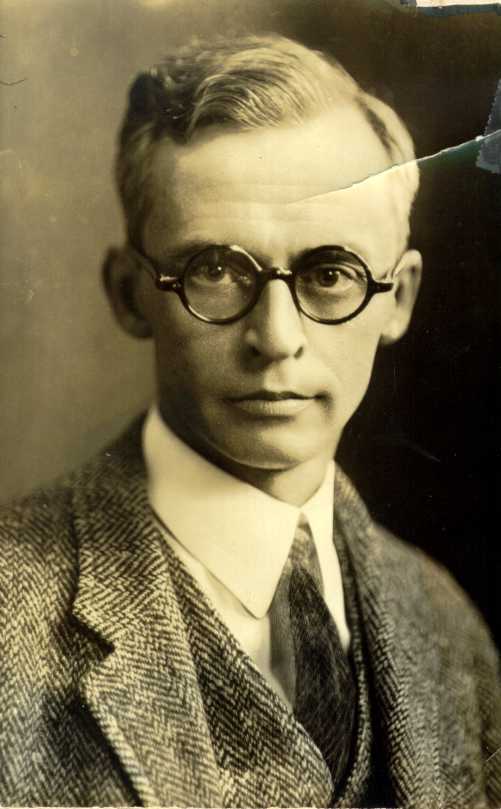
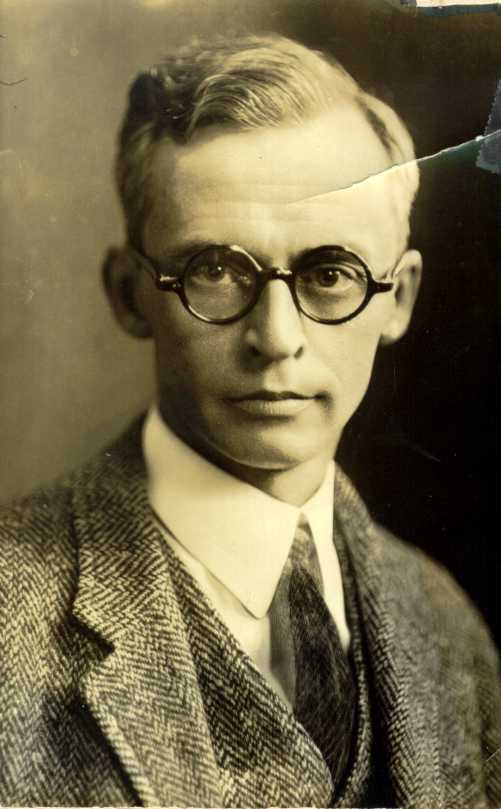
The History of Film Archives is as interesting as the contents of each individual repository. The Library of Congress Motion Picture Division was driven by a fortuitous series of events which led to its development. By locating material originally meant to be copyright deposit records, the Library found itself in the possession of a good segment of film history from 1894-1912. Copyright clerk Howard Walls who is credited with this discovery of what has become known at the Library’s “Paper Print Collection” was put in touch with pioneering cinematographer Carl Louis Gregory (illustrated) in 1943, who had actually produced some of the paper prints he was asked to copy back to celluloid. At the time Gregory was motion picture engineer for the U.S. National Archives. Gregory had developed an optical printer for shrunken and damaged and he modified it in order to reprint this delicate material.

The National Archives Motion Picture Division began in the mid-1930s and was the first U.S. Government institution to have as part of its mandate, “the Preservation of Motion Picture Film”. Members of the Society of Motion Picture Engineers Preservation Committee met several times in order to assist the National Archives in developing standards for the handling and care of motion picture film. As a matter of fact, three of the pioneering members of the Archives Motion Picture Division (John G. Bradley, Herford T. Cowling and Carl Louis Gregory) were all members of this S.M.P.E Preservation Committee.

It helps remind us that many events have conspired for and against preservation of these historic images. The foresight of many pioneers have allowed us the opportunity to revisit our film heritage.

Silent film blogs

What silent film blogs are there out there? I’ve not been able to find many specifically devoted to the subject. Here they are:

Cartoons on Films (http://cartoonsonfilm.blogspot.com) (mostly silent animation)

Ferdinand von Galizien (http://ferdinandvongalitzien.blogspot.com) (silent film reviews, warmly recommended)

Louise Brooks (http://louisebrooks.livejournal.com) (anything and everything on the 1920s screen icon)

The Silent Majority (http://silentmajority.tribe.net) (directory of discussion lists)

And one for screen entertainments of an earlier age:

The Magic Lantern Show (http://magiclanternshows.blogspot.com)

Surely there must be more. Any suggestions?

New section added

The Bioscope is one month old today, and I have now added a new section, Lists. This will contain filmographies and similar listings on early and silent cinema subjects. The first filmography put up is on the silent films of Alfred Hitchcock. Any ideas or contributions for this section will be very welcome.

Chaplin, celebrity and modernism

There a programme in the Sunday Feature slot on BBC Radio 3 tonight (21.30 GMT), called Chaplin, Celebrity and Modernism. Thirty years after Chaplin’s death, Mark Kermode investigates the great comedian’s celebrity role and influence on world culture from the modernists and Dadaists to the Russian avant-garde and imitators in Bombay. The 45-minute programme makes use of privileged access to Chaplin’s private archive to reveal remarkable letters from Truman Capote, Winston Churchill and James Agee. As usual with BBC radio programmes, it can be listened to worldwide online, and will remain available for a week thereafter through the Listen Again service.