Turn up the gramophone

phonofilm

Projecting with the De Forest Phonofilm system, from The Gramophone, March 1927

It’s been a while since we’ve been able to bring you news of digitised newspapers or journals accessible online, but here’s a treat for the new year. The Gramophone, the esteemed classical music journal, has just put up in its entire archive since 1923.

It’s searchable by keyword, date range and type of item, with results refinable by decade. So searches can be narrowed to the 1920s, and there is plenty on silent cinema for us to investigate. Search results give you the item title, the first few lines, date and page number. Individual items then give you a PDF of the page (though it is necessary to register first to access these), with the option to browse further through that issue, and the OCRed text (with the occasional wobble in the character recognition). It is very easy to use,with an array of handy extras you can explore for yourselves. How it was paid for, it doesn’t say, but the service is free.

So, what will we find on silent films in The Gramophone? A surprising amount, if sometimes tangentially expressed. A good example is this piece by J.B. Hastings, from April 1925, entitled ‘The Gramophone and Film Music’, on how cue sheets were put together:

The average person will be astonished to find how much time and trouble are spent in fitting suitable music to film plays. But the big film companies have come to realise that a really good picture play can be ruined by the accompaniment of inappropriate music, and, incidentally let me whisper, they have found that even a feeble production can be made fairly, tolerable by the ingenious use of the orchestra. So, with each super film, is issued a list of ” musical suggestions,” complete with the cues and signs necessary to fit the various selections to the screen action. In many cases the actual full music score, timed to a note, is hired out with the film. Since I have had the experience of compiling a large number of such lists—I forget whether the exact number runs into millions or merely thousands—perhaps I may be permitted to indicate here how it is done.

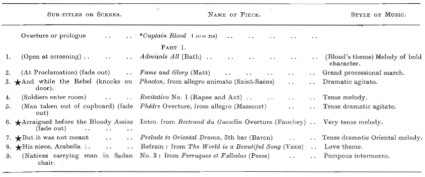
The film is projected in the cinema company’s private theatre and there I see the film with an assistant—and a stop watch. From the moment the first scene starts I am literally thinking in music. With a love scene I try to imagine just that type of sentimental melody that will exactly fit the picture, and move on in sympathy with it. A fight—then I endeavour to find an “agitato” of a tempo that will synchronise as near as possible with the speed and tensity of the film. Dramatic situations, storms, fires, sea scenes—all call for special treatment. As the film goes through, the “changes” are noted either by the sub-titles that precede them, or action on screen. In illustration of this I reproduce here a fragment of a typical “musical suggestions” sheet.

cuesheet_gramophone

The first column contains the cues, column 2 the music and composer, column 3 the style of the piece. Those cues marked with a (*) are the opening words of the sub-titles. Brackets indicate action on screen. Both types of cue indicate a change in the action or tempo. No. 9, for instance, shows a quick change from a quiet appealing melody to a pulsating allegro. It will be easily seen that a cinema orchestral leader must be on the alert the whole time. It might almost be said that he must work with one eye on the screen and the other on his music.

Many big photoplays call for a great number of “changes”—absolutely essential if the resultant entertainment is to be perfect. One of the most difficult films I have ever had to “fit” is Captain Blood, which is now showing throughout the country.

Mr. Rafael Sabatini’s story is so full of action and varying moods, and has been filmed with such faithfulness that no less than seventy changes are necessary, though this does. not mean seventy different selections. The chief “themes” in this story are (a) love; (b) dramatic; (e) sea battles and (ci) the “Captain Blood” theme itself. All these are there in various shades and emphasis.

As an introduction we start with the Captain Blood song, specially written as an overture or prologue. This is followed by Admirals All (Hubert Bath) and is used, in all, in eight different places.. For the love theme I have chosen The World is a Beautiful Song (Vane), and the principal seafighting scenes, Beethoven’s King Stephen overture from “presto,” varying this with various “incidental symphonies” specially written for film use.

Here is an extract from the music which I have fitted to the comparatively quiet first reel of Captain Blood:

cuesheet_gramophone2

Compare this with the smashing character of the music towards the end, when the terrific battle of Port Royal, Jamaica, is introduced. Here you will notice indication of “effects”.

cuesheet_gramophone3

Naturally, many cinemas cannot, for various reasons, follow the “official” musical suggestions in their entirety, especially as it is only in cases of exceptional films like Captain Blood that the complete score, correctly numbered and marked, can be hired from the film company.

No orchestra library under the sun can hope to contain every composition that may be wanted; and no musical director knows off-hand the exact nature of every composition in existence. It is here that the gramophone is so useful. When he finds himself “stuck” for a suitable number the musical director can always turn to the gramophone for guidance as to the style and tempo of any selection, the title of which seems to indicate possibilities. Moreover, many cinema orchestral leaders, to my knowledge, gain valuable hints from the reviews of records and music published in THE GRAMOPHONE.

In conclusion, I would say that the modern super-cinema, with its often excellent orchestra, together with the great study given to the musical side of films by cinema companies, is having a marked effect upon the musical taste of the British public.

What with this and broadcasting—both tending to familiarise the “Man in the Street” with all that is best in music—it is not surprising that the gramophone firms are experiencing what can most aptly be termed “a record boom.”

And, briefly, an editorial from April 1929 casts an interesting light on payment for musical accompaniment in cinemas, in this case involving the future composer of many a British film score, Malcolm Sargent:

Dr. Malcolm Sargent, at the age of thirty-three, has just refused to play the cinema organ for half an hour every day at 12s. 9d. a minute. This shows a more genuine horror of the instrument than even I could have fancied possible in these days of hard struggling for economic existence. What puzzles me, however, even more than Dr. Sargent’s devotion to art is why it should be worth while for a West End cinema theatre to pay £7,000 a year to any man, whatever his acrobatic and musical ability, to play their organ three times daily throughout the year for ten minutes at a session. I really should very much like to know the name of the cinema theatre which was prepared to offer this price, and I think Dr. Sargent owes it to his professional brethren with lower ideals than himself to reveal the name…

And there’s much more to discover, including some fascinating material on the coming of sound, as the illustration of the De Forest Phonofilm system at the top of this post indicates. Just type in ‘cinema’ or ‘film’ as a keyword, and start browsing.

National Film Registry

foolish_wives1

Foolish Wives, from http://www.kino.com

Twenty-five films have been announced as being added to the National Film Registry. Each year the Librarian of Congress, with advice from the National Film Preservation Board (and with recommendations made by the public), names twenty-five American films deemed “culturally, historically or aesthetically” significant that are to be added to the National Film Registry, “to be preserved for all time”. The idea is that such films are not selected as the “best” American films of all time, but rather as “works of enduring significance to American culture”.

These are the silents (excluding amateur films) included among the list just announced, which they describe as follows:

Foolish Wives (1922)
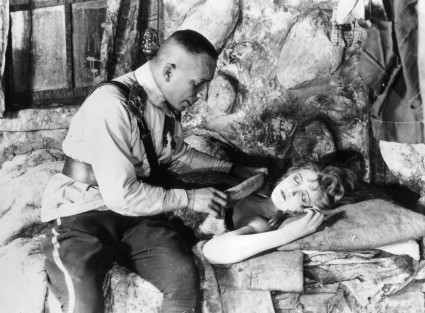
Director Erich von Stroheim’s third feature, staged with costly and elaborate sets of Monte Carlo, tells the story of a criminal who passes himself off as a Russian count in order to seduce women of society and steal their money. This brilliant and, at the time, controversial film fully established von Stroheim’s reputation within the industry as a challenging and difficult-to-manage creative genius.

One Week (1920)
“One Week” is the first publicly released two-reel short film starring Buster Keaton. One of Keaton’s finest films and one of the greatest short comedies produced during the 1920s, the film, as critic Walter Kerr noted, shows Keaton as “a garden at the moment of blooming.” Considered astonishingly creative even by contemporary standards, “One Week” is rife with hilarious comic, often surrealist, sequences chronicling the ill-fated attempts of a newlywed couple to assemble their new home.

The Perils of Pauline (1914)
“The Perils of Pauline” was among the very first American movie serials. Produced in 20 episodes, in a groundbreaking long-form motion-picture narrative structure, the series starred Pearl White as a young and wealthy heiress whose ingenuity, self-reliance and pluck enable her to regularly outwit a guardian intent on stealing her fortune. The film became an international hit and spawned a succession of elaborate American adventure serial productions that persisted until the advent of regularly scheduled television programs in the 1950s. Although now regarded as a satirical cliché of the movie industry, “Perils of Pauline” in its day inspired a generation of women on the verge of gaining the right to vote in America by showing actress Pearl White performing her own stunts and overcoming a persistent male enemy.

So’s Your Old Man (1926)
While W.C. Fields’ talents are better suited for sound films — where his verbal jabs and asides still delight and astound — Fields also starred in some memorable silent films. Fields began his career as a vaudevillian juggler and that humor and dexterity shines through in “So’s Your Old Man.” The craziness is aided immeasurably through the deft comic touches of director Gregory LaCava. In the film, Fields plays inventor Samuel Bisbee, who is considered a vulgarian by the town’s elite. His road to financial success takes many hilarious detours including a disastrous demo for potential investors, a bungled suicide attempt, a foray into his classic “golf game” routine and an inspired pantomime to a Spanish princess.

White Fawn’s Devotion (1910)
James Young Deer is now recognized as the first documented movie director of Native American ancestry. Born in Dakota City, Neb., as a member of the Winnebago Indian tribe, James Young Deer (aka: J. Younger Johnston) began his show-business career in circus and Wild West shows in the 1890s. When Pathé Frères of France established its American studio in 1910, in part to produce more authentically American-style Western films, Young Deer was hired as a director and scenario writer. Frequently in collaboration with his wife, actress Princess Red Wing (aka: Lillian St. Cyr), also of Winnebago ancestry, Young Deer is believed to have written and directed more than 100 movies for Pathé from 1910-1913. Many details of Young Deer’s life and movie career remain undocumented and fewer than 10 of his films have been discovered and preserved by U.S. film archives.

For the record, the other titles on the list are The Asphalt Jungle (1950), Deliverance (1972), Disneyland Dream (1956), A Face in the Crowd (1957), Flower Drum Song (1961), Free Radicals (1979), Hallelujah (1929), In Cold Blood (1967), The Invisible Man (1933), Johnny Guitar (1954), The Killers (1946), The March (1964), No Lies (1973), On the Bowery (1957), The Pawnbroker (1965), Sergeant York (1941), The 7th Voyage of Sinbad (1958), George Stevens WW2 Footage (1943-46), The Terminator (1984), Water and Power (1989).

The full list of films entered on the National Film Registry since 1989 can be found here, while this is the list of all silents on the Registry 1989-2007:

Ben-Hur (1926)
Big Business (1929)
The Big Parade (1925)
The Birth of a Nation (1915)
The Black Pirate (1926)
Blacksmith Scene (1893)
The Blue Bird (1918)
Broken Blossoms (1919)
The Cameraman (1928)
The Cheat (1915)
The Chechahcos (1924)
Civilization (1916)
Clash of the Wolves (1925)
Cops (1922)
A Corner in Wheat (1909)
The Crowd (1928)
The Curse of Quon Gwon (1916-17)
Dickson Experimental Sound Film (1894-95) [not strictly a silent, of course]
The Docks of New York (1928)
Evidence of the Film (1913)
The Exploits of Elaine (1914)
Fall of the House of Usher (1928)
Fatty’s Tintype Tangle (1915)
Flesh and the Devil (1927)
The Four Horsemen of the Apocalypse (1921)
The Freshman (1925)
From the Manger to the Cross (1912)
The General (1927)
Gertie the Dinosaur (1914)
The Gold Rush (1925)
Grass (1925)
The Great Train Robbery (1903)
Greed (1924)
H20 (1929)
Hands Up (1926)
Hell’s Hinges (1926)
The Immigrant (1917)
In the Land of the Head Hunters (1914)
Intolerance (1916)
It (1927)
The Italian (1915)
Jeffries-Johnson World’s Championship Boxing Contest (1910)
The Kiss (1896)
Lady Helen’s Escapade (1909)
Lady Windermere’s Fan (1925)
Land Beyond the Sunset (1912)
The Last Command (1928)
The Last of the Mohicans (1920)
The Life and Death of 9413 – A Hollywood Extra (1927)
The Lost World (1925)
Making of an American (1920)
Manhatta (1921)
Matrimony’s Speed Limit (1913)
Mighty Like a Moose (1926)
Miss Lulu Bett (1922)
Nanook of the North (1922)
Pass the Gravy (1928)
Peter Pan (1924)
Phantom of the Opera (1925)
The Poor Little Rich Girl (1917)
Power of the Press (1928)
President McKinley Inauguration Footage (1901)
Princess Nicotine; or The Smoke Fairy (1909)
Regeneration (1915)
Rip Van Winkle (1896)
Safety Last (1923)
Salome (1922)
San Francisco Earthquake and Fire, April 18, 1906 (1906)
Seventh Heaven (1927)
Sherlock Jr. (1924)
Show People (1928)
Sky High (1922)
The Son of the Sheik (1926)
Star Theatre (1901)
The Strong Man (1926)
Sunrise (1927)
Tess of the Storm Country (1914)
There it is (1928)
The Thief of Bagdad (1924)
Tol’able David (1921)
Traffic in Souls (1913)
The Wedding March (1928)
Westinghouse Works, 1904 (1904)
Where Are My Children? (1916)
Wild and Wooly (1917)
The Wind (1928)
Wings (1927)
Within our Gates (1920)

It’s festival time again

filmcans_banner

We see out 2008 with a reminder that the Bioscope Festival of Lost Films returns on Monday 5 January and runs for five days. The five films (with accompanying shorts) have now been selected, after rigorous checks by our team of researchers to ensure that none exists in any archive around the world. No clues about what will be shown, but we can guarantee a star or two, some surprises, and a touch of controversy.

filmcan1

We can, however, give some organisational details for those who want to plan ahead. For a start, there are the venues. As was the case last time, each is a building that was cinema in London in the silent era, but now has either turned to other uses or is simply no more. They have been chosen for their distinctiveness and for their variety. So, our festival venues will be:

  • The Theatre de Luxe – small but luxurious cinema in the Strand, established in 1908 as one of London’s first cinema circuit, formed by Electric Theatres (1908) Ltd., and now a branch of Optical Express
  • The Jardin de Paris – a select venue in the heart of Soho, opened in 1909, closed in 1916, its space now occupied by a hotel
  • Wonderland – Whitechapel’s notorious home of Yiddish theatre, boxing bouts and freak shows, which also put on film shows and burned down in 1911
  • Pyke House Cinematograph Theatre – a grand building at the east end of Oxford Street, once the centrepiece of the famed Pyke circuit, now a Waterstone’s bookshop
  • The Picture House – located at 161-167 Oxford Street, one the site of where a Hale’s Tours of the World show once ran, and where the Academy Cinema of fond memory was to stand until recent times, and which is now a Marks & Spencer store

filmcan1

For those of you planning to stay over in London for the festival, we would like to recommend the Savoy, conveniently located in the Strand close by our opening venue, the Theatre de Luxe. Discount rates are available for festival attendees who are able to stay five nights and can bring an empty can of film to the hotel desk as evidence of your intentions (please call the hotel for details). For those who may find that the cost of the Savoy a little steep (particularly if it comes on top of any steamship costs for those travelling from overseas), we have done a special deal with a number of humbler establishments along Gower Street in Bloomsbury, within stout walking distance of most of our venues. Call the festival office (you know the number) for more details.

filmcan1

Prices are 6d, 3d and 1d for standing at the back, with a special ha’penny ticket for children (please note that some of the films we will be showing may not be suitable for younger eyes – contact the festival office for further information). You will realise, therefore, that we have kept our prices fixed for well nigh a century, which is quite a bargain in these straitened times. Boxes are a shilling per person, to a maximum of four. Festival notes will be provided on the night, and we hope that you will make the most of your time with us to visit the sights of this great city. For eating out, we naturally recommend the Strand’s best-known restaurant, Romano’s, evocatively described here, even if today it is the home of Stanley Gibbons, the stamp emporium.

filmcan1

For those who may be new to this unique event in the film calendar, please be aware that the Bioscope Festival of Lost Films is a celebration of silent films that were shown once but can be seen no more. All of the films, though they may be described in such realistic detail that they may appear irresistibly before your eyes, no longer exist. All that we can do is peruse those documents which record their presence, study the extant images, exercise our imaginations, and sigh.

Do join us on Monday.

Music, maestros, please

horneandhound

Stephen Horne accompanying The Hound of the Baskervilles (1921), from http://www.stephenhorne.co.uk

Stephen Horne, one of the UK’s premier silent film pianists, has just published his website, www.stephenhorne.co.uk. To mark the occasion, I thought it would be interesting to produce a round-up of silent film musicians’ websites, where you can find out what industrious lives they lead, listen to sound samples, and maybe purchase a DVD or two.

Alloy Orchestra
The three-man Alloy Orchestra (Terry Donahue, Ken Winokur, Roger Miller) are among the best-known of silent film accompanists, though their ‘aural onslaught’ of electronica and found percussion is controversial for some. Their site includes details of the films they have accompanied, touring shedule, CD and DVD store, reviews, information about the instruments they use, and video clips with their scores from Blip.tv (One Week, The Lost World, The Unknown, Manslaughter etc) so you may judge for yourselves.

Elizabeth-Jane Baldry
Elizabeth-Jane Baldry is a harpist, particularly expert in Victorian fairy harp music. She has recently branched out into accompanying silent films, and there is a section of her site devoted to her silent film work, alongside other professional information, including her own filmmaking work.
neil-with-laurel-hardy

Neil Brand with friends

Neil Brand
Probably the best-known improvising silent film pianist working today, Neil Brand is also a playwright, actor, composer, scholar and eloquent advocate for the art of silent film in general. His website covers his musical and writing biographies, with news, reviews, and events calendar. There is a radio interview with Neil available (from 2000) and audio extracts from some of his scores (including Diary of a Lost Girl, The Ring and his recent orchestral score for Hitchcock’s Blackmail).

Timothy Brock
Timothy Brock is a conductor and composer specialising in concert works of early 20th-century music and silent films. His site gives details of his original silent film scores (Nosferatu, Lady Windermere’s Fan, Sherlock Jr. etc.) and restored scores (The Gold Rush, A Woman of Paris, City Lights etc.), images, news, articles and events calendar.

Robert Bruce
Composr and pianist Robert Bruce includes silent film performances in his repertoire, particularly the films of Buster Keaton. His site includes video clips of his live performances.

Günter Buchwald
Günter Buchwald is a pianist and violinist as renowned for his accompaniments alongside other silent film musicians as he is for his solo accompaniments. He often works as a duo with percussionist Frank Bockius or pianist Neil Brand, or with the Silent Movie Music Company as a trio or quartet. His site (in German) gives repertoire, reviews and events calendar.

Philip Carli
Phil Carli is a silent film accompanist, musicologist and film archivist. He has made special study of film, music and culture of the late 19th/early 20th centuries, and conducts the Flower City Society Orchestra of Rochester, New York, which is modeled on the ‘society orchestras’ that entertained guests in upper-class restaurants and resorts at the turn of the last century. His website covers this and his silent film work, including a list of broadcasts and DVD releases with his scores (including Regeneration, Sally of the Sawdust, Stella Maris etc.).

Club Foot Orchestra
Radical San Francisco ensemble which has come to specialise in silent film accompaniments. The site covers the films it has scored (Nosferatu, Pandora’s Box, The Hands of Orlac etc.) with links to CDs/DVDs where available.

Antonio Coppola
Italian pianist Coppola is a silent film accompanist of long-standing and high repuation. His site (in Italian, English and French) has a short biography and a long list of film directors (surname only) whose work he has played to.

carldavis

Carl Davis

Carl Davis
Composer and conductor Carl Davis is the best-known of all silent film musicians, for his work with Kevin Brownlow and Photoplay Productions, which did so much from the 1980s onwards to revive interest in silent films with live orchestral accompaniment, most notably his epic score for Abel Gance’s Napoleon. His site, however, does not dwell much on the past and is mostly interested in upcoming events, which continue to include silent films accompaniments with orchestra (notably Chaplin).

Devil Music Ensemble
Boston trio comprising Brendon Wood (guitars, lap steel, synthesizer), Jonah Rapino (electric violin, vibraphone, synthesizer) and Tim Nylander (drums, percussion, synthesizer). The group’s many forms of music performance include silent film accompaniments (Dr Jekyll and Mr Hyde, Nosferatu etc.), for which they provide video clips.

David Drazin
David Drazin is among the most prolific and praised of American silent film accompanists. His web page lists the main films he has accompanied, plus some information on his jazz, ballet and modern dance music work.

Arthur Dulay
Arthur Dulay (1891-1971) is perhaps the only silent film accompanist of an earlier generation to have website dedicated to him. Dulay played for silents from 1908, and late in his career as a musician in the 1950s he became resident pianist for the accompaniment of silent films at London’s National Film Theatre. The site includes sound samples of his work and a radio interview, as well as samples of his other musical work.

Costas Fotopoulos
London-based composer, arranger, silent film and jazz pianist, who regularly plays to silents at the BFI Southbank and the London Film Festival. His site has background information on the various aspects of his career, including silent filmwork, with a news section listing his silent film performances.

Gerhard Gruber
Composer and pianist Gerhard Gruber is Austria’s leading silent film pianist. His site includes testimonials, a repertoire list, links to festivals where he has played and to sound and video excerpts (including A Page of Madness). Much the same material also appears in a blog, silentfilm.wordpress.com, and on another site, www.silentmovie.eu.

hesperus

Hesperus

Jean Hasse
Hasse is an American composer based in the UK whose works includes silent film scores and accompanying silent films. The Visible Music site that she shares with other composers includes a list of the films for which she has composed scores with some short clips and some background information including her thoughts on composing for Faust.

Hesperus
Hesperus is a five-member ensemble with overlapping membership which performs a fusion of early and traditional styles from a variety of cultures. Its silent film work has included Robin Hood with English Renaissance music, The General with American Civil War music, and The Hunchback of Notre Dame with French medieval music. Its website is under construction, but there is information on its work at Class Acts on Tour.

Frederick Hodges
Pianist Frederick Hodges specialises in American songbook material from the 1920s and 1930s. His extensive silent film work incldes DVD recordings for Image Entertainment, Flicker Alley and Unknown Video, and his site has an informative page on silent film music and musical sources.

Stephen Horne
Stephen Horne has come to prominence recently, in particular for his scores for A Cottage in Dartmoor and The Battle of the Somme. His stylish site includes a short biography (he is a regular dance accompanist and has written screenplays), list of live dates, gallery and reviews. He can also boast a Facebook fan group, We’re in love with Stephen Horne.

In the Nursery
Rock band In the Nursery (ITN), headed by the twins Klive and Nigel Humberstone, have branched out into silent film scores for live performance and as DVD and CD releases. Their work includes Man with a Movie Camera, Hindle Wakes, the Electric Edwardians compilation and most recently The Passion of Joan of Arc. Their site includes discography, biography, reviews, films details, and MP3 downloads for purchase.

dennisjames

Dennis James

Dennis James
American Dennis James has accompanied silent films with piano, chamber ensemble and full symphony orchestra, but is probably best known for his theatre organ accompaniments, for which is perhaps the world’s leading exponent. His web page has a biography and list of engagements.

Jan Kopinski
British saxophonist Jan Kopinski is best-known for his radical jazz ensemble Pinski Zoo. With pianist Steve Iliffe he performs original compositions to silent films, including Earth, Berlin: Symphony of a Great City and The Seashell and the Clergyman. His site covers his various muscial outputs, with audio samples and video clips (including Earth and Nosferatu in performance).

Gary Lucas
Experimental guitarist Lucas, best known for his work with Captain Beefheart and Jeff Buckley, is perhaps the person from the rock music world most dedicated to silent films. He has played his scores for Sounds of the Surreal (three films by Clair, Leger and Starewicz) and Der Golem at numerous venues, and in 2009 produced scores for J’Accuse and The Unholy Three.

Donald Mackenzie
Mackenzie is the cinema organist at the Odeon Leicester Square, in the heart of London’s West End cinemas. He has accompanied silents at the Odeon and at venues across Britain and Europe, and includes many of the classics in his repertoire, among them The Phantom of the Opera, Dr Jekyll and Mr Hyde, The King of Kings, Carmen, The Black Pirate, Metropolis and Nosferatu. His site includes a biography and details of the Odeon’s cinema organ.

Eunice Martins
German composer and improvising pianist Eunice Martins has played at numerous silent film events. Her site includes her extensive repertoire, photographs and upcoming schedule.

Makia Matsumura
Composer, pianist and silent film accompanist who has played to silents in New York, Tokyo and Pordenone and accompanies Within the Law (1923) on the Kino DVD release. Her website has biographical information.

Minima
Minima are a British-based band which performs live accompaniments to silents and avant-garde film at cinemas, art festivals and music festivals. Their repertoire includes The Lodger, Nosferatu, Aelita and The Seashell and the Clergyman. Their website includes a performance calendar and a compilation video.

Jon Mirsalis
Jon Mirsalis is a film buff extraordinaire, a silent film pianist, and a leading bioscientist. This web page, which provides biographical details, is modestly tucked away as part of his Lon Chaney website.

Ben Model
The proud possessor of http://www.silentfilmmusic.com is the resident silent film accompanist for The Museum of Modern Art in New York. Model plays piano, theatre organ and a virtual theatre organ called the Miditzer. His site includes performance schedule, scores on DVD, and details of his orchestral scores. Model has also pioneered the idea of producing alternative scores to DVD releases of silent films as MP3 downloads, from his altscore.com site, and has a blog, Silent Film Music.
montaltoorchestra

The Mont Alto Orchestra

The Mont Alto Motion Picture Orchestra
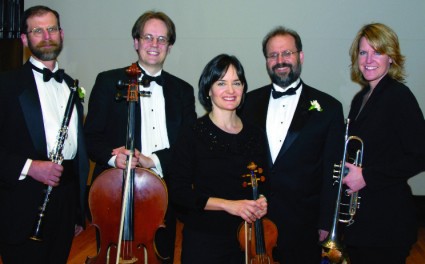
Mont Alto, led by Rodney Sauer, is an American five to seven piece chamber ensemble that recreates the small local orchestras popular in America from 1890 through to 1930. The ensemble has become well known for its many silent film scores for video and DVD releases, particularly for Film Preservation Associates and Milestone Video. Its site provides detailed information on the films for which it has provided scores (with some audio files), a schedule of its forthcoming silent film accompaniments and dances, and useful information for the general enquirer about silent film music of the period and today.

Michael Mortilla
Michael D. Mortilla is a composer, orchestrator and performer, who has produced hundreds of scores for film, television, dance, theatre, silent film, magic, mime, industrials, commercials, special events and the concert stage. The silents work has included Harry Houdini’s The Master Mystery serial and Chaplin Mutuals, and he has performed at many American silent film festivals. His site documents his many different activities.

Maud Nelissen
Dutch composer and pianist Maud Nelissen has performed for the Nederlands Filmmuseum, the Film in Concert Foundation and various festivals. She leads the six-member group The Sprockets, which has specialised in accompanying silent comedies (Chaplin, Keaton, Laurel and Hardy). Her scores for The Patsy and The Merry Widow (a combination of Léhar’s music and her own) are performed by the Orchestra da Camera Oscura, and the Asta Harmonists play her music for Asta Nielsen films. Her impressive website covers all facets of her musical career and includes silent film video clips.

Maria Newman
Daughter of the renowned Hollywood composer Alfred Newman, Maria Newman has produced scores for silents for the Mary Pickford Foundation and Turner Classic Movies. Information on her work can also be found in her entry on GarageBand.com.

panoptikon

The Panopikon Orchestra

The Panoptikon Orchestra
Panoptikon is a Swedish ensemble (trio), led by Matti Bye, that plays music for silent films, both precomposed scores and improvised music, using both traditional and modern instruments. Its site provides background information on the ensemble, a list of records and videos,with some audio samples (Joyless Street, The Phantom Carriage) and general news.

William Perry
William Perry is an American composer and television producer. His wide-ranging musical career has included many scores for silent films during twelve years as music director and composer-in-residence at the Museum of Modern Art in New York. His television series, The Silent Years (1971, 1975) starring Orson Welles and Lillian Gish, won an Emmy Award. His site gives basic biographical information.

Forrester Clifton Pyke
Forrester Pyke is a composer, teacher, church organist and silent film accompanist. He is based in Scotland and has played to silent films at the Filmhouse Edinburgh and Glasgow Film Theatre and compaosed scores for Scottish Screen Archive films. His site covers the various aspects of his music career.

Jeff Rapsis
American composer, performer and silent film accompanist. His lively Silent Film Live Music blog documents the life of the silent film pianist in an entertaining fashion.

Touve R. Ratovondrahety
Madagascan musician who has a strong profile as a silent film accompanist, hacing played at several festivals including Pordenone. His website gives some silent film events in its calendar section but is otherwise devoted to his work as pianist, organist and composer.

Judy Rosenberg
Judy Rosenberg is a silent film pianist and composer, as well as being (like others in the profession) a dance accompanist. She plays regularly to silents for the Pacific Film Archive in Berkeley, California and at the Niles Silent Film Museum in Niles, CA. Her site lists the films she has accompanied, gives upcoming screenings, and has a thoughtful statement on her art, comparing silent film and dance accompaniment.

Jordi Sabatés
Spanish jazz pianist and composer who has made a speciality of accompanying the magical films of Segundo de Chomón, as well the films of Buster Keaton and Nosferatu. His website (in Spanish) includes video clips, alongside photographs and an extensive curriculum vitae.

Silentones
German four-piece ensemble, comprising Susanne Peusquens, Matthias Jahner, Joachim Bärenz (a leading solo silent film pianist) and Christian Roderburg. Their site is in German, English and Italian, and has information on their scores for The Cabinet of Dr Caligari, The Golem, the films of Max Davidson, and others, with audio samples.

The Silent Orchestra
American duo Carlos Garza (keyboards) and Rich O’Meara (percussion) make up the Silent Orchestra who accompany silent films with both improvised and composed scores. Their site lists the films they have accompanied, including Nosferatu and Salomé which are Image Entertainment DVD releases, and there is news of past shows and reviews.

The Snark Ensemble
The Snark Ensemble is an American instrumental chamber ensemble dedicated to the creation and performance of new original scores for silent film. Its work includes DVD sets for Harry Langdon and Charley Chase. The site has video clips, complete sound files for some films, news and a catalogue of their work. Members Andrew Simpson and Maurice Saylor each have individual sites with more information on their silent work, solo and as a group.

Donald Sosin
The proud possessors of http://www.silent-film-music.com are pianist Donald Sosin and his singer/actress wife Joanna Seaton. Sosin keeps up a prodigious work rate through live performances, DVD releases and workshops, as documented on the website. Also to be found there are audio and video clips (Foolish Wives, Manhatta, King of Kings etc.) and a listing of recordings Sosin has made of his own performances which are available for purchase from Farmhouse Window Productions. Sosin also maintains a blog, Silent Film Music and other Sounding Off.

gabriel

Gabriel Thibaudeau

Gabriel Thibaudeau
Thibaudeau is composer, conductor, and pianist for the Cinémathèque québécoise, and has been composing silent film scores since 1990. He performs composed and improvised scores the world over, including at many festivals and major arts institutions. His bi-lingual (English / French) site lists the many films for which he has produced composed scores, some with audio or video clips, plus biographical information and news.

Yvo Verschoor
Dutch pianist Yvo Veerschoor plays regularly at the Filmmuseum and other venues in the Netherlands. His strikingly-designed website (mostly in Dutch, but with the key section also available in English and German) covers his career, repertoire and thoughts on silent film accompaniment, with a potted history of silent film and several QuickTime videoclips (including a television news item on Veerschoor’s work).

Vox Lumiere
Vox Lumiere combines rock music, live theatre and silent film. It brings together musicians, dancers, singers, multi-media and light shows to retells such films as The Hunchback of Notre Dame, Metropolis and The Phantom of the Opera as rock musical experiences. The multi-lingual site includes audio and video clips, image gallery, calendar and shop.

Clark Wilson
Organist Clark Wilson has played at the San Francisco Silent Film Festival, Cinequest, and plays a silent picture annually at LA’s Walt Disney Concert Hall. His site lists his many silent film scores, including Broken Blossoms, Dr Jekyll and Mr Hyde and Camille. He also runs his own pipe organ business.

For other silent film musicians, not all of whom have sites of web pages of their own (Robert Israel, Neal Kurz, Eric Beheim etc.), see the Silent Era’s page of weblinks for composers and musicians. Some, such as Britain’s John Sweeney, a Pordenone regular, and Germany’s Ekkehard Wölk at least have a Wikipedia page, while others, such as American organists Dennis Scott and Ken Double, France’s Eric LeGuen, Holland’s Hugo van Neck and Poland’s Adrian Konarksi, have websites or web pages but don’t provide any information on their silent film activities (or virtually none).

If anyone knows of any other musicians’ sites, do let me know, and I’ll add them to the record.

Roll away the reel world

joyce

http://www.jamesjoyce.ie

2009 sees the centenary of one of the odder corners of early film history. In December 1909, the then unknown James Joyce, future author of Dubliners, Ulysses and Finnegans Wake, opened a cinema in Dublin. This was through no particular passion for film; Joyce was merely seeking the means to get rich quick, and like a good many other people at the time, he saw the new cinema business as the way to do so. Cinemas were springing up all over Europe, and in Trieste – where Joyce was based – he had fallen in with a group of cinema owners, to whom he sold the idea of a city in Europe which had a half a million inhabitants, and yet not a single cinema. That city was Dublin, and although recent research indicates that there probably were one or two cinemas in Dublin at that time (and numerous film shows not in cinemas as such), Joyce’s business partners were interested enough to send him across to Dublin to establish the Volta Cinematograph.

Happily for literature, Joyce turned out to be a hopeless cinema manager, or rather he left the business all too quickly in other hands, only to see the hoped-for source of his fortune rapidly fail. The Volta (which was located at 45 Mary Street) floundered, as much through competition from other film entertainments as its own mismanagement, and it was sold at a loss in June 1910. Joyce’s own specific involvement with the cinema was brief, but intense. He spent several weeks setting up the business, staffing and equipping, promoting it, obtaining a cinematograph licence, and – it is to be assumed – selecting the films.

It is this last element that continues to attract scholarly interest. What films were shown at the Volta, what role did Joyce play in their selection, what did he think of such films, and what traces of the cinema can be uncovered in his art? These questions are all to be covered in in a two-day conference organised by the Trieste Joyce School and the Alpe Adria Film Festival, entitled ‘Roll away the reel world’: James Joyce e il Cinema, to be held 15-16 January 2009 at the Sala Tessitori of the “Consiglio della Regione Friuli Venezia Giulia, piazza Oberdan, 5, Trieste, Italy.

huguenot

Le Huguenot (Gaumont 1909 d. Louis Feuillade), shown at the Volta 24-26 January 1910

Speakers include Luke McKernan (yours truly), who will introduce a programme of films known to have been shown at the Volta and give a talk, ‘James Joyce and the Volta Programme’, Eric Schneider (‘Dedalus among the film folk’), Maria di Battista (‘The Ghost Walks: Joyce and the spectres of silent cinema’), Louis Armand (‘Joyce and Godard’), Jesse Meyers (‘James Joyce, Contemporary Screenwriter?’), Cleo Hannaway (‘”See ourselves as others see us”: Cinematic Ways of Seeing and Being in Ulysses’), Marco Camerani (‘Circe, Fregoli and Cinema’), Carla Marengo Vaglio (‘Joyce, between futurist music-hall and cinema’), Philip Sicker (‘Mirages in the Lampglow: Joyce’s “Circe” and Méliès’s Dream Cinema’), Katy Mullin (‘Joyce, Early Cinema and the Erotics of Everyday Life’), Davide Maschio (‘On Bute’s Finnegans Wake’), and Keith Williams (‘Odysseys of Sound and Image: “Cinematicity” and the Ulysses Adaptations’).

Added to all that, the Alpe Adria Film Festival, or Trieste Film Festival, is hosting a retrospective on Joyce and cinema, running 15-22 January, co-ordinated by Elisabetta D’Erme; and there is to be an exhibition, entitled Trieste, Joyce and Cinema: A History of Possible Worlds curated by Erik Schneider, tracing the connections between Joyce’s imaginative world, the city, and the cinema. For further information on the conference, which is free of charge and open to all, contact Professor John McCourt at mccourt [at] units.it, or visit the Trieste Joyce School site for the programme details.

Cecil B. DeMille and American Culture

demille

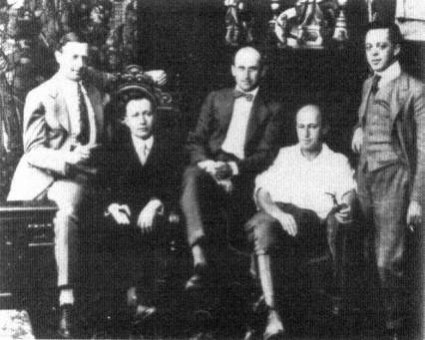
Cecil B. DeMille (second from right) poses with Jesse L. Lasky, Adolph Zukor, Samuel (Goldfish) Goldwyn, and Albert Kaufman after the Famous Players-Lasky merger, from Cecil B.DeMille and American Culture

Not all of the e-books that are freely available online are titles that have been out of print for decades. The University of California Press is one publisher that has boldly made the decision to make some of its relatively recent books available online to all, as part of its general eScholarship Editions initiative. Among the titles available are some silent cinema subjects. We’ve already mentioned Charles Musser’s Before the Nickelodeon. Now we have Sumiko Higashi’s Cecil B. DeMille and American Culture: The Silent Era.

This is an acclaimed study of the films of Cecil B. DeMille as they reflected American culture of the 1910s and 1920s. It is not a film history as such, but rather a social history, with a body of films as evidence. Higashi demonstrates how DeMille integrated cinema into what she calls ‘genteel culture’ by making the spectacle that it provided reflect middle-class ideology. DeMille took his subjects for films from texts – plays, novels, short stories – that were familiar to a middle-class audience, reflecting their world and its concerns. The DeMille we think of today was the producer of gargantuan Biblical epics, but the DeMille of the silent era was first a filmmaker artfully attuned to ‘genteel’ tastes, and then a trendsetter, whose 1920s films influenced advertising and consumer culture. The varied films discussed include Carmen, What’s His Name, Chimmie Fadden, Kindling, The Dream Girl, The Golden Chance, The Cheat, Joan the Woman, Old Wives for New, Don’t Change Your Husband, Why Change Your Wife?, The Affairs of Anatol and The Ten Commandments.

Cecil B. DeMille and American Culture, as with other UCP eScholarship Editions, is commendably well presented in chapterised form, with hyperlinked notes and index making it eminently searchable. There is also a filmography, and the welcome presence of all of the book’s illustrations (something not always offered with ebook editions). All in all, a stimulating read and a most helpful reference source, which now goes into the Bioscope Library.

200,000!

lolcat

http://icanhascheezburger.com

Hello, 200,000th visitor, whoever you may have been. OK, so that’s not a huge number by some standards, and the Bioscope stills lurks at no. 142,599 on the Technorati blog league table. And doubtless if we were to feature a few more pictures of comic cats, rather than concentrate quite so rigidly on the research aspects of early and silent cinema, then maybe we might be expanding the audience a little. But I’m rather pleased with the audience we have, and grateful to all who keep reading here.

Next stop, half a million. If I can just drum up a few more Chaplin-impersonating cats, and learn to loosen up the spelling a little…

The Researcher’s Guide to Screen Heritage

screenheritage

UK Screen Heritage Network

Today saw the launch at the British Library of the Researcher’s Guide to Screen Heritage. This is the the result of a project, led by the UK Screen Heritage Network, to map artefacts held in UK museums and archvies which relate to screen history. So this isn’t the films, or television programmes, but rather the costumes, sets, cameras, projectors, toys, documents, scripts, sheet music etc, and embracing a broader idea of screen history to inlcude magic lanterns, other kinds of slide presentation, digital media artefacts of today, and even art installations.

The resultant directory has been combined with an existing directory of moving image collections in the UK and Ireland, so that you can now search across the full range of moving image-related collections which are open to researchers. It a collection-level database, so you’ll find information on collections rather than individual titles; and it’s not everything, but it’s a strong start in attempting to map what what has generally lain scattered across the museums and seldom known about by film (or screen) historians.

So you are encouraged to explore for yourselves, but some of the gems from our area that you may learn about are:

  • the Black Country Living Museum in Dudley, which includes a complete 1920s cinema reconstructed and placed within the museum, plus a complete cinema percussionist’s kit used at the Picture House, Willenhall from 1923-27;
  • a collection of cinema slides dating from the First World War, consisting mainly of hand painted film publicity/advertising subjects, at the Clevedon Curzon Community Centre for the Arts;
  • the Barnes Collection of material relating to early film production in the South East, including Brighton and Hove pioneers George Albert Smith, James Williamson, William Friese-Greene, Esme Collings, Alfred Darling and Charles Urban, held by Hove Museum & Art Gallery;
  • early trade catalogues, oral history interviews on cinema-going and working in cinemas held by Beamish, The North of England Open Air Museum;
  • the collection of magic lantern slides used by the Congo Reform Association in their campaign to raise awareness about the abuses taking place under King Leopold II of Belgium’s regime in the Belgian Congo c.1880 to c.1909, held by Anti-Slavery International;
  • record of the Hepworth and Nettlefold studios at Elmbridge Museum.

As well as collections tucked away in unexpected corners, there are the leading museums in the field in the UK: the National Media Museum, Kingston Museum, the Cinema Museum, and the University of Exeter’s Bill Douglas Centre. The Researcher’s Guide to Screen Heritage is hosted by the British Universities Film & Video Council, and was developed for the UK Screen Heritage Network by the BUFVC, the National Media Museum and Screen Archive South East. Go explore.

It’s silent cinema, but not as we know it

damienbarr

A new kind of silent cinema is in town. The Andaz Hotel in London’s Liverpool Street has been trumpeting a special form of entertainment for its guests. It is offering them silent cinema. Marvellous, you may think, how immensely civilised, and does the lounge pianist provide the musical accompaniment as well? But, no, this is silent cinema of a different kind. The punters sit before the screen (the films are projected on to the wall of the 6-storey atrium), don wireless headphones, and then watch sound movies on screen but with the sounds hidden from all but themselves. Here’s how the hotel describes it:

Silent Cinema is a world first – it’s never been done anywhere else. Ever. Yet it’s beautifully simple: you wear wireless headphones to watch films on a full-size cinema screen. Sit back and relax without the unwelcome soundtrack – no noisy neighbours and no shhhhh! It’s like watching a movie at home only better because you’re in an amazing room full of like-minded people. And there’s a bar. You’re all enjoying an individual experience. Together.

Should you be in London at any time, you can book tickets via Ticketweb. There have been two screenings so far, both festive. They kicked things off with Black Christmas (oh joy) and on December 14th they’re showing It’s a Wonderful Life, with nothing to be heard bar the clink of glasses and the occasional sniffle.

Silent Cinema (of this kind) is not restricting itself to the Andaz. Damien Barr Silent Cinema, to be give its full, trademarked name (yes, Silent Cinema is now a trademarked term) has plans for further exhibition elsewhere, in London and Brighton, including outside screenings. Damien Barr is a journalist and radio playwright. So now you know.

Metropolis at Seminci

My thanks to John Riley for alerting me to these two videos. They depict the screening of Metropolis at the Seminci film festival in Valladolid, Spain, late October, when the Fritz Lang film was exhibited at the Miguel Delibes Auditorium with live orchestral accompaniment from the Orquesta Sinfónica de Castilla y León. Of itself, this might be of passing interest but nothing special. What pleases me is what these two festival-produced videos is what they capture of the atmosphere of a prestige silent screening. The first shows the audience arriving, chatting in the auditorium and taking their seats. It captures the sense of a cultural treat, the festival spirit. Brief as it is, it’s a people-watching treat.

And then the audience settles down, the orchestra takes its place, the conductor is applauded, the lights go down and the film begins. The second video captures such opening moments familiar to anyone who has attended a silent film show with orchestra, but there’s not much recorded of such events in this way, particularly the point where the film gets underway and we can see both orchestra and film on screen. It’s a brief record, but one worth sharing with you.