Remixed into silence

This an interesting development. Shown last week at the Edinburgh Festival and this week at London’s Rich Mix arts centre was Mother India – 21st Century Remix, or MI21. DJ Tigerstyle has taken the classic 1957 Indian film Mother India, directed by Mehboob Khan, and reimagined it as a 45-minute silent film. Tigerstyle (“world champion scratch DJ”) is joined by Matt Constantine on keyboards and cello, David Shaw on drums and Josh Ford on visuals. The promo above includes some clips of the performance, alongside interviews, audience reaction and so forth. The film’s website describes it thus:

Presenting the film to a contemporary audience, whilst preserving the power and vitality of the original piece is the key to this work. At 45 minutes in length, MI21 will engage you through the music to understand how dynamic a story the film has to tell.

Setting aside the qualms some may feel at seeing a cinema classic being deconstructed in this way (with the implication that a contemporary audience wouldn’t be able to sit through the original), it is a triumph of some sort for the art of the silent film, reclaiming a sound film through its images as one of its own. What other sound films have been reconstituted as silents? I know of one other recent example, the group British Sea Power adding a music soundtrack to an edited-down version of Robert Flaherty’s Man of Aran (1934), which once had a perfectly serviceable soundtrack of its own:

Interesting that some of the chat about this video has suggested that Flaherty’s film was a silent film originally (its sounds and dialogue may have been post-synched, but there was very much sound there all the same). It seems to be part of a similar urge for the poetics of the silent film. Maybe the sound dies for some films, eventually, but the images live on. Something to ponder, and a trend to look out for.

Meanwhile, Mother India – 21st Century Remix can be experienced at the following venues:

* Sat 05 Sept – Brighton Pavillion Theatre – 01273 709709
* Tue 22 Sept – Bristol Colston Hall – 0117 922 3686
* Sat 10 Oct – Coventry Belgrade Theatre – 024 7655 3055
* Sat 24 Oct – Bridlington Musicport Festival – 0845 3732760

Mr Laurel, Mr Hardy and Mr Bhaskar

sanjeev

http://www.slapstick.org.uk

The admirable attempts by the Bristol Silents crowd to rope in British comedy celebrities to promote the silent film proceeds apace. After Paul Merton, Eric Sykes, Phill Jupitus, Tim Brooke Taylor, Graeme Garden and Neil Innes, the latest welcome volunteer is Sanjeev Bhaskar, who is to be the host of a special event, Laurel and Hardy’s Comedy Mayhem, at the Colston Hall, Bristol, 9 September 2009. Here’s the blurb:

It’s 80 years since Stan Laurel and Oliver Hardy made their transition from silent to sound film and Bristol’s Slapstick Silent Comedy Festival celebrates their extraordinary onscreen legacy with a special live gala evening of film and music hosted by writer and comedian Sanjeev Bhaskar.

Best known for his work on Goodness Gracious Me and The Kumars at No 42 Sanjeev has selected his favourite Stan and Ollie comedies to delight new audiences including their oscar winning classic THE MUSIC BOX (1932) in which the boys play removal men who are trying to deliver a piano up a monumental flight of stairs!

Other highlights include live musical performances from a capella vocal group The Matinee Idles and a special appearance from Our Gang member and child performer with Stan and Ollie – Hollywood legend Jean Darling.

All this plus the world premiere of a newly commissioned orchestral score for the Laurel and Hardy classic silent comedy DOUBLE WHOOPEE (1929) featuring Jean Harlow’s screen debut and accompanied by the from Günter Buchwald and performed by the wonderful Emerald Ensemble.

A rare opportunity to see comedy legends Laurel and Hardy on the big screen with one of Britain’s best loved comic performers.

Let the mayhem begin!

The event is designed to help raise funds for next year’s Slapstick festival, so well worthy of your patronage if you’re anywhere in the Bristol vicinity.

Shakespeare on screen

Here’s news of a conference on Shakespeare and film which includes silent Shakespeare in its call for papers – though you’ll have to hurry, as the deadline is 28 August. The conference takes place at the Ohio University Inn and Conference Center, Ohio University, Athens, Ohio, USA, 22-24 October 2009:

SHAKESPEARE ON SCREEN: 1899-2009

Keynote Speakers

* Peter Holland (University of Notre Dame)
* Linda Charnes (Indiana University)
* Douglas Lanier (University of New Hampshire)

The conference organizing committee invites abstracts (200-300 words) or papers on a range of issues in film and television productions of Shakespeare from the Silents to the Age of Branagh and Baz. Papers can focus on individual films; the work of major directors; intertextual (and visual) dialogue between Shakespeare films or between stage and film Shakespeares; television Shakespeare; spin-off films and television programs; Shakespeare in cyberspace; global Shakespeare; theories of appropriation and adaptation; editions and screenplays; funding, promotion and marketing; photography and trailers; DVD material; audience; film scores; cinematography; cultural context; film clips; and teaching strategies.

Abstracts or papers are due by June 5, 2009 (early decision) or August 28, 2009 (final deadline). All inquiries should be directed to: Samuel Crowl/Department of English/Ohio University/Athens, Ohio/45701 or via email to crowl[at]ohio.edu.

All sessions of the conference except the Thursday evening keynote lecture will be held at the Ohio University Inn located just across the Hocking River from the campus of Ohio University. Special room rates will be available for conference attendees. The Friday evening conference banquet will be included in the registration fee.

Talking silents

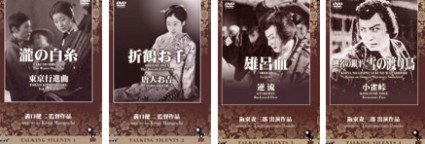
talkingsilents1_4

Talking Silents, vols. 1-4

One of the great treasures available to anyone with a serious interest in the history of silent cinema is the Talking Silents series produced by Digital Meme. This is a series of ten DVDs of Japanese silents films, with two or three titles per disc. Silent cinema continued in Japan well into the 1930s, but survival rates for Japanese silents make for sorry reading. It is estimated that between 95-99% of all Japanese silent films are lost (with almost none before 1923 owing to the destruction of the Nikkatsu film store in the Tokyo earthquake). Those that do survive are often in a poor condition. Classics such as Kinugasa Teinosuke’s A Page of Madness (1926) and Yasujiro Ozu’s I Was Born But… (1932) are well-known, but what is so interesting about the Digital Meme series is that it includes comparatively routine genre works, so that one gets a real taste of popular Japanese silent cinema.

The striking feature of the series is the use of benshi narration. In the silent era (and even for a while the sound period), Japanese films were accompanied by narrators, an inheritance from the Japanese theatrical tradition. Originally each part in a film was taken by a separate off-screen performer, until the film industry rebelled against this theatrical domination, around 1920, and the single benshi tradition began. The benshi were the stars of Japanese silent cinema: audiences revered theme, and the performers developed individual styles. The DVDs include narrations from recordings made of benshi in the 1970s and 80s, and recreations of the style by Midori Sawato. The narration is an optional feature, and the films carry both the original Japanese titles and English translated titles.

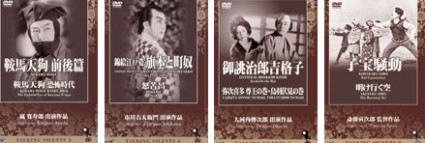
The films present fine mixture of styles, including samurai tales and contemporary dramas, with some early titles from the great master Kenji Mizoguchi. This is full list:

Talking Silents 1:

* Taki no Shiraito (The Water Magician)
Produced by Irie Production, 1933
98 minutes / 24 fps
Directed by Kenji Mizoguchi
Cast: Takako Irie, Tokihiko Okada, Ichiro Sugai

* Tokyo Koshinkyoku (Tokyo March)
Produced by Nikkatsu Uzumasa, 1929
28 minutes / 24 fps
Directed by Kenji Mizoguchi
Cast: Shizue Natsukawa, Reiji Ichiki, Isamu Kosugi

Talking Silents 2:

* Orizuru Osen (The Downfall of Osen)
Produced by Daiichi Eiga, 1935
90 minutes / 24 fps
Directed by Kenji Mizoguchi
Cast: Isuzu Yamada, Daijiro Natsukawa, Ichiro Yoshizawa

* Tojin Okichi
Produced by Nikkatsu Uzumasa, 1930
4 minutes / 24 fps
Directed by Kenji Mizoguchi
Cast: Yoko Umemura

Talking Silents 3:

* Orochi (Serpent)
Produced by Bantsuma Production, 1925
74 minutes / 24 fps
Directed by Buntaro Futagawa
Cast: Tsumasaburo Bando, Misao Seki, Utako Tamaki

* Gyakuryu (Backward Flow)
Produced by Toatojiin, 1924
28 minutes / 16 fps
Directed by Buntaro Futagawa
Cast: Tsumasaburo Bando, Benisaburo Kataoka, Teruko Makino

Talking Silents 4:

* Koina no Ginpei, Yuki no Wataridori (Koina no Ginpei, Migratory Snowbird)
Produced by Bantsuma Production, 1931
60 minutes / 24 fps
Directed by Tomikazu Miyata
Cast: Tsumasaburo Bando, Kikuya Okada, Reiko Mochizuki

* Kosuzume Toge (Kosuzume Pass)
Produced by Makino Tojiin, 1923
39 minutes / 16 fps
Directed by Koroku Numata
Cast: Banya Ichikawa, Shinpei Takagi, Tsumasaburo Bando

Talking Silents 5:

* Kurama Tengu
Produced by Arakan Production, 1928
71 minutes / 24 fps
Directed by Teppei Yamaguchi
Cast: Kanjuro Arashi, Takesaburo Nakamura,
Reizaburo Yamamoto, Kunie Gomi and Keiichi Arashi

* Kurama Tengu Kyofu Jidai (The Frightful Era of Kurama Tengu)
Produced by Arakan Production, 1928
38 minutes / 16 fps
Directed by Teppei Yamaguchi
Cast: Kanjuro Arashi, Reizaburo Yamamoto, Kunie Gomi and Keiichi Arashi

Talking Silents 6:

* Nishikie Edosugata Hatamoto to Machiyakko (The Color Print of Edo: Hatamoto to Machiyakko) (1939, Shinko Kinema, 65 min.)
Directed by Kazuo Mori
Cast: Utaemon Ichikawa, Yaeko Kumoi, Shinpachiro Asaka, Wakako Kunitomo

* Dokuro (Skull) (1927, Ichikawa Utaemon Production, 32 min.)
Directed by Sentaro Shirai
Cast: Utaemon Ichikawa, Kokuten Takado, Ritsuko Niizuma

Talking Silents 7:

* Oatsurae Jirokichi Koshi (Jirokichi the Rat) (1931, Nikkatsu, 61 min.)
Directed by Daisuke Ito
Cast: Denjiro Okochi, Naoe Fushimi, Nobuko Fushimi, Minoru Takase

* Yajikita Sonno no Maki (Yaji and Kita: Yasuda’s Rescue) (1927, Nikkatsu, 15 min.)
Directed by Tomiyasu Ikeda
Cast: Goro Kawabe, Denjiro Okochi

* Yajikita Toba Fushimi no Maki (Yaji and Kita: The Battle of Toba Fushimi(1928, Nikkatsu, 8 min.)
Directed by Tomiyasu Ikeda
Cast: Goro Kawabe, Denjiro Okochi

Talking Silents 8:

* Kodakara Sodo (1935, Shochiku Kamata, 33 min.)
Directed by Torajiro Saito
Cast: Shigeru Ogura, Yaeko Izumo

* Akeyuku Sora (1929, Shochiku Kamata, 71 min.)
Directed by Torajiro Saito
Cast: Yoshiko Kawada, Mitsuko Takao

Talking Silents 9:

* Roningai Dai Ichiwa (1928, Makino Production, 8 min.)
Directed by Masahiro Makino
Cast: Komei Minami, Juro Tanizaki, Toichiro Negishi

* Roningai Dai Niwa (1929, Makino Production, 72 min.)
Directed by Masahiro Makino
Cast: Komei Minami, Hiroshi Tsumura, Toichiro Negishi

* Sozenji Baba (1928, Makino Production, 32 min.)
Directed by Masahiro Makino
Cast: Komei Minami, Shinpei Takagi, Toroku Makino

Talking Silents 10:

* Jitsuroku Chushingura (Chushingura: The Truth)
Produced by Makino Production, 1928, 64 min.
Directed by Shozo Makino
Cast: Yoho Ii, Tsuzuya Moroguchi, Kobunji Ichikawa, Yotaro Katsumi

* Raiden
Produced by Makino Production, 1928, 18 min.
Directed by Shozo Makino
Cast: Toichiro Negishi, Arata Kaneko, Masahiro Makino
talkingsilents5_8

Talking Silents vols. 5-8

You get a little in the way of extras on each of the DVDs: a commentary from film critic Tadao Sato, an introduction by modern benshi Midori Sawato. The Digital Meme site has downloadable PDFs of introductions by Tadao Sato. The DVD booklets are thin and half in Japanese, half-English. What is noteworthy is the offer made to educational institutions. Digital Meme makes the series available under three prices: Home Use (allowing individual viewings), Rental Use (allowing institutions to give their members and affiliated persons the right to rent the collection and take it out of their libraries) and Institutional Screening Rights Agreement (for institutions that want to screen the DVDs to a public audience within their premises, or at an affiliate, on a non-commercial basis).

Digital Meme also make available a 1980 documentary on DVD on the life of film actor Tsumasaburo Bando, Bantsuma: The Life of Tsumasaburo Bando (Bantsuma: Bando Tsumasaburo no shogai), and a 4-DVD set Japanese Anime Classic Collection. This is a treasure trove of early Japanese animation, with some of the translated titles delightfully giving indication of their idiosyncratic content: The Tiny One Makes It Big, Dekobo the Big Head’s Road Trip, Why is the Sea Water Salty?, The Duckling Saves the Day. A section of the Digital Meme site gives details of each of the 55 titles on the four-disc set, with frame stills and some synopses. The set comes with English subtitles (and Chinese, and Korean), some live benshi narration, and examples of anime with synchronised audio tracks from gramophone records.

dekobo

Dekobo no Jidosha Ryoko (Dekobo the Big Head’s Road Trip)

And there’s more. Digital Meme also markets Masterpieces of Japanese Silent Cinema, a DVD-Rom which includes extracts from forty-five films, a database of 12,000 film titles, almost 1,000 stills, posters, original programmes and leaflets, interviews with film veterans, and reference articles, making it an interactive encyclopedia of Japanese silent film, albeit at a price of 18,000 Yen (around $180) which means only institutions are likely to purchase it.

For more on Japanese silent cinema, here’s a few handy sources:

On or about December 1910, human character changed

woolf

On or about December 1910, human character changed. I am not saying that one went out, as one might into a garden, and there saw that a rose had flowered, or that a hen had laid an egg. The change was not sudden and definite like that. But a change there was, nevertheless; and, since one must be arbitrary, let us date it about the year 1910.

So wrote Virginia Woolf in her 1924 essay ‘Mr Bennett and Mrs Brown’. What a load of old elitist rhubarb, you may think, but it’s a gem of a phrase for starting up a debate, putting together a book, or organising a conference. And it’s the latter route that the Scottish Network of Modernist Studies and the British Association of Modernist Studies have taken in organising ‘The 1910 Centenary Symposium’, to be held at the University of Glasgow, December 2010, which takes Woolf’s statement as its theme. Interestingly their concerns include film, as the pre-call for papers indicates:

We are inviting scholars from any discipline to respond to any aspect of this statement by suggesting panels and papers. A formal call for papers will follow later this year. Current panel proposals under consideration include: 1910 films; Scotland 1910; Women in 1910; and 2010: Human Character in the Age of Climate Change. Other areas that have been suggested as possible include: periodization; The Post-impressionist exhibition; 1910 from 1924; the grammar of modernism; 1910 and social/political activism.

Plenary speakers will include Jean-Michel Rabaté (University of Pennsylvia) and David Peters Corbett (University of York). The conference aims to bring together scholars from a wide variety of disciplines, from the UK and beyond. Although the majority of participants are likely to be modernist scholars, we do not want to limit participation to those who regard themselves as modernist scholars, and are keen to include the kind of oppositional and interrogative stances that the tone of the quotation implicitly encourages.

Proposals for panels and papers and expressions of interest should be sent to conference organisers Bryony Randall and Matthew Creasy via email at snms[a]arts.gla.ac.uk

So, what was pivotal about film in 1910 (or December 1910 for that matter)? Assuming such a thing as a change in human character at this time (and I guess we’re talking about people in the Western World – those most able to go to cinemas, for example), how might film have reflected it, or have been changed by it? It’s not generally cited as a pivotal year in early cinema form, except that every year around that time reflects some form of a step forward given the rapid evolution of the medium. But it was the year in which – in the UK at least – cinema became all-conquering, in its way a powerful agent for social change because of the command it had on people’s free time, and the free rein it gave to the imagination of all who attended it. The rise of modernity, which is what Woolf is referring to (and a little playfully, to be fair), is profoundly relevant to film, bound up as it was with the city, mechanisation, speed, and the triumph of electricty. You may find it in film style, or you may find it in the cinema as social institution. There should be a good paper or two in there, somewhere.

Update (13 May 2010): The dates of the conference are 10-12 December 2010, and there is now a conference web page: www.gla.ac.uk/departments/snms/1910centenaryconference. The call for papers has now closed.

From old Ireland

condon

While sojourning in Dublin last month, I picked up a copy of a new film history which I’d managed to miss up until now. Denis Condon’s Early Irish Cinema 1895-1921, published by Irish Academic Press, describes itself as examining “early and silent cinema and its contexts in Ireland”. It is a history not just of film production in Ireland (at a time when politically it was still a part of the United Kingdom), but its exhibition and its social and cultural contexts as well. Although there have been several histories of Irish film which include accounts of filmmaking in the silent era, so far as I am aware this is the first book dedicated to the early and silent cinema period alone.

Irish film production in the silent era was small-scale (and has attracted little interest among film scholars except those from Ireland) but Condon argues the attention given to these films by Irish commentators suggests that they have “a symbolic significance far out of proportion to their numbers”. The first Irish-produced fiction films did not appear until 1913 – one-reelers made by Irish Film Productions such as Michael Dwyer and Love in a Fix – and did not seriously begin until 1916 with the formation of the Film Company of Ireland, which made O’Neil of the Glen (1916), Knocknagow (1918) and Willy Reilly and his Colleen Bawn (1920), the latter two of which survive. Irish-themed films were made in profusion in America, however, mostly notably by Kalem, which sent a company headed by Sidney Olcott and Gene Gauntier over to Ireland and made such titles as The Lad from Old Ireland (1910), Arrah-na-Pogue (1911), The Shaugraun (1912) and Come Back to Erin (1914) (the latter one of those made by the Gene Gauntier Players, rather than Kalem). On the non-fiction side, there was Irish production from early on with local views produced by exhibitiors such as James T. Jameson, through to Norman Whitten’s General Film Supply, whose most interesting production was the newsreel Irish Events (1917-1920). Again, the greater number of Irish-themed non-fiction films came from outside, particularly British companies such as the Warwick Trading Company and the Charles Urban Trading Company, which produced assorted travelogue series.

This history Condon covers in remarkable detail. There appear to be few documentary sources that he has not examined, and his notes and sources will be plundered by future researchers for years to come. However, though he piles on the detail, he has arranged the book most interestingly. Avoiding too slavish an adherence to chronology, he divides the book into chapter entitled ‘Retrospection and Projection’, ‘Theatre’, ‘Virtual Tourism’, ‘Participation’ and ‘The Great Institution of Kinematography’. These reflect Irish cinema’s roots, its cultural inheritance, the importance of external producers’ work, Irish production itself, and a larger conception of cinema which includes the distribution of films, their exhibition and reception. The construction makes think about how Irish cinema was constructed.

This is a worthwhile, rigorous academic study. It is based on a thesis (and reads like it), with arguments about the institutional and pre-institutional form of early cinema which are designed to appeal to the film studies crowd. But it is also jam-packed full of every sort of detail, fascinating to dig through, and comes with a very helpful filmography that includes both films extant and films lost. My thought on reading it was that, despite the author’s progressive historiographical aims, there is something about the national film history which is a little quaint these days. We’ve done with the histories of this country and that country’s films, or we should have done. If cinema history teaches us anything it is that distribution had to flow over borders, if films were to make money. Condon certainly looks beyond Irish film production, and admirably so, but it is what audiences saw (American films, largely unmentioned except for the Kalem films) and what those audiences were (mostly absent from his book) that is the heart of the matter, not what any one country made.

Eloquent gestures

eloquent_gestures

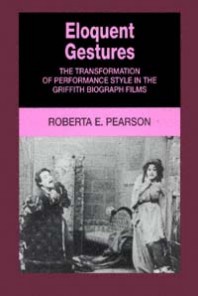
It’s been a while since we added anything new to the Bioscope Library. A new wing has been added to the tottering edifice that is Bioscope Towers, and first on the fresh new set of shelves therein is Roberta E. Pearson’s Eloquent Gestures: The Transformation of Performance Style in the Griffith Biograph Films, published by the University of California Press in 1992. This is one of the titles that the enlightened UCP has made available for free online as one of its eScholarship Editions offerings. It is a model ebook presentation, as well as being one of the most interesting and stimulating books written on the films of David Wark Griffith.

The book’s subject is the changes in the style of the actors’ performances in the films of D.W. Griffith, particularly between 1909 and 1912. Pearson sets this up in a delightful introduction in which she imagines Josiah Evans, “a man with a civic conscience who belongs to several progressive reform organizations”, attending a Broadway storefront picture show in 1909 in which he sees a film entitled The Drunkard’s Reformation, which he rather enjoys because it reminds him of the blood-and-thunder stage melodramas of his youth.

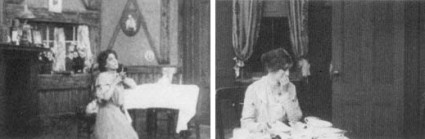
The acting of the young wife as she depicts her misery and desperation particularly affects him. She collapses into her chair and rests her head on her arms, which are extended straight out in front of her on the table. Then, in an agony of despair, she sinks to her knees and prays, her arms fully extended upward at about a forty-five degree angle.

Three years later he visit the Rialto Theatre on 14th Street, a considerably classier venue than that 1909 nickelodeon, and is struck in particular by a film entitled Brutality. It is similar in theme to the earlier film…

… but this moving picture does not remind him of the blood-and-thunder melodramas of his youth. The acting is the equal of Mr. Gillette’s in Sherlock Holmes or even of that in the Belasco play he and Lydia had attended last night. Particularly impressive is the young wife’s despairing reaction to her husband’s harsh treatment and abandonment. After he leaves for the saloon, the wife walks back to the dining-room table covered with the debris of their evening meal. She sits down, bows her head, and begins to collect the dishes. She looks up, compresses her lips, pauses, then begins to gather the dishes once again. Once more she pauses, raises her hand to her mouth, glances down to her side, and slumps a little in her chair. Slumping a little more, she begins to cry. How differently this actress portrays her grief from her counterpart in A Drunkard’s Reformation. A lot has changed in those three-and-a-half years since his first visit to a nickelodeon.

drunkard&brutality

A Drunkard’s Reformation (left) and Brutality, from Eloquent Gestures

How the films of D.W. Griffith moved on from the one style to the next is the subject of Pearson’s book. It traces in meticulous detail the transformation from an acting style inherited from the stage meodramas of an earlier era, to a nuanced style that benefitted from ‘realist’ developments in literature and theatre. It wasn’t there in 1909; it was there in 1912, and by examining closely the films made in that intervening period and being attuned to contemporary cultural developments, the path from the one to the other can be drawn. This is what Pearson does.

It is a very detailed study, one grounded a theoretical language which may not be to everyone’s taste, but the author needs to negotiate the pitfalls that terms such as “naturalism”, “realism” and “melodrama” can lead to. She wants to be precise about the meaning of words which are used all too loosely in general critical discussion (“melodrama” in particular), and to ground what one sees in these films, and what one sees in changing, in a close understanding of what was going on at the time. As she says:

The study of cinematic performance demands that we not depend upon our own aesthetic judgments, which we tacitly deem eternal and unchanging. Rather, we must acknowledge history by attempting to understand the aesthetic standards of another time and place, of a culture very different from our own.

The rest you must read for yourselves, and I warmly recommend that you do so. Though this is very much a thesis turned into a book, with all of the formal argument structures that one recognises (such as having an introduction which rubbishes the opposition), it illuminates understanding – not just of Biograph films, but of any cultural artefact from any period which we may be tempted to interpret from our personal aesthetic experience but which needs to be seen, first and foremost, as the product of its own times.

The ebook presentation is excellent. The book is divided up into hyperlinked chapters, and page breaks are indicated where they occur in the original, which is good for accurate citation. Notes in the text are hyperlinked to a notes section at the end, the index has hyperlinks so you can go directly from term back to the text, and the illustrations are available in small and full size versions. Finally there is a search box enabling to search the entire text of the book. Excellent all round. Into the Bioscope Library it goes.

Comedy! Melodrama! Schmaltz!

opotiki

http://www.silentfilmfest.org.nz

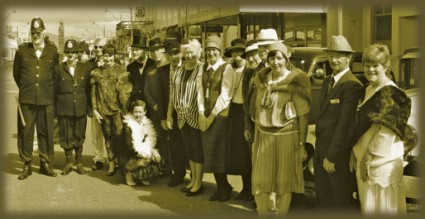
Another day, another festival. This time we’re in New Zealand, for the homely delights of the Opotiki Silent Film Festival. Organised by the Opotiki Community Arts Council, and held in Opotiki’s art deco De Luxe Theatre, the festival is noteworthy for encouraging its audiences to dress up in period costume, something that you can’t quite imagine happening in Pordenone (more’s the pity).

This year’s festival takes place 4-5 September. Financial constraints have led them to bill this year’s offering as a Mini Silent Festival, but it’s a fine programme for all that (all with live piano accompaniment):

1. COMEDY CLASSIC The Three Ages ~ Buster Keaton
4pm Friday 4th ~ 1923 ~ 63mins

In his first independently produced feature film Buster tells of love and romance through the Stone Age, the Roman Age, and the Modern Age.

2. MELODRAMA ~ The Show-Off
5.30pm Friday 4th ~ 1926 ~ 82mins

A show-off clerk posing as a railroad executive catches a young bride and then drives her family’s finances to the brink of ruin.

3. CHAPLIN COLLECTION
7.30pm Friday 4th ~ 4 films ~ 95 mins

* Kid Auto Races in Venice 1914 – The very first time we see Chaplin as ‘the Tramp’, hogging the camera at a real event.
* The Vagabond 1916 – An impoverished violinist falls for a beautiful gypsy girl. His love appears to be thwarted but he wins out in the end.
* The Fireman 1916 – Charlie is a fireman who always does everything wrong. Group slapstick at its very best.
* One A.M. 1916 – After a night on the town, Charlie comes home drunk and unable to find his key… A raucous one-man show.

4. ROMANTIC COMEDY ~ Steamboat Bill Jr. ~ Buster Keaton
2pm Saturday 5th ~ 1928 ~ 71mins

Willie is the effete son of riverboat captain ‘Steamboat Bill’, visiting his dad after years away. Bill tries to turn his son into a man without apparent success. Bill has a dispute with a powerful banker while Willie falls for Kitty, the banker’s daughter. When a hurricane hits, Willie leaps to the rescue and saves the day.

5. SCHMALTZ! ~ The Plastic Age ~ Clara Bow
3.30pm Saturday 5th ~ 1925 ~ 73mins

Featuring our favourite Clara Bow. A promising student is diverted by the ‘flaming youth in rebellion’ of the twenties who danced to wild jazz and had petting parties!

6. SHORTS SELECTION ~ A Symphony of Shorts
5pm Saturday 5th ~ 73mins

An amazing selection of European and US shorts providing a fascinating insight into life before the Talkies.

* Those Awful Hats
* For Her Mother’s Day
* Folies-Bergère Fireman (features nudity!)
* Monkey Chase ~ Titanic
* The Mystery of the Leaping Fish

7. SWASHBUCKLER ~ The Thief of Bagdad ~ Douglas Fairbanks
7.30pm Saturday 5th ~ 1924 ~ 155mins

A thief (Douglas Fairbanks Snr) falls in love with the Caliph of Bagdad’s daughter who will give her hand to the suitor who brings back the rarest treasure. The thief embarks on a magical journey, fraught with danger…

I like those helpful headings. A bit at a loss as to what Monkey Chase ~ Titanic might be, but all in all a great line-up. Further information, including booking form, and a delightful selection of photos from past festivals, showing how much the audiences gets into the swing of things, can be found on the festival site. The site also promises that “the foyer will be decorated in style, and tea with Lamingtons or shortbread will be available at the Nibblenook”. Perfect.

The Australian connection

muttandjeff

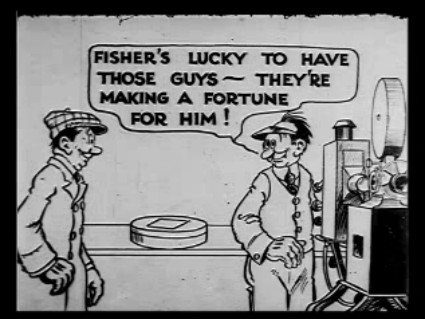
Mutt and Jeff: On Strike (1920), from The Film Connection

News of the successful outcome of an archival repatriation project. The Film Connection is a joint project between the National Film Preservation Foundation in America and the National Film and Sound Archive of Australia to bring American films no longer held in America back to American audiences. Through this collaboration, a number of short American silents that survive only in Australia have been preserved, digitised, and six of them made available online. The six are:

  • The Prospector (Essanay 1912)
  • U.S. Navy Documentary (1915?)
  • A Trip through Japan with the YWCA (The Benjamin Brodsky Moving Picture Co. c.1919)
  • Mutt and Jeff: On Strike (Bud Fisher Films Corporation 1920)
  • The Sin Woman Trailer (George Backer Film 1922?) [trailer for 1917 film]
  • Pathé News, No. 15? (Pathé News 1922)

The six films can be viewed and downloaded from the National Film Preservation Foundation site here, together with useful background information on each title, and you can read all about the project here. One of the films, the Mutt and Jeff cartoon On Strike, will feature at this year’s Pordenone silent film festival.

Jornada Brasileira de Cinema Silencioso

jornada

http://www.cinemateca.gov.br/jornada

Having told you a short while ago about Brazilian silent film journals available online, now it’s time to let you know (courtesy of the Pordenone film festival site) of the Cinemateca Brasileira’s third annual festival of silent film, Jornada Brasileira de Cinema Silencioso. The festival runs 7-16 August 2009, at the Cinemateca in São Paulo, and through the modern miracle that is Google Translate, I can tell you something about it.

The main strand of the festival is dedicated to French silent cinema, and features films from Les Archive du Film CNC, the Cinémathèque Française and (familiar to regular Bioscopists) the Musée Albert-Kahn. The programme includes shorts by the Lumière brothers, documentaries on Corsica, Tunisia and Abyssinia, and assorted feature films from the 1920s, including Marcel L’Herbier’s L’homme du large (1920), Pierre Marodon’s Salammbô (1925), Alfred Machin’s Le manoir de la peur (1927), Berthe Dagmar and Jean Durand’s L’île d’amour (1928) and Jean Grémillon’s Maldone (1928). André Sauvage’s Études sur Paris (1928) will be shown with orchestral score by Brazilian composer José Antônio de Almeida Prado. There will be a selection of early shorts directed by Alice Guy, and a special presentation by Isabelle Marinone on the relationship between anarchism and cinema in France, including films made by French film collective Cinéma du Peuple: La Commune (Armand Guerra, 1914), Les misères de l’aiguille (Raphael Clamour, 1914) and fragments from Le Vieux dock (Armand Guerra, 1914).

Silent films set in Brazil are also featured. There will be documentaries on Amazonian travel and ethnography by Luiz Thomaz Reis and Silvino Santos, including The River of Doubt (1928?) on a 1914 expedition headed by Theodore Roosevelt. There is more Latin American cinema with Chile’s El Husar de la muerte (Pedro Sienna, 1925), and a touch of modern fantasy with the Wisconsin Bioscope’s A expedição brasileira de 1916 (2006).

The festival has a section dedicated to notable titles previously featured at the Giornate del Cinema Muto in Pordenone. This year it is showing Marion Davies in The Patsy (King Vidor, 1928), Beatrice Lillie in Exit Smiling (Sam Taylor, 1926), Nell Shipman in Back to God’s country (David Hartford, 1919), and Li Lili in that great Bioscope favourite, Tianming/Daybreak (Sun Yu, 1933), plus Alfred Machin’s anti-war Maudite soit la guerre! (1914). And there’s a special programme devoted to the trick and fantasy films of Segundo de Chomón.

In short, it’s a fabulous-looking programme. Full details of the films can be found on the site, divided up by day and theme, along with contact details and other festival information, all in Portuguese.