You will recall the news from last year of a collection of generic silent film scores discovered at Birmingham Library, which exicted quite a bit of interest in the news media. That news interest would appear to have excited the Library in turn, which has pulled out all the stops to promote the collection. There have been performances of the scores and songs from the scores, the scores played to a modern film on Kristallnacht, and talk of a research project. Now the City of Birmingham Symphony Orchestra has announced a Silent Movies Animation Challenge, inciting animators to use one of the scores to accompany a silent animation film of their making.
The nine tracks have been made available on SoundCloud, which is sort of the audio equivalent of YouTube – the place to go for hearing, sharing and annotating sound recordings. You can also embed such sound files in your own website or blog, as above, so you can get a taste of the music composed for generic silent film acompaniment rather than having been composed for a specific film. Here are the sounds of the fairly run-of-the-mill cinema-going experience of the silent era.
This leads me to draw your attention to SoundCloud as a resource for silent film study in itself. Type in “silent film” or “silent film” into its search box and you will find a considerable number of scores by amateur and would-be professional composers for real or imaginary silent films, mostly performed on electric keyboards of various persuasions, as you would expect. If you go to the Advanced Search option and type in ‘silent’ into the Genre field you will get hundreds of results, though only a proprtion of these seem to relate to silent films.
The quality varies hugely, as you would also expect, but browsing through the mostly short sequences makes for a rather fascinating insight into how silent film conjure up musical sequences in our minds – and how listening to music can conjure up ideas of the films that might be accompanied by it.
Try this short piece by Joseph A. Fox, for example, and see what movie it creates for you:
Some of the scores are for actual silents. Here, for example, is composer Steve Bennett’s score for Nosferatu, broken up into seventeen themes:
There are also silent film scores which have featured in performance, such as Paul Van Vuplen’s score for The Extraordinary Adventures of Mr. West in The Land of The Bolsheviks, as performed by the Metropole Orchestra:
You will also find some silent film accompanists of established reputation on SoundCloud. Ben Model, perhaps the most new media savvy of all of them, is there, though surprisingly with just the one track (and that a radio interview). Donald Sosin is also represented by just the one piece (apparently completely silent). American duo Silent Orchestra have some taster clips of their work. Is there anyone on the site that we should know about, and why aren’t more sharing a least a few sample tunes through a site that is growing in popularity and influence?
Anne Elliot, the Birmingham Library archivist who found the collection of silent film scores explains its significance
The deadline for the CBSO competition is 2 April, and finalists’ work will be screened at Symphony Hall, Birmingham, accompanied by the CBSO on Friday 20 April 2012 as part of their Friday Night Classics: Classic Chaplin night. More details here, and a nod of acknowledgment to Silent London for the CBSO competition news.
It’s time for one of our occasional round-ups of recent publications on silent film, though one or two have been around for a few months now, and not all are directly about silent films – but that’s what makes them interesting.
Rin Tin Tin – The Life and the Legacy, by Susan Orlean, has already made quite an impact in the USA, with its acute mixture of nostalgia and cultural history. It tells the story of Rin Tin Tin, the German shepherd dog rescued from the trenches of WWI by Lee Duncan, whose innovative training methods led the dog to Hollywood stardom in the 1920s. Rin Tin Tin’s star waned in the 1930s, but a succession of junior Rin Tin Tins either sired or inspired by the original kept the aura going into the age of television. Orlean makes some elementary blunders about silent film history, and Lee Duncan doesn’t make for much of a hero (unlike his dog) but it is readable, wry and occasionally wise.
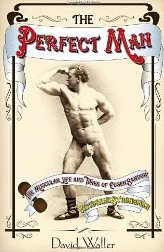
The Perfect Man: The Muscular Life and Times of Eugen Sandow, by David Waller, brings back to popular awareness one of the most remarkable, and certainly most famous, figures of the Late Victorian/Edwardian era, Eugen Sandow. Boddybuilder, strongman and adovcate of healthy living, he became the model of manly accomplishment for a generation. He also featured significantly in film history, being one of the very first subjects to go before the Edison Kinetoscope. He was also filmed by Biograph and even had a early film technology patent to his name. A terrific biography of someone whose life story illuminates the age in which he lived.
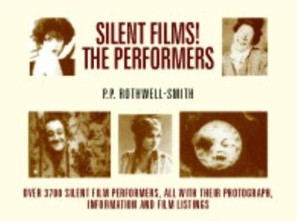
Silent Films! The Performers, by Paul Rothwell-Smith, is a self-published biographical guide to 3,700 performers from the silent era. This heroic undertaking was inspired by the author’s attendance at the British Silent Film Festival when it was held at the Broadway cinema in Nottingham. Rothwell-Smith is as interested in lesser-known names from the nether reaches of British film history as he is in those familiar to us all, and the book makes a bold statement of intent by having Clara Bow and Fred ‘Pimple’ Evans, knockabout British comedian of the 1910s, share equal billing on the front cover. I’ve not seen it, but the sheer scale of the endeavour commands respect.
Photography, Early Cinema and Colonial Modernity: Frank Hurley’s Synchronized Lecture Entertainments, by Robert Dixon, adds significantly to our understanding of how motion pictures were presented that weren’t conventional cinema fare. As historians are increasingly uncovering, as as the Bioscope has tried to document, the multimedia show which brought together photography, films, music and live lecturer was widespread throughout the silent era, being used in particular for recouting true tales of adventure and exploration. Frank Hurley was cinematographer for the Antarctic explorer Douglas Mawson and Ernest Shackleton, and the book documents the ‘synchronised lectures entertainments’ (Hurley’s words) made out of these adventures, as well as the later Sir Ross Smith’s Flight and Hurley’s dramatised documentary of life in Papua New Guinea, Pearls and Savages. The book is aimed at the scholars, but there are lessons for all of us, because we still haven’t got our film history right – we keep focussing too much upon the films.
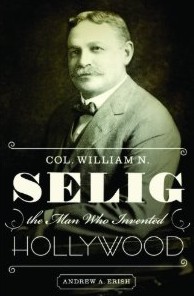
Col. William N. Selig, the Man Who Invented Hollywood, by Andrew A. Erish, published later this month, is a biography of a producer strangely neglected by film history. Selig was a magician and minstrel show operator, who encountered the Kinetoscope in 1896 and realised that motion pictures were for him. He was a notorious duper of other companies’ films in the early years, but moced to Hollywood, produced pioneering westerns and serials (The Adventures of Kathlyn in 1913) and specialised in animal pictures, with recourse to his own studio zoo. He was one of the most enterprising and colourful characters in early cinema, and this book’s bold and not wholly bogus subtitle ought to get people talking about him again.
Demonstration video for the Manchester Time Machine
Now here’s a really enterprising initiative, and a sign of where things will be going for archive film. The North West Film Archive in Manchester has just issued what is probably the first iPhone app using archive film. The Manchester Time Machine marries archive film of the city with GPS data, so that wherever you are in Manchester you can check your phone and see film of that place from decades past.
It doesn’t quite operate at street level – there are eighty video clips ranging from the 1910s to the 1970s, so you have to be in the right place, but it’s a natural way of connecting people today with a place’s moving image heritage. There isn’t a list of all the films used (unless you download the app of course), but the silent films include a Whit Walk in Market Street in 1911, and policemen marching in front of the Town Hall in 1914. The films are grouped by decade from the 1910s, or you can select a location from an interactive Manchester map, or just use your GPS to locate whichever archive film is near you. the clips come with background information and a ‘virtual compass’ so you can orient yourself to be facing in the same direction as the film was shot.
The app, which is free, can be downloaded from the iTunes app store, and versions for Android and iPad are to follow soon. Obviously it can only be used effectively by people in Manchester, but I’m pretty sure it’s an idea that is going to be emulated, in the UK and elsewhere. Just imagine how it might be used for silent film locations…
While we’re on the subject of the North West Film Archive, they also have a DVD out March 13th, Preston and its Guild 1902 to 1992. This is a history of the Lancashire town of Preston through its rich legacy of archive film. That there were so many local newsreel made of Preston in the early years was down to the superabundant energy of local filmmaker and impresario Will Onda, who is the subject of a research project by Emma Heslewood, who keeps up an engaging blog on her discoveries.
The North West Film Archive is one a of number of regional film archives in the UK whose great enterprise and whose important collections we have highlighted on these pages before now. Such archives have always had to think quickly on their feet, and the various ways in which they are grasping the opportunities of new media platforms is truly heartening to see.
Mabel May and the children of Piccanin village in The Picannins’ Christmas (1917), from http://www.vintagemedia.co.za
After rather too long a gap, we return to the Bioscope’s occasional series on national film histories – essentially a quick reference guide, with listings of online and offline resources for the researcher. So far we have covered Italy and China. And, inspired to a degree by my recent discovery of the guide to South African film and television, VintageMedia, our attention turns to a land not generally associated much with silent film at all, South Africa.
History
South African history, and therefore South African film history, is profoundly bound up with colonialisation, racial segregation and apartheid. The state enforced system of racial segregation was instituted in 1948 and ended only in 1994, but apartheid merely enshrined in statute an absolute state of privilege for the minority white population which had existed for a century or more. South African silent cinema was a minority cinema – white-owned, white-produced, white-performed (though not absolutely so) and exhibited for whites (again, not absolutely so). It was also a colonial cinema, similar to the situation in Australia, where local production was constrained by distance from Europe and America, by a lack of finance, and by a paucity of talent. It was a cinema on the margins.
Edna Flugrath and Holger Petersen in Der Voortrekkers (1916), from vintagemedia.co.za
When motion pictures first came to Johannesburg in 1895, South Africa did not exist as a country. There were the British colonies of Cape Colony and Natal, and the Boer republics of Transvaal and the Orange Free State. It was in 1910, following the upheavals of the Anglo-Boer War of 1899-1902 that the four combined as the Union of South Africa. Motion pictures came in 1895 in the same form as they did throughout the world, that is via the Edison Kinetoscope peepshow, which opened to the public on 19 April 1895 at Henwood’s Arcade in Johannesburg. American magician Carl Hertz brought projected film to South Africa when he first exhibited at the Empire Palace of Varieties, Johannesburg on 9 May 1896. Variety theatres quickly picked up on the new phenomenon, showing films mostly obtained via the Warwick Trading company in Britain, whose trademark projector the Bioscope became so fixed in the mind of South African patrons that it is still the common name for a cinema in South Africa over a century later.
The manager of the Empire Palace of Varieties, Edgar Hyman, became the leading figure in early South Africa film, obtaining a Bioscope cine-camera and becoming the first of a number of cameramen to film scenes from the Anglo-Boer War, an event of worldwide interest that ensured films from South Africa were in high demand. Joseph Rosenthal and William Kennedy-Laurie Dickson were aong the filmmakers whose war-front footage demonstrated the power (and the limitations) of the cinematograph as war reporter.
After the war and until the creation of the Union of South Africa, local production was minimal, mostly topicals of restricted interest, though British film companies, including Butcher’s and the Charles Urban Trading Company, filmed in the country. The first South African cinema opened in Durban in 1909, and such bioscopes spread rapidly throughout 1910, with the first cinema for ‘coloured people only’ reportedly appearing in Durban in December 1910. The issue of race came to the fore in 1910 with the banning of the film of the Jack Johnson-Jim Jeffries world heavyweight championship fight, because local authorities feared that its exhibition might cause racial unrest. Exhibitors in vain pointed out that in 1909 film of Johnson defeating the white Tommy Burns had not caused any social disruption, but the ban remained.
South Africa’s first fiction film, The Great Kimberley Diamond Robbery, was released in 1910. Made by the Springbok Film Company, it does not appear to have been a particularly disinguished production. The African Mirror newsreel, produced by I.W. Schlesinger African Films Trust, was a greater success, becoming the local agent for Pathé Frères. South Africa film production expanded in the teens through Schlesginger’s formation of African Film Productions in 1915. AFP brought in American talent in the form of Lorrimer Johnston and Harold Shaw to produce films with the potential for export to British and American markets.
Shaw was the most notable filmmaker in South African silent cinema. He directed three feature films [correction, four – see comments], each starring his wife Edna Flugrath: Der Voortrekkers (1916, retelling the story of the Great Trek of the Boer people and the Battle of Blood River), The Rose of Rhodesia (1917, a drama about stolen diamonds with a strong underlying theme of racial understanding, made by Shaw’s own company) and a horse-raing drama, Thoroughbreds All (1919), the only title of the three now lost (almost no other South African silent fiction films survive). A fourth film, The Symbol of Sacrifice (1918), was to have been made by Shaw, but after disgreements with the film company it was directed by Dick Cruikshanks. The only other director of note was Joseph Albrecht, who was AFP’s main director into the 1930s.
British newsreel showing a screeing of Der Voortrekkers (as Winning a Continent) at the West End Cinema Theatre, London, in 1917, from www.britishpathe.com
Der Voortrekkers gained some overseas screenings under the title Winning a Continent, but African Film Productions struggled to find a market outside South Africa for its productions, with only King Solomon’s Mines (1918), made by British director H. Lisle Lucoque, and the lavish The Blue Lagoon (1923) being relative successes. The great popularity of American product, with vastly superior production values, meant that local productions such as Prester John (1920) and The Man Who Was Afraid (1920) struggled to find audiences even in South Africa. AFP produced over forty fiction films between 1916 and 1924, before turning largely to documentary and newsreel work, South African fiction film production effectively disappearing until the talkie era.
South African silent cinema was white-produced for white audiences, but there were few South African films that did not feature the black population in one form or another. Inevitably such roles depicted the native population as either threatening or compliant, with Harold Shaw’s boldly inclusive The Rose of Rhodesia only able to stand out because it was an independent production (in every sense). Black performers appeared as tribes imperilling whites in gung-ho dramas of imperialist adventure such as King Solomon’s Mines and its sequel Allan Quatermain, and as naive and obedient in sentimental productions such as The Piccanins Christmas (1917). There were a few early AFP productions with all-black casts, notably the Zulutown Comedies series of slapstick shorts from 1917, performed by the Zulutown Players (though these made for white audiences). Zulu actor Goba starred in one of AFP’s first productions, A Zulu’s Devotion (1916) and in several productions thereafter.
Director Dick Cruickshanks (centre) with the Zulutown Players, from Screening the Past
Little now survives of South African silent film production, but scholarly interest has grown following the recent discovery of a print of The Rose of Rhodesia in the Netherlands, and through a rise in African film history studies generally, headed by such scholars as Jacqueline Maingard, Neil Parsons and James Burns. South Africa also boasts one of the most notable of all film histories, Thelma Gutsche’s truly epic The History and Social Significance of Motion Pictures in South Africa 1895-1940 (1972, but completed in 1946). South African film history is still trying to live up to it.
Notable filmmakers
Joseph Albrecht, Dick Cruickshanks, Henry Howse, Lorrimer Johnston, Norman Lee, Harold Shaw
Notable performers
Adele Fillis, Edna Flugrath, Goba, Mabel May, Marmaduke A. Wetherell, Grafton Williams
The Symbol of Sacrifice (some scenes were included in the DVD Isandlwana, Zulu Battlefield but this seems to be no longer available; The Symbol of Sacrifice was also available from online pay service Kuduclub but this closed down in 2011)
Screening the Past (special issue on the online film studies journal on The Rose of Rhodesia ith rich material on silent era South African production in general)
Vintage Media (useful site surveying South Africa film and television history, with authoritative descriptions of most South Africa silent fiction films)
Yesterday it was reported that Twickenham Film Studios is to close. Administrators have been called in, and the business will have been wound down completely by June 2012. Twickenham had been used for such classics as A Hard Day’s Night, Saturday Night and Sunday Morning, Repulsion, Alfie, An American Werewolf in London and Blade Runner, and at least three films up for Academy Awards this year used the studios facilities in one form or another (War Horse, My Week with Marilyn and The Iron Lady).
The studio’s closure comes just one year short of its centenary. Twickenham must be one of the world’s oldest continually running film studios. It was founded in 1913 by Ralph Jupp, who purchased a former roller skating rink at St Margaret’s, Twickenham on the outskirts of London, and converted it into a premier film studio. Jupp was the UK’s leading film exhibitor, being the managing director of the leading cinema circuit Provincial Cinematograph Theatres. Together with film director Percy Nash and actor John East he formed the London Film Company, with the aim of producing high-qality feature films able to match the best of American product (American directors were imported, George Loane Tucker and Harold Shaw), to be made at what was then called St Margaret’s Studios.
According to Rachael Low, the studio had one stage 165ft x 75ft with a part glass roof (blacked out in 1916) and the lot occupied three-quarters of an acre. The studio employed 50-60 (plus a stock company of actors), utilised Pathé, Debrie and Moy cameras, for lighting employed 120 Westminster arcs, six mercury vapour tubes and eight Boardman ‘North Lights’, its power supply was a 300KW rotary convertor fed from the Twickenham mains, and it had its own film processing plant.
East and Nash had left in 1914 to form Neptune Studios (later Elstree), and Jupp sold out to the ambitious Alliance Company in 1918. Alliance made such comparatively lavish productions as The Bohemian Girl and Carnival before going out of business in 1922, after which the studios were leased out to various companies, with such notable British silents as The Flag Lieutenant and The Only Way being made there. In 1928 the new owner Julius Hagen formed Twickenham Film Studios and the studios were active throughout the 1930s, making low budget productions of which the quota quickies directed by Michael Powell are now the most celebrated.
Hagen died in 1938, and the studios were hit by a bomb during the Second World War, but they continued as part of Alliance Film Studio (no relation to the earlier Alliance), subsisting on TV work but then enjoying a revival in the 1960s, perhaps most notably as home for the Beatles’ first two feature films. Work continued into present times, though the small studio was generally used for TV, commercials and post-production work.
Twickenham Film Studios today
The Twickenham Film Studios website gives no indication of its impending closure, and one wonders what will become of the website itself. It has information not only on the studio facility and recent productions, but has a history section (with minor errors dotted throughout), a picture gallery, and a downloadable filmography. There is real pride there in ninety-nine years of motion picture production. How do other silent era British film studios do when it comes to recording the history online?
Elstree gives no more than its founding date (1926), overlooking the earlier film history of the site going back to 1914. Ealing Studios notes that there was a film studio on the site from 1902, formed by Will Barker (Barker’s first actual studio on the site was 1907) but then bypasses nearly forty years of history to focus on the Ealing comedies of the 1940s and 50s. Gainsborough Studios in Islington is now a block of flats whose site says nothing of the site’s distinguished film history. Lime Grove studios, founded by Gaumont in 1915, was a BBC studio until 1991, after which the site was re-developed as a housing estate (see the Gaumont-British.co.uk website for an extensive history). Beaconsfield, founded in 1921, is now part of the National Film and Television School, though you would never know that from the NFTS site. Teddington, founded in 1912 by Ec-Ko Films (Charles Urban may have used the same site) and now part of the Pinewood Group, is active as a television studio, but there is no indication of its long history on the Pinewood Group site.
Of the others – Walton-on-Thames (a history going back to 1899, became Nettlefold and closed in 1961), Welwyn (the British Instructional Films studios, founded in 1927, closed in 1951), Isleworth (Worton Hall), Cricklewood, Bushey, Walthamstow, Harlesden (Craven Park) and more, nothing remains physicially and nothing therefore exists officially online, though fan sites and other such histories can be found (see in particular the useful summary histories on the Britmovie.co.uk forum). So it looks like the studio that cared most for its history, Twickenham, is the one that is going under. A sad day.
You may have noticed that we have a new address. I don’t mean the Bioscope’s physical location, which of course remains the ivy-clad fastness that is New Bioscope Towers, but rather its web address. After too long a wait, we have finally ditched the annoying ‘bioscopic’ and the WordPress.com and switched the domain to http://thebioscope.net. All old links will still take you to the site as it now is, but I hope it will now be a little clearer who we are and what we’re about. This is all part of a rolling programme of changes to the site to make sure it stays in tip-top shape.
To mark the occasion, a rather odd short video, which comes from a pair of Indian design students, Ashis Panday & Ankkit Modi, who have created a Bioscope for the YouTube age. As regulars will know, we are interested in the Bioscopes still to be found in India (and in other Asian countries, I am given to understand) which tour from town to town supplying peepshow views of film clips for children. One or two of these shows, which are managed by itinerant bioscopewallahs, feature original film projectors from the 1900s. This art work (or part of an art work) has taken YouTube videos and stitched them together in a random sequence. The video doesn’t really make it clear what is happening, but we like the concept even if the actuality may be lacking.
Letter from the American Foreign Service to MI5 seeking biographical information on Charlie Chaplin and evidence of communist affilation, from The National Archives, catalogue reference KV 2/3700
The National Archives in the UK holds the papers of British government departments, and releases these to the public after a period of 30 years (see the Bioscope guide to using TNA as research resource for film history). It releases previously embargoed papers at other times, and recently has been making available historical papers relating to MI5, the British counter-intelligence organisation whose very existence was officially a secret not so many years ago. Today’s release of a set of papers (available online) includes MI5’s dossier on Charlie Chaplin.
MI5 had no interest in Chaplin, and no reason to have one, until it was approached by the FBI in 1952 with the request that it seek out information on Chaplin’s birth and his supposed Communist sympathies. It was the height of the Cold War, and Chaplin had become a high-profile victim of the hysterical anti-Communist mania that swept through the United States in the late 40s and through most of the 1950s. Chaplin’s personal sympathies were clearly with the downtrodden, as his films demonstrated, but from 1942 onwards when he addressed a meeting of the American Committee for Russian War Relief with an enthusiastic ‘Comrades!’ and spoke at other events that supported from America’s war ally, he was viewed with increasing suspicion and distaste. That distaste had a lot to do with unsavoury details from his private life (the Joan Barry paternity suit, among other matters), and moral indignation combined with political paranoia to create an increasingly vicious hostility towards Chaplin, from the American press, broadcasters, religious bodies, politicians and government services.
Clipping from the Daily Mail, 18 April 1953, in the National Archives files
By 1947, and the release of Monsieur Verdoux (the sour tone of which somehow accentuated the suspicions held against him) Chaplin was being openly accused of being a Communist sympathiser. His frank, reasoned responses to questions fired at him from all sides did not help his cause. After making Limelight Chaplin left America with his family for Britain, 17 September 1952. When at sea the news came through that the US Attorney General James McGranery had rescinded Chaplin’s re-entry permit, stating that Chaplin would he held if made any attempt to enter the United States once more. Chaplin had been exiled.
It was following this bombshell that the FBI wrote to MI5 seeking the dirt on Chaplin. It is fascinating to read the dossier that the British secret service compiled. It is a mixture of letters, telegrams, memos, newspaper cuttings and marginalia, as the issue was kicked around from department to department, with the British trying in vain to find any information to support the American allegations (which they considered from the outset as being “of very doubtful quality”).
Chaplin had no birth certificate – this was immediately suspicious. The Americans believed that he might not be British-born at all, but that he could have been born in France, and that his true name might be Israel Thornstein. The documents do not say from where the Americans got this preposterous intelligence, though there is indication that they were prepared to believe every bit of innuendo fed to them by informers, and any suggestion of Jewish origins presumably further confirmed Chaplin’s moral turpitude and political heresy. Chaplin did not have a birth certificate, in Britain or in France, but had they searched a little harder they would have found the young Charles Chaplin recorded in the London census returns of 1891 (aged 2) and 1901.
Ivor Montagu’s 1952 telegram to Chaplin, when Montagu was in Peking
The FBI also wanted evidence of Chaplin’s Communist sympathies, ideally of Party membership. It was said that there was an “unknown issue” of Pravda in which Chaplin was praised and a Chaplin film to be made in Russia was promised. MI5 searched diligently for the mysterious issue, and found nothing. The FBI wanted confirmation (note their confidence that the evidence was out there somewhere) of Chaplin’s “financial and/or cultural contributions to the Communist movement”. None was found. The nearest the MI5 got to it was a cheerful telegram sent to Chaplin by Ivor Montagu, filmmaker, writer, table tennis player, associate of Hitchcock and – as we now know – a Soviet spy. But the telegram was innocuous and MI5 did not pass it on to the Americans.
The search carried on in desultory fashion until 1958, at which point a MI5 memo concluded (with a dash of film criticism):
It is of some interest that when Chaplin was last in London in 1957 with this film A King in New York (a not very successful satire which featured ‘McCarthyism’), he was at some pains to avoid entanglement with the Russian Embassy here. He did not want to run the risk of political embarrassment. It may be that Chaplin is a Communist sympathiser but on the information before us he would appear to be no more than a ‘progressive’ or radical.
And that of course was the truth. The mild bewilderment of the British secret service faced with actual evidence as opposed to political dogma tells its own tale. The whole disgraceful saga did not properly come to an end until Chaplin was welcomed back to the United States in 1972 to collect an Honorary Academy Award.
The chances are that few people even with a good knowledge of silent films will have heard of Niranjan Pal, though you may have started to hear about his films. The release on DVD of the film A Throw of Dice (Prapancha Pash) (1929) has brought to our attention the three silent films on Indian themes directed by Franz Osten: The Light of Asia (Prem Sanyas) (1925), Shiraz (1928) and A Throw of Dice, whose production history and whose very existence strike a fascinating, almost jarring note in film history. Where and how did these non-Indian Indian films get made, and who was behind them? Well, the person behind them was, to large degree, Niranjan Pal.
Niranjan Pal (1889-1959) had a more than usually interesting life story for a filmmaker. His name has previously been best known to scholars of Indian nationalism and revolutionary politics in Britain. Born in Calcutta (Kolkata), he was the son of Indian nationalist leader Bipin Chandra Pal (right), and was brought up in culture dedicated to Indian self-determination and the overthrow of British imperial rule. Father and son came to London around 1908 when the father was invited by Pandit Shyamji Krishna Varma to help conduct pro-Indian freedom propaganda in Britain. Krishna Varma was the founder of the Indian Home Rule Society and the celebrated India House, a home for Indian students which became a hotbed of nationalist thinking, something which got it closely monitored by the British police. Bipin Chandra Pal was on the moderate side of the nationalist arguments, but his son was fired with revolutionary thinking, and was soon drawn into dangerous activity, as his autobiography recounts:
I was initiated into the work of preparing cyclostyled copies of formulae for manufacturing bombs. These were sent out to India by the hundreds, to addresses found in street directories. I learned that the formula had been secured, with great difficulty, from certain Spanish and Russian sources.
Pal’s father was alarmed by the route down which his son was going, particularly the admiration he had for freedom fighter Vinayak Damodar Savarkar with his advocacy of violent revoution. Pal’s Irish girlfriend of the time had close links with Irish republicanism and was violently opposed to all forms of British rule. Things became particularly dangerous following the 1909 assassination at the Imperial Institute in London of Sir William Hutt Curzon Wyllie by Madan Lal Dhingra, with whom Niranjan was familiar. Ironically, it was not so much the attempts by his father to moderate his son’s passions as British culture itself that started to mollify Niranjan Pal’s thinking. As his great-grandson Joyojeet Pal writes:
Pal and his Indian friends were deeply torn between their sense of loyalty to an Indian homeland, and a conflicted relationship with their colonial masters. The same Indians who were subjected to second-hand citizenship back in India, were treated as equals under British law … They would grow to view the Englishman in England very differently from how they saw the Englishman back in India.
Pal was introduced to London’s literary/intellectual elite, meeting Bernard Shaw and the Countess of Warwick, befriending the writer David Garnett, and being supported by the journalist W.T. Stead after his father was arrested back in India. He made the key discovery for him of the London theatre, delighting in the colourful productions of the West End stage, bridling at its occasional representation of Indian life, and wondering how he might bring about a change in perceptions through his pen.
Pal abandoned his medical studies and took to writing for the stage. He joined up with Kedar Nath Das Gupta’s Indian Art and Dramatic Society, which put on recitals and dramatic productions designed to promote Anglo-Indian relations. One of these was an adaptation by Pal of Sir Edwin Arnold’s celebrated narrative poem, The Light of Asia, on the life of the Buddha. Entitled Buddha, it ran at the Royal Court Theatre for a few days in February 1912. Pal also acted, in the small role of Devadatta. Pal then offered the script to a couple of British film studios. The Hepworth Manufacturing Company gave him the courtesy of a hearing, but said it was not for them. Barker Motion Photography merely laughed at him.
Such work was unpaid, and to keep body and soul together Pal undertook assorted menial posts in London stores while looking to make money, and reach a wider audience, by tackling motion pictures more assiduously. He undertook a correspondence course which guaranteed, for the sum of one pound, to turn the young man into a screenwriter. He continued writing to British film studios, only to be met by a growing pile of formulaic rejection letters. Finally, someone wrote back. It was Charles Urban (left), who wrote to say that Pal’s script was completely unfilmable and that he needed the experience of seeing how a film was made. So it was that Niranjan Pal was invited to the south London studios of the Natural Color Kinematograph Company, helping out with scene shifting while learning what he could of the film production process.
While there Pal befriended director Floyd Martin Thornton. He showed Thornton his script for The Light of Asia, Thornton took it to Urban, and Urban decided it would make a handsome subject for a major Kinemacolor production. Urban was at the height of his fame at this time, having triumphed with the Kinemacolor record of the Delhi Durbar celebrations held to mark the coronation of King George V, and an exotic, Indian-themed story must have seemed a natural choice for a Kinemacolor fiction film production. Pal continued at the studio, uncertain that Urban would be as good as his word, only to be stunned by the huge payment of £500 for his script from the handsomely generous Urban.
It would be interesting to consider how Anglo-Indian film history might have developed had the Kinemacolor version of The Light of Asia ever seen the light of day. Sadly the production never reachd even the early stages of production, as Urban’s Kinemacolor business collapsed in 1914 following a court case brought by rival colour film inventor William Friese-Greene, which decided that the patent on which Kinemacolor was based was invalid.
Floyd Martin Thornton however remained keen to work with Pal, and tried continually to raise the finance to film The Light of Asia. Thornton was able to film two Pal scripts, both with stories set in India. The feature-length The Faith of A Child (1915) was made for the obscure Lotus Feature Films, and The Vengeance of Allah (1915) for the Windsor Film Company in Catford (Pal’s memoirs talk about filming for the Kent Film Company, which must have been associated with Windsor in some way). Pal also made a documentary, the title of which he recalls was A Day in an Indian Military Depot (1916), filmed at Milford-on-Sea, which he successfully sold to distributor William Jury (possibly on behalf of the War Office Cinematograph Committee with which Jury was involved), though I have not been able to trace any information about it.
Post-war, Pal remained in Britain, determined to succeed with his pen. He was still associated with Thornton, and began work on an adaption of Ethel M. Dell’s novel The Lamp of the Desert for Stoll Picture Productions. It is evidence of the conflicting impulses with Pal that this person so ardent in his wish for Indian independence and anxious for understanding of Indian culture should keep turning to sources that pandered to what we now refer to as Orientalism (the depiction of the East by the West, essentially), in the case of Dell by someone who had never even been to India. Pal was taken on as scriptwiter and technical adviser, but it seems that his suggestion that palm trees were not to be found on the North West Frontier did not tally with Stoll’s ideas of how India ought to look, and he was dropped from the production (Stoll eventually released it in 1922, directed by Thornton).
Pal attempted to go into production for himself, with a film entitled The Tricks of Fate, but he seems to have been duped by some con-men. The film that was to have been directed by, written by and starring Niranjan Pal was unscreenable, and he lost a lot of money. Instead he found success on the stage, with his play The Goddess (1922), which was put on with an all-Indian cast, first at the Duke of York’s Theatre, then the Ambassador’s Theatre and then the Aldwych, running for sixty-six performances over six months in London before touring the provinces.
Most significant for Pal’s future career was one of the perfomers in the cast of The Goddess, Himansu Rai. Rai formed an acting troupe, the Indian Players, and when efforts to stage The Goddess in India proved fruitless. Rai and Pal turned to the film industry, once again with the script for The Light of Asia. This time, with Rai’s greater drive and guile, they met with success, though not with a British studio but instead with German producer Peter Ostermayer, who agreed on a production at Berlin’s Emelka Studios, with location filming at Jaipur. Financing came from the Delhi-based Great Eastern Film Corporation. The director was Ostermayer’s brother, Franz Osten.
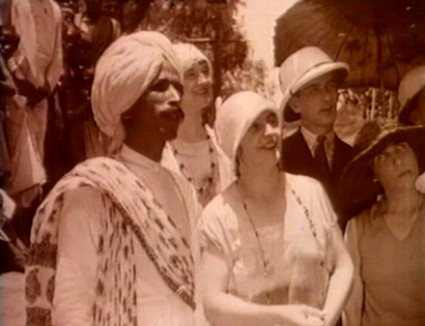
The Light of Asia, or Prem Sanyas, finally made it to the cinema screen as an Indo-German production in 1925. It told the story of Gautama (played by Himansu Rai), son of King Suddodhana, who leaves his sheltered existence to learn of the sorrows of the world, becoming a wandering teacher who brings Buddhism to the world. The cast was all Indian, and in keeping with Pal’s dedication towards educating a Western audiences in the ways of his country, it begins with a group of Western tourists in present-day India encountering an old man who then proceeds to tell them the story of the Buddha. The Light of Asia enjoyed modest success in Europe though it failed to find gain any bookings in Britain until Pal and Rai finally gained some attention for the film with a screening given before the royal family at Windsor Castle (King George V reportedly slept through it). The film also failed as an attraction in India.
Seeta Devi (Anglo-Indian actress Renée Smith) in A Throw of Dice
The film’s favourable reception in Europe led to two further productions, though owing to the lack of success in India the previous production finance source was no longer available to them. However, British companies were now showing interest, and British Instructional Films picked up the distribution rights for Shiraz (1928) and co-produced A Throw of Dice (1929) with UFA in Germany, both films therefore qualifying as Anglo-German productions. Both films were once again scripted by Pal and directed by Franz Osten, with Himansu Rai as lead performer among the all-Indian casts.
The Light of Asia, Shiraz and A Throw of Dice are each historical dramas set in India that stress exoticism (“halfway orientalist” is how Joyojeet Pal describes them), pandering as they do to a taste for a romantic India that was reflected in popular literature of the time. None is exceptional, but they are pleasing, well-constructed and attractively mounted productions which have found ready acceptance with audiences today, especially A Throw of Dice, which has enjoyed high profile through the score provided by Indian-British musician Nitin Sawhney, capped by a screening in London’s Trafalgar Square in 2007.
Pal perserved with British films for a while, writing further scenarios and seeing his story, His Honour the Judge, turned into the early talkie A Gentleman of Paris (1931), with Sinclair Hill directing and Sidney Gilliat the scriptwriter. It has no discernible Indian theme. Pal then returned to India, tried and failed to set up a film, Khyber Pass, to be filmed in Raycol colour and starring Clive Brook; had mixed fortunes making some films in India for his own Niranjan Pal Productions; then renewed his involvement with Himansu Rai and Franz Osten to become chief scenarist for the renowned Bombay Talkies. He stayed there until 1937, when he fell out with his fellow filmmakers (something of a recurring trait in Pal’s career, it has to be said), and concluded his career in film as a producer of advertising, documentary and newsreel films (he founded Aurora Screen News, 1938-42). He was also a pioneer of children’s films in India (with Hatey Khori, made in 1939).
Trailer for the documentary Niranjan Pal – A Forgotten Legend
Pal had been larely forgotten by the film industry and film historians when he died in 1959, but his son Colin went on to be an actor, technician and publicist for Hindi films (Pal had an English wife, née Lily Bell); his grandson Deep Pal is a cameraman; and his great grandson Joyojeet Pal is Assistant Professor of Information at the University of Michigan. He wrote his memoirs, entitled Such is Life, towards the end of his life, but they did not find a publisher, in Kolkata, until 1997.
Last year a project was launched by the South Asian Cinema Foundation in London to research Pal’s legacy, Lifting the Curtain: Niranjan Pal & Indo-British Collaboration in Cinema. With Heritage Lottery Fund support, the SACF has produced a documentary on Pal and published the memoirs for the first time in English, in a volume of essays, filmography and memoir, edited by Kusum Pant Joshi and Lalit Mohan Joshi, entitled Niranjan Pal: A Forgotten Legend & Such is Life: An Autobiography by Niranjan Pal. I was honoured to be asked to contribute a chapter, on Pal and the British film studios of the silent era. The evidence of Charles Urban, someone I have researched for many years, being so supportive on an impoverished and obscure Indian student when the rest of the film industry rebuffed him, was particularly heartening to learn. The volume’s wise introduction by Joyojeet Pal is particularly recommended.
Such is Life will have great value for anyone interested in the history of Indian nationalism or Anglo-British relations at the start of the twentieth century. It is also going to be of great interest to anyone interested in silent film history, from its eye-witness account of the Kinemacolor studios, to Pal’s sharp memory for the financial details of the deals won and lost when trying to get his films of the 1920s made. His memory is not always so sharp. Some dates are clearly wildly out – for example, he recalls being inspired to produce films from an Indian perspective after protesting outside a Lowell Thomas lecture-with-film on India. But Pal began his film career in 1912/13, five years before Thomas turned to the cinematograph, and ten years before Thomas made his travelogue Through Romantic India and into Forbidden Afghanistan, which was indeed the subject of Indian protests when presented at Covent Garden in London in 1922.
Niranjan Pal: A Forgotten Legend & Such is Life is available from the South Asian Cinema Foundation. A DVD is available of the accompanying 30mins documentary, though I don’t have details of how to obtain a copy except by contacting the SACF direct. Book and DVD were launched recently at the BFI Soutbank, and there is to be a launch event at the National Film Archive of India in Pune on 20 February 2012. A Throw of Dice, with the Nitin Sawhney scre, is available on DVD from the BFI in the UK and Kino in the USA. For those interested in Pal’s political background and that of the Indians in Britain around the time of India House and the burgeoning nationalist movement, I recommend the Open University’s Making Britain site, which has information on all the key individuals, locations, organisations and events. David Garnett’s autobiographical work, The Golden Echo (1953), recalls his friendship with Pal, known to him as Nanu, and other Indian nationalists in Britain (an extract is available here).
Niranjan Pal appears to have been hot-headed, a little gullible and tirelessly dedicated to his causes throughout his life. His life story was indeed his most dramatic production. It is certainly a story rich in incident and in the social, cultural and political themes of the times. That an Indian in the Britain of the 1910s and 20s should succeed in the way that he did, despite the racism that he clearly experienced on a continual basis, seems astonishing, though perhaps it was simply that he saw opportunities where others only saw hurdles. Hopefully the chance to read his life story will lead to further investigation of his life and times, and to DVD releases one day of The Light of Asia and Shiraz.
Bloggers are good people, or we strive to be, and what better evidence of this could there be than For the Love of Film: The Film Preservation Blogathon. A blogathon is where bloggers each write on the same theme on each of their respective blogs, linking to other blogs doing the same. The Film Preservation Blogathon, now in its third year, takes film history as its theme but goes that much further by raising funds for film preservation (i.e. a PayPal button appears on blog posts encouraging everyone to contribute their little bit).
In its first year the Blogathon raised funds to enable the National Film Preservation Foundation to restore The Sergeant (1910) and The Better Man (1912), two of the silent-era American films whose discovery in the New Zealand Film Archive we reported at the time. Last year funds were raised to help the Film Noir Foundation restore Cy Endfield’s The Sound of Fury (1950).
The subject of this year’s Film Preservation Blogathon is Alfred Hitchcock. The aim is to raise funds to enable last year’s great discovery, The White Shadow (1923), directed by Graham Cutts with Hitchcock serving as assistant director, art director and more, to be put online by the NFPF with music score (for four months only, presumably because of ongoing hosting costs). This excellent and imaginative objective will cost in the region of $15,000.
The Blogathon runs 13-18 May 2012, and you can read more about it on the blogs of its three organisers, Self-Styled Siren, Ferdy on Films and This Island Rod. There will be more information on how to participate, and how to contribute donations, on each of those blogs as the date gets nearer, or follow all developments on the For the Love of Film Facebook page.
As said, the subject is Hitchcock, any aspect, though the organisers have expanded on this to include (and I quote)
Hitchcock, British silent films, silent film scores, film preservation and the people who do it (but please, as much as we love and revere him, no tributes to Martin Scorsese), the suspense genre, the stars of The White Shadow, Graham Cutts, and other related esoterica.
The Bioscope fervently hopes that at least one Graham Cutts blog post appears out of this (an entire Graham Cutts blogathon was always going to be a bit of a folorn hope). The man has never been so famous, and now’s the time to give him his due when people will be listening. We’ll do something for the Blogathon here at The Bioscope, and fingers crossed we’ll all be able to see The White Shadow in the not so distant future.
It is not only films that are lost; too often it is film technology too. Many of the cameras, projectors and other equipment of the earliest years of cinema before such machines were manufactured en masse have disappeared. Other early cameras and projectors exist as single models, lovingly cared for by museums and collectors, but inevitably inaccessible to most. We do have the patent records, and they can tell the specialist a lot, but there is nothing quite like having the real machine in front of you for a proper realisation of history.
In 2000 the collector Gordon Trewinnard began a project to create working replicas of the first motion picture cameras. With advice from early film tchnology specialist Stephen Herbert and with the engineering skills of some bright and dedicated people, he has funded the production of a number of cameras key to motion picture history. This has not been just an exercise in creating objects a collector might not otherwise be able to obtain. The construction of the cameras (which can of course be used to shoot film) not increases our understanding of early film practice, but can overturn previously held assumptions derived from documentation alone.
The key example is the camera illustrated above, used by British film pioneer Birt Acres to film the 1895 Derby. For years film historians have followed arguments made by John Barnes that there was a camera built by Acres and Robert Paul (known familiarly as the ‘Paul-Acres’ camera) which no longer existed, but whose historical validity was confirmed by patent specifications and workshop drawings. The Trewinnard project has demonstrated that the camera posited in these documents could never have worked:
It soon became clear that the design as shown in the British patent would not have worked – there was a serious error in the gear ratio in relation to the cam and sprocket teeth – and the design shown in a workshop drawing would not have produced the profile that can be seen in the photograph of Acres filming the Derby horse race in the Spring of 1895.
Instead the camera ued by Acres to film the Derby (and presumably earlier films) matches a later German patent, Acres having journeyed to Germany just days after filming the Derby. The fine details of who did what, with what, and with what effectiveness, in the earliest months of British film are mostly of concern only to the specialist, such is the complexity of the technical matters at hand. But what is clear is that building the camera that no longer exists has changed film history, and a few bright minds are going to go back to the drawing board and find out what exactly did happen between Acres and Paul in 1895.
Replica of Louis Aimé Augustin Le Prince’s single lens camera of 1888
The Acres camera is illustrated in gleaming detail on the new project website, The Impossible Cameras. Other cameras on display, with authoritative explanatory texts, are Georges Demenÿ‘s Chronophotographe of 1895-96 (based on a surviving example in the collection of the Cinématheque Française); Wordsworth Donisthorpe and William Carr Crofts’ lost Kinesigraph of 1889, which successfully shot a test film of Trafalgar Square in 1890 and owes much of its design ideas to the wool-combing machines developed by the inventors’ fathers; the American Charles Francis Jenkins‘ Phantascope of 1894 continuous-motion film camera with four lenses (the original of which is long lost), which has been sucessfully tested i.e. by shooting film; and Louis Aimé Augustin Le Prince‘s single lens camera of 1888.
The Impossible Cameras documents the project so far. The aim is produce recreations of thirteen cameras in all. It will be particularly fascinating to find out what they learn from reconstructing the little-known Léon Guillaume Bouly‘s Cinématographe, patented in 1892 three years before the Lumière brothers appropriated the name for their own invention. Meanwhile what we have here is what is known as experimental or reconstruction archaeology – building lost technologies or artefacts to see if they actually worked – applied to film history. It’s a lesson to us all never to take anything for granted, nor to accept that any sort of history is necessarily lost. It just takes a little application, and imagination.







 The Bioscope