Val Williamson

cecilhepworth

I learned today from film historian and Cecil Hepworth expert Simon Brown that Valerie Williamson, Hepworth’s daughter by his second marriage, has died. As Simon explains in this short notice which he has kindly supplied, Val Williamson did much to ensure that her father’s legacy was understood and respected, and her sad passing means that the last direct generational link with the British film pioneers has been broken. Simon writes:

I am sorry to have to announce that Valerie Williamson, daughter of pioneer British filmmaker Cecil Hepworth, died on Thursday 8th October after a battle with cancer. Val was born well after Hepworth stopped making films at Walton Studios, but after the death of Elizabeth Hepworth in the 1990s, Val took over the mantle of keeper of her father’s memory. Although she resisted the limelight, rarely attending screenings of her father’s work, she nonetheless became a great friend to academics, historians, documentary makers and archivists over the years, helping to ensure the long-term legacy of Hepworth through careful managing of how her father’s surviving films were used. She will be particularly missed by those historians of early British cinema with whom she freely shared her memories of her father and his work. As one of the few surviving family members with direct links to the pioneer days, her contribution to our understanding of Hepworth has been considerable and her death is a tragic loss for us all, particularly for those of us lucky enough to call her a friend. Outside of the film world Val was a potter of considerable talent and lived quietly near Guildford with her husband and her two beloved daschunds.

For information on Cecil Hepworth, the leading figure in British dramatic film production before the First World War, and a significant creative filmmaker into the 1920s, here are a few links:

Continuous performance

cinemamonthlogo

Continuous Performance: Going to the Cinema a Hundred Years Ago is an exhibition marking the centenary of cinema-going in Britain. Well, we can argue the point whether 1909-2009 is any real sort of centenary, since pedants like me would point to the first British cinemas having appeared in London in 1906 (specifically, the Daily Bioscope opposite Liverpool Street Station gets my vote as cinema no. 1), but 1909 was undoubtedly the year when the phenomenon undoubtedly took off in a huge way and started to make such a great impact upon society.

continuous

The exhibition is taking place at the Templeman Library, University of Kent, Canterbury, as part of the Canterbury Festival. The exhibition celebrates the first film shows and their audiences through cameras, projectors, books, photographs, fan magazines, and other ephemera from the early years of the cinema. The exhibition has been put together by Dr Nicholas Hiley, head of the university’s world-renowned British Cartoon Archive and a great collector of early cinema apparatus and memorabilia. The Bioscope plans to visit the exhibition soon and to review it in detail, but as that may take a week or two as yet, do note that it is open Friday 2 Oct – Friday 6 Nov, Mon-Fri 8.45am – 10pm, Sat-Sun 12pm – 7pm. Admission is free, and you get to visit the fair city of Canterbury into the bargain.

Silents old and new

neilgaiman

Neil Gaiman directing Statuesque, from http://blog.amandapalmer.net

Keep the eyes peeled for two different approaches to the silent film on British television in the next couple or months or so. Firstly, comedian Paul Merton is continuing his mission to educate his great following in the art of silent cinema. Following on from his Silent Clowns series and Paul Merton looks at Hitchcock (not to mention his guide to early British comedy on the BFI’s Screenonline site), late 2009 or early 2010 will see Lost Silence (working title), a one-off documentary exploring early European cinema, with a 3x60mins series The Birth Of Hollywood scheduled for 2011 to coincide with what the BBC claims will be the 100th anniversary of the Hollywood film industry. Assuming the programme’s slot has not been decided as yet, they might like to take note of the generally accepted fact that the first film made in Hollywood was D.W. Griffith’s In Old California (shot in February 1910). Anyway, they say the series will “focus on the influence of early US cinema on today’s films“.

And there’s silent film today. Over Christmas Sky 1 will be screening 12 Days of Christmas, a 12-part series of specially-commissioned silent films, each of which will have a different writer and director. They include cult author Neil Gaiman, who has written and directed Statuesque, starring Amanda Palmer and Bill Nighy. Gaiman has blogged about the eight-minute film’s production on his website. Other films in the series (produced by Hilary Bevan Jones for Endor Productions) will include Three Kings, a new take on the Biblical tale written by novelist William Boyd and directed by Richard Eyre, and playwright Jez Butterworth collaborating with director Ian Rickson. Tony Grisoni, Terry Gilliam’s regular screenwriter, is another scheduled contributor. So we must wait and see (or for those like the Bioscope who don’t subscribe to Sky, not see at all, at least until the DVD gets released).

Tell me Grandpa

cinemamonthlogo

It’s been quite a while since we have an extract from one of the memoirs of early cinema-going that I like to collect. So here’s something from Josef Morrell’s Tell Me Grandpa, published in 1981. Morrelwas born in 1906, the son of a tailor living in Fulham, London. His memoirs cover the period from pre-war to the 1920s, and includes this really well-observed sequence on the child’s experience of the early cinema. Although what he recalls tooks place in the 1910s, I’m struck with how much something like this remained the experience of children’s cinema for decades afterwards. Certainly anyone like me who can remember children’s Saturday morning film shows in the (late) 1960s and early 70s (when they died out in the UK) should recognise the happy blend of anarchy and enthalment at the thrills and spills on the screen:

However low were the family’s finances, most parents tried to afford one penny for each of their children to visit the local cinema on Saturday mornings. I think there was method in this sacrificial attitude, and mothers could be forgiven for an innocent piece of blackmail. What better reason for withholding the entrance money, if certain jobs weren’t accomplished, before being allowed to see the latest episode of the exciting thriller that had been eagerly discussed since last week’s instalment. Also, most mothers thought that to be rid of her offspring for two or three hours was no bad thing, and at least they knew where their children were.

There were two picture palaces in the district, each competing with the other to show films that would fill their halls with screaming children each Saturday morning at ten o’clock. The proprietors no doubt were pleased to see a long queue of waiting customers, but whether the manager and his brave staff were as enthusiastic, is open to doubt.

However, the preparation of the showings were arranged with considerable thought. While each cinema had to provide a lengthy and attractive programme to ensure everybody had their money’s worth, the manager had to allow his staff sufficient time after the children had gone, to prepare for the adult programme starting early in the afternoon. It must have been a daunting task each week to clear the floor of sweet bags, orange peel and apple cores, thrown down by anything up to three hundred children.

The doors were opened and we filed in dropping our pennies into a box on the table, under the eagle eyes of two large gentlemen whose principal job was to see that no one disappeared through the curtains before their hot little hands had released their pennies. Once inside we scrambled to a seat, often resulting in skirmishes reminiscent of the action we were about to see in the films. There were another two attendants inside supervising the seating arrangements, but as I remember, they quickly lost heart when they saw the unruly and unorthodox manner the children chose their seats.

Miraculously, as soon as the curtains parted to reveal the screen, everyone was settled and cheered the announcement that the first film was to commence shortly. It was now that my praise of the management’s timing showed itself. Just as we were becoming restless, the lights went out and the beam from the projector showed on the screen.

Usually the first film was short and lasted about five minutes, and was probably a testing exercise to see that the apparatus was working correctly; it also allowed the lady pianist, seated below the screen, to be ready for her marathon performance. I still wonder at her marvellous concentration and ability to keep her eyes on the events of those silent screens and the synchronization of her hands to fit the action.

Immediately the introductory film finished, the title and captions of the main feature appeared. No time for the boy behind to be tempted to stuff orange peel down your collar, or to crawl under your seat and tie the laces of your boot together!

There was silence until the film got underway, then the piano gave the clues of the story. The pianist thumped the keys fortissimo when the hero was hurrying to rescue the heroine from all sorts of terrible fates, and we gave him every encouragement by raising our voices to a deafening pitch. It was when the leading lady’s baby was desperately ill, that the pianist gave her best. Soul stirring melodies were played in unbelievable silence, and the boys had to be on their guard not to be caught crying with the girls. Of course justice was seen to be done, and had we been able to reach him, we would have assisted the hero to throw the villain off the cliff. The end came with most of us standing on our seats cheering the epic drawing to a close.

With little or no time, in order to prevent private wars breaking out between children in the audience, the weekly serial appeared, and we had a few seconds flash-back to recount to the unfortunates who hadn’t been able to attend the previous week, what has so far taken place. ‘Pearl White’ and ‘Elmo the Mighty’ are names which only the very elderly will recall, but it is possible those not so old will remember their parents tell of those pioneers of the screen.

‘Elmo the Mighty’ is Elmo Lincoln, who would become the cinema screen’s first Tarzan.

The makers of those serial films really knew their business and their audience. Our hearts beat fast when the train carrying the heroine approached the damaged railway viaduct, and the gallant hero tried to bring his galloping horse alongside to warn the train driver of the peril.

It had come to an end, and we were left with feelings nearly as emotional as the film, realizing it would be a whole week before we knew for certain whether our favourite would be in time to save his sweetheart.

As we jostled our way out, the relief of the watching attendants can only be guessed. Then they made a systematic check by turning up the seats and examining the toilets, in case someone had secreted themselves away in order to see the adult programme without paying.

Arguments took place on the way home, trying to guess what would happen the following week, and our parents were of little help; when relating the exciting finish to the serial and asking whether everything would turn out the way we wished, they smiled and irritatingly said we would just have to wait and see.

Goldman concludes with an interesting insight into the difference between the child’s and the adult’s cinema-going experience, indicating the way in which cinema had moved from its earlier, rumbustious state to an ordered world where social pressures demanded conformity.

Very rarely, perhaps on my birthday, I was taken to the cinema by my parents. These visits were in complete contrast to the Saturday morning adventure, principally because we went in the evenings, and coming home in the dark was part of the grown-up world which I didn’t experience very often.

Mother and my sisters were always eager to go, but Father had to be coaxed. There were two feature films, and provided one of them was a western, he would be agreeable to come with us. I approved his taste, and hoped that if the other film was a love story, it would be shown first, so although having to endure it, I could sit and anticipate the fight between the cowboys and Indians later on.

Of course the quiet and peaceful atmosphere of the hall although nearly full, was in sharp contrast to the morning’s performance. For instance, with everyone orderly, there was no need for attendants to be waiting to throw out anyone misbehaving, and was therefore an early glimpse into the future and what was expected of me when I grew up.

A delightful piece, I hope you’ll agree, evocative and informative.

Lakeland

wastdale

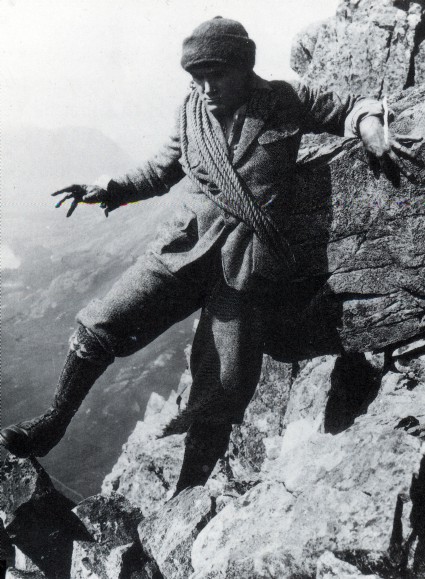
Milton Rosmer in A Romance of Wastdale (1921), from Ivan Butler, Silent Magic (1987)

Well I’m back from all too brief a sojourn in the Lake District, where my mind was on hills and dales and becks and crags, and not much on silent films. But the medium can pursue you wherever you may be, and though you might think the Lake District is the last place where you could expect silent cinema associations, they are there. To begin with, there’s the splendid still reproduced above, which comes from the only silent drama set in the area (so far as I know). A Romance of Wastdale (1921) was a British film, directed by Maurice Elvey for Stoll and starring Milton Rosmer and Valya Venitskaya (aka Valia). The film no longer exists, but Ivan Butler in his superlative book Silent Magic recalled seeing it:

Another adaptation from a well-known author, A.E.W. Mason’s A Romance of Wastdale (directed by Maurice Elvey), a grim tale of jealousy and revenge among the Lakeland mountains, was weakened by having the events turned into a dream; but it generated enough tension between the small group of characters to make certain scenes stick in the memory. The photography has a grey, gritty quality which admirably suits the circumstances, preserved in a fine still featuring Milton Rosmer.

Would that he had told which scenes impressed him so, and would that the film survived. It would be good to know more about its production. Jack Cox was the man responsible for the gritty cinematography. Wastdale (or Wasdale) is the area between Scafell Pike and Wast Water lake, by the way.

And then there’s Stan Laurel. OK, so the birthplace of Stanley Jefferson, Ulverston, is south of the Lake District, but not by much, and Ulverston is now home to the renowned Laurel & Hardy Museum. In the heart of the Lake District, in the town of Keswick, there is the cheerfully named The Cars of the Stars, a museum dedicated to famous vehicles from film and television. If you fell the urge to get up close to Chitty Chitty Bang Bang or Herbie, this is the place to go, and the exhibits include a Laurel and Hardy Model T and the sort-of-silent Mr Bean’s Mini.

keswick

The Alhambra, Keswick (in the rain)

Keswick is a small town (about 5,000 population), but it does boast a cinema, and one that has been in operation since 1913. The Lonsdale Alhambra, in St John’s Street, is a delight. It opened in 1913 and from its Edwardian facade it doesn’t look like it has changed much since then. The cinema provides a handy leaflet on its history, from which we learn that the Keswick Alhambra Theatre Co. Limited as registered with £2,000 capital on 27 May 1913. It was able to seat 595 people and showed one programme a day,with two changes of programme per week. Prices ranged from 4d to 1/3d. It had music, dancing and cinematograph licences, and variety acts performed alongside the films.

By 1916 it had a local rival, the gloriously named Queen of the Lakes Pavilion, around the corner in Station Street. In the 1920s it changed its name from the Alhambra Picture Theatre to simply the Alhambra, and converted for sound. It continued, taking over its rival the Pavilion in the 1940s, and enjoyed something of a boom with the arrival of holidaymakers in the 1950s discovering the Lake District for the first time. But hard times came, as they did across the cinema industry, and by the 1980s the Pavilion had closed and the Alhambra was shut during winter months. But it has survived, and hearteningly in 2006 it was leased to R.J. Towers & partners of Gretna, a business formed by former silent film pianist Towers.

keswick2

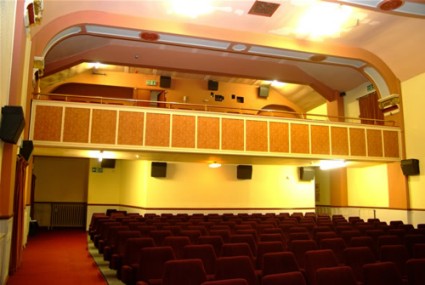
Interior of the Lonsdale Alhambra. For more images, visit www.keswick-alhambra.co.uk/gallery

Today the cinema seats 270, has Dolby stereo sound, and has an ambience that adroitly combines its past with the present. It has one or two screenings per day, and hosts the Keswick Film Club with its imaginative programme of world cinema titles. I saw District 9 (a proficient B-movie) in thoroughly comfortable circumstances and warmly recommend the place (though they should let the film credits roll through to the end, please). It also serves as an introduction for what is going to be cinema month here at the Bioscope. Alongside the usual reports and idle speculations, throughout October we will have a number of posts focussing on cinemas and the silent era, including publications, web resources, exhibitions and projects. Take your seats, and keep watching the screen.

(One last Lakeland connection – the Old Laundry Theatre at Bowness-on-Windermere has occasional silent film screenings, and on 21 November Neil Brand will be there accompanying a programme of Laurel and Hardy and Buster Keaton shorts)

Harishchandrachi Factory

harishchandrachi

http://harishchandrachifactory.com

Early cinema is making a bid for world recognition with the announcement that the film Harishchandrachi Factory has just been nominated as India’s official entry to the 2010 Academy Awards. The film, written, produced and directed by Paresh Mokashi, tells the story of Dhundiraj Govind Phalke, producer of India’s first full-length feature film in 1913, Raja Harishchandra.

Harishchandrachi Factory has a lively website, where you can see clips, stills and learn about the production and D.G. Phalke himself. It tells the romanticised story of how Phalke took the medium that was the plaything of Europeans, Americans and elitist Indians, and gave it to the people, creating the Indian film industry in the process.

phalke

Phalke was the one-man pioneer of Indian dramatic cinema – director, productor, cameraman, editor, actor, and all points in between. He was born in 1870, the son of a Sanskrit scholar, and after studying art and architecture became a photographer, make-up artist and even had a magic act, before established a printing works in in 1908. It was apparently the experience of seeing a filmed life of Christ in Bombay around 1911 that inspired him to establish a native Indian cinema. He travelled to Britain in 1912, puchasing a Williamson camera and gaining instruction in film techniques from Cecil Hepworth.

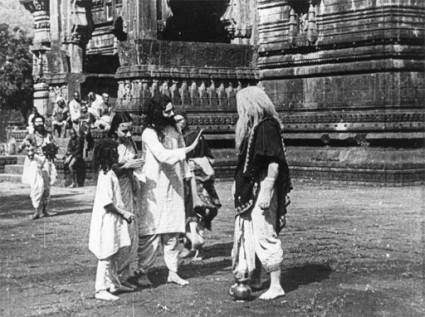
He formed the Phalke Films Company that same year, and made his first film Raja Harishchandra, in 1913 (Phalke encouraged the belief that his was India’s first dramatic film, but it was preceded by two short dramatic films). The film told the story from Hindu mythology of King Harishchandra, as told in the Ramayana and the Mahabharata. The story tells how the virtuous king sacrifices his kingdom and his family in the pursuit of truth, only to be restored to power through the intervention of the grateful gods. The film was originally 3,700ft long, and around half survives of what is said to be the film at the National Film Archive of India, though some sources state that what survives comes from Phalke’s 1917 remake Satyavadi Raja Harishchandra. The Archive lists eight Phalke films in its collection: Raja Harishchandra, Lanka Dahan (1917), Shree Krishna Janma (1918), Kaliya Mardan (1919), Sinhasta Mela (1921), Tukaram (1921), Brick Laying (1922), Setu Bandhan (1932) and the undated Pithache Panje. Scenes of Phalke at work also exist from a 1917 short Chitrapat Kase Tayar Kartat (How Films are Made).

harishchandra

Scene from Raja Harishchandra (either 1913 or 1917 version), from http://en.wikipedia.org/wiki/Raja_Harishchandra

Phalke Films made four more films, then in 1914 Phalke returned to London to established business contacts and obtain fresh production equipment, later setting up Hindustan Cinema Films and going on to make over forty silent features and one talkie. He died in 1944. Harishchandrachi Factory is bound to generate renewed interest in the revered founding father of Indian cinema, whose own history is now almost as much bound up in mythology as the subjects of his pioneering films.

Fit to win

It’s time to go back to the Bioscope Library, and to look at the latest addition, Karl S. Lashley and John B. Watson’s A psychological study of motion pictures in relation to venereal disease campaigns (1922). The study on which the book was based was initiated in 1919, and is said to have been the first large scale research project on the educational effectiveness of educational films, something which greatly exercised minds at the time. Films were self-evidently popular with the masses, and noticeably so with young minds, but could that popularity be converted into lessons for life? Did one actually learn anything from motion pictures? Plenty were saying that you did, but they were chiefly those with a vested interest i.e. film producers themselves. What was needed was controlled studies and verifiable evidence.

In 1919 the United States Interpartmental Social Hygiene Board awarded a grant of $6,000 to the Psychological Laboratory of John Hopkins University for the purpose of “investigating the informational and educative effect upon the public of certain motion-picture films used in various campaigns for the control, repression, and elimination of venereal diseases.” Psychologists Lashley and Watson headed the research and produced the report.

The problem of venereal disease exercised minds hugely at the time. Specifically VD had debilitated so many troops meant for fighting during the First World War that campaigns with official backing arose in Britain and America. In the latter, the campaign operated under the slogan ‘Fit to Fight’, which became the title of a 1917 film, directed by Lieutenant Edward H. Griffith and promoted by the US Public Health Service, which followed the fortunes of five men suitable for military service, four of whom succumb to “bootleggers and prostitutes”. In 1919 the film was revised and extended, and released under the title Fit to Win. The John Hopkins University study provides this synopsis:

The first 1,000 feet of the picture are devoted to the showing of lesions resulting from venereal disease, by photographs of cases and explanatory legends. A story is then introduced. It deals with five young men of diverse education and traditions. They are shown first as civilians, then as drafted and in training. On leave, they are approached by bootleggers and prostitutes. One, Billy Hale, influenced by the memory of his sweetheart, resists temptation. The others are exposed to venereal disease. Of the latter, Kid McCarthy resorts to medical prophylaxis promptly and escapes infection. The others are infected.

Kid McCarthy accuses Billy Hale of being a “mollycoddle,” and a fight ensues in which Kid is defeated. He admits himself beaten and at Billy’s instigation reforms. These two are then held up as examples of physical fitness and are selected for service abroad. The other three, infected, are disqualified for foreign service. One, infected with gonorrhea, is discharged and the others, infected with syphilis, are sent to the hospital for treatment.

The remaining reels were constructed after the signing of the armistice and added as an epilogue to the original picture. Billy is shown returning from France as a captain. Kid McCarthy has been killed, after citation for bravery in action. The youth afflicted with gonorrheal arthritis is shown at home, his father heartbroken over his infection, his mother ignorant of its cause. Billy carries Kid McCarthy’s medal for bravery to McCarthy’s sweetheart. He then meets and sympathizes with the men afflicted with syphilis, telling them that they are now probably completely cured. He then bids farewell to his company, advising them to be wary of prostitutes and to keep morally clean in civilian life. After purchasing a civilian outfit, he visits his sweetheart, and in the final scene they are shown at the altar.

Fit to Win was shown to segregated audiences, and not to children. It aroused considerable controversy, owing to its frankness over the causes of venereal disease, and was banned from exhibition in New York City.

For the purposes of the study, a shortened version of the film was shown – effectively the original Fit to Fight, since the post-Armistice scenes were left out – to 5,000 people, divided up into different groups. There was a Medical Group (around forty physicians and nurses), an Executive and Clerical Group, a Literary Club Group, a mixed audience (250 people from a village in Pennsylvania), a Car Men Group (railway employees in NYC), a Merchant Sailor Group, and a Soldier Group.

The study describes the film, the methodology and the statistical analysis in great detail. They were interested to discover what the levels of understanding were among the different types of audience, then how much and what kind of information might be imparted to each by a film, and what the effect of a single film over a programme of films or other kinds of information might be. Lashley and Watson had no interest in promoting the film for its own sake, and their conclusions are refreshingly frank. The medical group, they reported, “was frankly bored throughout the picture”, finding it exaggerated and falsely dramatic. The mixed audience displayed mixed responses, from ribald laughter to expressions of embarassment, reactions which in turn worried the investigators. The car men “reacted rather strongly to the suggestive parts of the picture”. The seamen showed an unexpected intelligent interest in the film. The soliders were under orders to stay silent, and did so apart from laughter at the bawdy house scene.

Unltimately, the study’s findings were inconclusive. On the film’s informational effect, it was discovered that audiences gained general impressions rather than accurate knowledge, and that while many came away with some basic facts acquired, others still displayed confusion over causes and details. On the film’s emotional effect, it was found to engender horror in most of those who saw it, but precision of influence was difficult to identify, and for many “the appeal of sympathy for the innocently infected is greater than of fear of disease”. However, in answer to the worries of censorious authorities who sought to prevent the film’s exhibition, they noted:

The picture does not produce any sexual excitement in the majority of the men. The replies to questionnaires, comments of the audience, and data gained from interviews with men after the performance all indicate that there is, instead, a temporary inhibition of sex impulses.

Fit to Fight and Fit to Win are lost films; not even a still appears to survive. The study provides such meticulous detail, however (down to the number of seconds in which audiences were exposed to various examples of syphilitic infection) that one has a very clear idea of the film’s contents, strengths and limitations. In the end it finds, a little surprisingly, that such a film’s appeal to the emotions that little value in changing hearts and minds, but that it could impart some basic information which could then be built upon by other educational means. So they judge the film before them, but do not call for better films, which might have provided the way forward that they were seeking.

A psychological study of motion pictures in relation to venereal disease campaigns is available from the Internet Archive in PDF (2.46MB), full text (209KB) and DjVu (1.49MB) formats.
Cinema she wrote

almareville

There has been, in recent years, a growing interest in women filmmakers in the silent period. Early cinema offered greater opportunities for women (in some countries, that is) to make a mark in the film business than would be the case for decades thereafter, and if the number of women directors was few (Alice Guy, Nell Shipman, Lois Weber, Esfir Shub and Germaine Dulac are among the most notable names), once you look more widely to production, scriptwriting, editing, lab work, criticism, continuinty, cinema management, projection, and acting of course, the numbers begin to grow.

It is with an enthusiastic spirit of investigation and a determination to reblanace early film history that international and national projects have been launched. Internationally, there is Duke University’s Women Film Pioneers project, led by Professor Jane Gaines. And here in Blighty there is Women in Silent British Cinema. This is a lively project which has a team of researchers pursuing a fascinatingly varied group of names, from the reasonably well known (Alma Reville, Blanche McIntosh, Mary Field) to the tantalisingly obscure. Anyone interested to help join in should get in touch through the website – there are many names left demanding assiduous detective work to rescue them from obscurity.

Next up for the project is a study day taking place at the BFI Southbank in London on 7 November, entitled Women and Silent Britain 2: Writers. The day will consider all aspects of writing for the screen by women involved in the British cinema industry of the silent era, whether as screenwriters, critics, columnists, publicists, or authors of source novels and plays. The day will feature the results of new research on critic Nerina Shute, novelist and director Elinor Glyn, and the prolific screenwrier Lydia Hayward.

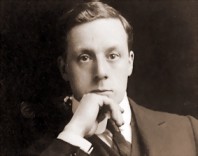
The day will consist of screenings from the BFI National Archive, talks and workshops, followed by Adrian Brunel’s rarely screened silent classic The Constant Nymph (1928), based on the play of a novel by Margaret Kennedy and Basil Dean and adapted for the screen by Alma Reville (pictured above, with husband Alfred Hitchcock).

The study day will include contributions from Christine Gledhill, Jane Gaines (Duke University), Drake Stuseman (editor Framework), Alexis Wheedon (University of Bedfordshore), Laurence Napper (Kings College, University of London), Claire Watson (UEA), Matthew Sweet (journalist and broadcaster), Amy Sargeant (Warwick University) and Nathalie Morris and Bryony Dixon of the BFI.

Tickets are £15 (concs £10) including the evening screening. The day takes place in NFT3, 10.00-17.00. For further details email nathalie.morris [at] bfi.org.uk

The last bioscopewallah

salim

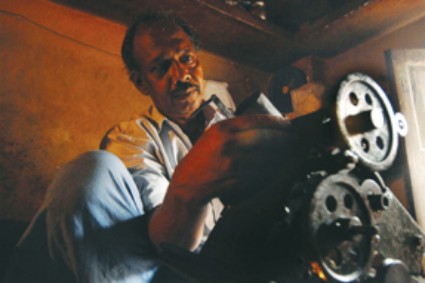
Mohammad Salim with his 100-year-old projector, from http://www.littleindia.com

We have written here before on the tradition of the travelling bioscope in India, film shows put on by men journeying from town to town with projector in a hand cart, some of whom work with equipment dating back to the early cinema period.

The subject has interested a number of filmmakers. There is K.M. Madhusudhanan’s feature film Bioscope, The Bioscopewallah by Prashant Kadam, Megha B. Lakhani’s Prakash Travelling Cinema (available in two parts on YouTube), Andrej Fidyk’s Battu’s Bioscope, Vrinda Kapoor and Nitesh Bhatia’s Baarah Mann Ki Dhoban and Salim Baba by Americans Tim Sternberg and Francisco Bello, which was nominated for an Oscar in 2008.

An article by Nilanjana Bhowmick on the man featured in that last film has turned up on Little India (an Indian newspaper published in the USA). Entitled ‘The last bioscopewallah’, its subject is Mohammed Salim, who tours Kolkata with his 100-year-old projector (apparently Japanese in origin) on a cart, accompanied by his reluctant son. It’s an evocative piece of writing, depicting a decades-old form of street entertainment that just about hangs on in the age of the iPod and the DVD, sustained by the belief of the bioscopewallah in the magic of literally bringing cinema to the people. These are a few choice paragraphs:

Bioscopewallah……bioscopewallah ayah….aao, dekho,nai purani filme sirf ek rupiya. (Here comes the Bioscopewallah, come and watch new and old films for just Re 1).

The throw-back cry from the 1960s and 1970s of Indian street vendors trying to lure children and adults to the magic of movies in a box still reverberates in the serpentine bylanes of Kolkata, mingled with the smell of moss and decay. The cry might not have the same verve, nor perhaps does it elicit the earlier enthusiasm. But it still attracts curious onlookers who crowd around as the last bioscopewallah of Kolkata sets up his shop near a school or a movie theater.

Children rush to his cart, clutching a rupee coin in their hands. Some older people might still remember the voyeuristic feeling of peek-a-boo cinema under the shade of the ominously grave-looking black cloth, but most have either forgotten or never experienced the charm of the movie in the wooden box.

Mohammad Salim, with his 100-year-old projector, is a relic from a forgotten era. He roams the streets of Kolkata, letting people experience in short bursts the often surreal world of the bioscope.

Salim’s voice has become weaker with age, but the enthusiasm remains undimmed. He is the thin string that binds Kolkata with its glorious past to the beginning of cinema — the Royal Bioscope Company, India’s first bioscope company. Salim is not only oblivious to the legacy he has carried on his shoulders for decades now, but he is equally nonchalant about his brush with international fame, which includes an Oscar nominated documentary on his life. He only understands his bioscope and beyond it everything else pales.

Salim’s journey on the Kolkata streets with his bioscope began more than 40 years ago. In his late fifties, he laboriously pushes along his archaic projector on a hand driven cart. These days often he is accompanied by one of his unwilling sons, for whom the bioscope holds no magic. Sometimes he is mistaken for an ice cream vendor, most times he is ignored. In this digital age, the wooden bioscope holds no attraction and Salim cuts a lone figure as he wanders from one street to another. However, as he sets shop and Bollywood music and dialogs burst forth from his bioscope, a small crowd gathers around him; a crowd that wants to lose itself in the garish, colorful, melodramatic and musical world of Bollywood movies. The glamour, thrill, drama and dreams of Bollywood are packed into three-four minutes of trailers that transport the viewer into a makeshift world of the movies — short lived, but an escape from the real world nevertheless …

… In the 1960s and 1970s the call of the bioscopewallah was eagerly awaited in the neighborhoods of Kolkata. However in this age of television and computers, the bioscope is as antiquated as the term itself. Salim recalls the golden days when his father’s bioscope ruled the roost: “When my father used to call out, people used to come rushing out of their houses, especially children and women. They used to stand in the balcony for hours in order to catch the bioscopewallah.”

Salim started with his father when aged just twelve. In those days there were many other bioscopewallahs, all of whom showed only silent films. To keep up with the times, Salim has had to adapt to sound, showing scraps of films that highlight songs, dances and fights.

Salim survives in an age dominated by iPods and DVDs by updating his equipment to keep pace with the modern age. His passion with the bioscope led him to experiment with it and add new features. The original bioscope had no provision for sound so Salim, realizing he will lose his audiences if he failed to add it to his trailers, acquired sound.

“I love my projector and the fact that this small box contains all the wonders of a cinema hall. And I told myself, there must be a way to put sound too! I went to the cinema halls and asked people about how they put the sound on the lip movements. We tried to replicate that in my projector and succeeded. It was because I went with the times that I have been able to keep this alive. If there was no sound, no one would have watched it anymore.” …

… The era of the bioscope will likely end with Salim. His sons are not interested in carrying forward the tradition of their father and grandfather. They are young men who have come of age in the digital era of mobile phones and computer games.

Salim is philosophical about his plight and the future of his craft. He insists he is not driven by money, otherwise he would have sold the projector — an antique piece — by now. “I have had offers from abroad to sell my bioscope, I have said no. It is the heritage of my country, why should I sell it to another country?”

It’s a delightful piece well worth reading in its entirety. Not exactly silent films, but definitely in their spirit.

London on the move

underground

Underground

The programme for the London Film Festival has been announced, and though there’s not much in the way of silents on offer, it’s well worth noting what there is.

For the past two years the LFF has featured a programme of archive films on London, plus a London-themed silent feature, for exhibition in Trafalgar Square. This year the feature film is Anthony Asquith’s Underground (1928), an expressionist brew of love, treachery and murder set in and around London’s underground railways, starring Brian Aherne and Elissa Landi. That screens on Friday 23 October, while on Thursday 22 there is London Moves Me, a programme of archive film on the theme of London and transport. The programme includes cycling in 1896, trams in 1901, boats in 1905, canoes in 1922, barges in 1924, underground trains in 1929, and much more. The indispensible Neil Brand will accompany on piano. The Trafalgar Square shows are free, and just the sight of seeing crowds of commuters, tourists, the curious and the dedicated gathered on the steps to witness silent films beneath Nelson’s Column is an experience to savour.

(Correction: Underground is screening at the Queen Elizabeth’s Hall. Shame.)

laila2

Laila

The LFF has an archive film section, which features the pick of the restorations and star selections from recent archive film festivals. The silent to look out for is the Norwegian Laila (1929), which was the hit of the Pordenone festival in 2008, enthusiatically reviewed by the Bioscope at the time. I warmly recommend this engrossing, dramatic, human and beautifully photographed masterpiece, screening on October 29. It is everything that a silent film can be.

The other silent offering is J’Accuse (1919), a new, colour-tinted restoration by the Nederlands Film Museum, in collaboration with Lobster Films, of Abel Gance’s epic anti-war statement.