An Italian Straw Hat

Albert Préjean as the bridegroom in An Italian Straw Hat, from http://www.flickeralley.com

Released on April 6th is the latest DVD release from Flicker Alley, René Clair’s Un Chapeau de paille d’Italie (1927), known in English as An Italian Straw Hat. This was one of the very first silent feature films I ever saw, some time back in the mid-1980s, and I remember it with such fondness, to an extent where I’m actually quite anxious that it lives up to the memories, as I’ve not seen the film since. It’s a comedy of bourgeois manners, set in late 19th century France, and based on a renowned stage play from 1851 by Eugène Labiche and Marc Michel. The plot revolves around the comic embarrassments that occur when a bridegroom’s horse eats the hat of an army officer’s mistress, leading to an intricately choreographed farce as efforts to restore social decorum are continually thwarted.

Flicker Alley have mastered the film in high definition at 19 frames per second (the speed at which it was shown at its French premiere) from the original 35mm negative used for the film’s English release in 1930, with elements cut for that release restored from an original French print. Intertitles are in English, while you get a choice of music scores, from the Mont Alto Motion Picture Orchestra and pianist Philip Carli.

Extras include Clair’s short film, La Tour (The Eiffel Tower) (1928) and Pathé’s Noce en Goguette (Fun After The Wedding) (1907, directed by Ferdinand Zecca), an an example of the kind of early film that inspired Clair. There is a new essay by Lenny Borger and a vintage one by Iris Barry, notes on the musical score by Rodney Sauer, and a 1916 English translation of Labiche’s play.

The Flicker Alley site includes an image gallery and two extracts from the film, including the opening horse-eating-hat sequence, plus an extract from Clair’s La Tour. Judging from those, I don’t think I’m going to be disappointed.

Toronto Silent Film Festival

http://www.ebk-ink.com/tsff

Acknowledgments to the ever-useful The Silent Treatment (the online PDF silent film newspaper) for news of the Toronto Silent Film Festival, which had previously escaped the Bioscope’s radar. This is a new festival, running 6-15 April 2010, so congratulations to all involved on having set it up. Here’s the programme, taken from the festival’s website:

Opening Night:
Tuesday April 6 Casa Loma
8pm
Toronto Theatre Organ Society presents:
Seven Chances 1925 USA
Director: Buster Keaton
Buster Keaton, Snitz Edwards, T. Roy Barnes
56 min
b/w with 2-strip Technicolor sequence

Musical Interpretation: Clark Wilson on the Wurlitzer Theatre Organ

Buster thinks his luck has turned a corner when he’s left $7 million in a will. The hitch-he must marry by 7pm on his 27th birthday and guess which day it is. So after completely offending his girlfriend, he sets out to find a willing bride only to strike out all 7 times. His friends do him a favour and place an advert for a bride willing to marry for money. The first 45 minutes is a great comedy film, the last 15 sends it into the stratosphere of insanity with the greatest chase scene in film history.

Preceded by Big Business with Laurel & Hardy

Thursday April 8 Fox Theatre
7pm
The Black Pirate 1926
Director: Albert Parker
Starring: Douglas Fairbanks, Billie Dove
88min
2-Strip Technicolor
Musical Interpretation: Laura Silberberg
Film introduced by Taylor Whitney, Archivist, Preservation Specialist of “Preserving the Past”, Rochester NY

“One of the silent era’s most spectacular blockbusters.
Fairbanks’s astonishing acrobatics remain as dazzling and as fresh today.”
The world’s greatest swashbuckler, Douglas Fairbanks, takes to the sea with cutlass in hand for the first great pirate movie and a gorgeous example of early Technicolor.

Sunday April 11 Revue Cinema
4pm
A THOUSAND LAUGHS
The Forgotten Clowns of Silent Comedy

Films introduced by programmer Chris Seguin, writer
Six Short Comedies featuring;

Roscoe ‘Fatty’ Arbuckle started out as one of Mack Sennett’s Keystone Kops, and quickly became Charlie Chaplin’s one serious rival. Nobody combined subtle charm with rowdy slapstick so artfully, and the innocent joy of 1919’s Love demonstrates precisely why he was so popular. Arbuckle’s career would be destroyed (unfairly) by scandal a few years later, but he would enjoy a comeback after a decade’s banishment from movie screens, just before his premature death at age 46 in 1933.

Lloyd Hamilton was, according to Charlie Chaplin, “the one actor of whom I am jealous.” His prissy, disapproving demeanour elevates the any-cliché-for-a-laugh approach of Breezing Along, where banana peels, exploding cigars and bum-pinching crabs are all par for the course. Consider yourself lucky that Breezing Along is still around to enjoy today – while Hamilton made more than 250 films in 20-year comedy career, most were destroyed in a studio fire in the 1930s.

Charley Chase’s sophisticated slapsticks of the 1920s seemed determined to prove one thing: folks back then sure liked sex. Men were wolfs, women were Hottentots, and Charley was generally caught in the middle. The split-second two-timing of Too Many Mammas was directed by Leo McCarey (The Bells of St. Mary, Duck Soup) while Charley’s starring series for Hal Roach Studios would last well into the ‘talkie’ era.

Snub Pollard started his film career as comedy sidekick to Harold Lloyd; when Lloyd moved on to bigger and better things, Pollard got his own starring series. His personality didn’t extend far beyond his hangdog moustache, but Snub could deliver a gag like nobody’s business – Looking For Trouble is the proof in the pudding. And we can guarantee you’ve seen this forgotten clown before – he’s the rain-soaked gent to whom Gene Kelly hands his umbrella at the end of Kelly’s classic Singin’ in the Rain number.

If Stan Laurel is remembered today, it’s as the wispy half of the comedy team of Laurel & Hardy. But the whimpering, slow-witted sidekick of pompous Oliver Hardy is nowhere to be seen in his solo work, where he’s usually a jackrabbit go-getter with more energy than brains. The Pest is a perfect example of Laurel’s fast & furious pre-Hardy style, and a great argument for having a giant catskin rug in the house at all times.

Goon-faced Larry Semon (a kind of a silent comedy precursor to Big Bird) had a simple philosophy: bigger is better. His films had the biggest pratfalls, the fattest fat men, and gooiest giant jars of jams and the most frantic finales. The Show doesn’t miss a trick, and includes the kind of budget-busting climax that made Semon a serious rival to Chaplin in the 1920s. (PC Warning: Black people will get white flour on their faces, white people will get black coal dust on their faces.)

Musical Interpretation: Andrei Streliaev

Tuesday April 13 Innis Town Hall
7:30pm

Man with a Movie Camera Soviet Union 1929
Director: Dziga Vertov
68min

Musical Interpretation: Richard Underhill and Astrogroove

This exhilarating experimentation of filming and editing knocks the audience for a loop with its playful and provocative style. Its expression of ideas without words turns it from a documentary of the day of the life of a Soviet city to an escalating feast for the eyes. Climb into the time machine and try to figure out who is watching whom.

Closing Night:
Thursday April 15 Innis Town Hall

7:30pm

Spotlight on Germany Double Feature

Films introduced by Angelica Fenner, Associate Professor of German & Cinema Studies, U of T

Adventures of Prince Achmed Germany 1926
65min
Director: Lotte Reiniger
Musical Interpretation: William O’Meara

The film print of Adventures Of Prince Achmed was made possible through the generous support of Liz Bartliff of the Sutton Group-Security Real Estate http://www.liztorontorealestate.com

German artist Lotte Reiniger took years to complete The Adventures of Prince Achmed, now the world’s oldest surviving animated feature. This is your chance to see her take on the Arabian Nights, in a fully restored print with vibrant tinting. Each of Reiniger’s all-black, jointed silhouettes moves fluidly against backgrounds recalling the ornate architectures of Ancient China and Persia. Beautiful or grotesque, locked in combat or touching their hands and lips to one another, her figures remain elegant, erotic and utterly human.

followed by…

Berlin: Die Sinfonie der Grosstadt
Berlin, Symphony of a Great City Germany 1927
62 min
Director: Walter Ruttmann
Musical Interpretation: William O’Meara

The essence of the city and the intimacies of its people are captured in this fluid cinematic tone poem. The filmic composition creates a romanticized, abstract view. From the arrival in pre-dawn of a locomotive to the gritty realities and unsettling scenes that follow throughout the day and into the night, Berlin and its people never gives up on its sheer joy of life.

A fine introduction to silent film for anyone, and I like the phrase ‘musical interpretation’. Check the festival website for venue and tickets information, and useful information on the (mostly local) musicians involved.

The year of Eadweard

This is the year of Eadweard Muybridge. No particular reasons why, given that the centenary of his death fell six years ago, but just the sheer excellence of his photographic work and the continued research and discovery that it encourages have led to three exhibitions of his work being planned for 2010 – a major one at the Corcoran Gallery, Washington DC, which then moves to Tate Britain in London and San Francisco in 2011, and two on a smaller scale at his home town of Kingston.

The Washington exhibition runs 10 April-18 July and is entitled Helios: Eadweard Muybridge in a Time of Change (‘Helios’ was the name Muybridge adopted for a time when working as a professional photographer). The exhibition is being organised by Corcoran chief curator and head of research Philip Brookman. Here’s the blurb, which indicates the great breadth of Muybridge’s work and its lasting influence:

Best known for his groundbreaking studies of animal and human locomotion, 19th-century photographer Eadweard Muybridge was also an innovative landscape artist and pioneer of documentary subjects. Helios: Eadweard Muybridge in a Time of Change, the first retrospective exhibition to examine all aspects of Muybridge’s art, will be on view at the Corcoran Gallery of Art from April 10 through July 18, 2010.

Born in England in 1830, Muybridge spent much of his career in San Francisco and Philadelphia during a time of rapid industrial and technological growth. In the 1870s, he developed new ways to stop motion with his camera. Muybridge’s legendary sequential photographs of running horses helped spark a technological revolution that changed the way people saw the world. His projected animations inspired the early development of cinema and the enormous impact of his photographs can be measured throughout the course of modern art, from paintings and sculptures by Thomas Eakins, Edgar Degas, Marcel Duchamp, and Francis Bacon, to the 1999 blockbuster film The Matrix and the music video for U2’s hit song Lemon.

Structured in a series of thematic sections, Helios: Eadweard Muybridge in a Time of Change includes numerous vintage photographs, albums, stereographs, lantern slides, glass negatives and positives, camera equipment, patent models, Zoopraxiscope discs, proof prints, notes, books, and other ephemera. Over 300 objects created between 1858 and 1893 are brought together for the first time from numerous international collections. Muybridge’s only surviving Zoopraxiscope—an apparatus he designed in 1879 to project motion pictures—will also be on view.

A catalogue of the exhibition will have with new essays by Brookman, Marta Braun, Andy Grundberg, Corey Keller, and Rebecca Solnit.

Then the exhibition moves to Tate Britain, where it will run 8 September 2010 to 16 January 2011, and thereafter it goes to the San Francisco Museum of Modern Art 26 February to 7 June 2011.

Kingston Museum’s Zoopraxiscope projector, from http://www.victorian-cinema.net

Meanwhile, in Muybridge’s home town of Kingston (where he was born and where he died, thoughthe majority of his working life was spent in the United States) the museum will be hosting its own exhibition, Muybridge Revolutions. Kingston Museum is home to Muybridge’s personal collection, comprising nearly 3,000 objects which makes the museum home to one of the world’s most important historic collections of ‘pre-cinema’ artefacts. The exhibition will open around the time of the Tate Britain show in September 2010.

Kingston has played a major part in equipping the Washington/Tate/San Francisco exhibition, in particular by supplying it with its Zoopraxiscope, arguably the world’s first motion picture projector, along with some of its collection of 67 of Muybridge’s Zoopraxiscope discs (only another three exist elsewhere in the world) through which he showed audiences from 1880 onwards animated sequences using silhouettes taken from his photographic sequences.

And there’s more, because Kingston University’s Stanley Picker Gallery is hosting a complemetary show which will include work produced by contemporary artists who have been given special access to the Muybridge collection.

Your first port of call for information on Eadweard Muybridge has to be The Compleat Muybridge site, while its offshot blog, Muy Blog (both are managed by Stephen Herbert) is the place to subscribe to for all the latest news on the year of Eadweard.

Carl Davis meets his Waterloo

Charles Vanel as Napoleon in Karl Grune’s Waterloo (1928), from http://www.southbankcentre.co.uk

The Bioscope normally avoids covering news of single film screenings. Requests come through from time to time suggesting that there be a Bioscope service advertising silent film screenings and not just festivals. My answer each time is that I’m not able to maintain such a service to the extensive level that would be expected of it, and instead I refer people to the Silent Screenings section of Nitrateville and (for information in the USA only) to the Silents in the Court and Silent Era sites.

But here’s an exception. 22 April sees the UK premiere of Carl Davis‘ score for Waterloo (Germany 1928), directed by Karl Grune. The screening will be at the Royal Festival Hall on London’s South Bank, with the Philharmonia orchestra conducted by Davis.

Abel Gance’s epic Napoléon, for which Grune’s film was conceived as a response, does not include the Battle of Waterloo. Gance’s film (which he madly hoped would be part one of six) ends with the invasion of Italy. Grune’s film tells the story from the German point of view, focussing on Blüchner (Otto Gebühr) who comes to the aid of the Duke of Wellington (Humberstone Wright) to defeat Napoleon (Charles Vanel). Grune looked to Gance’s film not only in theme but in technique, with spectacular battle scenes crowned by split screen images, though it is (by reputation) a far more conventional historical costume drama overall. Carl Davis has likewise looked back to his famous 1980 score for Napoleon, stating that his score is intended to be a follow-up, combining music from the period with his own.

A DVD of Waterloo is promised from Edition Filmmuseum (see its forthcoming releases list), but there is no indication that the release will feature Davis’ score. Abel Gance’s Napoléon, famously restored by Kevin Brownlow, is regrettably one of the more elusive of silent films these days. For its American release, the restored film was cut and put to a score by Carmine Coppola, Francis Ford Coppola’s father, which is the only version allowed to be screened in the USA. This has hamstrung the film’s availability, not least on DVD. If you don’t mind an inferior restoration with Coppola’s frankly second-rate score, the film is available on DVD from Spain in a two-disc format. But remember that Brownlow’s restoration of the film (last screened in the UK in 2004) is over ninety minutes longer, with more accurate editing, better print quality, and colour tinting – as well as Davis’ ever-expanding score for live performances.

Information on the screening of Waterloo is available from the Philharmonia Orchestra and South Bank Centre websites. The screening starts at 7.00pm and is proceeded by a free introductory talk at 5.45pm by film historian and film music authority John Riley.

First films

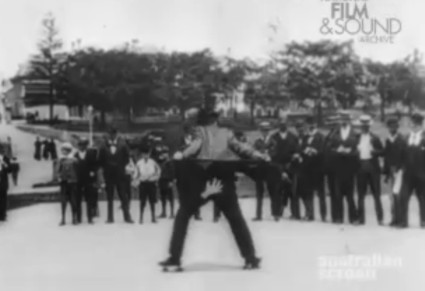
Patineur Grotesque, from australianscreen

I once had the privilege of attending a film show given in Paris, organised to mark the centenary of cinema in 1995, which brought together the various ‘first’ films from countries around the world. They made an interesting selection, for what survived, for how the national contributors interpreted the brief to find the earliest film in their collections, and for the sense of national competition. I was at the National Film Archive in those days, and we decided that we would defeat all comers by choosing Louis Augustin Aimé Le Prince‘s Traffic on Leeds Bridge, ‘filmed’ (on sensitised paper) in late 1888. France’s contribution was a selection of chronophotographic Phonoscope images by Georges Demenÿ from 1892-93, Germany’s the 1895 works of Max Skladanowsky. At this distance in time I forget most of the others, though I do remember vividly the Romanian choice, the 1898-1901 medical films of Gheorge Marinescu. The American choice would have been an Edison title filmed by W.K-L. Dickson – whether it was the ‘monkeyshines’ experiments from 1899 with microphotographs on a cylinder, or Dickson Greeting of 1891 (taken with horizontal feed camera) or A Hand Shake of 1892, where Dickson and his assistant William Heise shake hands to congratulate themselves on having finally cracked the problem of taking motion picture films, I can no longer recall.

There is – usually – something hauntingly special about such films, beyond their firstness. The ghostly hand-waving figure of the monkeyshines experiments, Dickson making to bow to the camera, the distant figures crossing Leeds bridge wholly unaware of their immortality, all contain something mysterious, something appropriate, that says that here is something new in the world. The variety acts captured by the Skaldanowsky camera (wrestlers, dancers, a boxing kangaroo) perhaps less so.

I don’t remember if Australia was included in the Paris show, but in any case time has marched on and what was previously considered the oldest surviving Australian film, a record of the Melbourne Cup horse race filmed by Marius Sestier on 3 November 1896, has now been replaced by a marginally earlier work by the same man. Discovered in 2005 (in France) and now restored by the National Film and Sound Archive of Australia (NFSA), Patineur Grotesque (Humorous Rollerskater) shows a man in exaggerated comic dress rollerskating in a Melbourne park before a small crowd [the location is now known to be Sydney – see comments]. A 10-second clip is available on the australianscreen site (why so short? the full film can only last 40-50 seconds), with the full action described thus:

A man in costume and on rollerskates performs for a gathering crowd. As part of the act the skater trips and falls, then drops his hat. As he attempts to retrieve the hat he continues to fall about. When finally the hat is restored to his head the act comes to a halt.

It is indeed grotesque, particularly when the skater lifts his coat-tails to reveal a hand printed on the seat of his pants. You do wonder whether Australia’s delight at having discovered this earlier film (which they estimate was filmed between 29 and 31 October 1896) might be tempered by some disappointment. It is a silly film, and the Melbourne Cup film that now comes second (and which you can also seen on australianscreen) is a more distinguished work and iconically Australian.

Sestier, the man who filmed both films, was French. He was a Lumière cameraman, one of a team sent around the world to spread the good word of the Lumière Cinématographe. Sestier was sent to Australia to work with the local Lumière concessionary, photographer Henry Walter Barnett. The first film he shot in Australia, Passengers Alighting from Ferry ‘Brighton’ at Manly, was filmed on 27 October, but no longer exists. Patineur Grotesque itself was shot soon after, but the NFSA has found no record of it being shown in Australia – instead it is first recorded being shown in Lyons, France on 28 February 1897.

So Australia has its earliest surviving film, but not its earliest film. The search for Passengers Alighting from Ferry ‘Brighton’ at Manly has to go on, not least to save Australia from the undignified embarrassment that, to be frank, is Patineur Grotesque. First films should be mysterious, or iconic, or in some way fitting that they are first. Otherwise they are just impostors.

More information on the discovery, and on Marius Sestier himself, is on the NFSA’s Marius Sestier Project, which includes fascinating biographical material and evidence of the detailed research undertaken by curator Sally Jackson using family history sources.

Photoplay and more

Cover for Photoplay, January 1927

As we’ve said before, while there is an embarrassment of riches when it comes to digitised historic newspapers now available online, for the specialist things are tougher and those interested in the study of film history have bemoaned the absence of the major trade paper and fan magazines in digitised form.

But while most of us have done the moaning, others have been acting. Today the Media History Digital Library project was announced. This announces itself as a major conservation and access project for histoical printed materials related to cinema, broadcasting and recorded sound. Concentrating on American media industry journals, and with recourse to private funds, the project has been established by film archivist and historian David Pierce. The project has hugely ambitious plans, but it has kicked off with eight volumes (covering four years) of Photoplay, and one volume each of Motion Picture Classic (1920) and Moving Picture World (April-June 1913), taken from the collection of the Pacific Film Archive. All have been made available via the Internet Archive, as follows:

Motion Picture Classic (Volume 9 – 11 (1920))
The Moving Picture World (Volume 16 (Apr. – Jun. 1913))
Photoplay (Volume 28 – 29 (Jul. – Dec. 1925))
Photoplay (Volume 30 – 31 (Jul. – Dec. 1926))
Photoplay (Volume 31 – 33 (Jan. – Jun. 1927))
Photoplay (Volume 33 – 34 (Jan. – Jun. 1928))
Photoplay (Volume 35 – 36 (Jan. – Jun. 1929))
Photoplay (Volume 36 – 37 (Jul. – Dec. 1929))
Photoplay (Volume 37 – 38 (Jan. – Jun. 1930))

This link will take you to all of the documents on one page: Media History Digital Library

As said, this is just the start. The Media History Digital Library’s press release outlines the ambitions:

The history of American media industries exists in the magazines of the day, but is largely inaccessible. Primary materials, such as Exhibitors Herald World and Photoplay are of significant research value to media scholars, historians, and the general public; however, use of these resources is severely limited by necessary noncirculating access restrictions and/or the lack of indexing or fifinding aids.

Using private funds, a pilot project is currently underway to digitize 300,000 journal pages, including volumes of Moving Picture World and Photoplay, and a range of additional materials to appeal to varied research interests.

Several major libraries and the owner of the largest private collection of such materials are participating in the pilot.

The goal of the Media History Digital Library project is to establish additional partnerships with libraries and archives for a joint digitization project to conserve and provide broad free access to these important resources.

These are the the titles that the project is targeting:

Industry MagazinesBillboard, Box Office, Cine-Mundial, Daily Variety, Exhibitor’s Herald, Exhibitor’s Trade Review, The Film Daily, The Film Index, The Hollywood Reporter, Motion Picture Daily, Motion Picture Herald, Motion Picture News, Motography, The Moving Picture World, Radio Broadcast, Radio Daily, Talking Machine World, Variety

Company MagazinesThe Lion’s Roar, Publix Opinion, RCA News, Radio Flash, Reel Life, Universal Weekly

Fan MagazinesMotion Picture Classic, Motion Picture Magazine, Motion Picture Digest, Radio Mirror, Screenland, Shadowplay

Technical JournalsAmerican Cinematographer, American Projectionist, The International Photographer, International Projectionist, Motion Picture Projectionist, Projection Engineering, Radio Engineering, Sound Waves, Transactions of the Society of Motion Picture Engineers

Well, that should keep us all busy. Of course this will take time and money (it’s costing 10 cents a page at the moment), but a model has been established whereby institutions holding such collections can work together efficiently, avoiding duplication of effort and adhering to common standards and formats to provide researchers with the best possible search and access opportunities.

The project outline is as follows:

  • Each archive or library agrees to offer its pre-1964 public domain journals for digitization.
  • Each archive or library will provide an inventory of its holdings, perform condition inspections and pack selected materials for shipping. The project will pay transportation and reasonable insurance both ways. Any funds for digitization will be welcome, but not required.
  • Each digitized volume will have an inserted page with the name and logo of the organization contributing the original volume, the organization that manages that part of the workflow, and the funder.
  • The Internet Archive will execute some of the digitization and will host the master and derivative format access files.
  • In return for contributing materials, each organization is entitled to receive copies of all digital files for any non-commercial purpose including hosting on their website.
  • David Pierce will raise financial support for the project as well as perform copyright searches.

As some may have noticed from the Bioscope’s recent survey of silent film journals online that the first fruits of this project have been available on the Internet Archive for a few weeks now, but the formal announcement of the project was held back while some digitisation issues were resolved. But Leonard Maltin spilt the beans in his enthusiastic blog post earlier today, so David Pierce went public today.

What can one say? This is a sensational development, with a myriad of opportunities for the researcher – not just in film studies, but social history, media history, histories of communications and technology, fashion history, genealogy, advertising studies, gender studies and so much more. But there is much that we can do to help. There’s the invitation for collection owners to participate in the project, but also each one of us can prove the value of this project by just using the documents. Download them, study them, blog about them, cite them in papers, curate them – demonstrate that this is what we need. The best way of saying thank you is to start using them. Go explore.

From silent screen to digital screen

The Bioscope on the pier at Weston-Super-Mare, c.1910

From Silent Screen to Digital Screen: A Century of Cinema Exhibition is a two-day conference to be held at De Montfort University, Leicester, 10-11 July 2010. The conference, to be hosted by the Cinema and Television History (CATH) Research Centre in DMU’s Faculty of Humanities, will celebrate a century of cinema exhibition since the Cinematograph Act 1909, the first major legislation relating to moving pictures in Britain, coming into force on 1 January 1910.

Keynote speakers will include Richard Gray of the Cinema Theatre Association, and others to be confirmed.

Proposals are invited on any aspect of cinema exhibition including:
audiences, technologies, cinema design and building, programming,
legislation and other aspects of the cinemagoing experience. If interested you should sent abstracts (500 words) with a short biography including contact details to Stuart Hanson (shanson [at] dmu.ac.uk) and Steve Chibnall (schib [at] dmu.ac.uk) by 23 April 2010. There isn’t a web page for the conference as yet, but I’ll add one to this post just as soon as one appears.

The conference gains its title from Stuart Hanson’s recent book From Silent Screen to Multi-screen: A History of Cinema Exhibition in Britain Since 1896, a commendable and rather useful work, which was covered by the Bioscope (a little too nitpickingly, I fear) here.

Update: The deadline for abstracts has now been put back to 14 May.

British Silents

http://www.britishsilents.co.uk

We’ve already made note of the British Silent Film Festival, being held at the Leicester Phoenix 15-18 April 2010, with the theme The World Before You: Exploration, Science and Nature in British Silent Film. However, there is reason to do so again on account of a detailed programme now having been made available, and the welcome appearance of a festival website. For some while now the festival has lacked a proper online presence – a WordPress blog helpd keep the flame alive, but now we have a proper www.britishsilents.co.uk, which includes not only details of the upcoming, 13th festival, but all previous festivals going back to 1998. Congratulations to the team on getting this up and running.

These are the programme details (with a modest contribution from yours truly, if that’s any sort of an incentive):

The World Before You: Exploration, Science and Nature in British Silent Film

Thu 15 April 11am
Q Ships
Long before Dunkirk, the little ships of Britain played a deadly game of cat and mouse with the German U-Boats. Underneath their modest exteriors these merchant ships were bristling with concealed weaponry, designed to lure the submarines to their doom.
UK/1928 Geoffrey Barkas/Michael Barringer

Thu 15 April 2pm
Beeman, Birdman, Hunter, Spy: the heroic age of the wildlife filmmaker
A particular breed of explorer from the earliest days of films was the wildlife cameraman. These intrepid pioneers risked life and limb, inventing their own equipment, travelling to the remotest parts of the planet to bring us unprecedented access to the natural world and inevitably having a few adventures along the way. This selection will show the work of J. C. Bee-Mason, Oliver Pike, Jim Corbett, and the legendary Colonel F.M. Bailey.
Presented by Bryony Dixon

Thu 15 April 4pm
The Masks of Mer
World Premiere of his new film presented by Michael Eaton
Writer, director Michael Eaton presents the world premiere of his new film about a unique film shot in the Torres Straits by Alfred Haddon in 1898, lasting for less than a minute, and the world’s first example of anthropological cinema. The Masks of Mer tells the extraordinary story of this experiment and traces the masks worn in the sacred initiation ceremony Haddon filmed. And, for the first time since Haddon himself publicly presented the work, his films are ‘synchronised’ with the team’s phonographic recordings.
Dir Michael Eaton, UK 2010, 60mins

Thu 15 April 6pm
The Bridal Party in Hardanger/Brudeferden i Hardanger
Presented by Jan-Anders Diesen and Halldor Krogh
A spectacular film based on one of the most famous paintings in Norway; Bridal Voyage on the Hardanger Fjord from 1848. Set amid stunning mountain and fjord scenery, this is the epic story of intertwining lives, love and loss during the lifetime of a young woman. A visual masterpiece that is both moving emotional drama and an authentic portrait of the vanishing cultures of the people who lived and farmed in the mountains of Western Norway.
This film will be screened with the new music score composed by Halldor Krogh
Dir: Rasmus Breinstein, Norway 1926, 74mins

Thu 15 April 9pm
The Sheik
Based on the steamy 1921 bodice ripper by Edith Maude Hull, this tale of passion between an aristocratic English woman and an Arab Sheik is the film that brought Valentino to prominence. He exudes a brooding, muscular sexuality which has lost none of its potency today and watching this film 90 years later, it is easy to see why his premature death drove women to despair and suicide.
Dir: George Melford, USA 1921. 80 mins
+
Crossing the Great Sagrada
Dir Adrian Brunel, UK

Fri 16 April 9am
She
Rider Haggard on Film
A sumptuous adaptation of Rider Haggard’s best-selling 1887 fantasy about a Cambridge professor’s quest for a lost kingdom in the heart of Africa where he encounters a magnificent sorceress who rules over her people as ‘She who must be obeyed’. This version was actively supervised by Haggard himself and stars Betty Blythe in the role later reprised by Ursula Andress.
Dir: Leander de Cordova, UK 1925, 2hrs
Fri 16 April 11.15am

With Lawrence in Arabia
Presented by Neil Brand and Luke McKernan
Neil Brand and Luke McKernan’s work in progress (in collaboration with the IWM) to recreate, using original text, slides and film extracts, Lowell Thomas’s famous lecture-cum-spectacle which is credited with creating and publicising the legend of Lawrence of Arabia. Thomas himself, a fascinating and flawed character but a master showman, delivers the narration.

Fri 16 April 12.15pm
Exploration, Adventure and Science Films from the Imperial War Museum Collection
presented by Toby Haggith

Fri 16 April 2.15pm
Sam’s Boy
Sam’s Boy is adapted by Lydia Hayward from one of the stories of W. W. Jacobs whose pet subject was the marine life or as Punch sardonically put it “men who go down to the sea in ships of moderate tonnage”. Filmed in the Thames estuary and on the Kentish coast this is a charming tale of an urchin in need of a father.
Dir: Manning Haynes, UK 1922 63mins
+
Premieres of recovered short films from the Scottish Film Archive presented by Janet McBain, including:
To Rona on a Whaler UK 1914, 12mins
In the Calm Waters of the Yare UK 1910, 6mins

Fri 16 April 4.15pm
The Race to the Pole: Britain and Norway
A programme of short films documenting early Polar exploration
The extraordinary story of the race to the South Pole by Amundsen and Scott is put into context by polar film expert Jan-Anders Diesen from Norway. The programme concludes with an extract of the BFI National Archive’s forthcoming restoration of The Great White Silence, Herbert Ponting’s record of Scott’s final expedition to Antarctica introduced by Bryony Dixon.

Fri 16 April 6.15pm
The Lost World
The first film adaptation of Conan Doyle’s classic novel of the land that time forgot and the prototype of every dinosaur movie since including Jurassic Park. Wallace Beery and Bessie Love star as Professor Challenger and Paula White who set out from London to rescue Paula’s father, the explorer Maple White lost on the Amazonian plateau where dinosaurs still roam. Conan Doyle took his family to see the film in 1925 and loved this version. Perfect family entertainment, then!
Dir: Harry O Hoyt, USA 1925, 100mins

Fri 16 April 9pm
South: Sir Ernest Shackleton’s Glorious Epic of the Antarctic
With a special musical score by Neil Brand
The definitive account of Shackleton’s legendary 1914-1916 Endurance Expedition, magnificently filmed by photographer Frank Hurley. A monumental document of human survival against all odds amidst the backdrop of some of the most stunning and inhospitable scenery on earth.
Prod. Imperial Trans-Antarctic Film Syndicate/ photography Frank Hurley, UK, 1919, 80mins

Sat 17 April 9am
Coast
Like the TV programme, we will trace the British coastline through its stories but we’ll be doing it using archive film from the silent days. With tales of great tempests, rough seas, daring rescues and tragic wrecks, of thronging docks, fishing ports and shipyards as well as scenes of a calmer nature, along the cliffs and beaches of our island home.
Introduced by Bryony Dixon
90mins

Sat 17 April 11am
Women in Silent Britain
Exploration into the hidden histories of women in silent British cinema is gathering momentum and this session will look at some of the fascinating and intrepid women working in film during this period, as writers, producers, technicians and critics as well as actresses.
Presented as part of the AHRC Women’s Film History Network – UK/Ireland that was recently set up to encourage new research into women’s contribution to cinema.

Sat 17 April 2pm
Family Matinee (PG)
Up the Pole
Get your coat on and join us on for a cornucopia of polar-themed cartoons and comedies featuring screen legends Ben Turpin, Buster Keaton, Jerry the Troublesome Tyke, Pimple and Bonzo the Peppy Pup, all struggling with inclement weather and harsh times. With live piano accompaniment (and much more) from Neil Brand.
This programme is dedicated to Dave Berry who brought Jerry the Troublesome Tyke back to our screens and devoted his life and work to the silent cinema that he loved.
Running time 80mins

Sat 17 April 2.15pm
A Maid of the Silver Sea
Husband and wife team Ivy Duke and director/ actor Guy Newall play opposite each other in this tale of familial conflict and mysterious death on a small island in the English Channel. The peaceable local fishing community is torn apart by the discovery of silver which threatens their way of life and matters get worse with the arrival of the English manager who falls in love with a local woman and is framed for murder.
Dir: Guy Newall, UK 1922, 63mins
Sat 17 April 4pm

The Annual Rachael Low Lecture
Presented by Tim Boon
This year’s Rachael Low lecture will be given by Tim Boon, Chief Curator of the Science Museum.
Tim Boon is the author of the recently published and highly acclaimed Films of Fact: A History of Science in Documentary Films and Television. He is also working with the BFI on a forthcoming DVD of the pioneering science and nature series Secrets of Nature. Rachael Low is a key figure in the history of the study of early and silent British cinema. Her pioneering studies published as The History of the British Film 1895-1929 (BFI) are an unrivalled source for students on the subject and the remain the unchallenged standard work in this field. Each year, the Festival pays tribute to her work by inviting a distinguished cultural commentator to give an illustrated lecture on a particular aspect of silent cinema.

Sat 17 April 6pm
The St Kilda Tapes
Live music, archive film and multi-media presented by David Allison
Using the evacuation of St Kilda in 1930 as a starting point, and with St Kilda evacuee Norman Gillies acting as narrator, this acclaimed show takes you on an emotional journey from the lonely Atlantic island to Glasgow, New York and Canada, before a triumphant and poignant return to St Kilda. With archive film and live music performed on guitar, 100 year old zither, ukulele and sampler, The St Kilda Tapes explores the themes of migration and home featuring archive films, St Kilda; Britain’s Loneliest Isle and A New Way to A New World.

Sat 17 April 9pm
Tol’able David (PG)
Accompanied with a new Blue Grass music score by Damian Coldwell, together with Nick Pynn on fiddle and Appalachian dulcimer and Lee Westwood on guitar
A thrilling David and Goliath story set in the beautiful Virginian Mountains. When the murderous Hatburn gang murders young David Kinemon’s older brother, the gentle David swears to protect his widowed mother and brothers and sisters. With a towering central performance by Richard Barthelmess as the young hero, and the unforgettable Ernest Torrence as the leader of the criminal gang. “Tol’able David is one of the enduring classics of the American screen.” Kevin Brownlow
Dir. Henry King, US 1921 100 min.
Preserved by The Museum of Modern Art, New York with funds provided by The Film Foundation.

Sun 18 April 9am
New Discoveries in British Silent Film
This programme will include new discoveries in British silent film, including regular contributor David Williams & Tony Fletcher with his programme called ‘Before and after Nanook’, examining how early filmmakers looked at cultures and societies before 1922.

Sun 18 April 11am
For Those in Peril on the Sea: Drifters and The Trawler Film
For centuries the deep sea fishermen were a mainstay of our island nation and this is revealed by the fascination with the trade by filmmakers since the earliest days. At the very end of the silent era John Grierson took the tradition of the trawler film and combined it with all the techniques of filmmaking that had developed over the decades to make his remarkable, lyrical film, Drifters, which heralded in a new era for the actuality film, the age of the documentary. This programme will show the whole of Grierson’s film and extracts from its antecedents.
Presented by Steve Foxon and Bryony Dixon.
Dir John Grierson, UK 1929, 80mins total

Sun 18 April 2pm
The Dodge Brothers performing to The Beggars of Life
The Festival is pleased to welcome the fabulous Dodge Brothers featuring Mike Hammond (guitar/ banjo), Mark Kermode (double bass/accordion), Aly Hirji (guitar/mandolin) and Alex Hammond (percussion) with guest Dodge Brother Neil Brand, performing their particular brand of Americana to William Wellman’s legendary tale of Depression-era, rail-riding hobos played by the iconic Louise Brooks and Jim Arlen.
Dir. William Wellman, USA 1928, 100mins

Sun 18 April 4pm
Climb Every Mountain
Jan Faull of the BFI presents a programme of mountaineering films including extracts from the ill-fated 1924 British Everest expedition immortalised on film in The Epic of Everest.

Sun 18 April 6pm
The Battle of the Ancre and the Advance of the Tanks
With a musical medley, specially reconstructed by Stephen Horne and Toby Haggith
The sister film to The Battle of the Somme, The Battle of the Ancre was filmed between September and November 1916 and contains the first shots of tanks in use at the Front and fraternization between German prisoners and their British captors. The work to reconstruct the original medley for this important First World War film has taken many months with the music suggested in the cue sheet being discovered as far away as Australia. After previewing this project at the 2009 Festival, we are pleased to present the completed score performed by Stephen Horne, Sophie Langdon and Martin Pyne and presented by Toby Haggith.
Dir: Geoffrey H Malins/J.B McDowell, UK 1917, 73mins

There are festival passes available, either a 4-day pass at £95 (£70 concessions) or a 1-day pass at £45 (£30 concession). Festival passes include lunch each day and tea and coffee during breaks. Tickets are also available for individual films and presentations, for which prices vary. For further information, visit the festival site or call Phoenix Square Box Office on 0116 242 2800.

Dave Berry memorial event

Dave Berry, from the Dave Berry Memorial / Man Coffáu Dave Berry Facebook group

To all who knew film historian Dave Berry, a memorial event is to take place at the Chapter Arts Centre, Cardiff on Friday 23rd April. There will be a matinee screening of Sidney Gilliat’s classic Welsh-themed movie Only Two Can Play (1962), then the memorial itself in the evening, from 6.15 – 8pm. The organisers promise that “there will be lots to share – tributes, memories, clips, and no doubt tears and laughter … hopefully we will do him proud”.

An obituary notice has now been published in The Independent. The Bioscope’s obituary notice for Dave (with plenty of tributes in the comments) is here.

Update: Here are details of the memorial event (with slight variations from information previously published):

Dave Berry Memorial Event

Fri 23 April • Gwe 23 Ebrill
Join us for a celebration of the life and work of our dear friend and colleague Dave Berry who died earlier this year at the age of 66. The event starts at 2.30pm with a screening of Only Two Can Play.

The evening session at 6.15pm includes personal contributions from his friends and colleagues and clips from some of Dave’s favourite films.
All are welcome.

“A moment in Dave’s company was something to treasure. Acerbic, fun, funny and generous, he was one of the great practitioners of journalism in Wales as well as one of its great characters. Our feelings for him went way beyond friendship and affection — but he was too self-effacing to recognise that. He’d interviewed everyone from the Rolling Stones to prime ministers. And of course he loved films. He was an original – and irreplaceable.”
Steve Groves, Western Mail.

+ Only Two Can Play
Fri 23 April • 2.30pm • Gwe 23 Ebrill
UK/1962/106 mins/PG . Dir: Sidney Gilliat.
With Ken Griffith, Peter Sellers, Richard Attenborough.

Described by Dave Berry in his book Wales And Cinema: The First Hundred Years, this is “undoubtedly the funniest of all Welsh screen comedies, a coruscating, almost sardonic view of Welsh insularity and punctured male vanities.” Sellers is on great form as John Lewis, a bored librarian, henpecked at home until the wife of a local councilor sets her sights on him.

We hope that this event will be introduced by Dave’s partner Gerhild Krebs, an archivist and film historian.

You can book for both events in advance, should you wish. This might be advisable as the cinema’s capacity is approximately 200.

1. The general public will be charged for the matinee but fund contributors can enter free of charge – give your name/s to the box office when booking and / or collecting your ticket/s as they will have a list of the contributors.

2. There will be no charge for the evening event but again give your name/s to the box office when booking or collecting your ticket/s.

For information see attachment or click here: http://www.chapter.org/18907.html (Place the cursor in the centre of the screen on the image of the April Magazine and Calendar, ‘View in fullscreen’ will appear, click on this to enlarge the image; there is a small white arrow in the middle, on the right hand edge of the image, level with the table top – click this until you arrive at page 29.)

If you have enquiries, please contact Sally Griffith, Chapter Cinema Manager, or Iola Baines, National Screen and Sound Archive of Wales, E-mail iba [at] llgc.org.uk

Giornate database

Pordenone catalogues

In 2002 the Giornate del Cinema Muto (aka Pordenone Silent Film Festival) produced a CD-ROM that listed and described every film shown at the festival 1982-2001. The CD-ROM is now out of print, but what was really wanted was an online version which could be updated year by year. And now we have it.

The Giornate database lists every one of the 6,330 films featured at the festival 1982-2008. You can search by year, title, director, year of release, production company, country and archive. It is a little disappointing that no searching is offered by cast member or other credits, still more that there is no searching of descriptions or a free-text search generally. Hopefully such functionality can be introduced later (such search options are available on the CD-ROM version), but as it is the database is still a very useful and welcome resource.

The database lists every film shown at the festival since 1982, with additional entries for films which have been shown more then once (i.e. in later years). The information available varies, with no synopses for earlier years, though that’s because such data was not included in the festival catalogue/booklet. More recent records are richer in detail as the catalogue has become an ever more handsome production, with background information in both English and Italian. What every record does provide is title, any alternative titles, year of production, year in which it was shown at the festival, the production company, director (where known), format (i.e. 35m, 16mm etc), the film speed at which it was shown, its duration, and the archive which supplied the copy. You even get the name of the musician who played to the film.

Such core data yields all sorts of information. For instance, the festival has shown 473 films directed by D.W. Griffith, 104 films made in 1905, 71 films made by the Cines company, 374 films made in Germany, and 505 films from the Nederlands Filmmuseum. One can find out so much – not just about the contents of films shown at the festival, but their provenance and location. Moreover, it is information that was rigorously researched in the first place for the Pordenone catalogue, and which can be relied upon. Also, there are records here for films from across the world of silent cinema which the researcher will simply not be able to find anywhere else. It is a treasure trove.

That said, it could be even better. The potential for searching by credits or across synopses has been mentioned. However, it might be that the festival could open up this resource still further to our research community, with a bit of Web 2.0 functionality. For instance, where there are gaps in the data for earlier years (if this is the case – it’s not clear is the database represents all the published information in the festival catalogues from 1982), volunteers might be willing to type in the missing text or credits. Contributing archives could add updated information on prints that they provide, likewise the scholars who contributed information to the catalogue could add updated information – in both cases not altering the original catalogue record, but putting data into a separate notes field. Anyone might contribute comments on films that they have seen – obviously with some form of moderation. Databases are such powerful tools – we mustn’t just see them as searchale lists, but instead must make full use of them as structured and updatable data.

But even as it is the Giornate database is a fabulous resource, and one that hopefully will be updated year-on-year from now on. Grateful thanks and congratulations are due to the Giornate del Cinema Muto for making the database available to all. Go explore.