A trip down Market Street

Last night CBS’s 60 Minutes programme had an item on A Trip Down Market Street, a ‘phantom ride’ view taken from a cable car travelling down San Francisco’s Market Street a month or less before the earthquake of 18 April 1906. The film, three copies of which survive, and which can be viewed on the Internet Archive or on the Library of Congress’s American Memory site, was previously thought to have been made in 1905, but film historian Dave Kiehn presents evidence in the programme (including weather reports and car registration numbers) to demonstrate that the film was probably made in March or early April 1906. The producers were the Miles Brothers, and two of their descendants appear in the programme as well as film archivist Rick Prelinger, owner of one of the surviving copies (that which appears on the Internet Archive).

We’ve covered the film on the Bioscope before now. There was a post on Bioscopist Joe Thompson’s discovery of a 1907 newspaper article on the film and more recently a post on the overlaying of a YouTube video of the film on top of present day Google Street View images of Market Street on the innovative There and Then site.

The SFGate blog has a full account of Kiehn’s research into the film’s correct dating.

The 60 Minutes piece includes footage of Market Street after the earthquake taken by a different filmmaker. Recently filmmakers Dan Meyerson and Matt Peterson put together a compilation of post-earthquake views of San Francisco, focussing on another travelling shot down Market Street. The post-nuclear landscape is all the more extraordinary for the matter-of-fact way in which people are seen to be still going about their daily business. Looking at pre- and post-earthquake films, the buildings are transient, fragile constructions, but ordinary people endure.

Who shot the post-earthquake films I don’t know. Some of the footage appears in a unidentified series of films of San Francisco in 1906 to be found on the Internet Archive (again from the Prelinger Archives). The main journey down Market Street appears to be unique, however. Anyone know who the filmmaker, or filmmakers, might be?

Pordenone diary 2010 – day three

Interior of the Verdi, showing the cover which goes over the central seats of the lower circle to prevent people sitting in front of the projector beam

Some said that it was a strong programme at Pordenone this year. But maybe they were misheard and what they really said as that you had to be strong for the programme at Pordenone this year. It certainly felt that way as we faced up to the epic offering on Monday morning, Ai Yo Jinrui To Tomo Ni Are (Love, Be With Humanity) (Japan 1931), all four hours and one minute of it. It took up the entire morning and the screening had to start half an hour earlier than usual, at 8:30, to fit it in.

I will confess that I lingered over breakfast and did not get to the Verdi until 9.00, where I expected to catch five minutes of the film and then head out for a coffee somewhere. But I got hooked. This wasn’t directed by Shimizu, it was the work of Shimazu (Yasujiro Shimazu), and what a difference the change in vowel made. This was as polished and authoritative a piece of direction as you could hope to find, aided by some outstanding performances. Love, Be With Humanity (is the title really that dreadful in Japanese too?) was the dramatic highlight of the festival so far.

The story was pure Peyton Place, or Jeffrey Archer. A rich, selfish father, superbly played by Sojin Kaminyama (who had returned to Japan after a period in Hollywood appearing in The Thief of Bagdad and as Charlie Chan), is deservedly saddled with four ungrateful, awkward children, each of different mothers. One is a wealthy wife most interested in jewelry than her child, another daughter is getting married, one son is a cold, intellectual, the other son is a fiery rebel (played by Denmei Suzuki) who refuses to take any money from his father, after the way his mother died wretchedly. The stage is set for a soap opera of epic proportions and concomitant confusion, but unlike his near namesake Shimazu so ably managed the interlocking elements of his narrative that you were never lost, and never impatient, despite the indulgent running time. In the end the father is ruined and the only child who cares for him is the rebellious son. Their climactic argument, where they trade insults yet the son’s wife recognises that they have actually already forgiven one another, exemplified the intelligent approach, constantly playing against expectation, that characterised the film.

And then there was the final reel. No one who was there is likely to forget it in a hurry. Father and son have emigrated to the USA, and taken up the cowboy life. The intertitles have switched from Japanese to English, and the whole conclusion, with stetsons, cowboy boots, beaming neighours and the home on the range, just boggled the mind. Doubtless it all rang true in Japan, but here we couldn’t quite believe our eyes. And then it was over, and there was huge applause for pianist Mie Yanashita, whose vivid accompaniment had been subtly attuned throughout to the film’s ebbs and flows, but it was sort of applause for ourselves as well for having made it all the way through.

I had been looking forward to the afternoon’s first offering. André Deed is generally thought of as one of the great non-American comic performers of the silent cinema period. He was a music hall comedian who joined the film business in 1901 with Georges Méliès in 1901, moving to Pathé in 1906. The character that he established, Boireau, became progressively popular throughout Europe and effectively established the idea of the comic character appearing in a series of films. He moved to Italy in 1908, establishing a new character, Cretinetti, for the Itala company (known as Foolshead in English) and it is Cretinetti films that I’ve long revered for their energetic style and clever mixture of half-wittedness with quick-wittedness. He returned to Pathé in 1911 and became Boireau once more before his career faded with the onset of the First World War.

Pordenone was presenting a strand on French comedy films (a speciality of festival director David Robinson) so it was Boireau that we got on Monday afternoon, ten titles, of which two were from his first period with Pathé, eight from his second. Sadly they were a huge disappointment. Deed mugged and gurned for all he was worth in a series of sloppily conceived scenarios that were resolutely unfunny. In the place of any visual invention we got face-pulling from Deed and much laughter directed at the camera from other performers – it’s always a bad sign when the actors feel obliged to laugh at the comic business, when that is our business. Alas, Boireau on this evidence was tedious, certainly no match for Cretinetti.

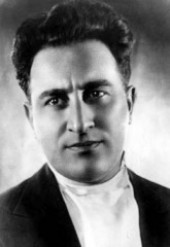
Variety is guaranteed at Pordenone. From pre-war French comedy we moved to late 20s Soviet cinema. One of the festival’s main strands was ‘Three Soviet Careers’, looking at the work of Mikhail Kalatozov, Abram Room and Lev Push. Lursmani Cheqmashi (The Nail in the Boot) (USSR 1931) was made by Georgian director Mikhail Kalatozishvili, who as Kalatozov would gain international fame for The Cranes are Flying (1957) and I Am Cuba (1964). His documentary films of the late 20s/early 30s were characterised by a truly extraordinary visual style but also a muddled ideology that saw them fall foul of Stalin’s censors.

The Nail in the Boot adapts the old tale of the nail eventually causing some great disaster as things build up because the original small irritation was not dealt with (“and all for the want of a horseshoe nail”). A group of soldiers in an armoured train come under attack. One of their number goes off to find help, but because of a nail in his boot he is hampered in his journey and the battle is lost. He is the subjected to a trial, where he comes in for intense criticism but eventually successfully argues his case.

The film was roundly criticised by the Soviets (particularly the Army) for being confusing and ideologically unsound, as a consequence of which it was banned. Seeing it now you have some sympathy with those critics. The nail theory is ridiculous, and the succession of calamities that befalls the soldier encourages our sympathies not our censure, so that he seems cruelly victimised by the subsequent show trial. Whosever’s fault it was that the armoured train was lost, it was surely not his. If there was a message there at all, it was not one that any true Soviet would wish to champion.

But in truth there is no message there at all. The Nail in the Boot is an exercise in pure cinematic style. No doubt Kalatosov was driven by some ideological certainties, but his camera drove him elsewhere. It is just an astonishing film to experience. Every image is burnished to perfection. The stylised results look like nothing on earth. There are the statuesque faces, the unreal landscapes, the astonishing shots from within gun barrels, the eerie intensity of the court room. It is cinematically brilliant – except that cinematic must mean more than technique, it must be technique applied to a particular and consistent aim. Here Kalatozov fails – but what an extraordinary failure.

Talking of extraordinary things, Stephen Horne‘s music was a multi-instrumental tour de force. Some may have though that there was a piano, accordion and flute trio accompanying the film, but no, it was the one man. Stephen can so far only play two of those three instruments at the same time, but it surely can’t be long before he is able to add the third as well.

Torres Straits islanders recreating ceremonies of the Malu cult for A.C. Haddon’s camera, from the 1898 film in the BFI National Archive

Anthropology was an unexpected sub-theme of the festival. Next up came The Masks of Mer (UK 2010), a documentary made by Michael Eaton about the Cambridge Anthropological Expedition of 1898 to the Torres Strait islands to the north of Australia. The expedition was led by Alfred Cort Haddon, a zoologist who became so fascinated by the native people he met on the islands when he first visited them in 1888 that he returned a decade later to study the humans. Remarkably he took with him not just notebooks to record his findings, but a phonograph to record songs and speech, and a motion picture camera.

The films survive, and form the centrepiece of Eaton’s fascinating and rather wise film. Haddon only received his camera a day or two before he was due to leave, but he captured short scenes of fire-making, of dances by some visiting Australian Aborigines, and most remarkable of all a Malu cult initiation ceremony dance which had had been suppressed by Christian missionaries. Haddon invited the people of the island of Mer to recreate three sacred masks (out of cardboard) which were essential to the ceremony and got them perform the forbidden dance for the camera. Some might think that this recreation falsifies the value of the film and the anthropological study, but Eaton argues persuasively that the collaborative nature of the film – Haddon working closely and sympathetically with his subjects – displays a deeper truth. Just pointing a camera at actuality does not reveal its true substance. It is what its subjects wanted to be shown that counts. This was as much the Torres Straits islanders’ film as it was Haddon’s, and that what was so extraordinary about Haddon, that he recognised this. The film also runs the sound recordings alongside the films. The two were not recorded together, but Haddon certainly exhibited them together (in 1906, if not before), so the experiment was justified. The film’s most magical moment was when Eaton visited Cambridge University and was shown the very masks that appear in the film, lovingly stored in the Haddon archive. It was a mysteriously moving moment. Anyway, a fine documentary of the kind you just don’t see on television any more.

So that was the afternoon done. Supper was spent in conversation about archives, exhibitions, scholarly project and the rich subject of colour, the fruits of which you may learn of at some other time. But then it was time to hurry back to the Verdi for the great treat of the evening, a film I had been waiting twenty years to see, ever since Kevin Brownlow programmed it at the National Film Theatre, describing it as one of the most amazing visual spectacles of the silent era, and for some reason I was unable to see it. This was going to be good.

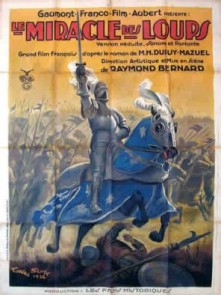
Le Miracle des Loups (The Miracle of the Wolves) (France 1924) has a reputation as one of the highpoints of French silent cinema. It is set in the fifteenth century during the reign of Louis XI (Charles Dullin) and it tells of the challenge to the king’s authority by the rebellious Charles the Bold, Duke of Burgundy (Vanni Marcoux), while rival noblemen fight over heroine Jeanne Fouquet, played by Yvonne Sergyl. The film, directed by Raymond Bernard, is on a truly epic scale, with setpieces of the battle of Montlhéry and the siege of the castle of Beauvais which are meant to show off the millions of francs that were clearly spent on them. Romance, rivalry, intrigue, violence, spectacle, all in the hands of a skilled director – what could possibly go wrong?

Oh dear, oh dear. Right from the start it was clear that something was wrong, when the prelude introduced us to the romance between Jeanne and Tobert Cotterau, played by the toe-curlingly unromantic-looking Romauld Joubé, during which she gets her pet dog to pass a message to him by lifting the bewildered dog over a wall. On top of this we were fed long and tedious intertitles filling us in on all the history, with all of the unwelcome earnestness of a history teacher of very much the old school. It set the tone for the disaster that was to unfold before us over the next two hours or more.

A more turgid plod of a movie it would be hard to imagine. What it did remind me of, in fact, is a 1909 Gaumont one-reeler, Le Huguenot, which crams in a complex plot with too many characters, overlong intertitles obsessed with pedantic detail, all put over with histrionic performances strong on gesture and redundant when it comes to human feeling. The Miracle of the Wolves is simply a 1909 historical film stretched out to 130 minutes. It was so half-hearted throughout. The performances were lethargic (particularly Charles Dullin, who tried to look Machivellian but just looked like he was struggling to remember where he was), and even the battle scenes were undercooked (despite some bloody examples of what fighting in the Middle Ages was actually like), with extras just about going through the motions.

The key scene was the miracle itself. Jeanne is being pursued by the evil Comte du Lau (Gaston Modot, chewing up the scenery) in the mountainside snows when she is surrounded by wolves, who settle down around her before attacking the Comte’s men. We were meant to be awe-struck – instead all too many of the audience laughted heartily at the scene’s absurd piety. All in all, a film without any heart at all. I’d waited twenty years to see it and it felt like twenty years watching it. There was some historical interest in the screening for which Touve Ratovondrahety played a piano transcription of Henri Rabaud’s original score, but to be honest it had little to stir the imagination. But then it had such poor material to work with. Oh dear oh dear.

But there would be better fare on the morrow.

Pordenone diary 2010 – day one
Pordenone diary 2010 – day two
Pordenone diary 2010 – day four
Pordenone diary 2010 – day five
Pordenone diary 2010 – day six
Pordenone diary 2010 – day seven
Pordenone diary 2010 – day eight

Pordenone diary 2010 – day two

Verdi theatre, Pordenone

There’s no time for slouching at Pordenone if you are serious about your film-watching. A few habitués of the Giornate del Cinema Muto seem to have come for the sun and conversation, taking up near permanent residence in the pavement cafés, but for the rest of us breakfast was swiftly followed by the first film of the day at 9.00am sharp and the final film of the day concluding around midnight. They do let you out for lunch and dinner, but in general it’s a tough regime we had to follow.

And so we move to day two, Sunday 3 October, and what was to become the daily routine of starting off with a long Japanese film, just to test our stamina. Our 9.00am offering was Nanatsu No Umi (Seven Seas) (Japan 1931-32), made in two parts and shown back-to-back over 150 minutes. The films were made by Hiroshi Shimizu, director of the previous day’s Japanese Girls at the Harbour, and there were clear similarities in preoccupations and style.

The film tells of Yumie (played by Hiroko Kawasaki) who is torn between two brothers. She is engaged to the first but seduced by the second, following which her father dies and her sister goes mad. She marries her seducer but takes her revenge by refusing to let him touch her and spending all his money on her sister’s care in a mental hospital. It was pure soap opera, with a somewhat discontinuous narrative (particularly in part 1) characterised by seemingly random elements (just who was it who committed suicide in part 1, and why?) and unclear connections between some of the characters. Then it all ended with a happy ending so rapidly organised that you suspected that a reel was missing. As with Saturday, Shimizu showed off plenty of directorial tricks but lacked the basic skill of connecting one shot with another to propel a narrative forward. But he also showed the same intriguing, codified cultural elements, dividing the action up into public lives that showed the influence of the West (clothing, occupations, the key location of a sports shop) and traditional Japanese dress and manners within the private sphere. You felt you had been given a privileged glimpse into early 1930s Japanese life in the kind of middle-brow film that doesn’t usually make it to retrospectives. Japan’s leading silent film pianist Mie Yanashita was an excellent accompanist for this and all the other Japanese films that featured in the festival.

Scenes from Rituaes e festas Borôro (1916), from http://www.scielo.br

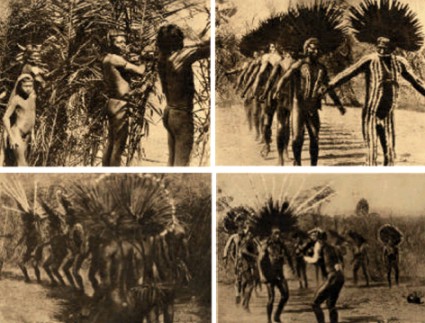
Now these dramatic films are fine in themselves, and even the severest of film critics likes to see a story told well, but regulars will know that what really stirs the heart of the Bioscope is the non-fiction film. So I was looking forward greatly to what was next on the list – Brazilian documentaries – and was not disappointed. In particular the first film of three, Rituaes e festas Borôro (Rituals and Festivals of the Borôro) (Brazil 1916) was one of the highlights of the festival. The filmmaker was Luiz Thomas Reis, photographer and cinematographer with the Commission of Strategic Telegraph Lines from the Mato Grosso to the Amazon, more simply known as the Rondon Commission. The Commission was tasked with mapping the unknown regions of Brazil and making contact with remote tribes. Reis documented this work on film, in part with the hope that the exhibition of such films would raise further funding.

Rituaes e festas Borôro is an extraordinary work, simply by letting the extraordinary speak for itself. Its subject is the Borôro people of the Mato Grosso region, specifically the funeral ceremonies for an elder of the village. I am no expert in anthropology, but the film seemed to me notable for its observant, unpatronising, humane manner. The camera never intruded, only witnessed, and the Borôro were not looked upon as objects of curiosity but as people respected for their customary practices and milieu. This was somewhat charmingly exemplified by the dogs. Stray dogs in early films are something of a Bioscope fetish, and Reis’ film captured not just the dances of the Borôro but the dogs who casually wandered in and out of the frame, surveying the strange things that these humans do in whatever part of the globe that humans happen to gather. The only questionable note was the assurance made by the film’s titles that these rites were not permitted to be seen by whites or women – yet here was the camera filming them. Such are the paradoxes of the anthropological film, a subject to which the Giornate would find itself returning in subsequent days.

Two other Reis films made for the Rondon Commission followed, Parima, fronteiras do Brasil (Brazil 1927) and Viagem ao Roroima (Brazil 1927). Each just under 30mins in length, these were more conventionally ‘travelogue’ in style. The first documented an inspection of the Brazilian-French Guiana border, following the river, with some thrilling shots taken from the front of a travelling canoe (the Brazilian version of the phantom ride), but with plenty of signs of encroaching colonisation in the builings that littered the banks of the river. The second explored the borderland between Brazil, Venezuela and British Guiana and concluded with breathtaking views of 1,000-foot high rock faces. In both films there were sequences where they came upon tribes, so positioned in the film as to be the big pay-off shots, the exotic conclusions which would capture the interest and wallets of likely funders. Rituaes e festas Borôro was in every sense the better film.

Mutter Krausens Fahrt ins Glück, with a band in the understage area playing the Internationale

So that was the morning session. A foul snack lunch and earnest conversations about budget cuts (again) and we were back at 14:30 for Mutter Krausens Fahrt ins Glück (Mother Krause’s Journey to Happiness) (Germany 1929). This was being shown as pat of the Giornate’s ‘The Canon Revisited’ strand. There is an occasional air of pompousness about the festival, and this idea of re-assessing canonical films exemplifies it. It’s a good idea to revisit classics, especially for the new audiences the festival is attracting, but a number of these films were titles that many of us had not had any chance to see the first time round; indeed I suspect most of us had not even heard of them. Mutter Krausens Fahrt ins Glück was a case in point; a film I’d vaguely heard of, but never seen, though I will admit it’s a classic of sorts and certainly merits being brought back to the screen once more.

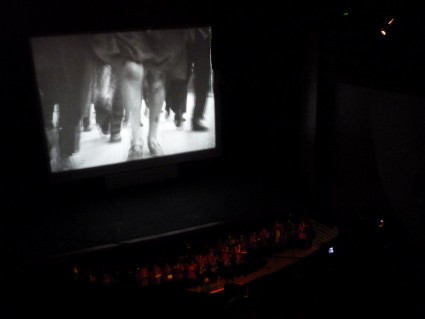
Mutter Krausens Fahrt ins Glück is as agit-prop a film as you could expect to see. Directed by Piel Jutzi, it combines melodrama with documentary realism in its depiction of the ground-down lives of the Berlin proletariat. It tells of the family and tenants of an apartment managed by the aged Mother Krause (Alexandra Schmidt), pitting the apathy and resignation of the individualised poor (generally the elderly) against the positive binding together of those who follow the Communist party (generally the young). Its highpoint is where the harassed daughter (Ilse Trautschold) joins her boyfriend in a protest march to the sounds of the Internationale – literally so in our case, because at this point a marching band of red-suited musicians entered the Verdi theatre and played the marching song to much applause. It was a wonderful thearical coup – typical of the imagination that goes into the Giornate.

However, despite such rousing gestures, the film’s message was an unsettling one. We were supposed to reject Mother Krause’s miserablist view of her fate, but only after the film had done all it could to make us feel sorry for her, so that the ending – where she gasses herself and a sleeping child, because life simply isn’t worth it for either of them – was distasteful and the conclusion ambiguous. It was a stylish and imaginatively experimental film, but what it expounded was more posture than principle.

Next up came a selection of Pathé short comedies with surprisingly sophisticated live musical accompaniment from pupils of the Scuola Media “Balliana-Nievo” from nearby Sacile, music that was a good deal richer in colour and instrumentation than other schools’ work with silent films that I have heard. They were followed by pupils of Pordenone’s Scuola Media Centro Storico, who took on the truly bizarre Charley Bowers, an American comedian whose gimmick was to combine comedy with stop-frame animation. In There it is (USA 1928) he plays a Scottish detective from Scotland Yard who tackles the case of a haunted house with the aid of his cockroach sidekick, MacGregor. It wasn’t strictly funny, but it left this viewer – whose first Bowers film it was – opened-mouthed at its unabashed weirdness. If Salvador Dali had been employed by Leo McCarey, he might have made There it is.

In need of a break, I missed the new documentary Palace of Silents (USA 2010) on the story of Los Angeles’ Silent Movie Theater, returning for the evening’s screenings. The Giornate was celebrating the 75th anniversary of two of the world’s leading film archives, MOMA and the BFI National Archive. To mark its 75th year, the BFI took the interesting decision to try and recreate part of a programme of the Film Society. The Film Society was formed in London in 1925 by a bunch of radicals led by the Hon. Ivor Montagu, which eventually included such notables as Anthony Asquith, Iris Barry, Sidney Bernstein, Roger Fry, Julian Huxley, Augustus John, Bernard Shaw and H.G. Wells. The Society (the first of its kind in the world) put on films of artistic, historic or political interest at the New Gallery Kinema in Regent Street, often showing films from the USSR which had been refused a licence by the British Board of Film Censorship (they could do so because the films were shown to members of a private club). The Film Society had a huge influence on British film culture, and after it ceased operating in 1939 its collection went to the BFI.

On 10 November 1929 the members of the Society witnessed perhaps the most remarkable film programming coup ever – the world premiere of John Grierson’s Drifters, the cornerstone of the British documentary movement, and the UK premiere of Sergei Eisenstein’s Battleship Potemkin, plus James Sibley Watson’s avant garde classic The Fall of the House of Usher (USA 1928) and Walt Disney’s Barn Dance (USA 1929). Now that’s programming.

Drifters (1929)

Audiences were made of sterner stuff in 1929, because we were only shown the first two. Drifters (UK 1929) is one of those classics more cited than seen and those who have seen it generally did years ago. Looking at it again after twenty years in my case, it is a work that easily merits its high reputation. It documents the work herring fishermen, and by its Soviet-inspired use of montage combined with a very British tatse for understated realism it immediately stands out from any other film of actuality produced in the UK (or anywhere else) to that date. One understands why its effect on audiences at the time was so electric, and why it did indeed inspire a whole school of documentary filmmaking.

However, it is also an odd film. It falls into three parts. The first, where the fishermen go out to sea, is in classic documentary style, showing man pitted against the elements, elevated (but not excessively ennobled) by toil. Part two, the night-time sequence, is strange. The fishermen sleep, but in the seas beneath we see the herring shoals swimming to and fro, menaced by dogfish. What has this to do with documentary? It tells us nothing of the people involved. Are we mean to gain insight into the lives of the fish? What is going on? It’s a sequence that dosn’t seem to get discussed much in studies of Drifters, yet here is the archetypal Griersonian documentary, and at its heart it slips into a strange, blue-tinted reverie, a fisherman’s dream. Part three is where the catch is taken to harbour, with often exhilaratingly scenes of commerce, industrialisation and human interaction. As Russell Merritt notes in the Giornate catalogue, “Grierson claimed the sequence was pointed social critique, exposing capital’s exploitation of the workers”. It is no such thing. It is unabashed championing of the power of the marketplace. Grierson the instinctive filmmaker was not the political filmmaker that he thought that he should be – he was too good for that.

Do you really need my thoughts on Bronenosets Potemkin (Battleship Potemkin) (USSR 1925)? As probably the most discussed film in history outside of Citizen Kane, I guess not. It was an odd way of celebrating the anniversary of the BFI National Archive, especially as the print came from the Deutsche Kinemathek, but it was enriching to compare and contrast with Drifters. It’s a film that disappointed me greatly when I first saw it (with the original Edmund Meisel score), probably because I was so expecting to be impressed and because of the absence of conventional narrative. As a story, it hasn’t got much going for it. As cinematic posturing, particularly as one of a planned series of films celebrating the 1905 revolution, it makes absolute sense. Every scene is overplayed, but it is always compelling to watch. There is not a dull composition in it.

And that was enough for a Sunday. I did see the first twenty minutes or so of Dmitri Buchowetski’s Karusellen (Sweden 1923), which looked fabulous. but I was sceptical of any story where a circus sharpshooter somehow is able to afford a vast country house and where the happily married wife instantly falls for a stranger because that’s what always happens with strangers. Enough of such artificiality – give me the kine-truth of documentary, and better still the unvarnished simplicity of actuality. For all of the canonical classics on show, the film of the day was a plain record of tribal dances from the Amazonian forest in 1916. So often the simplest is best.

Pordenone diary 2010 – day one
Pordenone diary 2010 – day three
Pordenone diary 2010 – day four
Pordenone diary 2010 – day five
Pordenone diary 2010 – day six
Pordenone diary 2010 – day seven
Pordenone diary 2010 – day eight

Pordenone diary 2010 – day one

Verdi theatre and Posta cafe, Pordenone, Italy

Every Giornate del Cinema del Muto has its particular theme. The world-renowned silent film festival, held in Pordenone, Italy every October, programmes according to themes. This year we were offered films from the Japanese Schochiku Company, three Soviet filmmakers (Kalatozov, Room and Push) and French clowns 1907-1914 as the main strands, but there is always another theme at play, usually a reflection of the world outside from which we festival-goers enjoy a week’s respite. And 2010’s theme was hard times.

Hard times first of all for the festival itself. The world economic crisis hit the Giornate as it has hit everywhere else, and the results were evident everywhere. The modest accreditation fee had gone up. The traditional Film Fair could not take place. There was only the one film venue (with the positive spin to be taken from this that everyone had a chance to see every film on show). There were fewer films on show. Early publicity for the festival had promised films from Weimar Germany and the comedy short films of Leo McCarey – they were not there.

Hard times were also the topic of many a festival conversation, particularly among those from cultural institutions, and especially among the British waiting to see how deeply the axe will fall come the Comprehensive Spending Review later this month. Everything cost a little more, the exchange rates were unkind, the invitations to guests were down. Hard times indeed.

And yet, and yet. This was also a particularly successful Giornate. If there were few out-and-out classics on display, there was a profusion of discoveries and revelations. The audiences were excellent (it was a struggle to find a seat for the evening shows), and among them there were many new, young faces either eager for silent films alone or simply widening their appreciation of film culture overall. There was a vitality about the place. Add on top of that some glorious sunshine (the one obligatory day of torrential rain aside – Pordenone is near to the Alps, after all), a most welcoming town, convivial company and an embarrassment of fine eating places, and we were in the best place possible enjoying the most civilised of activities.

And so we begin another Bioscope Pordenone diary – daily reports on each of the eight days of the Giornate, which ran 2-9 October 2010. Because your scribe was only there for five days or so, there will be some additional reporting from our substitute reporter who is known only by the name of The Mysterious X. His (or her) views on the films on show will be given in due course. But to kick things off, you are in my hands.

Cadging a lift in the Giornate car

There are three airports to choose from if you are flying to Pordenone. Most come via Venice or Treviso; I took the more scenic route via Trieste, which takes longer but rewards you with glorious views over the Adriatic as you take the airport bus into the city. Or at least I would have gone that way had I not been fortunate to be offered a lift in a Giornate car with John Sweeney, one of the festival’s team of supremely talented pianists. So it was that I arrived at Pordenone well ahead of schedule and in royal style. Registration was in the new town Library, set around a beautiful colonnaded square, and armed with catalogue, other literature and a lurid orange festival bag, I was able to get to my first film having only missed a collection of French clowns films and Nelly Kaplan’s 1983 documentary on Abel Gance. The films are screened in the new Verdi theatre in the centre of Pordenone, a strikingly modernist building with curving white walls, lots of glass, and oh so comfortable seating within for the several hundred accredited to the festival (locals swelled our numbers still further by coming to the evening screenings).

And so to Minato No Nihon Musume (Japan 1933), or Japanese Girls at the Harbour. The festival’s main strand was films of the Shochiku studio, founded in 1920, and three of its leading filmmakers, Yasukiro Shimazu, Hiroshi Shimizu and Kiyohiko Ushihara. All three worked at Shochiku’s Tokyo studios, where the preference was for modern dramas with a strong element of Western influences. This was very clear in Shimizu’s Japanese Girls at the Harbour. The film told of two young women, Sunako (Michiko Oikawa) and Dora (Yukiko Inoue). Sunako falls in love with Henry (Ureo Egawa) who becomes involved with gangsters. He falls for another woman, who is shot and wounded by Sunako, who flees the city and becomes a prostitute. Meanwhile Henry marries steady Dora. Then Sunako returns…

The film was distinguished by striking pictorial compositions and an array of eye-catching devices, among them dissolves, tracking shots and jump cuts. When Sunako shoots her rival the camera zooms in on her face in jolts, then just as joltingly zooms out again. It was further distinguished by fascinating elements of Westernisation, particulaly associated with Henry, including suits, dance styles, clothing, motor cars, cigarette smoking, piano playing, and the prominent positioning of a Christian church. What was problematic was that none of these elements combined to make a coherent film story. Right from the outset you got an unsettling sense of no one shot really connecting with another. The narrative drifted, and just what point the director hoped to make became obscured as the plot thickened. Uncertainty hung over everything, and not in a deliberate way. There were good things there, but the individual elements never quite cohered.

But there was more than enough there to whet the appetite, and I see that the film is available on a Shimizu boxed set from Criterion, which includes the one film of his that I knew beforehand, the utterly delightful Mr Thank You (Arigatau-san) (1936). This was a great favourite of the late John Gillett, programmer extraordinaire at the National Film Theatre who did so much to bring Japanese films to the West. But Mr Thank You is a sound film – Japanese films continued silent for quite some while into the 1930s, but not quite as far as 1936.

The entertainments carried on, but I did not. I’m not a one for shows were every seat is taken and you have to sit where a ticket tells you too (if you’re as tall as me this is a major issue), so I avoided the evening’s special, ticket-only screenings that launched the festival. For the record there was Ivor Montagu’s short film The Tonic (UK 1928), based on an idea by H.G. Wells and starring Elsa Lanchester and Charles Laughton (which I do regret missing); a new animation by Richard Williams, Circus Drawings (UK 2010) and Buster Keaton’s peerless The Navigator (USA 1924) with musical accompaniment from the grandly named European Silent Screen Virtuosi (Günter Buchwald and friends).

Instead I chatted to friends at the Posta cafe, which is situated opposite the Verdi and fuels the festival with cappuccini, where we discussed looming budget cuts with gallows humour. Then I shuffled off back to my hotel and prepared myself for the rigours of the day to come. Which you’ll learn all about in Day Two.

Pordenone diary 2010 – day two
Pordenone diary 2010 – day three
Pordenone diary 2010 – day four
Pordenone diary 2010 – day five
Pordenone diary 2010 – day six
Pordenone diary 2010 – day seven
Pordenone diary 2010 – day eight
Lulu’s journals

Still catching up on the silent news, and probably the biggest story from last week was the announcement from George Eastman House about the journals of Louise Brooks. Before her death in 1985, the star of Pandora’s Box and Diary of a Lost Girl bequeathed her private journals to the New York film and photography museum, on the understanding that they remained under lock and key for twenty-five years. That time elapsed in August, and George Eastman House is now examining the journals.

We have good reason to expect a real treat should they be published (GEH has not announced any plans as yet). Brooks’ acerbic, observant 1982 memoir Lulu in Hollywood is a classic, and she wrote a number of well-regarded articles towards the end of her life. Brooks writes keenly and illuminatingly on a Hollywood stripped of its glamour, with intelligent observations on her films, her peers, and the industry in which she was such a contrary figure. What we have learned so far is that Brooks kept a private journal from 1956 onwards, and that she writes about Greta Garbo, Marlene Dietrich, Humphrey Bogart, Lauren Bacall and her own film roles. There are twenty-nine volumes, which range in size and content, amounting to some 2,000 pages.

More information on the journals from The Examiner, Variety and the Huffington Post.

Pordenone pictures

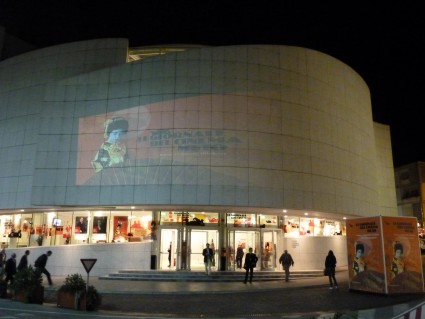
Verdi theatre, Pordenone, with trailer for the Giornate del Cinema Muto projected on the outside

Work has started on the Pordenone diary, which will take a little while to produce. In the meanwhile, I have uploaded a collection of photographs from the Giornate to the Bioscope’s Flickr site (scroll down to the bottom to find the Pordenone 2010 images) or else browse through my photostream (as they call it) starting here.

Bob shows Intolerance

Well I’m back from Pordenone, with plenty of stories to tell, and all in good time there will be the Bioscope’s Pordenone daily diary for your delectation. But a week is a long time in ther world of silent movies, and much of interest has been happening. So we’ll be having a few quick-fire news items, starting off with what for me is the pick of the bunch.

Bob Dylan has revealed a novel opening act for his new tour – he is showing twenty minutes of D.W. Griffith’s Intolerance (1916), shown completely silent. At Dylan’s shows at Fort Lauderdale (6 October) and at the University of South Florida, Tampa (7 October), the opening two nights of the tour, the film played as the audience were finding their seats. The Bob Links site provides this startled reaction from ‘Tampa Steve’:

How many concerts have you been to where there was no pre-recorded music played before the show? None? Same here. How many have you been to where 20 minutes of a silent film (Intolerance, from 1916) was played (silently) before the show? None! Welcome to the current Bob Dylan tour. The usual pre-party atmosphere of a big arena filled with concertgoers was deftly subverted by this simple dashing of expectations. Then, at the appointed hour, the house lights dimmed and the band strode onto the stage. Dylan waited 5 seconds, then sauntered out, too. Classy! The USF Sun Dome was less than half full at the time.

Dylan then came on stage and played ‘Leopard Skin Pillbox Hat’, though on the first night it was ‘Rainy Day Women #12 & 35’, which perhaps offers a more obvious link to the film’s title (“Well, they’ll stone ya when you’re trying to be so good…”). Which section from Intolerance is being shown is not certain, the fans on the Dylan forums being unclear on this point so far, but presumably it’s the Babylon sequence.

Whether Dylan will continue to show this new reverence for silent film remains to be seen – he has long taken to dropping references to films in his song lyrics, but never as far back as the silents, so far as I know. However, he does have a personal connection of sorts to Intolerance. In 1997 he was the recipient of the annual Dorothy and Lillian Gish Prize, which was established by Lillian Gish (who plays The Eternal Mother in the film, of course) in her will to be awarded to “a man or woman who has made an outstanding contribution to the beauty of the world and to mankind’s enjoyment and understanding of life.” There is a biography of Dylan and other details on the Gish site.

Pordenone bound

http://www.cinetecadelfriuli.org/gcm

The Bioscope is heading off to Pordenone to attend the Giornate del Cinema Muto. There will be our traditional detailed ‘diary’ of each day’s screenings after I get back, a week or so from now, but if you want to follow the progress of the festival as it happens, keep an eye on the Bioscope on Twitter from tomorrow. I will be tweeting throughout the festival (if I’ve managed to get the technology right), and I will do my best to conjure up such atmosphere as you can with 140 characters.

For the record, here’s the programe (web version), the daily schedule (1.6MB, PDF), and (jampacked with detailed riches) the full catalogue (8.5MB, PDF). The Bioscope’s reports on the Giornates of 2007-09 can be found on the Series page.

Muta Passione (Silent Passion)

Also for your delectation is this short documentary, Muta Passione (Silent Passion), made by Pasqualino Suppa in 2007. It’s a series of warm interviews with the founders, director, collaborators and guests of the Giornate, in the year where the festival moved from its temporary home in Sacile back to Pordenone. Most of it is in Italian, which is fine for our Italian readers (you know who you are), and features such festival luminaries as Paolo Cherchi Usai, Livio Jacob, Carlo Montanaro and Piera Patat. But you do also get ebullient festival director David Robinson and musicians Neil Brand, Günter A. Buchwald and Phil Carli in English, plus Donald Sosin and Joanne Seaton singing on stage and impromptu for the camera. It’s good to be going back.

See you in a week or so’s time.

Iceland digitised

Advertisement for The Prodigal Son (Glafaði sonurinn) in the icelandic newspaper Lögberg, 17 January 1924

Here’s a new and interesting challenge for the dedicated silent film researcher with a world view – Icelandic newspapers. Timarit.is is a digital library of the printed cultural heritage as preserved in newspapers and periodicals of the Faroe Islands, Greenland and Iceland. It brings together the collections of the National Library of the Faroe Islands, the National and Public Library of Greenland and the National and University Library of Iceland. It’s an ongoing project, but there are already nearly three-and-a-half million digitised documents on the site.

So what is there on film? Well, this is where the challenge comes in, because Icelandic is not one of the easier texts to navigate, and because I really only know one thing about Iceland and silent film, which is that it was the location for one of the longest, and most tedious, British films ever made, The Prodigal Son (1923), directed by A.E. Coleby, produced by Stoll, starring Stewart Rome and based on a novel by Hall Caine. In its fullest version the film was 18,454 feet in length, running to some four-and-a-half hours of screen time. I am one of the few who has actually sat through what survives of this film – the BFI has a version at a trim 9,118 feet – which it still took two long afternoons to get through. Funereal in pace, grimly histrionic, leadenly directed and singularly inept in its failure to make any creative use of its Icelandic settings, it is near the top of my top ten worst ever screen experiences. But it was made in Iceland, so what can we find about it in the Icelandic press of the time?

And the answer is quite a lot. Typing in “prodigal son” (in quotes) into Timarit.is brings up sixty-nine results, which it helpfully subdivides into decades, so you can instantly see that there are twenty-four hits from 1920-29 (and it then further subdividies these by individual years). You also quickly see that the film’s title in Icelandic was Glataði sonurinn. There are pieces on its production in 1922, its release in 1924, and its reissue (to something around 6,000 feet) in 1929. There are no photographs, but there are advertisements, you are able to gain enough of an idea about its importance and impact.

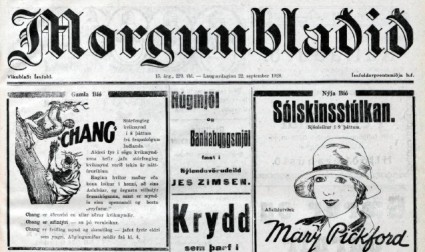
Varied film offerings advertised in Morgunblaðið, 22 September 1928

The presentation is excellent, with guidelines available in English. The search results given you a link to the title of the individual newspaper page, a line of text in which the search term appears, the date and page reference. Clicking on the link gives you a calendar (enabling you to browse adjacent issues), and a PDF of the full newspaper page with your search term highlighted. Thereafter it does depend on how strong your Icelandic is, but searching on some popular film names gives an indication of exposure and popularity – 547 hits for Chaplin between 1910 and 1929, 200 for Pickford, 272 for Fairbanks, 41 for Max Linder, and so on. Such hits usually lead you to advertisements for cinema programmes, so you can readly pick up an idea of what was being shown and when. Or just type in kvikmynd (film). It is possible to view text only (there’s a Text button on the left-hand column), so you can copy and paste text into Google Translate or whatever and get a rough idea of what’s going on.

There was a small Icelandic film industry in the silent era. The first films (actualities) were made in 1906, the same year that the Reykjavik Cinema Theatre was established. The first locally-produced fiction film was Ævintýri Jóns og Gvendar (The Adventures of Jon and Gvendur) (1923), directed by Loftur Guðmundsson. A feature film, Saga Borgaraettarinnar (Sons of the Soil), was made in Iceland in 1920, but it was a Danish production by Nordisk films (Iceland did not become completely independent of Denmark until 1944). However, there doesn’t seem to have been a whole lot more that was produced for several years thereafter, so Icelandic cinema for our period chiefly means exhibition, for which there is plenty to discover here. All in all, Timarit.is is well worth investigating for the bold and adventurous among you. Go explore.

Wara Wara

Trailer for the restored Wara Wara

Those who bemoan lost silent films, particularly in a national context, might like to consider the situation in Bolivia. Just the one silent fiction film survives of those (admittedly few) made in Bolivia, and that was only discovered in 1989. In that year sixty-three cans of nitrate film were found in a trunk in the basement of a house in La Paz. The films were the work of José Maria Velasco Maidana, all made between 1925 and 1930. Among the reels was Wara Wara, Bolivia’s sole surviving silent feature film.

Wara Wara was released in 1930, and in the form that survives it runs for 69 minutes (at 24 fps). It was directed by Maidana for Urania Film, and starred Juanita Taillansier, Martha de Velasco, Arturo Borda and Emmo Reyes. The film is based on the novel La voz de la quena by Antonio Diaz Villamil, and is set during invasion of the Inca kingdom by the Spanish conquistadors in the 16th century. Here’s the plot summary (adapted courtesy of the Jornada Brasileira de Cinema Silencioso site and Google Translate):

The peaceful kingdom of Hatun Colla is invaded by an army of Spanish conquistadors who destroy villages and kill its leader Calicuma and his wife Nitaya. In the chaos, the high priest Huillac Huma saves the princess Wara Wara and take her through secret passages into a cave in the mountains. In this hideway he masses an army of natives with the hope of eventually defeating the Spaniards. One day, Captain Tristan de la Vega, the head of a small force of Spaniards, arrives in the vicinity of the hideway. In the ensuing battle Captain Tristan ends up protecting Wara Wara and is wounded. She leads him into the hideaway and tends to his wounds. They fall in love and dream of a life together. But Huillac Huma and the other tribespeople would rather see Wara Wara dead than have her become an ally of the invaders. The couple are left to starve, but they are saved and are ready to begin a new life.

The restoration of the film has taken twenty years. It was originally copied onto acetate film stock in Germany, but reconstructing the film as released was a painstaking process involving considerable investigation of primary sources. A digital restoration was undertaken by the L’immagine Ritrovata in Bologna, Italy in 2009. The restored film was shown at Il Cinema Ritrovato in Bologna in July and at the Jornada Brasileira de Cinema Silencioso in August. It was given its official re-release in Bolivia on 23 September.

Trailer highlighting the restoration work done on Wara Wara

The film’s director José Maria Velasco Maidana (1899?-1989) was a notable composer and conductor as well as filmmaker. He is known in music circles for his ballets and symphonic works, a number of which embrace national/native themes. He was married to the American artist Dorothy Hood. He took up film in 1925 at the very start of Bolivian fiction film production. Films had been shown in Bolivia since 1897, but exhibition was dominated by North American product, and aside from some short actualities in the teens national film production did not begin until 1923, with the first fiction feature, Pedro Sambarino’s Corazón Aymara made in 1925. It was followed later that year by Maidana’s La profecía del lago, which was promptly banned by the local censor because it featured the love between a native man and a white woman. He formed his own production company, Urania, and made Wara Wara (1930) and Hacia la Gloria (1931), as well as various documentary shorts, before returning to music.

To judge from the clips available on the two trailers have have been issued, Wara Wara looks to be fascinating in detail and competent in construction, even if its epic ambitions were probably constrained by cost. There are some strong visual compositions, including a shadow puppet sequence. More than that I cannot say with only a trailer to go on, but certainly what is there whets the appetite for more – let’s hope for a local DVD release, given its great importance to Bolivian cinema.

There’s more information (in Spanish) on the Cinemateca Boliviana site and in the Jornada Brasileira de Cinema Silencioso 2010 catalogue.

A book has been written on the restoration by filmmaker Fernando Vargas Villazon, Wara Wara. La reconstrucción de una película perdida.

Information on silent films in Latin America generally can be found at Thomas Böhnke’s highly recommended Der Stummfilm in Lateinamerika site (in German), which includes a section on silent film in Bolivia (acknowledgements to Böhnke for his Nitrateville post about the film).