Things Australian no. 1: The Marvellous Corricks

Les Fleurs Animées (Pathé, France 1906), from the Corrick Collection in the National Film and Sound Archive of Australia

For the past few years those attending the Pordenone silent film festival have been treated to examples from an extraordinary collection of early films held by the National Film and Sound Archive of Australia. The films are those collected (and in some cases made) by the Corrick Family Entertainers, or The Marvellous Corricks, a performing troupe comprising Albert and Sarah Corrick and their eight children which toured Australia, New Zealand and South-East Asia between 1901 and 1914 and which included film in its act.

The Corricks’ show combined song, comedy, dance, lantern slides, poetry readings and film. Some 135 films survive, chiefly titles the family purchased from France, England, the USA and Italy, plus films that they shot themselves, which includes travel footage, a chase comedy (The Bashful Mr Brown) and film of them on tour. The films they purchased are superb in quality, combining fiction and non-fiction, several films with beautiful colouring (around a quarter of the collection is stencil coloured and another quarter tinted and toned). The Corricks clearly had a fine eye for a good film, favouring particular companies (notably Pathé, Charles Urban Trading Company and Edison). Many of the films are unique to the Corrick collection, and include some real cinematic treasures.

The Corricks c.1898: (Front row) Sarah, Ethel, Alice, Elsie, Albert. (Back row) Amy, Ruby, Leonard (the family’s cinematograph expert), Jessie, Gertrude, from the National Film and Sound Archive

As Leslie Anne Lewis writes in her excellent essay ‘The Corrick Collection: A Case Study in Asia-Pacific Itinerant Film Exhibition (1901-1914)’, Albert and Sarah Corrick planned for a musical family, and trained their children in singing, dancing, bell-ringing and playing a wide variety of musical instruments, among them piano, organ, flute, piccolo, cello, violin, saxophone, mandolin and cornet, with the children often proficient in a number of these. They played in concert halls, town halls and the like, stressing the family-friendly wholesome ness of their show, touring all of the Australian territories up to 1907 before going on an international tour. It was during this tour that they picked up many films, though a projector had been part of their act from the beginning. The family’s cinematograph expert was Leonard Corrick, and his film shows were often billed separately as ‘Leonard’s Beautiful Pictures’. Many people in Australia and South-East Asia saw their first films, and their first views of a world outside their home town, from a Corrick family show. It is evidence of how important variety shows were to early film, how film was integrated within such entertainments to be a part of song, dance and showmanship, and how eventually film outstripped itinerant shows such as those of the Corricks and became the show in itself.

The films began the tortuous process of joining the NFSA collection and gradually being properly preserved in 1968, with the definitive work really only being undertaken recently (see Leslie Anne Lewis’ essay for details). Basic information on all of the films can be found on the NFSA catalogue, with much greater details available for those titles shown at Pordenone by browsing the catalogues of past festivals or using the Pordenone festival’s database (which does not include 2010 screenings as yet). For your convenience (because that is the Bioscope’s mission), here is a list of titles that have been identified and screened so far:

  • “AND A LITTLE CHILD SHALL LEAD THEM” (d. D.W. Griffith p.c. Biograph, USA 1909)
  • THE ARRESTED TRICAR (GB? c.1905)
  • AU JARDIN ZOOLOGIQUE DE PARIS (p.c. Pathé, France 1905)
  • A BABY’S SHOE (d. Charles J. Brabin p.c. Edison, USA 1912)
  • BABYLAS VIENT D’HÉRITER D’UNE PANTHÈRE (d. Alfred Machin p.c. Pathé, France 1911)
  • BAIN DE BÉBÉ (p.c. Pathé, France 1904)
  • BASHFUL MR. BROWN (p.c. Corrick, Australia 1907)
  • LA BELLE AU BOIS DORMANT (d. Lucien Nonguet, Ferdinand Zecca p.c. Pathé, France 1902)
  • BETTINA’S SUBSTITUTE; OR, THERE’S NO FOOL LIKE AN OLD FOOL (d. Albert W. Hale p.c. Vitagraph, USA 1912)
  • BICYCLETTE PRÉSENTÉE EN LIBERTÉ (p.c.. Pathé, France 1906)
  • A CANADIAN WINTER CARNIVAL (p.c. Edison, USA 1909)
  • LE CHAPEAU (p.c. Pathé, France 1906)
  • CHASSE AU PAPILLON (p.c. Pathé, France 1906)
  • CHASSE AU SANGLIER (p.c. Pathé, France 1904)
  • COIFFES ET COIFFURES (d. Gaston Velle p.c. Pathé, France 1905)
  • COME CRETINETTI PAGA DI DEBITI (d. André Deed p.c. Itala, Italy 1909)
  • COMEDY CARTOONS (d. Walter R. Booth p.c. Urban, GB 1907)
  • [CORONATION OF KING EDWARD VII AND QUEEN ALEXANDRA] (GB 1902)
  • CRETINETTI LOTTATORE (p.c. Itala, Italy 1909)
  • [THE DAY-POSTLE MATCH AT BOULDER RACECOURSE, WESTERN AUSTRALIA] (p.c. Corrick, Australia 1907)
  • LES DÉBUTS D’UN CHAUFFEUR (d. Georges Hatot p.c. Pathé, France 1906)
  • DEUX BRAVES COEURS (p.c. Pathé, France 1909)
  • LE DINER AU 9 (p.c. Pathé, France 1909)
  • DON QUICHOTTE (d. Lucien Nonguet, Ferdinand Zecca p.c. Pathé, France 1904)
  • DOWN ON THE FARM (p.c. Edison, USA 1905)
  • DU CAIRE AUX PYRAMIDES (p.c. Pathé, France 1905)
  • FANTASIAS ARABES (p.c. Pathé, France 1902)
  • FIRE! (d. James Williamson p.c. Williamson, GB 1901)
  • LES FLEURS ANIMÉES (d. Gaston Velle p.c. Pathé, France 1906)
  • FUNERAL PROCESSION OF NEW ZEALAND PREMIER R.J. SEDDON (New Zealand 1906)
  • LES GRANDES EAUX DE VERSAILLES (p.c. Pathé, France 1904)
  • GUILLAUME TELL (d. Lucien Nonguet p.c. Pathé, France 1903)
  • THE HAND OF THE ARTIST (d. Walter R. Booth p.c. Paul, GB 1906)
  • HER FIRST CAKE (d. James Williamson p.c. Williamson, GB 1906)
  • HISTOIRE D’UN PANTALON (p.c. Pathé, France 1906)
  • HOW JONES LOST HIS ROLL (d. Edwin S. Porter p.c. Edison, USA 1905)
  • AN INDIAN’S GRATITUDE (p.c. Pathé, USA 1911)
  • LES INVISIBLES (d. Gaston Velle p.c. Pathé, France 1906)
  • J’AI PERDU MON LORGNON (d. Charles Lucien Lépine p.c. Pathé, France 1906)
  • [KING EDWARD VII AND QUEEN ALEXANDRA LEAVE A UNIVERSITY GRADUATION CEREMONY] (GB c.1907)
  • LIFE OF A COWBOY (d. Edwin S. Porter p.c. Edison, USA 1906)
  • LIVING LONDON (p.c. Urban, GB 1904) [note: now identified as THE STREET OF LONDON p.c. Urban, GB 1906)
  • THE LOST CHILD (d. Wallace McCuthcheon p.c. Edison, USA 1904)
  • THE MAGICAL PRESS (d. Walter R. Booth p.c. Urban, GB 1907)
  • MARIE-ANTOINETTE (p.c. Pathé, France 1903)
  • LA MÉTALLURGIE AU CREUSOT (p.c. Pathé, France 1905)
  • THE MINER’S DAUGHTER (d. James Williamson p.c. Williamson, GB 1907)
  • MIRACLE DE NOËL (p.c. Pathé, France 1905)
  • MONSIEUR QUI A MANGÉ DU TAUREAU (p.c. Gaumont, France 1907)
  • NAVAL ATTACK AT PORTSMOUTH (p.c. Urban, GB 1907)
  • NIAGARA IN WINTER 1909 (p.c. Urban, GB 1909)
  • PAUVRES VIEUX (Pathé, France 1907)
  • LES PETITS PIFFERARI (p.c. Pathé, France 1909)
  • LA POUDRE ANTINEURESTHÉNIQUE (p.c. Pathé, France 1909)
  • LA POULE AUX OEUFS D’OR (d. Gaston Velle p.c. Pathé, France 1905)
  • [PROCESSION OF BOATS ON RIVER, BURMA] (GB c.1905)
  • RECEPTION ON, AND INSPECTION OF, H.M.S. “DREADNOUGHT” (p.c. Urban, GB 1907)
  • LE REGNE DE LOUIS XIV (d. V. Lorant Heilbronn p.c. Pathé, France 1904)
  • LA RUCHE MERVEILLEUSE (p.c. Pathé, France 1909)
  • LE SCULPTEUR EXPRESS (p.c. Pathé, France 1907) (p.c. Urban, GB c.1905)
  • [THE SHORT-SIGHTED CYCLIST] (p.c. Eclipse, France 1907)
  • LE SINGE ADAM II (Pathé, France 1909)
  • SPORTS AT SEA ON THE S.S. RUNIC (p.c. Corrick, Australia 1909)
  • [STREET SCENES IN PERTH, WESTERN AUSTRALIA] (p.c. Corrick, Australia 1907)
  • TOTO EXPLOITE LA CURIOSITÉ (p.c. Pathé, France 1909)
  • LE TOUR DU MONDE D’UN POLICIER (d. Charles Lucien Lépine p.c. Pathé, France 1906)
  • [TRAVEL SCENES] (p.c. Urban, GB c.1905)
  • LA VIE INDIGÈNE AU SOUDAN ÉGYPTIEN (p.c. Pathé, France 1908)
  • THE WAIF AND THE STATUE (d. Walter Booth p.c. Urban, GB 1907)
  • WHEN THE WIFE’S AWAY (p.c. Paul, GB 1905)
  • WHO STOLE JONES’ WOOD? (p.c. Lubin, USA 1909)
  • A WINTER STRAW RIDE (d. Wallace McCutcheon, Edwin S. Porter p.c. Edison, USA 1907)

Other films in the collection are still in the process of being identified and preserved – the NFSA catalogue lists these, with such intriguing titles as The Burglar and the Baby, A Canine Arthimetician, Elephants Working in a Burmese Forest, Fée Aux Pigeons, Hallo! Haloo! Grinder, A Japanese Teahouse: Dance of the Geishas, Olympic Games in Athens [1906], and A Trip through Switzerland Engadin Valley.

You can read about the Corrick Collection on the NFSA’s Australian Screen site which includes a number of clips from the films (The Hand of the Artist, La Poule aux Oeufs d’Or and Street Scenes in Perth, Western Australia). There’s another overview on the main NFSA site.

Films from the Corrick Collection are currently featuring in My Bicycle Loves You, a collaboration between the NFSA and physical theatre company Legs on the Wall that combines film footage with live performance to reveal the world of the Corrick Family. It played at the Sydney Festival last week and will be playing at the Perth Festival 22-26 February.

Stage to screen

Members of the Society for Theatre Research at the Art Worker’s Guild

A couple of days ago I was fortunate to attend Viewing the Victorian Stage on 20th Century Film, an event organised by the Society for Theatre Research. Held in the quaintly elegant surroundings of the Art Worker’s Guild in London’s Queen’s Square, we saw a programme of rare and remarkable examples of Victorian stage practice preserved in one form or another on film. The programme was an outcome of years of research into the Victorian and Edwardian stage on film by Professor David Mayer and Helen Day-Mayer, and complementary research into its stage film holdings by the BFI’s Bryony Dixon. David introduced, Bryony talked us through the films, Neil Brand played the piano, and an enthusiastic and learned crowd lapped up the films with a mixture of amusement and astonishment.

We began with Georges Méliès’ Faust aux Infers (France 1903), presented as an example of a diablerie or férique film of the kind that was exhibited in British music halls and American vaudeville houses. The point made was that Méliès constructed a glass-roofed facsimile of his Robert Houdin’s theatre as his film studio, so that he could recreate stage effects as part of his films, using an array of ingenious machinery. For Méliès, film was a means to realise his theatrical dreams.

It was so useful to see these films from a theatre historian’s perspective. I have seen Edison’s Japanese Acrobats (USA 1904) before, and marvelled at the great skill on display, but had not known before that it shows an example of a ‘risley act’, named after Richard Risley Carlisle, an American acrobat who juggled with his feet while lying on his back, and act which he took to Japan in the 1860s. Will Evans, The Musical Eccentric (UK 1899) was less dazzling, showing a British variety comedians playing a ukelele and doing somersaults with a chair of the kind which you now see any week in the Premiership when the more acrobatic of footballers has scored a goal. He also had difficulty in keeping in shot, to a degree that you wondered why on earth the film company (Warwick) didn’t retake. But it was an unadorned demonstration of standard fare on a British variety stage on 1899, and that was what many in the audience were hoping to see – film as time machine, showing those who knew their theatre history something of what it was actually like to be there.

Particularly precious to witness was Lil Hawthorne sings ‘Kitty Mahone’ (UK 1900). This is a very early example of a synchronised sound film i.e. a silent film of a singer intended to be synchronised with a cylinder recording of their voice. The synchronisation wasn’t perfect, but it was very moving to hear her voice sing out ‘my pretty Kitty Mahone / I’m tired of living alone’ as she gestured to the audience in what looked like the stage of the Hippodrome in London, but which was actually a stage mock-up and was filmed on the roof of the theatre.

Faust aux Infers (1903)

American Mutoscope & Biograph’s Duel Scene from ‘Macbeth’ (USA 1905) was crude melodrama, Shakespeare reduced to knockabout swordfighting, the kind of rough-and-tumble extracts from plays that existed as popular variety theatre turns. Here We Are Again (UK 1913) was a surviving example of a harlequinade film, of the kind made for child audiences during holidays. It was simple knockabout stuff, but also gave the clearest of echoes to the proto-pantomimes of the early nineteenth century, when every such production had its Columbine and Harlequin.

One of the hits of the evening was Le Pied de Mouton (France 1907), a Pathé féerie or fairy play directed by Albert Capellani. To an audience of early film historians this would have been an interesting example of a fantasy film with two men (brightly stencil-coloured) encountering a giant head in a forest, notable for its staging in depth. For the stage historian, here were precious examples on show of vampire traps and star traps – types of trapdoor enabling performers to disappear and reappear through the floor at astonishing speed. Opinion afterwards was that Pathé had to have followed Georges Méliès’ lead and to have constructed its studio either from a theatre or by importing theatrical machinery. Not for the first time in the evening some argued that the film must show a scene inside a theatre – a holy grail for the theatre historian, again yearning to see what an actual audience member saw. But it was so much easier to recreate the effects in the studio than to go to the huge expense and inconvenience of setting up cameras in a theatre, with the considerable arc lighting that would have been required to illuminate the proceedings sufficiently. All of the films we were shown were filmed in a studio of one sort or another – with one astonishing exception, which we’ll come to.

The Whip (USA 1916) was a feature film version of a renowned Drury Lane drama about the attempts to nobble a horse, which on stage featured a sensational rail crash. What overwhelmed audiences when they saw it in a theatre was par for the course on the screen, and the realistic nature of Maurice Tourneur’s drama – from which we saw the sequence where the locomotive crashes, with the horse (The Whip) saved just in time – seemed worlds away from the theatre. The film could thrill, but it could not astonish. Rather better as a film was Pimple’s The Whip (UK 1917), a cheerfully stupid parody of film and play, in which the rescue of the horse (a pantomime horse) needs to be repeated a number of times because the train driver keeps on getting his cue wrong. As a practitioner of deconstructed comedy Pimple (the nephew of Will Evans, who we had seen earlier) seemed remarkably modern.

And then we found the holy grail. For many years now the BFI National Archive has had a film in its collection given the supplied title of (Collapsing Bridge) and dated c.1902. Here’s the description from the BFI database:

A section opening with an armed attack by men in peasant costume, led by a girl, against an unseen enemy. A painted backcloth represents mountain scenery and a bridge is in the foreground. The men and girl vanish at the aproach of two horse-drawn coaches from opposite directions which endeavour to cross the bridge simultaneously; water suddenly cascades down from the mountains, collapsing the bridge and plunging the horses and coaches into the water.

Described thus, it reads like part of a film scenario which we would expect to be divided up into a number of shots. But we see the entire action in one long shot, clearly filmed inside a hippodrome theatre, and featuring the stock-in-trade of hippodromes, a troupe of horses diving into the water. The effect is jaw-droppingly extraordinary. But what is the show, and who made the film? We don’t yet know. It’s quite likely that the film shows a 1902 show called The Bandits (described here), but no record has been found of any film made of the production. The filmmaker is possibly Walter Gibbons, future owner of the London Palladium, who we know filmed another Hippodrome production, Tally Ho!, around the same time, using an overpowering number of arc lights. But until we know for sure the film remains frustratingly fugitive even while it almost uniquely gives you the sense of truly being in the presence of the Victorian/Edwardian theatre at its maddest and boldest.

Trilby (UK 1914) is a disappointingly stolid piece of work. Its interest for the theatre historian is that it stars Sir Herbert Beerbohm Tree, in all his eye-rolling glory, as Svengali, but it fails to mesmerise. People talking afterwards noted the different acting styles of Tree and Viva Birkett, a florid Victorian manner alongside a subtler, even Ibsenian performance from her. It was good then to see Edison’s parodic Why Girls Leave Home (USA 1909), which cheerfully sends up every convention of the melodrama, including over-the-top acting, malfunctioning stage machinery and plot absurdities. The full film originally included a framing story in which a vicar tries to prevent his daughter from seeing a play, but she does so, and this is what she sees. Unfortunately what survives (held by the CNC archive in France) is in a dreadful state, with the image barely distinct, making us strain all the more to see laughs than would otherwise be the case. But it was clear that the Edwardians knew exactly how to laugh at the Victorians.

We finished with a long sequence (the tribunal scene) from The Only Way (UK 1926), an adaptation of Charles Dickens’ A Tale of Two Cities, and a star vehicle for theatrical great Sir John Martin-Harvey. He first appeared as Sidney Carton in 1899, and twenty-five years later he was still playing the same role, aged sixty-three. The feature film, directed by Herbert Wilcox, tries as far as possible to duplicate the stage production, though it was a film for all that and an engrossing example of the complex interrelationship between the two media. This came out in Martin-Harvey’s performance, which was a mixture of extravagant gestures and fine details that only the camera could pick up. It was pure ham from the theatrical knight, and you saw in his eyes someone who had played the same role a few hundred times too many, but you also saw such star magnetism that his great fame instantly made sense.

Silent film was profoundly indebted to the Victorian theatre. Actors, acting conventions, plays, genres, types of stage effect, its kudos, all had a huge effect on how the silent film grew. We can look at silent films and see endless traces of its Victorian stage origins, not just in films that clearly emulate a stage experience, but more subtly in how films were constructed, what they wanted to be, and then what they reacted against when they felt themselves outgrowing their theatrical inheritance.

But we cannot simply look at silent films for direct evidence of stage practice. Film changes everything it touches. Stage acts were changed to fit the dimensions of film – literally so, when the space in which a film could be made was smaller than stage space. The conventions of theatre were not so much borrowed as adapted for film, and then blended with the conventions of film itself. Also, film was not static, but changed greatly over the twenty-five years that we saw, during which the relationship between the two media grew ever more complex. In the end we witnessed not so much examples of stage practice recorded on film but rather a changing history of performance. Film became another stage for actors, dancers, comedians and magicians. Some adapted more happily than others, but as soon as they put themselves before a camera it changed them. It is that process of adaptation that film records rather than being some sort of literal mirror of what took place upon a stage. We may go looking for the evidence that we seek in a piece of film, but we will always end up finding something else.


Examples of American stage and variety stars from the early 1900s can be found on the Library of Congress’ American Memory site – the American Variety Stage 1870-1920 collection – and the Variety Stage: Vaudeville and Popular Entertainment playlist on its YouTube channel.

The organisers of the event produced a handy bibliography, which I’m going to take the liberty of reproducing, as the aim was to encourage others to engage in research in this area:

  • Richard Abel, French Cinema: The First Wave, 1915-1929 (Princeton University Press) 1984
  • ____,The Ciné Goes to Town: French Cinema, 1896-1914 (California University Press) 1994)
  • ____, (ed.) The Encyclopedia of Early Film (Routledge), 2005
  • Jacky Bratton, Jim Cook & Christine Gledhill (eds), Melodrama: Stage Picture Screen (British Film Institute), 1994
  • Ben Brewster & Lea Jacobs, Theatre to Cinema (Oxford University Press), 1997
  • Judith Buchanan, Shakespeare on Silent Film: An Excellent Dumb Discourse (Cambridge University Press), 2009
  • Jon Burrows, Legitimate Cinema: Theatre Stars in Silent British Films 1908-1918 (University of Exeter Press), 2003
  • Jim Davis (ed) Victorian Pantomime / A Collection of Critical Essays (Palgrave Macmillan), 2010
  • Bryony Dixon, Chaplin-In-Context A Catalogue of Music Hall Related Films 1895 – 1930 held by the bfi National Film and Television Archive, Downloadable as Chaplin-in-context.pdf No date
  • ____, 100 Silent Films (BFI & Palgrave Macmillan) forthcoming 2011
  • Linda Fitzsimmons & Sarah Street (eds), Moving Performance: British Stage and Screen 1890s-1920s (Flicks Books), 2000
  • Dennis Gifford, Books and Plays in Films 1896-1915: Literary, Theatrical and Artistic Sources of the First Twenty Years of Motion Pictures (McFarland & Mansell), 1991
  • Martin Miller Marks, Music and the Silent Film/ Contexts and Case Studies, 1895-1924 (Oxford University Press), 1997
  • David Mayer, Playing Out the Empire: Ben-Hur and other Toga Plays and Films 1883- 1908 (Clarendon Press), 1994
  • ___, Stagestruck Filmmaker: D.W. Griffith and the American Theatre (University of Iowa Press), 2009
  • Charles Musser, Before the Nickelodeon: Edwin S. Porter and the Edison Manufacturing Company (University of California Press), 1991
  • ___, Edison Motion Pictures, 1890-1900 (Smithsonian Institution Press & Le Giornate del Cinema Muto), 1997
  • Kemp R. Niver & Bebe Bergsten (eds) Early Motion Pictures: The Paper Print Collection in the Library of Congress (Library of Congress), 1985
  • David Robinson, Musique et Cinéma Muet (Réunion des Musées Nationaux), 1995
  • ____ From Peep Show to Palace: The Birth of American Film (Columbia University Press), 1996
  • Matthew Solomon, Disappearing Tricks: Silent Film, Houdini, and the New Magic of the Twentieth Century (University of Illinois Press), 2010
  • ____, (ed) Fantastic Voyages of the Cinematic Imagination: Georges Méliès’s Trip to the Moon (SUNY Press) forthcoming 2011

StummFilmMusikTage 2011

Germany’s festival of silent film and music, StummFilmMusikTage, returns once more, but in a somewhat reduced state [nothing to worry about – see comments]. What was previously a three-day event at Erlangen is now three screenings over the one day, 29 January 2011:

4pm
Short Film Programme: Charlie Chaplin’s Adventures
The Rink (USA 1916)
Behind the Screen (USA 1916)
A Night in the Show (USA 1915)
Score and accompaniment: Yogo Pausch

5:30pm
Introduction: All Quiet on the Western Front

6:30pm
All Quiet on the Western Front (USA 1930, 145 min, Dir: Lewis Milestone)
Music: Manfred Knaak; Accompaniment: ensemble KONTRASTE conducted by Christian Schumann

10pm
The End of the World (Verdens Undergang) (DK 1916, 74 min, Dir: August Blom)
Music and accompaniment: Interzone Perceptible

As before, the festival will be held in the Markgrafentheater Erlangen, a baroque theatre built in 1719 and still in use. There’s more information as always on the festival site, and they are now open for bookings.

In the lobby

Lobby card for The Covered Wagon (1923), part of the Western Silent Films Lobby Card Collection

For decades lobby cards were an integral part of the cinema-going experience. While posters appeared outside the cinema to lure you in, the cinema lobby or foyer would house sets of cards – effectively mini-posters – usually arranged in grid form, promoting films on show and films to come. Lobby cards played an important part in making the very process of going to the cinema something special. Though they had been replaced by plain black-and-white stills by the time I started going to the cinema, you still scanned the forthcoming attractions with delighy, like being in a sweetshop or a toyshop, each image extraordinarily filled with promise as you lived out the drama it depcited in your mind’s eye. You saw an entire film bound up in a single, evocative image. Expectation has always been the engine which has kept the cinema going.

Lobby cards appeared in the 1910s, produced first in sets of four, later usually appearing in sets of eight, and acquiring colour by 1917 (even if the films were black-andwhite they were neverhtless promoted in colour). The standard size was 8″x11″, and they would be shown on free-standing boards or easels, or else framed on the lobby walls. They have become a favourite subject for collectors, and they record not only the emotional import of films but frequently document films that do not survive in any other form. They ceased to be produced for American exhibition at some point in the 1980s (around the time that multiplexes became the norm), but still get made for film exhibition in other territories.

All of which is premable to the bringing to your attention of the Western Silent Films Lobby Cards Collection, part of the digital library of Yale University’s Beinecke Rare Book and Manuscript Library. The collection comprises 86 lobby cards and 19 printed fliers used to promote sixty-eight silent Westerns produced between 1910 and 1930. Each image is available as as thumbnail, then x4 and x8 size, plus a zoomable file if you have the right softare for viewing .sid files. The descriptive data is meticulous if dry, telling you all about the card but nothing much about the film that it promotes. Nevertheless, the site a delight to browse. The films featured include The Mollycoddle, The Covered Wagon, The Bronc Stomper, The Pony Express and The Thundering Herd, with stars such as Tom Mix, Hoot Gibson, William Farnum and Fred Thomson.

The collection is part of the Yale Collection of Western Americana at the Beinecke Rare Book and Manuscript Library, and to discover more about the broadcder contexts in which the silent Western sits, do try out other image sets from the Western Americana collection, such the Detroit Photographic Company’s Views of North America, ca. 1897-1924, Ruckus! American Entertainments at the Turn of the Twentieth Century or Mammoth Plate Photographs of the North American West.

My thanks to Brad Scott for bringing the collection to my attention.

Max and the girls

Max Davidson in Why Girls Say No (1927)

The Bioscope is going to try and devote more attention to new DVDs and new print publications in our field. But will we have any more welcome a title to announce than the latest offering from Germany’s Edition Filmmuseum, due out in February? It’s Max Davidson Comedies, a collection of twelve comedy shorts (two of them talkies) on a 2-disc set. Davidson was a Hollywood supporting actor who enjoyed a brief period as a star attraction when he appeared in a series of comedies made in the late 1920s for Hal Roach Studios. His speciality was Jewish humour, and though some have expressed doubts about the durability of such ethnic humour, the exuberant freshness of Davidson’s comedy, coupled with a knowing sense of the world’s follies which gives him a particularly modern appeal, have made Davidson a great festival favourite. Titles such as the sublime Pass the Gravy (a strong candidate for funniest silent comedy short of them all) and the gloriously named Jewish Prudence are essential viewing and a tonic for our tired times.

The full list of titles is:

DVD 1
* Why Girls Say No 1927, 22′
* Jewish Prudence 1927, 21′
* Don’t Tell Everything 1927, 22′
* Should Second Husbands Come First? 1927, 21′
* Flaming Fathers 1927, 24′
* Hurdy Gurdy 1929, 20′

DVD 2
* Call of the Cuckoo 1927, 19′
* Love ’em and Feed ’em 1927, 9′, tinted
* Pass the Gravy 1928, 25′
* Dumb Daddies 1928, 15′
* Came the Dawn 1928, 17′, tinted
* The Boy Friend 1928, 19′
* The Itching Hour 1931, 18′

The films features new scores by Joachim Bärenz, Christian Roderburg and Stephen Horne, a 20-page bilingual Booklet with essays by Richard W. Bann, Steve Massa, Stewart Tryster and Stefan Drössler, and copies of scripts, cutting continuities, stills and lobby cards of all the lost Max Davidson comedies as additional DVD-ROM features. The PAL DVD is region 0, with German or English titles.

While we’re here, we ought also to mention an Edition Filmmuseum release from last month, Female Comedy Teams. This shows the efforts made by Hal Roach Studios in the late 20s and early 30s to create female comedy duos, such as Anita Garvin and Marion Byron, Thelma Todd and ZaSu Pitts, and Thelma Todd with Patsy Kelly. The 2-disc set contains films that are mostly new to me, and I’m certainly very keen to see Garvin and Byron’s A Pair of Tights (1929), confidently described on the site as “one of the greatest silent two reel comedies ever done”.

Just the first two films on the disc (both Garvin and Byron) are silent, but in our new expansive spirit we’ll acknowledge the existence of the Thelma Todd sound shorts as well. The full list of titles is:

DVD 1
* Feed ’em and Weep 1928, 16′ (Garvin & Byron) [New score by Günter A. Buchwald (piano & violin)]
* A Pair of Tights 1929, 19′ (Garvin & Byron) [New scores by Joachim Bärenz (piano) and Christian Roderburg (percussion)]
* The Pajama Party 1931, 20′ (Todd & Pitts)
* On the Loose 1931, 20′ (Todd & Pitts)
* Show Business 1932, 19′ (Todd & Pitts)
* Asleep in the Feet 1933, 18′ (Todd & Pitts)
* Work in Progress: The Restoration of GOING GA-GA 5′

DVD 2
* The Bargain of the Century 1933, 19′ (Todd & Pitts)
* Beauty and the Bus 1933, 17′ (Todd & Kelly)
* Babes in the Goods 1934, 19′ (Todd & Kelly)
* Maid in Hollywood 1934, 19′ (Todd & Kelly)
* The Misses Stooge 1935, 18′ (Todd & Kelly)
* Top Flat 1935, 19′ (Todd & Kelly)

There is a 20-page bilingual booklet with essays by Anke Sterneborg, Dave Stevenson and Cole Johnson, and a DVD-ROM section with further essays, documents and stills. Again, it’s a PAL DVD, region 0, with German or English titles.

Trailers for both DVDs can be viewed on the Edition Filmmuseum site.

Cinema across media: the 1920s

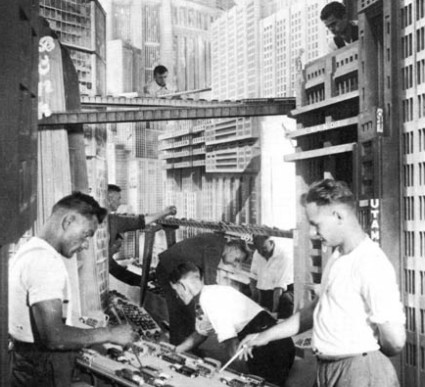
Conference image for Cinema Across Media, showing the construction of miniatures for Metropolis

Cinema Across Media: The 1920s is the title of what is promisingly advertised as the First International Berkeley Conference on Silent Cinema. It takes place 24–26 February 2011 at the University of California, Berkeley, and describes itself as follows:

Cinema’s institutional consolidation in the 1920s enlisted practitioners from many other fields and transformed the entire ensemble of established media. Avant-garde cinemas borrowed extensively from a variety of artistic practices, while the “cinematic” became the new standard for both modernist aesthetics and popular culture. Today’s multimedia environment brings cinema of the 1920s into new focus as the site of rich intermedial traffic, especially if the term “media” encompasses not only recording technologies and mass media, such as photography, phonography, radio, and illustrated press, but also the physical materials used for aesthetic expression, such as paint, print, plaster, stone, voice, and bodies.

Indeed what do they know of silent cinema who only silent cinema know. The starry line-up of plenary speakers will be Thomas Elsaesser (University of Amsterdam), Tom Gunning (University of Chicago), Gertrud Koch(Free University of Berlin), Paolo Cherchi Usai (Haghefilm Foundation) and Anthony Vidler (Cooper Union), and the full conference schedule has been issued, plus screenings (at the Pacific Film Archive Theater), as follows:

Saturday, Feb 19th

Pre-conference screening at 6.00pm of The Complete Metropolis, Fritz Lang (Germany, 1926)

Wednesday, Feb 23rd

Pre-conference screening at 7:30 pm of Rien que les heures, Alberto Cavalcanti (France, 1926)

Introduced by Anne Nesbet, Judith Rosenberg on Piano

Preceded by
Architecture d’aujourdhui (Pierre Chenal, France, 1930)
Die Neue Wohnung (Hans Richter, Switzerland, 1930)

Thursday, Feb 24th

4–5:30 pm

Tom Gunning, From the Cinema of Attractions to the Montage of Attractions: The Art of Running Film History Backwards

7–9:30 pm

Screening of L’Inhumaine (Marcel L’Herbier, 1924)
Introduction by Gertrud Koch
Judith Rosenberg on Piano

Friday, Feb 25th

9–10:30 am

Gertrud Koch, Off/On/In: Configurations of voice, body and apparatus

11 am–12:30 pm

“Local” Aesthetics and the Aesthetics of Location

Sarah Keller, Approaches to Truth: Jean Epstein and Intermedial Revelations of the 1920s

Luciana Corrêa de Araújo, Movie prologues in Rio de Janeiro (1926–1927)

Laura Isabel Serna, Picturing la patria: Ethnography, Costumbrismo, and Mexican Feature Film Production in the 1920s

The Body: Forms, Models, Constructions

Weihong Bao, Plastic Cinema, Flexible Media: Dan Duyu’s Amateur Art of Beauty and the Politics of Intermedial Embodiment in 1920s China

Kaveh Askari, Sculpture, Modeling, and Motion-Picture Craft: Promoting Rex Ingram at Metro

Mark Lynn Anderson, Deserts of Modernity: Valentino and The National Geographic

2–3:30 pm

Cinema, Light, Architecture

Megan Luke, Film-Space, Light-Architecture: Theo van Doesburg and Kurt Schwitters

Brian Jacobson, Producing Cinema and Industrial Modernity at the Cité Elgé, 1919–1929

Noam Elcott, Invisible Architectures

Media Consolidation and Conglomeration

André Gaudreault & Louis Pelletier, From Photoplays to Pictures: An Intermedial Perspective on the Names for “Moving Pictures” in the Late Silent Era

Charlie Keil, Inventing Hollywood for the 1920s

Ross Melnick, The Emergence of Convergence: Intermediality and the Convergence of Film, Broadcasting, and Music Publishing and Recording in the 1920s

4–5:30 pm

Anthony Vidler, The Promenade Architecturale: Space and Movement in 1930s Modernism from Eisenstein to Le Corbusier

7–8:45 pm

Paolo Cherchi Usai, The Unbearable Lightness of Canon: Silent Comedies in the 1920s

Pass the Gravy (Fred L. Guiol, 1928)
Springtime Saps (Les Goodwin, 1927)
Should Men Walk Home? (Leo McCarey, 1927)
Judith Rosenberg on Piano

Saturday, Feb 26th

9–11 am

Mobilizing the Archive: Projectors, Exhibitors, Industries

Plenary Roundtable

Haidee Wasson, Suitcase Cinema: The Case of the Portable Film Projector

Dino Everett, Old Dog New Tricks: Using 9.5mm films to revisit the final films of Vitagraph

Masaki Daibo, Umbilical links or discontinuities—Reconsidering the Early Japanese Sound Cinema in terms of Phonofilms

Kim Tomadjoglou, Itinerant Exhibitors Felix and Edmundo Padilla

David Wood, Sound, Colour and Intertitles in Silent Black and White Films: On Originality and Performance in 1920s Mexican Cinema

Jan-Christopher Horak, The Czech Film Industry in the 1920s: Questioning National Cinema

11:30 am–1 pm

Film Artistry and Multimedia Practice

Tami Williams, The Musicality of Gesture in the Cinema of Germaine Dulac

Oksana Bulgakowa, Eisenstein as multimedia artist, Peter Greenaway as his curator

Lucy Fischer, La Roue (The Rail), Silent Cinema and the “Wheels of Consciousness”

Theory, Performance, Fantasy

Johannes von Moltke, Classical Film Theory: A Novel

Jason McGrath, From Semiosis to Mimesis: Performance in Chinese Drama and Film Theory of the 1920s

Doron Galili & Yuri Tsivian, The Skybook: A Ubiquitous Media Fantasy

2:30–4 pm

Intermediary Zones: Film and the Avant-Gardes

Jennifer Wild, Reproductive Reception: The case of Francis—Marcel

Diane Wei Lewis, Words on Film: Avant-Garde Artist Murayama Tomoyoshi in “The Film Age”

Michael Cowan, The Moving Surface of Design: Abstraction and the Weimar Advertising Film

Sound, Aesthetics, Technology

Michael Raine, The limits of silent cinema: Ozu Yasujiro and the “neo-film sans silence”

Anupama Kapse, Song and Dance in the Indian Silent Film

Rob King, Stultification and Sensation: The Impact of Sound on the American Slapstick Tradition, 1928–1929

4:30–6:30 pm

Thomas Elsaesser, Cinema Across Media: Expanding the Avant-Garde beyond the Political Divide

Plenary Roundtable:
Thomas Elsaesser, Tom Gunning, Gertrud Koch, Paolo Cherchi Usai, Anthony Vidler

Well, that’s a heady line-up of speakers and subjects, while showing that silent film conferences are always going to have a clear advantage over any other kind of academic conference because you can get to do something like screening Pass the Gravy. It shows how dynamic the field is these days, and how much rich and genuinely international work is going, particularly looking at the interconnections between cinema and other media with which it always was so closely intertwined.

The conference site has details of speakers, locations, registration (it’s all free) and accommodation. It looks like the major event it has set out to be, and it will be very interesting to see what outputs derive from the conference and whether it does become the first in a series. If any Bioscopist is going to the conference and can report on some or all of it, do get in touch. I certainly wish I could be there – but I can’t.

The Bioscope decides

Thank you everyone for your thoughts on the direction of the Bioscope. I put the question whether it would be a good idea to expand its range beyond silent films. The balance of opinion seems to be not to do so. Of course, these are opinions from those who come to this site for its information on silent films, so there may be a slight bias there, but on careful reflection I agree with you. This is a blog about silent films, and it is best to keep it at that. Change would only be for change’s sake (which is seldom wise), and it would damage what has been built up quite carefully over four years. So we’ll stick to the brief of reporting on the world of early and silent cinema.

That said, I will start to make some excursions beyond the silent comfort zone from time to time, particularly when considering contexts and research resources. One must always bear in mind the phrase that C.L.R. James used for cricket in Beyond a Boundary, but which applies to so much else: what do they know of silent films who only silent films know? We must seek out the bigger picture, or delve behind the screen, or turn our backs on the screen sometimes and look in the other direction. Otherwise how can we say with any confidence that we know where we are?

The Bioscope wonders

Dear readers,

I have a question for you. Whither the Bioscope?

Let me explain. This blog is coming to its fourth birthday, and it is doing quite well. It gets around 6-700 visitors per day and just passed the 600,000 visitor figure overall. According to the web monitoring site Alexa it is number 1,166,704 in the ranking list of world websites. It would be good to break the 1 million barrier, and what Alexa has to say about the site’s demographic suggests things are narrower that they might be (“Based on internet averages, bioscopic.wordpress.com is visited more frequently by users who are in the age range 45-54, have no children, are graduate school educated and browse this site from home”), but on the whole it’s not bad for a site devoted to silent film – and often to corners of silent film that don’t always hold obvious interest for the dedicated few who like silent films.

However, I’ve been wondering whether it’s time for a change. I don’t just know about silent films, but though I’ve set up several other web resources, none has worked quite as well as the Bioscope, and managing six (as I currently do, plus several ancillary sites) is impractical. I would rather focus on fewer resources, and do the work better.

But as I’ve thought about change, I’ve been wary of spoiling a modestly successful model. It’s always good policy to keep to a clear theme, and straying beyond silent films could weaken the site’s impact and let down the existing audience that the site gets. On the other hand, I find myself again and again highlighting web resources of value to research (a speciality of this site) and artificially limiting what I say about them to silent films. It should be possible to widen the site’s frame of reference while keeping to its principle of encouraging discovery.

I’m not proposing a blog that’s about my personal interests. That would be tedious. So I wouldn’t go on about politics or what film I saw last night (The King’s Speech – not bad, I guess). It would be about art, culture, social history and research, and I’m fairly sure 80% of it would remain about silent films, because that’s what I know and there’s a lot to said about them that doesn’t get said elsewhere. It would be mostly about film, because it’s a great medium. But it would reach beyond to film and its contexts, and that’s something that was in my mind when I first imagined what this site might be, only it turned into something else. It something to do with the original definition of ‘bioscope’ as “a view of life or survey of life“, as a motion picture camera might observe it.

If I were to do this, I would have to reorganise the site somewhat so that the silent film resources it has built up (Library, Festivals, Videos etc) remain available. In particular I would need to maintain the links down the right-hand column which I know get used as a reference source in themselves. I might have to stay my hand simply to avoid damaging what exists and is useful.

I’m torn. I feel the need to move on and avoid repeating myself (which I’ve started to do in places). At the same time I know the importance of a clear message and the danger of spoiling what works, reasonably well.

So I would welcome your advice. What do you think? I know it’s my blog and if I want to change tack and make it a site about tree-frogs then I’m completely at liberty to do so. But the site was created to be useful, and I want to continue to be useful. Your advice, please.

Respectfully yours

Luke

(The image at the head of this post comes from the title page of Granville Penn’s The Bioscope, or Dial of Life, published in 1812)

Cricket on camera

Highlights from the Topical Budget newsreel of England beating Australia in the Fifth Test at Lords in 1926, thereby winning back the Ashes

Here in England the skies are grey, and when it’s not raining it’s sleeting and a cold wind blows. And yet there is a spring in our steps and sunshine in our hearts. We have beaten the Australians. For anyone outside the few countries that take cricket seriously, the news that England has won the Ashes – the name given to the periodic series of Test matches played between England and Australia – cannot mean anything much. But here in England it is glorious news, all the more so because the victory was in Australia (where four years ago Australia won 5-0), because it is so rare (the last time we won there was 25 years ago), and because it was done with such ruthless professionalism, which are not words always associated with English cricket. Damn it all, we played like Australians.

So how can the Bioscope – whose scribe is somewhat partial to the game – commemorate this great event? Well, how else but with a survey of cricket and silent film? There’s a rich history there, and some fine films to discover online, if you know where to look.


Cricket is not a game that lends itself easily to the motion picture camera, particularly for the era of silent film. Games can last up to five days, the action takes places at a distance in the middle of a large field, there are long stretches where nothing dynamic happens. For cameramen shooting with expensive film stock, and with limited lenses, cricket in the early years of film presented a huge challenge. It is no surprise to find that the earliest cricket films focus on individuals and illustrations of play specially set up for the cameras. In the 1910s and especially the 1920s greater efforts were made to capture periods of play, with remarkable success given the circumstances.

Arguably the first British film was a cricket film, since a test film made by pioneers Birt Acres and Robert Paul in February/March 1895 showed their colleague Henry Short dressed in cricket whites outside Acres’ London home (the film, of which a few frames survive, is variously known as Incident at Clovelly Cottage or Cricketer Jumping Over Garden Gate). However, the first true cricket films were made in 1897, and there is something particularly hallowed about those films from the 1890s which capture the end of the great Victorian sporting era. The first films were a set made by Australian photographer Henry Walter Barnett in December 1897 at the time of the England v Australia Test match in Sydney. Using a Lumière Cinématographe, Barnett filmed scenes of the England and Australia teams coming off the field of play and the English player (albeit Indian) Prince Ranjitsinhji shown practising in the nets. It shows the great stylist of his age going through a series of typically aggressive strokes, filmed from a position to the batsman’s right and of course far closer to the batsman than could have been possible were Barnett filming actual play. When the film was exhibited in Britain it was accompanied by sound effects of ball hitting bat, and when the film is shown today (it is the only one of the set to survive) the sound effect is faithfully reproduced.

W.G. Grace practising at Hastings in 1901, from BFI National Archive

The great figure of Victorian cricket was W.G. Grace, and he was a popular subject for filmmakers who looked to capture his celebrity as much as his play. Three films survive: and three films survive. Dr Grace’s Jubilee Procession, filmed by the Prestwich Manufacturing Company on 18 July 1898 on the occasion of the Gentlemen v Players match celebrating Grace’s 50th birthday at Lords shows a parade of cricketing legends passing by the camera: Grace himself, Arthur Shrewsbury, Andrew Stoddart, William Gunn, Arthur Lilley, Samuel Woods, Robert Abel, Edward Wynard, F.S. Jackson, J.T. Hearne, Gregor MacGregor, John A. Dixon, William Storer, William Lockwood, A.C. MacLaren, William Brockwell, Charles Townsend, Schofield Haigh, Alec Hearne, John Mason, Wilfred Rhodes, Charles Kortright and John Tunnicliffe – it’s practically the entire Victorian age of cricket captured in one fifty-foot film (the film can be found on the British Movietone site, albeit printed the wrong way round, though you need register beforehand). Film also exists of Grace in June 1899 walking past the camera, accompanied by Ranjitsinhji, at Trent Bridge on the occasion of the first Test v Australia. There is just the one film of Grace in action, filmed by Williamson in 1901, again in the company of Ranjitsinhji (clearly a popular subject for filmmakers) practising batting in the nets at Hastings in September 1901.

Other films exist of this period of the Australian team in England walking past the 70mm camera of the Biograph company, somewhere in England in 1899 (those on display are Joe Darling, Victor Trumper, Ernie Jones, Hugh Trumble, James Kelly, Frank Iredale and Frank Laver), and second Biograph film, Ranjitsinhji and C.B. Fry at the Wickets, made in 1901, which shows the two greats batting on the field of play in a sequence which clearly had to be set up, as the camera is postioned close to the action. But we must shed a tear for the films of this period whose descriptions we have but which are now considered lost. Just imagine, oh cricket lovers, what would be if we could see this set of Biograph films from the legendary 1902 Test match between England and Australia, as described in a theatre programme:

England versus Australia at the Oval:

(a) Return to the Pavilion after close of Australia’s 2nd innings
(b) Australians going to field for England’s 2nd innings
(c) Jessop batting
(d) Hirst plays Trumble
(e) Rhodes drives Trumble

Now there’s a holy grail for the cricket film archivist.

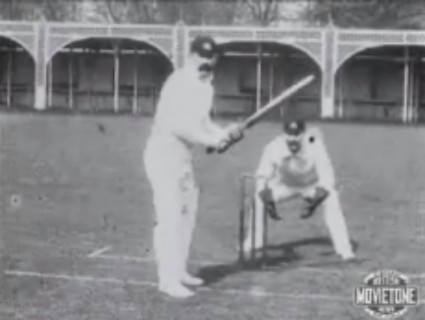
Joe Darling (batsman) and James Kelly (wicketkeeper) from 1905 film of the Australian team. Note the regulation fearsome moustaches. From www.movietone.com

It is at this point in cricket film history, however, that the available archive starts to lessen. As films started to get a little longer, ironically it became more of a challenge to film cricket, because short portrait shots were no longer enough, while films of five minutes or more struggled to capture anything of the game, or – presumably – to find an audience keen to seen such films. Combined with the usual losses to history of films from this period anyway, and there are sadly few film records of cricket 1900-1910. The most substantial is to be found in a renowned 1931 early sound film called That’s Cricket!, made by Australasian films, which has a section showing the 1905 Australians, showing Joe Darling, Sydney Gregory, Frank Laver, Warwick Armstrong, Tibby Cotter, James Kelly, Albert Hopkins, Clem Hill, Alfred Noble, Reginald Duff, Charlie McLeod and others, posing for the cameras and at practice. The 1905 film (some seven minutes of it) can also be found on the British Movietone site (again, you need to register first with the site to use it, but it is free). A much shorter version is also on the British Pathé newsreel site. Who originally produced I have not been able to find out.

Mitchell & Kenyon’s Arthur Mold Bowling to A.N. Hornby (1901)

However, in the 1900s there were attempts to provide local coverage of cricket matches; that is, films which would appeal to the audience of a particular town or county instead of aiming for a national audience. The Yorkshire filmmaker Jasper Redfern made a number of such films (he probably made the film of W.G. Grace at Trent Bridge but otherwise none of his cricket films are known to survive). Mitchell & Kenyon, now well-known for their actuality records of Edwardian life chiefly in northern England, regularly filmed cricket matches, though as with their football films the emphasis was on the crowds and the occasion as much as the play. An exception is the intriguing film illustrated above, showing Lancashire bowler A.H. Mold attempting to demonstrate that his controversial bowling action was legitimate (it looks OK to me), a very early example of a film being set up as evidence in a dispute. The batsman is A.N. Hornby.

The film record is not that much better for the 1910s, partly because the intervention of the First World War meant a lot less top class cricket and consequently far fewer cricket films. The newsreels were still finding their feet as a form, and they did not really take up the challenge of filming cricket at this period. A number of films from the teens exist at the BFI National Archive, while some interesting examples are held British Pathé, available to view on their site (do note that Pathé’s dating of these films is very approximate):

Sometimes films can be found which are no longer films. I’ve previously posted on film strips to be found in a cricket instructional book, A.C. MacLaren’s The Perfect Batsman: J.B. Hobbs in Action. Though published in 1925, the films of Hobbs it uses were made in 1914 by Cherry Kearton Ltd. It’s not the same film as appears on the British Pathé site, noted above. I’ve re-animated the clips, albeit crudely, and have placed two sequences on YouTube, adding a small something to the meagre archive of cricket films in the 1910s.

Re-animated plates 2, 8 and 10 from The Perfect Batsman: J.B. Hobbs in Action, showing Hobbs in 1914

Plates 3, 6 and 9 from The Perfect Batsman

It is when we get to the 1920s that the cricket film record starts to become very rich indeed. The British newsreels started to cover the game avidly, sometimes county games but especially Test matches. The films were not long – generally two or three minutes at most, and thus had huge challenges trying to document a day or more’s sport in such a tiny space. And yet they did, with a good amount of skill, luck and sleight of hand.

The Topical Budget newsreel film at the top of this post from 1926, when England regained the Ashes from Australia after fourteen years (and humiliation five years earlier in 1921), is a good example. It shows the procession of Australian wickets at the Oval ground on the final day’s play, neatly cutting between action on the pitch and the scoreboard. Sometimes the camera encompasses both the bowler and the batsman in the single shot, so that we know we are witnessing a complete action. More often, however, we see the bowler, then there is a cut to the batsman playing the shot. Most of the time the ball the batsman plays is not the bowl that we saw bowled to him in the previous shot. The art of editing to make us believe what the filmmaker wants us to believe extends beyond the fiction film. With up to ten wickets scheduled to fall in an innings that lasts several hours, it was an impossible for a cameraman with a few hundred feet of film at his disposal to capture every one. The film shows on a number of occasions a ball bowled, then a batsman walking away disconsonantly, without showing us how he got out. Remarkably on a couple of occasions we do see the actual fall of a wicket – a triumph for the quick-witted cameraman.

The newsreels dramatise cricket as much as they document it. The films are composed as battles; the assault by the one side with the ball, the response by the other wielding the bat. The Oval Test film expresses in its construction the pressure exerted by the England team’s bowling and the crumbling of the Australian resistance, cultminating in the joyous invasion of the crowd (no such scenes allowed these days) at the film’s climax. It is a triumphal film about a sporting triumph.

There are hundreds of British newsreels of cricket available to view online, on the British Pathé and ITN Source sites. For Pathé, click on the Advanced Search option, type ‘cricket’ into the Description box, then select 1920s from the Decades option lower down the screen. There are some 200 films available. For ITN Source, click on Advanced Search, type ‘cricket’ into the search box, tick the box marked New Classics, then select 1920s as the decade – there are 58 results. For anyone who knows their cricket history (and it was a golden period for cricket – Hobbs, Sutcliffe, Rhodes, Gregory, Grimmett, Woodfull, Woolley, Hendren, Bardsley, hammond, then in 1930 the arrival of the phenomenon that was Don Bradman), there are such riches to be found.

A blatant recreation of Hobbs hitting the runs by which he achieved his 126th century, from The Life of Jack Hobbs, from http://www.britishpathe.com

And it’s not all newsreels. There are training films, interviews (silent ones), and longer films. British Pathé has one of the most notable longer cricket films of the period, The Life of Jack Hobbs (1925), a biographical documentary of England’s greatest batsman of the period (or arguably any other period). The film shows Hobbs relaxing at home, demonstrating shots, playing in games, and securing his famous 126th century, thereby beating a record set by W.G. Grace. The film is available in four reels – one, two and three plus offcuts. It doggedly follows Hobbs round the country while he kept on not quite scoring the 100 runs the nation was willing him to score, before he did so at Taunton. The film captures the moment, but also gets Hobbs to recreate the shot in close-up with the camera hanging right over him mid-pitch.

This illustrates the degree to which cricketers were willing to co-operate with the cameras to show themselves to their best advantage. Hobbs had signed an exclusive deal with United International Corporation, producers of the film, and in his autobiography he has some interesting things to say about working with film companies as the price of fame.

The largest collection of cricket films from the silent era is that held by the BFI National Archive, which holds the Topical Budget newsreel, something of a cricket specialist, plus amateur films, documentaries, local topicals, animation films and advertisements. The BFI also holds one or two fiction films with a cricket film. The 1925 feature film A Daughter of Love features a cricketing hero (played by John Stuart) whose marriage at the end of the film sees the happy couple process between two lines of cricketers with their bats raised to form a row of arches. Just a few of the BFI’s cricket films are available online, alas, a couple of them included here.

The other major source of cricket films from this period is Australia, of course. There are twenty-five silent era cricket films given on the catalogue of the National Film and Sound Archive of Australia, and clips from a number of these can be seen on the excellent australian screen site. Here are some examples:

Just last month the NFSA unveiled a new digital master of the earliest known surviving film of test cricket action in Australia, filmed in December 1910 by Pathé’s Animated Gazette at the Sydney Cricket Ground when they were playing South Africa. Tantalisingly brief, it does at least show good camera positioning at an angle to the pitch to impart the right amount of dynamism.

South Africa v Australia, 9 December 1910. The film is described in loving detail on the NFSA blog

For a number of years I used to programme cricket films at the National Film Theatre in London. Others more expert than I would present the films on the stage, talking through the films and identifying every player, while noted cricketers from not quite such bygone ages sat in the audience and everyone sighed nostalgically for an era when giants seemed to walk the pitches of England, when times were nobler, the game was better played, and everyone shown in monochrome was so much greater than those wretched souls who toiled so desperately for England in the real world. I’ve never cared so much for a nostalgia which always places the past above the present, and believe firmly that the present generation of players would very probably humble the greats of yesteryear were they ever able somehow to have the two compete on the pitch.

But very fleeting nature of the early cricket film records enhances the greatness somehow. The sturdiness of a Hobbs off-drive, the beguiling spin of Clarrie Grimmett, the stylish nonchalance of Ranjitsinhji, the imperious confidence of W.G. Grace – so little of them survives on film, yet what is there, played over and over again, encapsulates the legend. We see just enough to have the tale told. Film is a romantic medium, and actuality film can sometimes be the most romantic of all.

For your diaries

Audience at the Pordenone silent film festival

In case you hadn’t noticed, 2011 is upon us, and in case you are wondering how you are going to fill it with worthwhile cultural activities, here’s what the year ahead holds for us in the way of silent film festivals, conferences and such like. Information on these is (or will be in due course) given in greater detail in the Bioscope’s Conferences and Festivals sections, while a summary listing of all events coming up is maintained in the Calendar section.

Things kick off in January with Slapstick, the annual festival of slapstick film celebrated in Bristol, UK. This year’s event takes place 27th-30th and features the usual mix of silent comedy greats (Chaplin, Keaton, Langdon) alongside live comedians of today (Neil Innes, Graeme Garden, Barry Cryer) – plus Kevin Brownlow and Shaun the Sheep (sadly not at the same time). The StummFilmMusikTage Erlangen is a festival of silent film music held in Erlangen, Germany. The 2011 festival dates haven’t been announced as yet, but they always seem to leave it to the last minute.

February sees the San Francisco Silent film Festival’s Annual Winter Event on the 12th. The Kansas Silent Film Festival is held annually in Topeka, Kansas. This year’s festival takes place 25th-27th and has as its special guest Harold Lloyd authority Annette D’Agostino Lloyd. Films to be featured include Speedy, Chang and Wings. The august-sounding First International Berkeley Conference on Silent Cinema will be held at Berkeley, University of California, 24th-26th on the theme Cinema Across Media: The 1920s.

It’s all happening in March. We have the annual Cinefest, at Syracuse, New York, scheduled for 17th-20th, programme to be announced. The enterprising Killruddery Silent Film Festival takes place 10th-13th in Bray, Ireland, though the website is still showing the 2010 programme. A new silent film festival makes its appearance this month. The Hippodrome Festival of Silent Cinema, billed as Scotland’s first, will held in Bo’ness, 18-20 March. More news on this nearer the time. Over 24th-27th there’s the small Festival du film muet held at the Café-Théâtre Barnabé, Servion, Switzerland. Starting in March (30th) and ending in April (7th) is the Toronto Silent Film Festival, now in its second year, with Maciste all’Inferno (126), Faust (1926), It (1927) and more on the bill. For the specialist, The Construction of News in Early Cinema is a seminar (conference really) being organised by the Museu del Cinema and the University of Girona, Spain, 31st March-1st April. Expect a report from the Bioscope on this, as I’m a guest speaker.

April sees the British Silent Film Festival, which returns to the Barbican in London 7th-10th with the theme Going to the Movies – Music, Sound and the British Silent Film. It takes place in conjunction with the Sounds of Early Cinema in Britain conference taking place 7th-8th at the Institute of Musical Research and the Barbican. Doing Women’s Film History: Reframing Cinema History is a conference with a strong silent cinema element taking place 13th-15th at the University of Sunderland, UK.

In May there’s the classic film convention Cinevent, held as always in Columbus, Ohio. 2010’s convention takes place 27th-30th, which promises such titles as The Passing of the Third Floor Back (1918), Dick Turpin (1925) and The Sky Pilot (1921).

In June we have the festival of silent cinema held annually at Hautes-Pyrénées, France, the Festival d’Anères, usually held in May but now shifting to June 8th-12th. No programme details as yet. In Bologna, Italy there is Il Cinema Ritrovato, the outstanding festival of restored films (always with a strong silent element). No dates or details of the programme have not been released as yet. The Broncho Billy Silent Film Festival will be held at Fremont, California in June, but again no dates yet.

July sees The Second Birth of Cinema: A Centenary Conference, to be held over 1st-2nd at Newcastle University, UK. André Gaudreault, Philippe Marion, Joe Kember and the ubiquitous Ian Christie are promised as keynote speakers. San Francisco hosts the San Francisco Silent Film Festival, this year over 14th-17th. Expect programme information in May. Slapsticon is the annual festival of silent and early sound film comedy, held in Arlington, Virginia, which this year is 14th-17th. Or there should be the International Silent Film Festival, a festival of classic silent films held each July in Manila – no dates or programme available as yet. One of the impressively-programmed silent film festivals of last year was StummfilmLiveFestival, held by the Babylon Kino, Berlin. This year’s festival runs 16th-31st and promises to be just as eye-catching with a complete retrospective of Charlie Chaplin’s films.

Then there’s August, which gives us New York’s Capitolfest, its annual summer classic and silent movie festival, taking place 13th-14th. Janet Gaynor is the featured star. Aosta in the Italian Alps hosts Strade del Cinema, a silent film festival with a strong emphasis on musical acompaniment (no exact dates or programme released as yet – they invariably leave things until the last minute). In São Paulo, Brazil there’s the always very good Jornada Brasileira de Cinema Silencioso, a silent film festival now in its fifth year (no exact dates or programme details as yet). It’s a busy month and Bonn in Germany will have its Bonner Sommerkino, a festival of silent film which is yearly growing in importance, this year taking place 11th-21st.

September kicks off with Cinecon, the annual classic film festival held in Hollywood, which runs 1st-5th, followed closely by Finland’s Forssa Silent Film Festival, also known as Mykkäelokuvafestivaalit, which takes place 2nd-3rd. The charming Opitiki Silent Film Festival will be held this month in Opitiki, New Zealand. Over 22nd-25th there’s the silent and early sound film festival Cinesation in Massillon, Ohio, USA, while over the 23rd-24th we have the Annual Buster Keaton Celebration, the Buster Keaton-themed festival held in Iola, Kansas. Silents of a different, modern kind feature in the Toronto Urban Film Festival, a public film festival of one-minute silent films held in Toronto, Canada. No dates as yet.

October is of course Pordenone month. The Giornate del Cinema Muto, or Pordenone Silent Film Festival, takes place in Pordenone, northern Italy, and in 2010 runs 1st-8th. So far we’re promised The Wind with live orchestra conducted by Carl Davis. The queues are probably forming already. Also in October, but no dates or programme announced as yet, should be Australia's Silent Film Festival, held in Sydney.

I don’t have much information on them, having not covered them before now, but November should see the Bielefelder Film+MusikFest in Germany and December is the time for Poland’s Festival of Silent Films, held in Krakow and organised by Kino Pod Baranami. Both seem to be well-established annual festivals.


If you know of other festivals or conferences I should be including, please me know through the comments. I’ll be adding new events (or updated information) to the Conferences and Festivals sections in any case, and will publicise individual events nearer to their start times in any case. Of course, silents turn up as special screenings in other kinds of festival, such as the London Film Festival and Telluride Film Festival, but I’ve kept this listing to those events largely dedicated to silent films themselves. Such festivals and conferences are a labour of love and a huge challenge to put on, logistically and financially, particularly in these difficult times – do support them if you can.