Looking back on 2011

News in 2011, clockwise from top left: The White Shadow, The Artist, A Trip to the Moon in colour, Brides of Sulu

And so we come to the end of another year, and for the Bioscope it is time to look back on another year reporting on the world of early and silent film. Over the twelve months we have written some 180 posts posts, or well nigh 100,000 words, documenting a year that has been as eventful a one for silent films as we can remember, chiefly due to the timeless 150-year-old Georges Méliès and to the popular discovery of the modern silent film thanks to The Artist. So let’s look back on 2011.

Ben Kingsley as Georges Méliès in Hugo

Georges Méliès has been the man of the year. Things kicked off in May with the premiere at Cannes of the coloured version of Le voyage dans la lune / A Trip to the Moon (1902), marvellously, indeed miraculously restored by Lobster Films. The film has been given five star publicity treatment, with an excellent promotional book, a new score by French band Air which has upset some but pleased us when we saw it at Pordenone, a documentary The Extraordinary Voyage, and the use of clips from the film in Hugo, released in November. For, yes, the other big event in Méliès’ 150th year was Martin Scorsese’s 3D version of Brian Selznick’s children’s novel The Invention of Hugo Cabret, in which Méliès is a leading character. Ben Kingsley bring the man convincingly to life, and the film thrillingly recreates the Méliès studio as it pleads for us all to understand our film history. The Bioscope thought the rest of the film was pretty dire, to be honest, though in this it seems to be in a minority. But just because a film pleads the cause of film doesn’t make it a good film …

And there was more from Georges, with his great-great-grandaughter Pauline Duclaud-Lacoste Méliès producing an official website, Matthew Solomon’s edited volume Fantastic Voyages of the Cinematic Imagination: Georges Méliès’s Trip to the Moon (with DVD extra), a conference that took place in July, and a three-disc DVD set from Studio Canal.

For the Bioscope itself things have been eventful. In January we thought a bit about changing the site radically, then thought better of this. There was our move to New Bioscope Towers in May, the addition of a Bioscope Vimeo channel for videos we embed from that excellent site, and the recent introduction of our daily news service courtesy of Scoop It! We kicked off the year with a post on the centenary of the ever-topical Siege of Sidney Street, an important event in newsreel history, and ended it with another major news event now largely forgotten, the Delhi Durbar. Anarchists win out over imperialists is the verdict of history.
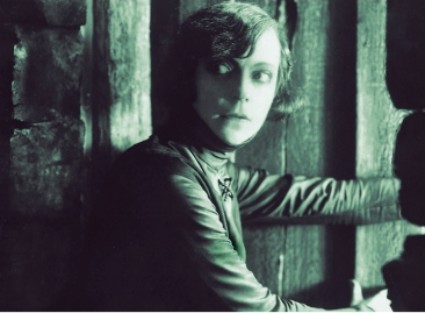
Asta Nielsen in Hamlet

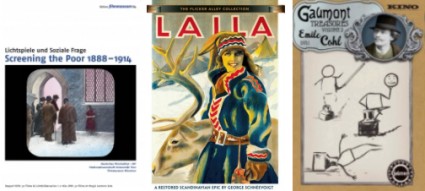
We were blessed with a number of great DVD and Blu-Ray releases, with multi-DVD and boxed sets being very much in favour. Among those that caught the eye and emptied the wallet were Edition Filmmuseum’s Max Davidson Comedies, the same company’s collection of early film and magic lantern slide sets Screening the Poor and the National Film Preservation Foundation’s five disc set Treasures 5: The West, 1898-1938. Individual release of the year was Edition Filmmuseum’s Hamlet (Germany 1920), with Asta Nielsen and a fine new music score (Flicker Alley’s Norwegian surprise Laila just loses out because theatre organ scores cause us deep pain).

We recently produced a round-up of the best silent film publications of 2011, including such titles as Bryony Dixon’s 100 Silent Films, Andrew Shail’s Reading the Cinematograph: The Cinema in British Short Fiction 1896-1912 and John Bengston’s Silent Visions: Discovering Early Hollywood and New York Through the Films of Harold Lloyd. But we should note also Susan Orlean’s cultural history Rin Tin Tin: The Life and the Legend, which has made quite an impact in the USA, though we’ve not read it ourselves as yet.

There were all the usual festivals, with Bologna championing Conrad Veidt, Boris Barnet and Alice Guy, and Pordenone giving us Soviets, Soviet Georgians, polar explorers and Michael Curtiz. We produced our traditional detailed diaries for each of the eight days of the festival. But it was particularly pleasing to see new ventures turning up, including the Hippodrome Festival of Silent Cinema in Scotland, which launched in February and is due back in 2012. Babylon Kino in Berlin continued to make programming waves with its complete Chaplin retropective in July. Sadly, the hardy annual Slapsticon was cancelled this year – we hope it returns in a healthy state next year.

The Artist (yet again)

2011 was the year when the modern silent film hit the headlines, the The Artist enchanting all-comers at Cannes and now being touted for the Academy Award best picture. We have lost count of the number of articles written recently about a revival of interest in silent films, and their superiority in so many respects to the films of today. Jaded eyes are looking back to a (supposedly) gentler age, it seems. We’ve not seen it yet, so judgement is reserved for the time being. Here, we’ve long championed the modern silent, though our March post on Mr Bean was one of the least-read that we’ve penned in some while.

Among the year’s conferences on silent film themes there was the First International Berkeley Conference on Silent Cinema held in February; the Construction of News in Early Cinema in Girona in March, which we attended and from which we first experimented with live blogging; the opportunistically themed The Second Birth of Cinema: A Centenary Conference held in Newcastle, UK in July; and Importing Asta Nielsen: Cinema-Going and the Making of the Star System in the Early 1910s, held in Frankfurt in September.

In the blogging world, sadly we said goodbye to Christopher Snowden’s The Silent Movie Blog in February – a reminder that we bloggers are mostly doing this for love, but time and its many demands do sometimes call us away to do other things. However, we said hello to John Bengston’s very welcome Silent Locations, on the real locations behind the great silent comedies. Interesting new websites inclued Roland-François Lack’s visually stunning and intellectually intriguing The Cine-Tourist, and the Turconi Project, a collection of digitised frames for early silents collected by the Swiss priest Joseph Joye.

The Bioscope always has a keen eye for new online research resources, and this was a year when portals that bring together several databases started to dominate the landscape. The single institution is no longer in a position to pronounce itself to be the repository of all knowledge; in the digital age we are seeing supra-institutional models emerging. Those we commented on included the Canadiana Discovery Portal, the UK research services Connected Histories and JISC Media Hub, UK film’s archives’ Search Your Film Archives, and the directory of world archives ArchiveGrid. We made a special feature of the European Film Gateway, from whose launch event we blogged live and (hopefully) in lively fashion.
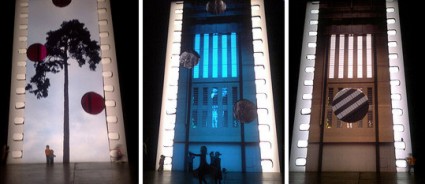
Images of Tacita Dean’s artwork ‘Film’ at Tate Modern

We also speculated here and there on the future of film archives in this digital age, particularly when we attended the Screening the Future event in Hilversum in March, and then the UK Screen Heritage Strategy, whose various outputs were announced in September. We mused upon media and history when we attended the Iamhist conference in Copenhagen (it’s been a jet-setting year), philosophizing on the role of historians in making history in another bout of live blogging (something we hope to pursue further in 2012). 2011 was the year when everyone wrote their obituaries for celluloid. The Bioscope sat on the fence when considering the issue in November, on the occasion of Tacita Dean’s installation ‘Film’ at Tate Modern – but its face was looking out towards digital.

Significant web video sources launched this year included the idiosyncractic YouTube channel of Huntley Film Archives, the Swedish Filmarkivet.se, the Thanhouser film company’s Vimeo channel, and George Eastman House’s online cinematheque; while we delighted in some of the ingenious one-second videos produced for a Montblanc watches competition in November.

It was a year when digitised film journals made a huge leap forward, from occasional sighting to major player in the online film research world, with the official launch of the Media History Digital Library. Its outputs led to Bioscope reports on film industry year books, seven years of Film Daily (1922-1929) and the MHDL itself. “This is the new research library” we said, and we think we’re right. Another important new online resource was the Swiss journal Kinema, for the period 1913-1919.

It has also been a year in which 3D encroached itself upon the silent film world. The aforementioned Hugo somewhat alarmingly gives us not only Méliès films in 3D, but those of the Lumière brothers, and film of First World War soldiers (colourised to boot). The clock-face sequence from Harold Lloyd’s Safety Last (also featured in Hugo) was converted to 3D and colourised, much to some people’s disgust; while news in November that Chaplin’s films were to be converted into 3D for a documentary alarmed and intrigued in equal measure.
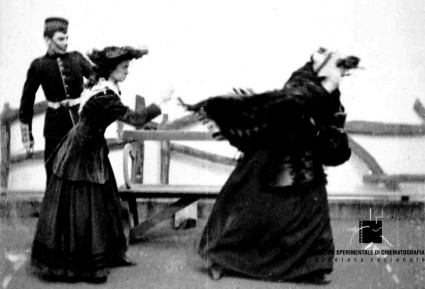
The Soldier’s Courtship

Film discovery of the year? The one that grabbed all the headlines – though many of them were misleading ones – was The White Shadow (1923), three reels of which turned up in New Zealand. Normally an incomplete British silent directed by Graham Cutts wouldn’t set too many pulses running, but it was assistant director Alfred Hitchcock who attracted all the attention. Too many journalists and bloggers put the story ahead of the history, though one does understand why. But for us the year’s top discovery was Robert Paul’s The Soldier’s Courtship (1896), the first British fiction film made for projection, which was uncovered in Rome and unveiled in Pordenone. It may be just a minute long, but it is a perky delight, with a great history behind its production and restoration.

Another discovery was not of a lost film but rather a buried one. Philippine archivists found that an obscure mid-1930s American B-feature, Brides of Sulu, was in all probability made out of one, if not two, otherwise lost Philippines silents, Princess Tarhata and The Moro Pirate. No Philippine silent fiction film was known have survived before now, which makes this a particularly happy discovery, shown at Manila’s International Silent film Festival in August. The Bioscope post and its comments unravel the mystery.

Among the year’s film restorations, those that caught the eye were those that were most keenly promoted using online media. They included The First Born (UK 1928), Ernst Lubistch’s Das Weib des Pharao (Germany 1922) and the Pola Negri star vehicle Mania (Germany 1918).

Some interesting news items throughout the year included the discovery of unique (?) film of the Ballet Russes in the British Pathé archive in February; in April Google added a ‘1911’ button to YouTube to let users ‘age’ their videos by 100 years (a joke that backfired somewhat) then in the same month gave us a faux Chaplin film as its logo for the day; in May the much-hyped film discovery Zepped (a 1916 animation with some Chaplin outtakes) was put up for auction in hope of a six-figure sum, which to few people’s surprise it signally failed to achieve; and in July there was the discovery of a large collection of generic silent film scores in Birmingham Library.

Barbara Kent

And we said goodbye to some people. The main person we lost from the silent era itself was Barbara Kent, star of Flesh and the Devil and Lonesome, who made it to 103. Others whose parting we noted were the scholar Miriam Hansen; social critic and author of the novel Flicker Theodore Roszak; the founder of Project Gutenberg, Michael Hart; and the essayist and cinéaste Gilbert Adair.

Finally, there were those ruminative or informational Bioscope posts which we found it interesting to compile over the year. They include a survey of cricket and silent film; thoughts on colour and early cinema; a survey of digitised newspaper collections, an investigation into the little-known history of the cinema-novel, the simple but so inventive Phonotrope animations of Jim Le Fevre and others, thoughts on the not-so-new notion of 48 frames per second, the amateur productions of Dorothea Mitchell, the first aviation films, on silent films shown silently, and on videos of the brain activity of those who have been watching films.

As always, we continue to range widely in our themes and interests, seeing silent cinema not just for its own sake but as a means to look out upon the world in general. “A view of life or survey of life” is how the dictionary defines the word ‘bioscope’ in its original use. We aim to continue doing so in 2012.

Slapstick hits the spot

http://www.slapstick.org.uk

Bristol’s annual Slapstick festival returns in January, with its tried and tested mixture of classic silent comedy and today’s TV and radio comedians making a crowd-pleasing combination. The festival runs 26-29 January 2012, with a pre-event on the 21st. Here are the programme details:

Saturday 21 January 2012 – pre-festival event

Les Bubb’s Silent Slapstick Funnies PG with Les Bubb

1300hrs, Venue: Watershed, Cinema 1 £4.60/£3.60 concs

Discover the delights of Charles Chaplin, Buster Keaton, Laurel & Hardy and Snub Pollard with a little help from world-renowned visual comedy performer and choreographer Les Bubb, with live piano accompaniment by Stephen Horne.

+ Cinekids: Slapstick Workshop with Les Bubb 8 – 12 years-olds

1500hrs – 1630hrs, Venue: Watershed Waterside 3 £2 per child

Ever wondered how silent comedy clowns make you laugh so much? After the Slaptick’s Silent Funnies screening, join international visual comedy performer Les Bubb for an action packed workshop to explore (and practice!) some of the techniques used by the silent comedy clowns. Wear comfy clothing and prepare for lots of laughter and some falling over.

Thursday 26 January 2012

Buster Keaton: Brownlow and Garden

1740hrs £7.20/£5.60, Venue: Watershed, Cinema 1

The first of two exceptional events dedicated to “The Great Stone Face”, hosted by Oscar-winner Kevin Brownlow, here in conversation with fellow-enthusiast Graeme Garden (of The Goodies and Sorry I Haven’t a Clue). Rare film illustrations recall Brownlow’s meetings with Keaton in the 1960s, his restoration of The General, and collaboration with David Gill on the definitive Keaton documentary, A Hard Act to Follow.

“Stupid Boy!”: Celebrating Dad’s Army with Ian Lavender
An Audience with Private Pike

1930hrs £16/£14, Venue: Hall 2 (Colston Hall)

A unique chance to hear Ian Lavender discuss in his own words what it was like being in one of the UK’s favourite comedies and playing one of our best loved comedy characters – Private Pike in Dad’s Army.

Ian comes to Bristol’s Slapstick Festival with stories of his time on the Dad’s Army set.

Ian will be onstage with writer/broadcaster Matthew Sweet and the evening will include favourite clips from Dad’s Army, a showing of a complete episode, music – and more. Plus there’s a special questions and answers session where you get the chance to ask Ian a question.

A delightful evening of family entertainment in celebration of one of our best loved television series.

Friday 27 January 2012

The Clown Princes

1400hrs Venue: Arnolfini £7/£5.50

Chaplin, Buster Keaton & Harold Lloyd were the undisputed kings of silent comedy – or were they?

Thousands more comedies were made in the silent era starring many, many more comedians. Some even rivalled the top names and occasionally surpassed them in the laughter stakes.

David Wyatt presents his selection of some of the finest and funniest; Charley Chase, Lloyd Hamilton, Max Davidson & Larry Semon among them. For those with Keaton withdrawal symptoms though, Buster may make a surprise appearance (or two?).

Buster Keaton: “A Hard Act to Follow” with Kevin Brownlow

1600hrs Venue: Watershed, Cinema 3 £7.20/£5.60

Kevin Brownlow presents documentary footage to illustrate his work, experiences and encounters in filming the definitive Keaton documentary A Hard Act to Follow (1986) with its spectacular sequences recreating the filming of the collapsing railway bridge in The General – the most elaborate scene in all silent comedy. A unique opportunity to discover the creative methods of one of the greatest figures of film comedy, through the eyes of the world’s most honoured film historian.

Griff Rhys Jones: Silent Comedy Spectacular
A star-studded evening of classic comedy featuring Buster Keaton’s masterpiece The General (1926)

Special guest host Griff Rhys Jones

1930hrs Venue: Colston Hall £18/£16/£8

Slapstick festival’s annual silent comedy gala presents three comic masterpieces celebrating the great silent comedians of yesteryear. Hosted by the inimitable comic actor and writer Griff Rhys Jones plus ‘master of ceremonies’ Chris Serle.

Buster Keaton’s The General (1926) is considered an undisputed masterpiece of cinema. Set in the American Civil War, Buster Keaton plays Jonnie Gray unable to enlist in the Confederate army because he is needed as a railroad engineer. His sweetheart, who thinks he’s a coward, won’t talk to him until he’s in uniform. Plus Laurel & Hardy in The Finishing Touch (1928) and Charlie Chaplin in The Adventurer (1916).

The World Premiere of a new score for The General will be conducted by Guenter A. Buchwald and performed by The European Silent Screen Virtuosi and Bristol Ensemble. Plus music from The Matinee Idles (featuring Paul McGann).

Saturday 28 January 2012

Charles Chaplin: Bridging Three Centuries

With David Robinson

0930hrs Venue: Arnolfini £7/£5.50

David Robinson is recognised as the definitive biographer and a world expert on Chaplin. In this presentation, richly illustrated with film and rare stills, he considers the phenomenon of an artist who was already on stage in the 19th century, became the most universally recognised personality of the 20th century; and in the 21st century still maintains his power as human symbol and supreme entertainer.

Since his definitive 1985 biography Chaplin: His Life and Art, David Robinson has been recognised as a world expert on the great comedian. In this presentation, richly illustrated with film and rare stills, he considers the phenomenon of an artist who was already at work as a stage artist in the 19th century, was to become the most universally recognised personality of the 20th century; and in the 21st century maintains his power, both as symbol and supreme entertainer, inspiring constant revaluation and study, and constantly attracting new young audiences. Chaplin has a unique place not just in cinema, but in the history of world art.

Grame Garden on Charley Chase

1100hrs Venue: Arnolfini £7/£5.50

To say Charley Chase is one of the comic greats of all time is no exaggeration: this brilliantly inventive and prolific comedian contributed to over 300 films as writer, director, or actor (sometimes as all three) before his untimely death at the age of 46. Chase worked with almost every major name in early film comedy including Chaplin, Arbuckle, Lloyd, Laurel & Hardy, and the Three Stooges. Chase made many comedy shorts in the twenties as a hugely popular comic/performer in his own right. Chase admirer, Goodie and I’m Sorry I Haven’t a Clue panellist, Graeme Garden selects his favourite shorts from this period to reveal Chase at his finest and funniest.

With live piano accompaniment by John Sweeney.

Harold Lloyd: Double Bill (U) with Barry Cryer

1400hrs Venue: Arnolfini £8/£6

Barry Cryer introduces two of Harold Lloyd’s finest comedies:

An Eastern Westerner (1920)
Dir Hal Roach USA 23mins

One of Lloyd’s funniest shorts An Eastern Westerner is consistently clever and amusing, well-paced and packed with gags. An immature playboy is shipped off out west in order to curb his outlandish behaviour, and ends up in a number of scrapes, in this amusing Harold Lloyd short.

Plus Grandma’s Boy (1922)
Dir Fred C. Newmeyer 60 mins

A rare chance to see Lloyd’s first feature film on the big screen. Harold plays an awkward, shy boy who is afraid of everything, including his own shadow. After a bully runs him off from the girl that he loves his Grandma tells him about a magic charm his Grandfather used to gain courage. After Harold begins carrying the charm he singlehandedly captures a killer and teaches the bully a lesson.

Featuring live musical accompaniment by The European Silent Screen Virtuosi.

Bill Oddie’s Top Comedy Moments in conversation with Chris Serle

1600hrs Venue: Watershed, Cinema 1 £7.20/£5.60

Whose first records were produced by George Martin, and who had two singles banned by the BBC? Who earned rave reviews on Broadway for his dancing? Who rode on the back seat of the Goodies’ tandem? Who has been called ‘Britain’s best-known birdwatcher?’ The answer to all of the above is… Bill Oddie.

A national treasure, Bill Oddie was one third of UK’s top comedy hit of the 70s – The Goodies and the UK’s favourite wildlife presenter regularly fronting Springwatch and Autumnwatch.

Witty, Candid and unconventional Bill invites you to join him as he recounts his working relationships with some of the greatest comic talents of his generation, including John Cleese, Jonathan Miller and fellow Goodies whilst delighting us with his top onscreen comedy moments from the last century. You can expect some Laurel & Hardy but otherwise Bill is not giving anything away in advance, and we don’t blame him! A fascinating insight into the comic influences of this unique comic performer.

He’s Not The Messiah He’s…Terry Jones!
Monty Python’s Terry Jones presents Life of Brian

Plus on stage discussion with Sanjeev Bhaskar.

1930hrs Venue: Colston Hall £16/£14

Terry Jones, one of Britain’s most famous comic writer/performers hosts a special screening of the Life of Brian, arguably the funniest British movie of all time, at Slapstick Festival.

This is a rare opportunity for Monty Python fans to enjoy this iconic film alongside the man who uttered the immortal words “He’s not the messiah, he’s a very naughty boy!” The legendary Monty Python comic will introduce the film and also join ‘Kumars at no42’ and ‘Goodness Gracious Me’ star Sanjeev Bhaskar to discuss the film and Terry’s role as Actor/Director.

It is consistently highly ranked in comedy and film polls by The Guardian, IMDB and BFI, remaining one of Britain’s greatest achievements in comedy and film.

Sunday 29 January 2012

Slapstick Spoofs Hosted by David Wyatt

0930hrs Venue: Arnolfini £7/£5.50

Long before AIRPLANE and NAKED GUN there were silent spoofs of current epics like BENDING HUR, MUD AND SAND and THE 3 MUST GET -THERES. Before Laurel & Hardy, Stan Laurel almost made a career out of it. See Buster Keaton parodying western star William S.Hart, Ben Turpin reducing Von Stroheim to rubble, Max Linder doing Doug Fairbanks and Will Rogers just about everyone else. Don’t miss Rogers’ UNCENSORED MOVIES, Laurel’s absolute classic THE SOILERS – and much more.

My Chaplin: with Sanjeev Bhaskar

1100hrs Venue: Arnolfini £7/£5.50

‘Goodness Gracious Me’ and ‘Kumars at No 42’ star Sanjeev Bhaskar selects his favourite shorts and shares his passion for Charlie Chaplin with Chaplin historian and film critic David Robinson. The best of Chaplin with one of our best loved comic writer/performers. With live piano accompaniment .

Buster Keaton: Young Keaton (U)

1400hrs Venue: Arnolfini £8.00/£6.00 Concs & Bristol Silents Members

Between 1919 and 1922 Buster Keaton completed 22 comedy shorts. Many feel this was the most prolific and productive period of his life and festival patrons and Keaton admirers Bill, Tim, Barry and Ian have each selected a short to reveal Keaton at his freshest, most spontaneous and inventive. Films include THE BOAT (1921) and THE SCARECROW (1920). Featuring live musical accompaniment by members of the European Silent Screen Virtuosi.

Pierre Etaix: The Laughter Returns

1600hrs Venue: Watershed, CINEMA 1 £7.20/£5.60

Throughout the sixties Etaix consistently produced some of the finest visual comedies onscreen yet due to a disastrous rights deal his films have not been seen for almost 40 years. Étaix is a clown, magician, illustrator and cabaret artist whose films recall the genius of Keaton, Chaplin and Lloyd. He worked with Jacques Tati on “Mon Oncle” (1958), then found an ideal collaborator for his own film projects in Jean-Claude Carrière.

In conversation with Sir Christopher Frayling this special event co-presented with Bristol Festival of Ideas celebrates the work of this neglected film maker and performer. Plus a complete screening of Etaix’s first comedy short Rupture (1962).

La Grande Amour (1969) introduced by Pierre Etaix
87 mins Dir by Etaix Fr

2000hrs £7.20/£5.60 Venue: Watershed, Cinema 3

To conclude Slapstick Festival we present one of Pierre Etaix’s best observed and accomplished features. Etaix plays Pierre, married to Florence (Annie Fratellini), though he figures he could have married one of numerous other women. Despite the salacious gossip of the elderly local women who watch his every move, he has enjoyed a largely happy marriage and a satisfactory, albeit not exactly stimulating, life. Then the arrival of a new secretary, 18 year old Agnes (Nicole Calfan), turns his world upside down.

Consumed by a passion which he is convinced must be love, he indulges in increasingly absurd and charmingly innocent romantic fantasies, utterly distracted from his day to day life. Over time, he becomes convinced that the only way he can be happy is to consummate his love. But the dilemmas this presents him with are overwhelming.

A bold mixture of the familiar and the surprising (I’ve never seen a Pierre Etaix film – he will be attending the festival and will become the fourth recipient of their annual Aardman/Slapstick Award for ‘Excellence in Visual Comedy’), put over with the right balance of knowledge and enthusiasm. More details, including information on previous Slapstick festivals, from the festival site. Booking is now open.

On first looking into Chaplin’s humour

Gilbert Adair, from Time Out

The death was announced last week of Gilbert Adair, the essayist, critic, screenwriter and novelist. He was aged 66. Adair’s talent was wide-ranging, with much of it touching on cinema. He was a cinéaste to his fingertips. He wrote the critical history Hollywood’s Vietnam and Flickers: An Illustrated Celebration of 100 Years of Cinema, wrote the novels Love and Death on Long Island and The Holy Innocents which were turned into films (the latter as Bertolucci’s The Dreamers), wrote film scripts for Raoul Ruiz, and wrote many essays, reviews and thought pieces on film.

It is his essays, collected in volumes with mocking titles such as Surfing the Zeitgeist and The Postmodernist Always Rings Twice, that have long been favourites of mine. Though he never quite attained the originality or depth of insight shown by the French writers (Barthes, Derrida and co) whose work he deeply admired, his essays touch omnivorously on so many aspects of modern life, with never a dull sentence and many a true observation. He weaves in films, and that includes silent films, in his survey of our times with knowing enthusiasm, and by way of a tribute I’m going to reproduce part of his 1985 essay ‘On first looking into Chaplin’s humour’ (a typically knowing and punning Adair title). This takes on the Chaplin vs Keaton debate with imaginative style. Keaton, for Adair, was ‘an aristocrat’ (you will have to read the full essay to judge why he thinks so); Chaplin stood for something else.

Charlies Chaplin remains, in his posterity, what he never ceased to be in his lifetime: a maverick, a dissident, a mischief-maker. Persecuted for almost six decades by the self-appointed arbiters of moral, political and ideological orthodoxies, he now finds himself posthumously assailed in the one category in which one had always supposed him to be impregnable: the aesthetic. For his detractors, apparently, Chaplin usurped the rank once universally accorded him as the century’s supreme clown. Not only are his films politically naive, flawed by an excess of pathos and not all that funny (sic), he himself was a boorish, mean-minded man, ungenerous ‘to a fault’ and consumed by jealousy of his co-performers … There even exists a suitable candidate for the pedestal from which Chaplin will be ejected when the dismantling of his reputation is complete: Buster Keaton … Yet Chaplin’s achievement seems to me a living model for our impoverished contemporary cinema; so that I would like to propose, not a theory (I am far too partial and subjective for a theorist’s severities), but, at least, an accessible back door or tradesman’s entrance into his deceptively transparent oeuvre …

The Immigrant, … one of his earliest masterpieces, is as good a point as any for my modest thesis. Chaplin, it should be recalled, himself had entered the United States as an immigrant Englishman; and, in his autobiography, he would savour the poverty he had suffered as an infant with an almost parodially Dickensian relish. On the other hand, he was soon to become the cinema’s single most prominent luminary, and as such was assuredly familiar with Soviet propaganda classics and the warped and jagged creations of German Expressionism. What he absorbed from the latter movement, however, was not the signifier – weird perspectives, evilly brewing shadows and all – but the signified, the thing filmed: the ghetto. Chaplin was, and stayed, the film-maker of the ghetto experience; of, in a word, dirt.

‘Dirt’, as a suffusive visual odour, so to speak – the scurfy piggishness of Stroheim, of Buñuel in his Mexican period, of the French directors Clouzot and Duvivier on occasions – is a filmic configuration for which the cinema would seem to have lost the formula. The ‘sordid’ it knows how to film (Raging Bull, La Lune dans le caniveau), if by that we understand either flamboyant putrefaction or a rafish, idealized, strobe-lit squalor … But, in Chaplin’s films, certainly up to Limelight, the sets are (or impress one as) grimy, the very light is filtered through the clinging, festering haze of the slums – and in a sense unintended by his critics, they stink. And Charlie himself? Naturally, he stinks. How could the paradigmatic ‘little man’ not do so? Crudely phrased, one’s apprehension of gamey underclothes is often quite overwhelming; and a reader tempted to dismiss such a contention as altogether uncouth and trivial might be reminded that, technically, underclothes constitute an immanent kind of off-screen space and may therefore be regarded as a minor aesthetic parameter (as indeed was the case with Stroheim’s fabled and finicky vestimentary perfectionism).

… It was from this total identification with the lumpenproletariat, with the material and physical realities of its quotidian existence, that Chaplin’s admittedly sometimes off-putting sainthood derives. Keaton was a great artist, to be sure, and his niche in the history of cinema is an elevated one; but Chaplin belongs to history itself.

The essay is reproduced in his 1986 collection, Myths & Memories, which I warmly recommend.

Time Out has a touching tribute to Gilbert Adair, written by Geoff Andrew.

The Delhi Durbar

The 1911 Delhi Durbar, showing the royal pavilion. From Wikimedia Commons

To the north of Delhi lies a deserted and desolate patch of open ground, surrounded by slums and a dual carriageway. Trees and scrub are broken up here and there by empty pedestals. Some statues stand there, though most have lost the inscriptions that told passers-by who the once great figures they represented were. One statue is still cared for, that of King George V, standing forlornly over a space where he once witnessed the pinnacle of his greatness, if greatness was what it was.

The space is Coronation Park, location in 1877, 1902/3 and 1911 of the three Durbars held to mark the establishiment of the Empress or Emperor of India. Though there are moves to restore the park, its desolate state now seems a rather appropriate comment on the vaingloriousness of the British Raj, and on human ambition generally. But while the Durbars are now chiefly of interest to imperial historians, romantics and collectors, the 1911 Durbar in particular is of importance to film history. It was one of the most important newsfilm subjects of its time, serving as a testing ground for the newsreels which had only recently be established. One film in particular of the Durbar, whose main ceremony took place 12 December 1911, one hundred years ago, became the most celebrated and influential film of its age. So let us spend a little time recounting the history.

A durbar was a Mughal word (taken from the Persian) meaning a reception, a court, or body of officials at such a court. The term was appropriated by the British Raj and used to describe the formal ceremonies held in 1877 to acknowledge the proclamation of Queen Victoria as Empress of India. Delhi was selected as the location, being the old Mughal capital, and the Viceroy Lord Lytton devised a celebration that set the pattern for the Durbars that followed. A temporary city of tents was constructed, and an ampitheatre wherein the main ceremonies were staged. In a richly colourful display, British rule in India, and the privileged but inferior position of the Indian princes (on whose presence particular emphasis was placed) within the ruling hierarchy was illustrated through procession, pageantry and obeisance. Queen Victoria did not attend.

When the second Delhi Durbar was held in 1902-3 (at the same location), to recognise Edward VII as the new Emperor of India, once again the King-Emperor did not go to India and was represented by the Viceroy of India, Lord Curzon. The ceremonies attracted several film companies, and some pioneering Indian filmmakers. The significant difference when it came to the Delhi Durbar of 1911 was that this time the King-Emperor himself attended. It was King George V’s own idea to go to India. George believed profoundly in the solemnity and responsibility of his position, and he wished to see his annointment as Emperor of India properly sanctified, as well as expressing a wish to do what he could to calm seditious tendencies (which had been insufficiently placated by the India Act of 1909 which established the Indian councils) by his presence.

His idea was not greatly welcomed by the British parliament, which feared the great expense that would fall upon the government of India. The eventual cost would be £560,000, plus a further £207,000 covering the management and manoeuvres for 80,000 troops (multiply those figures by 100 to get a rough idea of what those cost would be today). The King had suggested that he should be crowned Emperor on Indian soil, an idea vetoed by the Archbishop of Canterbury (noting that a ceremony of Christian consecration would be offensive to Muslim and Hindu sensibilities), and instead a new crown was made, the existing crowns not being allowed to leave British soil, at a cost to the people of India of £60,000. Preparations took over a year, and were organised by Sir John Hewett, the Lieutenant-Governor of the United Provinces.

The ceremonies were to take place in the same location outside Delhi as in 1877 and 1902/3, and a giant ‘city’ of 40,000 tents was erected, which was eventually to house some 300,000 inhabitants. On 11 November 1911 King George V and Queen Mary left on the P&O ship Medina for the three-week voyage to Bombay, arriving on 2 December.

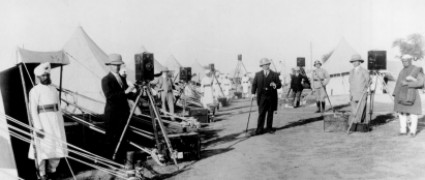
Charles Urban (centre) with his camera team at Delhi

Awaiting them in Bombay were the film cameramen. Five British film companies had successfully applied to the organising committee for permission to film the ceremonies: Barker Motion Photography, Gaumont, Pathé, Warwick Trading Company and the Charles Urban Trading Company. Each sent at least two operators; Charles Urban had a team of seven or eight, of whom probably four were cameramen (Joseph De Frenes, Hiram Horton, Alfred Gosden, Albuin Mariner). Urban’s intentions were to make two films – one newsfilm in black-and-white, but the other on a far greater scale was to be in colour. There were various announcements by Indian film companies that they would be filming the Durbar, though only the Bengali film pioneer Hiralal Sen definitely did so (his films, sadly are lost).

The day of the Coronation Durbar itself was 12 December. Up to 100,000 people filled the ampitheatre during the morning before the formal ceremonies began. At the head of the procession came veterans of past wars, including over a hundred survivors of the 1857 Mutiny, both Indian and British. Next came the Viceroy, Lord Hardinge (temporarily divested of his official power during the King-Emperor’s visit) and Lady Hardinge in an open carriage. An escort and the sound of fanfares preceded the entry of the royal carriage, with its canopy of crimson and gold, the King-Emperor and Queen-Empress dressed in their purple imperial robes, each wearing crowns. They processed down the central road, then round in a semi-circle past the central Royal Pavilion, to the Shamiana (a pavilion at the far end of the arena in front of the guests’ enclosure), where the Viceroy led them to their thrones. Here the Indian princes were to do homage to their Emperor, and after the King had given a short address, the maharajahs and princes of India came one by one (in strict order of precedence) to express their loyalty to the crown. One of the maharajahs, the Gaekwar of Baroda, caused a diplomatic incident when he declined to bow properly and then walk backwards after paying homage, instead turning his back on the King and Queen. Accident or deliberate act of defiance? Whichever, frame stills from the film record would later be used by the newspapers as evidence of the slight, for those who might not otherwise believe that such an act could even have been contemplated.

The prince identified on the Gaumont newsfilm of the Delhi Durbaras being the Gaekwar of Baroda, turning his back to King George and Queen Mary. Whether it is the Gaekwar is uncertain (see discussion below)

The Emperor and Empress rose from their thrones and walked to the central Royal Pavilion. Fanfares sounded. The official proclamation of the King’s coronation in June was made, in English and Urdu, and there were various announcements concerning beneficial funds and concessions made to the people of India. The royal couple returned to the Shamiana, while a salute was fired and cheers were taken up by the thirty thousand troops, then the sixty or more thousand guests, then those many thousands more outside the arena. At the Shamiana, the Emperor gave two last announcements concerning political changes, which had been kept in the greatest secrecy for months. These were that the capital of India was to move to Delhi, and that the partition of Bengal (an unpopular decision from the Curzon era) was to be cancelled. Both announcements, but particularly former, were received in almost stunned silence, before being greeted by general cheering. The Durbar was declared formally closed, the royal couple returned to their carriage, and departed.

The mood at the time, at least among the British, was one of complete awe as the majesty and colour of the spectacle, which seemed to be the very apex of the imperial dream. Journalist Philips Gibbs summed up its (British) impact:

Sound and colour combined to form a panorama of beauty and grandeur such as one might suppose could have its being only in a dream. Uniforms, robes, turbans of every shade and tone produced an effect which, though infinitely varied in its contrasts, was blended into one flawless harmony by the orderliness of the entire scheme. There seemed a mystic bond that welded the tremendous music of the bands, the clear notes of the bugles, and the tramp-tramp-tramp of marching hosts, into one vast paean of triumphant praise to the King-Emperor, and that found its more material counterpart in the riot of colour displayed so lavishly on every side.

The film companies hurried back to Britain. Only Urban’s camera team filming in the Kinemacolor process stayed behind (his black-and-white films were returned to Britain, however). He was seeing things beyond the news, and felt that so precious were the films that his team has captured that there was danger of their being stolen or damaged by his rivals. He later recalled:

We had the choicest of all possible positions; the officials afforded us the best of protection. They had heard rumors that rival film companies were bent on damaging or destroying our pictures and inasmuch as the King expected to see these pictures in London, it was up to the Army to see that we got them safely there. Each night we used to develop the negatives exposed during the day, and bury them in cases dug in the sand in my tent with a piece of linoleum and a rug on top – my bed on top of them, a pistol under my pillow and armed guards patrolling our camp.

The other film companies had also brought with them film processing equipment, so that they could show their films locally as well as dispatch prints back to Britain. Prints were sped back to Britain by ship and train. According to Stephen Bottomore, pre-eminent historian of the films of the 1902/3 and 1911 Durbars, all of the companies got their films onto screens in London on the same day, Saturday, 30 December 1911, including Kineto (Urban’s company filming in black-and-white), most if not all showing their results in the first show of the morning at 11:00. The films were news records, between five and fifteen minutes in length.

King George and Queen Mary viewing Barker Motion Photography’s black-and-white films of the Durbar at Calcutta House, 6 January 1912, from the Illustrated London News. Lord Hardinge noted in his diary: “In the evening we had a dinner of 50 and a cinematograph afterwards giving scenes from the Durbar and the Calcutta visit. They were not good but the King and Queen seemed to enjoy seeing them”

The films were a great, if brief, commercial success. Viewed as news, they were the toast of the town in January, and a dead duck by February, as Bottomore notes. News has to be fast, then it has to die, and a strategy of speed in order to capture the passing interest of the crowd was the only one the newsreel companies understood. Prints were sent out around the world, though perhaps not surprisingly few territories view the ceremonies with quite the same enthusiasm as did the British. But wherever you were, and whatever your sympathies, by February the Delhi Durbar was history. Its pomp was past.

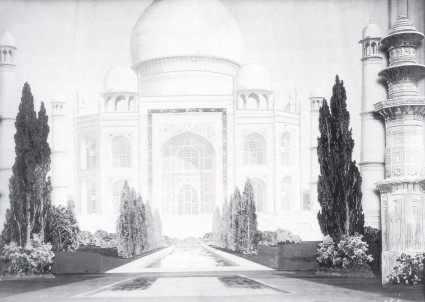
On 2 February 1912 at the Scala Theatre in London Charles Urban revealed his strategy. He did not see the Delhi Durbar as news; he saw it as living theatre. His plan was to recreate the experience and the emotion of the Delhi Durbar as far as might be possible on a London stage. It was not that people were tired of the Durbar; they had not seen it as it had been seen, and as it could now be presented. Urban organised his Kinemacolor footage into a two and a half hour programme (16,000 feet), a previously unheard of length for a film show, and with introductions and intervals it in fact stretched to three hours in full. It had the overall title With Our King and Queen Through India. Its centrepiece was entitled the Coronation Durbar at Delhi, but the programme as a whole covered the whole tour. The Scala stage was turned into a mock-up of the Taj Mahal, with special lighting effects. Music was composed and scored for forty-eight pieces, a chorus of twenty-four, a twenty-piece fife and drum corps, and three bagpipes. Music that had been played at the actual event was used whereever possible, including fanfares. This was virtual reality – pictures, sound, colour, pomp and circumstance, and all for a better and cheaper seat than if you had been one of those who had sailed off to India. The show at the Scala was going to be better than the real thing.

The Taj Mahal backdrop used for the screenings of With Our King and Queen through India at the Scala Theatre, from the National Media Museum collection

Things turned out as Urban had dreamed. With Our King and Queen in India became a huge hit, commercially and socially. It became the show that every discriminating person in London had to go and see, then repeated that success acros the UK, and then worldwide (it did particularly well in America). Society came to the Scala to see a medium that it would never have deigned to cast an eye on before. Duke and duchesses, lords and ladies, royalty themselves (King George and Queen Mary visited the Scala to see the film on 11 May 1912), all came to see the Durbar recreated on the screen. Children were taken to a show whose worthiness greatly commended it to parents who had previously been suspicious of moving pictures. Among such visitors were the young John Grierson (aged 11), Ivor Montagu (7) and Paul Rotha (4), future lions of the British documentary movement.

With our King and Queen in India was not a conventional film. Quite aside from its length, and the fact that it was in colour, it was more of a theatrical event than a film per se. Its different components recording incidents from the whole royal tour could be selected or ordered according to the length of available programme, so that no one screening might be the same as the next. The use of a lecturer throughout, the special music, stage and lighting effects, the whole sensory impact created something that was rather more than a mere picture show (to use a phrase said by one of Urban’s acquaintances at the time).

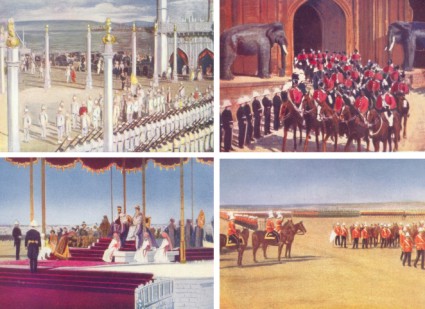
Four colour images from the 1912 Kinemacolor catalogue showing scenes from With Our King and Queen through India. It was not possible to reproduce Kinemacolor in print, so the images were conventionally coloured for print and do not accurately represent how the film actually looked. Clockwise from top left – the arrival of the royal couple in Bombay, state entry into Delhi, the royal review, and the Durbar ceremony itself

The film made a fortune. Urban calculated that through a combination of the Scala programme and five touring road shows in England, Ireland, Scotland and Wales, the film grossed more than £150,000 (though this figure may be for all Kinemacolor exhibited in UK); over the two years that Kinemacolor had its residency at the Scala, gross receipts (from a theatre that seated just 920) were £64,000. That’s six and a half million pounds in today’s money, from one small theatre alone.

And what of the film now? Just as Coronation Park, venue for vaingloriousness has become a deserted wasteland, so the Kinemacolor film that so entranced a world that still believed in the pageantry of empire is lost, with only reviews, catalogue records and memoirs to give us a second-hand sense of what experiencing it must have been like. Well, not entirely lost. Just as a statue or two, a commermorative obelisk and a plaque stand in the park as reminders of once was, so something of the Kinemacolor film survives, having been discovered in the Russian state film archive in 2000. It doesn’t show the main ceremonies; the single reel shows a parade of British troops and an artillery display that took place two days later. It is marvellous that it survives, and was undoubtedly grand to experience at the time, but it is a sideshow. The greater part is lost.

Frame still showing the Kinemacolor effect from the surviving reel of With Our King and Queen through India. The colour synthesis has been recreated electronically, because true Kinemaclor can only be see by projecting the films (via a rotating red/green filter). From the Russian State Archives

But fate has been kinder when it comes to the black-and-white films that were made. Those of Barker, Gaumont, Pathé, Warwick survive and can be found online in various places. They show us the spectacle, the deep sense felt of the power of the visual to express power, and the absurdity of it all. The best to watch is probably that by Gaumont, which is available on the Colonial Film: Moving Images of the British Empire site (despite some nitrate damage at the start). It includes a title that reads “How the Gaekwar of Baroda paid homage to King George”, but Stephen Bottomore has queried whether the prince shown is in fact the Gaekwar. Intriguingly the evidence of the films show that there was more than one Indian prince who turned his back on the royal couple (two turn their backs, both dressed in white, but one with a dark turban, the other white). Was this mass disdain, or was the whole incident manufactured by the press?

If you are interested to pursue the history of the 1911 Delhi Durbar and its films, there are several online sources available:

Parts of this post have been taken from my article “The modern Elixir of Life”: Kinemacolor, royalty and the Delhi Durbar, Film History, vol. 21 no. 2, 2009. I am also indebted to Stephen Bottomore’s essay ‘Have You Seen the Gaekwar Bob?’: filming the 1911 Delhi Durbar, Historical Journal of Film Radio and Television, vol. 17 no. 3, August 1997. Both are available online, but only via academic subscription services.

Finally, there are plans to redevelop Coronation Park, with gardening, more trees, a cricket area, an interpretation centre, and a general tidying up, though they have missed their original deadline which was the Durbar centenary. The Wall Street Journal has the story.

Coronation Park today, from The Wall Street Journal blog

Georges Méliès 1861-2011

Marie-Georges-Jean Méliès, the magician of early cinema, was born this day one hundred and fifty years ago. Though it seems to be pure coinicidence, his 150th year has been marked by a succession of notable Mélièsian events, culminating in the release this month of Martin Scorsese’s film Hugo, in which Méliès (played by Ben Kingsley) features as a leading character, and in which the production of Méliès’ films is lovingly created.

In celebration of the French master’s 150th, here is a set of links to the main DVDs, websites, publications and past Bioscope posts on Georges Méliès.

DVDs

Websites

Publications

Past Bioscope posts on Méliès

I’ve not provided any links to online videos, because we have a rule here at the Bioscope about not linking to films which have been ripped from DVDs, and practically every Méliès available on YouTube has indeed been ripped in this way. The films are in the public domain (though their new soundtracks are not), but it’s a shame to see, especially when the producers of such DVDs have gone to such trouble and expense to compile their productions in the first place. But for those who don’t know, don’t care, or who believe as a matter of principle that everything should be for free and online anyway, there is plenty to be found – and doubtless Georges would be thrilled that his productions continue to delight new generations.

Some of that delight is demonstrated by the many remakes of Méliès’s films or filming techniques that can be found online. It’s practically a genre in itself. So as a different sort of tribute we’ll show you one of these instead; most of them show more enthusiasm than skill, but I quite like this one for its simplicity and Mélièsian spirit:

And finally, a quotation, written by yours truly when reviewing the 5-DVD set back in 2008, which says all that I need to say on the matter.

Georges Méliès is confirmed here as among the pre-eminent artists of the cinema, perhaps the most exuberant of all filmmakers. The films display imagination, wit, ingenuity, grace, style, fun, invention, mischief, intelligence, anarchy, innocence, vision, satire, panache, beauty and longing, the poetry of the absurd. Starting out as extensions of the tricks that made up Méliès’ magic shows, to view them in chronological order as they are here is to see the cinema itself bursting out of its stage origins into a theatre of the mind, where anything becomes possible – a true voyage à travers l’impossible, to take the title of one of his best-known films. The best of them have not really dated at all, in that they have become timeless, and presumably (hopefully) always will be so. Méliès in his lifetime suffered the agony of seeing his style of filmming turn archaic as narrative style in the Griffith manner became dominant, but we can see now that is his work that has truly lasted. The films will always stand out as showing how motion pictures, when they first appeared, in a profound sense captured the imagination.

Bonne anniversaire, Georges.

Films from the fens

Stencil colour film of Blickling Hall, Norfolk, from Eve and Everybody’s Film Review (1929)

A significant release of archive films online, many of them silent, was announced recently. The East Anglian Film Archive, founded by David Cleveland in 1976, funded by the University of East Anglia, and now located in the Archive Centre, Norfolk, has published online 200 hours from its film collection, the outcome of a major cataloguing and digitisation project undertaken as part of the UK’s Screen Heritage programme which has been doing much to support public sector film archiving in the UK.

The search, browse and highlight options can all be accessed via the front page of the site. The site design is unusual, in a plain sort of way, but not ineffective and undoubtedly user friendly. It is certainly easy to find silent era films – you simply go to the browse option, where there is a timeline with sliders which you can drag for dates anywhere between 1895 and 2010, something I’ve not seen on many other sites and which is such a simple, sensible way of guiding people to a time period. Select 1895-1930, and you get around 150 items, all of them instantly playable, and with some some real treasures, surprises and at least one major discovery.

The films all come from those English counties covered by the East Anglian region, including Bedfordshire, Cambridgeshire, Essex, Hertfordshire, Norfolk and Suffolk. So there are many films of primarily regional interest only (which is of courses the raison d’être of a regional film archive), though equally they are encouragement to anyone interested in film history and history through film to consider the importance of place and regional (not just national) identity in film culture. For example, John Grierson’s celebrated documentary Drifters (1929) is generally lionised for its early position in the history of the art of documentary film, but it turns up here (in its entirety) because it was partly shot in Great Yarmouth, Norfolk. Drifters is, fundamentally, and importantly, a regional film.

There are many other records of the East Anglian region, from interest, travel, amateur and newsreel films of the period. The latter include probably unique examples of the rare Warwick Bioscope Chronicle and British Screen News newsreels, and local newsreel the Bostock Gazette (a number of UK towns and cities in the silent era had local news services, often maintained by an indiviual cinema where the projectionist doubled as camera operator, though other such ‘newsreels’ were produced by local enthusiasts on an amateur basis). There is 1929 stencil colour film of Blicking Hall in Norfolk, from Pathé’s cinemagazine Eve and Everybody’s Film Review; film pioneer Birt Acres’ 1896 film of Yarmouth fishing trawlers, the first film made in the region; an experimental work by George Sewell, one of the founder members of the Institute of Amateur Cinematographers, whose The Gaiety of Nations (1929) is a visually inventive comment on world politics; and several delightful examples of silent advertising films, including a number advertising Colman’s Mustard, which were based in Norwich (see for example the spoof 1926 newsreel The Mustard Club Topical Budget, featuring a popular set of characters from an advertising campaign of the period).

Jackeydawra Melford (wearing witch’s hat) as Jackeydawra in The Herncrake Witch (1913)

The major discovery is The Herncrake Witch (1913), which I had believed to be a lost film. It is a drama starring Jackeydawra Melford, one of the first women to direct a film in Britain. We have written about Jackeydawra Melford before now, in one of the earliest Bioscope posts, noting that she produced and starred in The Herncrake Witch (1912), The Land of Nursery Rhymes (1912) and The Inn on the Heath (1914), directing the last of those (her actor father directed The Herncrake Witch). None was known to survive. The EAFA catalogue record doesn’t give that much information about the film, which is intriguing in theme if quaintly produced, noting that it was made by Heron Films, a company founded by Andrew Heron who worked with Arthur Melbourne-Cooper, of whom more in a moment. The film is described as an ‘excerpt’, though there can’t be too much missing (it runs for 8 minutes, and the original length was 710 feet). Anyway, it is a major discovery for those interested in British silent women filmmakers, of whom there are a number.

Hey Diddle Diddle, the Cat and the Fiddle (c.1901), possibly filmed by Laura Bayley using the 17.5mm Biokam system (note the distinctive central perforations). The cat is playing its fiddle and the cow is jumping over the moon

Another welcome surprise is from another woman filmmaker. Hey Diddle Diddle, the Cat and the Fiddle (c.1901) is an example of the 17.5mm Biokam films issued by Brighton filmmaker George Albert Smith, for which there reasons to believe that the director was his actress wife Laura Bayley. What its East Anglian connection might be I’m not sure, but it’s a precious example of a pantomime act filmed on stage (the practice seems to have been that Smith made a 35mm film of a subject, then his wife shot the 17.5mm version, possibly simultaneously, but sometimes at a different time, as there are noticeable differences between the few examples where both 35mm and 17.5mm subjects survive).

A third example of a woman filmmaker is the amateur comedy Sally Sallies Forth (1928), directed by Frances Lascot, working with producer/editor Ivy Low, which is a well-produced example of the considerable number of amateur film dramas made at this time by hobbyist individuals and film clubs. It would have been nice to have a bit more information about the film’s production on the catalogue (not least where it was shot).

From pleasant surprises to not so pleasant surprises. There are several films in the collection attributed to the aforementioned Hertfordshire filmmaker Arthur Melbourne-Cooper, indeed there is a special section of the site devoted to him. Cooper is an interesting figure, involved in British films as assistant to Birt Acres from the earliest years, and later an important pioneer of the animation film. Unfortunately, his daughter and later some film historians took up his cause as a neglected master of early film, and claimed for him a number of films that he never made, or misdated other films to make them seem earlier examples of film innovation than is in fact the case. In some cases it seems Cooper told his family that films in his collection were ‘his’, when they were only so insofar as he may have exhibited them once and now owned them. I won’t go down the tedious route of pointing out which titles are wrongly identified and which aren’t (and there a quite a number that are genuinely his). It’s just really surprising that a responsible archive such as the EAFA put up these films with their dubious attributions to the fore, especially when their catalogue notes usually give pointers to the correct identification.

This abberation aside, the East Anglian Film Archive‘s new website is a very welcome new resource. It not only documents the East Anglian region so well, but for the silent film specialist it present the great variety of films of filmmaking from our period: dramas (professional and amateur), newsreels, travelogues, trick films, advertising films, industrials, magazines. It celebrates the medium in all its inventive richness, while reminding us of the particular meanings films have for particular people.

If you ae interested to find out more about the UK regional archives, visit the Film Archives UK website, or else read the 2009 Bioscope post on some of the UK regional film collections to be found online, including the Yorkshire Film Archive, Screen Archive South East and the Media Archive for Central England, all of whom have signficant silent films collection available to view online. And if you want to find them all (or at least a lot of what they hold) in one place, they you must try the new Search Your Film Archives portal hosted by the BFI (another UK Screen Heritage output). There is so much out there now to be found – do please reward the archives and those who have funded these initiatives by browsing, viewing, and taking film journeys down routes that you may not have expected.

Viewing matters

OK folks, after last week’s suggested reading list for some of the highlights among books published on silent film in 2011, here’s a selection of the best DVD and Blu-Ray releases of the year (at least in the Bioscope’s humble opinion).

  • The O’Kalem Collection 1910-1915
    This double-DVD set from the Irish Film Institute and BIFF Productions brings together eight productions made and set in Ireland by the American company Kalem (and associated producers), including The Lad from Old Ireland (1910), Rory O’ More (1911), The Colleen Bawn (1911), plus the recent documentary on what became knows as the ‘O’Kalems’, Blazing the Trail. A model package, archive-wise, scholarship-wise and entertainment-wise.
  • Hamlet & Die Filmprimadonna
    After a long, long wait, Edition Filmmuseum was finally able to bring out this year the 1920 German Hamlet, starring Asta Nielsen as Hamlet, from the German original version, with rich colour tinting and toning, and an exceptional new score from Michael Riessler. The two-DVD package includes the 1913 Nielsen film Die Filmprimadonna, documentaton on Hamlet‘s production and restoration, and an Asta Nielsen home movie compilation. Hamlet is so much more than a curiosity; an intelligent, deeply-felt and thoroughly thought-through reinterpretation of the Hamlet story.
  • Treasures 5: The West, 1898-1938
    The fifth boxed set in the National Film Preservation Foundation’s series of restored film classics takes as its theme the American West. Drawn from leading archives in America and New Zealand, the collection amply lives up to its ‘treasures’ billing. Highlights incude Beatriz Michelena in Gold Rush tale Salomy Jane (1914), Clara Blow in Mantrap (1926) and real-life outlaw Al Jennings recreating his exploits in Lady of the Dug-Out (1918), a rediscovered classic if ever there was one.

  • Screening the Poor 1888-1914
    2011 has been something of a year for innovative DVD releases, and none more so than Edition Filmmuseum’s Screening the Poor, which brings together early films and magic lantern slide sets depicting issues of poverty and poor relief from the period 1888-1914. The two-DVD set not only makes an important point in showing how we should consider the films of this period in their social as much as their aesthetic contexts, but that we need also to see how film was (and remains) only one part of a wider screen culture.
  • Laila
    Flicker Alley caters for the discerning silent film enthusiast (a Criterion in miniature), and such is the trust with which it must now be held that many will have purchased a Norwegian silent film of which they knew nothing simply because they trusted the label’s judgement. They won’t have been disappointed. This 1929 tale of a lost child and native destiny has won friends wherever it has been shown, simply for telling its thrilling, romantic story in the way that only the very best of silent films can achieve.
  • Gaumont Treasures Volume 2 (1908-1916)
    Kino’s follow-up to its Gaumont Treasures volume 1 is this fabulous three-disc set (based on a six-disc French original from 2009). The set covers the work of ingenious animator Emile Cohl, proto-surrealist and adventure storyteller Jean Durand and the elegant and witty Jacques Feyder, plus some synchrononised sound films (Phonoscenes) and examples of Chronochrome, Gaumont’s own pre-WWI natural colour process. A set to savour for its variety and quality.

  • The Great White Silence
    Among the best silent film reasons for making 2011 the year to invest in a Blu-Ray player has been the British Film Institute’s release of its restored version of The Great White Silence, Herbert Ponting’s 1924 re-edit of his original 1910-11 footage of the doomed Anatarctic expedition of Captain Robert Falcon Scott. Apart from the peerless quality of the polar images, the film demonstrates, not unlike Screening the Poor, the importance of considering photographic still images alongside motion pictures, as Ponting’s work is actually at its most powerful when he no longer has films to fall back on to tell his tragic story.
  • Max Davidson Comedies
    Don’t watch this compilation alone. It is essential that you enjoy the comedy shorts of Max Davidson in company (the larger in number the better), when the shared comic effect comes over best. Davidson’s Jewish-themed comedy had been rather lost to history when he was rediscovered through film festivals and he has now had the double-DVD set treatment from Edition Filmmuseum (label of the year, without a doubt). Pass the Gravy (1928) alone is as delirously funny a film as you will find anywhere.
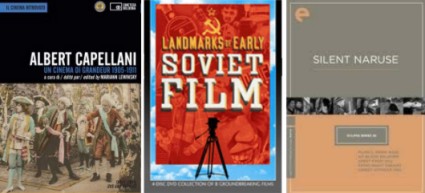
  • Coffret Albert Capellani
    It has been quite a year or two for early French cinema on DVD. On top of some superb releases curating Gaumont, Georges Méliès and Segundo de Chomón, this four-DVD set from Pathé presents the work of one of the leading directorial masters of the pre-war cinema period. The set has four longer films including the Capellani masterpieces Germinal (1913) and Le Chevalier de Maison Rouge (1914) and seven short films from 1906. An education in the ambition, creativity and artistic range of the early cinema.

  • Albert Capellani: Un cinema di grandeur 1905-1911
    But that’s not all we’ve had from Albert Capellani. Also in 2011 was the Cineteca di Bologna’s disc-and-booklet set on Capellani’s work 1905-1911, not overlapping with any of the content on the Pathé collection. This is one of a series of DVDs coming out of the 100-years-ago programme curated by Mariann Lewinsky for Bologna’s Il Cinema Ritrovato. An illuminating and captivating compilation, with excellent booklet notes (in English, Italian and French).
  • Landmarks of Early Soviet Film
    Most of these choices have been multiple disc sets, but it really has been a year for curated collections bringing in films from mulitple sources, aimed at the afficionado willing to invest a little more for a definitive set likely to take some while to view and absorb in its entirety. Flicker Alley’s collection of eight silent Soviet films widens our understanding of this period (i.e. beyond Eisenstein), including Boris Barnet’s The House on Trubnaya (1928), Lev Kuleshov’s The Extraordinary Adventures of Mr. West in the Land of the Bolsheviks (1924) and Mikhail Kalatozov’s eye-popping Salt for Svanetia (1930).
  • Silent Naruse
    And finally, from Criterion’s Eclipse series, five silents from the Japanese director Mikio Naruse: Flunky, Work Hard (1931), No Blood Relation (1932), Apart from You (1933), Every-Night Dreams (1933) and Street without End (1934). These are the only films among Naruse’s twenty-four silents now known to exist, and display Naruse’s emerging interest in the marginalised role of women in Japanese society. A fine set for watching Naruse gradually discover the style and theme that would make him one of the masters of Japanese film.

The magic of the lantern

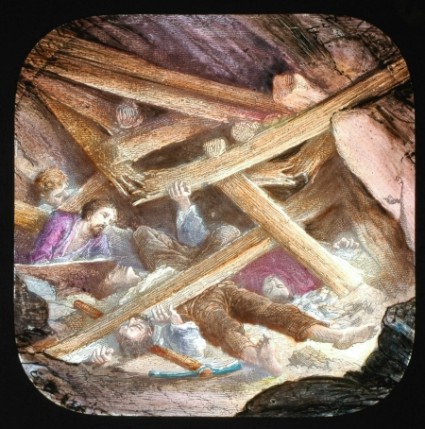
Slide 9 from The Miner’s Rescue (W. Rider & Co), Hecht Collection, Screen Archive South East, from the Lucerna database

Time may move in a straight line, but history does not. Despite the beliefs of the more traditional writers of history, particular themes seldom roll out as a succession of sequential events leading to a satisfactory conclusion. Film, or media history, for example, is not a case of one innovation neatly being followed by another, then another, leading to the media world with which we are familiar today. There are overlaps, reverses, diversions, false trails, parallel actions, missed opportunities, and all manner of divergent yet interconnected narratives. So, the historical argument that says there were optical toys, magic lanterns, chronophotographs and such like (bundled up in neat teleological fashion as ‘pre-cinema’), which were then followed by the cinema, the goal towards which so-called pre-cinema was inexorably aiming, is, quite simply, a-historical.

This we can see with the magic lantern, whose history has been opened up as never before by the publication of the Lucerna database, a new resource of some significance. Launched yesterday at the Screen Culture and the Social Question: Poverty on Screen 1880-1914 conference in London, Lucerna is an online database and information resource for the magic lantern. Magic lanterns are generally thought of as Victorian entertainments which prefigured the cinema. One of the things that Lucerna makes very clear is how the lantern did not die out once the cinema arrived, but that the two media co-existed for many years, with showmen employing both, production companies and distributors supplying both, and journals (such as The Kinematograph and Lantern Weekly, which lasted under that name until 1917) serving both. To understand early cinema, we need to understand the magic lantern too.

Lucerna is dedicated to the history of the lantern, in all its forms, reflecting its many relationships with social, political, religious, entertainment and cinema history. As the site says:

For more than 350 years the magic lantern has represented and fed into every aspect of human life and every part of the world. It is still used today, both in its original form and through direct descendants like the modern data projector.

The centrepiece of Lucerna is a database of slide sets, individual slide images, readings and other texts related to slide sets, lantern hardware, people and organisations involved in lantern history, locations associated with lantern production, and events. There is at present information on 6,332 slide sets (i.e. a set of images relating a particular narrative), 26,475 individual slides, 3,687 people and 1,366 organisations connected with lantern history. Many of the records are illustrated with slides from public and private collections, and browsing through the Slides and Slide Sets options is a marvellous way of viewing the preoccupations, beliefs and diversions of Victorian and Edwardian society (the slides available so far are predominantly British, though the lantern was of course a worldwide phenomenon).

Complete life model slide set for Beware!; or, The Effects of Gambling (Bamforth, 1893)

Lucerna does not have a single search option. Instead you are offered nine search options: slide sets, slides, people, organisations, events, locations, hardware, texts and keywords. Each offers a range of search parameters; Slide Sets, for example, lets you refine your search by country, manufacturer (with drop down menu for every manufacturer listed – indeed every search field under every option has a drop-down menu, so you never have to select any name or term at random), type of slide subject, type of image, date, and series title. Results can be ordered by title, date or series order, and crucially you can search under slide sets for those where there are images available, which is what most users of the site are going to want to do. Unfortunately you don’t seem to be able to do this for individual (‘orphan’) slides. Each individual record (and there ae tens of thousands of them) very usefully comes with a unique Lucerna ID number.

The best thing to do is to jump in at any point and start browsing, because such is the depth of hyperlinking that you are led inexorably from page to page, following themes, places or people as you construct your personal journey through lantern history. It soon becomes clear that this is a bit beyond your average database. It’s not obsessive as such, but it’s certainly in thrall to the richness of its subject. Person entries include not just birth/death dates and occupation, but references to census records and other archive sources, associated slides or texts, locations associated with them, businesses associated with them, literature references – and all of this with hyperlinks to everything mentioned. So, I find at random the record for Charles Acres, a partner in a slide painting business, and see that he was born in Islington. There’s a hyperlink – and lo I find there are seventeen lantern people associated with Islington (14 born there, 3 died there), one business located there, and one entry which reports on a lantern show which tooks place there, organised by the Sunday School Union. Click on that, and a huge list of events appears, all of them hyperlinked and described. And so the adventure continues.

(One searching tip – don’t hit the ‘go’ option on any search page without having put in at least one search term. Failing to do so appears to set the database into endless searching mode)

Slides from a 1911 Bamforth set to accompany the song ‘Are there any little angels blind like me?’

Themes that will soon become apparent are family, religion, the sufferings of the poor, temperance, war, empire, humour, gambling, travel, crime, patriotism, morality, romance, the supernatural and travel. Many are sentimental, and lead you to think how much audiences of the time were swayed by such images. Most tell stories of one kind or another, or illustrate songs with visual narrative, and the parallels with early films, in subject and tone, is immediately noticeable. Some slide sets, such as Ora Pro Nobis or Ostler Joe (each based on poems), later became films, and one sees not separate media histories, but rather the way in which a society wanted to see stories told, and the means that then developed technologically to make this happen.

A triunial or triple lantern (W.C. Hughes, 1880s)

Lucerna has been developed by the Universität Trier in Germany; Screen Archive South East, University of Brighton, UK; the Magic Lantern Society, UK; and Indiana University in the USA. However it is predominantly the work of one man, both in its programming and in the population of data, Richard Crangle, to whom the lantern world in particular and anyone in general at all interested in sceen culture and the worlds that screens depict should be hugely grateful. Crangle has set out not simply to display lantern images (as many other sites do), but to present the lantern in its many contexts, rigorously described, as a research resource. The ambition of the site is to encourage lantern enthusiasts to share their collections and knowledge, which they can do openly or anonyously as they wish, by signing up to the site and contributing information or images. So Lucerna is meant to be a collective, Wikipedia-like endeavour, and one hopes very much that it is able to be developed along such co-operative means.

If Lucerna whets your appetite for more information on the magic lantern (which it is bound to do), then here are a few links to encourage you to explore further:

  • The Magic Lantern Society – much information, well-illustrated, on lantern history, lanterns and slides
  • The Projection Box – distributors of Magic Lantern Society publications, including the indispensible Encylopedia of the Magic Lantern
  • Screening the Poor 1888-1914 – a double-DVD of early films and magic lantern slide sets on the theme of poverty, available from Edition Filmmuseum (reviewed by the Bioscope here)
  • Laterna Magica – Magic Lantern vol. 1 – a bi-lingual (English/German) illustrated history of the lantern in the 17th and 18th centuries, by Deac Rossell
  • Visual Media – heavily illustrated site by Thomas Weyants on ‘pre-cinema’ visual media, including magic lanterns, phantasmagoria, optical toys etc.
  • Museo del Precinema – Italian museum with extensive lantern resources, home of the Minici Zotti collection
  • Magic-Lantern.eu – large Dutch collection of lantern slides and equipment, handsomely illustrated

Lucerna is still in its early days, with the eventual aim of becoming the single definitive and comprehensive illustrated resource for the magic lantern. If enough of the lantern community join in and help Richard Crangle in his stupendous task, it may become so. But Lucerna is not just for the lantern specialist. The hope is to bring the lantern back into general consciousness, and to reintroduce it into those histories of screens, society, art, leisure, politics, religion and culture, where it most certainly belongs.

Go explore.

The British Newspaper Archive

http://www.britishnewspaperarchive.co.uk

As regular readers will know, we like to keep an eye on digitised newspapers of a general nature, as well as digitised film journals. Newspapers are where cinema was reported to a general public, and for the medium’s earliest years it is through newspapers that we can trace not only names and events but an idea of presence, of the progressive encroachment of moving pictures upon the public consciousness. An increasing number of silent film scholars, notably Richard Abel, are making extensive use of online newspaper archives and helping change our understanding of early film history in the process.

We have reported on the many newspaper digitisation projects to be found across the web, bringing together information on the key resources into a single Bioscope post. Today a new digitised newspaper collection was announced, with considerable palaver, and rightly so. The British Newspaper Archive is extraordinary. It is the first expression of a ten-year project between the British Library (my estemmed employers) and brightsolid, a family history business, which will eventually see 40 million newspaper pages published online. Version one offers a mere 3,079,053 pages (as of today – 8,000 new pages will be added each day), from the whole of the 19th century (content which is comfortably out of copyright) plus some of the 20th (where a few licences have been agreed). Though most of the newspapers covered date 1800-1900, some go back to 1700, and the most recent year covered is 1949.

The British Library already has its British Newspapers 1800-1900 site, which offers some two million pages from 49 local and national UK newspapers, available by subscription or for free if you belong to a subscribing UK university. The British Newspaper Archive widens the amount of regional newspaper content hugely (while incorporating the earlier resource’s content), drawn from 175 journals – ranging from The Aberdeen Journal to the Yorkshire Gazette. It doesn’t come free, however. The deal is that the content is avaiable under subscription models online, and free onsite at the British Library. Searching online is free, but viewing the documents comes at a price. If you get a 12-month subscription, at £79.95, you get unlimited access. 30-day (£29.95) or 2-day (£6.95) subscriptions are available, giving you 3,000 or 500 credits respectively, with views per page ranging from 5 to 15 credits per page. It’s an idea to search first to make sure that what you are looking for is really there.

Some of the search results for ‘cinematograph’

Once you have paid, the resource available is outstanding. Searching, advanced search options, browsing, filtering, viewing, presentation, analysis, annotation, OCR, tagging, bookmarking – everything has been thought of and presented in a state-of-the-art fashion. Just seeing the newspapers reproduced in colour rather than greyscale is such a pleasure. The British Newspaper Archive is aimed at the genealogy market first and foremost, but there is so much here for the film scholar as well. Inevitably, given the emphasis on the 19th century, it is mostly the very early years of film that can be explored. Our regular test search term demonstrates what lies in store. Typing in ‘kinetoscope’ gets 902 hits, 725 from 1894-1899, 11 from 1900-1944. The earliest reference comes from the Exeter Flying Post on 10 March 1894. Typing in ‘cinematograph’ brings up 9,032 hits; ‘bioscope’ scores 1,634; ‘movie’ gets 13,132. Having the musical hall and varety journal The Era (for the period 1838-1900) is of particular importance, because it reported so extensively on motion pictures for the early years.

This is going to be the major resource for discovering newspapers from the national collection from now on. It doesn’t include the leading titles, such as The Times and The Guardian, which have been made available separately by the newspapers in question. But it will be so extensive, and comes with such useful search and discovery tools, that it seems bound to lead the way. Eventually it must move into the 20th century (as it has a little already), if licences for use can be agreed with the copyright owners.

It is, I think, the second-best online newspaper archive now available. The best? That’s New Zealand’s Papers Past. Which is not only the best as the complete research resource (see the Bioscope’s 2008 review), but its two million pages come free to all. Sigh.

Save up, then go explore.

Reading matters

Well, it’s coming to that time of year again, and to help you get through the rigours of Christmas, we thought we come up with a selection of the books published this year on silent film which might be the sort of presents you’d rather like to get for yourselves as opposed to those you can expect from the nearest and dearest. So here’s an idiosyncractic selection of some of the publishing highlights of 2011:

Andrew Shail (ed.), Reading the Cinematograph: The Cinema in British Short Fiction 1896-1912 (University of Exeter Press). One of the most novel and interesting silent film books of the year is this mixture of anthology and critical history, which brings together eight short stories about early cinema, published at the time, paired with scholarly essays in each. Pieces such as Rudyard Kipling’s ‘Mrs Bathhurst’, George R. Sims’ ‘Our Detective Story’ and Mrs H.J. Bickle’s ‘Love and the Bioscope’ are introduced by Tom Gunning, Stephen Bottomore, Andrew Higson and others. The stories are facsimile reprints with the original illustrations, and the essays are illuminating, cogent and enthusiastic.

Bryony Dixon, 100 Silent Films (BFI/Palgrave Macmillan). The book surely no silent fan can resist is this knowledgeable, slightly polemical account of 100 representative silent films. Not the 100 best, but 100 that cover the great range of silent films, so encompassing not just the best-known feature films, but equally early cinema, documentary, newsreels, animation, natural history, actuality, advertising films and the avant garde. A book full of discoveries, with great knowledge expressed in an easy style.

Matthew Solomon, Fantastic Voyages of the Cinematic Imagination: Georges Méliès’s Trip to the Moon (State University of New York Press). It really has been Georges Méliès’ year, and two of the year’s most notable publications concern his iconic 1902 film, Le voyage dans la lune. Fantastic Voyages is a collection of essays that cover the many different aspects of the film, from its production history, to its contemporary contexts, to its meanings today. It also comes with a critical edition DVD. It’s a whole scientific adventure in itself.

La couleur retrouvée du Voyage dans la Lune / A Trip to the Moon Back in color (Capricci Editions / Technicolor Foundation). This 192-page book was produced by the Technicolor Foundation to accompany the sensational colour restoration of Le voyage dans la lune. Written in English and French, it is gorgeously illustrated and jam-packed with essential information on the film’s history, Georges Méliès himself, and the restoration. It is available for free as a PDF from the Groupama Gan Foundation website; hard copies can be purchased in France, but I got mine just by writing to Technicolor and asking.

Martin Loiperdinger (ed.), Early Cinema Today: The Art of Programming and Live Performance (John Libbey). One of the themes of silent film publication this year, at least as far as this selection is concerned, is pushing the subject out into new territories. I don’t recall seeing before now a whole book devoted to the presentation and performance of early cinema today. This fascinating selection brings together essays by academics, programmers and archivists who are discovering new meanings in the films of a century ago in the act of thinking how best to put them before the audiences of today.

Charles Drazin, The Faber Book of French Cinema (Faber). This, as the title indicates, is not solely devoted to silent films, but rather takes in the whole of French cinema. Single volumes recounting the history of a national cinema for a general audience rather than specialist academic have become something of a rarity, so an acessible and useful overview like this is particularly welcome. Drazin shows due and knowledgeable attention to French silent cinema, even the complexities of the earliest period when Pathé and Gaumont first set up their multinational empires, connecting it all to the latter years of Renior, Pagnol, Duvivier, Godard, Truffaut and Audaird.

John Bengston, Silent Visions: Discovering Early Hollywood and New York Through the Films of Harold Lloyd (Santa Monica Press). John Bengston’s photographic volumes illustrating the real locations used in the great silent comedies are innovative classics. Following on from his much acclaimed volumes on Chaplin and Keaton, here he illuminates the artistry of Harold Lloyd through an understanding of the locations used in Safety Last, Girl Shy, The Freshman, Speedy and others. A delight both for the film historian and any enthusiast for social or urban history.

Aubrey Solomon, The Fox Film Corporation 1915-1935 (McFarland). A solid, really useful acount of Fox before it was Twentieth Century-Fox, this studio history covers its foundation by archetypal mogul William Fox, the man who turned a “$1600 investment into a globe-spanning $300 million empire”, the production of such classics as The Iron Horse and Sunrise, and contains a comprehensive filmography. A film book publication of the traditional and entirely reliable kind.

Caroline Frick, Saving Cinema: The Politics of Preservation (Oxford University Press). As is becoming increasingly clear, cinema history is at a crossroads, as celluloid comes to the end of its natural life and digital takes over. This makes archiving riven with practical, aesthetic and politicial choices to be made, which are the subject of huge debate. This thoughtful and well-researched book shows the dilemmas but also the great opportunities that digital brings to film archives, especially in opening up previously invisible corners of our moving image heritage. Are we saving cinema, or are we saving something else?

These are just my suggestions. If you have favourites of your own from 2011, do let us all know.