New York’s Museum of the Moving Image had just published Moving Image Source, a combination of online journal and directory of information. The latter, called Research Guide, provides “a gateway to the best online resources related to film, television, and digital media.” There are several familiar sites listed but also an interesting sprinkling of unfamiliar sites on silent cinema, which I shall explore and pass on the fruits of my discoveries where appropriate. It’s all helpfully laid out and each site is described in a succinct line or two. And it would be even better if only they had thought to provide a search function…
Movies and conduct

Rudolph Valentino and Vilma Banky in The Son of the Sheik (1926)
Motion pictures are not understood by the present generation of adults. They are new; they make an enormous appeal to children; and they present ideas and situations which parents may not like. Consequently when parents think of the welfare of their children who are exposed to these compelling situations, they wonder about the effect of the pictures upon the ideals and behavior of the children. Do the pictures really influence children in any direction? Are their conduct, ideals, and attitudes affected by the movies? Are the scenes which are objectionable to adults understood by children, or at least by very young children? Do children eventually become sophisticated and grow superior to pictures? Are the emotions of children harmfully excited? In short, just what effect do motion pictures have upon children of different ages?
There were so many studies in the early years of cinema, so many anguished articles, doubtless so many sermons preached from pulpits, all seeking to explain the huge attraction of motion pictures among the young and trying to assess the damage done. The above paragraph neatly sums up many of the concerns that adults held – though presumably those adults who weren’t frequenting the cinema much themselves. The questions posed are reasonable enough, but they are underpinned by a fear of the young, a fear of a loss of control. Such studies end up telling us rather more about the prejudices of their authors than the motives of their subjects.
The paragraph comes from American sociologist Herbert Blumer’s Movies and Conduct, published in 1933. The book presents twelve studies of the influence of motion pictures upon the young, made by the Committee on Educational Research of the Payne Fund, at the request of the National Committee for the Study of Social Values in Motion Pictures. Sigh. But the reason for highlighting this 1933 book here is not for its questions or its conclusions, but for its evidence. The studies undertaken included interviews with filmgoers, who were asked about their cinema-going experiences as children, and hence it provides us with a rich selection of people’s fresh memories of watching films in the silent era.
Here, for example, are young adults remembering childhood play inspired by films:
Male, 20, Jewish, white, college junior – Quite often I would band together with other youths of my age, and we would play “Cop and Robber” or “Cowboy and Indian” trying to imitate the antics of the actors we saw in the movies. We would arm ourselves with toy pistols and clubs and chase each other over streets and yards. We would climb fences and barns, imagining them to be hills and all other objects necessary to make a realistic scene. At times we would get a little girl to play with us and we would have her be the heroine. Then someone else would rescue her, as we had seen it done in the movies.
Female, 19, white, college sophomore – We had a small hobby horse which was used by the hero and heroine alternately. As my cousin’s backyard was large and contained a large number of trees, we soon learned to climb these with agility, with only one or two casualties resulting a cracked arm and a sprained wrist. From these trees we would lasso the villain and his band as they rode by. We wore this plot almost threadbare and then began to use Indians as the villains. They were always cruel and painted terrifically with mud. These cruel villains usually about three would hide behind a tree about six inches in diameter. This hid them so completely that no one could see them, especially the heroine who happened to be out walking. Then the villain would fall upon her and drag her to the Indian camp about three or four feet away. By that time, of course, the dashing hero would try to make the daring rescue. Sometimes he would succeed, but at other times he would be captured. He would then make the spectacular escape with the heroine in his arms and the wild Indians at his heels. This plot was used many times with but few variations. It provided such a great amount of action that it was always a favorite.
Female, 20, white, college junior – From these pictures I received some of my ideas of beauty. I had a great desire to have curls like Mary Pickford’s and was forced to try to secure them secretly because my father forbade the curling of my hair … I got some comfort out of being “Mary Pickford” in our games, and improved my appearance with the aid of shavings from new buildings near by. I was also fond of old-fashioned clothes which I had first seen in the movies. I always loved to dress up as the old-fashioned lady, and used everything available to make my skirts stick out like a hoop skirt.
Female, 19, white, college sophomore-The first picture which stands out in my memory is “The Sheik” featuring Rudolph Valentino. I was at the impressionable and romantic age of 12 or 13 when I saw it, and I recall coming home that night and dreaming the entire picture over again; myself as the heroine being carried over the burning sands by an equally burning lover. I could feel myself being kissed in the way the Sheik had kissed the girl. I wanted to see it again, but that was forbidden; so as the next best thing my friend and I enacted the especially romantic scenes out under her mother’s rugs, which made excellent tents even though they were hung over the line for cleaning purposes. She was Rudolph and I the beautiful captive, and we followed as well as we could remember the actions of the actors.
There are some particularly rich examples of children becoming so totally immersed in re-enacting what they had seen on the screen that it led to harm:
Male, 20, white, college junior – Two peculiar events are still impressed upon my mind as directly resulting from the influence of the movies. Once we tied one of our members to an oak tree, and notwithstanding his frantic cries, proceeded with a boisterous war-dance about the victim. The struggling boy was almost strangled by the numerous coils of rope about his neck before his frenzied mother appeared to secure his release. At another time, I was compelled to walk home through the deep snow in my stocking feet because my playmates had chosen to forcibly remove my shoes and conceal them, in imitation of a humorous scene which they had witnessed at the theater on the same day.
There is more on imitation of dress, mannerisms, etiquette and modes of behaviour, and how tips from the stars might be adopted when dating:
Female, 19, white, college sophomore – Then came the time when I became interested in men. I had heard older boys and girls talking about “technique” and the only way I could find out how to treat boys was through reading books and seeing movies. I had always known boys as playmates, but having reached my freshman year in high school they became no longer playmates but “dates.” I didn’t want it to be that way but it seemed inevitable. I was asked to parties and dances and friends’ homes. The boys were older and sophisticated. I felt out of place. I noticed that older girls acted differently with boys than they did when with girls alone. I didn’t know what to do.
I decided to try some of the mannerisms I had seen in the movies. I began acting quite reserved, and I memorized half-veiled compliments. I realized my “dates” liked it. I laid the foundation with movie material. Then I began to improvise.
Of course, I had a rival in the crowd. Every time she began to receive more attention from the boys than I, I would see a movie and pick up something new with which to regain their interest. I remember one disastrous occasion. She was taking the center of the stage, and I was peeved. I could think of nothing to do.
Then I remembered the afternoon before I had seen Nazimova smoke a cigarette, and I decided that would be my next move. The party was at a friend’s home and I knew where her father’s cigarettes were kept. I got one, lit it, and had no difficulty whatsoever in handling it quite nonchalantly. The boys were fascinated and the victory was mine.
There is a lot of testimony on taking love-making tips from the movies, with Valentino frequently cited as a model, as in this droll, self-mocking example:
Male, 20, white, college junior – Later Valentino. I studied his style. I realized that nature had done much less for me in the way of original equipment than she had for the gorgeous Rodolfo, but I felt that he had a certain technique that it would behoove me to emulate. I practiced with little success. My nostrils refused to dilate – some muscular incompetency that I couldn’t remedy. My eyes were incapable of shooting sparks of fiery passion that would render the fair sex helpless. I made only one concrete trial. The young lady who was trial-horse for the attempt is still dubious about my mental stability. Worse yet, she made a report of the affair to her friends. The comments that came drifting back to me left no doubt in my mind about the futility of carrying on any longer. I gave up.
And so much more. There are examples of day-dreams and fantasies, of which stars they fell in love with, what induced sorrow, what thrilled them, and memories of what frightened them. The a several memories of a film in which a gorilla with the transplanted brain of a human commits murders (presumably the Bull Montana film Go and Get It, 1920), which clearly terrified many:
Female, 19, white, college sophomore – The horror-pictures and serials used to frighten me when I was a child. I remember one picture in particular I cannot even recollect the name of it but it was a newspaper story and concerned several mysterious killings which, it came out later, were committed by a huge orang-utan which had been given the brain of a man in an experiment by a doctor one of the men killed by the animal. I remember distinctly the scene which frightened me so. The ape was standing in an open window leering at his next victim who was lying in bed, a helpless invalid, rendered even more helpless by fear and horror. Of course, a newspaper reporter, the hero in the story, came in to his rescue just in time and shot the ape, but by that time I had been so thoroughly frightened that I could not sleep that night. Every time I closed my eyes, I could see this ape standing in the window and as the foot of my bed was only a few feet away from an open window, unprotected by even screens, I soon decided to spend the rest of the night in my mother’s bed with her. I remember being so paralyzed with fear that I could scarcely get out of bed, but once my feet touched the floor I ran as fast as I possibly could to my mother and spent not only that night but the next one, also, with her. I do not believe I cried, but I became speechless, powerless, rigid, staring wide-eyed into the dark, and the fright did not leave me for several days.
Finally, there is evidence of lessons learned from the movies, and of prejudices either reinforced or overturned. There is much on racial stereotyping, mostly the Chinese, but also this last piece of testimony summing up much that was worst about the movies:
Female, 17, Negro, high-school senior – It seems to me that every picture picturing a Negro is just to ridicule the race. When a Negro man or woman is featured in a movie they are obliged to speak flat southern words, be superstitious, and afraid of ghosts and white men. They have to make themselves as ugly and dark as possible. The bad things are emphasized and the good characteristics left out. This is very unfair to the race. All Negroes are not alike; there are different types as in other races. Why must they be portrayed as ignorant, superstitious animals instead of decent people that are just as capable of doing great things as any other race; all they need is the chance. It is the same with other dark races besides the Negro. They are always the loser, the shrinking coward, and never the victor. It is very unjust of the white race to make every nation appear inferior compared to them.
You can take or leave the analysis that goes with the text, but the short memoirs themselves are vivid, eloquent and revealing. There is much evidence here for anyone keen to explore the social impact of cinema (particularly on the young) in the 1920s and the mysteries of spectatorship. Movies and Conduct is available from the Internet Archive in DjVu (4.9MB), PDF (22MB) and TXT (542KB) formats. I’ll add it to the Bioscope Library.
Forgotten faces

One of the sad, or at least frustrating aspects of archival work on early films is trying to identify reels where there is no convenient main title to identify the film for you, and you can’t tell who the performers are. For every Pickford or Chaplin, there were hundreds of second and third tier players, probably not much known about at the time, and recognised by only a dedicated few now. And below they came those whose names were probably never known, who hoped for a little fame and never found it. If you can’t recognise them, or you can’t name the film in which they appear, film and performers remain in limbo, orphaned, acting for no one. Who are you, you ask, peering ever more closely at the screen in the hope of some subliminal clue. You take frame stills and show them to colleagues, leaf through the reference books, scroll through endless lists of film titles looking for some hopeful match between the action on the film fragment you have seen, trying to imagine these things with the mind of a 1910s film producer. Find the right title, or find a name, and you’re restoring someone back to some sort of a life. It’s a precious responsibility.
So it is that the Nederlands Filmmuseum, which has made something of a speciality of curating unidentified films, has put together a PowerPoint slide show of actresses from the silent era that either they are unable to identify, or of whom they know frustratingly little. They’ve done this to coincide with the upcoming Women and the Silent Screen Conference, being held in Stockholm 11-13 June, and they are inviting anyone who can to help identify the names. So, visit the conference site to download the PowerPoint, or take a look at the faces here. From the faces above, who is it on the left who appears in a British Lupino Lane film of the 1910s? Who is the actress (centre) who was found in a fragment of a mid 1920s comedy for Fox or Universal with Fred Spencer and Billy Bletcher? And can anyone name the actress (right) in a 1910s film which features Austrian and British officers going on a hunting party, who end up shooting a lion?

Or what of these? The actress on the left played the character of Cunegonde in a popular series of comedies 1911-1913 for the French company Lux, but no one knows her name. In the centre, this unidentified player appears in a Universal Century comedy fragment, dating around 1922, with Jimmy Adams and Jack Earle. And who on the right plays the title character in a Powers Company film of 1910 entitled The Lady Doctor?
If you have any idea, the Filmmuseum would love to hear from you. And, from the grave, the women would doubtless thank you too.
Peripheral vision
Time has crept up all too quickly, and I’ve only just realised that the Domitor conference is this month. The theme is ‘Peripheral Early Cinema’, meaning looking at the edges of early cinema, and it’s taking place at Girona, Spain, and Perpignan, France, 17-21 June. The conference has already been trailed here, but for the record, here’s the line-up of speakers and events, from the conference website:
MONDAY JUNE 16
20:00 Welcome at the Museu del Cinema
(Optional visit to the city 18 :00 to 20 :00. Departure place: Museu del Cinema)
TUESDAY JUNE 17
9:00 Welcome participants (Auditori Narcís de Carreras “la Caixa”)
9:30 Opening Domitor
10:00 Presentation: Frank Kessler, François de la Bretèque
10:15 Production et réalisateurs (1)– WALLER G. ( Indiana Univ. ): Toward a taxinomy of local films in the United States
– MINGUET BATLLORI J. (Univ. Autònoma de Barcelona): De la périphérie au centre. Segundo de Chomon et les attractions Pathé11:00 Pause
11:30– O’BRIEN C. (Carleton, Canada ) Lighting and cinematography in Griffith’s Biograph Shorts: electrification and film style, from east to west
– BASTIDE B. (Univ. Marne la Vallée): Fernand Itier, pionnier du cinéma dans le Gard
– DE LA BRETEQUE F. (Univ Montpellier 3 et Institut Jean Vigo): Dialectique du central et du provincial chez un représentant par excellence de l’institution dans le cinéma français des années 10: retour sur Louis Feuillade
– LECOINTE T. (Rectorat de Montpellier): Doit-on considérer, dans l’historiographie du cinéma français en 1896 que: les frères Lumière sont au centre du dispositif originel et les concurrents, des systèmes d’exploitation périphériques? Paris est centre de distribution et les régions, un réseau périphérique annexe?13:00 Lunch
15:00 Production et réalisateurs (2)– FLETCHER T. (London): The cinematograph in Rhyl
– WOOD D. M.J. (Univ. Autónoma México): Surviving early Mexican film on the border of the periphery?Distribution, exploitation (1)
– COSANDEY R. (Ecole cantonale d’art, Lausanne): Une histoire régionale du cinéma: centre et périphérie. Le cas suisse
– KESSLER F. & LENK S. (Univ. Utrecht, Nederlands Institut voor Beeld en geluid): Un centre périphérique : émergence et institutionnalisation du spectacle cinématographique à Düsseldorf
– IVERSEN G. (Univ. Trondheim, Norvège): Working in the periphery: two itinerant German exhibitors in Norway before 1910
– VAN BEUSEKOM A. (Utrecht Univ.): The Netherlands at the institutional periphery in the exhibition and distribution of major American films: the role of travelling showmen in the late teens.18:00 Guided tour Museu del Cinema
20:00 Projection lanterna magica Laura Minici Zotti. (Saló de descans del Teatre Municipal de Girona)WEDNESDAY JUNE 18
9:00 Welcome participants (Auditori Narcís de Carreras “la Caixa”)
9:30 Communications.Distribution, Exploitation (2)
– SANCHEZ SALAS D. (Univ. Rey Juan Carlos): La creación de la periferia cinematográfica en España 1912-1915
– BRAUN M. and KEIL C. (Univ. Toronto): No centre, no periphery? Early film exhibition in Ontario, Canada11:00 Pause
11:30– MOORE P. (Univ. Ryerson, Ontario ): The region as mediating scale
– OLLSON J. (Univ. Stockholm): Negoiationg peripheral feature market: Kristianstad-Stockholm-Paris or Malmo- Copenhagen-Berlin
– PROSKUROVA O. (Univ. Latvia): cinematographic in Latvia: re-animation of its publics (1895-1917)
– VERGOLIN L. (Il Cinema ritrovato, Bologna): Un cas de cinéma périphérique: Bologne en 190713:00 Lunch
15:00 Réception: Situation du spectateur, périphérie face au centre (1)– GAUDREAULT A. et LIU Y. (Univ. Montréal, Univ. Fujian): A la recherche du bonimenteur chinois…
– LACASSE G. (Univ. Montréal): Le film bonimenté, du centre à la périphérie
– BALAN C. (Univ. St Andrews): The metaphysics of the eyes: Undestanding Ottoman spectatorship in the precinematic era
– ASKARI K. (West. Washington Univ.): Nonsynchronous reception at the Grand Cinema, Teheran
– OZEN M. (Amsterdam): At the periphery of Europe : early cinema in the Ottoman capital Istambul
– CHATTERJEE R. (Univ. Westminster): Peripheral encounters: early cinema in Calcutta20:30 Projection Les origines de notre cinéma, “périphéries péninsulaires”, organisé par la Filmoteca de Catalunya (Cinema Truffaut)
THURSDAY JUNE 19: transfert
9:00 Departure Museu del Cinema
9:30 bus Figueras
10:30 Visit Museu Dali (In collaboration with the Fundació Gala-Salvador Dalí)
12:30 Departure Peralada
13:00 Lunch Peralada
15:30 Departure Collioure
16:30 Visit Collioure
18:30 Departure Perpignan
20:30 Buffet offert par le Conseil général au Palais des Rois de Majorque
21:30-45 Concert Palais des Rois de Majorque
22:30 Open air screening Palais des Rois de MajorqueFRIDAY JUNE 20
9:00 Welcome participants – Université de Perpignan
9:30 Réception: Situation du spectateur, périphérie face au centre (2)– CHRISTIE I. (University College, London) L’effet de présentation des films du ‘centre’ dans les régions coloniales pendant les premiers temps
– SOTO VAZQUEZ B. (Univ. Rey Juan Carlos): De la periferia de ultramar al centro de la metrópolis. El cinematógrafo y la guerra de Cuba vistos desde España11:00 Pause
11:30 Niveau intermédiatique, rapport à d’autres séries culturelles– WALTZ G. (USA) “Half real-half reel” entertainments: On the periphery of stage and screen
– KING R. (Toronto) Small-town slapstick; regional populism and regional pastoralism in transitional-era US comedy
– PHILLIPS W D. (New York Univ.): Place and utility of satire in early cinema
– HORAK L. (Berkeley) “The forgotten practice of cross-gender casting in early American film: Edna/Billy Foster at the Biograph Company.”13:00 Lunch
15:00 Historiographie– ABEL R. (Univ. Michigan): Small town newspapers about promotion and exhibition of motion pictures through the website newspaperarchive.com
– ALONSO GARCIA L. (Univ. Rey Juan Carlos): Desplazamientos: la reintegración de los estudios del cine primitivo en la historia de los medios
– BRAUN B. (Univ. Trier): Early local films in moderns applications17:00 Round table
– CHEFRANOVA O (…): From garden to kino: central and peripherial in Evgenii Bauer’s artistic career, Moscow 1880-1917
– DULAC N. (Univ. Montréal, Univ. Paris III Sorbonne-Nouvelle): Les jouets optiques et la genèse du cinéma: discours déterministe et « cinémato-centrisme » au tournant du 20e siècle
– CHEMARTIN P. GAUTHIER P. (Univ. Montréal, Univ. Catholique Louvain et Univ. Montréal, Univ. Lausanne): Genre, série culturelle ou institution parallèle? La question du dessin à transformations et des premiers temps du dessin animé17:00 Visit of Perpignan
22:00 Présentation Domitor (Arsenal – Institut Jean Vigo)
22:30 Open air screening (Arsenal – Institut Jean Vigo)SATURDAY JUNE 21
9:00 Welcome participants (Arsenal – Institut Jean Vigo)
9:30 Réception: Situation du spectateur, périphérie face au centre (3)– MACHETTI SANCHEZ S. (Univ. de Lleida): le center à l’niv. Lleida): El centre a l’ombra de la perifèria. Estudi quantitatiu del consum cinematogràfic dels primers temps en àmbits locals
– VERONNEAU P (Cinémathèque Canadienne, Montréal): Vivre dans la périphérie: stratégies de résistance11:00 Pause
11:30 Gender– MAULE R. (Concordia Univ.): Problematizing the trans-national from a feminist perspective : early cinema, modernity, and western-centered approaches to early cinema
– GAINES J. (Columbia Univ.): Anonymities: uncredited and as-yet-unknown contributors in early cinemaGenres, périphérie dans l’espace générique (1)
– SUAREZ CARMONA L. (Girona): Pornografia i erotisme en el cinema dels primers temps a Barcelona
– CONDON D. (Centre for media Studies, Maynooth, IRL): Rejecting the tourist gaze in provincial Irish picture Houses in the early 1910s13:00 Lunch
15:00 Genres, périphérie dans l’espace générique (2)– DAHLQUIST M. (Stockholm Univ.): Screening Congo in Swedish churches – Johan Hammar’s missionary films 1915-16
– PETERSON J. (Univ. Colorado, Boulder): Travelogues and immigrants
– SARGEANT A. (Univ. Warwick): From soap wrappers to soaps16:30 Closing speech: JOST F. (Univ. Paris 3)
17:00 Visit Institut Jean Vigo
19:00 Cocktail
I like a programme that allows space for pauses. It’s been some years now since I went to a Domitor conference – for those intrigued, Domitor is the international organisation for the study of early cinema, to which many of the great and the good in the small world of early cinema studies belong. Its major manifestation is its bi-annual conference, with associated publications. More information as always on the conference website.
13th Annual San Francisco Silent Film Festival

The Kid Brother (1927)
The San Francisco Silent Film Festival website has had an impressive makeover, and has details of this year’s festival, which takes place 11-13 July. This is the line-up of titles:
FRIDAY, JULY 11
The Kid Brother 7:00PM
Opening Night Party 9:15PM
SATURDAY, JULY 12
Amazing Tales from the Archives 10:00AM
The Soul of Youth 11:40AM
Les Deux Timides (Two Timid Souls) 2:15PM
Mikaël (Michael) 4:15PM
The Man Who Laughs 7:45PM
The Unknown 10:45PM
SUNDAY, JULY 13
The Adventures of Prince Achmed 10:30AM
The Silent Enemy 1:10PM
Her Wild Oat 3:50PM
Jujiro (Crossways) 6:10PM
The Patsy 8:45PM
The new site gives information on each title, this year’s musicians (Baguette Quartette, Stephen Horne, Mont Alto Motion Picture Orchestra, Michael Mortilla, Donald Sosin, Clark Wilson), venue (the Castro Theatre), hotels and tickets.
The Vortex

The Vortex, from http://www.sunrisesilents.com
Another British silent has been issued on DVD (see the post on A Cottage in Dartmoor for a round-up of which British silents are currently available on DVD). Sunrise Silents have released The Vortex (1928), Adrian Brunel’s film, made for Gainsborough, of the Noël Coward play, starring Ivor Novello and Willette Kershaw.
Who she? Adrian Brunel, in his autobiography Nice Work, tells his usual tales of battles with the philistines that generally ran things in British films at that time (not like that now, of course), and tells this tale of working with the stage actress, who was chosen after forty others were considered for the role (including Edna Purviance, who turned them down):
Finally we chose Willette Kershaw, the American stage actress. Physically she was ideal; she was pretty, and her doll-like face appeared youthful in a way the part demanded. She was a strange creature, rather pathetic, rather lovable and not quite real. She never seemed to eat – at least, not solid foods. Her diet consisted mainly of vegetable extracts pellets.
It was her first film and a trying ordeal for her. When she had been rehearsed and all was set for taking the scene, she would swallow one of her little pills, and I would give the word go. For the first five seconds of very scene she would be detached and miles away; then she would come to, performing excellently for about twenty seconds, when she would begin to sag. Naturally, therefore, I made her scenes as short as possible, but there was that lag in her attack and very often that sagging at the end.
Brunel then goes on to write about how he saved her work in the editing, only to have the editing of the film taken away from him. Brunel is wrong is saying that it was her first film, as IMDB gives three credits for her in the 1910s. But it was her last film. The play The Vortex was highly controversial in its day, for its allusions to drug addiction and implications of homosexuality – needless to say, the film version is heavily bowderlised.
Other British silents available from Sunrise Silents are Piccadilly (1929) and She (1925).
Pen and pictures no. 3 – J.M. Barrie
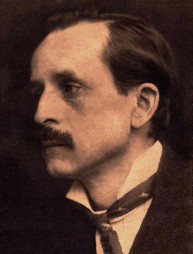
There were many authors in the silent era of cinema who dabbled with the film business, usually by having their works adapted for the screen. But some went further. J.M. Barrie, now chiefly known for Peter Pan, and for his custody of the sons of the Llewellyn-Davies family, the ‘Lost Boys’ (as recently retold in the film Finding Neverland), was among the most highly regarded writers of his time, as a novelist and especially as a dramatist. Barrie was fascinated by the cinema. Many silent films were made from his plays, among them Male and Female (1919, based on The Admirable Crichton), Peter Pan (1924) and A Kiss for Cinderella (1926). For Peter Pan Barrie wrote an original script, though it was not used. But Barrie did more than dabble with film scripts – he had been making his own films, which experimented with the relationship between film and theatre, fantasy and reality.
Two of these films were each connected with a combined theatre-and-film revue that Barrie had dreamt up in July 1914, only to abandon. Barrie had become fascinated by the French music hall actress, Gaby Delys, and wanted to write a revue for her that would extend his dramatic capabilities, and which would allow him to experiment with the borderline between cinema and theatre. He made notes to himself that indicate his radical way of thinking:
Combine theatre with cinematography – Cinema way of kissing. Burlesque of American titles, ‘Nope’ & ‘Yep’ – Gaby a chorus-girl, flirts with conductor in pit.
Barrie’s ideas became more ambitious. He organised a ‘Cinema Supper’ at the Savoy Hotel in London, to which he was able to invite such luminaries as the Prime Minister Herbert Asquith, Edward Elgar, George Bernard Shaw and G.K. Chesterton. His august guests first went to the Savoy Theatre to a series of short sketches written by Barrie and acted by such theatrical greats as Marie Lohr, Dion Boucicault, Marie Tempest, Gerald Du Maurier and Edmund Gwenn, before moving to the Savoy Hotel for supper, Barrie having hired a team of cameramen to film everyone arriving and then seated at their tables. Many apparently had no idea that they were being filmed, though the necessary lighting must sure have raised some questions among some. At one point in the evening Bernard Shaw got up and started delivering a speech haranguing three other guests present, namely G.K. Chesterton, the drama critic William Archer and the philanthropist Lord Howard de Walden, getting so heated as to start waving a sword around. The three he had insulted then all got up, bearing swords of their own, and chased him off stage. This was all a further part of Barrie’s plan, and according to Chesterton, Barrie had ‘some symbolical notion of our vanishing from real life and being captured or caught up into the film world of romance; being engaged through all the rest of the play in struggling to fight our way back to reality’.
The following day came the second part of Barrie’s plans. He had hired a cameraman, and with the playwright and theatre producer Harley Granville-Barker as director, he made a comedy Western, starring Shaw, Archer, de Walden and Chesterton. Chesterton has left us with the best description of this extraordinary little episode:
We went down to the waste land in Essex and found our Wild West equipment. But considerable indignation was felt against William Archer; who, with true Scottish foresight, arrived there first and put on the best pair of trousers … We … were rolled in barrels, roped over fake precipices and eventually turned loose in a field to lasso wild ponies, which were so tame that they ran after us instead of our running after them, and nosed in our pockets for pieces of sugar. Whatever may be the strain on credulity, it is also a fact that we all got on the same motor-bicycle; the wheels of which were spun round under us to produce the illusion of hurtling like a thunderbolt down the mountain-pass. When the rest finally vanished over the cliffs, clinging to the rope, they left me behind as a necessary weight to secure it; and Granville-Barker kept on calling out to me to Register Self-Sacrifice and Register Resignation, which I did with such wild and sweeping gestures as occurred to me; not, I am proud to say, without general applause. And all this time Barrie, with his little figure behind his large pipe, was standing about in an impenetrable manner; and nothing could extract from him the faintest indication of why we were being put through these ordeals.
Chesterton says that the film was never shown, while Barrie’s biographer Denis Mackail suggests that Barrie’s ideas were still half-formed and objections from some of the participants (notably Herbert Asquith, who sent a stern letter from 10 Downing Street forbidding his celluloid likeness from being used in a theatrical revue) caused both films to be withdrawn. However, the cowboy film was shown publicly, two years later at a war hospital charity screening at the London Coliseum on 10 June 1916, where it was given the splendid title of How Men Love. A review of the event indicates that Chesterton’s description of the action is what was seen on the screen, with the added detail that the others hanging from the rope over a cliff were too much even for a man of his great bulk to support, and he was forced to drop them. According to Mackail, a print was still in existence in 1941, but sadly no copy is known to exist today. Happily, this photograph does exist to demonstrate that it was not all just some mad dream:

(Left to right) Lord Howard de Walden, William Archer, J.M. Barrie, G.K. Chesterton and Bernard Shaw, in the middle of making the cowboy film How Men Love. From Peter Whitebrook, William Archer: A Biography
After a revue of his, Rosy Rapture, the Pride of the Beauty Chorus (1915), starring Gaby Delys, had a filmed sequence directed by Percy Nash included in one scene, Barrie turned filmmaker again in 1916. The Real Thing at Last was a professional film production by the British Actors Film Company, for which Barrie supplied the script. 1916 was the tercentenary of Shakespeare’s death, and among numerous celebratory productions, there was to be a Hollywood production of Macbeth, produced by D.W. Griffith and starring the English actor-manager Sir Herbert Beerbohm Tree. The idea of Hollywood tackling Shakespeare filled many with hilarity, and Barrie wrote a thirty-minute spoof which contrasted Macbeth as it might be produced in Britain, with how it would be treated in America. The film starred Edmund Gwenn as Macbeth, and among a notable cast Leslie Henson and A.E. Matthews both have left droll accounts of its production.
The film had a director, L.C. MacBean, but according to Matthews, ‘Barrie did all the work – MacBean just looked on admiringly’. The film gained all its humour from the contrasts in the British and American interpretations of Macbeth. In the British version, Lady Macbeth wiped a small amount of blood from her hands; in the American she had to wash away gallons of the stuff. In the British, the witches danced around a small cauldron; in the American the witches became dancing beauties cavorting around a huge cauldron. In the British, Macbeth and Macduff fought in a ditch; in the American Macbeth falls to his death from a skyscraper. The intertitles were similarly affected; a telegram was delivered to Macbeth that read, ‘If Birnam Wood moves, it’s a cinch’. Sadly, no copy (nor even a photograph, it seems) of this happy jest of Barrie’s is known to exist today.
What does exist, however, is The Yellow Week at Stanway. This film was made in 1923, and is a record of a house party held by Barrie at Stanway, the Cotswolds home of Lord and Lady Wemyss, which Barrie rented every summer. Barrie invited his many guests, which on one occasion included the entire Australian cricket team, to take part in theatricals, cricket matches and other such entertainments, and in 1923 he hired a professional cameraman, name unknown, to film a story that he initially called Nicholas’s Dream. Nicholas, or Nico, was the youngest of the five Llewellyn-Davies boys, and a little of their history is required to put the film in proper context.
The five boys were the sons of Arthur and Sylvia Llewellyn-Davies, friends of J.M. Barrie and the models for Mr and Mrs Darling in Peter Pan. Both died tragically early, with Barrie assuming the guardianship of the five boys. They were, of course, the inspiration for the ‘Lost Boys’ of Barrie’s imagination, and Michael Llewellyn-Davies in particular became the inspiration for the character of Peter Pan. But the family was to be visited by further tragedy. George, the eldest, was killed in action in 1915, then Michael, Barrie’s favourite, was drowned in 1921. Two of the others, Jack and Peter, moved away from Barrie, and the youngest, Nico, still at school at Eton, stayed with Barrie during holidays but felt Michael’s death deeply and knew that he was no substitute for him.
It is with this background, knowing both Nico and Barrie’s great personal sadness, that we should look at The Yellow Week at Stanway, which records a Stanway house party in 1923 to which Nico invited several of his Eton friends, with a complementary female component made up of friends of the Wemyss family, whose daughter Cynthia Asquith was Barrie’s secretary. She has provided us with a short account of the film’s production:
He [Barrie] was in marvelous form all through the cricket week, and in his most masterful mood – presenting the Eleven with special caps at a speech – making dinner, and summoning from London a ‘camera-man’ to film a fantasy called Nicholas’s Dream, into which he’d woven a part for everyone – a bicycling one for me. He also wrote a duologue for me and sister Mary. It was great fun having her to beguile the Etonians. Pamela Lytton, as lovely as ever, came, too, with her daughter, Hermione.
The film is largely in the standard home movie style (albeit at a time when home movies were a comparative rarity), with some simple trick effects and a distinctive tone of whimsy typical of Barrie, who wrote all of the rhyming intertitles as well as directing the film. It begins with the title, ‘The Yellow Week at Stanway. A record of fair women and brainy men’. The opening shots establish Stanway house and the Wemyss family. Nico Llewellyn-Davies greets the various guests for the Cricket Week, including roughly equal numbers of young men and women.
A game of cricket follows, where the umpire appears to be Barrie. A couple of rudimentary trick shots, with people disappearing or riding bicycles backwards come next, before an extended fantasy sequence. Nico is seen to fall asleep in ‘the forest of Arden’, and in his dream he seeks ‘his Rosalind’ but sees all the other house guests pair up without him. Mary Strickland leaves him for Anthony Lytton; another couple walk away when he greets them; another couple hit croquet balls at him; two others cycle past him; even Nico’s dog abandons him. Each vignette is accompanied by Barrie’s rhyming titles documenting Nico’s series of rejections.
Nicholas, Antony and Mary –
‘Your offer’s read sir, and declined
I will not be your Rosalind.’Edward and Pamela –
From the East to Western Ind
To Edward comes his Rosalind.Sam and Rosemary –
Same drove him off with deeds unkind
And so did gentle Rosalind.Pasty and Hermione –
If t’were not that love is blind
He’d keep an eye on Rosalind.
Eventually he wakes to find himself petted by all of the women, while the men walk away in disgust.
Following some further general shots, there comes the film’s most intriguing sequence. A title introduces ‘The Pirates’ Lagoon. An intruder’. Barrie and Michael Asquith (Cynthia Asquith’s young son) are seen on a small punt on a pond. The next title reads, ‘Michael the captain could stand when pressed. But drink and the devil had done for the rest.’ Michael and three other children, including his younger brother Simon, are seen in a boat. ‘’Ware the Redskins’, reads the next title, and Michael points a gun and a smaller boy a bow and arrow. ‘Escaping the tomahawks by a miracle’, reads the title, ‘Red Michael reached Stanway by a perilous descent.’ Michael is shown climbing through a window. The film concludes with Nico pretending to sleep and embracing an imaginary person; final shots of Stanway and the house guests; shots of Eton school; and concluding with Simon and Michael Asquith waving handkerchiefs through windows in a garden wall.
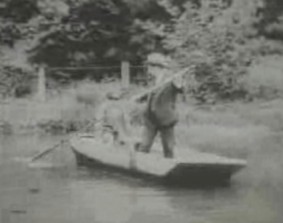
J.M. Barrie and Michael Asquith in The Yellow Week at Stanway, from http://www.knebworthhouse.com
The film is jointed, illogical and often plain silly in the manner of many home movies. The two fantasy sequences are notable, however. The ‘Nicholas’s Dream’ betrays some unfathomable and unconscious cruelty on Barrie’s part, depicting Nico as the unloved outsider, rejected by his peers, denied the pleasures of young love. Its allusions to Shakespeare’s As You Like It prefigure Barrie’s later involvement in the 1936 film of the play (the later film’s credits read ‘treatment suggested by J.M. Barrie’), with Elisabeth Bergner as a Peter Pan-like Rosalind. The pirate sequence, though brief and not elaborate in any way, is remarkably close in conception to his photo-story The Boy Castaways which was in turn the inspiration for Peter Pan.
The Yellow Week at Stanway is preserved in the BFI National Archive, and you can read the minutely detailed shotlist (penned by yours truly, long ago) on the BFI database. And there is just a fleeting extract from the film available on the Knebworth House website, showing Barrie and Michael Asquith on a punt.
Finally, just for the record, here’s a filmography of films from the silent era made from Barrie’s plays (play’s name where different in brackets), demonstrating just how popular his works were – and how ingenious producers were in renaming The Admirable Crichton:
- US 1910 Back to Nature [The Admirable Crichton]
p.c. Vitagraph Company of America - US 1913 The Little Minister
d. James Young p.c. Vitagraph Company of America - US 1913 Shipwrecked [The Admirable Crichton]
p.c. Kalem - US 1914 The Man of her Choice [The Admirable Crichton]
p.c. Powers - US 1915 The Little Gypsy [The Little Minister]
d. Oscar C. Apfel p.c. Fox - GB 1915 The Little Minister
d. Percy Nash p.c. Neptune - GB 1915 Rosy Rapture, the Pride of the Beauty Chorus
d. Percy Nash p.c. Neptune [for use in the play’s stage production (scene six)] - GB 1917 What Every Woman Knows
d. Fred W. Durrant p.c. Barker-Neptune - GB 1918 The Admirable Crichton
d. G.B. Samuelson p.c. Samuelson - US 1919 Male and Female [The Admirable Crichton]
d. Cecil B. DeMille p.c. Famous Players-Lasky - US 1920 Half an Hour
d. Harley Knoles p.c. Famous Players-Lasky - GB 1920 The Twelve Pound Look
d. Jack Denton p.c. Ideal - US 1921 The Little Minister
d. Penrhyn Stanlaws p.c. Famous Players-Lasky - US 1921 Sentimental Tommy
d. John S. Robertson p.c. Famous Players-Lasky - US 1921 What Every Woman Knows
d. William C. DeMille p.c. Famous Players-Lasky - GB 1921 The Will
d. A.V. Bramble p.c. Ideal - US 1922 The Little Minister
d. David Smith p.c. Vitagraph Company of America - US 1924 Peter Pan
d. Herbert Brenon p.c. Famous Players-Lasky - US 1925 Peter Pan Handled (Dinky Doodle series) [featured Peter Pan as a character] [animation]
d. Walter Lantz p.c. Bray Productions - US 1926 A Kiss for Cinerella
d. Herbert Brenon p.c. Famous Players-Lasky - US 1927 Quality Street
d. Sidney Franklin p.c. Cosmopolitan Productions
Seeing the unseen world

Francis Martin Duncan with microcinematographical equipment
Opening today is an exhibition at the Science Museum on the history of the science film. Entitled Films of Fact, it looks at the development of scientific films and television programmes from 1903 to 1965. Its subject, and that of the book that accompanies it, is not really scientific film as in film used in the study of science, but rather the presentation of science on film. So it’s about popularisation and communication.
Films of Fact as a title comes from the name of the company of social documentarist Paul Rotha, once renowned not just as a filmmaker but as a theorist and film historian. But the exhibition also focuses on an earlier period, when science film meant films of nature, and it has generated quite a bit of press interest in one film in particular, Cheese Mites, made by zoologist Francis Martin Duncan in 1903 using microcinematopgrahic equipment (microscope + cine camera, basically) for producer Charles Urban. Urban had had the extraordinary idea of putting science films before a music hall audience, in a show he called The Unseen World. This contemporary review from the Daily Telegraph gives an idea of the astonished audience reaction:
Science has just added a new marvel to the marvelous powers of the Bioscope. A few years ago it was thought sufficiently wonderful to show the picture of a frog jumping. Go to the Alhambra this week and you may seen upon the screen the blood circulating in that same frog’s foot. This sounds a trifle incredible, but it is an exact statement of the truth. The new miracle has been performed by the adaptation of the microscope to the camera which takes the Bioscope films. Last night The Charles Urban Trading Company Ltd, who has taken the photographs, had many other miracles to show and explain to a fascinated audience. There was a blood-curdling picture of cheese-mites taking their walks abroad, the tiny creatures looking on the screen as large as small crabs. The minute hydra which lives in stagnant water appeared shooting out its tentacles and taking a meal … Twenty-five minutes, the length of the exhibition, is a long time to give to a Bioscope turn, but the rapt attention of the audience and the thunders of applause at the conclusion testified to the way in which popularity had been at once secured by these unique pictures.

Cheese Mites (1903)
Cheese Mites was the hit of the show, and is only one the Unseen World films to survive (the BFI has it). Originally the film just showed the magnified creatures. Later Urban added a comic framing story, as this Charles Urban Trading Company catalogue entry explains:
A gentleman reading the paper and seated at lunch, suddenly detects something the matter with his cheese. He examines it with his magnifying glass, starts up and flings the cheese away, frightened at the sight of the creeping mites which his magnifying glass reveals. A ripe piece of Stilton, the size of a shilling, will contain several hundred cheese mites. In this remarkable film, the mites are seen crawling and creeping about in all directions, looking like great uncanny crabs, bristling with long spiny hairs and legs.
Unfortunately, these extra scenes don’t survive. There’s a news report on the BBC site about the exhibition, which include the Cheese Mites film, so do take a look, and ponder the alarm that was said at the time to have spread among cheese manufacturers, who begged for the film to be stopped being shown. There’s also an article in this week’s New Scientist magazine which tells the story behind the film and that of Percy Smith, a later collaborator with Charles Urban, who made such classics as The Balancing Bluebottle (1908) and The Birth of a Flower (1910), employing time-lapse photography, before going on to make the once-famous series The Secrets of Nature in the 1920s and 1930s.
The Acrobatic Fly (a retitled version of The Balancing Bluebottle), made by Percy Smith in 1908. As Smith explained, “The fly is quite uninjured and is merely supported by a silken band when performing with weights which would otherwise overbalance it. When its feats are accomplished it is allowed to fly away.”

And then there’s the book. Timothy Boon’s Films of Fact: A History of Science in Documentary Film and Television is something quite special. It’s a history of a type of film which has barely been covered by historians, and has much that is new or revalatory, for the silent era and beyond. But it’s also a cultural history, which addresses why these films were made, what the popularisation of science means, and how science relates to society at large. It’s an exciting read, and I’ll try and give it more space at another time, while looking at the literature of the early science film in general. Anyway, Charles Urban, F. Martin Duncan and Percy Smith are the flavour of the moment, which is unexpected but should be fun while it lasts. I saw Cheese Mites and Percy Smith’s The Acrobatic Fly shown before an audience this evening, and they excited much the same mixture of amusement and amazement as they did a century ago. The filmmakers of old did know a thing or two.
The Science Museum exhibition runs until February 2009.
Méliès by instalments
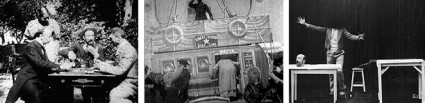
Une Partie de cartes, Entre Calais et Douvres and Un Homme de têtes, from http://filmjournal.net/melies
Parbleu! The publication of the Flicker Alley five-disc set of (most of) the works of Georges Méliès has already sparked off a lot of interest and investigation, some of it centred on identifying those titles which exist but aren’t included on the DVDs. But now we have Georges Méliès: An in-depth look at the cinema’s first creative genius. This is a new blog/research tool from Michael Brooke, part of the new Filmjournal blogging site. Brooke (a regular contributor to the BFI’s Screenonline site) has taken on the task of reviewing everyone of the 173 films on the Flicker Alley set, in chronological order. Each film is given under its English and French titles, with date, catalogue number and length; illustrated with a frame still; the action described; a detailed review follows (including comments on the DVD quality); then links (usually IMDB, Wikipedia and YouTube).
It’s well done and is going to build up into a really useful resource. The emphasis is very much on stylistic innovations, but there’s more to Méliès than magic and film form. His films were grounded in social and political realities (it’ll be interesting to see how his films of the Dreyfus affair are covered), and in ways of storytelling that reach way back before the upstart cinema. Anyway, an excellent effort so far, and an answer to the complaint on this blog that there weren’t any good Méliès sites out there. It looks like one is building up film by film before our eyes.
100 years of Georgian cinema
Regular readers will recall than we marked 100 years of Russian cinema a few months ago, and now it’s time to recognise 100 years of cinema in Georgia. This news report turned up on The Georgian Times today, of which I’ll give you the silent bit:
Georgia has been making films for one hundred years. Before the fall of the Soviet Union, Georgian cinema was known across Soviet blocs as being vibrant and creative. The Italian director Federico Fellini once described it as “a strange phenomenon, special, philosophically light, sophisticated, and at the same time, childishly pure.” But the economic breakdown which followed Georgian independence has made it very difficult to make films, although recently, experts say that quality Georgian filmmaking is beginning to return.
Georgian film production began at nearly the same time as European cinema. The first film festival took place in Tbilisi in 1896. In honor of the 100th anniversary of Georgian cinema, a number of exhibitions, festive events and showings of Georgian silent films have been planned. “A festive opening for Georgian cinema’s jubilee celebration will be held at Rustaveli Theater,” Nino Anjaparidze, a public relations department representative for the Georgian National Film Center, said, inviting the public to attend.
According to her, the Georgian filmmaking has begun to revive. “It turned out that the anniversary coincided with the 60 year anniversary of a well-known Georgian film Keto and Kote by Vakhtang Tabliashvili and Shalva Gedevanishvili,” Anjaparidze says.
“The film festival, will also consist of showing this film and we have newly reconstructed the film and a documentary about the period when this film was made is in the works by independent company ‘Kiono Project’ headed by Archil Geloavni,” stated Anjaparidze.
Experts widely consider 1908 the year cinema was born in Georgia, when film directors Dighmelov and Amashukeli made their first experimental shots. In 1912, Amashukeli shot the first full-length documentary movie, Akakis Mogzauroba [Akaki’s Journey], about poet Akaki Tsereteli. The film was unparalleled by any other movie in world at that time as to its theme, length and artistic level. The first full-range feature film in Georgia, Kristine was shot from 1916 to 1918. The film was directed by Aleksandre Tsutsunava. In 1924 “Three Lives” by Perestiani was a great success – the film was the first attempt to provide psychological insight into the heroes.
In the mid 1920s, theatre, literature and art professionals came to the cinema. When Samanishvili’s Stepmother (Marjanishvili) and Khanuma (Tsutsunava) appeared on the screen, they marked the beginning of a new genre of comedy film. Films of this period were very popular due to the first Georgian film star, Nato Vachnadze {from such films as The Story of Tariel Mklavadze, Who can Be Blamed, and others), the country’s first silver screen diva.
Next came a period of new genres and style in the Georgian Cinema. One of the best representatives of the generation was Nikolai Shengelaia. Though he lived in Stalin’s epoch, watching his films we feel the directors active strive for innovation and artistic expressions in his films. Now, N. Shengelaias and N. Vachnadzes sons Eldar and Giorgi Shengelaia are also famous directors of the Georgian cinema.
The film My Grandmother by Kote Mikaberidze (1929) was also a crucial turning point for Georgian film. In this movie, for the first time in Georgian and Soviet cinematography, the principles of expressionism appeared.The film was forbidden to appear on the screen, but many years later the film was restored and shown in La Rochelle. Soviet ideology was so pressing in the 1930s that little innovation took place. Only some films of the period were noteworthy: Siko Dolidze’s Dariko (1936), David Rondeli’s Lost Paradise (1937), and a few others.
Keti Dolidze a famous Georgian film director and a daughter of a well-known Georgian film director, says that she must congratulate the anniversary to the Georgian cinema in the past, and that nowadays, “Georgian cinema is in very bad condition because our government puts little money into cinema.. It is very difficult to revive after 15 years of falling and how can we overtake European cinema and even Russian cinema, as they have already produced 600 hundred movies this year because their government gives them enough money to produce films… Businessmen will never put money into this field because if they put money in, they will have to pay more taxes on it,” Keti Dolidze claimed.
To read the rest, go to The Georgian Times site. The great period of Georgian filmmaking (albeit overshadowed by Soviet ideology) was the 1960s/70s, with filmmakers of world renown like Otar Iosseliani and Sergei Parajanov (arguably one of the truly great silent directors). Of Georgian pioneers Vasil Amashukeli and Alexander Dighmelov I knew nothing before now, but there is information on them and silent cinema in Georgia generally on the Georgia & South Caucus blog.

