A call for papers has gone out for Instruction, Amusement and Spectacle: Popular Shows and Exhibitions 1800-1914, a conference taking place 16-18 April 2009, at the Centre for Victorian Studies, University of Exeter.
The conference aims to examine the eclectic range of popular entertainments in the nineteenth and early twentieth century, with a particular focus on exhibition practices. The intention is to provide a forum that brings together the range of research currently being undertaken by different disciplines in this area, including film studies, Victorian studies, history of science, performance studies, English literature, art history and studies of popular culture.
Potential topics could include but are not limited to:
The role of visual entertainments (e.g. magic lantern, panoramas, dioramas, photography, peep shows)
Early cinema: exhibition and reception
Local and regional exhibition cultures
Science and technology: demonstration and instruction
Improvement and rational recreation
Exhibitions of ‘Otherness’ (e.g. freak shows, ethnographic shows, minstrels)
Music hall, pantomime, vaudeville and variety
Public lectures and lecturing
Galleries, museums and civic institutions (e.g. The Royal Polytechnic Institution, Mechanics Institutes)
Travelling shows, fairgrounds and circuses
World’s Fairs and international exhibitions
Magic, illusion and spiritualism
Concerts, recitals and readings
Pleasure gardens, tourism and seaside exhibitions
Dance and physical performance
Literary and other representations of popular entertainments
Showmen and showmanship
Audiences: composition and reception
Intermediality and exhibitions
Image, narrative and performance
Proposals are invited of no more than 300 words, to be sent together with designation and affiliation to victorianshows@exeter.ac.uk, no later than 31 October 2008.
The conference is one output of the Arts and Humanities Research Council-funded project AHRC funded project Moving and Projected Image Entertainment in the South West 1820-1914 at the University of Exeter, which is using a regional study to demonstrate the extensive national distribution of moving and projected images between 1820 and 1914.
The New Scientist magazine has published this short video of early science film (from the BFI National Archive) to coincide with the Films of Fact exhibition at the Science Museum and the book of the same title by Tim Boon.
The video is a peculiar hodge-podge (goodness knows what the still from the 1960s BBC series Tomorrow’s World is doing in there), and early cinema clearly isn’t the commentator’s strong point, but you do get Tim Boon sneaking in a few words of wisdom, plus clips from F. Martin Duncan’s now legendary Cheese Mites (1903), Percy Smith’s time-lapse masterpiece The Birth of a Flower (1910) and and his perenially eye-popping The Acrobatic Fly (1908). Somewhat less scientifically, you also get a glimpse of one of my all-time favourite film titles, Edison’s Laura Comstock’s Bag-Punching Dog (1901), plus other Edison clips whose presence is difficult to comprehend.
For information on book, exhibition and filmmakers, see the earlier Seeing the Unseen World post.
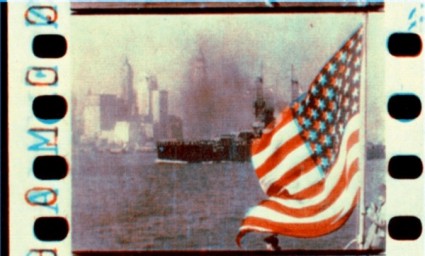
Unidentified Kinemacolor film of New York harbour (synthesised colour image)
We return, after something of a break, to our series on the history of colour cinematography in the silent era. We’re still not done with the history of Kinemacolor, the dominant natural colour process before the First World War, and there will be posts on Kinemacolor in America, Britain, and in other countries, then a post on Kinemacolor’s unhappy demise, before we move onto other colour systems.
Kinemacolor was first exhibited in America at Madison Square Gardens on 11 December 1909. 1,200 members of the film trade and general press gathered to hear George Albert Smith and Charles Urban explain their system and show twenty Kinemacolor subjects, including a film taken by John Mackenzie calculated to inspire the audience, which showed 20,000 schoolchildren forming the American flag. The intention was to find a buyer for the American rights. Urban tried to do a deal with the Motion Picture Patents Company, the monopolistic organisation which had been established in January 1909 to licence film production, distribution and exhibition exclusively, through control of the patents of Edison and others, but he failed to do so. His business timing was unfortunate, both because the MPPC was striving earnestly to stifle all independent film activity in America, and because the special equipment required for Kinemacolor ran counter to its wish to standardise the American film industry.
Children Forming United States Flag at Albany Capitol, from the 1912 Kinemacolor catalogue (note that this is an ordinary colour illustration, not a Kinemacolor ‘print’ – it was impossible to reproduce Kinemacolor as a still image).
Urban returned home disappointed, but he was pursued by two businessmen from Allentown, Pennsylvania, Gilbert Henry Aymar and James Klein Bowen. They secured the patent rights for $200,000 (£40,000), with a plan to exhibit Kinemacolor through a system of local licences in variety theatres rather than picture houses. They established the Kinemacolor Company of America in April 1910, planning not to produce their own films (at least initially), instead relying on showing British product. The business was badly mishandled, and eventually a New York stock speculator, George H. Burr & Co., paid $200,000 for the patent rights and floated a new Kinemacolor Company of America. The resultant company with patent rights was then sold in April 1911 to John J. Murdock, a theatre magnate.
Kinemacolor enjoyed a good year in 1911 owing to a succession of British royal events (including the coronation of King George V) which looked spectacular in colour. Audiences flocked to Kinemacolor theatres, happy to pay higher prices for a classy product and generally making the film industry marvel at the high tone of the proceedings and the money rolling in. But an American business could only go so far showing long newsfilms of British royalty. The Kinemacolor Company of America wanted to show fiction films. The British fiction films were uniformly terrible – so they needed to produce their own.
1913 Motion Picture News advert for Kinemacolor
A big problem with Kinemacolor was that it was an additive system. Essentially this means that it composed its colour record by the addition of separate colour records (television works on the same principle), but in doing so it absorbed a lot of the available light. The result was that it was not a good idea to shoot Kinemacolor in the studio; you had to film in good natural light (many of the British films were not filmed in Britain but in Nice, France).
So, technically, the odds were stacked against them when they set out to produce their first film. In a bout of wild over-ambition, they choose to produce The Clansman, based on a dramatised version of Thomas Dixon’s grotesquely racist novel about the Ku Klux Klan. A deal was signed with the Southern Amusement Company, producers of The Clansman play, and the perfomers were to be from the Campbell MacCullough Players, one of the several stock companies which were touring the States with the production. The director was William Haddock. Filmed throughout 1911 in the New Orleans area, as the stock company went on the road with the play, the ten-reel film (Kinemacolor films were double the length of standard films owing to the altenating red-green records) was completed in January 1912 at a cost of $25,000.
Then what? No one is sure. One suggestion is that there were problems over the story rights, though one can hardly believe that they would film for an entire year without being sure that they had full permission from Dixon to do so. The other argument is that the film was technically inept and unshowable, but again you’d have thought someone might have spotted this over the course of the year. Whatever the reason, it was never shown publicly. Film trade journalist Frank Woods, who had contributed to the script of The Clansman, showed what he’d written to one D.W. Griffith, who then went off and filmed The Birth of a Nation, based on the same novel. Had the Kinemacolor version been exhibited, Griffith would presumably never have made his film, and film history might have been completely different.
A new head of the Kinemacolor Company of America, Henry J. Brock, took over late in 1912, and studios were established at 4500 Sunset Boulevard in Hollywood. Its first film, after the debacle of The Clansman, was a two-reeler Western, East and West (1912). But production and exhibition continued to be beset by technical problems, and too few films were produced to sustain the company, despite it eventually obtaining a licence from the Motion Picture Patents Company in August 1913, making it the only new company to join the trust after its original formation. Exhibitors in particular resisted including Kinemacolor films requiring separate projection facilities within their programmes. The Hollywood studio closed in June 1913, taken over by the D.W. Griffith company, which renamed it the Fine Arts studio, where The Birth of a Nation would be filmed. The Kinemacolor Company of America opened a studio in New York in October 1913, but gradually faded from view. It ceased production in 1915.
The lesson from the Kinemacolor Company of America was that colour alone was not enough. Karl Brown, who worked for Kinemacolor processing negatives, noted the audience reaction:
Our little one-reel pictures were made to exploit color for color’s sake. There was one about a hospital fire, showing lots of flames; another, from a Hawthorne story about a pumpkin that becomes a man, showed up the golden yellow of the carved jack-o’-lantern very well indeed. There was another about British soldiers, featuring the red and gold and white of their uniforms.
The audiences at the California seemed to care nothing about our beautiful colors. What they wanted was raw melodrama and lots of it, and what seemed to stir them most of all was the steady flood pictures made by a man named D.W. Griffith…
That man again. Brown noticed the way things were going and left to join Griffith as assistant to his cinematographer, Billy Bitzer.
Lillian Russell in what may be a frame still from Kinemacolor film of her (I can’t remember where the image comes from). As with other ‘colour’ images of Kinemacolor, the colour is not true Kinemacolor – in this case, it seems to be a still taken from a colour print approximating the colour effect.
The Kinemacolor Company of America produced both non-fiction and fiction. Among the former, its most spectacular production was The Making of the Panama Canal (1912), a nine-reeler, lasting around two hours, which enjoyed a considerable reputation in its time. Dramatic production was headed by David Miles, with directors including William Haddock, Gaston Bell, Jack Le Saint and Frank Woods; members of the stock company included Linda Arvidson Griffith (Mrs D.W. Griffith), Mabel Van Buren, Murdock MacQuarrie, Clara Bracy and Charles Perley, while theatre great Lillian Russell made a short film with Kinemacolor, entitled How to Live 100 Years, which she included in a touring show of hers promoting physical fitness. The cameramen (the real stars of the show) included John Mackenzie, Alfred Gosden, Victor Scheurich and Harold Sintzenich.
A demonstration reel from DeBergerac Productions showing how the effect of Kinemacolor can be achieved synthetically, using Kinemacolor film shot in Atlantic City and New York, c. 1913, plus what looks like a dance scene from an unidentified drama.
Few Kinemacolor Company of America films survive (few Kinemacolor films of any kind survive, full stop). One reel of three of The Scarlet Letter (1913), based on the Nathaniel Hawthorne story and starring Linda Arvidson Griffith is held by George Eastman House. The Library of Congress has two examples of ‘Mike and Meyer’ comedies from 1915 starring the famous vaudeville team of Lew Fields and Joe Weber, produced by a subsidiary company, the Weber-Fields-Kinemacolor Company. The UCLA Film and Television Archive has a few seconds of Lillian Russell, presumably from How to Live 100 Years. A handful of actualities also survive – a few frames showing President William Howard Taft, scenes of passers-by in Atlantic City and New York (see above). The rest – and we have no clear idea of the extent of the Kinemacolor Company of America’s production – is gone.
John Ford’s Bucking Broadway (1917), from Europa Film Treasures
It’s here at last folks, Europa Film Treasures, the long-awaited online archive of assorted gems and oddities from film archives across Europe, created by the continually wonderful Lobster Films of Paris.
It’s a collection of truly disparate material, fiction and non-fiction, live action and animation, short and feature-length, ranging from 1898 to 1999. There are films from Austria, Denmark, Finland, Great Britain, the Netherlands, the USA and more. Participating archives include the Deutsche Kinemathek, Det Danske Filminstitut, GosFilmoFond, Filmarchiv Austria, the Scottish Screen Archive, the Imperial War Museum Film and Video Archive, Lobster Films itself, and many more, though several archives only contribute the one title (and some, such as the BFI, which had previously announced that they would be contributing, have not done so – yet).
And what will you find there? Well, there are early actualities by Danish cinematographer Peter Elfelt, pornography from Austria, Biblical lands film from 1906 (these are some of the films shown at Pordenone in 2007 when they were thought to be of an earlier date – see this post – clearly more identification work has been done since then), dance films, a Russian fish processing factory documentary, comedies (including Max Linder), trick films, science fiction (Walter Booth’s The Airship Destroyer from 1909, an important film listed here under a German title, Der Luftkrieg der Zukunft), Spanish newsfilm, Russian Yiddish drama, one of John Ford’s first Westerns Bucking Broadway (1917) – the only non-European title on view, the extraordinary Der Magische Gürtel (1917) – tracking the trail of destruction wreaked by a German U-Boat, French public health films, abstract animation from Viking Eggling, Soviet puppet animation, and more, much more.
This is a wonderful treasure trove, certainly highly eclectic. Some may be disappointed not to find a greater range or more familiar material, but they should be encouraged to explore. They will be amazed and delighted, I hope. Each film comes with credits, background description (in somewhat quaint English, clearly translated none too comfortably from French), and the films are all shown in Flash. A library of documentation and teaching resources are promised soon. There are a number of search options, allowing you to search by archive (the search option says Films), time period, country, genre etc, but finding an individual title (especially as few are in English) is a little laborious. And it’s available in English, French, Spanish, German and Italian.
There’s background information on the European-funded project in an earlier post. Up to 500 titles are promised eventually (there’s around fifty up so far), so clearly it’s a site to visit again and again. There were reports that the funding would only support the site for a year – and then what? I’ll try to find out. Meanwhile, go explore.
Regular readers will know how we try to track the availability of digitised newspaper online, highlighting the great opportunities they provide for researching silent cinema subjects. Now, seemingly out of the blue, The Times has made its archive freely available online. Previously available only to institutions by subscription, the Archive of 20 million articles dating 1785 to 1985 has been opened up to everyone.
To make use of the service you have to register with Times Online, during which process it is revealed that the archive is being made available for free for a limited period only, so grasp the opportunity while you can. But presumably an individual user subscription service will eventually follow (as employed by The Guardian Archive), which will be a boon long-term for the researcher not attached to an academic institution.
Those who have used the Times Archive before now (i.e. via Gale) will notice small differences in searching (only a basic search option – keyword and date) and results, but there is one major new feature. User are now provided with the OCR text i.e. the underlying, scanned text, which isn’t available with the Gale version. The option is called Full Text. This is great for copying and pasting, but do note it’s uncorrected text (the OCR software reads what it can, but sometimes struggles with unclear type). Here, for example, is the uncorrected text of The Times‘ report on the debut of the Kinetoscope in Britain, from its issue of 18 October 1894:
The latest, and not the least remarkable, of Mr. Edison’s inventions is the kinetoscone, of wnhich a private demonstration vas given last evening at 70, Oxford-street. This instrument isv,o the eye what Edison’s phonograph is to the ear,1An that it reproduces living movements of the most complex and rapid character. To clearly understand the effect it is necessary to explain the cause, but to appreciate the result the working of the invenzion m3ust be wit- nessed. The moving and, apparently, living figures in the kinctoseope rre produced iii the following manner :-3r. Edison has a stage upon which the per- fcrmances he reproduces are enacted. These perform- ances are recotded by taking a series of 43 photographs in rapid succession, the time occupied in tal.ing them hu-ing one second only. Thus every grogressive phase oa every single action is secured, an the photographs are successively reproduced on a film or celluloid of the length required for recording a gircn scene. When this film is passed before the eye at the same rate of speed as that at which the photographs were tae1cn the photographically disjoiuted parts of a given action are united in one comDlete whole. Tus, hsu posing a per-on to be photogranhed tlkng off his cat -as is done in one case-the successive views repre- senting the phase of action at every 4Zrd part of a second are joined up, and the complete operation of talking off the coat is presented to tLe eve as it would appear in reality In other words, the kinetoscope is aperfect reproduction of living action without sound. The apparatus in which ihis reproduction takes place is a cabinet about 4ft. high, 2ft. wide, and lIt. Oin. deep. It contains the celluloid film band, the apparatus for reconstructing the disjointed views and a small electric motor for driving the apparatus. The chief detail of the mechanism is a flat metal ring havingo a slot in it, ;hich makes about 2,000 revolutions per mitnute. The film pusses rapddl over the ring, beneath which is a light. The spectator looks tnrough a lens on to the film, and every action recorded on it pasSe under his view. Ten machines here shown in ohich the most rapid and compler actions wrere faithfullly reproduced. One scen,e repre- sentS a blacksmith’s shop in full ope.-ation, with tbree mnen hammering iron on an anvil, and wvho stop in their work to take a drink. Eiach drinks in turn and passes the pot of beer to the other. The smoke Frmm trhe fon.Te is seen to rise most perfectly. In another view a Spanish dancer is showvn going through her graceful evolutions, as is also Amna Belli in her serpentine dance. There is likewise a wrestling scene and a cock fight, in which the feathers are seen to fly in all directions. All the featnres of an original stage productioa are given, of course on a small scale, but possibly only for the vresent on a smaU scale, for 21r Edison promises to add the phono- graph to the kinetoscope and to reproduco. plays. Then by amplifying the ph nu”rapl and throwing the pictures on a screen, ma’fg them life size, he will give the world a startling reproduction of iluman life. THE KIATUTOSCORE.
So, in need of a little editing, and also a warning that any keyword you type in will not yield every instance of that word across the whole of the Archive (and if you type in the word KIATUTOSCORE, sure enough you get the above article).
The Times Archive has already become a standard academic reference source, an online journal of record to match the paper’s print pretensions, and the exciting route to countless new research avenues. Free or paid for, this is going to open up the resource still further. How truly lucky we are.
There’s more information on using the Times Archive and other digitised newspaper collections for searching silent cinema subjects in an earlier Bioscope post, but it’s high time we have a round-up report that covers all the resources that have appeared over the past year (with more promised soon). I’m working on it.
Update: The free offer ends on 18 September 2008. Thereafter there is to be a charge for viewing search results, with three ways of charging: Day pass: £4.95, Monthly membership: £14.95, or Annual membership: £74.95.
Well, we’ve been waiting with eager anticipation to discover which silent film would be the first to get the Blu-Ray treatment, with speculation upon speculation as to what, say, Criterion, might eventually be able to offer us. And now we have what I think is the first silent film to be offered commercially in High Definition, and the winner is… The Story of Petroleum.
Yes, the 25mins 1923 US Bureau of Mines and the Sinclair Oil Company documentary which was included as a surprise extra on the DVD release of Paul Thomas Anderson’s There Will Be Blood (previously reported here) has been given the HD treatment, scratches and damaged sections coming out at the viewer in all their heightened glory.
There’s a review of the disc, which gives mention to the silent short, on Audiophile Audition. There is no HD-DVD release scheduled, as Paramount have announced they will no longer be producing HD-DVD titles.
In fact, I believe the first silent to have been given any sort of HD transfer was Alfred Hitchcock’s The Lodger, produced by Granada International, which was scheduled to have a screening on the MGMHD channel before being mysteriously withdrawn at the last minute and replaced by Paul Morrissey’s The Hound of the Baskervilles (again, as reported earlier). This I have seen, but only a DVD copy, and where and in what form it will eventually appear in public I don’t know. But first out commercially, and definitely first on Blu-Ray is The Story of Petroleum. The bookies will have made a killing.
Too many things happening and too little time is leaving the Bioscope a little neglected of late, for which apologies. The colour series will return, and some more substantial posts, once I’ve got some other things out of the way. But in the meanwhile, let us have a cultural interlude. It has been too long since we had a poem for your delectation, so here is a particular favourite: Polish poet and Nobel Prize winner Wisława Szymborska‘s 1993 poem, ‘Slapstick’:
If there are angels,
I doubt they read
our novels
concerning thwarted hopes.
I’m afraid, alas,
they never touch the poems
that bear our grudges against the world.
The rantings and railings
of our plays
must drive them, I suspect,
to distraction.
Off-duty, between angelic –
i.e. inhuman – occupations,
they watch instead
our slapstick
from the age of silent film.
To our dirge wailers,
garment renders,
and teeth gnashers,
they prefer, I suppose,
that poor devil
who grabs the drowning man by his toupee
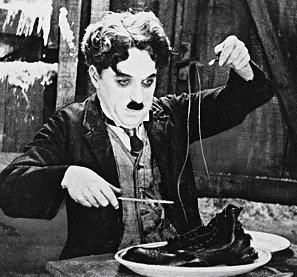
or, starving, devours his own shoelaces
with gusto.
From the waist up, starch and aspirations;
below, a startled mouse
runs down his trousers.
I’m sure
that’s what they call real entertainment.
A crazy chase in circles
ends up pursuing the pursuer.
The light at the end of the tunnel
turns out to be a tiger’s eye.
A hundred disasters
mean a hundred cosmic somersaults
turned over a hundred abysses.
If there are angels,
they must, I hope,
find this convincing,
this merriment dangling from terror,
not even crying Save me Save me
since all of this takes place in silence.
I can even imagine
that they clap their wings
and tears run from their eyes
from laughter, if nothing else.
From The End and the Beginning (1993), trans. Stanisław Barańczak and Clare Cavanagh
As the shoelace-devouring Chaplin put it (at least I think it was him), ‘life is a tragedy when seen in close-up, but a comedy in long-shot’. It all depends where you are standing, and who is observing.
The How and Why of Spuds (1920), National Archives Collection
This year’s Northeast Historic Film’s Summer Symposium takes place 25-26 July, at Bucksport, Maine. Northeast Historic Film collects, preserves, and makes available to the public, film and videotape of interest to the people of northern New England, and holds an annual symposium which focuses on regional film, much of it amateur, and stretching back to the 1920s. This year’s theme is City & Country:
Images and archetypes of the city and the country as seemingly distinct locations and ways of life have remained a potent force in the cultural imagination since the mid 19th century. Even though the transformations of industrial culture and mobility have changed rural and urban landscapes and lifestyles, the ideas and images associated with the City and the Country continues to thrive as traditional poles of modern experience. They are where we anchor the dreams and fears of technology and tradition, and where we are animated by hopes of progress and the comforts of nostalgia. As Raymond Williams noted of this powerful duality, “the contrast of country and city is one of the major forms in which we become conscious of a central part of our experience and of the crises of our society.”
It is with sadness that I have to report the death of John Barnes, film historian, collector, curator and filmmaker. John is best known for the five volume series The Beginnings of Cinema in England, 1894-1901, his unparalled study of the earliest years of English cinema. Begun in 1976, completed in 1998, it is as much a work of archaeology as historiography. John’s real passion was for the technology of film in the 1890s, and he was prodigious and exhaustive in tracking down every kind of motion picture machine from the period, explaining its distinctive qualities, tracing its use and recording its ownership.
Around this deep understanding of the technology of the era, he weaved stories of the personalities of the time (his great hero was Robert Paul, whose battles with fellow pioneer and rival Birt Acres he recorded with journalistic fervour), the modes of exhibition, and especially the films – each volume of his history contained filmographies of the whole of British film production for one year, information gleaned from catalogues, journals, posters, flyers, and a host of other sources. Details of hundreds of films from this era have been identified from Barnes’ work alone, a huge benefit to scholars and film archivists alike. An era of cinema that previously had been idly documented and frequently misinterpreted was enriched by an exhaustive study that has inspired a huge range of subsequent studies. No one has been able to write about this period of cinema history without reference to the works of John Barnes. He found the material, provided the signposts, and his work remains the sure foundations on which all other research in the field must be built.
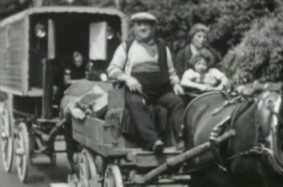
With the Gypsies in Kent (c.1938), film by John and Bill Barnes, from Screen Search
John and his twin brother William (who survives him) were born in 1920 and discovered film during the 1930s, becoming enthusiastic amateur filmmakers while still at school. Two of their films, Gems of the Cornish Riviera (1936) and Cornish Nets (1938) featured at the Pordenone silent film festival in 1997, the year in which both were awarded the prestigious Prix Jean Mitry for services to silent film scholarship. Eighteen of their silent films are now held by Screen Archive South East in Brighton, including The Wheat Harvest (c.1935), In the Garden of England (c.1938) and With the Gypsies in Kent (c.1938), clips from which can be seen on the Archive’s Screen Search site.
On leaving school the brothers studied film design and technique at Edward Carrick’s AAT film school, at which time they began collecting Victorian optical toys and associated literature, often frequenting the bookshops of London’s Cecil Court which three decades before had been ‘Flicker Alley’, home to the nascent British film industry. They hatched a plan to collect artefacts and documents that would trace the history of motion pictures from the 17th to the 20th centuries, an ambition put on hold while they served in the Royal Navy during the Second World War.
After the war, the brothers moved to St Ives in Cornwall, where Bill opened a second-hand bookshop. It was in rooms above this shop in 1951, during the Festival of Britain, that the brothers put on the first exhibition of their film history artefacts, the success of which encouraged them to collect all the more. This was at a time when relatively little was appreciated about pre-cinema tchnologies, and John’s great work was not simply to collect such objects but to understand them, explain them and to be able to contextualise them. Eventually the bookshop was closed and the brothers sold by catalogue alone, supplying books and artefacts to scholars and film museums around the world.
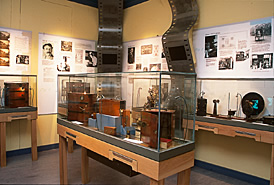
Objects collected by John and Bill Barnes now in Hove Museum
In the 1960s, while Bill went filming overseas, John and his wife Carmen (who also survives him) opened the Barnes Museum of Cinematography in St Ives. This famous collection attracted film scholars from around the world, and its catalogues became treasured documentary sources as serious interest grew in the roots of cinema. Collecting continued, and many objects were lent to museums around the world or formed the subject of illustrations in numerous text books. The Museum never found a London home, as John had hoped, and closed in 1986, its pre-cinema holdings going to the Museo Nazionale del Cinema in Turin, while much of the remainder is now housed in Hove Museum, near Brighton.
But John’s greatest monument is The Beginnings of the Cinema in England. The series began in 1976 with the book of that title, which documented the arrival of film in England, 1894-1896. Establishing his style, the book traced the history through the machinery, out of which followed the personalities involved, the modes of exhibition, and a thorough filmography for the period. It would be hard to underestimate the value this book (which was revised and republished in 1998) to the early cinema specialist. It simply defined a period. Subsequent research has built on his work, and occasionally challenged its findings (Barnes’ arguments around the so-called ‘Paul-Acres camera’), but those solid foundations remain. It was followed by volumes doggedly documenting the cinema in Britain (he wavered between England and Britain in his descriptions) for 1897 (perhaps his best work), 1898, 1899 and 1900, the whole series eventually being republished in a uniform edition by University of Exeter Press in 1998. While the original volumes are quite rare, the re-issued set can be found relatively easily and cheaply and is strongly recommended to any serious student of early film. In the historiography of British film, only Denis Gifford and Rachael Low can match John Barnes’ achievements.
John Barnes devoted his life to the history of cinema. He was as much a pioneer in his field as were those whose lives and technologies he championed in theirs. He faced innumerable battles with publishers and institutions, but that all goes with the part played in being an independent scholar-collector. His knowledge, unfailing help and sturdy friendship were valued by scholars and enthusiasts around the world, and his parting (he died on June 1st) will be recognised as a huge loss. But few of us who work in this field will be able to leave behind so much of such solid and lasting value: objects rescued, identified and their importance recognised; documents saved, preserved and republished; films identified and treasured; and books written that preserve the knowledge of a lifetime and which will benefit research for many years to come.
I’ll finish with a section from a review I made of The Beginnings of Cinema in England when the series was republished, as it rather sums things up for me:
Enthusiasm is the key to John Barnes’ history. Perhaps the chief reason why this area of film studies is so vital, is that in the hearts of its enthusiasts it is as if it were happening now. While other areas of academic cinema history seem doomed to atrophy, as films that were once entertaining no longer entertain, Victorian cinema is alive with debate and discovery … This is perhaps Barnes’ greatest achievement, to have achieved the trick that film has always claimed to do, to abolish time. Thanks to the finest work of empirical early film history that there is, the cinema of the 1890s is very much with us still.
Silent films and bedroom painting
Such is the title of an unlikely combination of 1910s non-fiction films and an exhibition of recent abstract paintings. Together they make up an exhibition at the Lab at Belmar, in Lakewood, Colorado. Silent Films features a continuous programme of travelogue, scientific and industrial films on three side-by-side screens, placing them outside of their historical context and highlighting their beauty and mystery. Learn more
Between the Devil and the deep blue sea
On stage at the Studio, Sydney Opera House, 17-28 June is Between the Devil and the Deep Blue Sea, a fusion of theatre and silent film by British theatre company 1927, who take their name from the year of The Jazz Singer. The show was a hit at last year’s Edinburgh Festival Fringe, and comprises ten ‘fractured fairy tales’ by writer, director and performer Suzanne Andrade, with animated sequences by Paul Barritt. Learn more
And finally…
Canadian experimental filmmaker Deco Dawson is enjoying a retrospective of his work. Inspired by silent films like his fellow Canadian Guy Maddin, Deco says, “What I appreciated about those early silent films is they really didn’t know how to make movies yet …” The Bioscope despairs. Learn more (if you must)