The Metropolis case

Fritz Rasp as the spy Schmale © Friedrich-Wilhelm-Murnau-Stiftung; Bildbearbeitung: Dennis Neuschäfer-Rube

A day on from all the excitement of the news that a print of the previously ‘lost’, complete Metropolis had been found in Argentina, the dust has settled a little, and more information has filtered through. So here’s a round-up of the film’s history, the discovery of the print, and why the news is so significant.

Let us travel to the year 2026, not so far away now. The giant city of Metropolis is maintained by a slave army which runs the machines which served the pampered ruling class. Freder, son of the city’s ruler, is captivated by a beautiful woman, Maria, and in following her discovers the horrors of the underground life of Metropolis. Maria is a figurehead for the restless workers, and Freder’s father instructs the scientist Rotwang to build a robot in her image so that the workers will follow ‘her’ and be duped into avoiding revolution. But the robot goes beserk and incites a rebellion. Eventually the workers see how they have been misled. They destroy the robot, while Freder, his father and Maria are reunited in happiness, Capital and Labour united at last. So, your typical tale of twenty-first century life.

Such was the vision conjured up by German film director Fritz Lang and his scenarist wife Thea von Harbou for the 1927 film Metropolis, one of the most ambitious, expensive (for the German film industry) and iconic of all silent films. However, at the time it was something of a flop with audiences. The industry reponded as the industry will, and cut the film drastically, to the extent of losing scenes essential to the film’s dramatic logic. Some 950 metres were removed; almost a quarter of its original length. The film at its original length of 4189 metres (147 mins at 25fps, though there is argument over the correct running speed) was therefore only seen for a short while (until May 1927 in Berlin); thereafter a cut version of around 113 mins was all that could be seen, and – so far as posterity aware – all that had survived thereafter, despite various restored versions being produced, most recently that overseen by Enno Patalas in 2001 (which runs at 118 mins).

Move forward to 2008. Paula Félix-Didier, newly installed as curator of the Museo del Cine in Buenos Aires, learns from her ex-huband (director of the film department at the Museum of Latin American Art) of a curiously long screening of a print of Metropolis at a cinema club some years before, a print which was now believed to be in the Museo del Cine. According to ZEITmagazin, which has reconstructed the story, one Adolfo Z. Wilson, who in 1928 ran the Terra film distribution company of Buenos Aires, had secured a copy of the full length version of Metropolis for screening in Argentina. A copy then found its way into the hands of film critic Manuel Peña Rodríguez. In the 1960s he sold the film to Argentina’s National Art Fund, with seemingly neither party to the deal realising the unique value of the film. A print (on 16mm) then came into the hands of the Museo del Cine in 1992. Sixteen years later, Paula Félix-Didier found it.
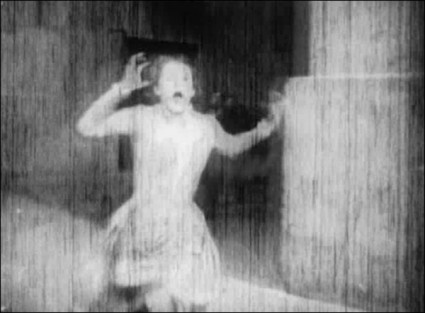
Maria (Brigitte Helm) flees from the mob © Friedrich-Wilhelm-Murnau-Stiftung; Bildbearbeitung: Dennis Neuschäfer-Rube

Félix-Didier then acted with care. Rather than announce the discovery in Argentina (where, apparently, she believed it would not attract so much attention) she chose to have the discovery announced in Germany, where the film had been produced, and where the Friedrich-Wilhelm-Murnau-Stiftung had been responsible for the most recent restored version of the film. She also had a friend who was a journalist for ZEITmagazin, which is how it ended up getting the exclusive and the stills which reveal that the print is indeed a well-worn 16mm copy, but whose very murkiness and lack of sharpness seem only to add to their haunting quality. (Word is that the stills are frame grabs from a DVD copy, so they look a little worse than the print actually is)

So, what is it that we have? What was found was a 16mm dupe neg of virtually the entire original version of Metropolis, minus just one scene, that of a monk in a cathedral, because it happened to be at the end of a reel that was badly torn (this information from Martin Koerber of the Deutsche Kinemathek, via the AMIA-L discussion list). The original 35mm nitrate print is lost. Precise details of the missing scenes (which were cut by the film’s American distributors, Paramount) are unclear, but it is reported that they reveal why the real Maria is mistaken by a rampaging mob for the robot created in her image; the significance of the role of the spy Schmale (played by Fritz Rasp), who pursues Freder, is made clear; and the scene where the workers’ children are saved by Freder and Maria towards the end of the film is revealed to be far more dramatic, and violent (a likely reason for its having been cut in the first place).
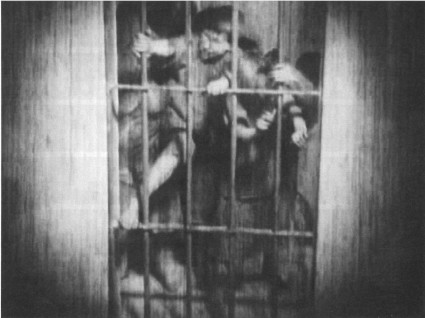
From Ain’t it Cool News, showing the trapped workers’ children trying to escape flood waters

And what will happen now? The above-mentioned restored version was produced in 2001, and has been made available on DVD in deluxe editions by Kino and Eureka. There is also a study or critical edition available from the Filminstitut der Universität der Künste Berlin. Kino recently announced that it would be issuing Metropolis on high-definition Blu-Ray early in 2009 – how will the news affect their plans?. The Friedrich-Wilhelm-Murnau-Stiftung has announced its intention to produce a ‘restored’ version, which would presumably simply mean inserting the relevant ‘lost’ sequences into the existing 35mm restoration. The reports from those who have seen the rediscovered print all indicate how coherent the complete work is, and hence how logically the extra scenes would slot in. Of course, there would be a somewhat brutal shift from pristine 35mm to battle-worn 16mm, but other such attempts at full restorations have shown similar changes in image quality where only inferior material remains, and the effect is not so jarring. Far more important will be the realisation of a story – and of one of the twentieth-century’s masterpieces of art in any form – made whole again. But what will get released, in what form, and when – it’s too soon to say.

© Friedrich-Wilhelm-Murnau-Stiftung; Bildbearbeitung: Dennis Neuschäfer-Rube

Where to find out more:

One last thought. What other lost silents might be lurking in South American film archives, perhaps not as thoroughly investigated as their North American cousins, but a territory where many American prints will inevitably have turned up? After such a tremendous discovery, we can only be greedy for more.

Update (4 July): Today in Argentina journalists were shown extracts from the rediscovered print of Metropolis. Photographs show that they were shown a DVD with brief clips. Reports indicate that the clips they were shown were (i) a worker who has exchanged clothes with Frederer gets in a car and drives to Yoshiwara, Metropolis’ red-light district; (ii) Smale, the spy following Frederer, at a newspaper stand; (iii) the robot Maria is seen in Yoshiwara; (iv) Frederer and the real Maria rescue the workers’ children, including scenes where the children are seen trapped behind bars as the flood water rise.

According to Digital Bits, Kino are intending to include the rediscovered new sequences in their already-announced Blu-Ray release of Metropolis from early next year, though it is surely too early for such confident pronouncements.

Further update (12 February 2010): For a report on the restored film’s premieres and the latest news news, see https://bioscopic.wordpress.com/2010/02/12/the-new-metropolis/.

Lost version of Metropolis discovered

Previously lost scene showing Maria fleeing, from the rediscovered print of Metropolis, from http://www.zeit.de © Friedrich-Wilhelm-Murnau-Stiftung; Bildbearbeitung: Dennis Neuschäfer-Rube

The wires are a-buzzing with the sensational news that a 16mm print of a lost version of Fritz Lang’s Metropolis has surfaced in Argentina, which may well be the original cut – around a quarter of the original film is missing from existing prints. The German newspaper Die Zeit has reported the news and published a gallery of startling images from the previously lost sequences of the film.

Word is that the Friedrich-Wilhelm-Murnau-Stiftung will work with the Museo del Cine Pablo C. Ducros Hicken in Buenos Aires on restoring the lost scenes, but it’s too early for any concrete details. More information is promised is tomorrow’s Die Zeit, meanwhile, here’s a press release (in somewhat quaint English) from the Friedrich-Wilhelm-Murnau-Stiftung:

Sensational discovery in Buenos Aires: Lost scenes from “Metropolis” rediscovered

Staff members of the Museo del Cine Pablo C. Ducros Hicken in Buenos Aires, found the missing scenes which had been considered lost up to now, in a 16mm Negative.

The tale of the concision of “Metropolis” is well-known. The film is renowned for the story of its restoration which began in the 1960s in the national Film archive of the German Democratic Republic, to the source critical reconstruction of the Film museum Munich (E. Patalas) in the 1980s, up until the film was digitally restored through Mr. Martin Koerber on behalf of the Friedrich-Wilhelm-Murnau-Stiftung, Wiesbaden in the year 2001. This restoration, which is based on the version of the Film museum Munich and on materials of the Bundesarchiv-Filmarchiv (Federal Archive / Filmarchive), Berlin, was completed not only with these two institutions but also with other partners of the Deutscher Kinematheksverbund (Association of German Film Archives)

In addition to this, Enno Patalas developed a study version of the film in collaboration with the University of Arts in Berlin. They supplemented the survived fragments in their original relation to the film in written form or with pictures and musical resources.

Because of these survived sources, the hiatuses which weren’t able to be found even after decades of research in national and international Film archives and private converts, were sorely cognizant. Pictures gave us the impression of what was missing – the to a supernumerary reduced figure of Georgy, the man named Slim, Josaphat, the car journey through Metropolis, the observation of Georgy through Slim, Freders delirium of Slim in which he changes into a apocalypse preaching monk. With this discovery in Buenos Aires these scenes will finally come back to life. Even if the quality of the picture is in a deplorable condition, thanks to the Argentinean material, the dream of the completion of “Metropolis” will finally come true.

According to Anke Wilkening, restorer of the Murnau Foundation “Hitherto incomprehensible is now intelligible, the sometimes puzzling relations of the figures among each other now make sense.” The story of the instauration can now come to an end.

Helmut Poßmann, managing director of the Murnau Foundation states that: “In continuance of the restoration from 2001, the Murnau Foundation would very much like to compile a complete version of the film together with the former partners and the Museo del Cine Pablo C. Ducros Hicken in Buenos Aires and to open it to the public, all the more because “Metropolis” is the first film which has been affiliated in this restored version from 2001 – safety lug Nr. 1 – to the Memory of the World register of the UNESCO.”

“This sensational discovery places the Murnau Foundation into a position being able to restore the film to a very large degree. That way it could be achieved to come as close to the masterwork of Fritz Lang as never before possible and present it to the world”, says Eberhard Junkersdorf, head of the board of trustees.

For the past 42 years the Friedrich-Wilhelm-Murnau Foundation has applied itself to save, preserve, restore and reconstruct a bulk of the German cinematic heritage of 2.000 silent films, 1.000 talkies and about 3.000 filmlets (commercials, documentaries, etc.) from the beginning of film up to the 1960s, trying to make these films accessible to the public.

Among films as “Metropolis”, German classics like “Das Cabinet des Dr. Caligari”, “Nibelungen”, “Der blaue Engel”, “Die Drei von der Tankstelle”, “Münchhausen”, “Große Freiheit Nr. 7“ just as a multitude of productions of important German-speaking directors such as Friedrich Wilhelm Murnau, Fritz Lang, Ernst Lubitsch, Detlef Sierck, Helmut Käutner and Wolfgang Liebeneiner.

The current extensive restoration project is Fritz Lang’s monumental film “Die Nibelungen” which is planned to premiere with a new musical score at the Berlin Film Festival in 2010.

Truly wonders will never cease, and lost films will only remain lost until someone finds them. More news here as it emerges.

Update: There’s more news, including a history of the print’s rediscovery and further images, in The Metropolis case follow-up post.

Pen and pictures no. 4 – Evelyn Waugh

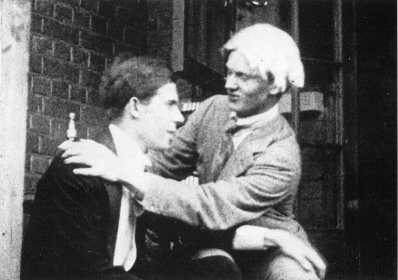
Evelyn Waugh (right) and John Greenidge in The Scarlet Woman

The subject of the latest in our series on literary figures and silent film is unusual in that his significant engagement with film preceded his first book publication. Evelyn Waugh was twenty-one, had just come down from Oxford, and was working on a novel, The Temple of Thatch (which was never to be completed), when he became involved in films.

Waugh was both fascinated and repelled by cinema. He professed a lowly opinion of films and commercial film production, but he was a compulsive filmgoer throughout his life (as his diaries reveal), and was fascinated by the narrative qualities of the medium. Such qualities he admired when appropriated in the literary works of others (Ronald Firbank, Graham Greene), and encouraged in other would-be writers, as in this 1921 exhortation to his friend Dudley Carew:

Try and bring home thoughts by actions and incidents. Don’t make everything said. This is the inestimable value of the Cinema to novelists (don’t scoff at this as a cheap epigram it is really very true). Make things happen. … Whatever the temptation, for God’s sake don’t bring characters on simply to draw their characters and make them talk. Fit them into a design. … It is a damn good idea. Don’t spoil it out of slackness or perversity but do MAKE THINGS HAPPEN. Have a murder in every chapter if you like but do do something. GO TO THE CINEMA and risk the headache.

Waugh found inspiration in films not for pictorial values as such, but in what he saw films could offer in terms of narrative design and continuity, of montage, propulsion, and changing fields of vision. Moreover, Waugh the satirist was inspired by film’s propensity for exposing falsity through display. As George McCartney (in Confused Roaring: Evelyn Waugh and the Modernist Tradition) puts it, ‘the medium’s peculiar perceptual qualities seemed to express just those unquestioned assumptions of his age that he most wanted to satirize’. Waugh would first experiment with filmic devices in his fiction in the 1926 short story ‘The Balance’, which uses scene directions and titles in the manner of a silent film, but before then he had engaged directly in exploring film’s potential to expose human folly.

One of Waugh’s Oxford friends, Terence Greenidge, was an enthusiastic member of the university’s cinema club and had acquired a 16mm camera. Greenidge made several satirical amateur films in early to mid-1920s, including 666, The Mummers, and The Cities of the Plain, in the first and third of which at least Waugh acted, for the latter as a ‘lecherous black clergyman’. None of these films is known to survive. Greenidge later wrote of the new-found enthusiasm for cinema among Oxford undergraduates at this time:

After ‘The Cabinet of Doctor Caligari’ had been shown in our city there was only one topic of conversation at gatherings of the Aesthetic individuals for several weeks to come. Finally undergraduates began to turn to the big task of film-production itself. Various nomadic groups made several vigorous little burlesques, negligible from the point of view of artistic quality, but capable of raising a good laugh in the University clubs wherein they were shown – and at any rate films.

One of Greenidge’s films does survive, however: The Scarlet Woman: An Ecclesiastical Melodrama. As the titles of the lost films indicate, religion was a favourite target, and for The Scarlet Woman Waugh provided the scenario, as well as acting in the film. It is a ribald satire on the Roman Catholic church, concerning as it does the attempt of the Dean of Balliol to convert the English monarchy to Catholicism. Waugh was of course to convert to Catholicism just a few years later, which gives The Scarlet Woman a particular piquancy, the final rebellious assault of one more drawn to the religion than he knew.

With £6 put up by each of the leading performers to finance the production, filming started in July 1924 and lasted largely until September, though the film was not ready for showing until November 1925, when it received its premiere in Oxford. We know a fair bit about the film’s production, from Waugh’s autobiography A Little Learning and the diaries, where he wearily records that he was quite disgusted with how bad it was. However, such disdain has an air of show about it: in A Little Learning, his brief account of the film’s production does refer to ‘the fun of our venture’, particularly noting his father’s delight in the amateur theatrical nature of the filming, recognising his own possessions being used as props. In the film Waugh acts his two parts with gusto. He plays the Catholic Dean of Balliol, a real figure of Waugh’s acquaintance whom he had come to despise, depicting him as a blonde-wigged homosexual with designs on the Prince of Wales; Waugh also plays the impecunious peer Lord Borrowington. Other performers John Sutro as Cardinal Montefiasco, Waugh’s writer brother Alec Waugh, as the cardinal’s drunken mother, Lord Elmley as the Lord Chamberlain, Guy Hemingway as the Pope, John Greenidge as the Prince of Wales, and Terence Greenidge as a Jesuit priest.

Elsa Lanchester and Evelyn Waugh in The Scarlet Woman, from An Evelyn Waugh Website (www.abbotshill.freeserve.co.uk)

What makes the film exceptional, apart from Waugh’s contribution, is the appearance of the young Elsa Lanchester. The same age as Waugh, the precocious Lanchester ran a London club called The Cave of Harmony, which Waugh often frequented. Playing the drug-addicted actress Beatrice de Carolle, who attracts the Prince of Wales away from the lascivious Dean, she clearly demonstrates the talent that would see her in Hollywood ten years later, married to Frankenstein’s monster. The film was shot in Oxford, on Hampstead Heath, and in the Waugh family’s Hampstead back garden. Waugh recalled that his publisher father was delighted at this new extension of the notion of amateur theatricals:

My father fully appreciated the fun of our venture … he delighted to find the cast at his table and when the film was shown him took particular satisfaction in recognising his own possessions. ‘That’s my chair’ … ‘Take care you don’t break that decanter.’

The film was first shown at the Oxford University Dramatic Society, where the future composer Lennox Berkeley provided the music accompaniment with gramophone recordings. A second screening was requested by the Society of Jesus at Campion Hall. Showing that the Catholic Church could take a joke, Father C.C. Martindale sanctioned a subtitle that remains on the print: ‘Nihil Obstat – projiciatur – C.C. Martindale SJ’. It was only ever shown among friends and private groups. Greenidge retained a copy, exhibiting it from time to time, and it resurfaced in the 1960s and is now preserved by the BFI National Archive.

The Scarlet Woman (which runs for 45mins) is both a juvenile jape, and an extraordinary window into the evolution of a satirical mind. Elsa Lanchester’s fevered performance raises it to a level that sometimes matches its pretensions, and makes it watchable today. It is an amateur film in perfomance, costumes, sets, picture quality and so forth, but judged on its own merits it has survived remarkably well. Waugh published his first novel, Decline and Fall, in 1928, and became a Roman Catholic in 1930. In the 1930s he worked for a time for Alexander Korda writing film scenarios (of which the title Lovelies from America indicates the wild improbabilty of any of Waugh’s work ever being produced). He was never involved in film production again, but offered a vicious satire of Hollywood life and the American way of death in his novel The Loved One.

More information on the film’s production can be found on the Evelyn Waugh Newsletter vol. 3 no. 2 (1969), which has much information on its rediscovery in the 1960s and records all of the intertitles, and on the Evelyn Waugh Newsletter and Studies vol. 33 no. 2 (Autumn 2002), which has a detailed description of the film’s action. Both are available online. The Scarlet Woman is available on DVD from Charles Linck, P.O. Box 3002 TAMU-C, Commerce, Texas 75429, USA, email linck [at] tamu-commerce.edu (earlier VHS copies were transferred at sound speed; the DVD corrects this). It can also be seen for free by anyone passing through London at the BFI Mediatheque on the South Bank.

Time travelling

The Time Travellers of 1908, from http://www.gmfilm.co.uk

I’ve added a new section among the links for Modern Silents, a subject that, as regulars will know, has been covered here from time to time. Modern silents until recently were occasional curiosities (Le Bal), spoofs (Silent Movie), imitations of slapstick (The Plank), eccentricities (Juha) or lacked dialogue merely because they featured dinosaurs (One Million Years B.C.). But the arrival of cheap digital equipment, broadband and YouTube has encouraged experimentation in this field (as it has in so many others). More than that, there seems to be growing interest in the stylistic tropes of silent cinema as an means of expression today among a number of accomplished filmmakers, of whom the Canadian Guy Maddin is the best known.

The Bioscope will continue to pay attention to such work, so let’s kick things off afresh by looking at Martin Pickles. He is a British filmmaker, whose G.M. Film site is named after his 2001 film G.M., which took its title and inspiration from Georges Méliès. Pickles does not produce pure silent films so much as work with the aesthetic and historiography of silent film in creating some of his own work.

Take, for example, Time Travellers of 1908. This short film follows two explorers, using a time-machine shaped like a movie camera, as they visit 21st century London. It was shot entirely on Edwardian hand-cranked cameras with original lenses, and the soundtrack recorded on a 1909 Edison phonograph. There is a real sense of modern London viewed anew (is it accident or ingenuity that makes their first shot of modern London a view of Trafalgar Square taken from much the same spot as Wordsworth Donisthorpe chose for his proto-movie of 1890?)

Or there’s G.M. itself, in which an Edwardian gentleman (looking not unlike Georges Méliès) is tormented by spirits who appear through holes in the wallpaper. In the simple but effective Camera Obscura a man dreams of a ballet dancer but finds himself literally tied to his office desk. And Trafalgar Square makes another appearance in Century’s End, a ‘film-poem’ of London filmed between midday and midnight on 31 December 1999, shot on 16mm at 16fps but telecine-ed at 25 fps, as Pickles says, ‘in order to give it the jerky look of an old Edwardian film’. One would usually protest at the notion of silent films being jerky and run at the wrong speed, but here the choice is knowing and apposite.

All these and more are available as QuickTime movies on the G.M. Film site, with background explanations on their production, rationale and funding. All are short, all are ingeniously creative. Seeing such work makes you realise how silent films will continue to have a creative life because they represent a form of artistic expression which is now set in time. They constitute a vision of things, a discrete way of telling stories, that will always have an appeal to some filmmakers. There was far more to silent films, even (or especially?) early silents, than the relatively simple aesthetic referenced in Pickles’ films, but what matters here is not the pastiche but the acknowledgment from today of a particular way of seeing things. They are an act of time travelling, whether we view the originals or whether we endeavour to imitate them.

I’ll keep on the lookout for more such filmmakers, and would welcome any recommendations.

The Silent Film Bookshelf

The Silent Film Bookshelf was started by David Pierce in October 1996 with the noble intention of providing a monthly curated selection of original documents on the silent era (predominantly American cinema), each on a particular theme. It ended in June 1999, much to the regret to all who had come to treasure its monthly offerings of knowledgeably selected and intelligently presented transcripts. The effort was clearly a Herculean one, and could not be sustained forever, but happily Pierce chose to keep the site active, and there it still stands nine years later, undeniably a web design relic but an exceptional reference resource. Its dedication to reproducing key documents helped inspire the Library section of this site, and it is a lesson to us all in supporting and respecting the Web as an information resource.

Below is a guide to the monthly releases (as I guess you’d call them), with short descriptions.

October 1996 – Orchestral Accompaniment in the 1920s
Informative pieces from Hugo Riesenfeld, musical director of the Rialto, Rivoli and Critierion Theaters in Manhattan, and Erno Rapee, conductor at the Capitol Theater, Manhattan.

November 1996 – Salaries of Silent Film Actors
Articles with plenty of multi-nought figures from 1915, 1916 and 1923.

December 1996 – An Atypical 1920s Theatre
The operations of the Eastman Theatre in Rochester, N.Y.

January 1997 – “Blazing the Trail” – The Autobiography of Gene Gauntier
The eight-part autobiography (still awaiting part eight) of the Kalem actress, serialised over 1928/1929 in the Women’s Home Companion.

February 1997 – On the set in 1915
Photoplay magazine proiles of D.W. Griffith, Mack Sennett and Siegmund Lubin.

March 1997 – Music in Motion Picture Theaters
Three articles on the progress of musical accompaniment to motion pictures, 1917-1929.

April 1997 – The Top Grossing Silent Films
Fascinating articles in Photoplay and Variety on production finance and the biggest money-makers of the silent era.

May 1997 – Geraldine Farrar
The opera singer who became one of the least likely of silent film stars, including an extract from her autobiography.

June 1997 – Federal Trade Commission Suit Against Famous Players-Lasky
Abuses of monopoly power among the Hollywood studios.

July 1997 – Cecil B. DeMille Filmmaker
Three articles from the 1920s and two more analytical articles from the 1990s.

August 1997 – Unusual Locations and Production Experiences
Selection of pieces on filmmaking in distant locations, from Robert Flaherty, Tom Terriss, Frederick Burlingham, James Cruze, Bert Van Tuyle, Fred Leroy Granville, H.A. Snow and Henry MacRae.

September 1997 – D.W. Griffith – Father of Film
Rich selection of texts from across Griffith’s career on the experience of working with the great director, from Gene Gauntier, his life Linda Arvidson, Mae Marsh, Lillian Gish and others.

October 1997 – Roxy – Showman of the Silent Era
S.L. Rothapfel, premiere theatre manager of the 1920s.

November 1997 – Wall Street Discovers the Movies
The Wall Street Journal looks with starry eyes at the movie business in 1924.

December 1997 – Sunrise: Artistic Success, Commercial Flop?
Several articles documenting the marketing of a prestige picture, in this case F.W. Murnau’s Sunrise.

January 1998 – What the Picture Did For Me
Trade publication advice to exhibitors on what films of the 1928-1929 season were likely to go down best with audiences.

February 1998 – Nickelodeons in New York City
The emergence of the poor man’s theatre, 1907-1911.

March 1998 – Projection Speeds in the Silent Film Era
An amazing range of articles on the vexed issue of film speeds in the silent era. There are trade paper accouncts from 1908 onwards, technical papers from the Transactions of Society of Moving Picture Engineers, a comparative piece on the situation in Britain, and overview articles from archivist James Card and, most importantly, Kevin Brownlow’s key 1980 article for Sight and Sound, ‘Silent Films: What was the right speed?’

April 1998 – Camera Speeds in the Silent Film Era
The protests of cameramen against projectionsts.

May 1998 – “Lost” Films
Robert E. Sherwood’s reviews of Hollywood, Driven and The Eternal Flame, all now lost films (the latter, says Pierce, exists but is ‘incomplete and unavailable’).

June 1998 – J.S. Zamecnik & Moving Picture Music
Sheet music for general film accompaniment in 1913, plus MIDI files.

July 1998 – Classics Revised Based on Audience Previews
Sharp-eyed reviews of preview screenings by Wilfred Beaton, editor of The Film Spectator, including accounts of the preview of Erich Von Stroheim’s The Wedding March and King Vidor’s The Crowd, each quite different to the release films we know now.

August 1998 – Robert Flaherty and Nanook of the North
Articles on the creator of the staged documentary film genre.

September 1998 – “Fade Out and Fade In” – Victor Milner, Cameraman
The memoirs of cinematographer Victor Milner.

October 1998 – no publication

November 1998 – Baring the Heart of Hollywood
Somewhat controversially, a series of articles from Henry Ford Snr.’s anti-Semitic The Dearborn Independent, looking at the Jewish presence in Hollywood. Pierce writes: ‘I have reprinted this series with some apprehension. That many of the founders of the film industry were Jews is a historical fact, and “Baring the Heart of Hollywood” is mild compared to “The International Jew.” [Another Ford series] Nonetheless, sections are offensive. As a result, I have marked excisions of several paragraphs and a few words from this account.’

December 1998 – Universal Show-at-Home Libraries
Universal Show-At-Home Movie Library, Inc. offered complete features in 16mm for rental through camera stores and non-theatrical film libraries.

January 1999 – The Making of The Covered Wagon
Various articles on the making of James Cruze’s classic 1923 Western.

February 1999 – From Pigs to Pictures: The Story of David Horsley
The career of independent producer David Horsley, who started the first motion picture studio in Hollywood, by his brother William.

March 1999 – Confessions of a Motion Picture Press Agent
An anonymous memoir from 1915, looking in particular at the success of The Birth of a Nation.

April 1999 – Road Shows
Several articles on the practive of touring the most popular silent epics as ‘Road Shows,’ booked into legitimate theatres in large cities for extended runs with special music scores performed by large orchestras. With two Harvard Business School analyses from the practice in 1928/29.

May 1999 – Investing in the Movies
A series of articles 1915/16 in Photoplay Magazine examining the risks (and occasional rewards) of investing in the movies.

June 1999 – The Fabulous Tom Mix
A 1957 memoir in twelve chapters by his wife of the leading screen cowboy of the 1920s.

And there it ended. An astonishing bit of work all round, with the texts transcribed (they are not facsimiles) and meticulously edited. Use it as a reference source, and as an inspiration for your own investigations.

A thousand imbeciles together in the dark

A call for papers has gone out for the 3rd Edinburgh International Film Audiences Conference, which will take place 26-27 March 2009 at the Filmhouse, Lothian Road, Edinburgh. Taking its cue from a line by Billy Wilder, the conference takes as its theme “Is the audience ever wrong? Exploring the worlds of film audiences.”

The conference is interested in all kinds of empirical research into film audiences, from any time period and any country. This is area of ever-increasing importance in film studies generally, as evidenced by a body such as the HOMER Project which is dedicated to research into cinema audiences, and particularly silent cinema, as demonstrated by such online projects as Cinema Context and the London Project, and publications from Richard Abel, Melvyn Stokes et al (some of these were listed in a recent post on The Birth of a Nation)

Here’s the full call:

“An audience is never wrong. An individual member of it may be an imbecile, but a thousand imbeciles together in the dark – that is critical genius.” Billy Wilder made this comment about audiences but just how much do we know about what film audiences think and how often are they credited with being geniuses or more often seen as imbeciles? Empirical research into film audiences is a small but developing field and this conference continues its aim of providing a space where those involved or interested in this area can come together to share research findings and discuss future ideas. Whilst the conference will appeal primarily to academics it is not confined to them. Previous conferences have had contributions from those directly involved in the film industry and this is to be welcomed. We are very pleased to announce that the opening and closing speakers have been confirmed. The opening speaker is Professor Ian Christie, from the School of Art, Film and Visual Media, Birkbeck, University of London. He is Vice President of Europa Cinemas, an EU funded organisation which supports exhibitors throughout Europe who show European films, and a Trustee of the Independent Film Parliament. He is also a regular reviewer and broadcaster on film matters. The closing speaker is Dr Sean Perkins. He has been Research Executive at the UK Film Council since 2001. His research interests include UK and global theatrical markets, the UK video and online markets, film on television and film audiences. He has managed research projects on the impact of local cinema and a qualitative study of avid cinemagoers.

There is only one criterion for proposed papers: they should be concerned with empirical research into film audiences. The audiences can be anywhere in the world and for any genre of film. They can be historical pieces of work that explore the construction of film audiences through governmental policy or pieces that look at the construction of fans via archival material. We are happy to receive abstracts from students and new researchers as well as established researchers no matter what their background is.

The conference takes place over two days in the heart of Edinburgh. One of the main attractions for participants is that we only run single track sessions – no more difficult decisions about who to go and listen to or the awful experience of presenting to just a couple of people whilst everyone else has gone to hear the famous speaker! Everyone is guaranteed a decent audience plus 30 minutes to present their paper followed by 15 minutes of questions – and we are very proud of our reputation regarding time-keeping.

Abstracts of no more than 300 words should be submitted as virus-free MS Word or rtf attachments, to Dr Ailsa Hollinshead no later than 31st August 2008. Abstracts will be reviewed by external referees and all contributors will be notified of the outcome by 30th September 2008. Copies of the conference paper will have to be with Dr Hollinshead by mid January 2009. There will be a bursary for the best student paper, which can include undergraduates as well as postgraduates (subject to proof of status). Successful candidates will be expected to book a place within one month of their paper being accepted. Costs and application forms can be obtained from the conference website.

More information is available on the conference website, including abstracts from last year’s conference.

Convening with Buster

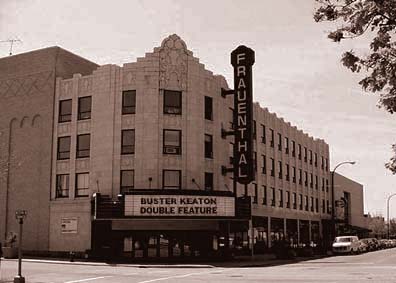
Frauenthal Theatre, Muskegon, from http://www.silent-movies.org/2008

The 14th Annual International Buster Keaton Society Convention, organised by that excellent crowd the Damfinos (if you have to ask you haven’t watched enough Keaton films yet) will be held 3-4 October, in Muskegon, Michigan (Keaton home town). Attendees this year are promised the exclusive screening of “a radically different print of a silent Keaton feature not shown anywhere in over 80 years”. Other highlights include the lost film from the 1957 stage production of Merton of the Movies in which Keaton starred, presentations on assortedl aspects of Keaton’s career, an authors’ panel featuring George Wead, David Macleod and Imogen Smith, author of the new book Buster Keaton: The Persistence of Comedy, screenings including a double bill of Battling Butler and The Navigator, plus a baseball game played on the same ground used by Buster when a child.

Full information on the convention, registration and acommodation from www.silent-movies.org/2008.

Urban dreams

Dundas ‘n’ Bathurst, from http://www.youtube.com/user/TUFFyear1

It’s good news to be able to report the return of TUFF, the Toronto Urban Film Festival. TUFF is an eight-day public film festival held in Toronto, which features urban-themed one-minute films, all of which have to be silent. Last year’s inaugural festival (reported by the Bioscope) produced some remarkably high quality entries – as an example of which, do take a look at 2007’s overall prize winner, the dazzling Dundas n’ Bathurst (an area of Toronto) by Charuvi Agrawal and Jeffrey Tran, or visit the YouTube site which hosted the 2007 entries.

The festival invites entries covering all genres of film, video, and animation from both trained professional, and untrained amateur, artists and filmmakers. National and international submissions are welcomed. Every entry has to fit in with one of the festival’s themes, which this year are:

* Urban Encounters – the moments that make city-living worthwhile
* Urban Fears – the darker side of living in a metropolis
* Urban Growth – from skyscrapers to suburban sprawl
* Urban Imaginary – hopes for the future of municipalities
* Urban Natural – the living city, both nurtured and oppressed
* Urban Secrets – stories about the hidden or forgotten city
* Urban Travels – from taking public transit to practicing Parkour

As stated, all submissions must be silent and exactly 60 seconds in length. The deadline for submissions is 1 July 2008, and the festival itself runs 5-12 September 2008. Films selected by the jurors for each thematic category will play on Toronto’s network of 250 TTC subway platform screens repeatedly during one day of the festival. All selected films will also be eligible to be posted on the festival website, for viewing and voting throughout the festival, as well as for future viewing. Filmmakers can also opt to have their film added to the TUFF YouTube collection.

Finally, not only is it free to submit, but the filmmakers retain rights, and receive $150 per selected film – $75 for taking part in TUFF on the TTC, and $75 for being a part of the website. Full details of how to enter can be found on the festival website.

What an excellent venture, further evidence of the rude health of the silent film today. I’ll publish more on it at the time of the festival itself.

Pixar goes silent

http://www.youtube.com/user/WallEMovie

The new Pixar animation film WALL-E is released soon, and there has been much made of how the virtually dialogue-free film, about a lonely robot left alone on an earth that has been vacated by humanity, is like a silent film. Without having seen it, I can’t judge, but its debt to silents is acknowledged by director Andrew Stanton, in this interview with the Baltimore Sun:

Even for Pixar, a company that thrives on new frontiers, WALL-E is a gutsy next move. It’s the first dystopian parable that’s actually ecstatic fun. It’s also the closest Pixar has come to making a full-length silent movie.

The choice of hero is audacious: a beeping, whirring Waste Allocation Load Lifter, Earth class, or WALL-E. For long, unbroken, startlingly seductive stretches, we see him navigate an abandoned American city all by himself. (He does have a pet cockroach.) Thanks to him, towering ziggurats made of trash compacted into cubes have sprouted up among malls and skyscrapers.

WALL-E‘s director, Andrew Stanton says he didn’t let the silence of these sections stymie him.

To Stanton, “WALL-E is not a silent movie that just happens to have sound, it’s a regular movie that just happens to use unconventional dialogue. My methodology, from the script on, was no different than it was approaching any ‘regular’ movie. It’s like I was dealing with a hero who spoke French all the time.”

Squat and scrappy, with binocular-like eyes that are as warm and eloquent as Bambi’s, WALL-E looks like a cross between R2D2 and a Cubist portrait of a geek. He’s the sole and surprisingly spirited survivor of a mammoth cleanup operation.

After Earth grew clogged with trash, the all-consuming Buy N Large corporation sent the human population into outer space and left behind a mechanical janitorial super-service to make the globe inhabitable once again. But these plans went awry (if they ever were sincere at all), and the one trash-compactor left is WALL-E, who has developed curiosity, survival skills and surprising wells of emotion – and expresses them with little more than a crook of his articulated elbows or a shift of his bifurcated head.

Stanton’s love for silent movies gave him confidence. “You just want to make sure the visuals and the acting carry as much information as possible because people’s senses are going to be a little more focused on them without dialogue.”

Stanton wrote the script with Jim Reardon, an old friend and college classmate who directed 35 episodes of The Simpsons.

“We put dialogue in brackets: We knew we would be swapping it out with something else to convey it. … so I wrote what I expected them to ‘say.’ ”

The influence of silent films on Pixar has been pronounced from the beginning. When I interviewed Stanton 13 years ago at Pixar’s old Point Richmond headquarters in the San Francisco Bay Area (the company has since moved to nearby Emeryville), he told me, “Buster Keaton is God.”

Despite Stanton’s devotion to Keaton, Charlie Chaplin’s Tramp may be the silent clown who hovers over the plucky and poignant WALL-E. Stanton agrees that in addition to “hundreds of other films,” WALL-E has a touch of Chaplin’s Modern Times: in content, as “an indirect comment on one possibility of the automation of humanity and losing your soul.” And in style, too – Modern Times (1936) was a silent made in the sound era, with a music track, sound effects, gibberish and only a smattering of English.

And just as Modern Times, despite its mordant view of modern industry, became Chaplin’s cheeriest film because of the Tramp’s romance with “a gamin” (Paulette Goddard), WALL-E became Pixar’s most piquant and satisfying film because of WALL-E’s courtship of EVE, the svelte Extra-terrestrial Vegetation Evaluator sent from the Buy N Large mother ship to see if plants have started growing again on Earth.

EVE helped Stanton locate the core of the movie and also simply added to the pantomimed fun: “I already had one ‘person” who spoke a different language than I did, and now he’d fall in love with someone of a different nationality who spoke another language.”

Read the rest of the article here. And there’s a whole raft of WALL-E promo videos on a YouTube channel if you want to test further the notion of modern silents.

Broncho Billy rides again

http://www.nilesfilmmuseum.org/festival2008.htm

The 11th Annual Broncho Billy Festival takes place 27-29 June, at the Niles Edison Theater, Fremont, CA. This year the festival marks the 100th anniversary of the formation of the Motion Picture Patents Company, that monopolistic organisation which sought to control all film production, distribution and exhibition in America, by programming titles from seven of the founder American companies that formed the MPPC: Edison, Selig, Kalem, Vitagraph, Lubin, Biograph and Essanay.

Here’s the programme:

Friday Evening, June 27

6:00 – 7:00 PM “Meet and Greet” at the Fremont Bank Building, 37611 Niles Blvd.
Reception for our historians & special guests “All Film Festival Pass” holders are invited to attend.

7:30 – 8:00 PM Opening remarks, Hubbard Award, Acknowledgements
8:00 – 10:00 PM Main Program – Films from EDISON
The Salt of the Earth – Russell Simpson, William Wadsworth (1917)
The Great Train Robbery – G.M. Anderson, Justus D. Barnes, Walter Cameron (1903)
The Passer-By – Marc MacDermott (1912)
The Simp and the Sophomores – Raymond McKee, Oliver Hardy (1915)
Bruce Loeb at the piano

Saturday Early Afternoon, June 28

12:30 – 2:30 PM Films from SELIG
Little Lost Sister – Bessie Eyton, Vivian Reed, George Fawcett (1917)
A Tale of the Sea – Hobart Bosworth, Tom Santschi (1910)
Captain Brand’s Wife – Sydney Ayers, Tom Santschi (1911)
Legal Advice – Tom Mix, Victoria Forde (1916)
Philip Carli at the piano

Saturday Afternoon, June 28

3:30 – 5:30 PM Films from KALEM
A Flyer in Flapjacks – Ham and Bud (1917)
Girl From Frisco (Episode 1): The Fighting Heiress – Marin Sais, True Boardman (1916)
The Fatal Opal – Paul Hurst, Marin Sais (1914)
The Vampire – Harry Millarde, Marguerite Courtot, Alice Hollister (1913)
David Drazin at the piano

Saturday Evening, June 28

7:30 PM – 10:00 PM Films from VITAGRAPH
Playing Dead – Mr. & Mrs. Sidney Drew (1915)
A Tintype Romance – Florence Turner, Leo Delaney (1910)
Omens of the Mesa – Robert Thornby, Anne Schaefer (1912)
The Egyptian Mummy – Constance Talmadge, Billy Quirk (1914)
Dunces and Dangers – Larry Semon (1918)
Jon Mirsalis at the piano

Sunday Morning, June 29

A Niles Canyon Railroad Adventure:
Ride the historic Niles Canyon Railway, See Niles Canyon
as it looked in 1913. Ride the rails with fellow film fans.

Sunday Afternoon, June 29

1:00 PM – 3:00 PM Films from LUBIN
A Man’s Making – Richard Buhler, Rosetta Brice (1915)
Beloved Adventurer Episode 8: A Partner in Providence – Arthur V. Johnson (1914)
Until We Three Meet Again – Harry Myers (1913)
Judy Rosenberg at the piano

Sunday Late Afternoon, June 29

4:00 – 6:00 PM Films from BIOGRAPH
Their First Divorce Case – Mack Sennett, Fred Mace (1911)
The Lonedale Operator – Blanche Sweet (1911)
A Dash Through The Clouds – Mabel Normand (1912)
An Unseen Enemy – Lillian and Dorothy Gish (1912)
Judith of Bethulia – Henry B. Walthall, Blanche Sweet (1914)
Philip Carli at the piano

Sunday Evening, June 29

7:30 – 9:30 PM Films from ESSANAY
The Madman – Francis X. Bushman (1911)
Broncho Billy’s Christmas Dinner – G.M. Anderson, Edna Fisher (1911)
Alkali Bests Broncho Billy – Augustus Carney, G.M. Anderson (1911)
The Shotgun Ranchman – Authur Mackley (1912)
Sophie’s Hero – Margaret Joslin, Augustus Carney (1913)
The New Church Organ – Francis X. Bushman, Beverly Bayne (1912)
Broncho Billy and the Claim Jumpers – G.M. Anderson (1915)
Versus Sledge Hammers – Ben Turpin, Victor Potel (1915)
Frederick Hodges at the piano

Full details as always from the festival website.