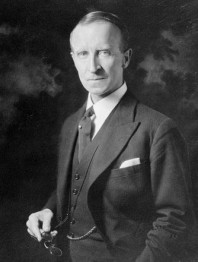
Pen and pictures no. 5 – John Buchan

For the next in our series of literary figures who became involved in their various ways with silent films, we turn to John Buchan, 1st Baron Tweedsmuir (1875-1940). Assorted films and television programmes have of course been made of Buchan’s popular novels, in particular The Thirty-Nine Steps, but it is not the adaptation of Buchan’s work that interest us here (almost all of which come after the silent era), but rather his probably unique contribution to film production – unique, that is, for a novelist. For during the First World War Buchan served as the head of the Department of Information, with responsibility for British propaganda, and consequently was the person ultimately responsible, at least for a time, for British official films of the war.

Though these things are partly a question of much contested definition, it is generally held that the arts of state propaganda, through use of the mass media, were established during the First World War, and that the British were the masters of those arts. Certainly the British were quick off the mark, seting up the covert War Propaganda Bureau under MP Charles Masterman within days of the outbreak of war. One of Masterman’s first acts was to invite a number of Britain’s leading authors to Wellington House (the Bureau’s London headquarters) to discuss how they could use their arts secretly (i.e. without anyone knowing that they were being guided by the government) to promote British interests. Those invited to the meeting on 2 September 1914 included Thomas Hardy, Arnold Bennett, G.K. Chesterton, Arthur Conan Doyle, Rudyard Kipling (who was unable to attend), H.G. Wells, John Galsworthy and J.M. Barrie.

The War Propaganda Bureau wanted to use the literary intelligensia for all the influence on hearts and minds that they could command, but Masterman was also interested in using film to target other audiences, and commissioned Charles Urban to produce a documentary feature, Britain Prepared (1915), which was exhibited around the world.

John Buchan was not yet of sufficient literary eminence to be named among Masterman’s greats, but he had political experience, having served as private secretary to Alfred Milner, the High Commissioner for South Africa. His African adventure novel, Prester John (1910), enjoyed great popularity, and The Thirty Nine Steps in 1915 made him famous. Buchan was increasingly courted by the British authorities, leading delegations and delivering lectures on behalf of the Foreign Office and the War Office. Meanwhile, the somewhat elitist approach of the War Propaganda Bureau was coming under increasing internal criticism (the public knew nothing of its existence). Buchan’s former mentor recommended Buchan to the new Prime Minister, David Lloyd George, and after Buchan had written a memorandum on propaganda for the cabinet in January 1917, a new Department of Information (DOI) was set up, with Buchan as its head.

British propaganda policy had originally targeted neutral nations, particularly America, with the hope that America might join Britain as combatant. Not long after Buchan took over, America did indeed join the war, but the need for a propaganda policy was felt all the more, now to persuade America of Britain’s contribution to the fighting, while seeking to keep a war-weary home audience convinced of the necessity of the struggle. Film had become an increasingly important aspect of this work, particularly as the emphasis shifted from convincing influential elites to persuading the masses.

Buchan was therefore in charge when an official newsreel was established, the War Office Official Topical Budget, a wide variety of actuality, documentary and instructional films were produced and distributed around the world (including the feature-length documentaries The Battle of the Ancre and The Battle of Arras), and production started on the fiction epic Hearts of the World, directed by D.W. Griffith. This was bold and committed policy, a world away from the general suspicion – if not contempt – that most of those in authority felt towards film (and its lowly audiences) at the start of the war. However, the DOI Cinematograph department battled throughout 1917 with the War Office Cinematograph Committee (WOCC), which produced most of the films, for overall control. The WOCC was run by Max Aitken, soon to be Lord Beaverbrook, who ultimately had greater political clout than Buchan. He took charge of British propaganda when he became head of a new Ministry of Information early in 1918, for the first time unifying the various conflicting strands of British war information policy (including film). Buchan became Director of Intelligence under him.

Buchan therefore had a strategic eye over film as a part of propaganda policy in 1917, but Beaverbrook (later to be a notorious newspaper magnate) was closer to the actual production of films, and ultimately did more with them. Nevertheless Buchan recognised the necessity and the potential effectiveness of film as a medium of persuasion. But, like most of his class, he found the medium had its ridiculous side. This sense of the absurd comes out in the Richard Hannay novel (Hannay is the hero of The Thirty-Nine Steps) that Buchan published in 1919, Mr Standfast.

In the novel, Hannay is being pursued and is running across Yorkshire moorlands when he stumbles across a peculiar scene, which gives us some insight into Buchan’s view of the industry with which he had to tangle:

Suddenly from just in front of me came a familiar sound. It was the roar of guns – the slam of field-batteries and the boom of small howitzers. I wondered if I had gone off my head. As I plodded on the rattle of machine-guns was added, and over the ridge before me I saw the dust and fumes of bursting shells. I concluded that I was not mad, and that therefore the Germans must have landed. I crawled up the last slope, quite forgetting the pursuit behind me.

And then I’m blessed if I did not look down on a veritable battle.

There were two sets of trenches with barbed wire and all the fixings, one set filled with troops and the other empty. On these latter shells were bursting, but there was no sign of life in them. In the other lines there seemed the better part of two brigades, and the first trench was stiff with bayonets. My first thought was that Home Forces had gone dotty, for this kind of show could have no sort of training value. And then I saw other things – cameras and camera-men on platforms on the flanks, and men with megaphones behind them on wooden scaffoldings. One of the megaphones was going full blast all the time.

I saw the meaning of the performance at last. Some movie-merchant had got a graft with the Government, and troops had been turned out to make a war film. It occurred to me that if I were mixed up in that push I might get the cover I was looking for. I scurried down the hill to the nearest camera-man.

As I ran, the first wave of troops went over the top. They did it uncommon well, for they entered into the spirit of the thing, and went over with grim faces and that slow, purposeful lope that I had seen in my own fellows at Arras. Smoke grenades burst among them, and now and then some resourceful mountebank would roll over. Altogether it was about the best show I have ever seen. The cameras clicked, the guns banged, a background of boy scouts applauded, and the dust rose in billows to the sky.

But all the same something was wrong. I could imagine that this kind of business took a good deal of planning from the point of view of the movie-merchant, for his purpose was not the same as that of the officer in command. You know how a photographer finicks about and is dissatisfied with a pose that seems all right to his sitter. I should have thought the spectacle enough to get any cinema audience off their feet, but the man on the scaffolding near me judged differently. He made his megaphone like the swan-song of a dying buffalo. He wanted to change something and didn’t know how to do it. He hopped on one leg; he took the megaphone from his mouth to curse; he waved it like a banner and yelled at some opposite number on the other flank. And then his patience forsook him and he skipped down the ladder, dropping his megaphone, past the camera-men, on to the battlefield.

That was his undoing. He got in the way of the second wave and was swallowed up like a leaf in a torrent. For a moment I saw a red face and a loud-checked suit, and the rest was silence. He was carried on over the hill, or rolled into an enemy trench, but anyhow he was lost to my ken.

I bagged his megaphone and hopped up the steps to the platform. At last I saw a chance of first-class cover, for with Archie’s coat and cap I made a very good appearance as a movie-merchant. Two waves had gone over the top, and the cinema-men, working like beavers, had filmed the lot. But there was still a fair amount of troops to play with, and I determined to tangle up that outfit so that the fellows who were after me would have better things to think about.

My advantage was that I knew how to command men. I could see that my opposite number with the megaphone was helpless, for the mistake which had swept my man into a shell-hole had reduced him to impotence. The troops seemed to be mainly in charge of N.C.O.s (I could imagine that the officers would try to shirk this business), and an N.C.O. is the most literal creature on earth. So with my megaphone I proceeded to change the battle order.

I brought up the third wave to the front trenches. In about three minutes the men had recognized the professional touch and were moving smartly to my orders. They thought it was part of the show, and the obedient cameras clicked at everything that came into their orbit. My aim was to deploy the troops on too narrow a front so that they were bound to fan outward, and I had to be quick about it, for I didn’t know when the hapless movie-merchant might be retrieved from the battle-field and dispute my authority.

It takes a long time to straighten a thing out, but it does not take long to tangle it, especially when the thing is so delicate as disciplined troops. In about eight minutes I had produced chaos. The flanks spread out, in spite of all the shepherding of the N.C.O.s, and the fringe engulfed the photographers. The cameras on their platforms went down like ninepins. It was solemn to see the startled face of a photographer, taken unawares, supplicating the purposeful infantry, before he was swept off his feet into speechlessness.

It was no place for me to linger in, so I chucked away the megaphone and got mixed up with the tail of the third wave. I was swept on and came to anchor in the enemy trenches, where I found, as I expected, my profane and breathless predecessor, the movie-merchant. I had nothing to say to him, so I stuck to the trench till it ended against the slope of the hill.

It is gentle mockery, and there’s a degree of sympathy for the filmmaking process, in that Hannay thinks that the scenes will impress their target audience, but also a touch of naivety in how he believes the director could so easily lose control of his own film. Was Buchan thinking of any director in particular? Griffith hardly seems to be the target, but maybe there is an element of Herbert Brenon, who late in 1917 (during Buchan’s time with the DOI) began filming another officially-backed but ill-fated feature-length fiction film, which was to have been called Victory and Peace (it was unfinished at the end of the war and was never exhibited). It was filmed in Chester with British troops used to portray Germans (the scenario was provided by Hall Caine, a once famous and now unreadable author, who was one of those invited to Masterman’s meeting on 2 September 1914). But I doubt that Brenon ever wore a loud-checked suit.

Buchan had some connection with the film business after the war, joining the board of British Instructional Films in 1925, and contributing to the script of one of the company’s acclaimed semi-documentary recreations of events from the war, The Battles of the Coronel and Falkland Islands (1927), directed by Walter Summers. His novel Huntingtower was filmed by George Pearson in 1928 (Prester John had been filmed in South Africa by African Film Productions in 1920).

Buchan could be argued to have had the greatest influence over film production of any author during the silent era, albeit for a year only. His political role in overseeing British official film production as an integral part of British propaganda policy had little connection with his fiction, but he treated the medium with greater respect than the comedy of the Mr Standfast scene might suggest. Nevertheless, the passage shows how Buchan intellectually remained at a remove from this popular, peculiar new medium, and it was Beaverbrook who showed the greater instinctive feeling for film, its audiences, and for the political arts of propaganda in general.

Feature attractions

The Cabinet of Dr Caligari, Kino DVD (left) and Republic Pictures Home Video laserdisc, from Steven Hill’s Movie Title Screens Page

Now here’s an epic undertaking, which some (most) may dismiss as mad, while the dedicated few may admire for its imagination and method. When I used to work as a cataloguer adding records to the BFI’s database, I used to ponder how useful – or at least interesting – it would be to have a frame grab of the title of a film appearing on the front page of a film’s record. It would help pinpoint the correct way of describing the film (except for such notorious example as Manhattan, which has no opening title, or Olivier’s Henry V, whose opening title is something quite different – go check), the source of possibly the most ruthlessly accurate of all film reference books, Markku Salmi’s National Film Archive Catalogue of Stills, Posters and Designs (1982). Even now (I will confess it), whenever I see a film title, something in me thinks, how useful if someone were to collect those. Ridiculous, yes, but surely useful, somehow.

And dang me if someone isn’t doing just that. Welcome to Steven Hill’s Movie Title Screens Page. Hill has taken on the task of publishing screen grabs of every film title frame that he can, mostly from VHS and DVD copies, giving title, year, director, image source, aspect ratio and Amazon link. Several films are represented more than once for different release versions. It’s arranged alphabetically, with no search option unfortunately, so there’s no immediate way of finding which silent titles are included, but silents there are. On quick inspection I found The Cabinet of Dr Caligari, The Cat and the Canary, The Manxman, The Adventure of Prince Achmed, The Gold Rush, The Golem, The Last Laugh, The Ten Commandments, Waxworks, London After Midnight (no kidding, it’s there) and many more.

Steven Hill has apparently been working on this for eleven years, and receives contributions from others dedicated to the cause. The Movie Title Screens page is but one section of his personal site, which has several other film sections, of which Fay Wray Pages has the most relevance to silents.

Anyway, a magnificent undertaking in its own way. And I’m sort of glad that he decided to take on the task, and not me.

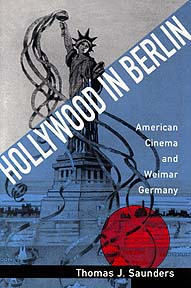
Hollywood in Berlin

The latest addition to the Bioscope Library is a welcome example of a modern film scholarship text made freely available online. Thomas J. Saunders’ study, Hollywood in Berlin: American Cinema and Weimar Germany, looks at the American film in Germany during the Weimar period. German films of the 1920s have been much championed and studied, in part as alternatives to American films of the period, but the focus here is on the considerable impact American comedies, serials, society dramas and historical epics had in Germany, and the debates they occasioned on the influence of cinema and the perils of Americanisation. Films covered include The Ten Comandments, The Hunchback of Notre Dame, Ben Hur and Greed, and the image and impact of Jackie Coogan, Mary Pickford, Harold Lloyd, Rudolph Valentino, Chaplin, Keaton and ‘slapstick’ in general. The book therefore looks at cultural and industrial relations between Germany and America in 1920s, through the prism of popular cinema, bringing together economic history, reception studies, film studies and social history.

The book has been published online in chapterised, word-searchable, web form as one of the California Digital Library’s eScholarship Editions, a welcome initiative to make sample scholarly text freely available online to demonstrate its range of publications. Another example from the same source, already in the Library, is Charles Musser’s Before the Nickelodeon. Academic publishers, where they are rich enough to do so, are increasingly experimenting with multi-platform strategies, making texts available in print, online by subscription or to a restricted group (many of the eScholarship Editions are available only to University of California staff and students), and a few titles (or sample chapters) available free to the public. It breaks down barriers, demonstrates the flexibility of text, encourages discovery. More such forward-thinking initiatives, please.

Early Chaplin

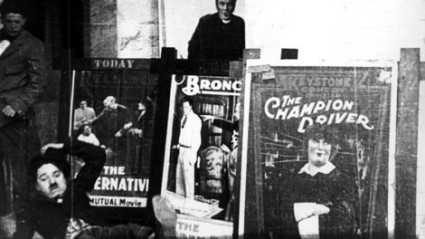
A Film Johnnie, from http://www.bfi.org.uk/southbank

Opening tomorrow at the BFI South Bank is the first month in a planned six-month retrospective of the work of Charlie Chaplin. The BFI National Archive, in partnership with the Cineteca di Bologna and Lobster Films, is restoring all of Chaplin’s films made for the Keystone company in 1914, as a follow-up to its earlier work on the Chaplin Mutuals. All of the surviving Keystones (Her Friend the Bandit remains lost) are being shown over August and September in nine programmes, as follows.

Here’s the blurb from the BFI site (and programme booklet):

The life of Charles Chaplin is the cinema’s greatest ‘rags-to-riches’ story. Bryony Dixon of the BFI National Archive presents a season of his early films showing how Chaplin became the world’s first movie megastar.

From the Victorian workhouse and the south London slums to the heights of Hollywood and movie stardom, the life of Charles Chaplin is cinema’s greatest ‘rags-to-riches’ story. It is less well known that the 20th Century’s greatest screen star was already a celebrity on this side of the Atlantic before he ever made a film. The fact is that we would never really have known the degree of Chaplin’s genius if he had not gone into films and if they had not survived.

The BFI National Archive, together with the Cineteca di Bologna and Lobster Films, is restoring all of Chaplin’s earliest films made for the Keystone company in 1914. These fascinating films document Chaplin’s rapid progress as a screen performer and director as well as furthering our acquaintance with a host of great comedians such as Mabel Normand, Roscoe Arbuckle, Edgar Kennedy, Ford Sterling, Al St John and Mack Sennett himself. The films – which have previously been seen only in mutilated copies – are brought back to life by painstaking restoration.

After acting in several Keystone films, Chaplin took control and directed most of his films thereafter. After 35 films for Keystone, Chaplin negotiated a better deal for himself with the Essanay Company and had a high degree of control over his comedies. He began to refine his character and further developed the ‘little tramp’ persona during his stay with the Mutual Company in 1916/17. It is during this period that many of his best-loved films were made. Chaplin described those years as the happiest of his life. In the following years Chaplin produced fewer but longer films for First National and in 1921 directed his first feature, The Kid.

This film more than any other laid the ghosts of his London childhood. Shortly after its release and after seven years of solid hard work and 72 films, Chaplin decided to go home for a visit. His reception on arrival in England was astounding.

Chaplin continues to be an important figure for us in Britain. His early films can illuminate our irretrievably lost comic traditions – they are an important part of our cultural heritage despite being made in the US. His life and works tell us about the development of screen comedy, about his adaptation of the music hall comedy of 19th century Britain to the 20th century American film, as well as recording the development of an individual artist and performer of genius.

As David Robinson, Chaplin’s biographer says, “The clothes he wears may have come from American sweat-shops; the streets in which he moves are at once no city and every city, but the origins of that hat and cane, boots and baggy pants, and shabby tenement streets, are unmistakably to be sought in his boyhood London.”

And here’s a list of the Chaplin Keystones being shown over August and September:

Programme 1: 9 & 13 August
Making a Living
Kid Auto Races in Venice, Cal.
Mabel’s Strange Predicament
Between Showers
A Film Johnnie

Programme 2: 16 & 20 August
Tango Tangles
His Favourite Pastime
Cruel, Cruel Love
The Star Boarder

Programme 3: 23 & 26 August
Mabel at the Wheel
Twenty Minutes of Love
Caught in a Cabaret
Caught in the Rain

Programme 4: 28 & 30 August
A Busy Day
The Fatal Mallet
The Knockout
Mabel’s Busy Day

Programme 5: 6 & 10 September
Mabel’s Married Life
Laughing Gas
The Property Man
The Face on the Bar Room Floor

Programme 6: 11 & 13 September
Recreation [fragment only]
The Masquerader
His New Profession
The Rounders
The New Janitor

Programme 7: 14 & 16 September
Those Love Pangs [incomplete]
Dough and Dynamite
Gentlemen of Nerve
His Music Career

Programme 8: 20 & 22 September
His Trysting Place
Getting Acquainted
His Prehistoric Past

Tillie Punctured Romance 21 & 24 September

Cinecon and Cinesation

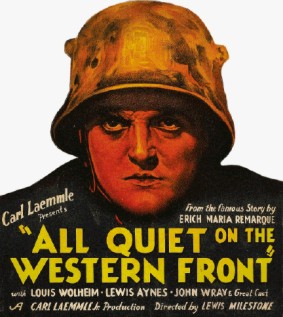
All Quiet on the Western Front, from http://www.cinephiles.org

In all these notices of upcoming silent festivals and the like, I’ve neglected two major American events in the calendar. So, as a quick catchup…

Cinecon
The Cinecon 44 Classic Film Festival takes place over Labor Day weekend, 28 August 1 September, in Hollywood. The festival feature nearly thirty silent and early sound features and multiple short subjects, with an emphasis on titles rarely given public screenings. This year’s lineup include Douglas Fairbanks in The Mollycoddle (1920), UCLA’s recent restoration of Tillie’s Punctured Romance (1914), Harold Lloyd in The Freshman, Larry Semon in Spuds (1927), Lon Chaney in a resotration of the long-lost Triumph (1917), Tom Mix in Sky High (1922) and Hobart Bosworth in The Blood Ship (1927).

Cinesation
The Cinesation film preservation festival takes place Film Preservation Festival 25-28 September, at the Lincoln Theatre, Massillon, Ohio. It also showcases silents and early sound features. The programme (particularly the short subjects) is still being finalised, but among the promised titles are Kenneth Harlan and Viola Dana in The Ice Flood (1925), Ken Maynard in The Grey Vulture (1926), Madge Bellamy in Soul of the Beast (1923), Oliver Thomas in Everybody’s Sweetheart (1920), Sessue Hayakawa in The Typhoon (1914), Lillian Gish in Sold for Marriage (1916), Constance Talmadge in Her Sister from Paris (1925) and the silent version of All Quiet on the Western Front (1930).

The truth is never quite what it seems

The Docker and the Rose, from http://www.liverpoolecho.co.uk

Showing at the National Theatre in London 12-15 August as part of its ‘Watch this Space‘ summer festival of outdoor entertainment is Movieplex, an entertainment that tells the story of a forgotten pioneer of Indian cinema, one Shanta Rao Dutt (1881-1987). Dutt, it seems, led a remarkable life. In 1896, when aged just 15, he witnessed a Lumière brothers’ film screening at the Watson’s Hotel, Bombay. Instantly struck by the magic of cinematography, Dutt – a porter at the hotel – discovering the unattended machine spooled with film ready for a demonstration the following morning, could not resist having a go for himself, and shot a film of the baby son of his landlord (‘negotiations are currently in progress between the Lumière estate and the Dutt family to release this print from the Lumière archive for public exhibition’). The prank got him fired from the hotel, but led him to pursue the Lumières to France.

There he was briefly employed by the brothers, before being fired for taking an unauthorised time lapse film. Undaunted, he worked for a time with Georges Méliès, before acquiring his own cinematograph camera. He returned to India in 1900, making films of his trip along the ay, then made a film of his brother Jeevan’s journey to Fiji as a bonded labourer (the only copy of the film was lost in a shipwreck). Dutt next took on commission from the British Raj, filmed in Japan, then went to England where he worked as a newsreel cameraman from Pathé, before joining British intelligence during World War One. He shot a film, The Docker and the Rose, in Liverpool in 1920, marrying its heroine. A copy was rediscovered in 2006. The Dutt family travelled to the Soviet Union in 1927 and met Eisenstein, then in 1933 Shanta founded the Movieplex company. He was knighted in 1945. The family continued its entrpreneurial activities, with one family member opening a cosmetic firm, and another opening the Movieplex Emporium on London’s Tottenham Court Road in 1975, selling VHS players. Shanta died in 1987, aged 106.

http://www.movieplex.biz

OK, enough of all this. You can follow the whole convoluted story, with chronology, genealogy, filmography and business promotions on the Movieplex site. The whole thing is a fiction, but one on which an extraordinary amount of effort has been spent. Aside from the main website and exhibition, there is a blog where an academic earnestly discusses Dutt’s films, a MySpace site from a young American fan who thinks Dutt was ‘some dude’, and a WordPress blog from a woman who says she is related to Dutt’s wife and has been researching the family history. Most brazenly, there is the previously ‘lost’ film The Docker and the Rose, an extract from which has been published on YouTube by the Liverpool Echo, which would appear from this press report to have fallen entirely for the story.

A 1920s tape discovered two years ago in a Wallasey antique shop was the inspiration for a major piece of outdoor art.

Movieplex is based on the work and life of lost filmmaker Shanta Roa Dutt and a nine-minute silent film, Docker and the Rose, which he made in Liverpool.

It was specially commissioned by Liverpool Culture Company and premieres in the city as part of The Imagine Festival which takes place next week.

The film was found in 2006 in the drawer of an Edwardian display box bought from an antique shop in Wallasey.

It was bought by Ajay Chhabra, co-artistic director of arts company nutkhut, who was in Liverpool with wife Simmy for the performances of Bollywood Steps.

He said: “My wife and I found the tape when antique hunting and borrowed equipment to watch it.

“We couldn’t believe what we had found.

“We decided we wanted to make it into a piece of outdoor art. Simmy and I enjoyed our time in Liverpool with Bollywood Steps so much and had made a number of friends, so we approached the Culture Company with the idea.

“They were very keen and commissioned us to go ahead. It seemed only right that a film made and based in Liverpool should come home in the Capital of Culture year.”

The specially commissioned piece of outdoor art features two containers, one with memorabilia from the Dutt family’s many films and history and the second a miniature cinema which shows the nine minute silent comedy.

A 1920s tape? Others have bought the story seemingly hook, line and sinker – for example, the Liverpool Post, Screen India and The Hindu. Even Manchester’s the North West Film Archive, as quoted in the press reports, has been ‘closely involved in the conservation and digital conversion of the film’, though one assumes they were rather less fooled than the papers and are playing along with the game.

What is going on here? The people behind the mischief are called nutkhut, a London-based ‘creative organisation’. Nutkhut in Sanskrit means ‘mischievous’, and nutkhut have applied considerable ingenuity to spinning a tale of enterprise and adventure, with just enough attention to plausible detail (the journey to Fiji, the VHS emporium in Tottenham Court Road) to dupe the unwary. In particular, the ‘lost film’ clips shows how many cannot tell an original from pastiche. Some of the publicity hints as an aside that not all may be as it seems, and the Movieplex website itself carries warning words on its banner – ‘The truth is never quite what it seems’. Others seem not to have realised this.

Why has it all been done? Apart from the impetus of Liverpool as a ‘City of Culture’ in 2008 (it was co-commissioned by Liverpool Culture Company Ltd), the show (or installation, or whatever exactly it might be) takes its inspiration from a general fascination with, but also confusion about, popular Indian culture in the West. There’s a story there of an independence of spirit, mixed with elements of film history vaguely known many, that has a quirky appeal. But is it good to publish so much false history? Will some hapless student end up trying to investigate The Docker and the Rose, or writing Dutt into a history of early Indian film? Is early film history just a game after all?

Movieplex plays at Theatre Square, the National Theatre, London 12-16 August, and Crawley Town Centre, 21-24 August. Exact times and other details are on the Movieplex site.

2nd International Silent Film Festival

Last year an unexpected and boldly-named addition to the world’s silent film festival was the 1st International Silent Film Festival, held in Manila in the Philippines. Well, one year on and here comes the 2nd International Silent Film Festival, to be held 26 August-8 September. Films are shown accompanied by live bands and again with ‘original scores’ (whatever that might mean). Here’s the programme:

FILMS WITH LIVE MUSIC
7pm, Shang Cineplex Cinema 1, Shagrila-la Plaza

Aug 26 The Black Man with a White Soul (El negro que tenía el alma blanca), Spain
music by Novo Concertante Manila
Aug 27 Cascading White Threads (Taki-no-shiraito), Japan
music by Bob Aves
Sep 2 Faces of Children (Visages d’enfants), France
music by JackRufo with Yosha
Sep 3 The Oyster Princess (Die Austernprinzessin), Germany
music by Noli Aurillo (with Louie Talan, Wendel Garcia and Kakoy Legaspi
Sep 4 Cabiria (Italy)
music by Caliph8 (with Malek Lopez and Matt Deegan)

FILMS WITH ORIGINAL SCORE
7pm, Shang Cineplex Cinema 1, Shagrila-la Plaza

Aug 28 Erotikon (Czechoslovakia)

FILMS WITH ORIGNAL SCORE
5pm, Listening In Style, 5/F Shangri-la Plaza

Aug 29 The Black Man with a White Soul (El negro que tenía el alma blanca), Spain
Sep 5 Cascading White Threads (Taki No Shiraito), Spain
Sep 6 Faces of Children (Visages d’enfants), France
Sep 7 The Oyster Princess (Die Austernprinzessin), Germany
Sep 8 Cabiria (Italy)

The International Silent Film Festival is back with a bigger and better lineup! This year, original participants Goethe-Institut Manila, Instituto Cervantes and Japan Foundation are joined by the embassies of the Czech Republic, France and Italy in treating moviegoers to screenings of classic silent films scored live by local bands. In addition, some of the films will also be shown with the original score in Listening In Style.

The German contribution to the festival is the 1919 Ernst Lubitsch film “The Oyster Princess (Die Austernprinzessin)”. In it, a pampered American oyster tycoon (Victor Janson) decides to find a prince to marry his daughter (Ossi Oswalda),but things don’t go quite as planned. Along the way, there are mishaps, misunderstandings and a foxtrot sequence that must be seen to be believed. Director Ernst Lubitsch was said to have “the Lubitsch touch”, a hard-to-define quality that makes his films masterpieces of sophisticated comedy. As this early and rare film makes clear, the Lubitsch touch was present almost from the beginning. Accompanying the film is a live score by legendary guitarist Noli Aurillo.

Other films to watch out for in the festival are “Cabiria” from Italy, “Erotikon” from the Czech Republic [sic], “Cascading White Threads” (Taki-no-shiraito) from Japan, “The Black Man With A White Soul” (El negro que tenía el alma blanca) from Spain and “Faces of Children” (Visages d’ enfants) from France.

The festival has grown in ambition from last year when there were just three titles screened, and it is impressively cosmopolitan in its range (interestingly, no American titles have been programmed). Further details on the Goethe-Institut Manila site.

For your selection

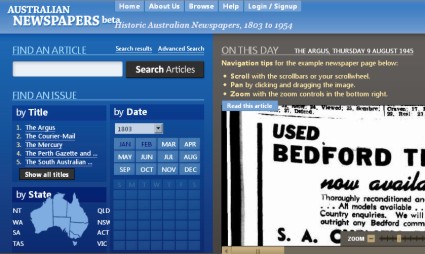
Australian Newspapers beta, http://ndpbeta.nla.gov.au/ndp/del/home

As regular readers will know, the Bioscope tries to keep an eye on the various newspaper and journal digitisation projects taking place around the world, some commercially-driven, some undertaken with public money. One long-awaited project has been the Australian Newspaper Digitisation Program, which has just reached the Beta test stage.

The National Library of Australia, in collaboration the Australian State and Territory libraries, is undertaking a huge, long-term programme to digitise out of copyright Australian newspapers. The aim is to produce a free online service allowing full-text searching of newspapers published in each Australian state an territory, from 1803 (when the first Australian newspaper was published, in Sydney), to 1954, when copyright kicks in (intriguingly late).

The programme is ongoing, but on 25 July a Beta service was released to the public, offering 70,000 newspaper pages from 1803 onwards, with additional pages to be added each week (as of 8 August there are 91,577 pages available). The service is very much in test mode, and they request that users provide feedback (while bearing in mind that the service is not official as yet).

So, how do we go about using it, and what is there to find on silent film? Simple search options are by any word within a text (uncorrected OCR), newspaper title (currently eleven on offer), state and date (with an attractively laid-out calendar option). You can use inverted commas to search on a phrase. The many advanced search options include combinations of terms, range of dates, length of article, and the option to search under types of article – advertising, detailed lists etc., family notices, news, and illustrated. You can also sort results by relevance, earliest or most recent date. In short, all the useful options that you would hope to see.

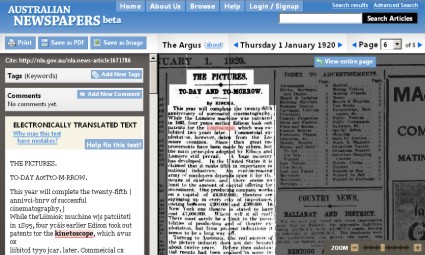
Article display page

Search results give a list of article titles with the name of the newspaper, date, page number and the first few lines of OCRed text. Most usefully, you are also given links for the same search term to the Australian National Bibiliographic Database and Picture Australia. The Article Display page, as illustrated above, shows the article with the search term highlighted, a zoom option and option to see the full page. On the left is the uncorrected OCR text, and options to add your own tags or comments (if you are logged in). And you can print, save as PDF, or save as image. Which pretty much covers everything.

On film subjects, there is plenty – though with some surprising gaps, probably explained by the absence of those editions yet to be digitised. Inevitably, there much to be found on the early Australian film business itself. So, our traditional text term ‘kinetoscope’ yields only two hits (both from the 1920s). ‘Charlie Chaplin’ scores 927, ‘Mary Pickford’ 600, ‘Norma Talmadge’ 175, ‘Kinemacolor’ 32, ‘Vitagraph’ 123, ‘Cinematograph’ 685, and so on. Turning to Australian silent films, good subjects to investigate include ‘On Our Selection’ (280, but that includes stage versions and the 1932 sound film as well as the 1920 silent), ‘West’s Pictures’ (281 for a renowned exhibitor), ‘Frank Hurley’ (83 for Australia’s national photographer), ‘Australasian Films’ (79 for the leading native film company) and ‘Raymond Longford’ (27 for the film director).

Finally, if you visit the Browse page, there’s a list of all the tags (keywords) that have been used to classify items – these include ‘classic movies’, ‘movie stars’ and ‘silent films’, but sadly only one article so far is so described. Time for us all to get tagging.

I’ll be doing a fresh round-up of newspaper digitisation sites some time soon. Meanwhile, go explore.

Social fears and moral panics

A call for papers has been issued for the next IAMHIST conference, due to be held in Aberystwyth, Wales, 8-11 July 2009, and incorporating the 3rd Gregynog Media History Conference. IAMHIST, or the International Association for Media and History, is an organisation comprising scholars, filmmakers, archivists and broadcasters interested in the intertwined themes of history and film (and television, and radio, and related media). It holds a conference every two years, and in 2009 the theme is to be ‘Social Fears and Moral Panics’ – certainly something with great potential for those engaged with the silent film era. Here’s how they describe it:

The aim of the conference is to explore both the role of the media in addressing, highlighting or perpetuating social fears, and the mass media itself as a perceived moral agent and/or threat. Topics to address might thus include questions of media content and/or language; concerns about public intrusion; censorship and the freedom of information; the reporting of crimes or disasters; invasion and security fears in times of peace or war; religious, cultural and/or linguistic fears; fears relating to youth or children, or to minority groups; fears relating to particular behaviours, pursuits or leisure activities; ‘golden ageism’.

We welcome paper proposals that address the theme in both contemporary and/or historical perspective; proposals which engage with the theme comparatively (both geographically and temporally); and proposals which engage with theoretical approaches, including the social theory of moral panic.

We also welcome proposals on their work in progress from postgraduate and early-career scholars in the field of media history, including on topics that may not be on the conference theme.

Proposals for complete panels (three themed papers) are welcome, as well as individual paper submissions. Papers presented at the conference should be 25-30 minutes in length and should use illustrative material (for instance film clips) wherever possible.

Abstracts of no more than 300 words per paper should be sent to Dr Sian Nicholas by 14 November 2008 at iamhist2009@aber.ac.uk c/o Department of History and Welsh History, Aberystwyth University, Penglais, Aberystwyth, Ceredigion SY23 3DY, Wales UK.

The conference is being organised by IAMHIST, in association with the Centre for Media History and Departments of History and Welsh History, and Theatre, Film and Television, Aberystwyth University, the Department of Media and Communications, Swansea University, and the journals Historical Journal of Film, Radio and Television and Media History, with the support of the National Screen and Sound Archive of Wales, National Library of Wales, Aberystwyth.

For further details, see the call for papers on the Aberyswyth University web site. For further information on IAMHIST and its many activities and interest, visit www.iamhist.org. And for the Bioscope’s take on last year’s conference, held in Amsterdam, on empires and such like, go here.

Incidentally, you do wish those planning such events took a look at the calendar (even the Bioscope’s calendar) first. There are now three conferences on history and the visual media taking place in Britain in July 2009 – the others are Visual Empires at the University of Sheffield, and Colour and the Moving Image at the University of Bristol. Come on somebody – show a little consideration, please.

Just like it was in the olden days

http://www.silentfilmfest.org.nz

Another day, another silent film festival. This time its New Zealand, and it’s the Silent Film Festival at Opitiki (‘Cinema – just like it was in the olden days’), which runs 5-6 September. Taking place in Opotiki’s Art Deco theatre, the festival encourages attendees to dress up in period style and travel in vintage cars. Piano accompaniment will be provided by Nick Giles-Palmer, and the films are accompanied by period shorts and newsreels courtesy of the New Zealand Film Archive.

Here’s the programme:

The Mark of Zorro 1920 ~ 93mins
In old Spanish California, the oppressive colonial government is opposed by Zorro, masked champion of the people, who appears out of nowhere with flashing sword and an athletic sense of humour, scarring the faces of evildoers with his Mark ‘Z’. Meanwhile, beautiful Lolita is courted by villainous Captain Ramon, rich but effete Don Diego… and dashing Zorro, who is never seen at the same time as Don Diego. As Zorro continues to evade pursuit, Ramon puts the damsel in distress…

Fairbanks’ prodigious athletic prowess and tremendous enthusiasm made the original movie a great success and enormous sets gave him plenty of room to swash and buckle in. His astonishing acrobatics amaze even modern audiences, particularly in the film’s climax.

Saturday 6th Sept ~ 7.30pm ~ Main Theatre ~ $14

It – starring Clara Bow 1927 ~ 77mins
Clara Bow, one of the most adorable actresses to grace the silent screen, stars in this delightful romantic comedy. As Betty Lou Spence a shopgirl at Waltham’s Department Store, she falls for her boss, the handsome Cyrus Waltham, Jr. and decides that he is to be her husband. With the help of his friend Monty and her own ‘It’ factor, Betty tries to win the man of her dreams.

Clara Bow’s vitality and sexiness defined the liberated woman of the 1920s and she became one of Hollywood’s brightest lights. Clara was known as The ‘It’ Girl. As well as representing sex-appeal, ‘It’ symbolized the tremendous progress women were making in society. Her dynamic performance as the cute, bubbly, down-to-earth Betty makes this film one of the most charming and entertaining silents as well as providing an interesting slice of history.

Saturday 6th Sept ~ 2pm ~ Main Theatre ~ $14

Venus of the South Seas 1927 ~ 77mins
Visited infrequently by the supply schooner ‘The Southern Cross’ lies the little island of Manea. The owner of the island has made a fortune in copra and pearl but more precious than all these treasures is his adored daughter – Shona, the most skilful diver in the South Seas. Romance blossoms when a yacht anchors in the mystic moonlit harbour and Shona swims out to meet it. A pearl pirate attempts to steal the pearls but is foiled by the young man Shona falls in love with.

Annette Kellerman, who plays Shona, was a champion diver and swimmer who made headlines in 1907 when she was arrested in Boston for wearing a one-piece bathing suit. The exterior scenes were filmed in Nelson, the interior in Christchurch.

Friday 5th Sept ~ 7.30pm ~ Main Theatre ~ $14

Intolerance 1916~3.5hr Spectacular!
Intolerance and its terrible effects are examined in four eras, spanning several hundreds of years and cultures. Themes of intolerance, man’s inhumanity to man, hypocrisy, bigotry, religious hatred, persecution, discrimination and injustice achieved in all eras by entrenched political, social and religious systems, create a spectacular and dramatic epic.

Director D.W. Griffith’s ambitious silent film masterpiece is one of the milestones and landmarks in cinematic history.

Saturday 6th Sept ~ 9.30am ~ Little Theatre
Includes buffet lunch.

Films of Opotiki
From the New Zealand Film Archives – a fascinating historical record of small town NZ.

A special compilation of films made by local electrician & projectionist John Wilkinson, between 1950-1974, forms most of this presentation. A fascinating record of Opotiki life they include films of the Opotiki port and the arrival of MV Waiotahi, dramatic scenes of thermal activity on White Island in 1956, terrible flood devastation in Opotiki and the clean-ups. Street parades, school kids in fancy dress and on floats, marching girls and Opotiki High performing the haka…and more. Another home movie by Ester and Deryk Rogers documents the cultivation of kumara at Maraenui in the 50’s. The programme begins with local personality, Epi Shalfoon, and His Melody Boys (1930) jazz band playing ‘E Puritai Tama e’.

By popular request, the programme concludes with the award winning short film, Two Cars One Night, (2003) made by Taika Waititi, which was filmed in the Te Kaha pub car park.

Friday 5th Sept ~ 1pm ~ Main Theatre ~ $14

Buster Keaton in ‘The Goat’ 1921 ~ 27mins
Madcap chases and hilarious displays of physical agility are the highlights of this frenetic Buster Keaton short. Dumb luck sets some policemen on his trail – after a series of innovative escapes, he gets mistaken for a murderer with a price on his head, which means the people that aren’t chasing him are fleeing from him. Nonstop laughter.

&

Harold Lloyd in ‘Sailor-Made Man’ 1921 ~ 46mins
Comedy great, Harold Lloyd, plays baseball-mad twerp ‘Speedy’ Swift. When his girl’s father insists that, before he will agree to Speedy marrying his daughter, he must first prove that he can do something more worthwhile than act the playboy, he joins the navy, just like that! Classic slapstick feature-length movie, especially in the final scenes.

Both showing together (total time: 75mins)
Fri 7th Sept – 11am and 4.30pm
Sat 8th Sept – 4.30pm
Sun 7th Sept – 11am, 1pm and 3pm

More details on booking, timetable, and a gallery showing how people have got into the spirit of things in past festivals can all be found on the site.