
The Bioscope is about to close down for a few hours, in order to undertake some necessary repairs behind the scenes. But fear not, we shall come springing back, hopefully looking much fresher, in just a short while. Return soon.
The Bioscope is about to close down for a few hours, in order to undertake some necessary repairs behind the scenes. But fear not, we shall come springing back, hopefully looking much fresher, in just a short while. Return soon.
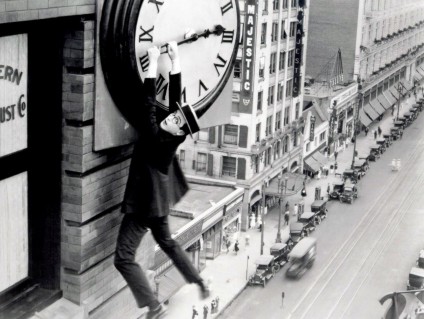
“This merriment dangling from terror…”: Harold Lloyd in Safety Last
The death has been announced of the Polish poet and Nobel prizewinner Wisława Szymborska. Her best-known connection with film is her poem ‘Love at First Sight’, which is believed to have been the inspiration for Krysztof Kieslowski’s film Three Colours: Red. However, in the same 1993 collection, The End and the Beginning, there is another Szymborska poem, ‘Slapstick’, which wryly considers silent film comedy as a metaphor for the human condition. We have reproduced this poem on the Bioscope before now, but it’s such a favourite of mine that I’m taking the liberty of posting it here once again on this sad occasion.
If there are angels,
I doubt they read
our novels
concerning thwarted hopes.I’m afraid, alas,
they never touch the poems
that bear our grudges against the world.The rantings and railings
of our plays
must drive them, I suspect,
to distraction.Off-duty, between angelic –
i.e. inhuman – occupations,
they watch instead
our slapstick
from the age of silent film.To our dirge wailers,
garment renders,
and teeth gnashers,
they prefer, I suppose,
that poor devil
who grabs the drowning man by his toupee
or, starving, devours his own shoelaces
with gusto.From the waist up, starch and aspirations;
below, a startled mouse
runs down his trousers.
I’m sure
that’s what they call real entertainment.A crazy chase in circles
ends up pursuing the pursuer.
The light at the end of the tunnel
turns out to be a tiger’s eye.
A hundred disasters
mean a hundred cosmic somersaults
turned over a hundred abysses.If there are angels,
they must, I hope,
find this convincing,
this merriment dangling from terror,
not even crying Save me Save me
since all of this takes place in silence.I can even imagine
that they clap their wings
and tears run from their eyes
from laughter, if nothing else.
I can warmly recommend Szymborska’s poetry in general – gentle, witty, accessible and wise. Her New and Collected Poems are published by Roundhouse, and there’s a fine Selected Poems published by Faber.

‘The pool, with the Old Man (1865?)’, animated GIF made with the NYPL Labs Stereogranimator
Now here’s something of tangential interest to us, but of interest nonetheless. The New York Public Library has a collection of around 40,000 nineteenth century stereophotographs – that is pairs of photographs designed to be looked at through a stereo viewer to give an illusion of depth. Such stereo viewers were hugely popular, and large numbers of stereo cards survive in archives and libraries.
The NYPL has opened up its collection online in an ingenious way. It has digitised the entire collection for anyone to browse, but the great pleasure of course is in seeing the images in 3D, as originally intended. So they have created an online tool, the Stereograminator (great name), enabling anyone to select a pair of images, to crop and resize them as appropriate, then to convert them into an animated GIF (you can choose slow, medium or fast for the alternation of the images) and 3D anaglyph (requiring 3D glasses, of course), with the results viewable to all via their online gallery.

Anaglyph version of the above
It’s an ingenious bit of popularisation through innovation, with a bit of what we in the library world rather painfully call ‘crowdsourcing’ i.e. getting you the public to do some of our documentation work for us. Here, with the help of site visitors, the NYPL will hope to have its entire collection converted into animated GIFs, such as the one above – and over 15,000 have been created already. Having created your GIF, you can then embed it in your blog or website, as I have done above. The resultant online gallery makes for odd viewing, with all of these images wobbling at you, but it’s addictive fun.
Other, static, nineteenth century stereograph images can be found online courtesy of the Library of Congress, Boston Public Library, and the University of Washington Libraries.

http://www.britishpathe.com (showing timeline option)
We return from our antipodean adventures with a number of developments in the silent film world to tell you about, the first of which is British Pathé’s new website. The company that now bears the name British Pathé has little connection with the original Pathé firm – the Pathé newsreel library in Britain was purchased by some venture capitalists a few years ago, but they have worked hard to raise the profile of the collection. This has included a high profile for Pathé clips on BBC television following a special footage deal, and the recent BBC4 television series on the history of the Pathé library.
British Pathé has also made energetic use of social media, blogging and tweeting with the best of them in a commendable effort to engage an online audience with archive film. This has now led to a re-designed website in which blog, Twitter feed and Facebook presence (6,634 people like them) are prominent on the front page alongside thematic selections of newsreel and cinemagazine footage. The British Pathé library amounts to some 3,500 hours (90,000 clips) ranging from the 1890s to the 1970s, and following a Lottery-funded grant in the early 2000s the whole collection was digitised and has been made freely available (in low resolution) to all ever since.
We have written about the non-fiction and (surprisingly enough) fiction films to be found on the Pathé site before now. What is new about ths site which is of particular interest to us is a timeline feature, which enables the researcher to select any time period, from one year to another by the use of a simple slider tool, making it easy to identify film from whichever part of the silent era interests us. The timeline tool doesn’t appear on the front page, but if you put in any search term, or simply click on ‘Search’ without having entered any term at all, you are taken to the search results page and the timeline appears. Use this to select the period 1890-1930, and you’ll find 16,875 relevant clips waiting for you. Alternatively, search for everything, then go to the Advanced Filters option on the right-hand side and select Videos with No Sound (there are 41,092 of them).
A warning or two is required when using the British Pathé site. The newsreel collection is reasonably well documented from 1918 onwards, but before then the collection is a mishmash of Pathé newsreels, bought-in footage, fiction films, unidentified material and all maner of oddities. A lot of it is not Pathé-produced (there are Lumière, Méliès, Hepworth, Eclair, Eclipse and other productions to be found). Many of these early items have only approximate dates and made-up titles, and often the catalogue records are more enthusiastic than historically informed. This can make Pathé an annoying site to browse, since they seem to know so little about such a significant corner of their collection, but it also provides the potential for some interesting discoveries for the knowledgeable researcher, because there is a lot there that is crying out for proper identification and appreciation.
Here are some of the unidentified fiction films that you might like to try and identify:
It can be difficult finding some of the undated films, since they won’t turn up by using timeline searches, but if you can find just the one fiction film and then search on its keywords, such as comedy or melodrama, then you’ll uncover more of these hidden fiction films.
For non-fiction and standard newsreels of the silent era, the British Pathé site is a joy. There is every personality, incident, location, fad, issue, fashion, talking point, invention and innovation you could wish for, from 1896-1930. With the timeline, categories and keywords, the British Pathé site has become all the more compulsively browsable, even if one could wish for a little less in the way of vague speculation among some of the catalogue records.
Go explore.
The Topical Budget newsreel shows Amy Johnson returning home to Britain following her epic solo flight to Australia
I will be close to the end of my Australian jaunt by now (he said, typing this on January 15th), and to finish things off, here’s a set of links to past posts on things Australian, which do demonstrate that we’ve been giving some attention to its silent film heritage over the past few years.
Back soon!
Here’s another in our series of interim posts on Australia and silent film, while I’m away in that country.
The subject is the Salvation Army, which played a very important part in the early Australian film industry. The video above comes from a DVD made by the Salvation Army today about its founder, William Booth – God’s Soldier. It includes a substantial amount of film of Booth, the founder of the Army, in the early years of the twentieth century, demonstrating how advanced the Army was in using new technologies (film, and as the clip demonstrates, motor cars) to spread the word. The film shows Booth’s motor tour through Britain in 1904 (unfortunately with added-on crowd noises and sound effects) but it was in Australia that the Booth family made such an impact with the visual media of the day.
I wrote a post on this four years ago, and it seems best to reproduce the substance of this, with updating of information and links where needed.
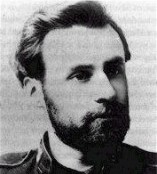
Many social interest groups and charities took an interest in using moving pictures to support their work, almost as soon as films were first made widely available on screen in 1896. None was more active in this area than the Salvation Army, particularly in Australia. There in 1896 Herbert Booth (left), rebellious son of William, joined Joseph Perry, who ran the Army’s Limelight Department. Together they added film to the Limelight Department’s multi-media show of Bible stories and uplifting instruction, which combined magic lanterns, photography, choral singing and sermons to create powerful, and hugely popular, narrative spectaculars. One such show, Soldiers of the Cross, first created in 1900, is sometimes cited as being the world’s first feature film, though in fact it was not a single film but rather a combination of slides, film, scripture and song. Moreover, it was preceded by an earlier effort, the two-and-a-half-hour Social Salvation (1898).
Booth and Perry built a glass-walled film studio at 69 Bourke Street, Melbourne in 1898. The room still exists as a archive and museum maintained by the army, with exhibits on the Limelight Department’s work. Initially they filmed with a Lumière Cinématographe, but by 1901 the were using a Warwick Bioscope. Soldiers of the Cross was exhibited across Australia, but Herbert Booth clashed with Salvation Army command in London, and left the Army in 1902, moving to San Francisco and taking Soldiers of the Cross with him. Perry continued in the film industry, increasingly making secular films, and continued as a film distributor into the 1920s.
William Booth himself made good use of film to propagandise for his cause. He had a film cameraman assigned to the Army, Henry Howse, who went with him to the Holy Land in 1905, and filmed many, if not all, of the early films of Booth featured in the God’s Soldier DVD. The original films are now preserved in the BFI National Archive.
There is an excellent site, Limelight, telling the story of the Limelight Department in Australia, based on a 2001 Australian Broadcasting Commission programme and exhibition. This has extensive information on the people behind the Limelight Department, the films they made and used, their tours, and the broader context of Australian early film history.
The National Film and Sound Archive in Australia has a feature on Soldiers of the Cross, which includes selections of the magic lantern slides that were a part of the show (none of the original film is known to survive, but the show did include some Lumière life of Christ films, which do survive).
The Who’s Who of Victorian Cinema site has biographical entries on Herbert Booth and Joseph Perry.
Much research has been done into the Salvation Army and its use of film in these early years by the American scholar Dean Rapp. His essay, ‘The British Salvation Army, the Early Film Industry and Urban Working-Class Adolescents, 1897-1918‘, in 20th Century British History 7:2 (1996), is well worth tracking down (it’s available online through academic subscription services).
Finally, the Salvation Army continues to make use of moving images, and has an active video unit.
We have written about the remarkable Corrick Collection before now. The Corrick Family Entertainer were performing troupe comprising Albert and Sarah Corrick and their eight children which toured Australia, New Zealand and South-East Asia between 1901 and 1914. Their act incorporated films, some shot by themselves, but mostly selected from the best offerings from French, American and British producers. Around 135 films survive in the National Film and Sound Archive of Australia, notable for their high quality and often exquisite colouring.
This video serves as an introduction to the family and the collection, with copious clips showing how the films serve as a primer for any keen to discovery the variety, inventiveness and delightfulness of early cinema. It’s a little odd in that it is entirely silent – not even music – but it is beautifully put together, and gives you all of the essential information, from the family history through to the film’s restoration.
For more information on the Corricks, see the australianscreen overview of the collection, the NFSA’s account of the films’ restoration, with film clips and interviews, or investigate newspapers, photographs, aticles and more on the Corricks via Australia’s peerless Trove database.
(Memo to the NFSA – you do know that the Corrick film in your collection which you continue to promote as Living London, made by Charles Urban in 1904, is in fact The Streets of London, made by Urban in 1906?)
Number two in our series of short posts on Australia while we happen to be away in said country is a quick look at the modern silent. Australia did produce a silent feature film in 2007, Dr Plonk, directed by Rolf de Heer, of Bad Boy Bubby infamy. It’s a slapstick, black-and-white comedy about a scientist from 1907 discovering that the world will end in 2008.
But instead, I recommend trying out Moonrise. This was made in 2010 by stuents from the Griffith Film School (great name for a place producing a silent film), Griffith University, Queensland. It’s a haunting, wry piece, simply done and nicely photographed in black and white. More people should have viewed it than has been the case up to now. Do take a look.
The first of our mini-posts on Australia and silent film (while we are away visiting the country) doesn’t feature the land of Australia at all. It’s some of the precious footage that survives of the disastrous Gallipoli campaign, in which many Australian and New Zealand troops died trying in vain to establish a sea route for Allied forces through to Russia.
The film was shot by British journalist (and later MP) Ellis Ashmead-Bartlett. Ashmead-Bartlett’s written reports aroused great passions, and were important in establishing the idea of the Anzac. He took a cine camera with him, and the resultant film, With the Dardanelles Expedition: Heroes of Gallipoli (1916), was shown in England, Australia and America, causing great consternation among the British authorities, for whom Ashmead-Barlett’s words and images were anything but helpful propaganda.
The film was acquired by the Australian War Memorial in 1919, and was restored in 2005 with help from Peter (‘Lord of the Rings’) Jackson. The above video is a three-minute sequence from the twenty-minute original.
Further clips with useful curatorial notes on the film can be found on the australianscreen site, which has a section devoted to Gallipoli on film generally.
An example of Ashmead-Bartlett’s reporting, covering the Anzac landing at Gallipoli, can be read on the Gallipoli and the Anzacs site, with extracts from his diary which mention his use of the cinematograph on the same site.
Film was also taken from the Ottoman Turk side, though it’s unclear by whom. The footage can be found on YouTube, though the original source is unclear, and certainly wasn’t consulted.

The Bioscope is going to be a little on the quiet side for the next couple of weeks, as I am heading off for Australia for a wedding, and don’t expect have much opportunity for blogging while I’m there.
However, to ensure that you are not left staring forlornly at the same post for a fortnight, I have set up some mini-posts (bloglets) which have been programmed to appear automatically at two-day intervals, each featuring an Australian-themed video with a bit of background information.
See you all again soon – and many congratulations of course to Liz and Dave.
 The Bioscope