Silent Chanel

cocochanel

Brad Koenig and Edita Vilkeviciute in Karl Lagerfeld’s Coco Chanel film

Let’s bring a little glamour to the sometimes rather fusty Bioscope, and take a look at the world of fashion. Because designer Karl Lagerfeld has made a ten-minute silent film about Coco Chanel, which premieres in Paris tomorrow. This article from Women’s Wear Daily Fashion provides us with the essential details:

A glamorous, big-budget short film of the silent variety will premiere in Paris this week, and it’s all due to Chanel and Karl Lagerfeld, who donned a director’s hat and let rip his encyclopedic knowledge of Gabrielle Chanel’s early years.

The 10-minute movie — in all its flapper glory, as these stills illustrate — will be screened at Le Ranelagh theater on Wednesday night, along with a showing of Chanel’s Paris-Moscow, a luxury pre-fall ready-to-wear collection embellished by the couture ateliers Chanel owns.

“Today, people are ready for silent movies again, as they spend time — hours, I would say — looking at text messages and e-mails,” says Lagerfeld. “I always loved silent movies.”

The designer gathered some familiar members of his entourage, including model Brad Koenig and his bodyguard/private secretary Sébastien Jondeau (mustachioed and surly as a Russian nightclub owner), for the cast, along with model Edita Vilkeviciute, her gamine allure, jutting chin and ramrod posture creating a beguiling portrayal of the young Coco from 1913, when the legendary designer first set up shop. As reported in WWD Nov. 17, Tallulah Ormsby-Gore plays a Chanel model who has to sell her real-life mother, Lady Amanda Harlech, a hat in the film. Even the workers in the Chanel atelier got to play parts as workers in the fashion house. “I cannot take extras,” Lagerfeld notes. “They don’t know how to touch the clothes.”

The second part of the film takes place in 1923, when Chanel was already established, and is interspersed with newsreel images from the First World War. The plot, conveyed with title cards, involves a fascinating cast of characters, many tied to Russia, including Chanel’s lover the Grand Duke Dmitri Pavlovich, from whom she borrowed the pea jacket and pelisse, giving them a feminine touch. “It’s a funny movie, unpretentious,” says Lagerfeld. “Chanel was a charming woman, at liberty to seduce men. Everybody this year has decided to make a movie about Chanel, and you know their historical worth is not always too exact.”

Lagerfeld’s mini movie took two days to shoot in a studio on the outskirts of Paris, and was “made like a Hollywood production,” the designer says. “I had every image in my head.” As for the collection he will show, he says it will be “constructed,” incorporating elements of imperial Russia and Russian folklore.

Well, I think we’re all pleased that Karl loves silent movies even if – were one to be cynical – he may not actually have seen one. And I’m impressed by the intellectual leap displayed when he says that people are ready for silent films once more because they dedicate so much of their time to reading texts and emails. If anyone has wise words on that one, I’d be glad to see them.

A title for Lagerfeld’s film does not appear to have been advertised, but no doubt it will generate far more column space than any conventional silent film screening today, and the same hackneyed ideas about what silents looked like and what they represented will persist. The WWD Fashion article includes an eleven-picture slideshow of images from the film, so you may judge for yourselves.

The ancient world

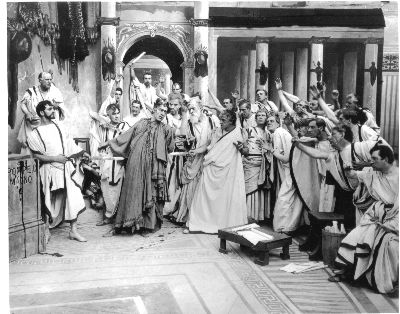
julius_-caesar

Studio still of the Vitagraph Company of America’s 1908 production of Shakespeare’s Julius Caesar

The classical world has always provided rich material for the cinema (until recent times, where togas are reserved for television and people shudder at the thought of Troy and Alexander), and this was especially true for early cinema. Classical subjects allowed the infant cinema to show how elevated it could be (and hence not deserving of some of the social criticism it was receiving), how it could handle famous texts (usefully out of copyright), and how it could dress up itself and indulge in special effects.

Above all, it could thrill audiences with true-to-life sights of Julius Caesar and Cleopatra, and allow them witness the siege of Troy and the last days of Pompeii. In Italy in particular, a thirst for the classical led to epics on a vast scale, such as Quo Vadis? (1913) and Cabiria (1914), which extended what the cinema could portray – visions of limitless space, populated by thousands, spectacularly arrayed, a vast panorama unfolding a highly romantic conception of history. (For more on such films, see The Bioscope Guide to Italy).

And so to what sounds like a lot of fun. The University College London (UCL) Department of Greek and Latin is presenting The Ancient World in Silent Cinema, an afternoon and evening of silent film screenings with piano accompaniment and related talks on Wednesday 28 January 2009, at UCL Bloomsbury Theatre, 15 Gordon Street, London, WC1H 0AH. The event is open to all and admission is free.

The screenings focus on Ancient Greece and Ancient Rome, with an emphasis on one-reelers rather than the later epics (no doubt because that enables you to squeeze in more titles). There is more information on the UCL site, including detailed, redolent synopses taken from the database of the BFI (which is supplying all the films), but here’s a summary listing:

THE AFTERNOON: ANCIENT GREECE

2-4pm Screenings of silent films set in ancient Greece:

Amour d’esclave (Fr 1907) 7 mins
La Morte di Socrate (IT 1909) 5mins
Elettra (IT 1909) 6 mins
La Légende de Midas (Fr 1910) 8 mins
La Caduta di Troia (IT 1910) 19 mins
L’Odissea (IT 1911) 29 mins
The Private Life of Helen of Troy (US 1927) [presumably an extract only]

4-4.30 pm Tea/Coffee break

4.30-5.45pm Speakers
Pantelis Michelakis (Department of Classics & Ancient History, University of Bristol) and Ian Christie (School of History of Art, Film and Visual Media, Birkbeck, University of London)

THE EVENING: ANCIENT ROME

7.15-7.45pm Speaker
Maria Wyke (Department of Greek & Latin, University College London)

8pm-10pm Screenings of silent films set in ancient Rome:

Julius Caesar (US 1908) 9 mins
Giulio Cesare (IT 1909) 7 mins
Cléopatre (Fr 1910) 9 mins
Lo Schiavo di Cartagine (IT 1910) 8 mins
Dall’amore al martirio (IT 1910) 11 mins
Patrizia e Schiava (IT 1909) 11 min
A Roman Scandal (US 1924) 6 mins
Jone O Gli Ultimi Giorni di Pompei (IT 1913) 43 mins

(Patrizia e Schiava, by the way, is the first film ever acquired by the National Film Archive, as it then was. It was acquired in 1935, under its English title Afra, and was give the vault location number 1A.)

And there will be more. A second afternoon and evening of Ancient World silent film screenings will be held on Monday 22 June 2009, from 2-6 and 7-10 pm at the Bloomsbury Theatre, with the theme this time being films with settings in Biblical or Near Eastern Antiquity.

Popular Italian cinema

All call for papers has gone out for Popular Italian Cinema: an international conference, to be held at King’s College, University of London, 27-29 May 2009. Proposals are invited for papers which deal with any aspect of popular Italian film culture from early silent film to contemporary cinema. Here’s the conference blurb:

This conference seeks to establish the importance of the study of popular Italian cinema. From the origins of the silent feature film and the creation of the star system, Italy has been at the forefront of cinema as a mass cultural phenomenon. The formal incorporation of music, melodrama, and comedy, and the development of the Italian genre system, are integral aspects of Italy’s domestic cultural heritage, responsive to and influential on film internationally.

Research into Italian cinema still needs to shift the paradigms beyond neo-realism and the canonical post-war auteurs. Furthermore, realism and auteurism in Italy can only be fully understood through their position within the rich vein of the wider film culture from which they arose. This conference will provide an opportunity for examining what is meant by the popular in Italian cinema, and for resituating the turning points in world cinema of silent spectacle and neo-realism.

Titles and abstracts (350 words) for proposed papers should be sent in English to the conference organizers by 15 February 2009. Keynote speakers are Richard Dyer (King’s College, London), Rosalind Galt (Sussex), Elena Mosconi (Cattolica, Milan), Federica Villa (Turin), Christopher Wagstaff (Reading).

Welcoming in 2009

2009

Emil Jannings in The Patriot (1928), from the 2009 Silent Movies Calendar

Want to be able to tell one day from another in 2009, see images from lost silent films, and contribute towards the preservation of silents that happily are not lost? Then purchase the Silent Movies Benefit Calendar for 2009.

This year’s calendar theme is ‘lost films’, and as well as a gorgeous image per month from the silent film of choice, you get a range of significant silent film events noted throughout the year. All proceeds after printing costs go towards a silent preservation project (last year’s calendar helped pay for the video restoration of Bardelys the Magnificent), and the calendars are priced at a modest $15 for a first copy, $12 each for further copies, plus postage.

For ordering information, go to the Mont Alto Motion Picture Orchestra site.

Mashing Edison

Let us return to our occasional mash-up series, where we look at how some creative people have taken silent footage and blended it with modern music or other found sounds. Each of the examples here demonstrates creative use of Edison films made freely available for download and personal use by the Library of Congress through American Memory and the Open Video Project. This first example, Grandpa Can Dance!, created by pixiecherries (a.k.a. Bernie Lee), is a model piece of work, as it mashes up open content from American Memory and for the music from the Internet Archive. The two films used are Foxy Grandpa and Polly in a Little Hilarity (1902) and The Boys Think They Have One Over on Foxy Grandpa but he Fools Them (1902), while the music comes from zefrank. Firstly, it is a fine piece of creative work, with the unlikely heavy beat music fitting in well with the old-time dancing to create something delightfully strange. Added to this, he provides background information as intertitles throughout, showing interest in and respect for the performers. An education, in every sense.

More of Bernie Lee’s mashup work can be found at http://wj4u.com.

Girl on Fire takes the 1898 Edison film, Turkish Dance, Ella Lola, from American Memory, filmed in the Black Maria studio. mediapetros has treated with visual effects, fire noises and indeterminate live sounds and snatches of what seem to be airport announcements, ending with a church organ and singing. The result is hypnotic and enigmatic. Ella Lola, though billed at the time as “a sensational dancer from the East”, in fact hailed from Boston.

Our third example is Love in an Elevator, which I take to be the name of the song by Aerosmith which has been laid over the Edison film Charity Ball (1897) (available from American Memory), featuring James T. Kelly and Dorothy Kent of the Waite’s Comedy Company, performing in the Black Maria studio. As in so many examples of films being placed alongside music which was not composed with it in mind, our brains seek out common points of reference, points of action matching points in the music. (Note that the film, which was probably shot at 30fps, has been transferred at too slow a speed). But the music, grim as it may be to my sensitive ears, does fit peculiarly well. And look out for that wild leap at the end. Let’s be seeing those moves at the dance halls soon.

And finally, thiscompost takes things a little further in this multi-screen presentation of a Serpentine Dance. There are two dancers shown. The first is not identifiable, though it is an Edison Kinetoscope film of a serpentine dance. The second is Annabelle, who is wearing butterfly wings, which is Annabelle Butterfly Dance (1894 or 1895 – there were multiple versions made). The film ends with the return of the first dancer. The music is a Nick Drake B-side played backwards and then forwards. Annabelle Whitford was the most filmed of the variety performers who appeared before the Edison Kinetograph in these earliest years. She was a follower of Loïe Fuller, and went on to join the Ziegfeld Follies. Here her presence (and that of the unidentified dancer) is reduced to mysterious icon, echoing the multiple presences she enjoyed on film peepshows and screens across the world as the motion picture first spread across the world.

A modern musketeer

modernmusketeer

Released next month is the latest mouth-watering, connoisseur-pleasing release from Flicker Alley, Douglas Fairbanks: A Modern Musketeer. This is a five-DVD set covering Fairbanks’ career 1916-1921, as he worked his way through the genres and ever-increasing stardom, before the series of great costume dramas that marked the peak of his fame in the 1920s. It’s officially released on 2 December, with a discount offer for advance orders.

The eleven titles featured on the set are:

  • His Picture in the Papers (1916)
  • The Mystery of the Leaping Fish (1916)
  • Flirting With Fate (1916)
  • The Matrimaniac (1916)
  • Wild and Woolly (1917)
  • Reaching for the Moon (1917)
  • A Modern Musketeer (1918)
  • When the Clouds Roll By (1919)
  • The Mollycoddle (1920)
  • The Mark of Zorro (1920)
  • The Nut (1921)

vance_fairbanks

It’s a sensational package, not just for the instrinc value of the films, but for the portrait it provides of the ‘all-American’ character leaping out of a pre-war world into post-war opportunity. The release of the set is complemented by the publication of Jeffrey Vance’s new biography, Douglas Fairbanks. This, we are told, is

the first critical analysis of Fairbanks’s body of work in over twenty-five years as well as the first full scale biography in over a half century. This extensively researched, engagingly written and sumptuously designed book goes behind Fairbanks’s public persona to thoroughly explore his art and far-reaching influence. Utilizing access to Fairbanks’s personal and professional papers, Douglas Fairbanks is a superb portrait of a true pioneer, critically important to the creation of cinema as the defining art form of the 20th-century.

The DVD set takes its apposite name from the title of the recently rediscovered 1917 A Modern Musketeer, which the curmudgeonly Bioscope didn’t much care for when it was shown this year at Pordenone. For a more generous view, within an illuminating critique of the Fairbanks persona, read David Bordwell’s latest post.

Lighting up again

smoking_tiger

There is a growing interest in exhibiting the alliances the silent cinema had with variety. Those alliances were undoubtedly there (so many early cinema shows were really variety programmes interspersed with films, or else the other way around), but what is novel is expounding the thesis through live entertainment. We have had the Crazy Cinématographe shows in Luxembourg, and in London there is The Smoking Cabinet.

This intriguing combination of early cinema screenings, cabaret and panel discussions was launched last year. A year on, the same concept returns to the Curzon Soho, 12-14 December. Billed as a ‘festival of early cabaret and burlesque cinema, 1894-1933’, the programme is suitably eclectic and exotic:

Opening Night The Smoking Cabinet Vs. Midnight Movies: Piccadilly (1929)
For this year’s opening night The Smoking Cabinet have teamed up with Midnight Movies to offer something a little different; live performance and music in the bar from 8:30pm followed by a special screening of E.A. Dupont’s Piccadilly (1929) featuring Anna May Wong.

Fri 12th Dec Bar performances and live music from 8:30pm, screening 11.30pm
Tickets £8 advance / £12 on door

On with the Dance!
A joyous evening of dance and showgirl themed films, featuring delights from Divine and Charles, Fatima and Carmencita, The Whirl of the Charleston (1927) and chorus girls galore.

+ Discussion Boom or Bust?
1894-1933 tracks the emergence of an entirely new form of entertainment in the shape of the moving image and cinema. We look at how the film absorbed more established forms of entertainment of the time from vaudeville to cabaret, burlesque and the musicals. We’ll also look at the cyclical nature of trends, asking why certain forms have boomed at specific times and bust at others. We’ll also ask if the death bell tolls for the current fascination with burlesque?

Sat 13th Dec 6:00pm
Tickets £8

smoking_woman
Sandow the Muscle Man and the Spirit of Coney Island

Roll up, roll up to witness boxing cats, the king of coins, and Edwin S Porter’s classic Coney Island at Night (1905), screening in a celebration of the extraordinary amusement empire that astonished, delighted and shocked a nation. There’s a rare opportunity to see Fatty Arbuckle and Buster Keaton’s 1917 romp Coney Island and to revel in the most magnificent spectacle of the world’s mad hunt for pleasure!

We’ll provide a Coney Island experience in the bar as we tip our sailor hats to the seaside fun and amusements of yesteryear and offer a free tipple to all guests!

+ Special guest speaker on the history and significance of New York’s decadent palace of pleasure.
Sun 14th Dec 4:00pm
Tickets £12

Closing Night: That’s all folks!
Join us for our last screening, live music, cakes and dancing as we wind down with an eclectic variety finale including Bob’s Electric Theatre (1909), Gus Elen: It’s a Great Big Shame and La Boite a malice (1903).
Sun 14th Dec 6:00pm
Tickets £8

There’s more information, including how to book, on The Smoking Cabinet website. Attendees are also encouraged to ‘dress to impress’, which – let’s face it – so few silent film audiences ever do these days. All this, and lessons in dancing the Charleston as well.

Harold Shaw and De Voortrekkers

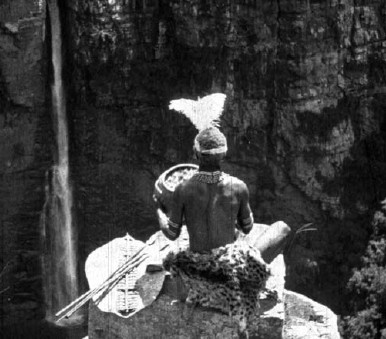
voortrekkers

Still from De Voortrekkers, showing Zulu warrior Sobuza, who converts to Christianity. From Jane M. Gaines’ essay ‘Birthing Nations’ in Metter Hjort and Scott Mackenzie (eds.), Cinema and Nation (2000)

The London African Film Festival is taking place 29 November-7 December 2008, a wide-ranging celebration of African cinema involving a number of venues across London. The programme brings together an imaginative programme of new and classic titles, with some eye-catching surprises. Among the latter, the one that is catches this eye in particular is De Voortrekkers.

This 1916 epic film was one of the first South African dramatic film productions, and tells the story of the Boers’ Great Trek, concluding with a reconstruction of the 1838 Battle of Blood River, where a few hundred Voortrekkers (Afrikaners) defeated several thousand Zulus. Commemorating as it did their view of a highly contentious area of history, the film came to be revered by Afrikaners. It enjoyed a long after-life in South African classrooms and was (and may still be) shown annually on the date of the Battle of Blood River (16 December). For a long time remained unseen outside of the Afrikaner community, though copies have been available on video from a Canadian company, Villon Films, for some while now.

De Voortrekkers was one of four films made during a short period in South Africa by the remarkable Harold Shaw (1876-1926), whose full story needs to be told properly by someone some day. Briefly, Shaw was an American, who began his career in film as an actor with Edison in 1908, graduating to film director and moving to the IMP company. His best known work from this first period is the haunting fantasy film, The Land Beyond the Sunset (1912), now recognised by the National Film Preservation Board, which has placed it on its National Film Registry for permanent preservation as a national film treasure.

haroldshaw

Shaw (left) moved to Britain in 1913 to direct for London Film Productions, making such prestigious titles as The House of Temperley (1913) and Trilby (1914). His best British work, for me, is a barely-seen 1916 propaganda piece, You (1916), which encourages various people to support the war effort by means of a piece of paper that floats from person to person, asking each ‘What are YOU doing for your country?’ It is so creatively put together. That same year he ventured out with actress wife Edna Flugrath to South Africa, where he had been hired by African Film Productions. His first film for them, De Voortrekkers (1916), which starred Flugrath, was sensationally successful locally and even gained some screenings overseas (in the USA it was known as Winning a Continent). The scenario was written by historian Gustav Preller, and its version of the Great Trek emphasised the common point of view between Britons and Afrikaners (the Anglo-Boer War was long past and the political stress was now on the strength of the Union) and the ‘savagery’ of the native peoples (who, the film argues, are led to rise against the Boers by Portuguese traders). News reports at the time stressed the authenticity of the props and costumes and the huge numbers involved: hundreds of extras, black and white, many of them mine employees. Telling tales were told of a filmed charge which was undertaken too enthusiastically, the ‘natives’ neglecting to fall dead and instead assaulting some of the Europeans, with mounted police having to restore order. The completed film ran for some two hours.

rose_of_rhodesia

The Rose of Rhodesia, from http://www.slottsbio.com

Disagreements with the production company led Shaw to withdraw from a follow-up film on the Zulu wars, Symbol of Sacrifice (1918, directed by Dick Cruikshanks), fragments of which survive and are apparently available on a DVD entitled Isandlwana, Zulu Battlefield. Instead he made a melodrama about stolen diamonds for a rival producer, The Rose of Rhodesia (1917), which was recently discovered in the Netherlands and is attracting growing academic interest. Shaw and Flugrath made a third film (now lost), a horse-racing drama entitled Thoroughbreds All (1919), then returned to Britain.

Shaw next went another strange journey, to the Soviet Union to film Land of Mystery (1920), a melodrama (now lost) set in the USSR and loosely based on the life of Lenin, whose strange history (the story was written by Basil Thompson, who was high up in the British secret service) is covered in Kevin Brownlow’s Behind the Mask of Innocence. Shaw made more films in Britain, including two H.G. Wells adaptations, Kipps (1921) and The Wheels of Chance (1922), before returning to America to direct for Metro. He then died in a motor car accident in 1926.

It’s an extraordinary personal history, and one day someone needs to do Harold Shaw’s strange career adequate justice. As it is, he has a small but dedicated band of devotees around the world, myself among them (we used to gather around a table at the Pordenone silent film festival – it wasn’t a very large table). Meanwhile, De Voortrekkers, which I’ve yet to see, comes to the Barbican in London on 3 December, screening with Joseph Albrecht’s 1938 129-mins epic Building a Nation (Bou van ‘n Nasie), another piece of Afrikaner apologetics. The films runs for 60 mins and musical accompaniment will be provided by Juwon Ogungbe with piano and traditional instruments such as the kalimba and marimba. Both films clearly need to be seen in the context of Afrikaner nationalism and racism, but it is good to see De Voortrekkers move from its time of closet, propagandist screenings to a public festival where it can be viewed in the fuller context of African film production, past and present.

The Bioscope Festival of Lost Films

filmcans

As the bitter winds sweep down direct from the North Pole, and the first Winter snows settle upon the roof of Bioscope Towers, it is time to look to new hopes for the new year, and the return of the Bioscope Festival of Lost Films. Yes, it’s a year since we startled a complacent film world with the very first festival of lost films. Other festivals will show you newly-made films, classic films, obscure films, films you know well and films you’ve never heard of – only the Bioscope Festival of Lost Films will exhibit films that were shown once but can be seen no more.

filmcan

The festival will follow the pattern last year, with some innovations. Over five days, we will feature five silent films that, so far as our researchers are able to determine, no longer exist. Each will come with a programme of extras, such as short films, guest interviews and so on. Each will be shown in a venue that was once a cinema but is now dedicated to other business. There will be appropriate live accompaniment from some noted silent music practitioners of the past. As before, it is not possible to announce what any of the films to be shown will be. Partly this is to maintain the element of surprise, partly because the most stringent efforts need to be taken right up to the last minute to ensure than none of the films on show does, in some far-flung corner of the film archive world, exist.

filmcan1

The festival will take place 5-9 January 2009. Please cancel all other engagements. A year ago we had excellent participation from the Bioscopists, who very much got into the spirit of things, though none quite so much as the person who became so enthused that he asked if his own work could be considered for a future festival. The idea of producing films that are lost before they are even made (the dreams that never made it to celluloid reality) is for another festival, at another time. These are the films that were once, and are no more.

As before, the Bioscope Festival of Lost Films is dedicated to the anonymous person who visited this blog with the search request “lost films download”. We must all continue to live with such hopes.

The cinema king

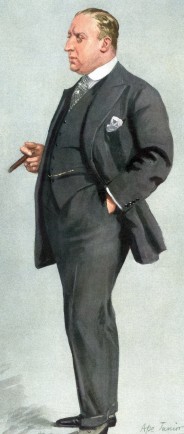
pyke_vanityfair

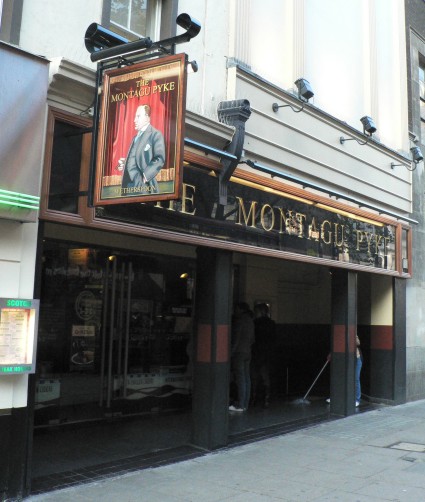
Should you find yourself in London’s Charing Cross Road, on the right-hand side looking south, halfway between the Palace Theatre and Foyles book store, you will find a bar. It bears the extraordinary name of The Montagu Pyke. It is part of the Wetherspoons chain, and is apparently a popular and fashionable spot. A sign outside bears the picture of an assured Edwardian gentleman in an immaculate suit, sporting a monocle, cigar in hand. He is Montagu Pyke, and for a time he was most renowned person in British film. For Monty Pyke was the cinema king.

A huge onrush of cinema building occured in London following the passing of the Cinematograph Act (the first UK legislation devoted to the new industry) at the end of 1909. Fortunes were to be made in this new business so attractive to a mass audience which, though it didn’t pay much for its pleasures, was prepared to turn up once or twice a week, every week, to the cinema. For a new breed of speculators, it looked like a licence to print money. That’s certainly how it must have appeared to Montagu A. Pyke, a former commercial traveller, gold miner and bankrupted stock market gambler. Pyke had seen crowds lined up in Oxford Street to see Hale’s Tours (films of journeys shown inside a rocking rail carriage) and decided this was the business for him.

Obtaining a £100 loan from a City business friend, Pyke formed Recreations Ltd in 1908, with nominal capital of £10,000, but no assets of his own. He identified a property in Edgware Road:

… firstly because it is a very thickly populated neighbourhood, and secondly, it appeared to me from the class of people one sees daily on the streets that they would make an appreciative audience if you gave them good value and the prices were right.

Pyke found two shop properties at 164-166 Edgware Road, and recalled that they were next door to Funland, a shop show which operated for a short period in 1908/09 and undoubtedly played its part in influencing the choice of location, as a proven film-going attraction. He raised money by exploiting society connections and spinning tales of vertiginous profits, including £1,000 from Lady Battersea, sister of Lord Rothschild. Pyke placed his first cinema in a populous neighbourhood with good passing trade, and offered a continuous show between twelve noon and midnight, with prices at 3d, 6d and a shilling. Programmes lasted between an hour and an hour and fifteen minutes. Takings, he recalled, were £400 a week, against outgoings of just £80, and Pyke embarked on a rapid programme of expansion, with investors queuing up to join him.

Initially Pyke’s cinemas were shop conversions, but his policy soon turned to larger venues in prestige locations. Each building was given the generic title of Cinematograph Theatre. Each cinema was also a limited company in itself (a common feature of cinema capitalisation at this time), but he established an umbrella company Amalgamated Cinematograph Theatres Ltd in 1910, with £150,000 capital, by which point he was managing five cinemas. At its peak, the ‘Pyke Circuit’ included fourteen cinemas in central London.

The Pyke Circuit

  • Recreations Theatre – 164/166 Edgware Road – opened 19 March 1909
  • Finsbury Park Cinematograph Theatre – 367-369 Seven Sisters Road – 1 October 1909
  • Walham Green Cinematograph Theatre – 583 Fulham Road – 29 December 1909
  • Ealing Cinematograph Theatre – 22 Ealing Broadway – 5 January 1910
  • Pyke House Cinematograph Theatre – 19, 21 & 23 Oxford Street – 17 February 1910
  • Shepherds Bush Cinematograph Theatre – 57/57A Shepherds Bush Green – 3 March 1910
  • Piccadilly Circus Cinematograph Theatre – 43-44 Great Windmill Street – 5 March 1910
  • Hammersmith Cinematograph Theatre – 84-88 King Street – 1910
  • Clapham Junction Cinematograph Theatre – St John’s Hill – 27 July 1910
  • Elephant and Castle Cinematograph Theatre – 47/51 Walworth Road – 5 November 1910
  • Croydon Cinematograph Theatre – 62 & 64 North End – 21 December 1910
  • Peckham Cinematograph Theatre – 166 Rye Lane – February 1911
  • Brixton Cinematograph Theatre – 101 & 103 Brixton Hill – 10 March 1911
  • Holloway Cinematograph Theatre – 71/83 Seven Sisters Road – 29 March 1911
  • Balham Cinematograph Theatre – 172 High Road – 1911
  • Cambridge Circus Cinematograph Theatre – 105/107 Charing Cross Road – 26 August 1911

Pyke’s business methods were highly dubious, and soon exposed. A committee of investigation formed in 1912 uncovered numerous business irregularities, including dividends being paid out that had not been earned. Pyke was the most notorious exploiter of investors’ eagerness to profit from the cinema craze. His strategy was based on the assumption that the boom would be short-lived, tempting avaricious investors with quick-term profits from a pyramid of flotations. He certainly profited handsomely himself. From a salary of £25 a week in 1908 he had risen in 1911 to paying himself £10,000 a year. As the cinema business only established itself all the more, and competition from larger and more competently managed rivals grew, Pyke’s business necessarily collapsed. He had only two cinemas in operation by the end of 1913 (Piccadilly Circus and Cambridge Circus), and was made bankrupt in 1915, the same year in which he was accused of manslaughter following the death of an employee in a nitrate film fire at the Cambridge Circus venue. Pyke’s ambitions to expand into the provinces were never realised. Amalgamated itself was reconstituted as a company in December 1916 and continued to manage five theatres (Edgware Road, Finsbury Park, Oxford Street, Walham Green and Shepherd’s Bush) to the end of the war.
pykebook

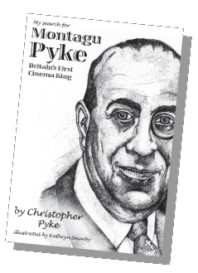
Pyke had been the most prominent figure in the British film business for a short while, but he disappeared into obscurity. Few cinema histories mention him, and it was only with the growth of interest in a social history of British cinema that researchers started to recover his story. Their task was helped by the publication of a chapter of Pyke’s otherwise unpublished autobiography, When I Was the Cinema King, in an edition of Picture House, the Cinema Theatre Association journal (no. 10, 1987). The text was made available by his grandson, Christopher Pyke, who has now produced a website devoted to Pyke and to selling a book, a self-published combination of biography of Pyke, using his memoir, and an account of Pyke’s own investigation into his grandfather’s history. The book, My Search for Montagu Pyke: Britain’s First Cinema King, can only be ordered online from CPI Book Delivery. It was launched last month at the Montagu Pyke bar.

I’ve long had a fondness for Monty Pyke. He was a rogue of sorts, and an employee did die in a fire at one of his premises, even if he was acquitted of manslaughter. But he had his philosophical side, and I’m fond of quoting lines from a 1910 pamphlet of his, Focussing the Universe (also reproduced in that issue of The Picture House). In an earlier post I gave you his use of the words of Isaac Walton to suggest the profound sense of cinema as a diversion. In this passage, he recognises its universal appeal:

Not least of the charms of the Picture Theatre for me is the fact that it is, in the real sense of the word, catholic, appealing not only to men and women of every class and degree, but to men, women and children of all ages. Before its advent, the process of amusing or interesting the child at a public entertainment was a somewhat difficult one, while the possibility of instructing him or her thereat, was never considered at all … The Picture Theatre, if it has done nothing else, has brought delight to the minds and souls of thousands upon thousands of mites in this great Metropolis, some of whom look upon it as the one oasis in the desert of their dull and sordid lives.

The signboard outside the former Cambridge Circus Cinematograph Theatre (where the fire took place) depicts Pyke in his pomp, adapted from the 1911 Vanity Fair portrait of him at the top of this post. He would be proud.
pykebar

The Montagu Pyke, 105-107 Charing Cross Road, London

This post is adapted from my 2006 paper on London’s first cinema circuits, Unequal Pleasures: Electric Theatres (1908) Ltd. and the early film exhibition business in London, which you can find on my personal website.