Bioscope Newsreel nos. 8 and 9

newbooks

In a special double issue of the all too infrequently published Bioscope Newsreel, we bring you news of some of the books on silent cinema recently published or due for publication soon (publication dates are for the UK, please note). Some of these titles I’ll be writing on in greater detail later.

United Artists 1919-1950
Tino Balio’s United Artists: 1919-1950 – The Company Built by the Stars, to be published in April, recounts the history of the studio founded by Charlie Chaplin, Mary Pickford, Douglas Fairbanks and D.W. Griffith.

Shakespeare on Silent Film
At last a work to challenge Robert Hamilton Ball’s Shakespeare on Silent Film (1968), Judith Buchanan’s Shakespeare on Silent Film: An Excellent Dumb Discourse shows how the early cinema went about tackling high culture. It is published in May.

Weimar Cinema
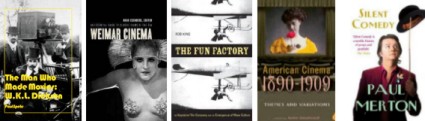
In Weimar Cinema: An Essential Guide to Classic Films of the Era Noah Eisenberg discusses sixteen iconic German films, silent and sound, made between the two world wars.

American Cinema
The Screen Decades is a series from Rutgers University Press, designed for course use and scholarly research. The first three volumes under American Cinema are André Gaudreault, American Cinema 1890-1909: Themes and Variations (yes, it does say 1890 as a start date); Charlie Kiel and Ben Singer, American Cinema of the 1910s: Themes and Variations; and Lucy Fisher, American Cinema of the 1920s: Themes and Variations.

Ghosts on the Somme
Alistair H. Fraser, Andrew Robertshaw and Steve Roberts have produced an intensive analysis of the classic 1916 documentary, The Battle of the Somme, investigating it in unprecedented depth and with many exciting discoveries. Ghosts on the Somme: Filming the Battle, June-July 1916 is published in March.

The Fun Factory
Academia takes on Keystone in Rob King’s The Fun Factory: The Keystone Film Company and the Emergence of Mass Culture, described as viewing “the changing politics of early film culture through the sociology of laughter”.

Film 1900
Klaus Kreimeier and Annemone Ligensa are the editors of Film 1900: Technology, Perception, Culture, a collection of essays which look at early cinema as media history, comparing its impact to that of the current digital revolution.

Stagestruck Filmmaker
The important connection between Griffith’s film career and his stage inheritace is dealt with in David Mayer’s Stagestruck Filmmaker: D.W. Griffith and the American Theatre, which explores early cinema’s theatrical roots. Published in March.

Silent Comedy
Paul Merton, the British comedian who is dedicated to introducing classic silent comedy to new audiences, has his book Silent Comedy published in paperbackin May to coincide with his new Silent Clowns tour.

The Man Who Made Movies
Paul Spehr’s magnum opus, The Man Who Made Movies: W.K.L. Dickson, is a enjoyable biography of the man who deserves more than anyone else the accolade of the inventor of cinema, and an exceptional technological history.

Picturing American Modernity
In Picturing American Modernity: Traffic, Technology, and the Silent Cinema Kristen Whissel takes an innovative look at early cinema in the context of turn-of-the-century American culture.

The Silent Cinema in Song
Ken Wlaschin’s The Silent Cinema in Song, 1896-1929: An Illustrated History and Catalog of Songs Inspired by the Movies and Stars, with a List of Recordings brings together songs about movies and moviegoing created between 1896 and 1929, biographies of the stars with the songs that were dedicated to them, and a discography with availability information.

‘Til next time!

The Kinetoscope of Time

kinetoscopeoftime

Title of ‘The Kinetoscope of Time’, from Cornell University Library

Tales of Fantasy and Fact is an 1896 collection of short stories by James Brander Matthews. He was Professor of Literature at Columbia University, subsequently America’s first professor of drama, among whose achievements was his own theatre museum. The collection includes a remarkable story, ‘The Kinetoscope of Time’, which is the reason for adding the collection to the Bioscope Library.

‘The Kinetoscope of Time’ was originally published in Scribner’s Magazine, December 1895. It takes the form of a Gothic horror story. The narrator finds himself at midnight in a large hall, the walls furnished with dark velvet. He comes across “four curiously shaped narrow stands”, about one foot wide and four feet high, each equipped with eye-pieces inviting the beholder to look within.

So of course he does, and he sees a succession of visions which, though they are not immediately identified as such, are the dance of Salomé, Hester Prynne and Little Pearl from The Scarlet Letter, Topsy dancing in Uncle Tom’s Cabin, Nora in A Doll’s House, the fight between Achilles and Hector, Don Quixote and Sancho Panza, the duel of Faust and Valentine, and Custer’s Last Stand. The narrator raises his head from these visions and is approached by a man who, though middle-aged, says that he had witnessed all these scenes, even though they mingle fact with fiction. He may or may not represent Time itself. He invites the narrator to behold two further visions, for which there will be a charge, one to witness his past, the other his future. The narrator refuses, and exists the hall to find himself in the outside world, “in a broad street”, with an electric light flashing and a train clattering by. He sees a shop window, and in it there is a portrait of the man he has just met, who is revealsed to be Cagliostro, the 18th century Italian occultist and adventurer.

kinetoscope_parlour

Kinetoscope parlour in San Francisco

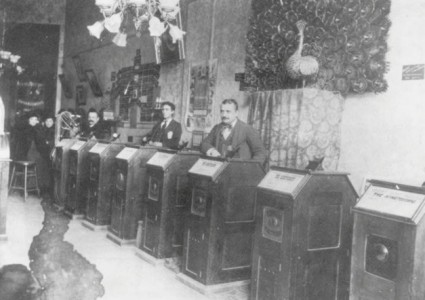
This is a remarkable tale in a number of ways. Firstly, its Poe-like fantasy clearly takes place somewhere akin to a Kinetoscope parlour, where the Edison peepshow viewers that preceded projected film shows were placed side by side, offering a view of one film per machine. But the velvet walls, the dark of the hall and that disorienting exit into what Matthews calls “the world of actuality” seem to be a premonition of the cinemas that were to come, while the subjects are remarkably prescient, almost all of them soon to become iconic scenes in motion pictures.

But the story’s real subject is the Kinetoscope’s relationship with time. The great fascination that motion pictures held for many observers when they first appeared was their quality as a time machine. The Kinetoscope turned one, potentially, into the observer of all time – able to witness the continuum of time as events passed before one’s eye on a ribbon of film. As Mary Ann Doane writes in The Emergence of Cinematic Time:

The story conjoins many of the motifs associated with the emerging cinema and its technological promise to capture time: immortality, the denial of the radical finitude of the human body, access to other temporalities, and the issue of the archivability of time … Its rhetoric echoes that which accompanied the reception of the early cinema, with its hyperbolic recourse to the figures of life, death, immortality, and infinity. The cinema would be capable of recording permanently a fleeting moment, the duration of an ephemeral smile or glance. It would preserve the lifelike movements of loved ones after their death and constitute itself as a grand archive of time.

The story provides a metaphor for the fundamental mysteries of the moving image, in what it shows, in what it supposes it shows, and in what it supposes it is able to capture. What does it mean to represent time in any case? The cinema is a mechanical thing, a conjuror’s illusion, a Cagliostro trick. It does not portray time but rather an idea of time. The narrator does not realise this, but maybe Matthews did.

‘The Kinetocope of Time’ has been much cited down the years, and the full text is reproduced in George C. Pratt’s classic compilation of original texts about the silent cinema, Spellbound in Darkness.

Tales of Fantasy and Fact is available from the Internet Archive in PDF (17MB), b/w PDF (6.2MB), full text (219KB) and DjVu (5.2MB) formats. It is available as a single story from a number of sources – Cornell University Library‘s version reproduces the look of the individual pages from the Scribner’s Magazine original, each page (GIF image) with an illustration of the appropriate vision.

Marie Glory

marieglory

Marie Glory in L’argent, from Eureka Video

One of the very last silent film actresses pased away on 24 January. French actress Marie Glory (1905-2009) was born Raymonde Louise Marcelle Toully and took the name Arlette Genny when she first appeared on film in 1924, for a small part in Raymond Bernard’s classic Le miracle de loups. Her most notable silent work was in Marcel L’Herbier’s L’argent (1928), arguably one of the greatest – certainly one of the most expensive – of French silent films, where she had the lead female role, starring alongside Pierre Alcover and Brigitte Helm.

Thereafter she changed her name to Marie Glory, and made a successful transfer to sound films, in such titles as Leo Mittler’s Le Roi de Paris (1930) and E.A. Dupont’s Les Deux mondes (1930). Gradually she slipped from lead roles to midway down the cast, to small parts, but she did not make her last film until 1960, and last appeared on television as an actress in 1964. Silent film fans probably best recognise her from the interview she gave to Kevin Brownlow for his television series Cinema Europe: The Other Hollywood in 1995.

There’s a handy short biography for her on the Alternative Film Guide.

And who is still with us among performers who appeared on silent films? Barbara Kent (appeared in Flesh and the Devil), Mickey Rooney (debut as ‘a midget’ in Not to be Trusted in 1926), Diana Serra Cary (Baby Peggy), Daisy D’Ora (Pandora’s Box), June Havoc (perhaps the last person left who appeared in a film before 1920 – her debut was in 1918, aged five), Carla Laemmle (The Phantom of the Opera), Virginia Davis (Disney’s Alice in Cartoonland), and a few more.

Visiting the ancient world

troy

La caduta di troia (Italy 1910), from http://www.mondomostre.it

A few words of praise are in order for a marvellous early cinema event which took place in London this week. The Ancient World in Silent Cinema (which was trailed by the Bioscope a while back) tookplace at the Bloomsbury Theatre on 28 January. It was an afternoon and an evening of films from the silent era on Ancient Greek and Ancient Roman themes, organised by the University College London’s Department of Greek and Latin.

This was a significant part of the interest, that a classical studies department had undertaken to exhibit these films, offering the promise of fresh insights and new angles into material that cannot only be the preserve of we early cinema hacks. Of course, we hacks turned up an occupied the front row, but the theatre was full of some 250 or so new enthusiasts, who had for the most part never seen such films, and who were clearly thrilled at the sense of discovery. Yes there was a giggle or two, but no more giggles than Brad Pitt in Troy got – in fact, probably a good deal fewer. Stephen Horne accompanied the films in bravura style, on piano, electronic keyboard and flute. He didn’t quite manage to play all three at the same time, but he did manage two (and that’s piano and flute, folks, not just piano and second keyboard). A number I spoke to afterward couldn’t believe it was all improvised and that he hadn’t seen the films beforehand.

I only saw the afternoon screening of Ancient Greece on film, alas (if anyone attended the Roman show, do add your comments). But what a well-selected delight it was. All of the films came from the BFI National Archive. Amour d’esclave (France 1907) was an effective pocket melodrama with some poignancy behind the histrionics, as Polymos falls in love with a slave girl and prefers to take poison with her and die rather than return to his wife. In the middle came a delightfully incongruous dream sequence featuring the Pathé dancing girls. La Morte di Socrate (Italy 1909) gave us Socrates’ death by drinking hemlock, fresh from the pages of Plato, so it felt, once you’d allowed for a certain amount of arm-flailing. Elettra (Italy 1909), given an extraordinary jagged piano accompaniment by Horne, portrays the bloody revenges of Greek tragedy with enthusiastic passion.

Louis Feuillade’s La Légende de Midas (France 1910) was just wonderful. In contrast to the high tone of the previous films, here was the humour to be found in Greek myth. King Midas prefers Pan’s music to that of Apollo, so the latter punishes him by giving him asses’ ears. Midas tries desperately to hide the disfigurement under a hat, but his barber discovers the secret and has to tell someone, so he says what he knows into a hole in the ground. Reeds grow up and whisper the secret to couples passing by, who then tease the hapless Midas. It was done in such a spirit of fun, with effects that got across just the right sense of magic.

Then came La caduta di Troia (Italy 1910). What a fine filmmaker Giovanni Pastrone was, a point made all the clearer by L’Odissea (Italy 1911) which followed it, which covered the same territory with some fine special effects but none of the genius for action, spectacle and connection beween scenes that Pastrone displayed. Among the gems were Paris and Helen floating across screen on a giant seashell on their way to Troy, the wooden horse (of course), and expertly orchestrated mayhem as the Greeks pour into the city. Anyone who read Homer (or Homer-based stories) when young and remembers the thrill of character and incident that marks out the myths would have had to thrill at such dedicated attempts to recreate their look and spirit. One also saw the early cinema stretching its boundaries – more space, more people, more movement, boldness in invention,delight in the stimulus to the imagination. L’Odissea had less directorial imagination, but we had a fantastic cyclops, convincingly huge against Odysseus and his men (thanks to superimposition) and graphically blinded, and a startling Scylla and Charybdis.

It was a pity that the show was concluded by showing two fragments from Alexander Korda’s otherise lost The Private Life of Helen of Troy (USA 1927). In other circumstances this mocking burlesque would have been great fun, but here in took us into another world from that of the early cinema productions, which had so earnestly tried to recapture the thrill of the ancient world to the impressionable imagination.

As said, I missed the Ancient Rome half of the day, but for the record the films shown were Julius Caesar (USA 1908), Giulio Cesare (Italy 1909), Cléopatre (France 1910), Lo Schiavo di Cartagine (Italy 1910), Dall’amore al martirio (Italy 1910), Patrizia e Schiava (Italy 1909), A Roman Scandal (USA 1924) and Jone O Gli Ultimi Giorni di Pompei (Italy 1913).

There has been a reasonable amount written about representations of the classic world on film, but little of it devoted to the silent era. The films were being shown as part of a research project on the theme, and one of the academics involved, Maria Wyke, has written Projecting the Past: Ancient Rome, Cinema and History,which covers the silent era. Other relevant titles are David Mayer’s Playing Out the Empire: “Ben-Hur” and Other Toga Plays and Films, 1883-1908, William Uricchio and Roberta E. Pearson’s Reframing Culture: Case of the Vitagraph Quality Films.

The UCL project is to return with a second set of screenings and talks on 22 June at the Bloomsbury Theatre, when the theme will be films set in Biblical or Near Eastern Antiquity. More news on this when I have it. It will be the place to be.

A festival of silent cinema

harwichelectricpalace

Interior of the Harwich Electric Palace, from http://www.electricpalace.com

News of an introductory festival of silent cinema being held 7-10 May in Harwich, Essex at the Electric Palace, one of the oldest cinemas in Britain still to be showing films, indeed with its original screen from the silent period, original projection room and ornamental frontage still intact.

A Festival of Silent Cinema
Thursday 7th May – Sunday 10th May 2009

A four day programme of silent films aiming to show exactly what these first films looked like and what the audience were seeing between 1896 and the late 1920s.

The Programme Curator is David Cleveland, founder and now retired director of the East Anglian Film Archive in Norwich. Presentations and commentary contributions will also be given by other film archivists and film historians.

Over the four day festival in May, 2009, there will be a unique opportunity to experience an array of original silent films. The programme will include many rare films; some will not have been shown since first distributed almost a century ago. The Electric Palace will be host to films typical of the period 1896 -1929: comedies, dramas, animations, features, topicals and shorts. These will have authentic accompaniment as well as specially composed music. The programme will also include live re-creations of music hall acts. which would have been common for the time. What audiences were seeing before motion pictures, will be illustrated by Magic Lantern Shows. In addition, there will be an exhibition of early cinema technology as well as a display of pre-cinema media.

Films will be shown on the Electric Palace’s Kalee 35mm projectors and, in the case of some very early films, on a specially installed Gaumont Chrono projector. All films will be projected onto the cinema’s original hand-painted screen.

The Festival will open on Thursday May 7th, with a special reception and screening of the Alfred Hitchcock film ‘The Ring’ (cert U), 1927. At its close, on Sunday 10th May, there will be a guest presentation and feature to be confirmed.

A full programme hasn’t been published as yet, but is promised soon. You can read more about the history of the Electric Palace, and other pre-1914 cinemas in Britain, here.

Faded glory

micheaux1

Oscar Micheaux directing (possibly Within Our Gates), from the magazine film Screen Snapshots (1920), held by the BFI National Archive

News, a little late in the day, of a conference taking place 6-7 February 2009 on the key African-American filmmaker of the silent era, Oscar Micheaux. Faded Glory: Oscar Micheaux and the Pre-War Black Independent Cinema is being presented by the Columbia University School of the Arts Film Programme and Film Society of Lincoln Center. It is, they say, fifteen years since the last conference took place on Micheaux’s work, and undoubtedly a great deal of work on Micheaux has appeared since then, as well as re-discovered film titles.

The conference site gives this useful background information on the rise in Micheaux studies, showing how important it is for film studies in any period to have films to study (not always the option when it comes to silent cinema – but what survives generally determines what is understood, and written about):

In 1991, American film history was radically transformed when the U.S. Library of Congress acquired a 35mm print of a silent film titled La Negra (1920) from the Filmoteca in Madrid in a swap for a print of Dracula (1932). La Negra, as historian of African American history, Thomas Cripps, discovered, was the lost film, Within Our Gates (1920), one of twelve silent era films produced, directed, and written by African American director Oscar Micheaux. Soon after, the Museum of Modern Art acquired a print of Symbol of the Unconquered (1920), this time from the Cinémathèque Royale in Brussels, with intertitles still in Flemish and French. Suddenly, these two films opened up a radical new angle on the prolific filmmaker who had been known primarily through his controversial sound films. Paired with Body and Soul (1924), in which Paul Robeson plays a double role, the three silent Micheaux films became a trilogy that brought scholars of African American culture into silent era film history (1895 – 1929). The teaching of D.W. Griffith’s The Birth of a Nation (1915) was transformed as now it could be countered with Micheaux’s Within Our Gates (1920), the film that grew from opposition to Griffith and Thomas W. Dixon’s offensive epic.

More importantly, the Micheaux silent trilogy allowed teachers and scholars to raise sensitive cultural issues because of the filmmaker’s bold approach to the question of what it meant to be a black American. It is not only that Within Our Gates contains a sequence in which a black man and woman are lynched and white Southerners gleefully cheer. In Symbol of the Unconquered, a black man passing as white rides with the Ku Klux Klan against a black oil prospector, and in Body and Soul, a black preacher rapes a loyal churchgoer’s daughter. From the position of Micheaux’s films, 1918 – 1948, which take the political pulse of the pre-civil rights era, one is led to ask about voting rights, property ownership, educational inequity, black entrepreneurialism, urbanization and black-white intermarriage.

It has been nearly fifteen years since the first serious Micheaux conference. Held at the Yale University Whitney Humanities Center in January of 1995, “Oscar Micheaux and His Circle,” was structured as the second generation of Micheaux scholarship, a reconsideration of the definitive 1970s Black Film as Genre by Thomas Cripps. The films screened at Yale had an immediate second life on the program of the Giornate del Cinema Muto international festival in Pordenone, Italy, in October, 2001, and a collection, Oscar Micheaux and His Circle, edited by Pearl Bowser, Jane Gaines, and Charles Musser followed. Soon, a number of other scholarly works on race theory, black audiences, black musicals, and early African American cinema appeared. In 2007, the first comprehensive biography, Oscar Micheaux: The Great and Only by Patrick McGilligan was published.

The consensus among Micheaux scholars is that a third generation of scholarship is now emerging, fueled by the fact that Micheaux remains a mystery and therefore a high priority research challenge. Some scholars have attempted to fit him into the Harlem Renaissance, others have argued that black literary Harlem was elite and Micheaux was a popularizer; some have defined him as a conservative, others as a radical, but Oscar Micheaux as an historical figure still remains elusive. Micheaux, however, is symbolic of the historical difficulty of retrieving the consciousness of another era. The fact that some of his motion pictures have survived him, however, makes the challenge of understanding his moment all the more alluring. Thus a defining feature of this conference weekend will be the Lincoln Center public exhibition of Micheaux films never screened together.

Now, in 2008, there are additional motion picture titles, some newly restored, that fill out the cultural territory of what was then called the “race movie” circuit. Both fragmentary footage and still images from the “lost” titles and the public 35mm and 16mm film exhibition of relatively complete work will bring to life the productions of these companies: The Richard Norman Company (Florida), the Lincoln Motion Picture Company (Los Angeles and Omaha, Nebraska), the Ebony Company, Richard Maurice Film Company (Detroit); other directors: Spencer Williams (Blood of Jesus, Dirty Gertie from Harlem, Juke Joint), and important actors: Paul Robeson, Bert Williams, Charles S. Gilpin, Evelyn Preer, Noble Johnson, and black film genres: (Harlem, western, detective, comedy).

Further information, including a full conference schedule, is available from the conference site. For background information on Micheaux, as well as the books cited above, see the Micheaux Society website and the Oscar Micheaux Home Page.

Silents in Latin America

latinamerica

Clockwise from top left: La Venus de nácar (Venezuela 1932), Braza dormida (Brazil 1928), Del pingo al volante (Uruguay 1928); El húsar de la muerte (Chile 1925), Luis Prado (Peru 1927), El automóvil gris (Mexico 1919), from Der Stummfilm in Lateinamerika

Now that we have such marvellous tools as BabelFish and Google Translate to assist the stubbornly monolingual amongst us, there is no excuse for not looking out for sites beyond those in English that offer valuable information on silent film.

A fine example is Der Stummfilm in Lateinamerika, which though it is in German, has as it subject the silent film in Latin America. Were you to read any of the general histories of silent cinema, you would probably not realise that there was any film production going on at that time in Latin America at all. When I worked on a book called Who’s Who of Victorian Cinema many moons ago, examining the lives of the earliest film pioneers worldwide, investigating what had gone on in South America and environs felt like the deepest archaeology. Spanish and Portuguese books were hard to find, and the major source turned out to be in French, Guy Hennebelle and Alfonso Gumucio-Dagron, Les Cinémas de l’Amérique Latine: Pays Par Pays, l’Historie, l’Economie, les Structures, les Auteurs, les Oeuvres (1981).

More has been published since then (some of it in English), and a small amount has come out on DVD, though there is still a sense of discovery of litle-known lands (at least for the non-Latin American), which is where Der Stummfilm in Lateinamerika is so good. The main part of the site is potted histories of film production and exhibition during the silent era in Mexico, Venezuela, Peru, Columbia, Chile, Bolivia, Brazil, Uruguay, Puerto Rico, Cuba, Argentina, the Dominican Republic, Paraguay, Ecuador, Guatemala, El Salvador, and Costa Rica. For some the history is a little thin, but one gets an overall picture of great vitality and creativity, with the strongest production centres being Brazil, Argentina and Mexico.

Other sections cover stars and directors (generally their dates, a photograph and a filmography), including such notable names as Enrique Rosas, Carlos Gardel, José Agustín ‘Negro’ Ferreyra, Lupe Vélez and Dolores del Río; descriptions of some key films, posters, examples of lost films, book on silent film in Latin America (divided up by country but surprisingly not citing any studies of Latin/South American film generally), and documents. Crucially there is a welcome section on the handful of Latin American silents available on DVD and VHS, and those that survive in film archives (pitifully few).

Der Stummfilm in Lateinamerika is put together by Thomas Böhnke, to whom all praise for shining such a light on a neglected corner of world film history.

Investigating 1911

1911census

http://www.1911census.co.uk

Apparently two years ahead of schedule, the 1911 census for the United Kingdom has been released to the public. The reason given is that the 1920 Census Act, which ruled that 100 years had to elapse before information could be released on any one census, did not cover the 1911 census. At any rate, it’s here, and as has been argued here before, family history sources are a precious source of information for the early film historian. So let’s investigate.

The 1911 census is being made available through a commercial genealogy service, www.findmypast.com. So far as I know, the information is only available online through this one source i.e. it hasn’t been made a part of subscription genealogy services such as Ancestry. It is a record of everyone living in the United Kingdom on Sunday 2 April 1911 (bar those few who avoided the census takers or engaged in boycotts – as some suffragettes did). Consequently one can find anyone who was working in the film business in Britain at that time, provided they weren’t abroad that day. Generally they will be found at home rather than at the workplace.

Searching is free. Under person you can search by first name, last name (this is required for all searches, though wildcards can be used), year of birth, place of birth, county, residential place, and if you use the advanced search option there are additional fields such as occupation, keywords and place of birth. Under place there is a range of search options, but you have to include street name, which is very limiting.

Search results for a person will give you schedule type (e.g. Household), first and last name, sex, birth year, age in 1911, district, county and the option either to see a transcript of the census form or an image of the original document. This is where the pricing comes in. A credit system is used: you can by 60 credits for £6.95, 280 credits for £24.95 or 600 credits for £49.95, with different expiry dates. To see a transcript costs 10 credits; to see a facsimile document costs 30 credits. Payment is online, through WorldPay.

So it can be a bit pricey, and it’s worth knowing what exactly you are looking for before launching in. But there is plenty to be uncovered – and a fair bit of it you can glean without payment. Obviously there are the notable names in the industry at that time – I’ve found Charles Urban, Cecil Hepworth, Alfred Bromhead, George Albert Smith, Montagu Pyke and several more, though a number of names remain elusive or just too common (Will Barker, for example).

But the interesting option to test is searching under Occupation. Frustratingly you cannot do this alone, but seach under Smith as a surname and Cinematograph as occupation, and you get 19 hits; under Bioscope and Smith you get 5; under Kinematograph and Smith you get 2 (including George Albert Smith); under Cinematographer and Smith there is 1, ditto for Cinema. However, word truncation comes to the rescue – search under A* in surname (wildcard option) and Cinematograph as profession, and you get 25 hits, with surnames from Adams to Avery; 103 under B*; 77 under C*, and so on. More will be found searching under Film (a term that probably would not have been considered a year or so earlier).

For the patient, lateral-thinking researcher, a lot could be uncovered, and one could get a picture say of the number of women in the cinema profession at this time (very few, to judge by initial searches). Note, by the way, that most of the people will be working in cinemas, not in film production. And of course not everyone described themselves so helpfully (so will simply be Manager, for example). Be on the look out for anomalies – I wonder what Master Herbert Clarke of Wandsworth, aged five months, was doing being classified under Cinematograph as his occupation. Child star…?

if you fork out for a transcript or a facsimile document, you get everyone else included in that household, which reveals all sorts of interesting information, not least social standing or wealth (Charles Urban, for instance, had three servants – his profession he gives as ‘Kinematograph Specialist’). For most purposes, the transcripts will do and will therefore save you money, but do be aware that errors creep into the transcriptions (which can affect searching, of course) and that only the original document (or its facsimile) counts as a primary source.

The 1911 census goes alongside an exciting range of genealogy online sources which I’ve certainly used for film history research, and would encourage others to investigate. The 1901 census gave us a snapshot of the industry just emerging; in 1911 film has become a mature business, and there is a vast exhibition sector that has opened up that could not have been envisaged in 1901. For some of the other resources, see the Bioscope’s earlier post Family History for Film Historians.

And go explore.

Prometheus Triumphant

Trailer for Prometheus Triumphant, from Mad Monkey Productions

It’s been a while since we had a look at any modern silents – the examples on show at Pordenone last year rather set back the cause of the silent film for today, I thought.

But now we have Prometheus Triumphant, or, to give its full title, Prometheus Triumphant: A Fugue in the Key of Flesh. Reportedly two years in the making, this is a feature-length film shot silent (with intertitles) in German Expressionist mould, as you may judge from the trailer. It was made by Mad Monkey Productions, directed by Jim Towns and Mike McKown, and stars Josh Ebel and Kelly Lynn in a tale of a white-masked young man seeking to raise back to life the dead body of his lover. Mad Monkey’s YouTube section has a number of curious videos about the film’s production.

Much more than that, I cannot tell you, except to say that there’s a plot synopsis on Film Baby, that Cinema Epoch is selling it on DVD, that it runs 79mins, that it reportedly aims to be explicit about the sexuality that the German Expressionists left implicit, and that maybe the German Expressionists knew more of what they were doing than those who have come after them…

Paul Merton hits the road again

paulmerton2009

Paul Merton’s Silent Clowns show is touring the UK once more, April-May 2009 (with an extra date in July). As before, Paul Merton is introducing assorted classic clips from the great comedians of American silent film, with piano accompaniment from the peerless Neil Brand. The show features Charlie Chaplin, Laurel and Hardy, Harold Lloyd, Buster Keaton (Steamboat Bill Jr. will be shown in its entirety) and many others.

These are the dates for the tour, with weblinks to the venues.

April
Friday 3 – Belfast – Belfast Film Festival – 02890 330443
Sunday 5 – Bath – Theatre Royal – 01225 448844
Tuesday 7 – York – Grand Opera House – 0844 847 2322
Wednesday 8 – Durham – Gala Theatre – 0191 3324041
Friday 10 – Birmingham – Alexandra Theatre – 0844 847 2294
Saturday 11 – Leicester – De Montfort Hall – 0116 233 3111
Sunday 12 – Buxton – Opera House – 0845 127 2190
Tuesday 14 – Reading – The Hexagon – 0118 960 6060
Wednesday 15 – Canterbury – Shirley Hall, King’s School – 01227 787787
Friday 17 – Perth – Perth Concert Hall – 01738 621 031
Saturday 18 – Aberdeen – Music Hall – 01224 641122
Sunday 19 – Inverness – Eden Court – 01463 234234
Tuesday 21 – Dundee – Caird Hall – 01382 434940
Wednesday 22 – Glasgow – Glasgow Film Theatre – 0141 332 6535
Friday 24 – Cheltenham – Cheltenham Town Hall – 0844 576 2210
Saturday 25 – Huddersfield – Lawrence Batley Theatre – 01484 430 528
Sunday 26 – Lincoln – Drill Hall – 01522 873894
Monday – Harrogate – Harrogate Theatre – 01423 502 116
Tuesday 28 – Preston – Charter Theatre – 01772 258858
Wednesday – Derby – Assembly Rooms – 01332 0255800

May
Friday 1 – Barnstaple – Queens Theatre – 01271 324242
Saturday 2 – Salisbury – City Hall – 01722 434 434
Sunday 3 – Exeter – Northcott Theatre – 01392 493 493
Monday 4 – Bournemouth – Opera House – 08701 989898
Tuesday 5 – Weston Super Mare – Playhouse – 01934 645 544
Wednesday 6 – Yeovil – Octagon Theatre – 01935 422884
Friday 8 – Worthing – Assembly Hall – 01903 206206
Sunday 10 – London – Hackney Empire – 020 8985 2424
Tuesday 12 – St Albans – The Alban Arena – 01727 844488
Friday 15 – Tunbridge Wells – Assembly Hall Theatre – 01892 530613
Saturday 16 – Basingstoke – The Anvil – 01256 844 244
Sunday 17 – High Wycombe – Wycombe Swan – 01494 512 000

July
Sunday 7 – Newbury – Newbury Comedy Festival – 01635 522733

Tour date information taken from www.mickperrin.com.

The tour coincides with the publication in paperback in May of Merton’s widely applauded book Silent Comedy.