Killruddery tales, and a touch of Dante

Kevin Brownlow at Killruddery Silent Film Festival 2009

Two interviews from the recent Killruddery Silent Film Festival, made by Irish company DOCUMENTAVi, have appeared online. The first is with Kevin Brownlow, an engaging twenty-minute film in which Kevin ranges widely over a lifetime promoting the silent film. He discusses discovering silent film while at school, the first films he collected, befriending silent directors (Al Parker in particular) and the task he took on of interviewing those who made the silent film. He covers film festivals, the Thames Silents series, Ireland and silent film, the power of silents experienced live as opposed to online or on TV, and the importance of live, ‘authentic’ (he is amusingly scathing of the taste for modern rock groups to dabble with silents). It’s a delightful encounter.

Stephen Horne at Killruddery Silent Film Festival 2009

Then, looking somewhat bleary-eyed, as anyone might who had just accompanied three silents in a row at the festival, pianist Stephen Horne talks about how he got into providing music for silent films, how this combines with the work he does accompanying dance, and his recent experiences performing the ‘original’ score for The Battle of the Somme. It’s an eloquent, informative seven-minute piece.

Talking of the estimable Mr Horne, he can be heard this Sunday at the Barbican in London, accompanying Guiseppe di Liguoro’s L’Inferno (1911), together with percussionist Martin Pyne and a smattering of electronic samples amid the piano accompaniment. Stephen assures me that it will be nothing like Tangerine Dream (whose DVD score for the film has pained many – doubtless Kevin Brownlow among them), so there’s every reason to go along and catch the Dante-inspired film which caused such a sensation in its time (chiefly on account of copious nudity among the damned). Fragments from a second 1911 L’Inferno, directed by Giuseppe Berardi, will also be shown, apparently for the first time in the UK.

linferno

L’Inferno, from http://www.barbican.org.uk

Silents for the weekend

Those in the know know that the classiest online video site around is Vimeo. It’s home to the work of budding filmmakers, film school graduates, animators and those for whom YouTube is altogether too low grade. It is not particularly a place where one is going to find silent films, but that may change with its recently-announced Weekend Project on silent films. The site organises occasional Weekend Projects where Vimeo members are encouraged to produced films along a particular theme. This time they are being asked to produce silent films. One of the site’s organisers says says:

Last time I suggested a Weekend Project, it was all about making noise. This week, I’m swinging the pendulum to the opposite side and proposing a Silent Film project. And when I say silent, I mean no sound. At all. This means you’re going to have to make actions, edits, and direction speak for you. You are allowed to use those old-timey slides to show what people are saying and to narrate your story. But remember, silence!

Well, not strictly silence, since the filmmakers are allowed to include music (not songs), with the less than encouraging suggestion that “Cheesy piano music is the way to go if you use music.” Winners will be announced next Friday. I’ll let you know. Meanwhile, the above video by Benjamin VanderVeen exploring the School of Art and Design at Northern Michigan University is held up as a model effort. Hmm.

Projection Box Awards

pbawards

http://www.pbawards.co.uk

The winners of the 2008-2009 Projection Box Awards for essays on popular optical media to 1900 have been announced. The first prize of £250 has gone to Professor Erkki Huhtamo for ‘Aeronauticon! Or, the Journey of the Balloon Panorama’, described by the judges as “… an excellent piece of well- documented new research. The essay is packed with exciting ideas … expressed with imaginative, speculative and argumentative flair. There is a clarity throughout and an easy, unpretentious turn of phrase which is delightful to read.”

Second prize goes to Mark Butterworth for ‘Imaging a Continent: the George Washington Wilson & Co’s Lantern Slides of Australia’ and third prize to Dr R.M. Callender for ‘The Enthusiastic Amateur of Redhill, Surrey: John Sterry’.

The competition for 2009-2010 has been announced, as follows (note the extension of popular optical media from 1900 now to 1910):

THE PROJECTION BOX ESSAY AWARDS: 2009-2010

Open to all, applications now welcomed

First Prize £250
and publication in the journal Early Popular Visual Culture
Books (value £100) as 2nd & 3rd prizes

The aims of this award, now in its third year, are to encourage new research and new thinking into any historical, artistic, or technical aspect of popular optical media to 1910, includingearly cinema: photography: panoramas & dioramas: the magic lantern: shadow theatre: optical toys, and to promote engaging, accessible, and imaginative work.

Essays, of 5000 to 8000 words, may be co-authored. Although the judges welcome international submissions, all essays must be in English. Work must be the author’s own,
and not previously published. Deadline: 30 January 2010

www.pbawards.co.uk for further details, rules, and application form.

The Projection Box was established 1994 by Stephen Herbert & Mo Heard.
We publish and distribute books and CD-roms on silent film, popular optical media, and visual culture. Current titles at: www.stephenherbert.co.uk

Who’s Who on the Screen

whoswho

Top row (L-R) June Mathis, Albert Capellani, Ruth Stonehouse; bottom row (L-R) Sessue Hayakawa, Teddy Sampson, Buster Keaton, from Who’s Who on the Screen (1920)

As some may know, while in the small hours I run The Bioscope, in the daylight hours I take occasional care over Screen Research, a social network/information source on moving image research. The latter is mostly devoted to current activity in the online video world, but the photograph section concentrates on older material, simply on acount of rights issues.

So this is just to let Bioscopists know that there is a growing collection of silent film images to be found there. In particular, I have just finished working my way through the Internet Archive copy of Charles Donald Fox and Milton L. Silver’s Who’s Who on the Screen (1920). This is a 400-page biographical guide to Hollywood in 1920, with a photograph and mini-biograph per person per page. I have published each individual on their individual page in four ‘albums’, with actors in Part 1, Part 2, and Part 3, and directors, executives etc. in Part 4. I find the parade of images haunting (the quality of the photography is outstanding, even if the image resolution is low – the photographers are credited in an acknowledgments page on Part 4) and the biographies intriguing for the emphasis placed on how healthy every one was. All the actors stress the sports they follow and their love of the outdoors. The executives feel less need to do so.

There is more silent material to be found under the Photos section. Film historian Deac Rossell has added some gems from his personal collection, including lobby cards, programmes, contemporary collectors’ scrapbooks, and some rare examples of movie star pennants from 1915. Do take a browse.

Nazimova in Leicester Square

salomehandbillco

http://www.cinema-organs.org.uk

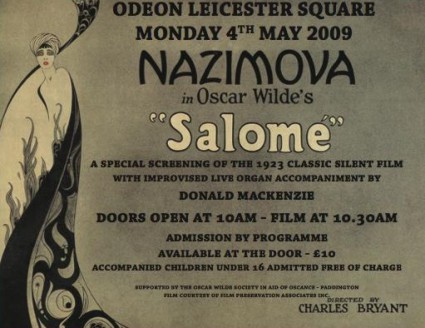
Normally the Bioscope doesn’t advertise single screenings of silents, because other sites perform that service very well, but when a silent film comes to Leicester Square, London’s cinema heartland, then we have to take notice. So, on Monday 4 May there is to be a screening of Salome (1923), starring Nazimova, at the Odeon Leiceste Square, with accompaniment on the cinema’s organ by Donald Mackenzie. The screening is at 10.30am, please note.

There’s information at the Cinema Organs site on the screening here, and the organ itself here.

Library of Congress on YouTube

Imperial Japanese Dance, Edison Manufacturing Company, 1894, featuring the Sarashe Sisters

The Library of Congress has launched a YouTube channel. Starting with just seventy videos (but with more promised), the channel is divded into seven playlists: 2008 National Book Festival author presentations, the Books and Beyond author series, Journeys and Crossings (a series of curator discussions), Westinghouse industrial films from 1904, scholar discussions from the John W. Kluge Center, and early Edison films.

Those familiar with the LoC’s American Memory service will know that it has been serving the Westinghouse and Edison content since the late 1990s, but there are new digitisations, with High Quality option. The channel is part of a programme of new media initiatives recently announced by the LoC, which includes releasing content through Apple iTunes and its Flickr still image project. As said, more is promised – at present there are twenty-one videos of the Westinghouse industrial works in 1904, and twenty Edison films from 1891 to 1894.

With new eyes

bakker

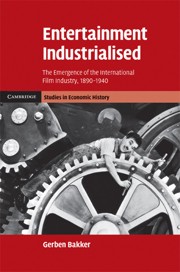
Gerben Bakker’s Entertainment Industrialised: The Emergence of the International Film Industry, 1890-1940 (Cambridge University Press, 2008) opens with a quotation from Marcel Proust:

The real voyage of discovery consists not of finding new lands, but of seeing the territory with new eyes.

A bold claim indeed for any book seeking to make its mark in a territory so exhaustively documented (or so it would seem) as film history. Of course, read the blurb of almost any new film monograph and it will confidently tell you that what lies within is certain to set a new standard for the field or to overturn preconceptions. Open those books and one tends to find exactly as one has found before in countless other monographs, with just a few of the arguments rearranged for novelty’s sake. Open Entertainment Industrialised on any page, and the sense of real discovery is instant. This is history with new eyes.

Gerben Bakker is based at the London School of Economics. His studies into the rise of the international film industry have been exciting a small number of us in the past few years, but they have not made much of a crossover as yet to the wider world of film history. The publication of this magnum opus ought to change things, though it has been issued as part of the Cambridge Studies in Economics History strand (at a hefty price), and is aimed primarily at economics historians. Though some of the language is specialist, the general tone will be clear to all, and the writing is lucid and inviting. It is a book that demands to be read.

His subject is the rise of the film entertainment industry in France, Britain and the United States between 1890 and 1940. That cross-national sweep immediately takes us away from the parochialism of so many film studies, while illuminating the national picture. Its contention is that cinema’s great innovation was not technological, but economic. In a helpful prologue, Bakker set out his theme by reference to the life experience of Charlie Chaplin:

When Charlie Chaplin was nineteen years old he appeared in three music halls a night. On one fine day he started in the late afternoon at the half-empty Streatham Empire in London. Directly after the show he and his company were rushed by private bus to the Canterbury Music Hall and then on to the Tivoli. This constituted the maximum number of venues an entertainer could visit on an evening, and thus the inherent limit to a performer’s productivity.

Yet, barely five years had passed before Chaplin would appear in thousands of venues across the world at the same time. His productivity had increased almost unimaginably. Most of this efficiency jump translated into lower prices, far lower than prices for music hall. Chaplin himself, therefore, was able to capture only a small percentage of revenues. Yet this tiny cut made him the world’s highest-paid performer.

There is the matter in a nutshell. The modern technologies that went with what the author calls the second industrial revolution (bringing with it the almost universal adoption of electricity, synthetic chemicals and the combustion engine) led to a huge leap in productivity. We are now in a world where we expect, without thinking, to have instant access to entertainments from around the world, at any time, wherever we might be located, cheaply or freely, and across multiple platforms. How did we get here? That is what Bakker sets out to describe, not by anecdote or easy assumption, but by thorough powerful analysis of the economic evidence using models established by business history.

bakker_chart

‘Total released film negative length and cinema seats, US, Britain, France and Italy, in metres, 1893-1922’, originally from ‘The evolution of entertainment consumption and the emergence of cinema 1890-1940’ (available at http://eprints.lse.ac.uk/5937)

His method is common to other kinds of economic enquiry, one based on understanding of essential principles tested against factual evidence which can be gleaned from contemporary studies or deduced by subsequent analysis. It is a book full of graphs and tables with titles such as ‘Total released film negative length and cinema seats, US, Britain, France and Italy, in metres, 1893-1922’, ‘Management as percentage of all non-creatives in the French entertainment industry, 1901-1936’, ‘Prices, capacity, sales potential, price elasticity and consumer surplus for various types of specator entertainment venues, Boston, 1909’ or ‘Indicators of sectoral shift in the entertainment industry, US, Britain and France, 1900-1938’. It is daunting but exhilarating stuff. All the time that we were enjoying ourselves, this is what was really going on underneath.

Bakker says that his book has three main themes running through it: how motion pictures industrialised spectator entertainment, how a quality race between firms changed the structure of the international entertainment market, and what effect this had on economic and productivity growth. He explores the rise of entertainment generally, the rise of the international film industry as a part of this movement, and then the notion, mechanisms and consequences of industrialised entertainment. Out this investigation he makes seven main claims (though there are many other interrelated findings):

  • Cinema industrialised live entertainment by automating it, standardising it and making it tradeable.
  • This industrialisation was largely demand-led.
  • It was the index case for the industrialisation of other services that would follow.
  • In a process of dynamic product differentiation old formats were not competed away, but often reinvented themselves when new formats arrived: theatre changed after vaudeville, vaudeville changed after cinema, and motion pictures changed after television.
  • The tradeability of motion pictures integrated national entertainment markets into an international one.
  • A quality race in which firms escalated their costs sunk into film production and marketing, triggered in the 1910s, led to the emergence of feature films as we know them now.
  • Although the Hollywood studios have won the race, American consumers lost it. Their European counterparts enjoyed a far greater variety of both live and filmed entertaiment, and consumed lots of exotic pictures next to the standard Hollywood fare.

Some of this may seem obvious, but that is because we are familiar with the outcomes. The important point is that the success of cinema in the particular form that it took was not a completely foregone conclusion. With only small variables in pricing (of raw stock, of theatre prices), discoveries in technology, competing entertainments or other socio-economic factors, cinema might never have arisen in the form that it did. He gives the example of cinema’s “major fellow traveller” the Phonograph, which remained “a premium product for a limited elite”. Contra such arguments, cinema can be seen almost inevitably to have filled a gap. Increased wages, falling hours of work, the rapid growth in urbanisation, a consequent demand for leisure, the opportunities provided by mass electrification, all can be said have created cinema – or the gap that cinema filled – because they had to.

Many studies have explored this area with this general thesis in mind. Bakker gives us the figures, and the hard reasoning. We may recognise the names and the general territory, but are encouraged to do so with such notions as deregulated entertainment markets, age elasticity of demand, industrial organisation theory and sunk costs – the latter a key concept for Bakker: costs incurred which can’t be reversed, essentially. Bakker’s argument is that the increase in sunk costs exercised by American film businesses in the period up to and throughout the First World War was their source of strength (crudely speaking, they spent more on production and promotion, and audiences responded to the quality on offer). He writes:

The First World War did matter, but in a different way than previously thought: not primarily because of the disruption of European markets, but because the war prevented the European film industry from taking part in the escalation of quality.

Now there’s a thesis you might like to argue over – but make sure you understand what endogenous sunk costs are first.

So he is right in his bold contention that this is a history with new eyes. Of course film historians have considered the economics of their subject before now, and he acknowledges the work done by David Bordwell, Richard Brown, John Sedgwick, Kristin Thompson and a few others. Yet for the most part film history has been written from a film studies perspective, focussing on style and content, in a form that may please its own community and which has interest to some in art and cultural studies, but which means little to other disciplines. Consequently what looks like an over-analysed subject is one which, rather, has been analysed too greatly in one direction, and far too slightly in others. Why were films made? Why did cinema succeed? Why do we have the entertainment industry that we do? Looking at the money doesn’t answer every question, but it helps answer a fair number of them, and we should have been asking these question (or asking them in a better way) long before now.

Bakker knows that he has produced something truly groundbreaking here. It deserves to have the same impact on film history as Peter Bailey’s Music Hall: The Business of Pleasure has had for music hall or Wray Vamplew’s Pay Up and Play the Game has had for the study of sports history – works that simply open our eyes to the economic realities underpinning their subjects, changing understanding.

There is a gentle mocking tone to some of the book, knocking those of us who have produced film histories which have concentrated on technical innovations, inventors or entrepreneurs, as if they alone made things happen. Of course they didn’t, and of course we have always known that there were greater forces that drove the real take-off of the film industry. What we have needed for so long is a guide to those forces, lighting up the territory for all. Now we have it.

(While you are persuading your local library to invest in a copy of Entertainment Industrialised, you might like to visit Bakker’s research papers site, where there are downloadable copies of several of the papers he has produced leading up to his book.)

Taking flight

taube

German aviator Otto Linnekogel with camera operator on a Rumpler Taube, from Flight 15 May 1914

While the growth in digitised historic newspaper collections has proved a huge boon for the silent film researcher, there are specialist journals now being digitised and made available online which hold valuable material that one might not immediately suspect was there. A model example has recently been made available, Flight.

Flightglobal has put up the entirety of Flight magazine, from 1909 to 2005. Every issue has been scanned and is fully searchable in PDF format. There are save and print options, and you can copy and paste the uncorrected OCR text from the PDFs. Searching is by keyword or you can browse by year, and with each search result it is easy to browse back and forth from page to page, handily visible in thumbnail form. The term you have search for is highlighted on the PDF. Search can be limited by date range, so it is easy to narrow things down to our era. It’s a model service, and it’s all free.

And there is plenty there on motion pictures. Film and flight grew up together, with some of the pioneers of sequence photography being closely allied to those experimenting with powered flight towards the end of the nineteenth century, and as each made its appearance on the public stage they fed off each other (an essay I wrote on this subject is available from my personal site, here). For many people, the first sight they had of an aeroplane was not in the sky but on a cinema screen, when newsfilms such as those of the influential Rheims airshow of 1909 (the first gathering of the world’s aviators) amazed audiences everywhere. Films recorded the great aviators of those heroic times, they promoted air races and air meetings, they created exciting dramas in which aviators and their machines served as natural heroes. In return, aviation revelled in the attention the cinema brought to the field, used the cinematograph as demonstration of the feats aviators could achieve, equipped planes with cameras, and planes were used as speedy means of transporting films.

All of this can be traced through the pages of Flight. Useful search terms to use include ‘cinematograph’, ‘cinemato’ (often the fuller word is broken up), ‘bioscope’, ‘kinematograph’, ‘cinema’, ‘films’ and ‘Pathe’. For example, searching under ‘bioscope’ gives you this report from 25 April 1914 of aviator B.C. Hucks and unnamed newsreel operator filming the Royal Yacht in the English channel:

On Tuesday morning after a trial flight with the operator to get him used to his peculiar position—he faced towards the tail—I started off across the Channel at exactly 11 a.m. in brilliant sunshine and very little wind, exactly half an hour after the departure of the Royal Yacht from Dover. It took me some time to pick up the Royal Yacht as there was a considerable mist on the surface of the sea, but after about fifteen minutes’ flying, I noticed a haze of smoke and as this was the only sign of activity in the neighbourhood I made for it and discovered my quarry. The French cruisers had already joined the escort, and to give my operator every facility I dived down to about 400 ft. and enabled him to get a fine picture of the mid-Channel scene.

I circled the fleet completely on three occasions, being then right out of sight of land. As we were nearing Calais I hovered about and flew over Calais Harbour at the precise moment of the entry of Their Majesties’ Yacht, when my photographer obtained what turned out to be a most magnificent and novel film. I then made direct for the Calais Aerodrome, flying over the town at 800 ft, I landed at 12 noon, when I was presented with a bouquet from the Mayor of Calais and also learnt that I was the first English airman to land at Calais.

The operator then extracted the exposed film which I fixed in the passenger seat of my machine together with the bouquet, and at 1.45 I started off for Hendon. I struck the English coast at the exact point of my departure, followed the railway line to Ashford, and on reaching the outskirts of London, I took last year’s Aerial Derby course to Hendon, where I arrived at 2.35. I had covered the 125 miles in 110 minutes. The journey overland was a very bumpy one, there being a terrible lot of remous owing to the extreme heat of the sun.

On landing, the film was handed to a representative of the Warwick Bioscope Chronicle Film, and rushed off to Charing Cross Road, where it was developed, a print made, and a complete record of the King’s journey from London to Calais was shown at the matinee performance at the Coliseum at 5.20. Actually, the film was delivered to the Coliseum at 4.45.

Flight and film were both equated with speed and modernity – the one recorded the instant moment, the other could deliver it to you before it had lost any freshness. Aviation clearly revelled in its association with film. It enjoyed asserting its superiority by telling tales of nervous cameramen filming stunts while on board, but also emphasised the cinematograph’s value as documentary record. There was commercial sense involved as well, as some of the long-distance flights such as those undertaken by Alan Cobham in the 1920s were part-financed by the filming rights. There is also interest in aviation as the subject of film drama, as in this report from 18 December 1914, which concerns British aviator Claude Grahame-White:

I was greatly interested in a “trial run” of a new Imp cinematograph drama produced for the Trans-Atlantic Film Co. Ltd., entitled, “The Secret of the Air.” It will be “released” on January 21st, 1915, and should appeal to a number of FLIGHT readers, since it shows, incidentally to the “story,” several scenes from Hendon at its best in bright sunlight as we all like to remember it. It would not be fair to reveal the plot, but it is sufficient to state that the airman’s part is played by Claude Grahame-White, who, in those days, before the war claimed his services in a more serious capacity, revealed himself as an amateur film actor of no mean order. Among the other scenes witnessed on this film, and only indirectly connected with the “story,” is a very exciting start by the late Gustav Hamel on his 50 h.p. Bleriot in a nasty side wind, and an equally fine landing showing Hamel in his best form. As a reminiscence of Hendon’s great days, “The Secret of the Air” is well worth seeing, apart from the interest attached to the “plot.”

There is much to be discovered, though little that I have found so far in the way of handy illustration – just the one photograph, reproduced above, of a camera on board a plane, plus several images from the air taken from films. Anyway, a very welcome new resource, and my thanks to Nick Hiley for drawing it to my attention. Go explore.

Music while they worked

In The Parade’s Gone By, Kevin Brownlow has a short chapter on that intriguing aspect of studio practice in the silent era, the use of musicians on set to help the actors get into the right mood. Not all directors used it, and not all actors needed it, but Conrad Nagel recalled

Every set would have musicians. Mickey Neilan had an orchestra of four, so there was always fun on his set … These musicians would know a hundred to a hundred fifty pieces of music, and they’d have a piece to go with whatever happened on the set. For hundreds of years, when you went to war, the regiment would take a band along. The music would give a great lift to the soldiers. And it was the same on a silent-picture set; the music kept you buoyed up.

Marshall Neilan, King Vidor, William Wellman all approved of the practice; Charlie Chaplin and Edward Sloman never used it. It is such a familiar part of silent film history, and yet how much do we actually know about it, beyond the anecdotal? I received an enquiry from researcher Polly Goodwin the other day about the use of musicians on set, and I realised I knew next to nothing. So, with her permission, I am reproducing her request here, in the hope that readers will be able to suggest texts, films, photographs or whatever. Here’s her email:

I am a researcher into silent film acting and I am currently investigating the phenomenon of on-set music during the filming of (many) silent films. So far, whilst I can find a few mentions of the frequency with which musicians (I believe sometimes called ‘sideliners’?) were invited onto the set, to play whilst the cameras were rolling, accounts tend to be brief and sporadic. There are a few photographs showing them at work, and the odd anecdote from actors and other on-set workers and in contemporary articles, but that is as far as I have been able to go. I wondered if anyone could give me any advice about where I might find more information on this (if, indeed, there is much information to find?) As yet, I have not found any accounts by the musicians themselves, for instance, or (which would be most interesting) by actors/directors etc. really addressing the impact (positive or negative) that this music and those who played it had. I find it such an intriguing situation – acting with the presence of music, and also of the director’s ‘direction’, in many cases, and would love to really get a fuller picture of what this unique acting environment would be like to perform in.

Has anyone come across any information about this, or any evidence in the form of photos, or, even more pie-in-the-sky-optimistically, in any snippets of on-set ‘behind the camera’ footage?

Any advice or suggestions would be more than appreciated.

Well, the Brownlow book is a start – chapter 30 covers the practice, and has two photographs, one of William de Mille with Efrem Zimbalist Jr on set, the other showing Pauline Starke and Conrad Nagel in Edmund Goulding’s Sun-up, with violinist on location. But what else is there?

Ghosts

ghosts

Every film is an archive. The actuality to which it is witness is embedded in every frame. All we need is are the eyes to see it and the intelligence to express it. A model example that will hopefully become an inspiration to others is Alastair H. Fraser, Andrew Robertshaw and Steve Roberts’ Ghosts on the Somme, an archaeological study of the 1916 documentary The Battle of the Somme. It is as revelatory a piece of film scholarship as you are likely to find, and this has been achieved by the simple expedient of experts from another field examining the film with the same methodological principles as they would apply to any other historial artefact.

The story behind The Battle of the Somme was covered by a recent post on The Bioscope, coinciding with its release on DVD in a digital restoration by the Imperial War Museum with both original score and new orchestral score from Laura Rossi. In short, it is a feature-length documentary recording the build up to the opening day (1 July 1916) of the Battle of the Somme, the day itself, and its immediate aftermath (all from the British perspective).It was produced by the British Topical Committee for War Films, a film trade body working at the behest of the War Office. The two cameramen were Geoffrey Malins and J.B. McDowell.

Most histories which discuss the film have chiefly considered its production and reception. The authors of Ghosts on the Somme, all military historians, have instead viewed the film itself as a piece of hisorical evidence, examining it frame by frame (in some cases literally so) to determine precisely what it shows. There has long been controversy over the authenticity of parts of The Battle of the Somme. One of the book’s major accomplishments is to confirm that the greater part of the film is quite genuine – indeed, that some scenes previously believed to be faked, or rather shot away from the front line, are not so.

In analysing the film, the authors considered seven major elements of evidence:

  • The film itself, and not just for its photographic evidence – a lip reader helped identify some conversations;
  • The Imperial War Museum’s collection of stills, many of them taken by Ernest ‘Baby’ Brooks, who worked alongside Malins (though the captions are frequently inaccurate);
  • Malins’ autobiographical book How I Filmed the War, a somewhat boastful account whose evidence needs treating with care;
  • A ‘tie-in’ book, Sir Douglas Haig’s Great Push:The Battle of the Somme (1916/17) which has photographs taken from the original film, including sequences which no longer exist;
  • The ‘dope sheet’, compiled between 1918 and 1922, a record of each of the shots from the film in caption order – now known to be highly inaccurate;
  • Assorted war diaries for the identification of men and units, plus other original documents in The National Archives;
  • The present-day landscape of the Somme battlefield.

The result is extraordinary. The authors identify not only locations, units and dates, but people. The grey figures whose faces point at the camera as they march cheerily to war and return shaken are, in a few, precious cases, given names, ages, a past history and – for some of those who survived – a subsequent history. There is such power in being able to put a name to a face. Previously, perhaps we have been guilty at times of sentimentalizing the film when we see those ghostly faces; this book humanizes it.

somme5

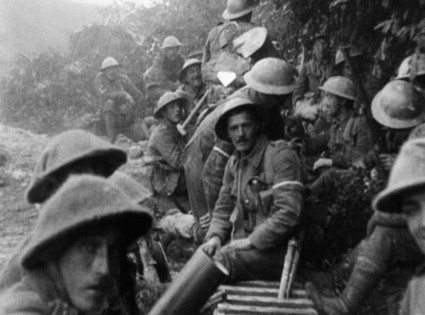
Men of B Company, 1 Lancashire Fusiliers, in a sunken lane in front of Beaumont Hamel, filmed by Geoffrey Malins, 1 July 1916 (frame grab from DVD)

This is a book chiefly for the military history enthusiast. The film historian will welcome the attention paid to the practicalities of the film’s production (there is a chapter on the cameras used and the limitations of orthochromatic film stock, which was not sensitive to the full spectrum, though more could have been said about lenses), while expressing surprise that the book refrains from saying anything about the film’s history once it had been released to an astonished British public (more than half the population saw it). It is pedantic in its dogged desire to identify and list every place, every unit, leaving no scene of the film unturned – a tabulation at the end of the book lists each shot (extant and lost) in order, with timing, date, camera operator, location, subject, date and caption. It is not a history for those who crave narrative.

So it may not find a place on any film studies shelf, but for the factual historian, it opens up a medium for study. As Roger Smither, Keeper of the Film and Photograph Archives at the IWM, says in his foreword, “Ghosts on the Somme sets a new standard for the examination of archive documentary film”. The convention has always been to distrust the record the actuality film provides, to emphasise film’s propensity for lying. Ghosts on the Somme shows that, ultimately, film records reality, and that we can uncover that reality, if we have eyes to see. Perhaps it really should be on a few film studies shelves.