Kermode on silents

http://www.bbc.co.uk/markkermode

Mark Kermode, the BBC’s amusingly opiniated film critic, has a second life as bassist with retro band the Dodge Brothers (another member is film professor Mike Hammond). At the recent British Silent Film Festival the Dodge Brothers accompanied the William S. Hart western White Oak (1921) and here Kermode talks about the experience. Once we have got past the unfunny silent pastiche at the start, Kermode typically enough has some sharp points to make, comparing the CGI-dominated summer blockbusters to the artistry of the silent film, and arguing that “we have lost the ability to tell stories through facial gestures… we have lost the melody of melodrama, we have lost the tunes that used to make cinema work”. Discuss.

3rd International Silent Film Festival

3rdinternational

http://www.goethe.de/ins/ph/map/en4721033v.htm

Next week sees the start of the Philippines’ 3rd International Silent Film Festival, the festival of classic silent films from around the world accompanied by Philippine music. The festival runs 30 July to 27 August, with screenings every Thursday at the Shang Cineplex Cinema 1, Shangri-la Plaza, Mandaluyong City. The festival is organised by the Goethe-Institut, Instituto Cervantes, Japan Foundation and the embassies of France and Italy in partnership with the Shangri-la Plaza.

Here is this year’s screening schedule:

July 30
JAPAN: JIROKICHI THE RAT (Oatsurae Jirokichi Koshi)
directed by Daisuke Ito, 1931
Music by Kalayo

The story was adapted by Ito from a novel written by Furukawa Eiji based on the life of Nezumi Kozo (The Rat), a notorious burglar active during the early 1800’s (the end of the Edo Period). Nezumi Kozo won great fame for his daring adventures stealing from the homes of wealthy people late at night. Eventually he was captured and executed in 1835.

The film follows Jirokichi as he leaves Edo for Osaka to get away from the police. Along the way he meets Osen, a young woman forced into prostitution by her older brother. Although Osen falls for Jirokichi, his heart goes out to Okino, a poor girl from a fallen samurai family. Jirokichi learns that it was he himself who brought about the collapse of Okino’s family when he robbed a rich feudal lord back in Edo. Nikichi, Osen’s older brother, has got his own plans for Okino.

August 6
ITALY: THE MECHANICAL MAN (L’uomo meccanico)
directed by Andre Deed, 1921
Music by Caliph8 with Kalila Agilos, Malek Lopez, Pasta Groove and Tad Ermitaño

A city is gripped in terror as a colossal robot runs rampant in an unstoppable crime spree. The police are powerless in the face of the frightening carnage and destruction, but the remotely controlled menace may soon meet its match – a second mechanical man is sent to confront it in a horrific showdown at the local opera house.

This ultra-rare, nearly forgotten silent horror epic from the dawn of Italian cinema was long considered lost. Some reels of the Portuguese release version were discovered in Brazil. The discovered film amounted to 740 meters which is believed to be approximately 40% of the complete film. Though missing much of its original footage, this historic work is still a striking and powerful piece of early fantasy film-making featuring one of the few directorial efforts by André Deed, a protégé of Georges Melies, the godfather of cinema magic.

August 13
GERMANY: PEOPLE ON SUNDAY (Menschen am Sonntag)
directed by Robert Siodmak, 1929/30
Music by Nyko Maca + Playground

A summer day in Berlin, 1929: With unpretentious humor this astonishing first film by artists who were soon to become Berlin exiles deals with how the working class spends its precious leisure time. Berlin is as empty as a ghost town, everyone flees to the countryside, the train stations are packed. Erwin, a taxi driver, meets up with a young traveling salesman and his female companions, who are on their way to a nearby lake for a day of swimming, snoozing, and flirting, leaving the cabbie’s wife to sleep away her Sunday.

Billed as a ‘film without actors’, each of the on-screen participants effectively played themselves and returned to their day jobs once production had concluded. The film is the early collaboration of five young Berlin-based filmmakers – Robert and Curt Siodmak, Billy Wilder, Edgar G Ulmer, Eugen Schuefftan and Fred Zinneman – who would all go on to great international success. Produced with little financial assistance, it made film history as the avant garde precursor of poetic realism.

August 20
SPAIN: THE CURSED VILLAGE (La aldea maldita)
directed by Florián Rey, 1930
Music by Johnny Alegre AFFINITY

A story about poverty, honor and forgiveness in a small Castilian village, during a time when women had no rights at all to live their own life without the protection of men. It depicts a dramatic experience of the capabilities of the human mind in a time that the concept of honour was completely determined by the grade of submission of your wife.

Juan Castilla lives with his wife Acacia and their child, and with the boy’s blind grandfather, Martin. Juan got imprisoned for quarrelling with the local political tyrant and usurer, Lucas, during a crisis. Magdalena, the neighbour, convinces Acacia to leave the impoverished town that seemed to have a curse on it. Three years later, Juan finds his wife working in a pub. He obliged her to return home and to serve the family until the death of the sick grandfather Martin.

August 27
FRANCE: FANTOMAS: UNDER THE SHADOW OF THE GUILLOTINE (Fantomas: A l’ombre de la guillotine)
directed by Louis Feuillade, 1913
Music by Corporate Lo-fi

Feuillade presents to us the character of Fantomas through a series of dramatic episodes: the robbery of the Royal palace Hotel, the successive transformations of Fantomas, and the substitution of the actor Valgrand. The masked hero is presented as a cruel being. We discover the mistress, Lady Beltham, accomplice and victim of Fantomas, then the obsessive inspector Juve introduced as her best enemy.

Bonner Sommerkino 2009

sommerkino

Evening screening at the Arkadenhof, Bonn University, from http://www.film-ist-kultur.de

Germany’s silent film festival Bonner Sommerkino returns to Bonn 13-23 August. The programme seems to get more eye-catching each year, and this time around highlights include the recently discovered oldest surviving Korean feature film, Cheongchun’s Sipjaro (Crossroads of Youth) (1934), Victor Sjöström’s Klostret i Sendomir (1919), a rare Mexican silent, El Puño de hierro (1927), everyone’s festival favourite Bardelys the Magnificent (1926), and Louise Brooks in William Wellman’s Beggars of Life (1928). The starry line-up of musicians includes Neil Brand, Stephen Horne, Günter Buchwald, Joachim Bärenz, Aljoscha and Sabrina Zimmermann.

Details of the festival are on the website, in German, which includes the programme. Here’s what’s on show – German titles in capitals, original language title (where relevant) in brackets:

Arkadenhof der Universität Bonn

Thursday, 13 August 2009
21.00 LIEBE ZU FUSS (Amor Pedestre)
Italy 1914, Marcel Fabre, 6 Min.
DER SPRUNG INS GLÜCK (Totte et sa chance)
France/Germany 1927, Augusto Genina, 97 Min.

Friday, 14 August 2009
21.00 DAS KLOSTER VON SENDOMIR (Klostret i Sendomir)
Sweden 1919, Victor Sjöström, 76 Min.
22.30 DIE EISERNE FAUST (El Puño de hierro)
Mexico 1927, Gabriel García Moreno, 77 Min.

Saturday, 15 August 2009
21.00 DIE BEIDEN SCHÜCHTERNEN (Les deux timides)
France 1928, René Clair, 62 Min.
22.30 DER HERR FILMVORFÜHRER (His Nibs)
USA 1921, Gregory La Cava, 56 Min.

Sunday, 16 August 2009
21.00 DIE HERUMTREIBER (The Vagabond)
USA 1914, Charles Chaplin, 15 Min.
BETTLER DES LEBENS (Beggars of Life)
USA 1928, William A. Wellman, 100 Min.

Monday, 17 August 2009
21.00 DAS WEIB DES PHARAO
Germany 1922, Ernst Lubitsch, 103 Min.
TUTANKHAMEN
Austria 1923, Raymond Dandy, 27 Min.

Tuesday, 18 August 2009
21.00 DER AUTONARR (Get Out and Get Under)
USA 1920, Hal Roach, 25 Min.
AUSGEFLIPPT (Running Wild)
USA 1927, Gregory La Cava, 80 Min.

Wednesday, 19 August 2009
21.00 DAS GESCHWÜR (Kobutori)
Japan 1929, Yasuji Murata, 10 Min.
THEATERFIMMEL (Stage Struck)
USA 1925, Allan Dwan, 78 Min.

Thursday, 20 August 2009
21.00 NOCTURNO
Croatia 1935, Oktavijan Miletic, 11 Min.
DER MORDFALL WARE (The Ware Case)
UK 1928, Manning Haynes, 90 Min.

Friday, 21 August 2009
21.00 WASSER HAT BALKEN (Steamboat Bill, Jr.)
USA 1928, Charles Reisner, Buster Keaton, 71 Min.
22.30 NACH UNSERER TRENNUNG (Kimi to wakarete)
Japan 1933, Mikio Naruse, 72 Min.

Saturday, 22 August 2009
21.00 JUGEND AM SCHEIDEWEG (Cheongchun’s Sipjaro)
Korea 1934, Ahn Jong-hwa, 74 Min.
22.30 DER FAULPELZ (Lazybones)
USA 1925, Frank Borzage, 78 Min.

Sunday, 23 August 2009
21.00 TRAILER: DIE ABENTEUER EINES ZEHNMARKSCHEINS
Germany 1926, Berthold Viertel, 2 Min.
DER LEBENDE LEICHNAM (Zhivoy trup)
Germany/USSR 1929, Fedor Ozep, 120 Min.

LVR-LandesMuseum Bonn

Sunday, 16 August 2009
15.00 ALBERT EINSTEINS RELATIVITÄTSTHEORIE UND DAS KINO
Vortrag mit Film von Milena Wazeck
17.00 WUNDER DER SCHÖPFUNG
Germany 1925, Hanns Walter Kornblum, 92 Min.

Sunday, 23 August 2009
15.00 DER ITALIENISCHE FUTURISMUS UND DAS KINO
Vortrag mit Filmbeispielen von Donatella Chiancone-Schneider
17.00 GALGENHOCHZEIT (Bardelys the Magnificent)
USA 1926, King Vidor, 90 Min.

La Promenade des Papillons

Time for another modern silent, and my thanks to The Mysterious Ad)ri.an B(e;ta[m.a.x. (possibly not the name on his birth certificate) at Cahiers2Cinéma for alerting me to La Promenade Des Papillons, written and directed by Los Angeles filmmaker Josie Basford. Here’s how she describes it:

Lillian Lavender loves to stroll with her pet butterflies, greeting her neighbors all along the way. When Monsieur Dastard hatches a plan for Lillian’s demise, her walk takes a dark turn. What will happen to dear sweet Lillian and her butterflies?

So long as you don’t ask too many questions along the lines of, why would anyone go for a walk with butterflies, then this is a pleasing, quirky film, put together with some inventiveness and a good eye for pastiche. It also boasts a very enterprising score. Interestingly, the intertitles are in French (with English subtitles). It would be interesting to know what you think of it.

Badford has made at least one other silent pastiche, a very short comedy entitled The Freeloader, which you can view on YouTube.

Conference diary

summerschool

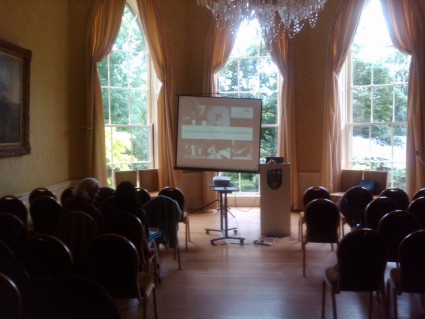
Newman House, Dublin

I was recently on my travels, attending a couple of conferences and a summer school, and this is my report. The first half of July was remarkably crowded with moving image-related conferences and other such events in the UK (and environs). Because of the jam-packed schedule, sadly I had to say no to the Visual Delights conference at Sheffield, on the theme of Visual Empires. This had an intriguing selection of papers surveying assorted lost empires and the media they sought to bend to their needs, with an encouraging number of new speakers (new to me, that is). Perhaps someone could say something about how they found the conference.

I also had to give a miss to Researching Cinema History: Perspectives and Practices, a symposium at Burlington House in London, which normally would have been right up my street, discussing as did the changes that seem to be happening to the historiography of cinema. For I was by then in Dublin, to speak to the Dublin James Joyce Summer School on Joyce and his fleeting management of the Volta cinema in Dublin in 1909 (centenary year, you see). This took place in the delightful Georgian building of Newman House, where they nervertheless managed to drum up a decent digital projector. The gathering of students looked a little bemused at times as I piled on the detail of how one went about managing (or mis-managing) a cinema in 1909, but they loved the film clips. A Cretinetti comedy (Come Cretinetti paga di debiti / An Easy Way to Pay Bills) and a scatalogical Pathé film C’est Papa qui à pris la purge, but could have been a film shown at the Volta entitled Beware of Castor Oil!, went down particularly well. The chances are now that it isn’t the film shown at the Volta, but it was certainly something like it (a man drinks his son’s castor oil medicine by mistake and gets caught short in assorted public places). In the end it was concluded that it was probably best that Joyce turned out to be such a poor cinema manager, because otherwise he’d have become a minor, prosperous businessman who never quite got round to writing that novel he’d been dreaming about, and none of them would have been there at such a summer school at all.

slyboots2

An uncredited Max Linder appearing in C’est Papa qui à pris la purge (1906)

And then it was off by plane to Birmingham followed by the epic train journey through Wales (anxiously following the first Test through text messages on the mobile phone) to get to the University of Aberystwyth for the Iamhist, or International Association for Media and History, conference, on the theme Social Fears and Moral Panics. Well, hard to go wrong with a theme like that, and there was a fine array of papers covering the multifarious ways in which the media acreates, reflects, perpetuates or addresses social fears – as well as being the subject of such fears itself. This was a particularly well-managed event, where for once I could find no complaint with any of the speakers that I heard (though surprisingly I encountered only one brave enough to try showing film clips) and all topics contributed usefully to the greater theme.

There wasn’t much on silent cinema, curiously enough, because the silent era had more than its fair share of moral panics – Fatty Arbuckle, Wallace Reid etc – indeed early cinema in general was ubiquitously viewed as a social threat of the first order. But for the record I heard papers on the ‘quality’ press and its adversion to commercial radio (Richard Rudin), the battles to preserve the Welsh language through film (Kate Woodward), how Limerick newspapers helped and hindered the fight against the 1832 cholera epidemic (Michelle Mangan), the very topical print history of influenza (Penelope Ironstone-Catterall), local reporting on the Ottoman bankruptcy crisis of 1875 (Gul Karagoz-Kizilca), the fears aroused by the arrival of the telephone (Gabriele Balbi), the image of Marconi operators given in the pages of Wireless World (David Hendy), the ‘Lady Chatterly’ trial and its press coverage (Nick Thomas), the use of fear in British government public information films (Linda Kaye, the speaker with the film clips) and the 1950s obscentity campaign against British seaside postcards (Nick Hiley).

In fact, the only silent cinema subjects I encountered were James Burns speaking on early cinema and moral panic in various parts of the British Empire, amusingly pointing out how different countries ended up worried about different things (in South Africa they feared racial mixing, in Southern Rhodesia it was sexuality, in the West Indies it was images that diminshed British prestige that concerned them, in India they worried about the threat of motorised crime); and me. I spoke on How Working Men Spend their Spare Time, a social survey conducted by George Esdras Bevans in New York in 1912, which I’ve written about on the Bioscope before now. You can find a copy of the talk on my personal website, should you be interested.

socialfears

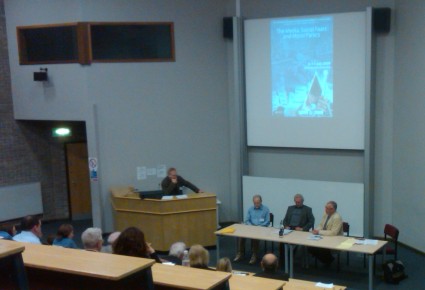
An impassioned moment from the debate on regulation and the media, with (L-R) Nick Cull (chair), Martin Barker, Julian Petley and Sir Quentin Thomas

There was a silent film screening, however. We were in the heart of Wales, with the National Screen and Sound Archive of Wales just down the road, so it was more than appropriate that we were treated to Maurice Elvey’s The Life Story of David Lloyd George (1918), previously described here in detail. The film was shown in NSSAW’s distinctively cylindrical Drwm cinema, and had Neil Brand playing the piano. A somewhat prolonged introduction over-sold the film, and it was a rather flat atmosphere that was created by an audience of worldy-wise media historians unaccustomed to adjusting their perceptions to the demands of silent film. In February when I saw the film at the British Library it was fresh and thrilling; here it seemed to drag, and its highlights seemed perfunctory. It’s the audience that makes the film, every time.

With the practice such conferences have of parallel sessions I missed many papers, while others I had to skip while putting together mine (a last-minute job, alas as usual with me). There were also plenary sessions: one on Government, Panics and Media Crisis (Virginia Berridge eloquent on AIDS, Merfyn Jones – former BBC governor – choosing his words with care but equally with feeling in recounting the fresh history of the Hutton enquiry into the Iraq war), and a thought-provoking session on Regulation and the Media, with Martin Barker on ‘disguised politics’, Julian Petley on the failure of the 1977 Williams committee which sought to change laws on obscenity, and an urbane turn from Sir Quentin Thomas of the British Board of Film Classification, who didn’t saying anything much but said it with authority.

My travels should then have taken me to Colour and the Moving Image: History, Theory, Aesthetics, Archive at Bristol, but weariness overcame me. A shame, because this looked like an agenda-setting conference, with a remarkable range of papers mostly focussing on the aesthetic side of things. The publication of the papers would be very welcome.

800m

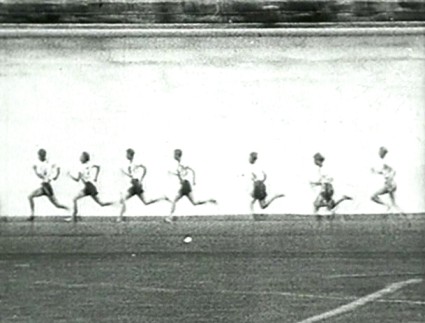
The women’s 800 metres from De Olympische Spelen, the official film of the 1928 Olympic Games (a notorious event because one competitor – according to the evidence of the film – collapsed at the end of it, leading the event to be withdrawn from the Games until 1960 because it was thought to be too strenuous for women)

Instead, a few days later, I dragged myself to Pembroke College, Cambridge, for a conference held by the Sport in Modern Europe academic network. This was a select gathering of some of the leading sports historians, and I was somewhat dazzled to be in the same room as Richard (Sport and the British) Holt, Wray (Pay up and Pay the Game) Vamplew, and Kasia (Boxing: A Cultural History) Boddy. But no matter how wise in the ways of the world sports historians are generally, they welcome a bit of guidance when it comes to film, so that was my cue to speak to them about the films of the 1924 and 1928 Olympic Games (again, as previously covered here at the Bioscope), with emphasis on the use of slow versus natural motion and whether the sports filmmakers of the silent era were more interested in athletic records or idealised athletic motion (a bit of both, really).

So there you are – a couple of weeks in the life of the roving academic, and illustration of just where film can take you because it has this marvellous facility to reflect – and illuminate – all subjects. Which is perhaps why James Joyce was drawn to it, why the workingmen of New York in 1912 preferred it far above any competing leisure attraction, and why the seemingly plain records of the Olympic Games of the 1920s grow all the more fascinating the more you try to unpick them.

Going to the show

bijou

Postcard of the Bijou, Wilmington, N.C., 1914, from Going to the Show

Though there are some who would deny it, cinema history involves the history of cinemas. The study of a medium that ignores the social form in which it has been consumed is a blinkered one, yet sadly so much of film studies exists in just such state of denial. Happily there has been a concerted effort by a dedicated band of academics in recent years to investigate cinema-going as an integral part of cinema history. Inspired in the first place by Douglas Gomery’s Shared Pleasures: A History of Movie in the United States (1992), the school uses socio-historial tools to analyse the experience of movie-going through patterns of audience types (age, gender, race, class), venue locations, social mobility, transportation links, purchasing power, leisure time and competing attractions. The significant output from such investigations has become the database which maps and documents particular territories. We’ve already had Cinema Context for the Netherlands and the London Project for the early film business in London. Now we have Going to the Show for North Carolina, 1896-1930.

This is a fabulous resource. It is going to make many other places wish that they had something much the same. Going to the Show “documents and illuminates the experience of movies and moviegoing in North Carolina from the introduction of projected motion pictures (1896) to the end of the silent film era (circa 1930)”. At its heart are 750 Sanborn Fire Insurance maps of forty-five towns and cities in North Carolina between 1896 and 1922 that locate film venues within general urban life. All of these are mapped to a database (a welcome feature for the specialist is that not only are all the database fields explained but the database relationship diagram is given) to which have been added photographs, postcards, newspaper clippings, architectural drawings, advertisements and more. It totals over 1,300 film venues across two hundred communities.

burlington

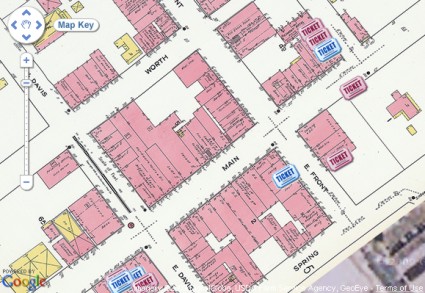
Film venues marked on Sanborn fire insurance map for Burlington, N.C.

As said, Going to the Show is based around fire insurance maps, and gives this explanation of their provenance and use:

From 1867 to 1977, the Sanborn® Map Company of Pelham, New York, produced large-scale (usually 50 feet to the inch) color maps of commercial and industrial districts of some 12,000 towns and cities in North America to assist fire insurance companies in setting rates and terms. Each set of maps represented each built structure in those districts, its use, dimensions, height, building material, and other relevant features (fire alarms, water mains and hydrants, for example). The intervals between new map editions for a given town or city in the early decades of the twentieth century varied according to the pace and scale of urban growth — from a few years to more than five years. In all, Sanborn® produced 50,000 editions comprising some 700,000 individual map pages. Because almost all early movie theaters were repurposed from an existing retail space located in the commercial heart of a town or city, they appear on thousands of Sanborn® map pages after 1906. Larger, purpose-built theaters were included in later Sanborn® maps.

Going to the Show takes these precise records of film venues and marries them to Google Maps, with all the familiar tools of zoom-in, zoom-out, scan across and marking of venues with hyperlinks to further information. But it is the range of extra information that makes Going to the Show so powerful. Map searches can be refined by year, venues and period in which the venue was active, while you can select whether to view modern or historical map with an opacity slider, and bring in current street names. Each venue is marked with a Ticket icon, which links you to additional information.

dixie

New Bern, N.C. shown through modern Google map and Sanborn fire insurance map, pinpointng the Dixie Theatre 1913-1918 catering for African American audiences only

A major aspect of the research has been the racial division of film venues. Keen to demonstrate how race conditioned the experience of movie-going for all North Carolinians – white, African American and American Indian – the resource extends beyond the silent era to document every known African American film venue in North Carolina operational between 1908 and 1963.

What distinguishes Going to the Show is its attention to database searching and presentation. The faceted browse option shows how you can refine searches by item type (Architectural Drawing, City Directory, Commentary, Illustration, Newspaper, Organization, Overlay Map, Periodical, Person, Photograph, Postcard, Typescript, Venue),
location (by City, County or Region), venue name, date (allowing for searching by decade), and keyword or tag (including such useful terms as admission price, boxing films, children, fire, influenza, penny arcade, racial policy, religious objection and separate entrance). The tag ‘notable’ leads you to some of the choice items, such as this 1897 press notice saying that owing to the popularity of the Edison Projectoscope at the Wilmington Opera House that the dress circle will be reserved for “colored citizens”:

projectoscope

Wilmington Star, 20 March 1897

And there’s more. Robert C. Allen, James Logan Godfrey Distinguished Professor of American Studies, History, and Communications Studies at the University of North Carolina at Chapel Hill, and the presiding genius behind Going to the Show, has produced an eye-catching timeline for Wilmington, N.C., chronicling and commenting upon twenty-six venues from 1897 to the end of racial segregation in 1954. Business papers from this period are a rarity, and another very welcome feature is the Joyland Theatre Ledger, the manager’s ledger from 28 September 1910, to 14 January 1911, including expenses and ticket receipts.

searle

Going to the Show is handsomely and sensibly presented. It merits detailed study. It has been produced as one of a number of University of North Carolina digital resources under the title Documenting the South. It ought to be the springboard for much further research, not simply within film/cinema studies, but as part of that general social history of which film history needs to be a part. This is the point – that so much of film history speaks only to those who know about film. It constricts itself to a narrow field by not speaking the language that is natural to other disciplines. I’ve mentioned at a couple of conferences what for me is the shocking case of G.R. Searle’s A New England? Peace and War 1886-1918 (2005), part of the New Oxford History of England. This 951-page magisterial history builds on new research in the areas of social, cultural, ecnomic and political history, yet among all those 951 pages just one throwaway paragraph is devoted to cinema. The bibliographic essay notes the extensive work done in music hall and sport history, but has nothing on cinema at all. Film historians – and in this case particularly British film historians – simply aren’t writing in a language than anyone else recognises, or cares about. The situation is better in America, as the work of Gomery, Allen, Garth Jowett and others indicates, but much much more remains to be done. Moreover, such moviegoing studies as there are often tend to get subsumed within concerns about spectatorship – handy enough in itself, but still making the audience subservient to the film. For discussion on this issues, read Richard Maltby’s essay for Screening the Past, ‘How Can Cinema History Matter More?‘, the title of which rather sums it up. To read about some of the other projects worldwide which are investigating cinema-going, see the HOMER website (History of Moviegoing, Exhibition, and Reception).

To understand the phenomenon of film, of course we need to appreciate it as an art form, but we must ask those basic questions how, where and when motion pictures were consumed, and to see their world as integral to a wider social world. Datasets and databases don’t answer everything by themselves, but they provide the foundations for thinking about the right answers. Going to the Show points the way.

Note

Robert C. Allen would welcome any feedback from Bioscope readers. You can email him at rallen [at] email.unc.edu.

Laterna Magicka

As the Bioscope celebrates the immient arrival of its 300,000th visitor (keep on coming by folks, and tell your friends), here’s a taster for a sixty-minute documentary, Laterna Magicka, about the filmmaker Bill Douglas and his astonishing collection of pre-cinema artefects which now make up the Bill Douglas Centre for the History of Cinema and Popular Culture at the University of Exeter. The documentary has been made by Sean Martin and Louise Milne and produced by 891 Filmhouse in association with Accidental Media. It is to be included in the BFI DVD and Blu-Ray release of Douglas’ 1986 film Comrades, which features a magic lanternist as a central figure. The film, which tells the tragic story of the Tolpuddle martyrs, pioneers of British trade unionism, is released on both formats on 20 July.

Film studies is dead… long live film studies

vitagraph_office

Vitagraph’s Manchester office in 1921, from Richard Brown’s article ‘The Missing Link: Film Renters in Manchester, 1910–1920’

OK, not that film studies, but Film Studies the journal, published by Manchester University Press, produced out of the University of Kent, which is no more. This is sad news, because it was handsomely produced and filled with stimulating riches, issue after issue. But, as Catherine Grant on the never less than essential Film Studies for Free reports, Manchester University Press has done the decent thing and made all of the articles in the journal 2004-2007 freely available online in PDF format (earlier content 1999-2004 isn’t available in digital form). Film Studies for Free lists all of the articles that are available; here at the Bioscope we’re selective in our tastes, so here is all the articles which touch on silent cinema:

Volume 10 (Spring 2007)
Luke McKernan, ‘Only the screen was silent …’: Memories of children’s cinema-going in London before the First World War
(pp 1-20)
Full Article in PDF p1 (273 k)

Simon Brown, Flicker Alley: Cecil Court and the Emergence of the British Film Industry
(pp 21-33)
Full Article in PDF p21 (122 k)

Janet McBain, Green’s of Glasgow: `We Want "U" In’
(pp 54-57)
Full Article in PDF p54 (124 k)

Richard Brown, The Missing Link: Renters in Manchester, 1910-1920
(pp 58-63)
Full Article in PDF p58 (157 k)

Frank Gray, Kissing and Killing: A Short History of Brighton on Film
(pp 64-71)
Full Article in PDF p64 (113 k)

Brigitte Flickinger, Cinemas in the City: Berlin’s Public Space in the 1910s and 1920s
(pp 72-86)
Full Article in PDF p72 (173 k)

Kate Bowles, ‘All the evidence is that Cobargo is slipping’: An ecological approach to rural cinema-going
(pp 87-96)
Full Article in PDF p87 (120 k)


Volume 9 (Winter 2006)

David Lavery, ‘No More Undiscovered Countries’: The Early Promise and Disappointing Career of Time-Lapse
Photography
(pp 1-8)
Full Article in PDF p1 (92 k)

Volume 8 (Summer 2006)

Patrick Colm Hogan, Narrative Universals, Nationalism, and Sacrificial Terror: From Nosferatu to Nazism
(pp 93-105)
Full Article in PDF p93 (208 k)

Volume 6 (Summer 2005)

David Trotter, Virginia Woolf and Cinema
(pp 13-26)
Full Article in PDF p13 (152 k)

Elizabeth Lebas, Sadness and Gladness: The Films of Glasgow Corporation, 1922-1938
(pp 27-45)
Full Article in PDF p27 (236 k)

Volume 4 (Summer 2004)

Charles Musser, The Hidden and the Unspeakable: On Theatrical Culture, Oscar Wilde and Ernst Lubitsch’s Lady Windermere’s Fan
(pp 12-47)
Full Article in PDF p12 (478 k) [this PDF is not working at present]

A marvellous selection, including a number from a special issue on Cities and Cinema. I can quite recommend the top article to you – and all the others just as much. For the remaining articles, do visit the relevant MUP web page. If a journal does have to fold, this is a noble way of keeping its contents available, especially for those without easy access to academic libraries, so plaudits to MUP, and hopefully it’s a model that others will follow (though of course we’d rather not have any more film journals fold, of course).

Cinecon 45

cinecon

Photographs from last year’s Cinecon 44

Cinecon, the classic film festival, takes place 3-7 September over Labor Day weekend, at Grauman’s Egyptian Theater, Hollywood Blvd. Cinecon describes itself as is a five day celebration of the movies, with screenings of nearly thirty rare silent and early sound feature films and as many short subjects from leading film archives and Hollywood studio vaults. It is dedicated to showcasing unusual films that are rarely given public screenings, mostly on 35mm, with live piano accompaniment for silents. There are celebrity guests and opportunities to buy movie memorabilia in six dealers’ rooms. Titles to be screened won’t be announced until a month before the event, but these are the film screening hours:

Thursday Sep. 3 7 pm – midnight
Friday Sep. 4 9 am – midnight
Saturday Sep. 5 9 am – midnight
Sunday Sep. 6 9 am – 6:30 pm
Monday Sep. 7 9 am – 6:00 pm

To attend the Cinecon Classic Film Festival you need to become a Cinecon member. Membership is included when you buy a full festival pass or a single day pass. No admissions to individual films are sold. Passes also include free entrance to the memorabilia dealers’ rooms but for those who only want to shop they offer a separate dealers-room-only admission. Background information and registration details are available on the Cinecon site.

Silents from Sulphur Springs

clownesse

Georges Méliès’ La Clownesse fantôme (1902)

The Bioscope returns from its travels in Ireland and Wales (about which you will learn something in due course) to report once more on what’s been happening in the world of early and silent cinema. Kicking things off, the Sulphur Springs Collection of Pre-Nickelodeon Films is a collection of early American films recently published online. The collection is part of the G. William Jones Film and Video Collection (formerly the Southwest Film/Video Archive) held by Southern Methodist University (SMU), Dallas, Texas. Twenty-nine of the thirty-three films, dating 1898-1906, have been published as part of SMU’s Central University Libraries (CUL) Digital Collections.

Below is a list the films being made available. Highlights include a Lubin imitation of Edison’s Life of an American Fireman (Lubin was notorious for borrowing other companies’ good ideas), several Edison panoramic films of the San Francisco earthquake of 1906, an atavistic chase film Tracked By Bloodhounds, or A Lynching in Cripple Creek (the victim is not black), and the otherwise lost Georges Méliès film, La Clownesse fantôme.

1. A Shocking Accident (Lubin, 1904)
2. [Couple Feeding Barnyard Fowl] (unidentified, 1903)
3. Earthquake ruins new Majestic Theater and City Hall (Edison,1906)
4. Epopée napoléonienne: Crossing Mt. St. Bernard (Pathé Frères, 1903-04)
5. [Feeding Fowl on a Country Path] (unidentified, no date)
6. [Gymnastics] (unidentified, no date)
7. Inexhaustible Cab (Lubin, 1901)
8. Japs Loading and Firing a Gun on Battleship ‘Asam’ (Edison, 1904?)
9. La Clownesse fantôme (The Shadow-Girl) (Star Films, 1902)
10. Le Laveur de devantures (The window cleaner) (Pathé Frères, 1903)
11. Life Of An American Fireman (Lubin, 1905)
12. Love in a Railroad Train (Lubin, 1902)
13. The Maniac Barber (American Mutoscope and Biograph Co., 1899)
14. Panorama City Hall, Van Ness Ave., and College of St. Ignatius (Edison, 1906)
15. Panorama Nob Hill and ruins of millionaire residences (Edison,1906)
16. Panorama notorious ‘Barbary Coast’ (Edison, 1906)
17. Panorama ruins, aristocratic apartments (Edison, 1906)
18. [Pillow Fight Scene] (unidentified, no date)
19. Ruins of Chinatown (Edison, 1906)
20. S.S. ‘Coptic’ (Edison, 1898)
21. The Counterfeiters (Lubin, 1905)
22. The Farmer’s Troubles in a Hotel (Lubin, 1902)
23. The Fight on the Bridge for Supremacy (Lubin, 1904)
24. The Golf Girls and the Tramp (Edison, 1902)
25. The Goose Takes a Trolley Ride (Lubin, 1903)
26. Tracked By Bloodhounds, or A Lynching in Cripple Creek (Selig, 1904)
27. [Trio of Acrobats] (unidentified, 1901)
28. Two Rubes at the Theater (Lubin, 1901)
29. Vertical panorama City Hall and surroundings (Edison, 1906)

The films are available in QuickTime format, and each is catalogued in much hyperlinked detail. The image quality is fine, and the original films look in good conditions, with just some touches of nitrate decomposition here and there. The website provides this statement regarding usage:

The files in this collection are protected by copyright law. No commercial reproduction or distribution of these files is permitted without the written permission of Southern Methodist University, Central University Libraries. These files may be freely used for educational purposes, provided they are not altered in any way, and Southern Methodist University is cited.

So now you know. It’s an excellent collection, ranging from single-shot actualities to multi-shot narratives, informative, coherent and illuminating. You can find out more about the collection, with background on all of the films, including the four not included online)) in Rick Worland, ‘The Sulphur Springs, Texas early films discovery‘, Journal of Film Preservation 51 (1995), pp. 56-64, available in PDF format from the FIAF site. It will get added to the Bioscope’s list of video sources. Go explore.