Catwalks and pavements

Paris fashions displayed through stencil colouring, from the Discovering Cinema DVD, www.flickeralley.com

A subject I’ve long meant to cover on the Bioscope is fashion in silent film. It’s a subject of great importance, because of the strong relationship between what was worn on the screen and what the audience in the cinema then dreamt of wearing. That relationship was exploited commercially, by fashion firms whose products featured in films and by those stars who were used to promote fashions (on and off-screen). Moreover, there is an equally important, if less recognised connection between fashion and film, which is the record that film can provide of what ordinary people in the street were wearing. Fashion is found not just on the catwalk or the movie screen, but on the pavement as well.

However, I am no expert in fashion (as anyone who has seen how I dress would be quick to affirm). But I can produce a guide to some sources, particularly online video sources, to help those who might like to explore this area further for themselves.

Let’s start with films of the fashion houses. Short films showcasing the latest fashions from the Paris houses were a staple of film programmes of the 1910s and 20s. Films showing mannequins parading gowns, hats and shoes beyond the hopes of most in the cinema audience were seen in individual films and occasional special film series, but more commonly as part of newsreels and cinemagazines. Beyond the hopes of most they may have been, but not all. There was commercial sense in it because coturier fashions were starting to move from appealing to the exclusively rich and were starting to appear in department stores, just at the time when cinema was doing it best to attract a more middle class and monied audience. Fashion films were part of the general aspirational trend of the cinema, and they were there in particular to attract women to the cinema.

French film companies became the natural specialists in the field, not least because Pathé and Gamuont had factories dedicated to producing artificially coloured films employing a stencilling process (and many women workers painting the individual frames using those stencils). Fashion films in which the models moved slowly displaying gorgeously coloured gowns were ideal subjects for a colour process that struggled to capture objects moving at speed. Colour was naturally attractive for the fashion film, and fashions were a fine means of showing off colour processes. One of the earliest of all magazine film series was Kinemacolor Fashion Gazette (1913), edited by British fashion journalist Abby Meehan, which showcased the pioneering natual colour process and combined its exhibition with a live fashion revue organised by the Evening News newspaper at the West End Cinema in London.

An exquisite example of a stencil colour fashion film can be found on the Flicker Alley site, in its Screening Room – a 1926 Unie Film Revue from the Netherlands showing fashions from Maison Redfern, Maison Blanche Lebouvier and Maison Tolmann (click on the Discovering Cinema option – the clip comes from their Discovering Cinema 2-DVD set, or you can find the same film on Europa Film Treasures). There’s a frame grab at the head of this post. And below is a c.1927 colour tinted film from Australian Screen, here showing off a Le Mennier headpiece:
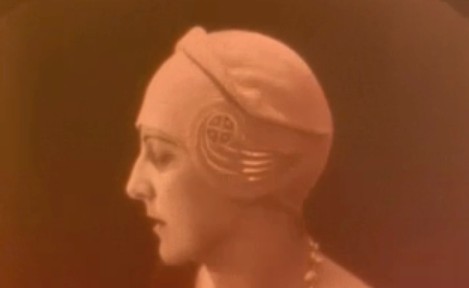
Scene from Camp-Berlei Foundation Garments: Physiological Support (c.1927), from Australian Screen, http://aso.gov.au/titles/ads/camp-berlei-foundation/clip1/

Colour fashion films from the silent era are hard to find online, but there are monochrome examples a-plenty. The British branch of Pathé featured many fashion items, particularly in its women’s magazine series Eve’s Film Review, and numerous examples (including Fashions à la Parisienne, illustrated below) can be found at www.britishpathe.com (type in ‘fashions’, ‘maison’ or ‘paris fashions’ for the best results.
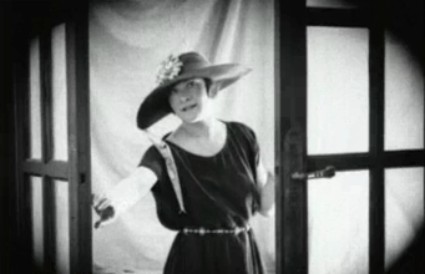
A black and blue hat with ribbon cockade and flowers from Maison Mimoso, from Fashions à la Parisienne, Eve’s Film Review (c.1921), www.britishpathe.com

The sheer extent of fashion films in British newsreels can best be judge by applying the same search terms to the BUFVC’s News on Screen database of all British newsreels, though there are no clips (there are links across to the Pathé site, however). Or search under such fashion houses as Lucile’s (i.e. Lady Duff-Gordon, sister of Elinor Glyn), Maison Lewis, Marco’s, Joseph Paquin, Maison Worth and Paul Poiret. British Gaumont films (which as with Pathé include many international films which happened to be released through the British reels) can be seen on the ITN Source site – go to Advanced Search, click Deselect All under Partners then click on New Classics, select 1920s as a decade, then put in your search term. There are numerous fashion clips there, such as this interesting example of Chinese fashions (actually from the American International News):

New Fashions for Chinese Flappers, International News (1926), www.itnsource.com/shotlist//BHC_RTV/1926/03/15/BGT407111003

Gaumont’s early 1920s Around the Town cinemagazine had many fashion-related items, though only a few examples of the series exist today, and none online (many of the lost films can nevertheless be found described on News on Screen). Examples from French Gaumont and Pathé can be found on www.gaumontpathearchives.com, though that requires registration and it’s not easy to obtain permission unless you are a production company.

But as said, there was more to fashion than Paris. One of the overlooked virtues of archive films is what they are able to show us of what we wore. There is nothing quite like film for showing what was worn by people day-to-day, how those clothes fitted in motion, and how popular fashions changed. Again the newsreels provide an excellent source, but a still more useful one has just emerged from Brighton. It was Brighton professor Lou Taylor whose 1980s television series Through the Looking Glass first alerted me to the value of using archive actuality film to study what ordinary people were wearing, and it is the University of Brighton’s Screen Archive South East which is the source of Screen Search Fashion, a thematic guide to fashion and dress in films of the 1920s and 30s held in the Archive’s collection.

Group of people standing outside the Heath cinema in Haywards Heath, c.1928, from the Screen Archive South East collection

This wonderful resource employs selected themes (1920s fashion, 1930s fashion, work, sport, leisure, travel etc) to guide users through the collections, using stills and clips from the Archive. There are overviews of types of fashion and periods, descriptions of the clothing to be seen in the clips, and even modern photographs of particular clothes for comparison (or else links to external collections). As an example of the descriptive text, here is part of what’s written about the Heath cinema film above:

A group of young people stand outside a cinema in Burgess Hill. The men wear three-piece suits. One man wears the fashionable ‘plus fours’ style popularised by the Prince of Wales rather than full-length trousers. The women follow the fashionable androgynous silhouette of the period with knee-length hemlines. They wear interchangeable separates including sweaters, skirts, dresses and coats. One woman sports a necktie reinforcing the boyish look. Their clothing is probably ready-to-wear rather than made by a dressmaker. All the women have bobbed hair and none wear hats.

This is just what film archives should be doing – making us look at films anew. Amateur films, home movies, newsreels and magazine films are filled with sociological detail, but it needs someone with an intelligent understanding of the films’ milieu and contents to open our eyes to hat these films contain. This Screen Search Fashion does so well, illuminating men’s and women’s clothing, and for both adults and children. It is such a sensible and well-executed idea to have had, and I warmly recommend it.

Turning to the feature film, there was a close connection between the couture houses and some film producers from the mid-1910s onwards. The already-mentioned Lucile, or Lady Duff-Gordon (shown left, from www.ladyduffgordon.com), was the great pioneer, dressing a number of films from the mid-teens onwards (Lillian Gish tell us that Lucile supplied the models for the ball scene in Way Down East) as well as ensuring that her fashions appeared regularly in magazine films.

Elizabeth Leese, author of the essential Costume Design in the Movies (1991), writes:

Couture houses have always supplied dresses for feature films, particularly from New York, as quite a lot of filming was done in the East Coast studios. The couture houses did not, as a general rule, get any kind of screen credit, although news items often appeared in trade and fan magazines telling film-goers that a star would be getting her dresses from a particular fashion house. Many actresses who were rather short on acting talent relied on the lavishness of the wardrobes, because the ability to wear clothes well was just about all they had to offer. Roberta Hickman (who was working around 1915) wore clothes from Lucille [sic] and Poiret, Irene Castle used Lucille Ltd. Alice Joyce and Corinne Griffith were faithful to Madame Frances. Many actresses used Hattie Carnegie, but she was smart enough to get a screen credit for the films she did with Constance Bennett.

Then were were people from the couture houses who went to work in films – but that takes us into the world of the costume designer as a profession in the silent era, and that will have to be the subject of another post, at another time.

For some further reading (aside from Elizabeth Leese), Jenny Hammerton’s For Ladies Only? Eve’s Film Review: Pathe Cinemagazine 1921-33 is very informative on the fashion films in this key series, while Emily Crosby’s essay ‘The Colour Supplement of the Cinema: The British Cinemagazine, 1918-1938’, in Projecting Britain: The Guide to British Cinemagazines illuminatingly links the cinemagazines’ use of fashion to the place of fashion in 1920s culture as a whole. The book also contains some interesting examples of letters written by Pathé’s editor to some fashion houses.

The magic lantern and Victorian culture

Joseph Boggs Beale magic lantern slide illustrating ‘The Curfew Shall not Ring Tonight’, CC http://www.flickr.com/photos/79874673@N00/151375362

Well it’s clearly the time of year when people are itching to get out of the darks and start organising things for 2010. Before long we’ll be having a catch-up post on the festivals being organised for next year, but the conferences and such like are also starting to get announced. And so, a call for papers has gone out for the 2010 Convention of the Magic Lantern Society of the United States and Canada, to take place in Bloomington, Indiana, 20-23 May 2010. Here it is:

The Magic Lantern Society of the United States and Canada invites scholars to submit papers or proposals for papers pertaining to the lantern to the conference organizers, Professor Joss Marsh and Mr. David Francis (Indiana University, Bloomington) and Mr. Dick Moore (President, AMLS). (Papers in research sessions will be held to 20 minutes in length.) Deadline 15th February 2010.

Presentations will be especially welcome that address the key theme of the Convention: The Magic Lantern and Victorian Culture.

Topics might include (but are not limited to):

  • advertising with the lantern/advertising the lantern
  • lantern-slide manufacturers and distributors
  • exhibition practices
  • individual and itinerant lanternists
  • multi-media lantern shows and lantern use
  • the lantern and nineteenth-century theatre, opera, and ballet
  • the lantern and Music Hall/Variety shows
  • local lantern shows
  • the missionary lantern
  • the Temperance lantern
  • the lantern and social change
  • urban and social lantern investigation
  • the psychology and theory of 19th century lantern spectatorship
  • the lantern and science
  • educational uses of the lantern
  • lantern-assisted virtual travel
  • the lantern and horror
  • literary reflections of the lantern
  • lantern performance of literature
  • the lantern and childhood
  • the lantern and cinema
  • lantern-inspired early films
  • lantern-slide use in movie theatres
  • animated slides and lantern representation of movement
  • the magic lantern and the long history of the ‘screen experience’
  • lantern song-slides
  • lantern humour
  • the lantern and Empire
  • lantern story-telling and lantern readings
  • the Victorian family lantern

Principal sessions of the Convention will take place at the Convention Centre, in downtown Bloomington, and on the campus of Indiana University. Presentations include a ‘Grand Optical Variety Show’ at the vintage Buskirk-Chumley (Indiana) Theater, Professor Mervyn Heard M.C., with Mr. Philip Carli at the piano.

Please address proposals to: jomarsh [at] indiana.edu; djfranci [at] indiana.edu; rmoore0438 [at] aol.com.

Well, something there for everyone, and a reminder of how close the worlds of the lantern and the early cinema were. A general post on discovering the world of the magic lantern is promised, soon.

Women and the Silent Screen VI

The sixth International Women and Film History Conference is to take place in Bologna, Italy 24-26 June 2010, immediately preceding the Il Cinema Ritrovato Film Festival. A call for papers has been issued, and here are the details, culled from the festival site:

The VI International Women and Film History Conference (Bologna, 24-26 June 2010) will pay tribute to the women’s involvement in the silent film industry and culture across the globe. The event will provide an insight into women’s contribution to the silent screen through a series of scholarly panels, keynote addresses and archival screenings. In the dynamic spirit that caracterized each of the previous Conferences held in Utrecht (1999), Santa Cruz (2001), Montréal (2004), Guadalajara (2006), and Stockholm (2008), presentations will consider a wide range of themes related to the spheres of the motion picture economy, history, criticism, narrative forms, transnational film culture, the social contexts of film production and much more, all seen through the lens of feminist theory and historiography. It will be an opportunity for scholars and young researchers to expose and discuss the new issues and ideas that are spreading at the cutting edge of Film and Women’s Studies, exploring the future directions to be possibly pursued.

Proposals are welcomed concerning not only the female directors, screenwriters, producers and actors of the era, but also the larger role of women in modern mass culture. If you are proposing a paper please fill in the on-line submission form. We will only accept proposals in English that use this form, and the deadline for submission is January 10, 2010, but earlier submission are welcomed. This form will allow you to view and change your proposal and to keep in touch with the peer-review editors up to one month before the deadline. Ideally you will be given an answer by the middle of February.

Please notice that the Conference will occur in Bologna in the week immediately preceding Il Cinema Ritrovato Film Festival (running June 26 through July 3, 2010), sponsored by Alma Mater Università di Bologna (Dipartimento di Musica e Spettacolo – La Soffitta), Women and Film History International, Regione Emilia-Romagna, Cineteca di Bologna, and the Biblioteca Italiana delle Donne. We are particularly happy to announce that the festival will host a special section on women in silent cinema, curated by Mariann Lewinsky in cooperation with WSS VI. All the participants in WSS VI will directly be registered at no fees at the festival, and will be eligible to reserve rooms at special price at hotels located in the city centre, within walking distance to the conference site.

We invite papers and panels not only on the directors, screenwriters, producers, and actors of the era, but also on the role of women in modern mass culture, broadly considered. Continuing the dynamic spirit that characterized previous conferences in Utrecht (1999), Santa Cruz (2001), Montréal (2004), Guadalajara (2006), and Stockholm (2008) the conference will provide an open and friendly atmosphere for the exchange of research and insight into women’s involvement in the first four decades of film history.

Papers and panels might consider:

* Words, wordlessness, and bodily expression
* Divas and antidivas
* Audiences, moviegoers, and fans
* Theorists, critics, and writers
* Body genres
* Serial screen narratives
* Motion picture economies and gendered divisions of labor
* Global and local exhibition practices
* The social realities of World War I
* Feminist historiography and the transnational
* The modern as period and problematic
* Synchronized sound: transition, continuity, and the question of change
* The archives: theory, practice, politics
* Feminist theory and the silent screen

Submission Deadline: January 10, 2010

Further details are available on the festival site, including details of the submission process for papers.

The world of local topicals

Sir Harry Lauder Visits the Regent Picture House (1928), from the Scottish Screen Archive

I am pleased to be able to offer for you a piece written especially for The Bioscope by Janet McBain, Curator of the Scottish Screen Archive at the National Library of Scotland. Janet’s subject is the local topical. You will have to search very hard in the film history literature to find anything written on the local topical, but go to any UK film archive and you’ll find them in abundance. For the local topical was a local newsreel – filmed locally (often by a cinema’s projectionist) and shown locally. Such films, which flourished in particular in the 1910s and 20s, showed parades, civic marches, works’ outings, visits of dignitaries, or often simply people miling about in the street, filmed by a touring showman who would then tell you to turn up at the ton hall that evening, where you would be guaranteed to see yourself on the screen.

Just such films have become known to more than archivists of late, thanks to the sterling work done by the British Film Institute and the National Fairground Archive to promote the Mitchell & Kenyon collection of films predominantly showing working class life in English northern towns in the 1900-1910 period. M&K were commissioned to film local parades, galas, football matches and such like, and would indeed film people in the streets to encourage them to see the film show in the evening. Mitchell & Kenyon have achieved modern fame, through books, a television series and DVDs. But there were many other such films, as Janet McBain’s piece informs us.


The world of local topicals: observations on life after Mitchell and Kenyon through local films made for the Regent Cinema, Glasgow in the 1920’s

As we have seen with the Mitchell and Kenyon film collection early independent exhibitors, in the first decades of the moving picture, clearly understood the appeal and the business value of ‘ local films for local people’. With marketing slogans such as ‘Come and see yourselves as others see you’ they understood their audiences and what they wanted to see and exploited this with flair and showmanship learned out on the road with the travelling fairground shows.

Still very much in the shadow of these Edwardian films and ripe, I would suggest, for re-discovery are local topicals from succeeding decades. Still presented and marketed as ‘see yourself on the silver screen’, but offered by exhibitors running permanent, fixed site shows from 1911/12 onwards.

There are literally hundreds of these post-M&K films in the UK’s moving image archives dating from just before the Great War to the decades after World War 2. (Scottish Screen Archive has over 500 titles in its collection alone). They are classified inconsistently as topicals, local topicals or local newsreels. The fact that we in the archive community still do not have a standardised genre or classification term is indicative of the lack of understanding of, or attention to, this material.

When talkies came along in the late 20’s the local topical continued – but remained silent. Due in part to shortage of film stock during the Second World War they disappear, only to re-emerge in the post-war era – still mostly silent. But by the end of the 1950’s, with changes in cinema-going habits and the demise of many of the independently owned cinemas the local topical all but disappeared.

Typical of the content of these films are crowd pulling events: gala days, parades, local festivals and holidays, unveiling of war memorials, sports meetings – events that would get local people out onto the streets and in front of the camera lens.

We still know relatively little about audience reception, means of production or how the exhibitors financed and publicised these films. There is evidence that some exhibitors and cinema managers shot the films themselves, other times that they engaged newsreel and production professionals to make them.

Whatever and whoever he was the cameraman would be instructed by the exhibitor to get in as many close-ups of faces in the crowd as possible. Hence the frequent use of the panning shot, very much the hallmark of the local topical, to maximise your audience who would be enticed into the picture hall a few nights later with the prospect of seeing themselves on the big screen.

Local topicals sit somewhat uncomfortably between news reportage and actuality. They can be seen as both … and neither. They are not hard news per se, but they cover newsworthy events within a local sphere. They are intended as promotional tools and this influences content, which in turn robs them to a degree of the objectivity of the actuality. Perhaps the local topical could be described as a discrete genre in its own right.

Two examples of local topicals discovered recently by Scottish Screen Archive illustrate the fudged line between news and actuality – the grey zone in which sits the local cinema newsreel.

They have a consistent theme. Both were commissioned by William McGaw, manager of the Regent Picture House in Renfield Street in Glasgow, one of the first purpose built cinemas in the city centre. McGaw was a enthusiastic publicist and won many trade awards for showmanship during his career.

Both films were shot on the occasion of special screenings at the Regent with the personal appearance of a film star, illustrating another fascinating feature of the local topical, that of recording the history of cinema-going itself.

Both films were intended to serve as local topicals – to be shown in the picture house, and to engage the audience through recognition, of themselves and their friends, on the screen. The Minute Books for the Regent’s proprietary company give accounts of the manager’s application to the Directors’ to approve this advertising strategy.

The two films differ, however, in editorial approach.

Vera Reynolds Visits Regent Picture House (1926)

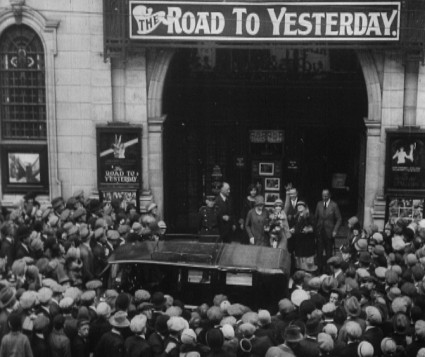
The first one records Vera Reynolds, young American actress, making a personal appearance at the cinema in September 1926 for the Scottish premiere of The Road to Yesterday. It looks like a newsreel item. The focus is on the celebrity, it is a two-camera shoot suggesting it was made by a professional unit, possibly local stringers from Gaumont’s or Pathe’s Glasgow office. Reynolds herself is very camera aware and is the star of the film in every sense.

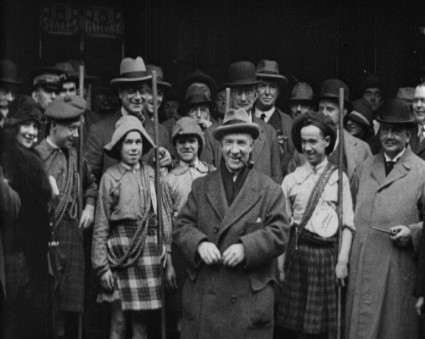
The second title comes two years later on 5th October 1928 with Sir Harry Lauder’s personal appearance at the cinema for the premiere of Huntingtower, George Pearson’s adaptation of the novel by John Buchan and in which Lauder took the leading role as Glasgow grocer Dickson McCunn. We know from reports in the trade press that the topical was shot by James Hart, projectionist at the Grosvenor Cinema, a small picture house in the west end of the city. At the time Hart made this film for McGaw and the Regent his own locals, under the banner Grosvenor Topical News, were appearing on screen on an almost weekly basis. Lauder travelled specially from Edinburgh on a Friday morning to see Huntingtower for himself for the first time. Hart’s topical was screened at the first house on that same evening and before every performance of the big picture during the weeks thereafter.

Sir Harry Lauder Visits the Regent Picture House (1928), Lauder himself in the centre

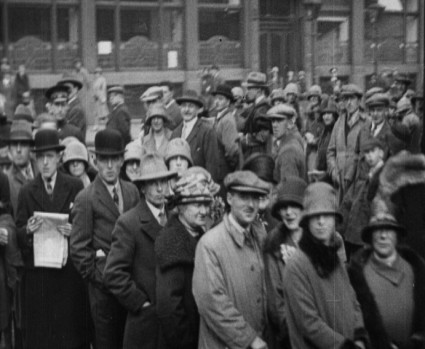
Of the two films Hart’s footage is more quintessentially recognisable as a local topical. He foregrounds the future audience with long tracking shots and pans of the cinemagoers and the crowds waiting on the street outside the picture house, almost overshadowing the appearance of the star. Lauder and four boys from the cast of Huntingower posed in the entrance of the cinema are on screen for maybe a third of the film. Hart gives us intertitles identifying the participants, including McGaw the cinema manager. He understood the rationale for the film, arguably more so than the professional newsreel maker who assembled the earlier Reynolds film. In this one she is undoubtedly the star taking up all the screen time. There are no identifiable shots in this film of the local people – they are not visible on camera as individuals.

Both films have been preserved by Scottish Screen Archive and can now be viewed along with other local topicals online at www.nls.uk/ssa.

Also another of the writer’s favourites – illuminating aspects of cinema history – is also now available online:

There are hundreds more local topicals awaiting re-discovery in the nation’s archives – come and find them!

Janet McBain
Curator
Scottish Screen Archive,
Glasgow

December 2009


As pointed out, you can see the two Regent films at the Scottish Screen Archive’s excellent site (where there are over 1,000 film clips freely available to view), the subject of a Bioscope post a year or so ago. Other UK film archives with local topicals can be found via the Film Archive Forum site, or you can see examples on Moving History, a sampler site of films from archives around the UK. For example, check out the North West Film Archive’s Milnrow and Newhey Gazette (1913) or the Media Archive of Central England’s The Meet of the Quorn Hounds 1912, each of which is accompanied by a mini-history of the local topical genre..

If by chance you haven’t come across Mitchell & Kenyon as yet, the BFI provides a handy guide which gives an overview of the collection, the history of their production, images, and links to DVDs and books, particularly Vanessa Toulmin, Simon Popple and Patrick Russell (eds.), The Lost World of Mitchell and Kenyon: Edwardian Britain on Film (2004). And there are numerous examples of M&K films available to videw for free on the BFI’s YouTube channel.

And now for something almost completely different

http://www.slapstick.org.uk

The sixth edition of Bristol’s Slapstick festival takes place 21-24 January 2010. As in past years, the programme combines classic comedy from the past with the comedians of today. This year the star attraction is former Python Michael Palin, who will be featured in Michael Palin: Something Almost Completely Different and who will introduce a screening of Buster Keaton’s The Navigator. Other comedy giants on show include W.C. Fields, Harold Lloyd and Laurel and Hardy, plus screenings of René Clair’s sublime An Italian Straw Hat and Boris Barnet’s Soviet hit from this year’s Pordenone, The House on Trubnaya Street.

Featured comedians from the sound through to television era include Will Hay, Kenny Everett, Barry Cryer, Tim Brooke-Taylor, Graeme Garden, Phill Jupitus and former Bonzo Dog Doo Dah Band member Neil Innes. There will be the world premiere of a recently rediscovered college film by Innes, featuring the inimitable head Bonzo Vivian Stanshall, and featured in “The Bonzo Dog Scrapbook Show”.

The full festival brochure is here (warning – it’s a 2.5MB PDF), but the ever-obliging Bioscope brings you the main contents anyway:

THURSDAY

SLAPSTICK GALA WITH MICHAEL PALIN
Something Almost Completely Different

THURS 21 JAN 1930hrs Venue: Colston Hall

Bristol’s Slapstick Silent Comedy Festival invites you to a star-studded evening of classic comedy and live entertainment for its Sixth Slapstick Gala. This unique event presents comedy legend and national treasure Michael Palin onstage to discuss his illustrious career in comedy with fellow writer/performer Graeme Garden. On screen – in homage to Palin’s traveling legacy – we present one of Buster Keaton’s greatest omedies THE NAVIGATOR (1924), set to the world premiere live musical accompaniment by The European Silent Screen Virtuosi. This newly formed five-piece musical ensemble features triple Oscar winning film animator and jazz cornetist Richard Williams and world-acclaimed silent film maestro Günter Buchwald on violin and piano, along with their international friends.

With other celebrity guests both on stage and on screen including Neil Innes, this is a once-in-a-lifetime event not to be missed! Early booking is recommended to avoid disappointment.

Tickets: £16.00/£12.00 concessions and Bristol Silents members
Book via Colston Hall: 0117 922 3686 or visit www.colstonhall.org.uk.

FRIDAY

THE ITALIAN STRAW HAT (U)
with live accompaniment by Barbara Lenz

FRI 22 JAN 1740hrs Venue: Arnolfini
Dir. René Clair, France / Germany, 1928, 1h 25m

A hilarious misadventure, heralding the beginning of ‘screwball comedy’, this early classic of French cinema is full of wonderful character gags and situation comedy. On the way to his wedding Ferdinand (Albert Préjean) discovers that his horse has eaten the straw hat of a married woman (Olga Tschechowa) canoodling in the bushes with her lover, Lieutenant Tavernier (Geymond Vital), and his big day begins to go rapidly downhill.

Tickets: £7.00/£5.00 concessions and Bristol Silents members

GIRL SHY (U)
with live accompaniment from The Slapstick Boys

FRI 22 JAN 2000hrs Venue: Arnolfini
Dir: Fred Newmeyer, USA, 1924, 1h 22m

One of Harold Lloyd’s finest and funniest, this rich character comedy about a bashful stutterer who is chronically shy of women is packed with extraordinary sight gags, brilliant intertitles and hilarious performances. Including live musical accompaniment from The Slapstick Boys, four of the finest musicians in Europe for silent film accompaniment, this screening will also feature an onstage discussion with film historian and filmmaker Kevin Brownlow and avid Lloyd fan, Withnail and I actor Paul McGann. An unmissable medley of
fine silent comedy, exhilarating music and discussion!

Tickets: £7.00/£5.00 concessions and Bristol Silents members

SATURDAY

SLAPSTICK INTERNATIONAL: PORDENONE SILENT FILM
FESTIVAL ITALY: THE HOUSE ON TRUBNAIA STREET PG
With live accompaniment by Günter Buchwald and Lee Mottram

SAT 23 JAN 1100hrs Venue: Watershed Cinema 1
Dir: Boris Barnet, Russia, 1928, 1h 04m

The big surprise hit of the 2009 Pordenone Silent Film Festival in Italy was this delicious comedy from (improbably) the classic era of Soviet cinema. True to melodrama tradition, a simple peasant girl (along with an obstreperous duck) arrives from the country, a ripe victim for all the perils of the big city. Exploited by a stingey hair-dresser and his odious wife, she uses the new social order to turn the tables. A uniquely entertaining piece of work. With special introduction from the Director of Pordenone Festival, David Robinson.

Tickets: £6.50/£5.00 concessions and Bristol Silents members

LAUREL & HARDY: CLASSICS & RARITIES
SAT 23 JAN 1400hrs Venue: Arnolfini

With an eclectic programme of classics & rarities from the ‘two minds without a single thought’, Graeme Garden (The Goodies) & silent comedy expert David Wyatt demonstrate why Stan and Ollie are now considered amongst the best comedy teams ever. They will divulge the duo’s influence on other comedy teams including ‘The Goodies’, and introduce films and clips of the rarest of all L & H appearances in Charley Chase’s Now I’ll Tell One (1927) and a complete screening of their classic silent short Putting Pants on Philip (1927).

Tickets: £7.00/£5.00 concessions and Bristol Silents members

THE REAL FRED KARNO
SAT 23 JAN 1600hrs Venue: Watershed Cinema 1

Tim Brooke-Taylor and Tony Staveacre (author of ‘Slapstick!’) investigate the legacy of the Exeter-born showman and impresario, Fred Karno. Credited with discovering Chaplin, Stan Laurel and even the pie-in-the-face gag, he has pioneered a tradition of physical comedy which still flourishes today. Their presentation will include rare archive footage of the great man himself as well as clips of his alumni, including Sandy Powell, Flanagan & Allen, Will Hay, Denny Dennis, George Carl, Stan Laurel and Charlie Chaplin. A rare opportunity to discover the genius of this master showman.

Tickets: £6.50/£5.00 concs and Bristol Silents members
Slapstick Festival Special event

An evening with Neil Innes THE SEVENTH PYTHON (PG)

SAT 23 JAN 1850hrs Venue: Arnolfini
Dir: Burt Kearns, USA, 2008, 1h 34m

This UK premiere is a recent documentary based on the life, work and
unplanned career of musical satirist Neil Innes. The Seventh Python traces one man’s winding path of whimsy as he flirts with destiny at the edge of fame with incredibly influential and unusually lasting work that keeps one foot planted in the worlds of comedy and the other in rock ‘n’ roll. Neil Innes has proven to be the greatest musical comedy satirist of the past fifty years. He has brought us delights from the Bonzo Dog Doo – Dah Band, Monty Python and The Rutles. With contributions from John Cleese, Terry Jones, Eric Idle, Michael Palin and Slapstick regular Phill Jupitus.

Tickets: £3.00/£2.00 concessions and Bristol Silents members

‘An evening with Neil Innes’ is followed by:
THE BONZO DOG BAND FILM AND TV SCRAPBOOK
with NEIL INNES
SAT 23 JAN 2040hrs Venue: Arnolfini

40 years on from the split of the original Bonzos Slapstick 2010 welcomes you to a celebration of all things ‘Innes’ with a special focus on the visual and musical lunacy of The Bonzo Dog Do-Dah Band. Celebrating the Dadaist creative insanity of the Bonzo’s, Neil Innes is the inspired creator of many of their best known numbers including Equestrian Statue, Urban Spaceman and Death Cab for Cutie. Neil is joined onstage by Culture Show’s Matthew Sweet and using extracts from the band’s anthology will together explore the incredible influence of this one band revolutionary force on both music and comedy. As if all this wasn’t enough, Neil will be screening the premiere of his recently discovered student art film from 1965 featuring footage of Viv Stanshall performing his famous mock striptease. An evening of the finest filmic and musical hilarity not to miss!

Tickets: £7.00/£5.00 concessions and Bristol Silents members

SUNDAY

WILL HAY – MASTER OF COMEDY
SUN 24 JAN 1100hrs Venue: Watershed Cinema 1

Will Hay was Britain’s best known film comedian of the 1930s and 40s and his film OH MR PORTER one of the funniest of the period. Join David Wyatt and Graham Rinaldi, author of the recent Will Hay biography, as they discuss and explore his films and theories while showing extracts starring Hay, and some of his favourite comedians such as Chaplin, W.C. Fields, and Laurel & Hardy. Rarities will include silent footage from Hay’s 1922 revue show, on the set outtakes and their new unfinished documentary on the making of OH MR. PORTER – NEXT TRAIN’S GONE. Discover the delights of one of Britain’s finest comedians. A book signing will follow the event.

Tickets: £6.50/£5.00 concessions and Bristol Silents members

BARRY CRYER: THE LOST GENIUS OF KENNY EVERETT
SUN 24 JAN 1400hrs Venue: Arnolfini

Already one of Britain’s most successful radio DJs, Everett rose to national acclaim with the Kenny Everett video show, showcasing his unique, anarchic humour. As part of Slapstick after Silents, this is a special event with one of his closest working collaborators, the legendary comedy writer and Sorry I Haven’t a Clue Star, Barry Cryer. With insights from Cryer, who was Everett’s comedy writing partner for over a decade, and onscreen footage of Kenny, join Slapstick 2010 in celebrating the work of this innovative visual comedian.

Tickets: £7.00/£5.00 concessions and Bristol Silents members

SLAPSTICK INTERNATIONAL: SAN FRANCISCO:
SO’S YOUR OLD MAN PG
Introduction by Chris Serle

SUN 24 JAN 1600hrs Venue: Watershed Cinema 1
Dir. Gregory la Cava, USA, 1926, 1h 07m

Another festival triumph, this time from the 2009 San Francisco Silent Film Festival. Mostly remembered for his nasal wheeze and acidulous one-liners, W.C. Fields is here revealed as one of the great silent visual comics, just as funny without sound. He plays the bibulous Mr. Bisbee whose plans to launch his unbreakable windscreen are somewhat complicated by a glamorous visiting princess, a pony, a demanding family and his own taste for sarsaparilla and spirits. Great characters make up a sharp view of small-town life – and Fields manages to slip in his famous vaudeville golf routine. A real discovery!

Tickets: £6.00/£4.50 concessions and Bristol Silents members

SLAPSTICK at JESTERS NEW VENUE
SUN 24 JAN Doors open from 5.45pm Venue: Jesters

1830hrs Desert Island Slapstick 12
2115hrs The Rutles: All you Need is Cash

Bristol’s Slapstick Silent Comedy Festival proudly present a double bill evening of classic comedy, film, music and special guests at Jesters, a delightful silent cinema, built in 1914 and now home to Bristol’s premier music and comedy venue. Make sure you pre-order your food before the first act and you can enjoy the fine food and drink of Jesters during the break between performances. Also available are meal inclusive tickets through Jester’s website and box office. In between, please enjoy Jester’s fantastic food and drink menus.

Tickets: £12.00/£10.00 concessions and Bristol Silents members – Includes both events.
Book via Jesters: 0117 909 6655 or visit www.jesterscomedyclub.co.uk

DESERT ISLAND SLAPSTICK
Chaired by David Robinson

If you were stuck on a desert island with only one silent comedy to keep you company, which would you choose? The first act of Slapstick’s hilarious double bill is our ever popular celebrity panel show Desert Island Slapstick. Join three of Britain’s best loved television and radio personalities as they each in turn choose their favourite silent comedies for our viewing pleasure. This year’s panel features three members of Radio 4’s I’m Sorry I Haven’t Clue team including festival regulars Tim Brooke-Taylor and Graeme Garden plus for the first time at Slapstick festival illustrious comedy writer and performer Barry Cryer. What will they choose?

THE RUTLES: ALL YOU NEED IS CASH 12
Dir: Eric Idle & Gary Weis, UK / USA, 1978, 1h 16m

One of the first films of its kind, The Rutles is primarily a series of skits and gags that each illustrate a different part of the fictional Rutles story, closely following the chronology of The Beatles’ story. The cohesive glue of the film is the acclaimed soundtrack by Neil Innes, who created 19 more songs for the film, each an affectionate pastiche of a different Beatles song or genre of songs. Introduced in person by Neil Innes AKA Rutle Ron Nasty, this is a unique opportunity to see the inspiration for successful Rob Reiner cult comedy film, This Is Spinal Tap which followed in 1984. And as a grand finale to the festival, if we can persuade him, Neil Innes may just play us a Rutle hit or two live!

All events are held at Arnolfini and Watershed except the Gala event, Michael Palin: Something Almost Completely Different which is at Colston Hall and Desert Island Slapstick and The Rutles: All you Need is Cash which are at Jesters Comedy Club.

More information, including a special festival pass priced £55 (£40 concessions), is available from the festival website.

iCUBED silent film contest

Back we go to the modern silent, and to another competition which encourages budding filmmakers to think in a silent way. iCUBED.us is a Hong Kong-based social website for teenagers, and last year it established a one-minute silent film festival/competition. The competition returns this year, in collaboration with the relief agencies Crossroads and UNHCR. Anyone registered with the contest and aged between 13 and 21 can submit a one-minute silent video, which can include music but no speech. Contestants are encouraged to enter as teams. There are no formal judges. Entrants need to upload their videos to YouTube and send iCUBED.us the link by 1 February 2010. The two films with the highest rating (i.e. up to five stars) and the highest number of raters will be the winners. Which is an ingenious and social way of running a contest.

The video above shows the winners from the 2008/09 contest – Imagination, Rumors, and Kindness – Girl & Xmas Tree. More details of the contest, including a registration form, from the iCUBED.us site.

Fotoplayer redux

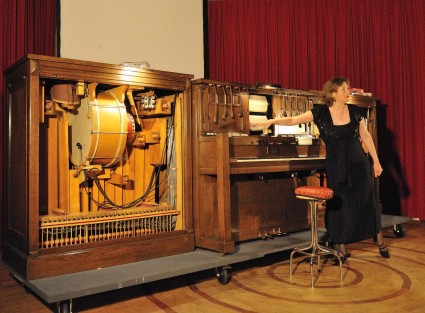
Maud Nelissen introducing the Fotoplayer

A while ago the Bioscope told you about the Fotoplayer, a remarkable form of player piano with added percussion and sound effects used in the silent era to accompany films. I have now added four photographs to the post (one of which is reproduced above), plus an account of performing with the Fotoplayer, all kindly supplied by silent film musician Maud Nelissen (also the source of the previous post on The Three-Must-Get-Theres, so thanks are due doubly to her). The post also contains a mini-history of the Fotoplayer (and other photoplayers of a smiliar kind) and a delightful YouTube video of Maud playing the machine. Do take a look.

The Three Must-Get-Theres, and other pleasures

Max Linder in The Three Must-Get-Theres (1922), from http://www.europafilmtreasures.eu

Welcome news arrives from silent film musician and composer Maud Nelissen. Europa Film Treasures, the free online library of European films put together by Lobster Films, has published the uproarious Max Linder film The Three Must-Get-Theres (1922), with a fine new score by Maud and her band The Sprockets. The film is a cheerful parody of Douglas Fairbanks’ The Three Musketeers (1921), sending up the Fairbanks persona while having with more than a little of the spirit of Alexandre Dumas itself, in between the anachronistic gags and slapstick knockabout. It looks good, and sounds terrific.

We’ve already reported on Europa Film Treasures, an extraordinary collection of fiction and non-fiction titles from across Europe (plus some from the USA), dating from 1898 to 1999, and from archives such as Deutsche Kinemathek, GosFilmoFond, Filmarchiv Austria, the Imperial War Museum Film and Video Archive, and Lobster Films itself. To quote from the earlier report, the films include

early actualities by Danish cinematographer Peter Elfelt, pornography from Austria, Biblical lands film from 1906, dance films, a Russian fish processing factory documentary, comedies (including Max Linder), trick films, science fiction (Walter Booth’s The Airship Destroyer from 1909, listed here under a German title, Der Luftkrieg der Zukunft), Spanish newsfilm, Russian Yiddish drama, one of John Ford’s first Westerns Bucking Broadway (1917) – the only non-European title on view, the extraordinary Der Magische Gürtel (1917) – tracking the trail of destruction wreaked by a German U-Boat, French public health films, abstract animation from Viking Eggling, Soviet puppet animation, and more, much more.

That was a year and a half ago, when there were fifty or so titles, with the promise of 500 eventually. More titles have been added since then – around forty – among which are Twee Zeeuwse Meisjses in Zandvoort (1913), a plotless comedy about two young Dutchwomen visiting the seaside, starring Annie Bos; Rijks-veeartsenijkundige hoogeschool (1918), a visit to the Royal Veterinary School of Utrecht in the Netherlands; Hesanut Builds a Skyscraper (1914), an American animation film about the building of a skyscraper; and Chamber of Forgetfulness (1912), an American drama of jealousy and photography directed by Étienne Arnaud for Eclair, starring Alec B. Francis and Barbara Tennant.

You can keep up with the additions by following the Europa Film Treasures blog, which records each new film as it goes up. Fresh material is promised, including titles by Georges Méliès. Additional features are being added to the site, including documentary resources, including an introduction the history of colour in cinema and an essay on film conservation. A debate section covers issues such as the digital projection of heritage films. The site continues to have its oddities, not least a quaint use of the English language (the site in in English, French, Italian, Spanish and German) that reads in place like they used translation software. You can either view this as having an amusing charm, or you can be disappointed that an excellent site funded out of the European MEDIA programme could not be just that little bit better in its presentation (another quibble is films given under the language title of the print rather than their original title).

Anyway, as always, go explore.

Miss Mend

The latest DVD from the marvellous Flicker Alley shines a light on a playful and unashamedly entertaining side of Soviet silent cinema that will come as a surprise to some. Miss Mend is a three-part serial from 1926 directed by Boris Barnet and Fedor Ozep. The fast-moving, exuberant adventure story emulates the style of the American serials that were so popular with Soviet cinema audiences while cheerfully satirising Soviet-American relations (the scenarist was ‘Jim Dollar’, actually a Russian woman Marietta Shaginian) with a story which takes place in part in a technologically-advanced but corrupt America. Its impact is described on the Flicker Alley site in this quotation by the late John Gillett (of fond memory for old BFI hands), whose notes its borrowings from American and German Expressionist cinema alike:

Fusing elements of Fairbanks, Feuillade and Lang with brilliant location shooting in city and countryside … The film’s prolific visual invention take in a Nosferatu-like body in a coffin, mysterious encounters in a chateau, kidnappings on a jetty, and culminates in an extended, accelerating pursuit involving cars and horses. Barnet and Ozep exploit all the serial conventions and improves on them, winding down to a charming, poetic epilogue.

The films have been mastered in high definition from original 35mm elements produced by David Shepard and Jeffery Masino, with digital restoration and editing being carried out by Eric Lange of Lobster Films, Paris. The 2-DVD set runs for four-and-a-half hours and includes a 25-minute documentary on the films’ history, a 15-minute documentary on its music, and a booklet film historians Ana Olenina and Maxim Pozdorovkin, new English title translations, and an orchestral score by Robert Israel. It is released on 15 December and is available at a special introductory sales price of $29.96.

Silent movies calendar 2010

http://www.mont-alto.com/Calendar.html

2009 is slipping away, 2010 is clamouring to take over, and it’s time once more for the Silent Movies Benefit Calendar, produced each year by Rodney Sauer of noted silent film musicians the Mont Alto Orchestra. The calendar features photographs of silent film stars contributed by fans, and highlights birthdays and marriages of stars. Proceeds from the calendar go towards silent film preservation – the 2009 calendar supported an internship in film preservation through the San Francisco Silent Film Festival.

The cost is $15 for the first calendar to a particular address, plus $12 for any additional calendars going to the same address. Shipping is $2.49 for one calendar, $3.09 for two, or $4.95 for three or more. The Monto Alto website has a postage calculator which includes shipping to European countries. Payment is by cheque or credit card through Google Checkout.