Losing films

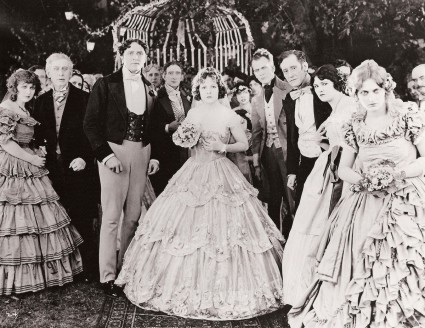
Production still for 4 Devils, from http://www.lost-films.eu

The keen-eyed among you may have noticed that there has been no announcement for the Bioscope Festival of Lost Films. I’ve decided not to pursue the festival any further. It ran for two years, and attracted quite a bit of interest, but I was never quite happy with the way it worked, and then there were the various people who contacted me subsequently who wanted to know where these long-lost films were, and who couldn’t grasp what was going on. And then there was the embarrassment of one of the films that I wrote about not being lost at all – or so I understand (I’ll identify it and report on its happy rediscovery when more concrete information emerges). All in all, it’s time to move on to other things.

But while we’re on the subject of lost films, it would be handy to summarise where things are these days, in particular to reassess the Lost Films site created by the Deutsche Kinemathek. Established in 2007, the ‘Lost Films’ project set out to gather information on films believed to be lost, with archivists and historians invited to add information, documents etc. What started out as a wiki with a strong emphasis on lost German films has grown into a fully-fledged portal, “aimed at collecting and documenting film titles, which are believed or have been declared ‘lost'”. 3,500 titles are now listed, many of them described in detail and illustrated by photographs and documents, and while the emphasis remains with German cinema the range has extended greatly to include lost films from around the world. Not all are silent films, but given the biases of time, the great majority comes from the pre-1930 era.
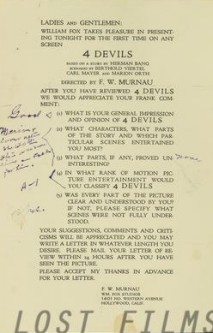
As an example of what one can now find on the site, take a look at one of the most keenly sought of all lost films, F.W. Murnau’s 4 Devils (US 1927). Starring Janet Gaynor, Charles Morton, Barry Norton and Nancy Drexel, this circus drama was Murnau’s second American film, and it was issued both as a silent as with a Movietone score (not with Murnau’s co-operation) with synchronised sound effects, music and dialogue sequences.

Lost Films gives us a synopsis (including different versions of the ending), cast and credits for both silent and sound versions, release information including length and censorship details, premiere dates, and this commentary by the Deutsche Kinemathek’s Martin Koerber on the film’s ‘lost status:

A print of this was last seen in the 1940s in the Fox warehouse in Los Angeles. According to the files on this title in the Fox papers at UCLA, the print was given to Mary Duncan, lead actress. Legend has it that she either burned it or drowned it in her swimming pool. We can still hope this is an urban legend. No one has traced Mary Duncan’s things, she died only in the 1990s, and there may be heirs. Janet Bergstrom’s video essay about this lost film is a fascinating story, presenting all the surviving stills and sketches and other evidence. This is a bonus on the SUNRISE DVD (or on some of them, anyway.)

Attached to this record are a mouth-watering 172 digitised documents:stills, programmes, advertisements, audience questionnaires (see above), censorship documents, drawings, screenplay (just a sample page, alas), distribution documents and more. The documents come from the Deutsche Kinemathek’s F.W. Murnau collection, and obviosuly not every lost film will be so richly documented, but nevertheless Lost Films has become a rich research resource, not just for specific lost films but for silent film history in general.

There are various ways in which you can search for films – by title, director, country, or year. One needs to be aware of the bias towards German production, and that the numbers of lost films per country is not a measure of overall loss – so, for example, there are currently 1,931 German films listed, but only 42 Japanese, yet the survival rate for Japanese silent film is catastrophic – at least 95% of all production is estimated to be lost (more on such figures in a moment). There are 752 American films listed, and 174 from the UK. Not all are silents, do note. Many of the American and British titles come from the Presumed Lost section of Carl Bennett’s Silent Era site.
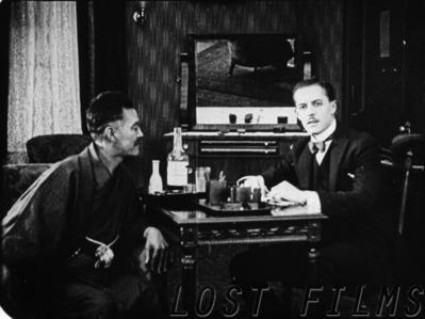
Unidentified film no. 145 from Lost Films, a drama of Europeans in Japan, thought to date c.1925, possibly American

Lost Films invites you to register and then contribute information, including adding your own digital materials. It has a helpful links section (though I wish they’d spell my name right), which covers not only lost films but report on films which have been re-discovered. There are different kinds of lost film – those which we know about but no longer exist; those which exist in incomplete form or some non-original version only; those which exist but are hard to find (or see); and those which exist but are effectively lost because they are unidentified. So Lost Films has a section on films that require identification, all illustrated with stills, and a number (chiefly American) happily now identified.

A number of the stills has been contributed by the Nitrate Film Interest Group, and off-shoot of the Association of Moving Image Archivists (AMIA), which is using Flickr to host images of unidentified films in the hope that someone somewhere can identify a name, place or film company logo. There are some highly knowledgeable folk out there who can, and there is pleasure to be had simply in witnessing how sharp-eyed some people are. Do have a go, becuase if you don’t recognise the performers you may be able to spot a location, or a form of dress, and a piece of décor which may provide the vital clue.

There are other lost film resources out there, either aimed at the film history enthusiasts or the archivist looking to identify the mysterious or to help complete a national collection.

  • Moving Image Collections – Lost Films
    The AMIA and Library of Congress-support film archives portal includes a lost films section (all American), and a complementary found films section too.
  • The Silent Era – Presumed Lost
    The aforementioned Silent Era service list hundreds of lost silents from around the world, with credits, references and technical information, plus updated information on films previously listed as lost which survive complete or incomplete somewhere.
  • Recherche des films perdus
    Listing (in French) of films which were listed as lost in 1996 but which have been discovered in archives around Europe by the LUMIERE project (the list is arranged by country of archive, then by country of production).
  • Der Stummfilm in Lateinamerika
    This handy site on Latin America silent cinema (it’s in German) includes a listing of key lost films from Argentina, Brazil, Mexico etc.
  • Wikipedia
    Wikipedia has a selective list of lost films, arranged by decade, which many of the most sought-after titles. It also provides lists of incomplete or partially lost films and rediscovered films. (Much of the information derives from The Silent Era).

  • For the rest, check out Lost Filmslinks page.

To review all of the Bioscope Festival of Lost Films entries, visit the Series section of this site which has all the links – and see if you can guess which one now survives. While you’re there, you can also follow the links for the Lost & Found series, which tells the stories of the discovery of lost film collections.

There are some books on the subject too: Harry Waldman, Missing Reels: Lost Films of American and European Cinema; David Meeker and Allen Eyles, Missing believed Lost: The Great British Film Search; Frank T. Thompson, Lost Films: Important Movies that Disappeared. Note also Anthony Slide’s Nitrate Won’t Wait: a history of film preservation in the United States (2000); David Pierce’s essay, ‘The Legion of the Condemned: Why American Films Perished’, Film History vol. 9 no. 1 (1997), a revised version of which appears in Roger Smither (ed.), This Film is Dangerous: A Celebration of Nitrate Film (2002); and Gian Luca Farinelli and Vitorio Martinelli, ‘The Search for Lost Films’, in Catherine A. Surowiec, The LUMIERE Project: The European Film Archives at the Crossroads (1996).

There are different kinds of lost film, and different degrees of loss. Indeed, some argue that no film can be described as being definitively lost, since by the very nature of the medium multiple copies were produced, so there is always the chance that one may be squirreled away somewhere. Lost films are found in archives, in private collections, on distributors’ shelves, in projection rooms, in people’s basements, attics or garden sheds, in auction sales, and in some romantic cases among a collection of old radios (The 1895 Derby), hoarded by a Swiss school (the Joseph Joye collection), in a Chinese flea market (The Case of Lena Smith), at the bottom of the sea in the wreck of the Lusitania (The Carpet from Bagdad), buried underneath a Canadian swimming pool (the Dawson City collection), or on eBay (Zepped).

Nitrate films in an advanced state of decomposition, from http://www.archives.gov

But just how many silent films are lost? The figure generally bandied about is 80% of all films from the pre-1930 era, this was put together quite a few years ago (I believe it was at the behest of the Federation of Film Archives, or FIAF), and it hasn’t been challenged much since. It may be correct, but it was estimated by matching titles held in national film archives with the titles recorded in national filmographies. But national film archives don’t hold everything (as any proud collector will tell you) and national filmographies have tended until recently to restrict themselves to the fiction film. Nowadays there seems to be a less blinkered approach, but as the Film Foundation says, while “a mere 10 percent of the [fiction] films produced in the United States before 1929 are still in existence … for shorts, documentaries, newsreels, and other independently produced, ‘orphan’ films, there is simply no way of knowing how many have been lost”. Where did that 10% figure come from? The American Film Institute calculated in the mid-1970s that 25% of American silent era films were lost, a much-quoted figure, but as Anthony Slide points out, “such figures, as archivists admit in private, were thought up on the spur of the moment, without statistical information to back them up”.

Solid information for other countries is hard to find, and is certainly not gathered together in any one place that I know of. Here’s a start, however:

  • Australia – 50 out of 250 feature films made between 1906 and 1930 survive in whole or in part (source: National Library of Australia)
  • Brazil – around 10% of silent feature films survives, though many only in a fragmentary state (interview with Carlos Roberto de Sousa)
  • China – 5% of 1,100 productions made 1905-1937 survive (source: Griffithiana no. 54, 1995)
  • Germany – No overall figure, but of 700 films made in 1916 just 60 survive, while one fifth of films made in 1925 are held by the Bundesarchiv (source: Bundesarchiv, ‘Lost Films’)
  • India – of around 1,330 silent fiction films made, thirteen survive, all incomplete (India Profile)
  • Japan – 95-99% of all silents are estimated to be lost (Le Giornate del Cinema Muto catalogue, 2001)
  • Russia – 286 films, out of an estimated 1,716 films produced 1907-1917, or one sixth of production, is preserved by Gosfilmofond (Silent Witnesses: Russian Films 1908-1919, 1989)
  • United Kingdom – “a huge proportion of Britain’s early film heritage is believed lost” (BFI Collecting Policy document)
  • USA – a survival rate of 7-12% for each year of the teens (feature films only), moving to 15-25% for the 1920s (Library of Congress figures from 1993, cited by David Pierce)

(Anyone who has a source for figures from other countries, or better figures, please let me know)

We need an up-to-date international set of figures, one which takes into account the most authoritative filmographic work and which makes it clear the proportion of fiction and non-fiction, professional and amateur film that we should be considering. It would need to make clearer the national differences in survival rates, and what survives in public institutions, commercial concerns, and privately (however much of a guess the latter would have to be). Where certain figures cannot be computed, we need formulae that give an indication. The methodology needs to be made clear. We need the same for the talkie era, for the television era, and now all over again for the digital era, when user-generated content is rewriting the rules for what can be produced. Only then will we know with accuracy just how shamefully we have treated the medium that supposedly is the great mark of the modern age. And we will treasure what survives all the more.

A sixth part of the world

Happy new year one and all, happy new decade too, and to kick things off well for 2010 there’s news of the latest silent DVD release from the always excellent Edition Filmmuseum, Dziga Vertov’s A Sixth Part of the World (Sestaja cast’ mira) and The Eleventh Year (Odinnadcatyj), with new scores by Michael Nyman.

As your scribe is currently suffering from a sprained wrist (one icy pavement too many), and writing is a bit of a trial, I hope you’ll forgive me if I mostly just give you Edition Filmmuseum’s own words on the release:

Edition Filmmuseum 53

The poetic travelogue A Sixth Part of the World and the “visual symphony” The Eleventh Year mark the beginning of Dziga Vertov’s most creative period, which peaked in the canonical film Man with the Movie Camera. This 2-disc set presents the two rare masterpieces in a new transfer and with new soundtracks by British composer Michael Nyman. The bonus features offer materials on the methods of the filmmaker, as well as an introduction to the Vienna research project on Vertov, “Digital Formalism.”

The Films

Sestaja čast’ mira (A Sixth Part of the World) Soviet Union 1926 Directed by: Dziga Vertov Assistant and editor: Elizaveta Svilova Director of Photography: Michail Kaufman – Produced by: Goskino, Moscow – Premiere: October 19, 1926 (Berlin)

Odinnadcatyj (The Eleventh Year) Soviet Union 1928 Directed by: Dziga Vertov Assistant and editor: Elizaveta Svilova Director of Photography: Michail Kaufman – Produced by: VUFKU, Kiev – Premiere: March 21, 1928 (Kiev)

Im Schatten der Maschine. Ein Montagefilm (In the Shadow of the Machine. A Compilation Film) Germany 1928 Directed by: Albrecht Viktor Blum, Leo Lania – Produced by: Filmkartell “Weltfilm”, Berlin – Premiere: November 9, 1928 (Berlin)

Vertov in Blum. Eine Untersuchung (Vertov in Blum. An Investigation) Austria 2009 Written and directed by: Adelheid Heftberger, Michael Loebenstein, Georg Wasner – Produced by: Österreichisches Filmmuseum, Vienna – First release

DVD features (2-disc DVD)

DVD 1

* Sestaja čast’ mira 1926, 73′
* Music by Michael Nyman
* 32page bilingual booklet with essays by Barbara Wurm, Thomas Tode, Adelheid Heftberger, Aleksandr Derjabin, Michael Loebenstein, Alexander Horwath

DVD 2

* Odinnadcatyj 1928, 53′
* Music by Michael Nyman
* Im Schatten der Maschine. Ein Montagefilm 1928, 22′
* Vertov in Blum. Eine Untersuchung 2009, 14′
* ROM section with additional documents and interactive applications about Vertov’s “Phrases” in Odinnadcatyj, the film’s intertitles, the “Blum Affair” and the projekt “Digital Formalism”.

Edited by: Österreichisches Filmmuseum, Vienna
DVD authoring: Ralph Schermbach
DVD supervision: Michael Loebenstein, Adelheid Heftberger, Georg Wasner

First edition: December 2009

Further silents are promised by Edition Filmmuseum soon. Shortly to be released will be Svend Gade’s Hamlet (1920), with Asta Nielsen as the Dane, and Boris ‘Miss Mend’ Barnet’s Devushka s korobkoy & Dom na Trubnoy (1927/28), while these titles are in preparation:

Frankfurt im Film 1900-1945
Karl Valentin und das Kino 1912-1930
Der Hund von Baskerville Rudolf Meinert, 1914
Sein eigner Mörder Max Mack, 1914
Von morgens bis Mitternacht Karl Heinz Martin, 1920
Sappho Dimitri Buchowetzki, 1921
Max Davidson Comedies Leo McCarey, 1927-1928
Abwege Georg Wilhelm Pabst, 1928
Das Mädchen Sumiko Shigeyoshi Suzuki, 1929
Waterloo Karl Grune, 1929
Der lebende Leichnam Fedor Ozep, 1929

Silents on the National Film Registry

The Great Train Robbery (1903), as featured in Precious Images (1986), one of the twenty-five films added to the National Film Registry

As is traditional at this time of year, the announcement has been made of twenty-five further films being added to the National Film Registry. Each year the Librarian of Congress (James H. Billington), with advice from the National Film Preservation Board (and with recommendations made by the public), names twenty-five American films deemed “culturally, historically or aesthetically” significant that are to be added to the National Film Registry, “to be preserved for all time”. The idea is that such films are not selected as the “best” American films of all time, but rather as “works of enduring significance to American culture”.

Six silent or silent-related films are among the titles chosen for 2009: Winsor MacCay and J. Stuart Blackton’s early animation classic Little Nemo; the slapstick gem Mabel’s Blunder; a Red Cross film on wounded WWI veterans, Heroes All; Karl Brown’s remarkable anthropological drama of mountain people, Stark Love; a compilation of actuality and fictional film concerning the Mexican revolution, The Revenge of Pancho Villa; and Chuck Workman’s dazzling compilation Precious Images, which brings together iconic images from American cinema 1903-1985, so therefore includes many silent film sequences. The National Film Registry supplies these descriptions for the silent choices:

Heroes All (1920)
The Red Cross Bureau of Pictures produced more than 100 films, including “Heroes All,” from 1917-1921, which are invaluable historical and visual records of the era with footage from World War I and its aftermath. “Heroes All” examines returning wounded WWI veterans and their treatment at Walter Reed Hospital, along with visits to iconic Washington, D.C., landmarks. Several Red Cross cinematographers achieved notable film careers, including Ernest Schoedsack and A. Farciot Edouart.

Little Nemo (1911)
This classic work, a mix of live action and animation, was adapted from Winsor McCay’s famed 1905 comic strip “Little Nemo in Slumberland.” Its fluidity, graphics and story-telling was light years beyond other films made during that time. A seminal figure in both animation and comic art, McCay profoundly influenced many generations of future animators, including Walt Disney.

Mabel’s Blunder (1914)
Mabel Normand, who wrote, directed and starred in “Mabel’s Blunder,” was the most successful of the early silent screen comediennes. The film tells the tale of a young woman who is secretly engaged to the boss’ son. When a new employee catches the young man’s eye, a jealous Mabel dresses up as a chauffeur to spy on them, which leads to a series of mistaken identities. The film showcases Normand’s spontaneous and intuitive playfulness and her ability to be both romantically appealing and boisterously funny.

Precious Images (1986)
Chuck Workman’s legendary compilation film to commemorate the 50th anniversary of the Directors Guild of America is also a dazzling celebration of the first near-century of American cinema. The pioneer of rapid-fire film history montages, “Precious Images” contains in the space of seven short minutes nearly 500 clips from classic films spanning the years 1903-1985. It became the most influential and widely shown short film in history. Workman is known for creating the montages shown during the annual Academy Awards broadcast.

The Revenge of Pancho Villa (1930-36)
This extraordinary compilation film was made by the Padilla family in El Paso, Texas, from dozens of fact-based and fictional films about Pancho Villa. The films were stitched together with original bilingual title cards and dramatic reenactments of Villa’s assassination were added to the revised print. “The Revenge of Pancho Villa” provides stirring evidence of a vital Mexican-American film presence during the 1910-30s.

Stark Love (1927)
A maverick production in both design and concept, “Stark Love” is a beautifully photographed mix of lyrical anthropology and action melodrama from director Karl Brown. “Man is absolute ruler. Woman is working slave.” Such are the rigid attitudes framing this tale of a country boy’s beliefs about chivalry that lead him to try to escape a brutal father with the girl he loves. “Stark Love,” cast exclusively with amateur actors and filmed entirely in the Great Smoky Mountains, is an illuminating portrayal of the Appalachian people.

The other twenty-two titles nominated are: Dog Day Afternoon (1975), The Exiles (1961), Hot Dogs for Gauguin (1972), The Incredible Shrinking Man (1957), Jezebel (1938), The Jungle (1967), The Lead Shoes (1949), The Mark of Zorro (1940), Mrs. Miniver (1942), The Muppet Movie (1979), Once Upon a Time in the West (1968), Pillow Talk (1959), Quasi at the Quackadero (1975), The Red Book (1994), Scratch and Crow (1995), The Story of G.I. Joe (1945), A Study in Reds (1932), Thriller (1983), Under Western Stars (1938).

The full list of films entered on the National Film Registry since 1989 can be found here, while this is the list of all silents on the Registry 1989-2008:

Ben-Hur (1926)
Big Business (1929)
The Big Parade (1925)
The Birth of a Nation (1915)
The Black Pirate (1926)
Blacksmith Scene (1893)
The Blue Bird (1918)
Broken Blossoms (1919)
The Cameraman (1928)
The Cheat (1915)
The Chechahcos (1924)
Civilization (1916)
Clash of the Wolves (1925)
Cops (1922)
A Corner in Wheat (1909)
The Crowd (1928)
The Curse of Quon Gwon (1916-17)
Dickson Experimental Sound Film (1894-95)
The Docks of New York (1928)
Evidence of the Film (1913)
The Exploits of Elaine (1914)
Fall of the House of Usher (1928)
Fatty’s Tintype Tangle (1915)
Flesh and the Devil (1927)
Foolish Wives (1920)
The Four Horsemen of the Apocalypse (1921)
The Freshman (1925)
From the Manger to the Cross (1912)
The General (1927)
Gertie the Dinosaur (1914)
The Gold Rush (1925)
Grass (1925)
The Great Train Robbery (1903)
Greed (1924)
H20 (1929)
Hands Up (1926)
Hell’s Hinges (1926)
The Immigrant (1917)
In the Land of the Head Hunters (1914)
Intolerance (1916)
It (1927)
The Italian (1915)
Jeffries-Johnson World’s Championship Boxing Contest (1910)
The Kiss (1896)
Lady Helen’s Escapade (1909)
Lady Windermere’s Fan (1925)
Land Beyond the Sunset (1912)
The Last Command (1928)
The Last of the Mohicans (1920)
The Life and Death of 9413 – A Hollywood Extra (1927)
The Lost World (1925)
Making of an American (1920)
Manhatta (1921)
Matrimony’s Speed Limit (1913)
Mighty Like a Moose (1926)
Miss Lulu Bett (1922)
Nanook of the North (1922)
One Week (1920)
Pass the Gravy (1928)
Peter Pan (1924)
The Perils of Pauline (1914)
Phantom of the Opera (1925)
The Poor Little Rich Girl (1917)
Power of the Press (1928)
President McKinley Inauguration Footage (1901)
Princess Nicotine; or The Smoke Fairy (1909)
Regeneration (1915)
Rip Van Winkle (1896)
Safety Last (1923)
Salome (1922)
San Francisco Earthquake and Fire, April 18, 1906 (1906)
Seventh Heaven (1927)
Sherlock Jr. (1924)
Show People (1928)
Sky High (1922)
The Son of the Sheik (1926)
Star Theatre (1901)
The Strong Man (1926)
Sunrise (1927)
Tess of the Storm Country (1914)
There it is (1928)
The Thief of Bagdad (1924)
Tol’able David (1921)
Traffic in Souls (1913)
The Wedding March (1928)
Westinghouse Works, 1904 (1904)
Where Are My Children? (1916)
Wild and Wooly (1917)
The Wind (1928)
Wings (1927)
Within our Gates (1920)

Alla ricerca di Chaplin e Keaton

http://www.cinetecadibologna.it

The Cineteca di Bologna has just issued two handsomely-produced book and DVD sets, All ricera di Charlie Chaplin – Unknown Chaplin (The Search for Charlie Chaplin) and Alla ricera di Buster Keaton – A Hard Act to Follow.

The two sets bring together the classic documentary series together with accompanying texts written by Brownlow. The three-part television series Unknown Chaplin was produced by Brownlow and David Gill in 1983, and showcased the previously-unseen collection of Chaplin out-takes that so richly illuminated his working methods. The text, originally written by Brownlow in 1983, was published for the first time by the Cineteca in 2005 in a dual-language edition with DVD. This re-issue has the Italian text only (163 pages), while the DVD is the English-language series (with Italian subtitles). It includes the extras How Unknown Chaplin was Made (on the making of the TV series), The Making of The Count (historian Frank Scheide examines the process of making the Mutual film) and Chaplin meets Harry Lauder (1918). These are available on the UK and American DVD releases.

Frank Scheide viewing The Count

Buster Keaton – A Hard Act to Follow is a three-part television series made by Brownlow and Gill in 1987. It documents the story of Keaton’s working life, with close examination of his working method through the films (though without the revelation of a hidden archive of film this time round). The accompanying book (250 pages) has been written for this publication, which makes it particularly important, but again, the text is in Italian only (there are hopes of an English publication eventually). The DVD is of the English-language television series, but the release has Brownlow’s approval, as opposed to the UK version which lacks many explanatory titles. There are no extras.

The sets are available for 15.00 € each or 27.00 € for the two, from the Cineteca di Bologna site.

For your diaries

The Jornada Brasileira de Cinema Silencioso in São Paulo, from http://www.cinemateca.gov.br/jornada

With 2010 all but upon us, naturally you’ll be thinking how you can fill the year ahead with silents-related activities, and here to assist you is a guide to the festivals and conferences that are coming up over the next twelve months. Information on these is given in greater detail in the Bioscope’s Conferences and Festivals sections, while a summary listing of all events coming up is maintained in the Calendar section.

Things kick off in January with Slapstick, the annual festival of slapstick film celebrated in Bristol, UK. This year’s event takes place 21st-24th and features Buster Keaton’s The Navigator, René Clair’s An Italian Straw Hat and Boris Barnet’s The House on Trubnaya Street, plus W.C. Fields, Harold Lloyd and Laurel and Hardy, along with appearances by present-day comic stars Michael Palin, Phill Jupitus and Neil Innes. The StummFilmMusikTage Erlangen is a festival of silent film music held in Erlangen, Germany. The 2010 festival has as its motto Tough Guys and Easy Girls and will include Louise Brooks in Diary of a Lost Girl, German gangster film classic Asphalt and Fritz Lang’s masterpieces Dr. Mabuse Part I and II as a double feature. It takes place 28th-31st.

February sees the Niles Essanay Film Silent Film Museum’s Midwinter Comedy Festival, running 12th-14th, in Niles, California. Keaton, Griffith, Langdon, Pollard, Chase, Davidson and much more. The Kansas Silent Film Festival is an event held annually in Topeka, Kansas. This year’s festival takes place 26th-27th and has as its special guest Melissa Talmadge Cox, grand-daughter of Buster Keaton and Natalie Talmadge, so Keaton (Our Hospitality) and Talmadge (Norma, in Smilin’ Through) feature, as well as William Boyd and Elinor Fair in The Yankee Clipper and various comedy shorts.

Killruddery silent film festival, from http://killrudderyarts.wordpress.com

With March there is the Karlsruher Stummfilmtage in Karlsruhe, Germany, which takes place 11th-14th and is devoted to René Clair and Jean Renoir; or you may journey to Syracuse, New York for the annual Cinefest, scheduled for 25th-28th, programme to be announced. Meanwhile on the other side of the Atlantic, the Killruddery Silent Film Festival takes place 11th-14th in Bray, Ireland. The programme has yet to be announced, but the theme is ‘Overlooked & Forgotten Cinema’ and Kevin Brownlow is the guest of honour.

April 7th-11th features the Filmmuseum Biënnale in Amsterdam, the Netherlands, a festival of music, art and film which has a strong silent film element, including a programme of films from the Museum of Modern Art in New York. April is the new month for the British Silent Film Festival. No longer held in its traditional Nottingham home in June, the peripatetic festival now finds itself taking place at the Phoenix Square Cinema, Leicester, over the 15th-18th. The theme will be the relationship between the natural world and cinema before 1930.

In May there’s the festival of silent cinema held annually at Hautes-Pyrénées, France, the Festival d’Anères. Despite rumours that the festival’s future is in some doubt, dates have been announced for the 19th-23rd, though no details of a programme as yet. Or States-side you could head for the classic film convention Cinevent, held as always in Columbus, Ohio. 2010’s convention takes place 28th-31st.

The Piazza Maggiore, Bologna, from http://www.filmfestivaltourism.com

June 13th-17th sees Beyond the Screen: Institutions, Networks and Publics of Early Cinema – 11th International DOMITOR conference. The bi-annual conference on the study of early cinema is taking place in Toronto, Canada. Silent film scholars will then have to jet off to Bologna, Italy for the Sixth International Women and Film History Conference, taking place 24th-26th. The theme of the conference is women’s involvement in the silent film industry and culture across the globe. Immediately after, and in the same city, there is Il Cinema Ritrovato, the festival of restored films (always with a strong silent element). The festival takes place 26th June-3rd July, but no details of the programme have been released as yet. The Broncho Billy Silent Film Festival will be held at Fremont, California in June, but exact dates haven’t been given as yet.

In July the BFI in London hosts a conference Colonial Film: Moving Images of the British Empire, 1895-1939 over 8th-9th (a second strand takes place in Pittsburgh in September covering 1939-1965). San Francisco hosts the San Francisco Silent Film Festival, this year over 15th-18th. The programme will be announced in late May. At the same time (15th-16th), Slapsticon, the annual festival of silent and early sound film comedy, held as ever in Arlington, Virginia, promises us Ben Turpin, Monty Banks, Mr and Mrs Sidney Drew, Billy Richie, John Bunny, Billy Bevan, Edward Everett Horton and a whole lot more. Or you could look further afield and consider the International Silent Film Festival, a festival of classic silent films held each July in Manila – no exacts dates or programme available as yet.

Bonner Sommerkino, from http://www.film-ist-kultur.de

August is clearly the month when the programmers are expecting us to combine holidays with silents. So, you might consider central New York’s Capitolfest, its annual summer classic and silent movie festival, taking place 13th-15th. Or why not sample Aosta in the Italian Alps for Strade del Cinema, a silent film festival with a strong emphasis on musical acompaniment (no exact dates or programme released as yet). Or be bold and head for São Paulo, Brazil to enjoy the highly-impressive (at least to judge by past programmes) Jornada Brasileira de Cinema Silencioso, a silent film festival now in its fourth year (no exact dates or programme details as yet). Or maybe Bonn in Germany will tempt you, with its Bonner Sommerkino, a festival of silent film which is yearly growing in importance (no dates or programme as yet). Or you could escape from some of the summer’s heat by sampling Finland’s Forssa Silent Film Festival, also more challengingly known as Mykkäelokuvafestivaalit, which in 2010 takes place 27th-28th.

If it’s September then it must be Cinecon, annual classic film festival held in Hollywood, which will run 2nd-6th. The charming Opitiki Silent Film Festival will be held this month in Opitiki, New Zealand. Over 23rd-26th there’s the silent and early sound film festival Cinesation in Massillon, Ohio, USA, while over the 24th-26th we have the Annual Buster Keaton Celebration, the Buster Keaton-themed festival held in Iola, Kansas. Silents of a different, modern kind feature in the Toronto Urban Film Festival, a public film festival of one-minute silent films held in Toronto, Canada. No dates as yet, but the films are ew productions entered in competition.

Pordenone audience

October is of course Pordenone month. The Giornate del Cinema Muto, or Pordenone Silent Film Festival, is generally considered the world’s leading silent film festival, takes place in Pordenone, northern Italy, and in 2010 runs 2nd-9th. We await the first details of 2010’s programme. October also sees Charlie in the Heartland: An International Charlie Chaplin Conference, which takes place 28th-30th at Ohio University Zanesville, Zanesville, Ohio,and which takes as its theme anything to do with Chaplin and his relationship with, influence on, or evocation of America. Also in October, but no dates or programme announced as yet, will be Australia's Silent Film Festival, held in Sydney.

Nothing of any particular relevance seems lined up for November (as yet), but in December there will be the 1910 Centenary Conference, hosted by the University of Glasgow. It’s not about silent cinema itself as its theme is 1910 as an arguably watershed year for the ushering in of modernism, but it includes film amongst its areas of interest, so in it goes (precise dates have yet to be announced). December will also see the San Francisco Silent Film Festival‘s ‘mini’ festival, its Winter Event.


If you know of other festivals or conferences I should be including, please us know through the comments. I’ll be adding new events (or updated information) to the Conferences and Festivals sections in any case, and will publicise individual events nearer to their start times in any case. Of course, silents turn up as special screenings in other kinds of festival, such as the London Film Festival and Telluride Film Festival, but I’ve kept this listing to those events largely dedicated to silent films themsleves. Such festivals and conferences are a labour of love and a huge challenge to put on, logistically and financially – do support them if you can.

Finally, I recommend the Stummfilm.info site (in English and German) for its handy directory of silent film festivals worldwide.

Merry Christmas everyone

Festive greetings to one and all. Before I head off into the snowy wastes of Kent to spend a few days with the nearest and dearest, I present to you this rather charming home-made silent (by TheBrothersGrin) as a seasonal treat. Our heroine finds herself in peril of her life on the toy train tracks beneath the Christmas tree, but our hero comes to the rescue not once but twice. See you all in a few days’ time.

Silents on Blu-Ray

One of the interesting trends to follow for 2010 in our field will be the appearance of silents on Blu-Ray. Following the curiosity of a 1923 short, The Story of Petroleum, turning up as an extra on the Blu-Ray release of There Will Be Blood as the first silent to be released in high definition, there are currently these silents available or announced.

Buster Keaton’s The General (1927) has been issued in the USA on Region 1 by Kino Video. Mastered in HD at 1080p from a 35mm print struck from the original negative, the release comes with three music scores to choose from – Carl Davis’ 1987 Thames Silents orchestral score (in DTS-HD Master Audio 5.1 or uncompressed 2.0 stereo), a 1995 score arranged and directed by Robert Israel, and a theatre organ score by Lee Erwin. Extras include a video tour of the real General, presented in association with The Southern Museum; a tour of the filming locations, presented by John Bengtson, author of Silent Echoes; behind-the-scenes home movie footage; filmed introductions by Gloria Swanson and Orson Welles; and ‘The Buster Express’ a montage of train gags from throughout Keaton’s career. The release has received high praise, and there’s an illuminating interview with Kino’s Bret Wood on the challenges of coverting a silent to Blu-Ray on the DoBlu review site. Remastering films of such vintage for high definition is no easy task:

Preparing silent films for Blu-ray is proving to be a daunting challenge. Even when we are able to locate the best surviving film elements of a particular title, these elements have considerably more grain and printed-in wear than one finds in a studio-preserved negative that is, say, twenty years old.

When a film is mastered in HD, the image is sharper than it has previously been, but as a consequence the film grain becomes more pronounced. When we first transferred The General, a minimal amount of digital grain reduction was applied and it is this version that was released on DVD. Upon close inspection of the Blu-ray test discs, we found that even that small amount of digital noise reduction had created visual artifacting, a slight blurring and ghosting of the image. We brought the film element back to the lab (Crawford Communications) and re-transferred it specifically for Blu-ray, without DRS or any artificial grain reduction. So the film was remastered specifically for the Blu-ray release …

… The DVNR technology of the DVD era is not subtle enough for the 1080 requirements of the Blu-ray age. In fact, when I look back at some silent films that were released on DVD, heavily treated with digital noise reduction, I cringe. I now recognize the degree to which the film’s natural grain and sharpness have been glossed over for the sake of a smooth image. I worry that this has spoiled the consumer, who will now expect every film to look this way when the actual film never looked that way to begin with!

So the big question that is yet to be answered is whether or not Blu-ray users will be satisfied with an HD copy of a film that is not pristine, but looks like an 80-year-old film actually looks.

In Britain, meanwhile, first off the blocks with a region 2 Blu-Ray release has been Eureka, who have given us Sunrise (1927). The release features1080p HD transfers of two versions of the F.W. Murnau classi: the previously released Movietone version (i.e. with original synchronised music score), and an alternate silent version of the film recently discovered in the Czech Republic (with optional English subtitles). The generous array of extra includes an alternate Olympic Chamber Orchestra score in stereo (the Movietone score is mono, of course); a full-length audio commentary by ASC cinematographer John Bailey on the Movietone version; outtakes with John Bailey commentary; Murnau’s 4 Devils: Traces of a Lost Film — Janet Bergstrom’s updated 40-minute documentary about the lost Murnau film; original theatrical trailer; original ‘photoplay’ script by Carl Mayer with Murnau’s handwritten annotations (150 pages in PDF format); and a 20-page illustrated booklet with film restoration and DVD/Blu-ray transfer information, along with a comparison between the two versions.

Silents can also up in the extras, and Warner Home Video’s Blu-ray release The Wizard of Oz (70th Anniversary Ultimate Collector’s Edition) (i.e. the 1939 film) includes in its extras The Wonderful Wizard of Oz (1910), The Magic Cloak of Oz (1914), The Patchwork Girl of Oz (1914) and The Wizard of Oz (1925), though all four are in standard definitions, not HD.

Is there a business for the video companies in releasing silents on Blu-Ray, particularly given some of the challenges outlined by Bret Wood? The mass audience will want cleaned-up images (if it wants to see silents at all), whereas the afficionados would welcome sight of the grain. Well, some are taking up the challenge, as there are a number of titles being announced for 2010. This is what I’ve been able to trace so far:

And, just to complete the picture, there’s one modern silent also on Blu-Ray – Mel Brooks’ Silent Movie (1976), as part of The Mel Brooks Collection.

Alas for Intute

It is possible that the majority of the readers to the Bioscope will not have heard of Intute. This is a shame, because for a long time it has been a gem of a research resource, but one whose future has just been stylied by funding cuts. Intute (a terrible name – it was much better when it was known as the Resource Discovery Network, or RDN) is a directory of websites selected for their value to academic research and then described and classified by a team of subject specialists. It is funded by the Joint Information Systems Committee, a somewhat scary-sounding UK body which supports online services for UK universities, but the JISC has just announced a funding cut from August 2010, the result being that Intute will no longer be updated from that point onwards.

This is a great shame, because Intute is a well-organised, imaginative and useful service. Among the several thousand web resources it lists, under such academic areas as Biological Sciences, Geography and Environment, Pyschology and Social Sciences, there are many under Media Studies and Creative and Performing Arts which relate to film, and some of those relate to silent film. Of these, most will be familiar to you (or can be found among the links on the right-hand column of this site), but looking again I found a few that were new to me. Here are three, with Intute’s own descriptions:

Bibliografie des fantastischen films : bibliography of fantastic film
http://www.bibfan.de

The ‘Bibliography of Fantastic Film’ is a free online bibliography of the secondary literature on such films. As of August 2008 the bibliography contains around 54,000 items. The bibliography is a personal project by Holger Schnell, begun in 1991. Schnell describes the bibliography as covering “the whole range of fantastic film from the silent era to nowadays including horror, science fiction and fantasy as well as animation and experimental film”. Books and articles from magazines are covered, as well as thesis and dissertations. The bibliography can be browsed by person, film title and subject, and a free search can be conducted for the whole database or in a selected index. The website contains a special feature on ‘Religion In Film’, and lists on selected subjects, directors, and key films. The website is cleanly designed and easy to use and navigate.

Cinema and film industry in Weimar Republic, 1918-1933
http://www.korotonomedya.net/theoria/weimar.html

‘Cinema and film industry in Weimar Republic, 1918-1933’ is a 14,000-word extract from an unpublished thesis undertaken by Secil Deren at the Middle East Technical University, Ankara in 1997. The text outlines the Expressionist Period through an examination of ‘Das Kabinett Des Dr. Caligari’ and the films that Caligari influenced, including ‘Metropolis.’ The text then outlines: the ‘Stabilization Period After the Dawes Plan’; ‘Montage Documentaries and Walter Ruttmann’; ‘Cinema as a Means of Political Propaganda’; and ‘Cinema Industry and the Left-Wing Intelligentsia’. Students will find the analysis here of the intrusion of political and economic matters into cultural life in the Weimar period to be an interesting starting point for further study. There is a bibliography.

Spanish-American war in United States media culture
http://chnm.gmu.edu/aq/war/

The “Spanish-American War in United States media culture” website contains a hypertext essay with pictures and drawings about the representation of the 1898 Cuban-Spanish-North American War (or Spanish-American War) in United States media culture. The essay investigates the role of the film “Unthinking Eurocentrism” in the larger mediation of the Spanish-American War and attempts to increase the understanding of pre-classical cinema in the United States. Contained here is an introduction followed by six sections that includes “Film studies and the Spanish-American War”, “Media culture and representations of war”, “Early cinema and the Spanish-American War”, “Receptions of war”, “The war at home” and “Resisting spectators”. Each major section links to pages both inside and outside that section or to a different website. In addition, there is a bibliography, a link to American Quarterly and links to other online resources.

Unfortunately such a labour-intensive service could not be sustained by central funding for ever, particularly when there are so many of us out there who are happy to do much the same sort of work for free, if not quite so thoroughly. It’s good that at least what Intute has produced so far will be kept online, but the Web never stands still, and the information Intute preserves will gradually become irrelevant. Such is the fate of every reference guide that is fixed in time, alas.

Kansas Silent Film Festival 2010

Norman Talmadge in Smilin’ Through, from Alt Film Guide, http://www.altfg.com

The Kansas Silent film Festival takes place 26-27 February 2010 at White Concert Hall, Washburn University campus, Topeka, Kansas. This is the advertised programme (subject to change, of course):

Fri. Feb. 26, 2010, starts at 7 p.m.

Overture by the Mont Alto Motion Picture Orchestra
Opening Titles performed by the Mont Alton Motion Picture Orchestra
Intros by Denise Morrison

Angora Love (1929) 20 min.
with Stan Laurel and Oliver Hardy
—Organ music by Greg Foreman

The Vagabond (1916) 20 min.
with Charlie Chaplin
—Organ music by Marvin Faulwell

Short Break
Intermission slides featuring Phil Figgs on piano

Special Guest: MELISSA TALMADGE COX, grand-daughter of Buster Keaton and Natalie Talmadge. Ms. Cox will discuss why OUR HOSPITALITY is her favorite Keaton film because it features her grandparents, her great grandfather (Joe Keaton) and her own father (James) playing Buster as an infant.

Our Hospitality (1923) 75 min.
with Buster Keaton
—Music by the Mont Alto Motion Picture Orchestra

Sat. Feb. 27, 2010, starts at 10 a.m.

Overture by Jeff Rapsis
Opening Titles – Music by Jeff Rapsis
Welcome and Intros by Denise Morrison

Rescued by Rover (1905) 8 min.
with Blair, the collie
—Piano music by Jeff Rapsis

The Iron Mule (1925) 16 min.
with Al St. John
—Piano music by Jeff Rapsis

Thundering Fleas (1926) 20 min.
with Our Gang
—Piano music by Jeff Rapsis

The Magic Clock (1928) 30 min.
A magical color-tinted animated feature, directed by Wladyslaw Starewicz
—Music by the Mont Alto Motion Picture Orchestra

Lunch Break (on your own), resuming at 1:00 p.m.

Sat. Feb. 27, 2010, starts at 1:00 p.m.

Overture by Marvin Faulwell
Opening Titles – Music by Marvin Faulwell
Intros by Denise Morrison

Flaming Fathers (1927) 20 min.
with Max Davidson
—Music by Jeff Rapsis

The Matrimaniac (1916) 46 min.
with Douglas Fairbanks Sr. & Constance Tamadge
—Organ music by Marvin Faulwell

Short Break
Intermission slides featuring Jeff Rapsis on piano
— Cookies and Punch served in the lobby —

Special Guest: MELISSA TALMADGE COX
Melissa, the grand-niece of movie stars Norma and Constance Talmadge
will speak about her aunties and their lives after their careers had ended.

Smilin’ Through (1922) 90 min.
with Norma Talmadge & Harrison Ford
—Organ music by Greg Foreman
(DVD Presentation)

Supper Break, resuming at 7:00 p.m.

CINEMA-DINNER
Served buffet-style
Featuring our special guest Melissa Talmadge Cox
Bradbury Thompson Alumni Ctr., Washburn University, Topeka, KS
—Total cost: $25 per person (non-refundable) —
Tickets will be on sale at the event, but seating is limited.
Why not make reservations early? Send reservation requests to:

KSFF Cinema-Dinner
P.O. Box 2032
Topeka, Kansas 66601-2032

Sat. Feb. 27, 2010, starts at 7 p.m.

Overture – Music by Greg Foreman
Opening Titles – Music by Greg Foreman
Intros by Denise Morrison

The Unchanging Sea (1910) 14 min.
by D.W. Griffith, with Linda Arvidson and Mary Pickford
—Organ music by Greg Foreman

The Moony Mariner (1927) 20 min.
with Billy Dooley
—Organ music by Jeff Rapsis

The Yankee Clipper (1926) 80 min.
with William Boyd, Elinor Fair and Junior Coghlan
—Organ music by Marvin Faulwell & Bob Keckeisen, Percussion
(DVD Presentation of a Restored Film)

There will be an intermission in the Feature Film

More details, including detailed programme notes, directions and accommodation information, can be found on the festival site.

A call to war

Film historian Stephen Bottomore has got in touch to ask if The Bioscope can publish a call for papers for an upcoming special issue of Film History which Stephen is editing, on the subject of film and the First World War. More than happy to do so:

Call for papers: World War I and cinema

Film History is planning a special issue about film and the First World War, and we are in the early stages of soliciting material on this theme. We are looking for articles, preferably with good illustrations, on any aspect of the relationship between World War I and cinema during wartime: from production (both non-fiction and fiction) to exhibition and distribution, and any combination thereof. Themes might include film propaganda, war cameramen, the international film trade, the effect of the war on the world’s film industries, etc etc. We might also be interested in articles which explore issues outside the 1914-1918 time-frame, including about film and other conflicts in the silent era, or about the representation of World War I in later (or earlier?) films. Other, related themes might also be considered.

We will mainly be interested in articles from more established scholars, but will also consider pieces from less experienced writers if sufficiently interesting in content, and well-written.

The editor of this issue will be Stephen Bottomore, and the commissioning process will go through four stages:

1) Author e-mails SB a summary of, or rough idea for, the article by end of January 2010.
2) If we agree to go ahead, author sends SB a first draft by Summer 2010.
3) After SB’s comments and further discussion, author sends in final draft (with citations correctly formatted) along with other materials including illustrations – by October 2010, about the time of the Pordenone festival.
4) All the materials will then be forwarded to the editor in chief, Richard Koszarski, who might have his own queries or amendments.

Please feel free to pass on this call for papers to anyone qualified to contribute to this special issue.

Stephen Bottomore
December 2009
warnjai2 [at] fastmail.fm

We’ve not had calls for papers for publications on The Bioscope before now, but if they broadly relate to the subject of silent cinema I’d be glad to include them here.