The original Neil Brand

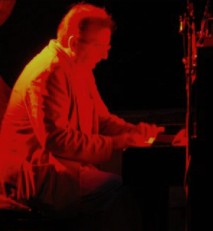
Neil Brand is a silent film pianist. That much is known by most enthusiasts for silent film in the UK, and by a good many around the world as well. It may not always be realised that Neil is also a writer, composer, actor and scholar, one whose prodigious energies and superabundant talent make him not far short of a national treasure. Hmm, why that note of qualification? – he is a national treasure. And now, as if accompanying silents live and on DVD, writing radio scripts and musical comedies, acting on film and TV, writing books and educating students were not enough, now he has turned online archivist with his latest venture, The Originals.

The Originals is a new section of Neil’s personal site which brings together original materials relating to the performance of music to film in the silent era. For some while now Neil has been collecting articles, scores, interviews, memoirs and eye-witness accounts which document the experience of seeing or performing to films in the 1910s and 1920s. He has now started to put some of this material online.

http://originals.neilbrand.com

The site is in three sections: Interviews, Archive and Memories. Interviews features a small collection (so far) of interviews and articles which give the point of view of musicians who were employed in cinemas during the silent era. These include a transcription of a 1988 interview with the 94–year-old Ella Mallett, former silent movie musician (carried out as part of the BECTU History Project which records interviews with veterans of the British film and television industries); an extract from Maurice Lindsay’s memoir of Glasgow life, As I Remember; an extract from New Zealander Henry Shirley’s memoir Just a Bloody Piano Player; and a highly evocative piece from novelist Ursula Bloom about her experiences as a teenage silent film pianist in St Albans (contributed by yours truly).

Archive is the section that is going to attract the most interest. This offers PDF copies of various original documents relating to silent film music, including extracts from original music that would have been performed with various films. The jewel here is selected pages from the score for The Flag Lieutenant, compiled by Albert Cazabon, and the only surviving full score for a British silent fiction film in existence. You’ll also find music for the Douglas Fairbanks picture The Black Pirate, an eyebrow-raisingly dismissive article on the profession of silent film pianist, cue sheets for Hell’s Heroes and The Hound of the Baskervilles, and more.

The third section, Memories, presents extracts from the 1927-1930 diaries of Gwen Berry, who played ‘cello in the orchestra pit of the Grand Cinema, Alum Rock Road, Saltley. The extracts, from 1929, show Gwen’s apprehension at the arrival of the “terrible talkie pictures” which were going to throw so many musicians such as her out of work. The diary is presented in a elegant turn-the-pages digital form, which does require that you install a plug-in for DNL ebook software.

All in all, The Originals is an excellent idea, and one that The Bioscope hopes will grow and grow, not least if those interested are able to send relevant materials to Neil so that they might be shared by all.

Meanwhile, here’s a handy survey of other things NeilBrandian…

Bravo, Neil.

Silent days at the Barbican

Extract from Yogoto Yo Yume (1933), with Nitin Sawhney score

The Barbican has become London’s home for the silent film, and on 1 March it hosts a screening of revered Japanese director Mikio Naruse’s 1933 Yogoto Yo Yume (Nightly Dreams) with the London Symphony Orchestra playing a new score by boundary-crossing Asian-British composer Nitin Sawhney. Sawhney has already made his mark with his score for the Anglo-Indian production A Throw of Dice (Franz Osten 1929), now available on DVD from the BFI. He is certainly going for the less-obvious when it comes to picking silents to supply scores to, and bringing a new audience with him as well. More details from the Barbican site.

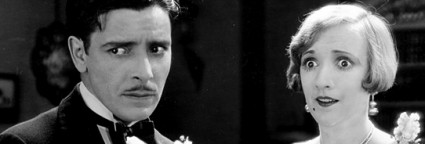
Her Sister from Paris (1925), from http://www.barbican.org.uk

Meanwhile the Barbican’s regular Silent Film & Live Music series held on Sunday afternoons continues as healthily as ever, and there are some real gems and rarities among the offerings between January and March. Here’s the line-up:

The Ghost Train (El tren fantasma) (PG) + live piano accompaniment by Neil Brand
16:00 / An action laden adventure from Mexico’s silent film era
24 Jan 10 / 16:00 / Cinema 1

Adolfo Mariel, a railroad engineer, is sent by his company to the town of Orizaba to investigate a series of robberies on the railway’s ‘El Ferrocarril Mexicano’ line. As he alights, he is welcomed by various officials but is smitten by the stationmaster’s daughter – only to find that another man, Paco Mendoza, has also taken a romantic interest.

As Adolfo tries to solve the railway crimes, the story unfolds as an exciting adventure laden with action sequences and remarkable camera movements – much ahead of its time for many silent films of the era. Together with breath-taking stunts, chases, and fights on the railway line as the train approaches. El tren fantasma is one of just a handful of silent Mexican films that still survive, and to cap it all, the actors performed their own stunts.

Mexico 1927 Dir. Gabriel García Moreno 71 min

Orphans of the Storm (U)
15:00 / A Celebration of Twenty Years of Photoplay Productions beginning with DW Griffith’s epic melodrama
7 Feb 10 / 15:00 / Cinema 1

Accompanied by the symphonic splendour of John Lanchbery’s epic score.

Photoplay Productions is the leading ambassador for silent film presentation in the UK, perhaps the world. We are delighted to mark its twentieth anniversary with three performances, starting with DW Griffith’s epic melodrama. Lillian and Dorothy Gish star as the eponymous orphans thrust into the maelstrom of the French Revolution.

US 1921 Dir. DW Griffith 154 min.

The Kreutzer Sonata (Kreutzerova sonáta) (PG)
16:00 / A rare adaptation of Leo Tolstoy’s story, with live accompaniment by acclaimed Czech percussionist Pavel Fajt
28 Feb 10 / 16:00 / Cinema 1

This rare Czech adaptation of Leo Tolstoy’s story tells the tale of a man driven to rage and revenge when he hears his pianist wife and her lover playing Beethoven’s Kreutzer Sonata.

Czechoslovakia 1927 Dir. Gustav Machatý 95 min.

Presented in association with the Czech Centre, London

Her Sister From Paris (PG)
16:00 / Sidney Franklin’s scintillating comedy with specially commissioned live musical accompaniment from Jane Gardner
7 Mar 10 / 16:00 / Cinema 1

As part of the Birds Eye View film festival’s ‘Blonde Crazy’ strand, we are delighted to present Sidney Franklin’s scintillating comedy starring Constance Talmadge and Ronald Colman.

Dowdy Helen turns to her glamorous twin sister Lola for help in re-igniting romance in her marriage. They trick her husband into believing Helen is Lola – he falls for it, and Helen seduces her own husband. But how far can the dupe go?!

US 1925 Dir. Sidney Franklin 70 min.

South (U)
16:00 / A tribute to Australian director Frank Hurley with live piano accompaniment by Neil Brand
21 Mar 10 / 16:00 / Cinema 1

As part of the London Australian Film Festival we present a celebration of the work of Frank Hurley – Australian filmmaker, photographer, adventurer and writer.

Hurley’s stunningly beautiful and dramatic images of Ernest Shackleton’s ill-fated 1914-16 expedition to Antarctica, and the destruction of the ship Endurance, are amongst the most breathtaking ever captured on silent film, and confirm South as one of the most remarkable exploration films ever made.

UK 1919 Dir. Frank Hurley 88 min.

More details for all screenings, including ticket prices and how to book, from the Barbican site.

Voici Gallica

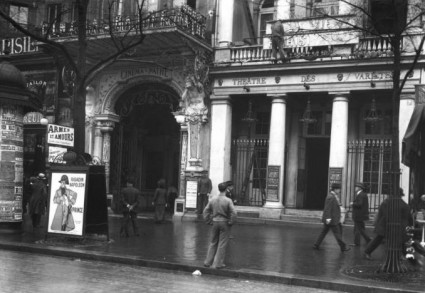
Cinéma Pathé next door to the Théatre des Variétés, boulevard Montmartre, 1913, from Gallica (http://gallica2.bnf.fr/ark:/12148/btv1b6927366c). Note the poster for Rigadin Napoleon, starring Charles Prince.

Gallica is the digital library of the Bibliothèque nationale de France. Established in 1997, today it contains just under one million digital documents, including 150,000 monographs (over 90,000 of which are word-searchable), 675,000 pages from over 4,000 periodicals, over 115,000 images, 9,000 maps, 1,000 sound recordings, 5,500 manuscripts and 2,300 music scores. Content comes both from the BnF and a range of partner libraries. It is unquestionably one of the outstanding digital resources worldwide, and one which anyone with a serious interest in researching silent cinema will want to use, however limited their French might be.

To begin with, Gallica is reasonably Anglo-friendly. There is an English language option (plus Spanish and Portuguese), with basic user guidelines, though introductory texts remain in French. The front page includes the main Search option and link to Advanced Search. This offers a thorough range of options, allowing you to refine searches by title, author, text, date, language, broad subject, document type and access type (i.e. free versus paid-for content). Look also for the link to Themes, providing a handy way into what can a bit bewildering at first on account of its sheer size.

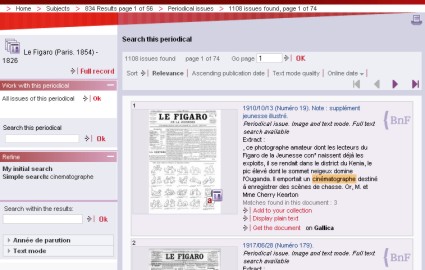
Also linked from the front page is the newspaper section. As far as I can see, the main front page search option does not cover the newspaper holdings, so you will want to follow this link to discover the digital library for such key titles as Le Figaro, L’Humanité, Le Temps, La Croix and many more (for film journals see below). Searching is by periodical title – so, for example, if you select Le Figaro, you are presented with a table of years, from 1826-1942, and you can either click on one of those years and browse a calendar to get to a specific day’s edition, or else use the search option to investigate all titles. Search for ‘cinematographe’, and this is what you’ll see:

One you have identified a newspaper that you are interested in, you can add it to you digital collection (an option provided for registered users), view the plain text, or view the scanned document. When you click on the document, check on the left-hand side for the page number where the search term you have used can be found, because the full digitised newspaper will have turned up, and it is necessary either to scroll through page by page or you can type in a number and go direct to the desired page. Your search term will be highlighted in yellow on the page. You can download pages as PDFs, print them, email the refernece to yourself, or even listen to the citation for the selected newspaper – in French, of course. There are also full screen and zoom options, as well as a range of other options to assist your searching and browsing.

There is much more to Gallica than simply newspapers. As said the main search option on the front page covers everything else, which means chiefly digitised books, manuscripts, serials and images. Content ranges from the ancient to the recent (more recent texts are only available under subscription through external providers), and there is extensive material that relates to silent cinema. Searching on ‘cinematographe’ yields 1,318 hits, ‘melies’ brings up 280 hits, ‘pathe’ 2,128, and ‘gaumont’ 957. Note the option to refine searches given on the left-hand column; so, for example, the ‘gaumont’ search can be narrowed to searches by periodical (537), book (413) or image (7), as well as by author, date, theme and language. Remember also when searching for phrases to put the words in quotation marks for more accurate results. Much of it is books and serials, but you can dig up treasures such as the photograph of a Montmatre Pathé cinema above or this Max Linder scenario complete with sample film strip:

Scenario with filmstrip for Les Débuts de Max Linder au cinématographe (1912), from Gallica (http://gallica.bnf.fr/ark:/12148/btv1b6404152z)

Also to be found through the main search option are a number of film journals from the silent era. There is no simple way of identifying these, so (with the help of some Bioscopists) here’s a listing of journals that I’ve managed to locate:

Given the scarcity of silent era film journals online generally, this is an absolute treasure trove all by itself. Most important among them is Cinéa, which was the focal point for intellectual debate on film culture in France at this time.

Raquel Meller in Carmen, front cover of Cinéa, 15 November 1926, from Gallica (http://gallica.bnf.fr/ark:/12148/bpt6k5739086t.vocal.f1.langEN)

Gallica is an amazing resource, and one which has been in the news recently. It has been billed for some while now as France’s answer to Google Books, and it was announced this week that France is making further moves to counter the Anglo-Saxon hegemony by developing a still more extensive online portal, based on Gallica, by establishing deals with publishers an private companies (including Google?) to build up all-encompassing French digital library. Last month Nicolas Sarkozy announced that €750 million would be allocated for the ongoing digitisation of France’s libraries, specifically to counter the threat represented by Google’s plans for extensive digitisation of out-of-copyright works (Google Books is currently ten times the size of Gallica). Gallica will be the outlet for this digital activity, as will the European digital library, Europeana (which will be the subject of Bioscope post some day soon). At any rate, we are all going to be the beneficiaries – all the more so if we can only brush up on our French.

I’ve added a new category to the options of the right-hand side of the Bioscope, ‘digitised journals’, and I’ll go back over the blog and mark all those posts that have covered digitised newspapers and journals under this category as a reference aid. And look out soon for a post which will round up newspaper digitisation projects around the world which are relevant to our area.

Now go explore.

Méliès in 3D

First Chaplin, now Georges Méliès. Much more of this and we’re going to need a new category for stereoscopy. Kristin Thompson, on the essential blog Observations on film art which she co-authors with David Bordwell, has written a piece on a season of 3D films that they saw recently at the Cinémathèque Française. Part of the season was a programme of early 3D films presented by Serge Bromberg of Lobster Films. And when we say early, we mean really early – Bromberg showed experiments made by French inventor René Bunzli in 1900, ten-second vignettes including “a mildly risqué scene of a man arriving to visit his mistress and another discovering his wife in bed with her lover”.

But the startling revelation is the 3D effect achievable from films which were not shot in 3D in the first place, which is where Méliès comes in. Thompson explains:

Méliès’s early shorts were often pirated abroad, and a lot of money was being lost in the American market in particular. Aftern the Lubin company flooded that market with bootleg copies of a 1902 film, Méliès struck back by opening his own American distribution office. Separate negatives for the domestic and foreign markets were made by the simple expedient of placing two cameras side by side. The folks at Lobster realized that those cameras’ lenses happened to be about the same distance apart as 3D camera lenses. By taking prints from the two separate versions of a film, today’s restorers could create a simulated 3D copy!

Two 1903 titles – I think that they were The Infernal Cauldron [Le chaudron infernal] and The Oracle of Delphi [L’oracle de Delphes] – triumphantly showed that the experiment worked. Oracle survived in both French and American copies, and the effect of 3D was delightful. For Cauldron only the second half of the American print has been preserved. Watching the film through red-and-green glasses, you initially saw nothing in your right eye, while the left one saw the image in 2D. Abruptly, though, the second print materialized, and the depth effect kicked in. The films as synchronized by Lobster looked exactly as if Méliès had designed them for 3D.

One’s first thought is how absolutely delighted Méliès himself would have been at this unexpected effect. The second – more remote – is whether other such instances of films being shot side-by-side for domestic and foreign markets (not an uncommon practice in the silent era) might be found which might demonstrate the same 3D effect. Would we want to see this, or might it be a vulgarisation comparable to the colorisation of black-and-white films? Vulgar or not, I’m rather thrilled by this glimpse of a hidden dimension to early film just waiting to be untapped. Hats off to the lateral thinkers at Lobster for having spotted the possibility.

Chaplin in 3D

Announcement of the Chaplin series being made in Mumbai

DQE, an India-based company which describes its activities as “Animation, Gaming, Live action production and global distribution” has announced its intention to produce a series of 3D animated short films for television, in collaboration with French production companies Method Animation and MK2. The subject of the 104 six-minute episodes will be Charlie Chaplin. The press release fascinatingly describes the character they will create as being Chaplin’s “Animated Avatar”, and promises that the films will preserve “the sense of humour and the emotional values present in all of Charlie Chaplin’s 70 films, all the while bringing out the quirky, burlesque and comic tone of the character he created”. The films will be ‘silent’ themselves, and though they won’t follow any of the story-lines of Chaplin’s own films, they will use gags from them, while putting Chaplin in modern situations, which sounds intriguing. Variety reports on seeing a 45-second clip in which an animated Chaplin performs “one of his trademark pratfalls” against a New York City backdrop, and shows him using a mobile phone which is shaped like an old-fashioned phone. The press release stresses this intention to combine past with present:

With a global production budget of approximately Euro 8 million, the first series will be developed in colour creating a timeless atmosphere and a unique look, blending early 20th century with present time, allowing for younger generations to identify with the Charlie Chaplin character. In keeping with the spirit of Chaplin, the short episodes will be presented without dialogue, giving enough space for the full scope of the famous character’s talents in pantomime. Completing the picture, putting particular emphasis on the choice of music and the sound design, will add to the laughter and emotion of the adventures of the legendary tramp.

The really intriguing element here is the 3D. The press releases promises that “the entire series will be produced in stereoscopic 3D bringing forth a fully immersed visual and emotional experience”. 3D television is gloing to be the next big media revolution (at least, that’s what the industry is baking on) and there is going to be a need for ready-to-use programming to help fill world schedules. The series will be developed for mobile, television, home video and internet platforms, naturally.

So this may be a smart move by DQE and partners (DQE has already found success with the 3D animated series Iron Man: Armored Adventures), producing a language-free content package which will have appeal across the world, though whether “21st century kids and the[ir] families” will identify with – or even recognise – Charlie Chaplin is something that remains to be seen.

Méliès encore!

Undoubtedly one of most significant DVD releases in recent years in the early and silent cinema field was Flicker Alley’s Georges Méliès: First Wizard of Cinema (1896-1913). Issued in 2008, this 5-DVD set features 173 titles made by the premier filmmaking genius of the early cinema period. It brought together material from collections around the world in as near comprehensive a form as possible, turning what had previously would have taken half a lifetime for just a handful of dedicated researchers to see into something available to all. The set contained revelations for everyone, whether early cinema expert or those stumbling upon these visionary films of magic for the first. The Bioscope produced a review with full listing of all of the titles, including Star-Film catalogue number (the name of Méliès’ film company), the original French title and English title on the discs.

The set was extensive, but it was not complete. More Méliès films were known to be out there, and now Flicker Alley has just announced Georges Méliès Encore, a single disc follow-up which adds a further 26 titles produced by the Frenchman between 1896-1911, plus two titles by his Spanish contemporary Segundo de Chomón done in the Méliès style which have long been is taken for his work. That latter offering sounds a bit odd (let’s instead see a comprehensive DVD dedicated to the supremely artistic work of de Chomón alone one day, please), but the chance to take things that much closer to the complete extant archive is a cause for rejoicing.

The production description available on Amazon.com gives these English titles:

The Haunted Castle from 1896 relies on shot-substitution, the filmmaker’s first trick discovery; it is a work in 21 shots at a time when everyone else in the world was making only single-shot films! An Hallucinated Alchemist is a beautifully-colored trick film from 1897, which survives in perfect condition. Among other surprises, the set includes military re-enactments (The Last Cartridges, Sea Fighting in Greece), dream films (The Inventor Crazybrains and His Wonderful Airship, Under the Seas), dramatic narratives (The Wandering Jew and The Christmas Angel, both with original narrations), slapstick comedies (How Bridget’s Lover Escaped, The King and the Jester, The Cook’s Secret), and, of course, a substantial group of the lovely trick films on which rest Méliès modern reputation.

Flicker Alley has now (updated information, 27 January) provided a full title listing on its website, from which the Bioscope has produced this listing (which corrects some slips):

1896
15 – Défense d’afficher / Post no Bills
78-80 – Le manoir du diable / The Haunted Castle

1897
95 – L’hallucination de l’alchimiste / An Hallucinated Alchemist [Note: this is a misidentification – see comments]
100 – Sur les Toits / On the Roofs
105 – Les Dernières cartouches [Flicker Alley call this Bombardement d’une maison] / The Last Cartridges
110 – Combat naval en Grèce / Sea Fighting in Greece

1901
359 – L’omnibus des toqués ou Blancs et Noirs / Off to Bloomingdale Asylum

1902
392-393 – l’oeuf du sorcier / The Prolific Egg
397 – Éruption volcanique à la Martinique / Eruption of Mount Pele
430-443 – Les aventures de Robinson Crusoé (fragment) / Robinson Crusoe

1903
472 – La flamme merveilleuse / Mystical Flame, The
545 – Un peu de feu s.v.p. (fragment) / Every Man His Own Cigar Lighter

1904
662-664 – Le juif errant / The Wandering Jew
669-677 – Détresse et charité / The Christmas Angel

1905
550-551 – Les apparitions fugitives / Fugitive Apparitions
662-664 – Le juif errant / Wandering Jew, The
669-677 – Détresse et charité / Christmas Angel, The
693-695 – Le baquet de Mesmer / A Mesmerian Experiment
750-752 – L’île de Calypso / The Mysterious Island
786-788 – Le dirigeable fantastique ou le cauchemar d’un inventeur / The Inventor Crazybrains and His Wonderful Airship

1906
888-905 – Robert Macaire et Bertrand, les rois des cambrioleurs / Robert Macaire and Bertrand

1907
912-924 – Deux cent milles sous les mers ou le cauchemar du pêcheur / Under the seas
929-933 – Le mariage de Victorine / How Bridget’s Lover Escaped
1010-1013 – Satan en prison /
1040-1043 – François 1er et Triboulet / The King and the Jester

1909
1476-1485 – Hydrothérapie fantastique / The Doctor’s Secret
1530-1533 – Le papillon fantastique (fragment) / The spider and the butterfly

The three Pathé titles are
Le vitrail diabolique / The Diabolical Church Window (1911)
Les roses magiques / Magic Roses (1906)
Excursion dans la lune / Excursion to the Moon (1908)

So, where (and what is) The Cook’s Secret?

Georges Méliès Encore is released on 16 February 2010, price $19.95.

StummFilmMusikTage 2010

Die Carmen von St. Pauli, from http://www.stummfilmmusiktage.de

StummFilmMusikTage is a festival of silent film and music which takes place each January, held in Erlangen, Germany. This year’s festival takes place 28-31 January, and takes as its theme ‘Tough Guys and Easy Girls’. Here’s what they mean by that:

Friday, January 29th

6pm Film Historian Kevin Brownlow introduces Josef von Sternberg and Underworld

7pm Underworld (USA 1927, 80 min, Dir: Josef von Sternberg) – Score and accompaniment: Helmut Nieberle Trio

Saturday, January 30th

4pm Buster Keaton goes crime (short Films, USA 1921 – 22, 60 min, Dir: Buster Keaton u.a.) – Score and accompaniment: Yogo Pausch

6pm Introduction Sadie Thompson and Gloria Swanson by Film Scholar Ursula von Keitz

7pm Sadie Thompson (USA 1928, 94 min, Dir: Raoul Walsh) – Score: Joseph Turrin; Accompaniment: ensemble KONTRASTE conducted by Frank Strobel

9pm Introduction to Asphalt and the German Crime film

10pm Asphalt (GER 1929, 90 min, Dir: Joe May) – Score and accompaniment: Interzone Perceptible

Sunday, January 31st

11am In the beginning there was the hold-up – treasures from the BFI Archive (GB/USA/F 1900 – 10, 60 min) – Score and accompaniment: Miller the Killer

12.30pm Slapstick-Lunch – Snacks and Short Films in the Upper Foyer

3pm Die Carmen von St. Pauli (GER 1929, 114 min, Dir: Erich Waschneck) – Score and Accompaniment: Miller the Killer con Conny Corretto

6pm Reading from the novel Dr. Mabuse by Norbert Jacques
7pm Dr. Mabuse, The Gambler – Part 1 (GER 1922, 95 min, Dir: Fritz Lang) – Score and accompaniment: Aljoscha Zimmermann Ensemble

A fine programme, though a slapstick lunch sounds a bit hazardous. The festival is being held as usual in the Markgrafentheater Erlangen, a baroque theatre built in 1719 and still in use. Details, including advance tickets, are now available from the festival site (in German and English).

The man who stopped time

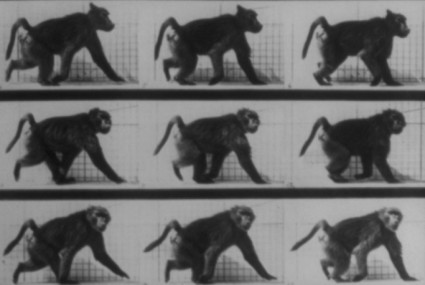
Another day, another Muybridge image, but they always look so good, and fit practically any purpose. This time it’s because there’s news of what should be a highly worthwhile event at the British Library. Currently we’re running there an exhibition on nineteenth century photography, entitled Points of View, which I’ve seen twice and will see twice more if I can, and strongly recommend it to anyone in the vicinity. It’s as clear and illuminating an introduction to the history of photography as you’re likely to find. The exhibition stays open until 7 March.

There are events associated with the exhibition, and on 1 February there is to be The man who stopped time: Eadweard Muybridge – pioneer photographer, father of cinema and murderer. It will be presented by Brian Clegg, author of The Man Who Stopped Time, the recent biography of Muybridge, and an additional attraction will be some unique animations of Muybridge photographic sequences by Marek Pytel. Come along at witness the historical point at which photography wills itself into cinema.

The event takes place 18:30-20:00 at the British Library Conference Centre (close by St Pancras station), and tickets can be booked now, price: £6 / £4 concessions.

The great Londoner

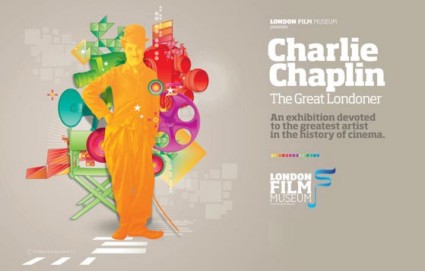
Yesterday an exhibition opened at the London Film Museum, Charlie Chaplin – The Great Londoner. The exhibition promises “insights into the life and career of Charles Chaplin, the boy from the London slums who won universal fame with his screen character of the Tramp, and went on to become a Knight of the British Empire”. Produced by Jonathan Sands and devised by Leslie Hardcastle in collaboration with David Robinson, Chaplin’s biographer, the exhibition is in six sections, described thus:

A London Boyhood
Charles Chaplin was born in 1889 in East Street, Lambeth, and his early years were spent, often in acute poverty, in this square mile to the South and East of the present London Film Museum. This section evokes the life of the poor in late Victorian Lambeth, and the escape provided by the light, colour and fun of the music halls, in which his parents were performers.

A Child of the Theatre
At the age of 10 the young Chaplin found work in a juvenile music hall troupe, and his future was decided. As a boy actor he made his mark as the comic page-boy in Sherlock Holmes, and even played the role in the West End. But his greatest success came in the music hall, and at 20 he was already a star of the Karno comedy companies. This section sets out to recall the atmosphere and the stars of the music halls, with memorabilia relating to Chaplin’s own stage career.

America and the movies
Between 1910 and 1913 Chaplin twice toured the American vaudeville circuits as a star of the Karno company, and was greatly excited by his encounter with the New World. At the end of 1913 he yielded to an offer from the Keystone Comedy Company, ruled by Mack Sennett and arrived in Hollywood. At first disoriented by the new medium, he learned rapidly, and within weeks was directing his own films. The exhibition evokes the buccaneering atmosphere of early Hollywood, its primitive studios, and its rapid evolution towards an international industry.

The Tramp
Searching for a character for his second film, Chaplin put together a costume from elements found in the Keystone wardrobe shed. The result – the Tramp – achieved instant popularity and within a year or two was known and loved across the world. Chaplin’s creation remains to this day the screen’s iconic and most universally recognised character.

Citizen of the World
When Chaplin finally took a rest and visited Europe in 1921, he was astonished to find himself a world celebrity, mobbed by crowds everywhere he went, and sought out by the great men of the day. Increasingly he used his comedy to comment on the fundamental problems of humanity. Modern Times is a broad-ranging social critique; and in The Great Dictator, having finally abandoned his character of the Tramp, he pillories Adolf Hitler, fascinated by the physical resemblance between the best-loved man in the world and the most hated.

The Happy Exile
In the paranoia of the Cold War years, Chaplin became an object of suspicion to the Communist-obsessed American political right. His anti-war statements in Monsieur Verdoux and his friendships with liberal intellectuals led to increasingly virulent attacks and accusations of Communist sympathies. In 1952 he came to England for the premiere of his last American film, Limelight (a recollection of the London music halls of his youth) never permanently to return to the United States. His final years were spent contentedly in Switzerland, surrounded by his growing family and still planning films, two of which, A King In New York and A Countess from Hong Kong, were made in Britain.

This is good news, and the exhibition will also become part of the permanent museum display. But what’s the London Film Museum, eh? Last time I looked there wasn’t one. The Museum of the Moving Image (MOMI) sadly closed in 1999, and in 2008 an odd and seemingly short-term attraction with the ungainly title of The Movieum appeared on the South Bank as part of the popular attractions based in the former County Hall complex. It didn’t look like it would last long or offer much.

Bu the Movieum has turned out to have more staying power and ambition towards being a genuine commemoration and repository for moving image heritage than one might have supposed. It has been rebranded as the London Film Museum (strictly speaking, the London Film Museum now incorporates the Movieum), at the same location, and the first expression of its new status is the Chaplin exhibition. And, as some will know, Leslie Hardcastle was one of the presiding geniuses behind MOMI, so to have his approval of the new venture is significant indeed. We shall watch these developments with interest.

Literature and the mass-produced image

http://nyugeoconference.wordpress.com

All call for papers has been issued for a one-day conference taking place at New York University on 2 April 2010. Although Literature and the Mass-Produced Image isn’t specifically about silent film, the conference themes are each reflected by film from the silent era. Here’s the conference blurb to explain more:

New York University’s English Department will host a graduate student conference exploring the fate of literature in the age of the reproducible image. The nineteenth-century emergence of photography, a medium which Walter Benjamin referred to as “the first truly revolutionary means of reproduction,” coupled with the subsequent development of the motion picture, irrevocably shook not only the art world, but also the literary. This conference aims to uncover the affinities, negotiations, and interrelations between literary texts and visual media like photography, cinema, and the more recent medium of digital imaging and video. Investigating these issues from the perspectives of both literary and visual culture, this one-day event aims to bring together new work being produced by graduate students studying literature, cinema studies, visual culture, the history of media, and social historiography.

We will be focusing on a number of related questions including (but not limited to): How has the development of visual media affected literary aesthetics? In what sense has the vocabulary of film and photography been appropriated from and by literary culture? How do motion and pacing – elements inherent to cinema – reveal themselves in creating and staging action, plot, and character development in literary narrative?

Other possible topics include:

  • Photographic representation in literary texts
  • Literature as motion: imagery and the mind’s eye, storytelling and motion
  • Cinema, literature, fragmentation and non-linear chronology
  • Descriptions of photographs within literary works
  • The ‘urban’ and its centrality to cross-media works
  • Modernist critique/appropriation of visual culture
  • Art, the avant-garde, and experimental motion/stop-motion
  • The function of written text in a visual medium
  • Depictions of movies and movie-going in literary narrative
  • Film vs. Literature: ‘high art’ in the era of mass culture

Please send abstracts (400 words) to nyugeo.conference@gmail.com by FEBRUARY 1, 2010. Abstracts should include your name, contact information, paper title, and a short bio with your institution & department affiliation and year in graduate school. Please specify any audio-visual requirements. Panel proposals are also welcome for panels comprised of 3-4 participants; in your proposals, please include panel title and brief description (limit 500 words) as well as a list of papers with corresponding abstracts and speaker information.

Conference organizers: Yair Solan, Kathryn Bullerdick and Blevin Shelnutt.

This conference is sponsored by the New York University Department of English, with financial support provided by the NYU Graduate School of Arts and Science.

I think it is something to be proud of when one can combine academia with film fandom, and it’s worth noting that conference co-organiser Yair Solan is the person behind the estimable The World of Charley Chase website. Modern literature and silent comedy – now there’s a really healthy combination of life-skills.