Lives in film no. 1: Alfred Dreyfus – part 2

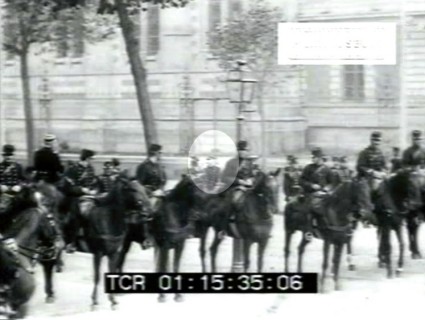
Alfred Dreyfus (inset) walks from the courtroom at Rennes, with the military guard lined up with their backs against him because of the disgrace that he represented. This and other frame grabs taken from the Biograph series of Dreyfus trial scene films, with kind permission of the Filmmuseum, Amsterdam.

This series looks at the ways in which the early motion picture recorded and influenced the lives of some significant individuals. We have started with Alfred Dreyfus, and in part one we saw how Georges Méliès documented the ‘Dreyfus affair’ by creating a multi-part drama that demonstrated great fidelity to genuine incident and appearance. For part two, we look at the responses of other film companies to Dreyfus, which ranged from dramatic sketches to on-the-spot news coverage. Firstly, a recap of the Dreyfus story itself.
The Dreyfus affair
Alfred Dreyfus, a Jewish French officer, was arrested in October 1894 on suspicion of spying for Germany. A military court suspended him from the Army and on highly dubious evidence he was sentenced to life imprisonment on Devil’s Island. In 1896 one Colonel Picquart found documents which seemed to offer convincing evidence of Dreyfus’ innocence and it became apparent that the guilty party was another French officer, Ferdinand Walsin Esterhazy. The military authorities under General Auguste Mercier ordered the matter hushed up, and Picquart was transfered to Tunis. But Dreyfus’ family continued to plead his cause, and a campaign led by the author Emile Zola (who wrote an open letter to the French president Émile Loubet famously entitled ‘J’accuse’) resulted in a fresh trial in 1899, which became a mockery through the Army’s refusal to admit that it could be in the wrong and the general anti-Jewish hysteria that abounded. Dreyfus was found guilty again (to the shock and disgust of world opinion), but President Loubet swiftly pardoned him. The case was reviewed in 1906 and Dreyfus found innocent. The whole affair saw France bitterly divided between Dreyfusards (generally liberals, Socialists, anti-clericals and intellectuals) and anti-Dreyfusards (generally Roman Catholics, monarchists, anti-Semites and nationalists). It became the major political crisis of the Third Republic, and seriously weakened the world view of France as a champion of liberal values.

Francis Doublier
It’s not certain whether Lumière cameraman Francis Doublier‘s tale of exhibiting films of the Dreyfus affair while he was touring Russia in 1898 is apocryphal or not, but it is such a good story – recounted several times in histories of documentary – that has to be included for the record. He told the story several times – this version comes from a lecture that he gave in 1941 at New York University, which was reproduced in 1956 in Image magazine:

The Dreyfus affair was still a source of great interest in those days, and out of it I worked up a little film-story which made me quite a bit of money. Piecing together a shot of some soldiers, one of a battleship, one of the Palais de Justice, and one of a tall gray-haired man, I called it “L’affaire Dreyfus.” People actually believed that this was a filming of the famous case, but one time after a showing a little old man came backstage and inquired of me whether it was an authentic filming of the case. I assured him that it was. The little old man then pointed out that the case had taken place in 1894, just one year before cameras were available. I then confessed my deception, and told him I had shown the pictures because business had been poor and we needed the money. Suffice to say, I never showed “L’affaire Dreyfus” again.

Whatever the precise truth, Doublier’s story reveals two fundamental truths about film – one, that it doesn’t matter what the image literally shows but what you say that it shows that counts; two, that audiences aren’t always quite a dumb as filmmakers like to believe that they are. Or at least some of them aren’t.

Biograph
Biograph is a name associated with D.W. Griffith, but the original company was the American Mutoscope and Biograph Company and it made use of a 68mm filmstock which produced films of startling size and image quality. In term of product, it produced both comic sketches, often of a midly salacious nature for viewing through the peepshow Mutoscope, and films of actuality which tended to feature at prestige theatre screenings. It gained a high reputation for films of news, sport, travel and famous personages, particularly when one of its founders, William Kennedy-Laurie Dickson, moved to Britain in 1897 to become filmmaker for the British Mutoscope and Biograph Company. Biograph diversified further, and the Société Française de Mutoscope et Biographe was formed in 1898. These two companies, and the American parent company, each produced Dreyfus-related films.
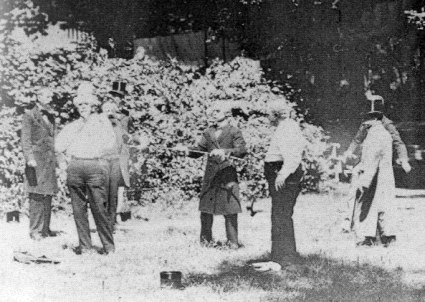
The Zola-Rochefort Duel, from The Wonders of the Biograph (1999/2000).

The first Biograph film related to the Dreyfus affair was the British Mutoscope and Biograph Company’s The Zola-Rochefort Duel, made around June/July 1898. This was the year of Emile Zola’s polemical open letter ‘J’accuse’ which brought the Dreyfus injustice out into the open. Henri Rochefort was a journalist and a rabid anti-Dreyfusard. The film dramatises a duel with swords between the two men in a park. A Biograph catalogue record describes it this:

This is a replica of the famous duel with rapiers between Emile Zola, the novelist, and Henri Rochefort, the statesman. The duel takes place on the identical ground where the original fighting occurred, seconds and doctors being present as in the original combat. The picture gives a good idea of how a French affair of honor is conducted.

However, there was no duel fought between Zola and Rochefort in reality, so either the film is meant to be symbolic or it is based on a false news report.
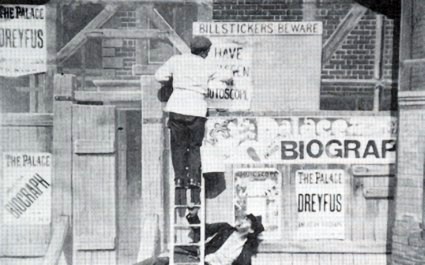
The American Biograph at the Palace – an advertising film for Biograph films (which were billed in the UK as American Biograph) at the Palace Theatre, London, highlighting films of the Dreyfus trial. From Richard Brown and Barry Anthony, A Victorian Film Enterprise. (1999).

The following year, at the time of the trial, Biograph used all of its publishing muscle (the British company was managed by newspaper and magazine interests) to promote itself as the company with all that anyone needed to see relating to the story of the hour. It produced an advertising film in which a billsticker puts up posters advertising Dreyfus films to be seen at the Palace Theatre in London (Biograph’s showcase theatre). The British company also produced Amann, the Great Impersonator, in which quick-change artist Ludwig Amann poses before the camera as Zola and Dreyfus, while the American branch made two films staring Lafayette, ‘the great mimetic comedian’, entitled The Trial of Captain Dreyfus and Dreyfus Receiving His Sentence (these latter two films do not appear to exist, but the three British films do).
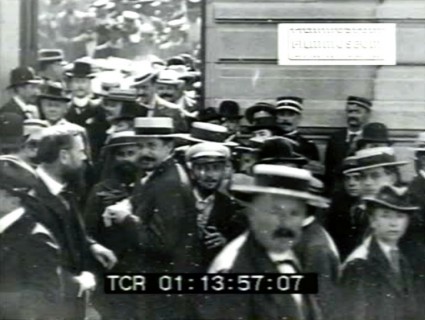
Crowds pouring out of the courtroom at Rennes, filmed by Biograph. Dreyfus trial scenes, Filmmuseum.

However, Biograph’s major contribution to the Dreyfus affair was made by its French branch. The Société Française de Mutoscope et Biographe produced a series of what are effectively news reports filmed outside the courtroom at Rennes during Dreyfus’ second trial over August-September 1899. Here we are taken away from the comic sketches and dramatic reconstructions to the startling reality. The series of films (which are held by the Filmmuseum in Amsterdam) are extraordinary to witness, not just because they document the actuality, but because they do so with a camera style that comes across as all too modern. This is the inquisitive news camera, eagerly gazing on history in the making, making us news voyeurs, as we urge the camera to give us whatever glimpse it can of the personalities involved.
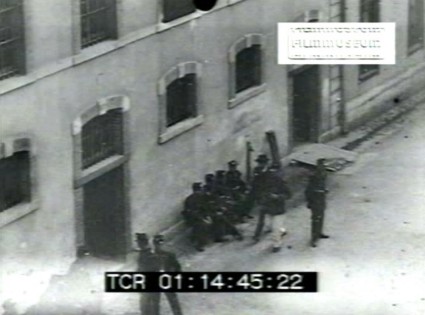
Alfred Dreyfus, in hat and dark civilian clothes, accompanied by an official (with white trousers), walks in the prison yard at Rennes, filmed by the Biograph camera from a high vantage point. Dreyfus trial scenes, Filmmuseum.

The camera operator certainly tried his best (we don’t know his name; some sources credit Julius W. Orde, but he was a director of the French company, not a cameraman). The most remarkable achievement was to capture a few seconds of of Dreyfus exercising in his prison yard, filmed from a platform built on a overlooking roof. It is pure paparazzi, except that the operator was working with a camera which with all its batteries and accoutrements weighed over half a ton. The fleeting sight of the man of the hour became a huge coup for Biograph, its brevity only enhancing the sense of a precious image snatched by the ingenuity of the operator. This film captured the headlines, but a second film of Dreyfus – illustrated at the top of the post – was also obtained, just managing to show him (via a frantic panning shot) walking from the court room across the street with a guard all standing with their backs to him because of the dishonour he represented (there was supposed to be a practical side to it as well, because the guard would be looking out for assassination attempts rather than looking at Dreyfus). A third film in the Filmmuseum set has a similar line-up of guards but it is unclear whether Dreyfus passes through them.
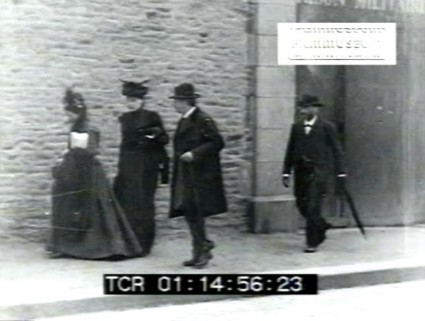
Lucie Dreyfus (second left) and Mathieu (second right) leaving the prison at Rennes, filmed by the Biograph cameraman tracking left. Dreyfus trial scenes, Filmmuseum.

The other film among the Dreyfus set that attracted much interest was filmed of Dreyfus’s wife Lucie and his brother Mathieu walking from the prison, with the camera tracking left to follow them as they turn a corner. The camera feels invasive, but we are also struck by the ordinariness of the scene, as the subjects recede in to the distance and the indifferent passers-by drift past or glance at the oddness of the Biograph camera. The remaining surviving films from this set include shots outside the court, with notable figures coming and going – one appears to be General Mercier, the lead prosecution witness. The films really should receive careful analysis from experts in the field, because none of the footage is accidental; the cameraman was trying as far as he could to capture something of all of the notable names. Another shot shows someones leaving the courtoom and entering a carriage (possibly Lucie Dreyfus), while another shows people pouring out of the courtroom into the open air in such a clear and animated image that the years fall away and we are back there in Rennes in 1899.

The other valuable thing about the Biograph films of the trial is that we know something of their reception. Of the court yard scene, a British theatre reviewer (from an unidentified journal clipping) wrote:

Out … comes Captain Dreyfus in civilian attire escorted by an official. Before the pair have walked five yards towards us the official espies the camera [it is not clear if this is the case], and at once hurries his charge out of sight again through the nearer door. Captain Dreyfus, who has come out for daily exercise, does not get much, for he is not in our sight for more than five seconds. The Biograph kindly repeats the view, not as an encore, but in consideration of its brevity. Without being an artistic success, it is likely to remain for some time the view that will excite the most interest. Last night it was received in ominous silence, but was heralded and succeeded by loud cheers.

This account (part of a longer review) shows how such films could be viewed both ironically and straightforwardly, while exciting a range of emotions in the general audience. Other reports reveal the sympathies of the British audience – film of Dreyfus’ lawyer Labori was cheered, while film of General Mercier was roundly booed (this also indicates that the films had live commentary from someone explaining who was to be seen going in or out of the courtroom).

Pathé
While Georges Méliès’s L’affaire Dreyfus (discussed in part one) is relatively well-known, the L’affaire Dreyfus series produced by Pathé is less-discussed, chiefly because only one part of an original eight items survives. However it was quite similar in method to Méliès’s films, using dramatisation to document the reality and breaking up the the story into dramatic tableaux which could either be viewed singly or as a complete set. In this case we know the name of the actor who played Dreyfus – Jean Liezer. These are the titles of the individual episodes:

  • Arrestation, aveux du colonel Henry
  • Au mont Valérien: suicide du Colonel Henry
  • Dreyfus dans sa cellule à Rennes
  • Entrée au conseil de guerre
  • Audience au conseil de guerre
  • Sortie du conseil de guerre
  • Prison militaire de Rennes, rue Duhamel
  • Avenue de la Gare à Rennes

Each episode was 20 metres in length. To judge from the one episode that survives (at the BFI National Archive), Dreyfus dans sa cellule à Rennes, the style was more restrained than that adopted by Méliès (though Pathé like Méliès showed the bloody suicide of Colonel Henry). It place emphasis on producing a pseudo-realistic of the personalities and places involved, with a greater concentration on the events surrounding the second trial (conseil de guerre). The extant film (no still available to illustrate, unfortunately) shows the guards with their backs to those entering the courtroom. Were the whole series to survive, one suspects that it would be a comparable work to that of Méliès, in its keen attention to detail if not in dramatic verve.
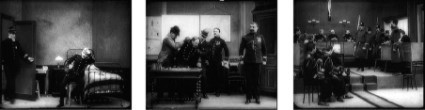
Frames from L’affaire Dreyfus (1908), directed by Lucien Nonguet, from Dreyfus à l’écran film programme, Musée d’art et d’histoire du Judaïsme, 2008

What does survive, however, is a second Pathé film, made nine years after the trial and two years after Dreyfus was finally found innocent. This is a longer work (370 metres) and a single, multi-scene film, directed by Lucien Nonguet and produced by Ferdinand Zecca. However, from the frame stills (I’ve not seen the film myself) the mise-en-scène seems remarkably similar to the 1899 films, the emphasis still being on documenting the look of key incidents through close replication of people and locations (compare the trial scene, to the right of the above frames, with the trial scene filmed by Méliès, illustrated in part one). The major difference comes through an additional character – this L’affaire Dreyfus features Esterhazy, the man who produced the document betraying French miitary secrets to the Germans that Dreyfus was accused of having written. His guilt is made clear from the opening scene, turning a series of unfortunate incidents in something with tragic impetus.
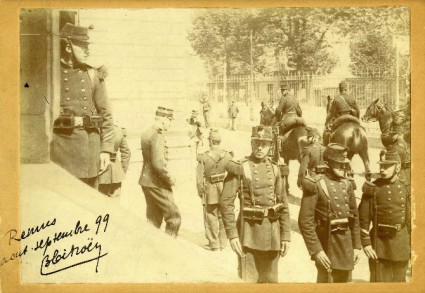
Photograph of Dreyfus leaving the courtroom at Rennes, showing the guard with their backs turned. Taken from the Dreyfus Rehabilitated site, http://www.dreyfus.culture.fr

Envoi
The 1909 film was the last to be made of the Dreyfus case until 1930. In 1915 the French banned any dramatic representation of the Dreyfus case from being made, and when Richard Oswald’s 1930 feature film Dreyfus was made, France still refused to allow it to be screened. But for the silent period, it was documenting history in the making that was important. The young medium used every means at its disposal to record the news story of 1899 (for some, the news story of the century) and to turn it into profitable entertainment. It employed both dramatic reconstruction and actuality, pushing the boundaries of the medium’s expression in each case, and demonstrating the power of motion pictures to capture the moment in a form that no other medium could quite emulate. Cinema brought you face to face with life itself.

Though it may be something of an inappropriate speculation, given Dreyfus’s Jewish faith, there is something of the Christian Stations of the Cross in the early Dreyfus films. Each illustrates the key stages in the victim’s noble passage to the point where false justice is executed through a series of tableaux. In each the victim is noble, passive, and wronged. The narrative does not develop in a form that is understandable to anyone new to the story, but instead represents passages of suffering told through tableaux that the faithful will recognise as having special meaning. It is interesting that the main multi-scene film narratives made in the 1890s are the two L’affaire Dreyfus films, assorted lives of Christ (by Lumière, Pathé and others), and Méliès’ Cendrillion (1899), or Cinderella – another episodic tale of suffering and redemption.

But what of Alfred Dreyfus himself? He is not recorded as being aware of the films that were made of him, and of course they were only a trivial distraction in the context of the issues that raged around him, issues of patriotism, religion, race and social order. Dreyfus was pardoned soon after the farce of the second trial, and was finally pronounced innocent in 1906. Despite the way it had treated him, he rejoined the Army, but retired on grounds of ill-health in 1907. However, he joined the Army once more in 1914 and rose to the rank of lieutenant colonel (he had had hopes of eventually becoming a general before the catastrophe of 1894). He was awarded the Légion d’honneur in 1918, and died in 1935.

Information on Biograph, including the filming and exhibiting of Biograph films, can be found in two sources in particular: Richard Brown and Barry Anthony, A Victorian Film Enterprise: The History of the British Mutoscope and Biograph Company, 1897-1915 (1999) and Mark van den Tempel and Luke McKernan (eds.), The Wonders of the Biograph, special issue of Griffithiana, nos. 66/70, 1999/2000). Although more has been discovered since it was written (not least the Biograph trial films), Stephen Bottomore’s article ‘Dreyfus and Documentary’, Sight and Sound (Autumn 1984) is still the best source for learning about the relationship between the Dreyfus affair and early film. Stephen also covers still photography, making it clear just what a media scramble the whole Affair was.

For extensive background information on the Dreyfus affair, the personalities and the issues involved, see the generally excellent Dreyfus Rehabiliated website. Unfortunately its section on the films of the affair is muddled. For a concise and informative book acount, see Eric Cahm, The Dreyfus Affair in French Society and Politics. For an atmospheric eye-witness account of the second trial itself, read G.W. Steevens’ The Tragedy of Dreyfus (1899), available from the Internet Archive.

The Biograph and Pathé films are not available online or on DVD.

The third and final part of this account will be a filmography.

Lives in film no. 1: Alfred Dreyfus – part 1

L’affaire Dreyfus: la dictée du bordereau – the first part of Georges Méliès’ 1899 film series. October 1894 – Dreyfus (seated) gives a sample of his handwriting and is accused by Colonel Du Paty de Clam (left) of being the author of the Bordereau

I’m starting up a new series here at the Bioscope. It is going to document the ways in which the early motion picture recorded and influenced the lives of some significant individuals. Public lives from 1896 onwards started to be different to a significant degree because they began to be led in front of motion picture cameras, which could record them in reality or reconstitute them dramatically as entertainment. Each post in the series will investigate an individual of significance to social, cultural or political history and try to see them particularly in the light of the cinema. Each post will include a filmography including both non-fiction and fiction films. I don’t know whether any of the subjects will be actors or filmmakers – maybe so. But the series starts with a French soldier, victim of one of the most notorious cases of miscarriage of justice in history, Alfred Dreyfus.

The Dreyfus affair
Alfred Dreyfus (1859-1935), a Jewish French officer, was arrested in October 1894 on suspicion of spying for Germany. A military court suspended him from the Army and on highly dubious evidence he was sentenced to life imprisonment on Devil’s Island. In 1896 one Colonel Picquart found documents which seemed to offer convincing evidence of Dreyfus’ innocence and it became apparent that the guilty party was another French officer, Ferdinand Walsin Esterhazy. The military authorities under General Auguste Mercier ordered the matter hushed up, and Picquart was transfered to Tunis. But Dreyfus’ family continued to plead his cause, and a campaign led by the author Emile Zola (who wrote an open letter to the French president Émile Loubet famously entitled ‘J’accuse’) resulted in a fresh trial in 1899, which became a mockery through the Army’s refusal to admit that it could be in the wrong and the general anti-Jewish hysteria that abounded. Dreyfus was found guilty again (to the shock and disgust of world opinion), but President Loubet swiftly pardoned him. The case was reviewed in 1906 and Dreyfus found innocent. The whole affair saw France bitterly divided between Dreyfusards (generally liberals, Socialists, anti-clericals and intellectuals) and anti-Dreyfusards (generally Roman Catholics, monarchists, anti-Semites and nationalists). It became the major political crisis of the Third Republic, and seriously weakened the world view of France as a champion of liberal values.

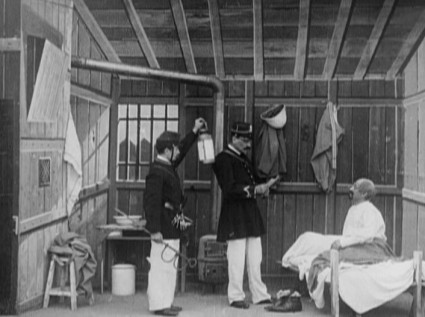
L’affaire Dreyfus: L’île du diable. April 1895 – Dreyfus (seated) within the palisade on Devil’s Island, where a guard brings him a letter from his wife but is forbidden to speak to him. Dreyfus was imprisoned on the island for over four years.

The Dreyfus affair was debated across the world. It filled the newspapers, and the second trial at Rennes in 1899 witnessed a media frenzy of a kind we are all too familiar with today. Eager to participate in that frenzy and take advantage of one of the first news stories of worldwide interest to come into its view was the motion picture camera. Films were made of the Dreyfus affair because they were excellent business, but also – in one significant case – because they enabled the filmmaker to express his dedication to the Dreyfus cause. The motion picture industry responded with newsfilm, dramatic reconstructions and sketches, so that the Affair served as a demonstration of everything that the young medium could do to capture the semblance of reality.

L’affaire Dreyfus: Mise aux fers de Dreyfus. 6 September 1896 – Dreyfus is placed in irons inside his cell on Devil’s Island. He was shackled to his bed for a period between September-October 1896 after a false report of an escape attempt.

Four companies produced films on the Affair while it was ongoing: Star-Film (i.e. Georges Méliès), Pathé Frères, the British Mutoscope and Biograph Company and its sister company the Biograph and Mutoscope Company for France. There’s a lot to cover so the latter three will be covered in a second post, with a full filmography in a third post. Here we will tackle the contribution by Georges Méliès.

Star-Film
George Méliès is said to have picked up his strong Dreyfusard feelings from discussions with his cousin Adolphe. It is heartening to know that France’s great creative filmmaker in the early years of cinema chose the right side. He set about making his Dreyfus films with an eye to commercial opportunity but also as a means to express his personal sympathies – probably the first time that film had ever been used in this way. His approach was radical – he would make a multi-part news narrative, tracing the Dreyfus story from his original imprisonment in 1894 to the second trial in 1899. At a time when films were almost entirely single-shot narratives of less than a minute in length, Méliès produced a 15-minute, eleven-part chronological series of documentary fidelity and great cinematic invention (strictly speaking it was twelve parts, as one scene covers two catalogue numbers in the Star-Film catalogue). Filming took place August-September 1899, while the trial was taking place, at his studios at Montreuil, Paris.

L’affaire Dreyfus: Suicide du Colonel Henry. 31 August 1898 – Colonel Joseph Henry, who discovered the ‘bordereau’ that incriminated Dreyfus but who later forged documents in an attempt to compromise the Dreyfus-supporting Colonel Picquard, cuts his throat with a razor while in prison in Paris.

Méliès did not consider filming actuality – he got nearer to his idea of the truth through dramatic recreation. He took great care to replicate locations, using newspaper illustrations and photographs as reference, and employing performers who looked like the leading players in the real-life drama. An unnamed blacksmith played Dreyfus because of a physical similarity, while Méliès himself played Dreyfus’ bearded lawyer, Fernand Labori. The choice of tableaux indicate Méliès’s sympathies while showing both his commercial sense and artistic imagination. The series (nine parts of the original eleven survive today at the BFI National Archive and are illustrated throughout this post) starts with Dreyfus being accused of writing the Bordereau, the notorious document that betrayed French military secrets to the Germans. The scene in which Dreyfus was dishonourably discharged from the French army by having his sword symbolically broken is lost, so next comes Dreyfus imprisoned on Devil’s Island, followed by a scene in his cell in which he is placed in leg-irons, punishment for a supposed escape attempt. Méliès’s Dreyfusard sympathies are already made clear. The scene then switches to France to show Colonel Henry in prison, the man whose zealous loyalty led him to forge documents intended to compromise Dreyfus supporter Colonel Picquard, spectacularly cutting his throat with a razor blade. It’s the point where Méliès meets Tarantino; probably the first blood to be seen shed in cinema history.

L’affaire Dreyfus: Débarquement à Quiberon. 30 June 1899 – Dreyfus (the figure in civilian clothes in the centre) returns to France at Quiberon (where a storm rages) to face his second trial.

With the next scene the news realism takes over. Dreyfus is shown returning to France at the port of Quiberon, at night, in the middle of a storm. Lightning flashes, the performers are soaked in water, sailors on the boat bob up and down on the waters – it is as far as possible the scene as it had occured only a few weeks before Méliès started filming. We then see Dreyfus in jail, where he converses with his lawyers (including Méliès as Labori, giving himself the heroic defender role – was this series the first set of films in which named living people were portrayed by actors?) before meeting with his wife Lucie in a calculatedly pathetic scene.

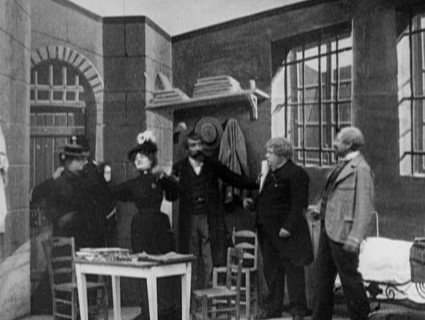
L’affaire Dreyfus: Entrevue de Dreyfus et de sa femme à Rennes. 1 July 1899 – Dreyfus (furthest right) in prison at Rennes meets his wife Lucie for the first time in four years. Georges Méliès, playing the lawyer Labori, is the figure in the centre, with another Dreyfus lawyer, Edgar Demange, portrayed to the right.

Next follows what was an assassination attempt on Labori, Méliès going to the trouble of replicating the locale, next to a bridge crossing the river Vilaine at Rennes. Labori survived a shot in the back and is seen in the next scene in which Dreyfusard and anti-Dreyfusard journalists come to blows. The scene appears symbolic, but reflects actual uproar that occurred at the court-house in Rennes on 14 August 1899 when news of the attack on Labori was reported, with a confrontation occuring between anti-Dreyfusard Arthur Myer of the Gaulois and Dreyfusard ‘Séverine’ (Caroline Rémy) of the Fonde, as the Star-Film catalogue relates. A New York Times report makes clear the connection between the two incidents. For film form enthusiasts the scene is most remarkable for the way the journalists all run at and past the camera, breaking the cinema screen’s fourth wall in revolutionary style. However there is some dramatic licence, because the injured Labori did not return to the trial for a week after the shooting.

L’affaire Dreyfus: Attentat contre M. Labori. 14 August 1899 – In the company of Colonel Picquart and M. Gast, Mayor of Rennes, Dreyfus’s lawyer Labori is shot in the back by a would-be assassin beside the river Vilaine at Rennes.

L’affaire Dreyfus: Bagarre entre journalistes. 14 August 1899 – rival news reporters fight one another during the court martial proceedings upon hearing the news of the attempted assassination of Labori.

The double-length court room scene is where Méliès took the greatest trouble in depicting the news as it was more or less happening. The catalogue description makes clear the minute attention to detail regarding personality, action and appearance (text from the English language version in the Warwick Trading Company catalogue):

A scene in the Lycée at Rennes, showing the military court-martial of Captain Dreyfus. The only occupants of the room at this time are Maître Demange and secretary. Other advocates and the stenographers now begin to arrive and the sergeant is seen announcing the arrival of Colonel Jouaust and other officers comprising the seven judges of the court-martial. The five duty judges are also seen in the background. On the left of the picture are seen Commander Cordier and Adjutant Coupois, with their stenographers and gendarmes. On the right are seen Maître Demange, Labori, and their secretaries. Colonel Jouaust orders the Sergeant of the Police to bring in Dreyfus. Dreyfus enters, saluting the court, followed by the Captain of the Gendarmerie, who is constantly with him. They take their appointed seats in front of the judges. Colonel Jouaust puts several questions to Dreyfus, to which he replies in a standing position. He then asks Adjutant Coupois to call the first witness, and General Mercier arrives. He states that his deposition is a lengthy one, and requests a chair, which is passed to him by a gendarme. In a sitting position he proceeds with his deposition. Animated discussion and cross-questioning is exchanged between Colonel Jouaust, General Mercier, and Maître Demange. Captain Dreyfus much excited gets up and vigorously protests against these proceedings. This scene, which is a most faithful portrayal of this proceeding, shows the absolute portraits of over thirty of the principal personages in this famous trial.

L’affaire Dreyfus: Le conseil de guerre en séance à Rennes. 12 August 1899 – The court room at Rennes, with the lead prosecution witness General Mercier (centre) making a showy entrance. Dreyfus, dressed in military uniform, is seated on the raised dais to the right.

L’affaire Dreyfus concluded with a now-lost scene showing Dreyfus being led away to prison once more. The set of films was produced with the intention of capturing audience attention immediately following the trial (which ended on 9 September 1899). The films could be bought as a complete set (lasting some 15 minutes) or individually, according to taste and pocket. Méliès’ granddaughter much later wrote that there were pitched battles in the theatres where the films were shown. Police had to separate Dreyfusards from anti-Dreyfusards, which supposedly led to the film being banned by the French government and that consequently no film was allowed to be shown about the Dreyfus affair until 1930. However, there is no concrete documentary evidence that I’m aware of for the film being banned, or even for the scuffles in theatres, and in any case the French ban on accounts of the Dreyfus affair was not made until 1915 (so, for example, Pathé made a film about Dreyfus in 1908). However, there must have been great uncertainty among some exhibitors about showing the film, as film historian Stephen Bottomore suggests that some British theatres chose not to screen the films because of the unseemly passions they might arouse, so one can hardly expect less of a reaction that this in France. Nevertheless the films were never removed from the Star-Film catalogue, and by remaining on sale one has to deduce that they were never banned, not in France or anywhere else.

In truth we don’t know much about the reception of Méliès’ films. We have commentaries, and we have concerns raised in some quarters about the dramatisation of actuality. “Where is this new kind of photo-faking to stop?” asked Photographic News, wringing its hands in mock despair. What we can gather from watching what survives today is that the news story gave the filmmaker the opportunity to produce a documentary (there can be no other word for it) using every valid filmic device at his disposal while expressing through the mise-en-scène his sympathy for Dreyfus the victim.

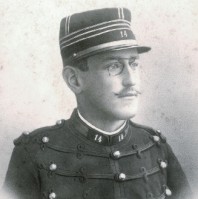
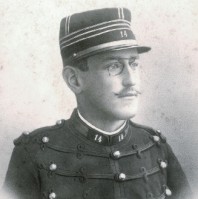
Unsurprisingly the films do not give us much of an idea of Dreyfus the man, but it is remarkable that they give us anything of him at all. Throughout the affair, and in all acounts that were made of it, Alfred Dreyfus was a cipher, a figure upon who one could unload one’s prejudices or sympathies. Dreyfus (shown left, in 1895) was not an unremarkable man. He had had a notable military career, and was recognised for his keen intelligence. He seems to have been something of an unpopular figure, however, standing out from his fellow officers by being neither one of the humbler sort (he was wealthier than most of them) nor an aristocrat. A perceived aloofness stood against him. During both trials he refused to play the pity card and put his faith in reason – a stubborn policy when surrounded by such rabid anti-Semitism and blind refusal from many to accept that the French military could do any wrong. But there was nobility in such a stance, and Méliès’ Dreyfus does at least give us some sense of his principled forebearance, and this at a time when films had not yet advanced to giving much sense of individual character in dramatic representations. Among the many ‘firsts’ that can be ascribed to L’affaire Dreyfus is surely the first human portrayal of someone on screen.

The Méliès L’affaire Dreyfus is available to view online on the Europa Film Treasures site and as part of the 5-DVD set issued by Flicker Alley, Georges Méliès: First Wizard of Cinema (1896-1913) (also the source of the frame grabs used here). For a filmic analysis, see Michael Brooke’s Georges Méliès blog.

For extensive background information on the Dreyfus affair, the personalities and the issues involved, see the excellent Dreyfus Rehabiliated website. Unfortunately its section on the films of the affair is muddled. For a concise and informative book acount, see Eric Cahm, The Dreyfus Affair in French Society and Politics.

The essential account of the Dreyfus Affair and early film is Stephen Bottomore’s essay ‘Dreyfus and Documentary’, Sight and Sound, Autumn 1984, to which these posts are much indebted.

Part two will explore the dramatic records made by Pathé, at the time of the trial and later, and the extraordinary actuality films of the trial made by Biograph. Part three will be a Dreyfus filmography.

Exporting entertainment

Scholarly works in the silent cinema field – indeed in most fields – don’t last long. They catch the latest academic wave for a time, surf along for a while, then sink beneath the waves as the next key text comes along. For a while it is important to cite them in your own work; then it ceases to be a necessity; finally it becomes an embarassment. You are writing an essay in 2010 and you are citing a book published in 1985? Think again.

But then just a handful of books break through academic fashion and turn out to have lasting value. You have always to refer back to them, because they are one of the signposts. They point the way. In the silent (and early sound) cinema field, one such book is Kristin Thompson’s Exporting Entertainment: America in the World Film Market 1907-1934, published in 1985 and a book that I have referred back to time and time again ever since, and one which has had a strong influence on our corner of film studies.

In part that influence is due to the unusual nature of its theme. Its subject is mechanics of the early Hollywood film industry and how it gained world dominance from the First World War inwards. But it is not so much the thesis as the method, as Thompson looks at such previously overlooked data as import and export records, industrial data and market reports – data which had scarcely been considered the stuff of film history before then, but which turned out to be essential in understanding the intracacies of production, distribution and exhibition on a worldwide scale. The information could then underpin an understanding of why, as the book’s blurb puts it, “Hollywood has become practically synonymous with cinema”.

Exporting Entertainment has inspired other works, notably Ruth Vasey’s The World According to Hollywood: 1918–1939 (1997) and Andrew Higson and Richard Maltby’s Film Europe and Film America: Cinema, Commerce and Cultural Exchange, 1920–39 (1999). It was also pioneering in its emphasis on empirical data, a trend which has been picked up in recent years by exhibition studies. Some of its arguments may have been superseded by economist Gerben Bakker’s recent Entertainment Industrialised: The Emergence of the International Film Industry, 1890-1940 (discussed in detail in an earlier post), but those steeped in film history will find Thompson’s book easier to navigate, even if it is not a light read that you are going to polish off in one sitting. But it should be read, because it sees the industry not through the starry eyes of the fan journals of the period but through the hard-bitten minds of the trade papers, who saw things in so many pounds or dollars per foot of film. The detail is amazing (as is the research behind it), and you really do see cinema on a global scale (Panama, Peru, Siam, the Malay States, Romania and Estonia all end up in the subject index). The book makes you recognise why national cinema is such a suspect way of going about investigating film history when the business was so deeply bound up by the ebbs and flows of a world market.

The reasons for all this now is to announce the happy news that Exporting Entertainment is now freely available online from David Bordwell and Kristin Thompson’s website. As Thompson explains in her useful introduction on the book’s web page, the book has been long out of print and was never distributed in the United States (it was published by the BFI). The book has been made available in PDF form, though be warned that it is a simple scanning job and consequently the file size is large (87MB) and there is no underlying OCR so the text is not word-searchable. This is a shame, and one wonders whether Thompson might take advice from those who regularly produce e-books and re-issue the text in word-searchable format. It would certainly open up the text anew for researchers. But setting that petty point aside, this is a very welcome means of re-introducing an important but rare text to the research community, and it has gone into the Bioscope Library.

The Metropolis showroom

Frame comparison demonstrating stabilisation with camera pans, from http://www.scientific-media.de/showroom/metropolis

Those who haven’t yet had their fill of the story of the restoration of Fritz Lang’s Metropolis may be interested to check out the websites of two of the facilities companies involved.

Scientific|Media is a German digital media production company. On its Metropolis Showroom it demonstrate through short clips the work it has to do to the battered 16mm elements which had to be inserted digitally into the final version. Processes illustrated include stabilisation (OnePoint, MultiPoint, Cross-DeWarp and MotionFiltering/DeJitter), grain management, and the inserting of sequences such as letters and handwritten notes into German. It’s for the technical specialist, but you do get a clear sense of the huge challenges involved.

Secondly there is Alpha-Omega Digital, another German company, which undertook the overall digital restoration work, matching the new material to that which it produced for the Friedrich-Wilhelm-Murnau-Foundation in 2001. Their website reports on this and describes in detail the work that it undertook for the film’s 2001 restoration.

For the record, previous posts here on the Metropolis discovery are:

Disappearing tricks

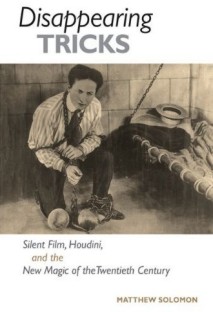
Published this month by the University of Illinois Press is Disappearing Tricks: Silent Film, Houdini, and the New Magic of the Twentieth Century, by Matthew Solomon. It revisits the golden age of both theatrical magic and silent film to reveal how professional magicians shaped the early history of cinema. This is a subject which is often referred to but seldom give book-length treatment. The classic study for years now has been Erik Barnouw’s The Magician and the Cinema, while Dan North’s Performing Illusions ties together the illusions of the pre-cinema and early cinema worlds to the CGI and SFX of today. Matthew Solomon focuses on the work of those professional illusionists who transferred from stage to screen between 1895 and 1929, looking in particular at the work of Georges Méliès and Harry Houdini. The book also investigates “anti-spiritualism and presentational performance in silent film … highlighting early cinema’s relationship to the performing body, visual deception, storytelling, and the occult”.

So, who were those illusionists? The Who’s Who of Victorian Cinema site has biographies of the leading figures from the 1890s, which was the main period in which magicians made their mark on the new medium:

  • ‘Professor’ Phillip Anderson – magician who toured India and South Asia, ading films to his act in 1898
  • Billy Bitzer – D.W. Griffith’s cinematographer started out pursuing his interest in magic and developing novelty toys before branching out into film
  • J. Stuart Blackton – the co-founder of Vitagraph had a cartooning and conjuring act with Albert Smith before they established one of the leading early American film companies
  • Walter Booth – British conjurer who turned trick filmmaker for Robert Paul and Charles Urban
  • David Devant – famous British magician who made film a part of his act in 1896
  • John C. Green (‘Belsaz’) – magician who tourned Canada and the USA, adding film to his act in 1896
  • Carl Hertz – American magician who introduced films to South Africa
  • Emile and Vincent Isola – Franch magicians who added film to their Paris act at the Théatre Isola and were rivals to Georges Méliès
  • John Maskelyne – famous British magaixian who re-invented the art as theatrical performance and who became interested in film as exhibition and on the invention side
  • George Méliès – French magician turned cinema illusionist of the highest order
  • John Schuberg (‘Johnny Nash’) – Swedish magician and film showman who operated in Canada
  • William Selig – American magician and minstrel show operator turned film producer
  • Albert Smith – British conjuror whose double act with J. Stuart Blackton led to their forming the Vitagraph Company of America
  • G.A. Smith – Started out with a ‘second sight’ act which led to his being used as a subject by the Society for Psychical Research, before he became innovative filmmaker and inventor
  • Félicien Trewey – French shadowgrapher (hand shadows), entertainer and friend of the Lumières, he introduced their films to Britain
  • Alexander Victor – Swedish magician who exhibited films in the USA from 1897, founded the Victor Animatograph Co. and invented successful devices for amateur film production

Just outside the Victorian period was Gaston Velle, magician and the son of a magician who directed fantasy films for Pathé in the early 1900s.

Harry Houdini was unusual in being a magician/illusionist from a later era who made a strong impact upon cinema (or else it made a strong impact upon him). He was a one-man thesis on the boundaries between illusion and reality, being magician, escapologist, actor, film producer and someone dedicated to exposing frauds such as spiritualism. He included films as part of his vaudeville act from the mid 1900s, then starred in a serial which showed off his skills in escaping from impossible perils: The Master Mystery (1919, in 15 parts), followed by two feature films for Paramount, The Grim Game (1919) and Terror Island (1920). He formed the Houdini Picture Corporation to make The Man From Beyond (1921) and Haldane of the Secret Service (1923), but cheap production and a lack of real film presence in Houdini himself meant that his film career petered out. His stunts also featured in newsreels of the period. Kino Video has a 3-DVD set Houdini: The Movie Star, which includes The Master Mystery, Terror Island, The Man From Beyond, Haldane of the Secret Service, a five minute section from The Grim Game, and assorted archival films of Houdini in action.

In 2006 Matthew Solomon curated a section of the Pordenone silent film festival programme on magic and film. You can find the list of films and his notes on the festival catalogue, here.

Alice – random but cool

Alice in Wonderland (1903) from http://www.youtube.com/user/bfifilms

It has been fascinating to watch what has been happening to the BFI’s latest online video release of Alice in Wonderland (1903). Restored and issued a few days ago to coincide with the release in the UK of Tim Burton’s new Alice in Wonderland feature film, made for Disney, the film has enjoyed a remarkable reception. Since 25 February it has attracted 123,564 hits on YouTube and has been embedded on numerous other websites (now including this one). Blogs have commented on it, websites have reviewed it. The link has been passed on goodness knows how many time via Twitter, and again and again the reaction from all kinds of people has been positive about the film. The line that keeps on being repeated is that the film is superior to Burton’s bloated effort, but there is more enough evidence of genuine appreciation for what could be achieved in 1903. Here are some sample tweets:

jolie_jolie In anticipation for the Alice in Wonderland movie, here’s the very first film, from 1903 – over 100 years ago! http://tinyurl.com/ydc4kp2

sillyjilly81024 RT @ohnotheydidnt Random but cool: silent Alice in Wonderland from 1903: Just in time for Tim Burton’s new, some… http://bit.ly/bUOhYZ

alisongang RT @neatorama Alice in Wonderland – 1903 version – Neatorama http://bit.ly/aJQe0x

RadioNikki The VERY FIRST Alice in Wonderland film from 1903 !! http://wmee.com/AirStaff/NicholeRoberts.aspx

katejcrowley The first Alice in Wonderland movie ever made. We’ve come a long way! Pretty cool though. From 1903: http://bit.ly/bvhaJL via @addthis

I read this as meaning that the general audience of 2010 is more than capable of appreciating the creative strengths of early cinema. There is delight at its invention alongside amusement at its quaintness. There is genuine appreciation of its proto-special effects with an understanding of how they fit into an ongoing history of film fantasy.

How different from the ways such films were disseminated and received only a few years ago. Alice in Wonderland has been in the BFI National Archive for years, and the common ways in which we were able to present such films to an audience were at very occasional screenings at the National Film Theatre as part of early cinema programmes (attended by a couple of dozen people if you were lucky) or at festivals and exchange screenings with other film archives and institutes. Sometimes we just viewed the films by ourselves and bemoaned the fact that so few people could see them, or might ever want to see them. Only we understood their true value – or so we believed. VHS and DVD came along to help spread the message, but it was always a tough proposition to sell a compilation of early films. What one seldom had the opportunity to do was to show such films individually.

Now look where we are. Alice may well have garned more views in the first week than it received on its original release in 1903 (does anyone know how many people got see an individual film in 1903? I’ve no idea). Moreover it is being seen by such a wide range of people. It has been taken out of its specialist field into general appreciation. This is what YouTube does, and what other film archives need to take note of. It establishes a common platform that is so much better for these films than the specialist ones that we have created for them in retrospectives, festivals and niche DVD releases. When these films are shown to the afficionados or those deemed to know best how to appreciate them, we learn little about them that is new. They are constrained by their select surroundings. Make them available among the skateboarding cats, comic skits, rants and ravings, music videos and TV clips that make up YouTube’s mad mix (all of them short films, just like early cinema) and they are given new life through new audiences. The reactions will be wild at times, there will be plenty of misinterpretation or ignorance of ‘proper’ film history, but the positives far outweigh the petty negatives. The positives are that the film is available to all, that it will be placed in contexts that we as curators or custodians might never think of, that it is exchangeable and shareable as information, that it belongs to today as much as yesterday. And since I started writng this post two hours ago, the number of views has risen by nearly 5,000 to 128,285. While I’ve been rambling, others have been watching, and sharing.

For the record, Alice in Wonderland was produced in Britain by Cecil Hepworth (left), whose studies were in Walton-on-Thames outside London. Denis Gifford, in his British Film Catalogue, credits the direction to Hepworth and his regular director at this period, Percy Stow. Mabel (May) Clark, who had joined Hepworth as a film cutter, plays Alice; Hepworth himself plays a frog, his wife Margaret plays the White Rabbit and the Queen of Hearts, while future director of Irish films Norman Whitten plays the Mad Hatter and a fish, while cinematographer Geoffrey Faithfull and his brother Stanley are two of the playing cards. The film was originally 800 feet or twelve minutes in length (though it was divided up into sixteen scenes which could be bought separately). Eight minutes survive today, in a somewhat ragged state. It was the longest British film yet made.

Alice was made with close attention to Tenniel’s original drawings, though it was bold enough to include its own additions to the narrative, giving Alice a magic fan (Tim Burton adds the Jabberwock to his version of the tale, which seems a somewhat greater liberty to take). Its special effects, achieved using optical printing and some ingenious use of scenery, allow us to see Alice grow large and small with impressive effectiveness. But perhaps the most delightful element is the procession of playing cards (filmed at the Mount Felix estate at Walton), which seems to have involved the participation of a local school. The narrative makes no sense when viewed with cold logic, but then neither does Lewis Carroll’s original. In short it is random – but cool. Now go tell someone about it.

Silent film journals online

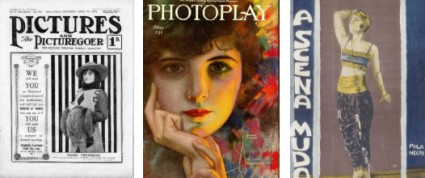
Pictures and the Picturegoer (1915), Photoplay (1921) and A Scena Muda (1921)

That post on the appearance online of the George Eastman House journal Image made me think that it would be useful to have a round-up of those silent film journals that are available on the Web. Though few of the leading journals of the period have digitised, given the specialised nature of the subject we’re not doing too badly. Note that the range of years and the number of issues refers to what is available online, not necessarily what was originally published.

  • Bollettino di informazioni cinematografiche
    Country: Italy
    Years: 1924-25
    Number: 8 issues
    Description: Pittaluga film company journal with information on films available for showing (no illustrations)
    Available from: Teca Digitale piemontese
    Format: Java-based viewer
    More information: Bioscope guide
  • Bollettino edizioni Pittaluga
    Country: Italy
    Years: 1928-29
    Number: 6 issues
    Description: Pittaluga film company journal, with full page illustrations
    Available from: Teca Digitale piemontese
    Format: Java-based viewer
    More information: Bioscope guide
  • Bollettino staffetta dell’ufficio stampa della anonima pittaluga
    Country: Italy
    Years: 1929-31
    Description: Bulletin for the Pittaluga film company
    Number: 23 issues
    Available from: Teca Digitale piemontese
    Format: Java-based viewer
    More information: Bioscope guide
  • Cinéa
    Country: France
    Years: 1926
    Number: 81 issues
    Description: Intellectual magazine discussing film art and culture
    Available from: Gallica
    Format: PDF
    More information: Bioscope guide
  • Cinearte
    Country: Brazil
    Years: 1926-1942
    Number: 561
    Description: Film fan magazine, with news, reviews, photographs, gossip, advertisements etc.
    Available from Biblioteca Digital das Artes do Espetaculo
    Format: PDF
    More information: Bioscope guide
  • Cinéma: annuaire de la projection fixe et animée
    Country: France
    Years: 1911-1914
    Description: Photography and film journal
    Number: annual volumes for what was originally a photography journal
    Available from: Gallica
    Format: PDF
    More information: Bioscope guide
  • Al cinema: settimanale di cinematografia e varietà
    Country: Italy
    Years: 1922-30
    Number: 439 issues
    Description: Weekly film magazine with stories, features, illustrations
    Available from: Teca Digitale piemontese
    Format: Java-based viewer
    More information: Bioscope guide
  • Cine Mondo: rivista quindicinale illustrata de cinema
    Country: Italy
    Years: 1927-31
    Number: 102 issues
    Description: Film trade journal
    Available from: Teca Digitale piemontese
    Format: Java-based viewer
    More information: Bioscope guide
  • Ciné-schola. Bulletin de la Ligue pour l’enseignement par la cinématographie
    Country: France
    Years: 1922
    Number: 2 issues
    Description: Bulletin covering the use of film in education
    Available from: Gallica
    Format: PDF
    More information: Bioscope guide
  • Eco film: periodico quindicinale cinematografico
    Country: Italy
    Years: 1913
    Number: 4 issues
    Description: Film trade journal
    Available from: Teca Digitale piemontese
    Format: Java-based viewer
    More information: Bioscope guide
  • The Era
    Country: UK
    Years: 1838-1900
    Number: Weekly issues to the end of 1900
    Description: Theatre trade journal which reported regularly on film exhibition from 1896 onwards
    Available from: British Newspapers (subscription service only)
    Format: JPEG
    More information: Bioscope guide
  • Figure mute: rivista cinematografica
    Country: Italy
    Years: 1919
    Number: 1 issue
    Description: Film trade journal with characteristic advertisements
    Available from: Teca Digitale piemontese
    Format: Java-based viewer
    More information: Bioscope guide
  • Filmnyheter
    Country: Sweden
    Years: 1923
    Number: 8 issues
    Description: A.V Svensk Filmindustri film company journal
    Available from: Virtual History Film
    Format: JPEG
    More information:
  • Films Pittaluga: rivista di notizie cinematografiche: pubblicazione quindicinale
    Country: Italy
    Years: 1923-25
    Number: 20 issues
    Description: Pittaluga film company journal
    Available from: Teca Digitale piemontese
    Format: Java-based viewer
    More information: Bioscope guide
  • Hebdo-film. Revue indépendante et impartiale de la production cinématographique
    Country: France
    Years: 1916, 1917, 1930, 1933, 1934
    Number: 149 issues
    Description: Film trade journal
    Available from: Gallica
    Format: PDF
    More information: Bioscope guide
  • Journal of the Society of Motion Picture Engineers
    Country: USA
    Years: 1930-62
    Number: 32 annual volumes (plus synopses of papers 1916-1930)
    Available from: Internet Archive
    Description: Film technicians’ journal with many key papers on motion picture technology
    Format: PDF, DjVU and TXT
    More information: Bioscope guide
  • Kinematograph and Lantern Weekly
    Country: UK
    Years: 1890s (when journal was Optical Magic Lantern Journal), early 1915, 1943-mid-1954, 1955-1971
    Number: This is an index to the journal only, and does not include the text of articles
    Description: One of the two leading British film trade journals of the silent era
    Available from: The British Cinema History Research Project
    Format: Filemaker database
    More information: BCHRP website
  • Il Maggese cinematografico: periodico quindicinale
    Country: Italy
    Years: 1913-15
    Number: 46 issues
    Description: Film journal with information on new releases
    Available from: Teca Digitale piemontese
    Format: Java-based viewer
    More information: Bioscope guide
  • Mon Ciné
    Country: France
    Years: 1922-25
    Number: 43 issues
    Description: French film fan magazine
    Available from: Virtual History Film
    Format: JPEG
    More information: Movingmags.com
  • Motion Picture Classic
    Country: USA
    Years: 1920
    Number: 1 volume covering monthly editions
    Description: Film fan magazine
    Available from: Internet Archive. See also the note at the end of this post
    Format: PDF, DjVU, TXT
    More information: Bioscope report
  • Moving Picture World
    Country: USA
    Years: 1913
    Number: Volume covering weekly editions April-June 1913
    Description: The leading American film trade journal of the early cinema period
    Available from: Internet Archive. See also the note at the end of this post
    Format: PDF, DjVU, TXT
    More information: Bioscope report
  • Photoplay
    Country: USA
    Years: 1925-30
    Number: 8 volumes, each covering six months of the weekly journal
    Description: The great American film fan magazine of the silent era
    Available from: Internet Archive. See also the note at the end of this post
    Format: PDF, DjVU, TXT
    More information: Wikipedia, Bioscope report
  • Picturegoer
    Country: UK
    Years: 1910s-1960s
    Number: Front cover images only
    Description: British film fan magazine
    Available from: Picturegoer Online which links to sales of original copies. Searchable only by name of actor
    Format: PDF, DjVU, TXT
    More information: Wikipedia
  • Popular Film
    Country: Spain
    Years: 1926-1934
    Number: 137
    Description: Spanish film fan magazine
    Available from: Biblioteca Nacional de España
    Format: PDF
    More information: San Francisco Silent Film Festival blog
  • Rassegna delle programmazioni
    Country: Italy
    Years: 1925-26
    Number: 4 issues
    Description: Pittaluga film company bulletin
    Available from: Teca Digitale piemontese
    Format: Java-based viewer
    More information: Bioscope guide
  • The Reel Journal
    Country: USA
    Years: 1924-26
    Number: 3 annual volumes of weekly journal
    Description: American film exhibitors’ journal, precursor of Boxoffice
    Available from: Internet Archive
    Format: PDF, DjVU, TXT
    More information: Boxoffice
  • Revue scientifique et technique de l’industrie cinématographique et des industries qui s’y rattachent
    Country: France
    Years: 1913-1914
    Number: 1 issue
    Description: Journal for the use of film in science and industry
    Available from: Gallica
    Format: PDF
    More information: Bioscope guide
  • A Scena Muda
    Country: Brazil
    Years: 1921-1955
    Number: 1136
    Description: Film fan magazine, with news, reviews, photographs, gossip, advertisements, including striking coloured cover photos
    Available from: Biblioteca Digital das Artes do Espetaculo
    Format: PDF
    More information: Bioscope guide
  • La Scène
    Country: France
    Years: 1921
    Number: 7 issues
    Description: Magazine covering the social scene, including theatre, film, music, the Arts and sport
    Available from: Gallica
    Format: PDF
    More information: Bioscope guide
  • Les Spectacles: Paraît tous les vendredis
    Country: France
    Years: 1921-1933
    Number: 366 issues
    Description: Entertainments journal
    Available from: Gallica
    Format: PDF
    More information: Bioscope guide
  • The Stage
    Country: UK
    Years: 1880-2007
    Number: over 6,500 issues
    Description: Theatre trade journal with substantial film coverage, particularly for the silent era
    Available from: The Stage (subscription service only, but note that annual volumes are available for free for 1908-1919 from the Internet Archive)
    Format: ActivePaper
    More information: Bioscope guide
  • Theater und Film Kino
    Country: Austria
    Years: 1919
    Number: 3 issues
    Description: Austrian theatre and film magazine
    Available from: Virtual History Film
    Format: JPEG
    More information:
  • Le Travail manuel, les sciences expérimentales et le cinéma à l’école
    Country: France
    Years: 1922
    Number: 3 issues
    Description: Film in science and education
    Available from: Gallica
    Format: PDF
    More information: Bioscope guide
  • Variety
    Country: USA
    Years: 1914-present day
    Number: Reviews only, selection from each year
    Description: Venerable American entertainment trade magazine
    Available from: Variety
    Format: PDF
    More information: Bioscope guide

This list only covers those journals which were active during the silent era, so it leaves out journals from later eras such as Image or Film Studies which are now available online, purely online journals like Bright Lights Film Journal or Screening the Past, and modern journals available from academic subscription sites such as Project Muse or JSTOR. It also leaves out digitised newspapers, an updated round-up of which will be the subject of another post.

If anyone knows of a silent era journal available on the Web (free or subscription) that isn’t listed above, please let me know so I can make the guide comprehensive.

Update 1: This post has been revised to incorporate some corrections and additions, and to add short descriptions (please will readers of French, Italian and Portuguese correct me for any errors of interpretation). Additionally, I have been informed about those silent film journals which are available through Google Book Search in the USA only: there are five volumes of Photoplay (1915, 1916, 1917 (1), 1917 (2), 1920), plus Motion Picture News (Vols. 20-24, 1919) and Moving Picture World (Vol. 3, 1908; Vol 4, 1909; Vol. 17, issues 1-6, 1913; Vol. 18, issues 1-7; Vol. 18, issues 8-13, 1913; Vol. 19, issues 1-7, 1914; Vol. 20, issues 4-6, 1915; Vol. 25, issues 4-6, 1915; Vol. 25, issues 7-9, 1915).

Update 2 (18 March 2010): It can now be reported that the issues of Motion Picture Classic, The Moving Picture World and Photoplay on the Internet Archive are part of the Media History Digital Library project, organised by David Pierce. Read more about this major media journal digitisation project on the Bioscope, here.

Update 3 (25 March 2010): Acknowledgments to the San Francisco Silent Film Festival blog, which is doing its own survey of digitised silent film journals, for the discovery of Popular Film available among the extensive range of digitised Spanish and Spanish-language digitised journals on the Biblioteca Nacional de España site.

Update 4 (5 April 2010): And the numbers just keep on growing – a further eighty-three (!) silent film journals from the Museo Nazionale del Cinema in Italy have been made available online. See this Bioscope post for details, and visit the new Journals section of the Bioscope Library for the complete list of all journals.

Image

Production still from Georges Méliès’ Eclipse de soleil en pleine lune (1907), from Image vol. 34 (1991)

The number of digitised film journals on the Web remains very few, the number dedicated to silent film miniscule, and the number of those in English nanoscopically small. So it is terrific to be able to report that George Eastman House has published online most of Image, 1952-1997.

Image was the journal of George Eastman House, International Museum of Photography and Film, for forty-seven years. It reported on and documented scholarship in photography and motion pictures, with particular reference to its own collections. Its distinguished contributors included photography historian and GEH’s first curator Beaumont Newhall, GEH’s first motion picture curator, James Card, George Pratt, author of one of the essential silent film books, Spellbound in Darkness, and more recently GEH curators Jan-Christopher Horak and Paolo Cherchi Usai. Today the name of Image lives on in part through Marshall Deutelbaum’s fine collection ‘Image’ on the Art and Evolution of the Film (1979).

Image covered photographic and motion picture history, so only a part of the journal run relates to silent film, but what is there is excellent, often with key historical or filmographic data published for the first time, and gorgeously illustrated. Below is a selection of some of the articles with links to web page for the individual issues (many of which are also reproduced in Deutelbaum’s book). Please note that the journal has been digitised volume-by-volume and each PDF file is 30MB or more in size. Be aware also that the journals are not arranged in complete chronological order, so one can find oneself jumping from the 1950s to the 1970s then back to the 50s in places. There do not seem to be many issues for the 1960s, for reasons that are not explained (it appears it just wasn;t published too often that decade).

  • Collecting Old Films: Article stressing the importance of motion picture archives and the need for a collective effort to preserve film history. IMAGE (1952. vol 1. issue 7.)
  • The Kammatograph: Description of the apparatus developed and patented by Leo Kramm in England, 1897. The Kammatograph, a camera and projector in one unit, recorded up to 550 images in a spiral pattern on a circular glass plate that could then be projected. IMAGE (1952. vol 1. issue 8.)
  • Silent Film Speed, by James Card. Discusses the factors in trying to determine correct projection speeds for silent films, as the speeds vary, sometimes even from scene to scene within a single film. The end of the article provides a list of 29 silent films and their correct projection speeds. IMAGE (1955. vol 4. issue 7.)
  • Eadweard Muybridge and the Motion Picture, by Beaumont Newhall. IMAGE (1956. vol 5. issue 1.)
  • Out of Pandora’s Box: New light on G. W. Pabst from his lost star, Louise Brooks, by James Card, and Mr. Pabst, by Louise Brooks. IMAGE (1956. vol 5. issue 7.)
  • The George K. Spoor Collection. Equipment and film recently given to the museum, by James Card. IMAGE (1956. vol 5. issue 8.)
  • Early Days of Movie Comedies: Reminiscences by a director in the early silent comedy days, by Clarence G. Badger. IMAGE (1957. vol 6. issue 5.)
  • Film Archives: Historians of the future might have had the rare privilege of consulting filmed documents of all the world events from the year 1898, by James Card. IMAGE (1958. vol 7. issue 6.)
  • The Posse is Ridin’ Like Mad: An account of Westerns and Western stars from 1907 through 1914, by George Pratt. IMAGE (1958. vol 7. issue 4.). Part II IMAGE (1958. vol 7. issue 7.)
  • The Films of Mary Pickford: On early screen legend Mary Pickford and her enduring appeal. With An Index to the Films of Mary Pickford. IMAGE (1959. vol 8. issue 4.)
  • The Jack-Rabbits of the Movie Business: On the prolific and profitable nickelodeon theatres of the early 1900s. IMAGE (1961. vol 10. issue 3.)
  • Firsting the Firsts. George Pratt posits that film projection on the Eidoloscope in America pre-dated the first public screenings by Lumière in France and Skladanowsky in Germany. IMAGE (1971. vol 14. issue 5–6.)
  • “”If You Beat Me, I Wept””: Alice Terry Reminisces About Silent Films. Excerpts from a taped interview with actress Alice Terry and veteran cameraman John Seitz conducted by George Pratt in 1958. IMAGE (1973. vol 16. issue 1.)
  • “”It’s Just Wonderful How Fate Works””: Ramon Novarro on his Film Career. Ramon Novarro, who played the title role in Ben Hur (1925), reminisces about his film career in this taped interview conducted by George Pratt. IMAGE (1973. vol 16. issue 4.)
  • The Most Important Factor was the ‘Spirit’: Leni Riefenstahl During the Filming of The Blue Light. IMAGE (1974. vol 17. issue 1.)
  • “Anything Can Happen—and Generally Did”. Buster Keaton gives a detailed account of his silent film career during a talk with an unnamed interviewer in Los Angeles in 1958. IMAGE (1974. vol 17. issue 4.)
  • “She Banked in her Stocking; or, Robbed of her All”: Mutoscopes Old and New. IMAGE (1976. vol 19. issue 1.)
  • Early Film Activities of William Fox. Excerpt from Paul C. Spehr’s book The Movies Begin: Making Movies in New Jersey. IMAGE (1977. vol 20. issue 3–4.)
  • Cue Sheets for Silent Films: On Theodore Huff’s collection of thematic cue sheets for silent films presented to George Eastman House in 1953. IMAGE (1982. vol 25. issue 1.)
  • The Color of Nitrate: Some Factual Observations on Tinting and Toning Manuals for Silent Films, by Paolo Cherchi Usai. IMAGE (1991. vol 34. issue 1–2.)
  • A Trip to the Movies: Georges Méliès, Filmmaker and Magician (1861-1938) by Paolo Cherchi Usai. IMAGE (1991. vol 34. issue 3–4.)

And that’s just a selection on what’s available on silent film. It’s such a treasure trove, and all word-searchable – do note, by the way, that once you have searched for a keyword, you must uncheck the box on the left which says ‘Search within results’, or else further keyword searches will only be within the results of the previous search. Also, search under More Options for browing by author, keyword, volume number and year.

Warm praise is due to George Eastman House for making the journal available in this way. Go explore.

The beskop in Tibet

Jigme Taring

Bioscope is a word with many meanings (which is why it was chosen for the title of this blog). Bioscope can mean a view of life (its original dictionary definition), a cinematograph camera, a projector, a fairground film show, a cinema, a make of microscope, a film trade journal, and a science-based visitor attraction in France. The term was commonly used for a place to see films in the early years of the twentieth-century, and that term persisted in some countries, notably India and South Africa. What I hadn’t know before now is that it also also adopted in Tibet – albeit in the local pronunciation, beskop. I have just come across two detailed and fascinating articles on the history of film in Tibet, ‘The Happy Light Bioscope Theatre & Other Stories’, written by Jamyang Norbu for the Tibetan news website Pahyul.com. Part one is here, and part two is here. It can also be read on Jamyang’s Shadow Tibet blog. He has quite a story to tell.

Film had come to Tibet by 1920. Jamyang tells us that when the “first (invited) British mission reached Lhasa” the head of the mission, Charles Bell, was entertained by Tsarong Dasang Dadul, commander-in-chief of the Tibetan army, with some film shows held in his private screening room. Tsarong operated the projector himself. Jamyang doesn’t say what the films were, but reasons that it was probably one of only two projectors in Tibet. The Dalai Lama is likely to have had the other one.

Tibetans however were not unaccustomed to screen entertainments. Jamyang traces the history of puppet shows with special visual effects and the magic lantern shows exhibited by British visitors at the turn of the centiury. But after 1920 subsequent British political missions brought film projectors with them. Jamyang says that Frederick Bailey (political agent and spy) showed newsreels in Lhasa in 1924, including King George V opening parliament, while in 1933 Derek Williamson showed Charlie Chaplin and Felix the Cat films to the 13th Dalai Lama. His wife Peggy, in her memoirs recalled:

In Lhasa, Charlie Chaplin was the great favourite; we had one of his films called The Adventurer, in which he played an escaped convict. The Tibetans renamed this film ‘Kuma’ (The Thief) and everyone wanted to see, including His Holiness, who laughed heartily throughout the performance.

Tibetans called Chaplin ‘Chumping’, from Charlie the Champion, the word entering the language. Rin Tin Tin was another great favourite. The cinema came to be known as beskop, adapted from bioscope, though now Tibetans use the term ‘lok-nyen’, a translation of the Chinese ‘dian-ying’ (electric shadows). Jamyang stresses that there is little evidence of Tibetans having viewed the cinema superstitously. The first cinema in Lhasa may have opened before 1934, managed by two Muslim brothers named Radhu, Muhammad Ashgar and Sirajuddin, though the details are uncertain. It seated around a hundred, with a balcony for twenty or thirty paying higher prices, from which a Muslim translator would narrate the story to the Tibetan audience.

Much of the evidence for all this comes from accounts written by British political mission members and explorers. The Austrian adventurer Heinrich Harrer, author of the celebrated Seven Years in Tibet, wrote that talkies were being shown in Lhasa by the mid-1930s. Sir Basil Gould, who headed the British mission of 1936, reported that:

Monks were amongst the most ardent of our cinema clientele. There is nothing which Tibetans like better than to see themselves and their acquaintances in a frame or on the screen.

Gould was among those who supplied that need, because as well as bringing projectors with them the British brought cine cameras.

Extract from Sir Basil Gould’s films of Tibet (1940), from the BFI’s YouTube channel

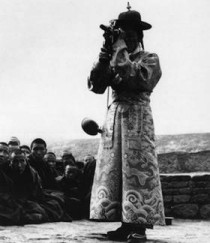
The first film shot in Tibet was probably film taken by J.B.N. Noel, cinematographer with the 1922 British Everest exhibition, whose footage is included in the documentary feature Climbing Mt Everest (1922). It is included in a new BFI National Archive touring programme, The Search for Shangri-La: Tibet on Film 1922-1950. The bulk of the programme is (silent) home movie footage shot by British missions and explorers iin the 1920s, ’30s and ’40s. They include the botanist George Sherriff, the aforementioned Frederick Bailey and the Williamsons, Charls Bell (on his return to Tibet in 1934) and Sir Basil Gould, who brought a cameraman with him to Lhasa, Frederick Spencer Chapman. These films feature ceremonies, landscapes and Tibetan flora and fauna. Shot for the most part in colour they form an extraordinary archive of Tibetan life before the Chinese takeover, and were used in the 2008 BBC television series The Lost World of Tibet (now available on DVD).

The first Tibetan filmmaker may have been Tsarong Dasang Dadul, who acquired a camera at some time after the projector with which he entertained Charles Bell in 1920. Actuality films were made by Tsarong’s son Dundul Namgyal, while Tsarong himself filmed Anglo-Tibetan football matches outside Lhasa in 1936. Heinrich Harrer reports that the young 14th Dalai Lama was a keen filmmaker and knew how to dismantle a projector and put it back together again. Jamyang Norbu writes that another filmmaker in the 1940s was Tibetan official Jigme Taring (shown at the top of this post) who filmed festivals and street life in Lhasa, and the 14th Dalai Lama’s official tour of Sera, Drepung and Ganden.

Jamyang goes to to write about films and cinema exhibition following the Chinese occupation, including Tibetan fiction films (the first is believed to have been made in the mid-1970s). He also writes about his personal experience of exhibiting world cinema classics to Tibetan students in the 1980s, including Nosferatu (1922). It’s a fascinating history, showing how film was not just the harbinger of modernity for Tibet but how it fitted into (and documented) established traditions. Film was never simply about the shock of the new; it complemented the old as well, and was shaped by every society that encountered it.

The Search for Shangri-La tours Britain until May 2010 – details of screenings are here; while the Everest films of J.B.L. Noel will feature at this year’s British Silent Film Festival in April.

A war film

From time to time the Bioscope lifts its eyes from the screen, looks wistfully out of the window, and turns its mind to poetry. And when it does so it adds another poem to the select list of those works which touch upon the subject of silent film.

I’m ashamed to say that ‘A War Film’ is a poem that is new to me, though I now discover that it is a much-anthologised and popular work. It was written by Teresa Hooley (1888-1973), a British poet from Derbyshire who in private life went under the name of Mrs Frank Butler. The fascination behind ‘A War Film’ is her reaction to seeing a film of the First World War, and then trying to determine which film it was:

I saw,
With a catch of the breath and the heart’s uplifting,
Sorrow and pride, the “week’s great draw” –
The Mons Retreat;
The “Old Contemptibles” who fought, and died,
The horror and the anguish and the glory.
As in a dream,
Still hearing machine-guns rattle and shells scream,
I came out into the street.

When the day was done,
My little son
Wondered at bath-time why I kissed him so,
Naked upon my knee.
How could he know
The sudden terror that assaulted me? …
The body I had borne
Nine moons beneath my heart,
A part of me …
If, someday,
It should be taken away
To war. Tortured. Torn.
Slain.
Rotting in No Man’s Land, out in the rain –
My little son …
Yet all those men had mothers, every one.

How should he know
Why I kissed and kissed and kissed him, crooning his name?
He thought that I was daft.
He thought it was a game,
And laughed, and laughed.

The event to which she refers, the British retreat from Mons in Belgium, took place in August-September 1914. However, there was no film made about the retreat at the time, as officially-sanctioned films of the war were not being produced at this date, and in any case no film at this date or later in the war would have included the word ‘retreat’ in its title. So commentators have speculated that the film could be The Battle of the Somme, made in 1916, or one of the other British official war films. However it would seem unlikely that the poet would confused Mons with the Somme, and a more likely candidate is the 1926 film Mons, made by British Instructional Films. BIF produced a series of dramatised documentaries in the 1920s which recreated key conflicts from the First World War. The films (all feature-length bar the first) were The Battle of Jutland (1921), Armageddon (1923), Zeebrugge (1924), Ypres (1925), Mons (1926) and The Battles of Coronel and Falkland Islands (1927). They were all produced by H. (Harry) Bruce Woolfe, generally with Army or Admirality assistance, and combined official actuality films of the war with recreations, models and animated maps. The films gained the remarkable triple of popular, critical and official acclaim, and while they were characterised by a certain amount of dogged literalism, the best sequences merit comparison with the Soviet documentaries of the twenties. Many a dramatised scene from them has ended up being used in television documentaries which take the scenes to show actual warfare. Mons itself was directed by Walter Summers and was given the re-issue title of The Retreat from Mons, which adds further credence to the theory that it was the film that triggered the poem.

It is unclear when Hooley wrote ‘A War Film’, though it was first published in 1927 in her volume Songs of all Seasons, which again suggests the 1926 film is the right one. That would make her reaction to the film one of the fear of another war that would engulf her child rather than a war that was then raging. Its tone is in any case a retrospective one – few on the home front thought of corpses rotting in No Man’s Land in 1914. Such grim visions came to haunt the public only as the war dragged on and as the enormity of the sacrifice made shook society in the years immediately after the war.

It would take cinema a while before it felt able to depict the war in terms of futility. Ironically, Mons the film was a sober minded drama-documentary with more of a mind to demonstrate military procedure and heroic achievement than to make its audience think of the horror and anguish. Hooley’s poem was perhaps inspired not so much by the film she saw as by the memories it triggered. It was a silent film, after all – no machine-guns rattled and no shells screamed. Hooley saw the film in her mind, while a plainer account unspooled itself on the screen.

Mons is held by the BFI National Archive and in incomplete form by the Imperial War Museum. You can get an idea of the BIF style, however, by seeing Ypres, which is available to view from the British Pathe website (the link is to reel one of seven on the site).