Carl Davis meets his Waterloo

Charles Vanel as Napoleon in Karl Grune’s Waterloo (1928), from http://www.southbankcentre.co.uk

The Bioscope normally avoids covering news of single film screenings. Requests come through from time to time suggesting that there be a Bioscope service advertising silent film screenings and not just festivals. My answer each time is that I’m not able to maintain such a service to the extensive level that would be expected of it, and instead I refer people to the Silent Screenings section of Nitrateville and (for information in the USA only) to the Silents in the Court and Silent Era sites.

But here’s an exception. 22 April sees the UK premiere of Carl Davis‘ score for Waterloo (Germany 1928), directed by Karl Grune. The screening will be at the Royal Festival Hall on London’s South Bank, with the Philharmonia orchestra conducted by Davis.

Abel Gance’s epic Napoléon, for which Grune’s film was conceived as a response, does not include the Battle of Waterloo. Gance’s film (which he madly hoped would be part one of six) ends with the invasion of Italy. Grune’s film tells the story from the German point of view, focussing on Blüchner (Otto Gebühr) who comes to the aid of the Duke of Wellington (Humberstone Wright) to defeat Napoleon (Charles Vanel). Grune looked to Gance’s film not only in theme but in technique, with spectacular battle scenes crowned by split screen images, though it is (by reputation) a far more conventional historical costume drama overall. Carl Davis has likewise looked back to his famous 1980 score for Napoleon, stating that his score is intended to be a follow-up, combining music from the period with his own.

A DVD of Waterloo is promised from Edition Filmmuseum (see its forthcoming releases list), but there is no indication that the release will feature Davis’ score. Abel Gance’s Napoléon, famously restored by Kevin Brownlow, is regrettably one of the more elusive of silent films these days. For its American release, the restored film was cut and put to a score by Carmine Coppola, Francis Ford Coppola’s father, which is the only version allowed to be screened in the USA. This has hamstrung the film’s availability, not least on DVD. If you don’t mind an inferior restoration with Coppola’s frankly second-rate score, the film is available on DVD from Spain in a two-disc format. But remember that Brownlow’s restoration of the film (last screened in the UK in 2004) is over ninety minutes longer, with more accurate editing, better print quality, and colour tinting – as well as Davis’ ever-expanding score for live performances.

Information on the screening of Waterloo is available from the Philharmonia Orchestra and South Bank Centre websites. The screening starts at 7.00pm and is proceeded by a free introductory talk at 5.45pm by film historian and film music authority John Riley.

First films

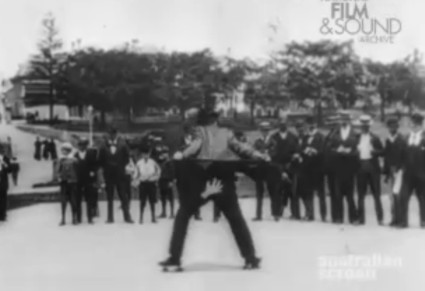
Patineur Grotesque, from australianscreen

I once had the privilege of attending a film show given in Paris, organised to mark the centenary of cinema in 1995, which brought together the various ‘first’ films from countries around the world. They made an interesting selection, for what survived, for how the national contributors interpreted the brief to find the earliest film in their collections, and for the sense of national competition. I was at the National Film Archive in those days, and we decided that we would defeat all comers by choosing Louis Augustin Aimé Le Prince‘s Traffic on Leeds Bridge, ‘filmed’ (on sensitised paper) in late 1888. France’s contribution was a selection of chronophotographic Phonoscope images by Georges Demenÿ from 1892-93, Germany’s the 1895 works of Max Skladanowsky. At this distance in time I forget most of the others, though I do remember vividly the Romanian choice, the 1898-1901 medical films of Gheorge Marinescu. The American choice would have been an Edison title filmed by W.K-L. Dickson – whether it was the ‘monkeyshines’ experiments from 1899 with microphotographs on a cylinder, or Dickson Greeting of 1891 (taken with horizontal feed camera) or A Hand Shake of 1892, where Dickson and his assistant William Heise shake hands to congratulate themselves on having finally cracked the problem of taking motion picture films, I can no longer recall.

There is – usually – something hauntingly special about such films, beyond their firstness. The ghostly hand-waving figure of the monkeyshines experiments, Dickson making to bow to the camera, the distant figures crossing Leeds bridge wholly unaware of their immortality, all contain something mysterious, something appropriate, that says that here is something new in the world. The variety acts captured by the Skaldanowsky camera (wrestlers, dancers, a boxing kangaroo) perhaps less so.

I don’t remember if Australia was included in the Paris show, but in any case time has marched on and what was previously considered the oldest surviving Australian film, a record of the Melbourne Cup horse race filmed by Marius Sestier on 3 November 1896, has now been replaced by a marginally earlier work by the same man. Discovered in 2005 (in France) and now restored by the National Film and Sound Archive of Australia (NFSA), Patineur Grotesque (Humorous Rollerskater) shows a man in exaggerated comic dress rollerskating in a Melbourne park before a small crowd [the location is now known to be Sydney – see comments]. A 10-second clip is available on the australianscreen site (why so short? the full film can only last 40-50 seconds), with the full action described thus:

A man in costume and on rollerskates performs for a gathering crowd. As part of the act the skater trips and falls, then drops his hat. As he attempts to retrieve the hat he continues to fall about. When finally the hat is restored to his head the act comes to a halt.

It is indeed grotesque, particularly when the skater lifts his coat-tails to reveal a hand printed on the seat of his pants. You do wonder whether Australia’s delight at having discovered this earlier film (which they estimate was filmed between 29 and 31 October 1896) might be tempered by some disappointment. It is a silly film, and the Melbourne Cup film that now comes second (and which you can also seen on australianscreen) is a more distinguished work and iconically Australian.

Sestier, the man who filmed both films, was French. He was a Lumière cameraman, one of a team sent around the world to spread the good word of the Lumière Cinématographe. Sestier was sent to Australia to work with the local Lumière concessionary, photographer Henry Walter Barnett. The first film he shot in Australia, Passengers Alighting from Ferry ‘Brighton’ at Manly, was filmed on 27 October, but no longer exists. Patineur Grotesque itself was shot soon after, but the NFSA has found no record of it being shown in Australia – instead it is first recorded being shown in Lyons, France on 28 February 1897.

So Australia has its earliest surviving film, but not its earliest film. The search for Passengers Alighting from Ferry ‘Brighton’ at Manly has to go on, not least to save Australia from the undignified embarrassment that, to be frank, is Patineur Grotesque. First films should be mysterious, or iconic, or in some way fitting that they are first. Otherwise they are just impostors.

More information on the discovery, and on Marius Sestier himself, is on the NFSA’s Marius Sestier Project, which includes fascinating biographical material and evidence of the detailed research undertaken by curator Sally Jackson using family history sources.

Photoplay and more

Cover for Photoplay, January 1927

As we’ve said before, while there is an embarrassment of riches when it comes to digitised historic newspapers now available online, for the specialist things are tougher and those interested in the study of film history have bemoaned the absence of the major trade paper and fan magazines in digitised form.

But while most of us have done the moaning, others have been acting. Today the Media History Digital Library project was announced. This announces itself as a major conservation and access project for histoical printed materials related to cinema, broadcasting and recorded sound. Concentrating on American media industry journals, and with recourse to private funds, the project has been established by film archivist and historian David Pierce. The project has hugely ambitious plans, but it has kicked off with eight volumes (covering four years) of Photoplay, and one volume each of Motion Picture Classic (1920) and Moving Picture World (April-June 1913), taken from the collection of the Pacific Film Archive. All have been made available via the Internet Archive, as follows:

Motion Picture Classic (Volume 9 – 11 (1920))
The Moving Picture World (Volume 16 (Apr. – Jun. 1913))
Photoplay (Volume 28 – 29 (Jul. – Dec. 1925))
Photoplay (Volume 30 – 31 (Jul. – Dec. 1926))
Photoplay (Volume 31 – 33 (Jan. – Jun. 1927))
Photoplay (Volume 33 – 34 (Jan. – Jun. 1928))
Photoplay (Volume 35 – 36 (Jan. – Jun. 1929))
Photoplay (Volume 36 – 37 (Jul. – Dec. 1929))
Photoplay (Volume 37 – 38 (Jan. – Jun. 1930))

This link will take you to all of the documents on one page: Media History Digital Library

As said, this is just the start. The Media History Digital Library’s press release outlines the ambitions:

The history of American media industries exists in the magazines of the day, but is largely inaccessible. Primary materials, such as Exhibitors Herald World and Photoplay are of significant research value to media scholars, historians, and the general public; however, use of these resources is severely limited by necessary noncirculating access restrictions and/or the lack of indexing or fifinding aids.

Using private funds, a pilot project is currently underway to digitize 300,000 journal pages, including volumes of Moving Picture World and Photoplay, and a range of additional materials to appeal to varied research interests.

Several major libraries and the owner of the largest private collection of such materials are participating in the pilot.

The goal of the Media History Digital Library project is to establish additional partnerships with libraries and archives for a joint digitization project to conserve and provide broad free access to these important resources.

These are the the titles that the project is targeting:

Industry MagazinesBillboard, Box Office, Cine-Mundial, Daily Variety, Exhibitor’s Herald, Exhibitor’s Trade Review, The Film Daily, The Film Index, The Hollywood Reporter, Motion Picture Daily, Motion Picture Herald, Motion Picture News, Motography, The Moving Picture World, Radio Broadcast, Radio Daily, Talking Machine World, Variety

Company MagazinesThe Lion’s Roar, Publix Opinion, RCA News, Radio Flash, Reel Life, Universal Weekly

Fan MagazinesMotion Picture Classic, Motion Picture Magazine, Motion Picture Digest, Radio Mirror, Screenland, Shadowplay

Technical JournalsAmerican Cinematographer, American Projectionist, The International Photographer, International Projectionist, Motion Picture Projectionist, Projection Engineering, Radio Engineering, Sound Waves, Transactions of the Society of Motion Picture Engineers

Well, that should keep us all busy. Of course this will take time and money (it’s costing 10 cents a page at the moment), but a model has been established whereby institutions holding such collections can work together efficiently, avoiding duplication of effort and adhering to common standards and formats to provide researchers with the best possible search and access opportunities.

The project outline is as follows:

  • Each archive or library agrees to offer its pre-1964 public domain journals for digitization.
  • Each archive or library will provide an inventory of its holdings, perform condition inspections and pack selected materials for shipping. The project will pay transportation and reasonable insurance both ways. Any funds for digitization will be welcome, but not required.
  • Each digitized volume will have an inserted page with the name and logo of the organization contributing the original volume, the organization that manages that part of the workflow, and the funder.
  • The Internet Archive will execute some of the digitization and will host the master and derivative format access files.
  • In return for contributing materials, each organization is entitled to receive copies of all digital files for any non-commercial purpose including hosting on their website.
  • David Pierce will raise financial support for the project as well as perform copyright searches.

As some may have noticed from the Bioscope’s recent survey of silent film journals online that the first fruits of this project have been available on the Internet Archive for a few weeks now, but the formal announcement of the project was held back while some digitisation issues were resolved. But Leonard Maltin spilt the beans in his enthusiastic blog post earlier today, so David Pierce went public today.

What can one say? This is a sensational development, with a myriad of opportunities for the researcher – not just in film studies, but social history, media history, histories of communications and technology, fashion history, genealogy, advertising studies, gender studies and so much more. But there is much that we can do to help. There’s the invitation for collection owners to participate in the project, but also each one of us can prove the value of this project by just using the documents. Download them, study them, blog about them, cite them in papers, curate them – demonstrate that this is what we need. The best way of saying thank you is to start using them. Go explore.

From silent screen to digital screen

The Bioscope on the pier at Weston-Super-Mare, c.1910

From Silent Screen to Digital Screen: A Century of Cinema Exhibition is a two-day conference to be held at De Montfort University, Leicester, 10-11 July 2010. The conference, to be hosted by the Cinema and Television History (CATH) Research Centre in DMU’s Faculty of Humanities, will celebrate a century of cinema exhibition since the Cinematograph Act 1909, the first major legislation relating to moving pictures in Britain, coming into force on 1 January 1910.

Keynote speakers will include Richard Gray of the Cinema Theatre Association, and others to be confirmed.

Proposals are invited on any aspect of cinema exhibition including:
audiences, technologies, cinema design and building, programming,
legislation and other aspects of the cinemagoing experience. If interested you should sent abstracts (500 words) with a short biography including contact details to Stuart Hanson (shanson [at] dmu.ac.uk) and Steve Chibnall (schib [at] dmu.ac.uk) by 23 April 2010. There isn’t a web page for the conference as yet, but I’ll add one to this post just as soon as one appears.

The conference gains its title from Stuart Hanson’s recent book From Silent Screen to Multi-screen: A History of Cinema Exhibition in Britain Since 1896, a commendable and rather useful work, which was covered by the Bioscope (a little too nitpickingly, I fear) here.

Update: The deadline for abstracts has now been put back to 14 May.

British Silents

http://www.britishsilents.co.uk

We’ve already made note of the British Silent Film Festival, being held at the Leicester Phoenix 15-18 April 2010, with the theme The World Before You: Exploration, Science and Nature in British Silent Film. However, there is reason to do so again on account of a detailed programme now having been made available, and the welcome appearance of a festival website. For some while now the festival has lacked a proper online presence – a WordPress blog helpd keep the flame alive, but now we have a proper www.britishsilents.co.uk, which includes not only details of the upcoming, 13th festival, but all previous festivals going back to 1998. Congratulations to the team on getting this up and running.

These are the programme details (with a modest contribution from yours truly, if that’s any sort of an incentive):

The World Before You: Exploration, Science and Nature in British Silent Film

Thu 15 April 11am
Q Ships
Long before Dunkirk, the little ships of Britain played a deadly game of cat and mouse with the German U-Boats. Underneath their modest exteriors these merchant ships were bristling with concealed weaponry, designed to lure the submarines to their doom.
UK/1928 Geoffrey Barkas/Michael Barringer

Thu 15 April 2pm
Beeman, Birdman, Hunter, Spy: the heroic age of the wildlife filmmaker
A particular breed of explorer from the earliest days of films was the wildlife cameraman. These intrepid pioneers risked life and limb, inventing their own equipment, travelling to the remotest parts of the planet to bring us unprecedented access to the natural world and inevitably having a few adventures along the way. This selection will show the work of J. C. Bee-Mason, Oliver Pike, Jim Corbett, and the legendary Colonel F.M. Bailey.
Presented by Bryony Dixon

Thu 15 April 4pm
The Masks of Mer
World Premiere of his new film presented by Michael Eaton
Writer, director Michael Eaton presents the world premiere of his new film about a unique film shot in the Torres Straits by Alfred Haddon in 1898, lasting for less than a minute, and the world’s first example of anthropological cinema. The Masks of Mer tells the extraordinary story of this experiment and traces the masks worn in the sacred initiation ceremony Haddon filmed. And, for the first time since Haddon himself publicly presented the work, his films are ‘synchronised’ with the team’s phonographic recordings.
Dir Michael Eaton, UK 2010, 60mins

Thu 15 April 6pm
The Bridal Party in Hardanger/Brudeferden i Hardanger
Presented by Jan-Anders Diesen and Halldor Krogh
A spectacular film based on one of the most famous paintings in Norway; Bridal Voyage on the Hardanger Fjord from 1848. Set amid stunning mountain and fjord scenery, this is the epic story of intertwining lives, love and loss during the lifetime of a young woman. A visual masterpiece that is both moving emotional drama and an authentic portrait of the vanishing cultures of the people who lived and farmed in the mountains of Western Norway.
This film will be screened with the new music score composed by Halldor Krogh
Dir: Rasmus Breinstein, Norway 1926, 74mins

Thu 15 April 9pm
The Sheik
Based on the steamy 1921 bodice ripper by Edith Maude Hull, this tale of passion between an aristocratic English woman and an Arab Sheik is the film that brought Valentino to prominence. He exudes a brooding, muscular sexuality which has lost none of its potency today and watching this film 90 years later, it is easy to see why his premature death drove women to despair and suicide.
Dir: George Melford, USA 1921. 80 mins
+
Crossing the Great Sagrada
Dir Adrian Brunel, UK

Fri 16 April 9am
She
Rider Haggard on Film
A sumptuous adaptation of Rider Haggard’s best-selling 1887 fantasy about a Cambridge professor’s quest for a lost kingdom in the heart of Africa where he encounters a magnificent sorceress who rules over her people as ‘She who must be obeyed’. This version was actively supervised by Haggard himself and stars Betty Blythe in the role later reprised by Ursula Andress.
Dir: Leander de Cordova, UK 1925, 2hrs
Fri 16 April 11.15am

With Lawrence in Arabia
Presented by Neil Brand and Luke McKernan
Neil Brand and Luke McKernan’s work in progress (in collaboration with the IWM) to recreate, using original text, slides and film extracts, Lowell Thomas’s famous lecture-cum-spectacle which is credited with creating and publicising the legend of Lawrence of Arabia. Thomas himself, a fascinating and flawed character but a master showman, delivers the narration.

Fri 16 April 12.15pm
Exploration, Adventure and Science Films from the Imperial War Museum Collection
presented by Toby Haggith

Fri 16 April 2.15pm
Sam’s Boy
Sam’s Boy is adapted by Lydia Hayward from one of the stories of W. W. Jacobs whose pet subject was the marine life or as Punch sardonically put it “men who go down to the sea in ships of moderate tonnage”. Filmed in the Thames estuary and on the Kentish coast this is a charming tale of an urchin in need of a father.
Dir: Manning Haynes, UK 1922 63mins
+
Premieres of recovered short films from the Scottish Film Archive presented by Janet McBain, including:
To Rona on a Whaler UK 1914, 12mins
In the Calm Waters of the Yare UK 1910, 6mins

Fri 16 April 4.15pm
The Race to the Pole: Britain and Norway
A programme of short films documenting early Polar exploration
The extraordinary story of the race to the South Pole by Amundsen and Scott is put into context by polar film expert Jan-Anders Diesen from Norway. The programme concludes with an extract of the BFI National Archive’s forthcoming restoration of The Great White Silence, Herbert Ponting’s record of Scott’s final expedition to Antarctica introduced by Bryony Dixon.

Fri 16 April 6.15pm
The Lost World
The first film adaptation of Conan Doyle’s classic novel of the land that time forgot and the prototype of every dinosaur movie since including Jurassic Park. Wallace Beery and Bessie Love star as Professor Challenger and Paula White who set out from London to rescue Paula’s father, the explorer Maple White lost on the Amazonian plateau where dinosaurs still roam. Conan Doyle took his family to see the film in 1925 and loved this version. Perfect family entertainment, then!
Dir: Harry O Hoyt, USA 1925, 100mins

Fri 16 April 9pm
South: Sir Ernest Shackleton’s Glorious Epic of the Antarctic
With a special musical score by Neil Brand
The definitive account of Shackleton’s legendary 1914-1916 Endurance Expedition, magnificently filmed by photographer Frank Hurley. A monumental document of human survival against all odds amidst the backdrop of some of the most stunning and inhospitable scenery on earth.
Prod. Imperial Trans-Antarctic Film Syndicate/ photography Frank Hurley, UK, 1919, 80mins

Sat 17 April 9am
Coast
Like the TV programme, we will trace the British coastline through its stories but we’ll be doing it using archive film from the silent days. With tales of great tempests, rough seas, daring rescues and tragic wrecks, of thronging docks, fishing ports and shipyards as well as scenes of a calmer nature, along the cliffs and beaches of our island home.
Introduced by Bryony Dixon
90mins

Sat 17 April 11am
Women in Silent Britain
Exploration into the hidden histories of women in silent British cinema is gathering momentum and this session will look at some of the fascinating and intrepid women working in film during this period, as writers, producers, technicians and critics as well as actresses.
Presented as part of the AHRC Women’s Film History Network – UK/Ireland that was recently set up to encourage new research into women’s contribution to cinema.

Sat 17 April 2pm
Family Matinee (PG)
Up the Pole
Get your coat on and join us on for a cornucopia of polar-themed cartoons and comedies featuring screen legends Ben Turpin, Buster Keaton, Jerry the Troublesome Tyke, Pimple and Bonzo the Peppy Pup, all struggling with inclement weather and harsh times. With live piano accompaniment (and much more) from Neil Brand.
This programme is dedicated to Dave Berry who brought Jerry the Troublesome Tyke back to our screens and devoted his life and work to the silent cinema that he loved.
Running time 80mins

Sat 17 April 2.15pm
A Maid of the Silver Sea
Husband and wife team Ivy Duke and director/ actor Guy Newall play opposite each other in this tale of familial conflict and mysterious death on a small island in the English Channel. The peaceable local fishing community is torn apart by the discovery of silver which threatens their way of life and matters get worse with the arrival of the English manager who falls in love with a local woman and is framed for murder.
Dir: Guy Newall, UK 1922, 63mins
Sat 17 April 4pm

The Annual Rachael Low Lecture
Presented by Tim Boon
This year’s Rachael Low lecture will be given by Tim Boon, Chief Curator of the Science Museum.
Tim Boon is the author of the recently published and highly acclaimed Films of Fact: A History of Science in Documentary Films and Television. He is also working with the BFI on a forthcoming DVD of the pioneering science and nature series Secrets of Nature. Rachael Low is a key figure in the history of the study of early and silent British cinema. Her pioneering studies published as The History of the British Film 1895-1929 (BFI) are an unrivalled source for students on the subject and the remain the unchallenged standard work in this field. Each year, the Festival pays tribute to her work by inviting a distinguished cultural commentator to give an illustrated lecture on a particular aspect of silent cinema.

Sat 17 April 6pm
The St Kilda Tapes
Live music, archive film and multi-media presented by David Allison
Using the evacuation of St Kilda in 1930 as a starting point, and with St Kilda evacuee Norman Gillies acting as narrator, this acclaimed show takes you on an emotional journey from the lonely Atlantic island to Glasgow, New York and Canada, before a triumphant and poignant return to St Kilda. With archive film and live music performed on guitar, 100 year old zither, ukulele and sampler, The St Kilda Tapes explores the themes of migration and home featuring archive films, St Kilda; Britain’s Loneliest Isle and A New Way to A New World.

Sat 17 April 9pm
Tol’able David (PG)
Accompanied with a new Blue Grass music score by Damian Coldwell, together with Nick Pynn on fiddle and Appalachian dulcimer and Lee Westwood on guitar
A thrilling David and Goliath story set in the beautiful Virginian Mountains. When the murderous Hatburn gang murders young David Kinemon’s older brother, the gentle David swears to protect his widowed mother and brothers and sisters. With a towering central performance by Richard Barthelmess as the young hero, and the unforgettable Ernest Torrence as the leader of the criminal gang. “Tol’able David is one of the enduring classics of the American screen.” Kevin Brownlow
Dir. Henry King, US 1921 100 min.
Preserved by The Museum of Modern Art, New York with funds provided by The Film Foundation.

Sun 18 April 9am
New Discoveries in British Silent Film
This programme will include new discoveries in British silent film, including regular contributor David Williams & Tony Fletcher with his programme called ‘Before and after Nanook’, examining how early filmmakers looked at cultures and societies before 1922.

Sun 18 April 11am
For Those in Peril on the Sea: Drifters and The Trawler Film
For centuries the deep sea fishermen were a mainstay of our island nation and this is revealed by the fascination with the trade by filmmakers since the earliest days. At the very end of the silent era John Grierson took the tradition of the trawler film and combined it with all the techniques of filmmaking that had developed over the decades to make his remarkable, lyrical film, Drifters, which heralded in a new era for the actuality film, the age of the documentary. This programme will show the whole of Grierson’s film and extracts from its antecedents.
Presented by Steve Foxon and Bryony Dixon.
Dir John Grierson, UK 1929, 80mins total

Sun 18 April 2pm
The Dodge Brothers performing to The Beggars of Life
The Festival is pleased to welcome the fabulous Dodge Brothers featuring Mike Hammond (guitar/ banjo), Mark Kermode (double bass/accordion), Aly Hirji (guitar/mandolin) and Alex Hammond (percussion) with guest Dodge Brother Neil Brand, performing their particular brand of Americana to William Wellman’s legendary tale of Depression-era, rail-riding hobos played by the iconic Louise Brooks and Jim Arlen.
Dir. William Wellman, USA 1928, 100mins

Sun 18 April 4pm
Climb Every Mountain
Jan Faull of the BFI presents a programme of mountaineering films including extracts from the ill-fated 1924 British Everest expedition immortalised on film in The Epic of Everest.

Sun 18 April 6pm
The Battle of the Ancre and the Advance of the Tanks
With a musical medley, specially reconstructed by Stephen Horne and Toby Haggith
The sister film to The Battle of the Somme, The Battle of the Ancre was filmed between September and November 1916 and contains the first shots of tanks in use at the Front and fraternization between German prisoners and their British captors. The work to reconstruct the original medley for this important First World War film has taken many months with the music suggested in the cue sheet being discovered as far away as Australia. After previewing this project at the 2009 Festival, we are pleased to present the completed score performed by Stephen Horne, Sophie Langdon and Martin Pyne and presented by Toby Haggith.
Dir: Geoffrey H Malins/J.B McDowell, UK 1917, 73mins

There are festival passes available, either a 4-day pass at £95 (£70 concessions) or a 1-day pass at £45 (£30 concession). Festival passes include lunch each day and tea and coffee during breaks. Tickets are also available for individual films and presentations, for which prices vary. For further information, visit the festival site or call Phoenix Square Box Office on 0116 242 2800.

Dave Berry memorial event

Dave Berry, from the Dave Berry Memorial / Man Coffáu Dave Berry Facebook group

To all who knew film historian Dave Berry, a memorial event is to take place at the Chapter Arts Centre, Cardiff on Friday 23rd April. There will be a matinee screening of Sidney Gilliat’s classic Welsh-themed movie Only Two Can Play (1962), then the memorial itself in the evening, from 6.15 – 8pm. The organisers promise that “there will be lots to share – tributes, memories, clips, and no doubt tears and laughter … hopefully we will do him proud”.

An obituary notice has now been published in The Independent. The Bioscope’s obituary notice for Dave (with plenty of tributes in the comments) is here.

Update: Here are details of the memorial event (with slight variations from information previously published):

Dave Berry Memorial Event

Fri 23 April • Gwe 23 Ebrill
Join us for a celebration of the life and work of our dear friend and colleague Dave Berry who died earlier this year at the age of 66. The event starts at 2.30pm with a screening of Only Two Can Play.

The evening session at 6.15pm includes personal contributions from his friends and colleagues and clips from some of Dave’s favourite films.
All are welcome.

“A moment in Dave’s company was something to treasure. Acerbic, fun, funny and generous, he was one of the great practitioners of journalism in Wales as well as one of its great characters. Our feelings for him went way beyond friendship and affection — but he was too self-effacing to recognise that. He’d interviewed everyone from the Rolling Stones to prime ministers. And of course he loved films. He was an original – and irreplaceable.”
Steve Groves, Western Mail.

+ Only Two Can Play
Fri 23 April • 2.30pm • Gwe 23 Ebrill
UK/1962/106 mins/PG . Dir: Sidney Gilliat.
With Ken Griffith, Peter Sellers, Richard Attenborough.

Described by Dave Berry in his book Wales And Cinema: The First Hundred Years, this is “undoubtedly the funniest of all Welsh screen comedies, a coruscating, almost sardonic view of Welsh insularity and punctured male vanities.” Sellers is on great form as John Lewis, a bored librarian, henpecked at home until the wife of a local councilor sets her sights on him.

We hope that this event will be introduced by Dave’s partner Gerhild Krebs, an archivist and film historian.

You can book for both events in advance, should you wish. This might be advisable as the cinema’s capacity is approximately 200.

1. The general public will be charged for the matinee but fund contributors can enter free of charge – give your name/s to the box office when booking and / or collecting your ticket/s as they will have a list of the contributors.

2. There will be no charge for the evening event but again give your name/s to the box office when booking or collecting your ticket/s.

For information see attachment or click here: http://www.chapter.org/18907.html (Place the cursor in the centre of the screen on the image of the April Magazine and Calendar, ‘View in fullscreen’ will appear, click on this to enlarge the image; there is a small white arrow in the middle, on the right hand edge of the image, level with the table top – click this until you arrive at page 29.)

If you have enquiries, please contact Sally Griffith, Chapter Cinema Manager, or Iola Baines, National Screen and Sound Archive of Wales, E-mail iba [at] llgc.org.uk

Giornate database

Pordenone catalogues

In 2002 the Giornate del Cinema Muto (aka Pordenone Silent Film Festival) produced a CD-ROM that listed and described every film shown at the festival 1982-2001. The CD-ROM is now out of print, but what was really wanted was an online version which could be updated year by year. And now we have it.

The Giornate database lists every one of the 6,330 films featured at the festival 1982-2008. You can search by year, title, director, year of release, production company, country and archive. It is a little disappointing that no searching is offered by cast member or other credits, still more that there is no searching of descriptions or a free-text search generally. Hopefully such functionality can be introduced later (such search options are available on the CD-ROM version), but as it is the database is still a very useful and welcome resource.

The database lists every film shown at the festival since 1982, with additional entries for films which have been shown more then once (i.e. in later years). The information available varies, with no synopses for earlier years, though that’s because such data was not included in the festival catalogue/booklet. More recent records are richer in detail as the catalogue has become an ever more handsome production, with background information in both English and Italian. What every record does provide is title, any alternative titles, year of production, year in which it was shown at the festival, the production company, director (where known), format (i.e. 35m, 16mm etc), the film speed at which it was shown, its duration, and the archive which supplied the copy. You even get the name of the musician who played to the film.

Such core data yields all sorts of information. For instance, the festival has shown 473 films directed by D.W. Griffith, 104 films made in 1905, 71 films made by the Cines company, 374 films made in Germany, and 505 films from the Nederlands Filmmuseum. One can find out so much – not just about the contents of films shown at the festival, but their provenance and location. Moreover, it is information that was rigorously researched in the first place for the Pordenone catalogue, and which can be relied upon. Also, there are records here for films from across the world of silent cinema which the researcher will simply not be able to find anywhere else. It is a treasure trove.

That said, it could be even better. The potential for searching by credits or across synopses has been mentioned. However, it might be that the festival could open up this resource still further to our research community, with a bit of Web 2.0 functionality. For instance, where there are gaps in the data for earlier years (if this is the case – it’s not clear is the database represents all the published information in the festival catalogues from 1982), volunteers might be willing to type in the missing text or credits. Contributing archives could add updated information on prints that they provide, likewise the scholars who contributed information to the catalogue could add updated information – in both cases not altering the original catalogue record, but putting data into a separate notes field. Anyone might contribute comments on films that they have seen – obviously with some form of moderation. Databases are such powerful tools – we mustn’t just see them as searchale lists, but instead must make full use of them as structured and updatable data.

But even as it is the Giornate database is a fabulous resource, and one that hopefully will be updated year-on-year from now on. Grateful thanks and congratulations are due to the Giornate del Cinema Muto for making the database available to all. Go explore.

Lives in film no. 1: Alfred Dreyfus – part 3

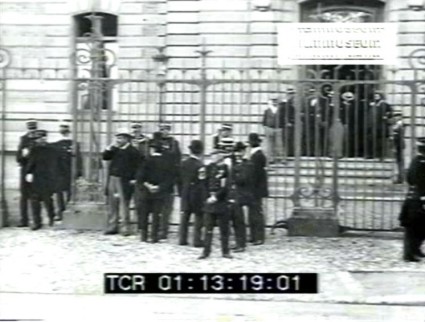
Scene outside the court room at Rennes, probably showing chief prosecution witness General Mercier on the left, from the Société Française de Mutoscope et Biographe Dreyfus trial scene film, courtesy of Filmmuseum, Amsterdam.

Part one of this series covered the early films of the Dreyfus affair made by Georges Méliès; part two completed the picture with the early films made by Biograph and Pathé. This final post supplies a plain filmography, for reference purposes. It includes a film by Lubin which was overlooked for the first two posts. It is arranged by film company. It does not include post-silent era productions.

American Mutoscope and Biograph Company

Dreyfus Receiving His Sentence (USA 1899)
Cast: Lafayette [Sigmund Neuberger] (Alfred Dreyfus)
68mm bw st ??ft
Archive: none
Impersonation. “Lafayette, the mimic, showing Capt. Dreyfus reading the verdict of the court-martial in his prison, and meeting with Madame Dreyfus. This picture is very dramatic, and true to the details of the actual scene.” (American Mutoscope and Biograph Company, Picture Catalogue, 1902)

Trial of Captain Dreyfus (USA 1899)
Cast: Lafayette [Sigmund Neuberger] (Alfred Dreyfus)
68mm bw st ??ft
Archive: none
Impersonation. “An impressive character impersonation by Lafayette, the great mimetic comedian. The scene is from the famous court-martial at Rennes, ending with the prisoner’s dramatic declaration, ‘I am innocent’.” (American Mutoscope and Biograph Company, Picture Catalogue, 1902)

British Mutoscope and Biograph Company

The Zola-Rochefort Duel (UK 1898)
ph. W.K.-L. Dickson
68mm bw st 45″ (30fps)
Archive: Filmmuseum (Amsterdam)
Dramatic sketch. “This is a replica of the famous duel with rapiers between Emile Zola, the novelist, and Henri Rochefort, the statesman. The duel takes place on the identical ground where the original fighting occurred, seconds and doctors being present as in the original combat. The picture gives a good idea of how a French affair of honor is conducted.” (American Mutoscope and Biograph Company, Picture Catalogue, 1902)

Amann, the Great Impersonator (UK c.1899)
Cast: Ludwig Amann (Emile Zola/Alfred Dreyfus)
68mm bw st 30″ (30fps)
Archive: BFI National Archive (London)
Impersonation. Quick-change artist Amann impersonates first Emile Zola and then Alfred Dreyfus.

[American Biograph at the Palace] (UK 1899)
68mm bw st 35″ (30fps)
Archive: Filmmuseum (Amsterdam)
Comic sketch/advertisement. A tramp and a billsticker come to blows while the latter puts up a notice saying ‘Have You Seen the Mutoscope’. There are several posters advertising the Palace Theatre and the Biograph/Mutoscope, two of which mention the Dreyfus films.

Lubin

The Trial of Captain Dreyfuss at Rennes, France (USA 1899)
p. Siegmund Lubin
35mm st bw ??ft
Archive: none
Listed in Library of Congress Motion Pictures Catalog 1894-1912, copyrighted 28 September 1899

Pathé Frères

L’affaire Dreyfus (France 1899)
Jean Liezer (Dreyfus)
35mm bw st 155m
Catalogue nos. 516-523
Archive: BFI National Archive (one, possibly two, episodes only of eight, Entrée au conseil de guerre and maybe Dreyfus dans sa cellule à Rennes)
Description: French descriptions taken from Pathé Frères 1897-1899 catalogue; English versions taken from The Era, 21 September 1899.

No. 516/515: Arrestation, aveux du colonel Henry (20m)
“M. Cavaignac, ministre de la guerre, discute avec son chef de cabinet. Il mande un planton et lui ordonne de faire introduire le colonel. Le ministre interroge l’inculpé et lui présente le faux; le colonel se trouble et nie l’authenticité de la note. Mais, confronté avec le général accusateur, le colonel fait ses aveux. Le ministre le fait arrêter.”

No. 517/516: Au mont Valérien: suicide du Colonel Henry (20m)
“Aspect de la cellule. On aperçoit le colonel très agité. Le prisonnier envoie son gardien porter un message. Pendant ce temps, un général lui rend visite, le prie d’espérer et se retire. Mais le colonel, découragé, saisit son rasoir et, d’un élan énergique, il se coupe la gorge et tombe inanimé sur le sol.”

No. 518/517: Dreyfus dans sa cellule à Rennes / Dreyfus in the Military Prison at Rennes (20m)
“Assis à côté de sa femme, il veut la convaincre de son innocence et la prie d’espérer. Embrassades et pleurs. Un capitaine de gendarmerie entre et prévient Mme Dreyfus que l’heure de sa visite est écoulée.Les époux s’embrassent et Dreyfus reconduit sa femme jusqu’à la porte. Entrent les deux défenseurs: Mes Demange et Labori. Dreyfus les fait asseoir; ils se mettent ensemble à compulser le dossier.” / “Showing the cell in the prison in which Dreyfus, the accused, is confined during the time of his wife’s daily visit. Embraces and tears. A sergeant enters to tell Madame Dreyfus her visiting time is up. The parting of husband and wife is most pathetic and emotional. Dreyfus conducts his wife to the door. The two counsels for the defence, Maîtres Demange and Labori, then enter. The latter with his usual smile on his face full of good nature. Dreyfus asks them to be seated, and the three examine some documents together connected with the case.”

No. 519/518: Entrée au conseil de guerre / Entering the Lycee, 6.0 am (20m)
“Dreyfus traverse la rue et entre au Conseil. Mes Demange et Labori suivent en causant avec animation. Viennent ensuite les officiers témoins: général Mercier et autres, puis le colonel Jouaust, président du Conseil.” / “Streets lined with soldiers with fixed bayonets. Dreyfus with the Captain of Gendarmerie, crosses the street and enters the Lycee. Maître Demange and Labori, who appear very excited, then enter, followed by Officer-witnesses, General Mercier and other well-known personages are easily recognisable. Then comes Colonel Jouaust, the President of the Court.”

No. 520/519: Audience au conseil de guerre / Court Martial at Rennes (20m)
“Les avocats se concertent. Le colonel Jouaust les avertit que la séance va commencer: la cour entre, on introduit l’accusé. Le président donne la parole au général Mercier qui dépose.” / “A scene at the Lycee at Rennes, showing the military Court Matial of Captain Dreyfus. The only occupants of the room at this time are maîtres Demange and Labori, who are holding an animated conversation. The judges begin to arrive, and take their seats, Colonel Jouaust declares the court open, and orders the Sergeant to bring in the accused. Dreyfus enters, saluting the court, followed by the Captain of Gendarmerie, who is constantly with him. They take their appointed seats in front of the judges. Colonel Jouaust asks Adjutant Coupols to call the first witness, and General Mercier arives, and proceeds with his deposition. The scene which is a most faithful portrayal of the Court-Martial at Rennes, shows the absolute portraits of the principal personaes in the famous trial.”

No. 521/520: Sortie du conseil de guerre / Leaving the Lycee (20m)
“Officiers témoins, général Mercier en tête. Puis Dreyfus, accompagné d’un capitaine de gendarmerie. Viennent ensuite Mes Demange et Labori.” / “After the sitting witnesses go out, General Mercier first, followed by a number of others. Then Dreyfus, accompanied by Captain of Gendarmerie. Then Counsels for the Defence, Maîtres Demange and Labori, who seem pleased with their morning’s labours, and glad of the fresh air.”

No. 522: Prison militaire de Rennes, rue Duhamel (20m)
“Arrivée de l’officier d’infanterie assistant à l’entrevue dans la cellule. Arrivée de Mme Havet, tante de Mme Dreyfus et de M, son père. Sortie de Mme Dreyfus; Mme Havet et M l’accompagnent. Sortie de l’officier.”

No. 523: Avenue de la Gare à Rennes (15m)
“Sortie de Dreyfus du lycée. Aussitôt le barrage fermé, deux gendarmes sortent du lycée en traversant l’avenue pour aller ouvrir la porte de la manutention. Vient ensuite Dreyfus, suivi du capitaine de gendarmerie préposé à sa garde.”

L’affaire Dreyfus (France 1908)
d. Lucien Nonguet
p. Ferdinand Zecca
35mm bw st 370m
Catalogue no. 2237
Archive: Archives du Film (?)
Description: “L’Affaire Dreyfus – Cette intéressante vue nous donne une vivante idée des principaux incidents de l’affaire Dreyfus qui troubla si violemment les milieux militaires français en 1894. Alfred-Henri Dreyfus, officier au Ministère de la Guerre, était accusé d’avoir vendu des secrets militaires à une puissance étrangère. Il fut jugé et reconnu coupable, d’après des preuves insuffisantes, puis condamné à la détention à l’île du Diable où il resta huit ans. Jusqu’au moment où l’influence de ses partisans démontra qu’il était victime d’un complot . Finalement, il fut gracié par le président Loubet et reprit sa place dans l’armée. Dans la première scène, on voit Estherazy s’emparer d’un papier sur le bureau d’Henry pour l’envoyer à Swartzkoppen. Henry le voit le prendre, mais n’en laisse rien savoir, parce que c’est lui qui a forgé le document et l’a mis juste à l’endroit où on pouvait s’en emparer. Un garçon du baron découvrit le document sur son bureau et le fit tenir au Ministre de la Guerre – qui soupçonne Dreyfus. Il fait venir ce dernier et le prie de signer son nom. Cela fait, il compare l’écriture avec celle du document et accuse Dreyfus de trahison. Il appelle des agents de la sûreté et Dreyfus est arrêté. Nous le voyons ensuite dans sa cellule où vient le voir sa fidèle femme convaincue de son innocence. Il est traîné devant le conseil de guerre et, après un rapide procès, condamné à une terrible sentence. Alors, il est dégradé en place publique et voit son sabre brisé sur le genou d’un officier, son supérieur. On l’emmène en prison, marqué comme un traître, et c’est une pathétique scène que celle de son départ pour l’île du Diable. On le voit dans sa solitude, alors qu’il passe son temps à regarder l’horizon, rêvant de sa famille dans la patrie lointaine. Enfin, après des années de souffrance, pendant lesquelles ses amis luttèrent pour sa justification, Henry avoue son faux et se suicide. L’heureuse nouvelle de la grâce arrive au prisonnier dans sa case et nous le voyons rentrer en France où il est replacé dans le grade qu’il avait précédemment dans l’armée” Et voilà justement comme on écrit l’histoire au cinématographe-monopole ! Ne croirait-on pas voir quelque vieille image d’Épinal dont se réjouissait notre enfance ? Un tel document au lieu de relever la faveur du cinéma est de nature à l’abaisser … mais quoi ? tout le monde n’est pas Michelet !” [This is a French translation of part of a review in Moving Picture World, 4 July 1908, reproduced at http://filmographie.fondation-jeromeseydoux-pathe.com]

Société Française de Mutoscope et Biographe

[Dreyfus Trial Scenes] (France 1899)
68mm bw st c.4mins (30fps)
Archive: Filmmuseum (Amsterdam)
Actuality. Several scenes filmed at Rennes during the time of the Dreyfus re-trial, including fleeting views of Dreyfus himself and several of the major participants in the drama.

[Trial scene 1]
Scenes at Rennes in front of Lycée court building. Carrying out evidence in a basket? Various presumably notable figures exit the main gates.

[Trial scene 2]
Carriage arrives outside the Lycée for woman, presumably Lucie Dreyfus. Large gathering of military officers.

[Trial scene 3]
Guards on foot and on horseback lined up outside Lycée with their backs to a figure who comes out of the building (presumably Dreyfus) and passes by (view obscured) to left, with rapid panning shot.

[Trial scene 4]
Possibly General Mercier standing by the main gate to the Elysée. Dreyfus’ lawyer Fernand Labori may be in this scene as there are reports of British audiences cheering Labori and booing Mercier.

[Trial scene 5]
Large crowd (probably journalists) coming out of a doorway during the trial, some of whom recognise the camera.

Dreyfus in Prison
View from above of the prison courtyard showing Dreyfus and an accompanying officer walking out of one door and in through another. Sequence repeated. Title from London Palace Theatre of Varieties programme, 21 August 1899.

Madam Dreyfus Leaving the Prison
Lucie Dreyfus and her brother-in-law Mathieu Dreyfus walking along street, with panning shot. Title from London Palace Theatre of Varieties programme, 21 August 1899.

Dreyfus Walking from the Lycée to the Prison
Figures leave court room including Dreyfus (only half-visible) past the guards on foot and on horseback all with their backs turned. Dreyfus followed as he passes to the left by panning shot. Guards then disperse. Title from Manchester Palace Theatre of Varieties programme, 4 December 1899.

Star-Film

L’affaire Dreyfus (France 1899)
d. Georges Méliès
Cast: Georges Méliès (Fernand Labori)
35mm bw st 240m c.15mins
Catalogue nos. 206-217
Archive: BFI National Archive (London) [nine episodes from original eleven; nos. 216 and 217 are missing]
Descriptions taken from the Warwick Trading Company catalogue (November 1899):

No. 206: La dictée du bordereau / Arrest of Dreyfus, 1894 (20m)
“Du Paty de Clam requests Captain Dreyfus to write as he dictates for the purpose of ascertaining whether his handwriting conforms to that of the Bordereau. He notices the nervousness of Dreyfus, and accuses him of being the author of the Bordereau. Paty du Clam offers Dreyfus a revolver, with advice to commit suicide. The revolver is scornfully rejected, Dreyfus stating that he had no need for such cowardly methods, proclaiming his innocence.”

No. 216: La dégradation / The Degredation of Dreyfus in 1894 (20m)
[note that the catalogue number is not correct in terms of historical chronology]
“Shows the troops ranging in a quadrant inside the yard of the Military School in Paris. The Adjutant, who conducts the degredation, reads the sentence and proceeds to tear off in succession all of the buttons, laces, and ornaments from the uniform of Captain Dreyfus, who is compelled to pass in disgrace before the troops. A most visual representation of this first act of injustice to Dreyfus.”

No. 207: L’Ile du diable / Dreyfus at Devil’s Island – Within the Palisade (20m)
“The scene opens within the Palisades, showing Dreyfus seated on a block meditating. The guard enters bearing a letter from his wife, which he hands to Captain Dreyfus. The latter reads it and endeavours to talk to the Guard, who, however, refuses to reply, according to strict orders from his Government, causing Dreyfus to become very despondent.”

No. 208: Mise aux fers de Dreyfus / Dreyfus Put in Irons – Inside Cell at Devil’s Island (20m)
“Showing the interior view of the hut in which Dreyfus is confined. Two guards stealthily approach the cot upon which Dreyfus is sleeping. They awake him and read to him the order from the French minister – M. Lebon – to put him into irons, which they proceed at once to accomplish. Dreyfus vigorously protests against this treatment, which protests, however, fall on deaf ears. The chief sergeant and guards before leaving the hut, inspect the four corners of same by means of a lantern.”

No. 209: Suicide du Colonel Henry / Suicide of Colonel Henry (20m)
“Shows the interior of the cell of the Prison Militaire du Cherche-Midi, Paris, where Colonel Henry is confined. He is seated at a table writing a letter on completion of which he rises and takes a razor out he had concealed in his porte-manteau, with which he cuts his throat. The suicide is discovered by the sergeant of the guard and officers.”

No. 210: Débarquement à Quiberon / Landing of Dreyfus from Devil’s Island (20m)
“A section of the port Quiberon, Bretagne, at night where Dreyfus was landed by French marines, and officers after his transport from Devil’s Island. He is received by the French authorities, officers, and gendarmes, and conducted to the station for his departure to Rennes. This little scene was enacted on a dark rainy night, which is clearly shown in the film. The effects are further heightened by vivid flashes of lightning which are certainly new in cinematography.”

No. 211: Entrevue de Dreyfus et de sa femme à Rennes / Dreyfus in Prison of Rennes (20m)
“Showing room at the military prison at Rennes in which Dreyfus the accused is confined. He is visited by his counsel, Maître Labori and Demange, with whom he is seen in animated conversation. A visit from his wife is announced, who enters. The meeting of the husband and wife is most pathetic and emotional.”

No. 212: Attentat contre Me Labori / The Attempt Against Maître Labori (20m)
“Maître Labori is seen approaching the bridge of Rennes in company with Colonel Picquart and M. Gast, Mayor of Rennes. They notice that they are followed by another man to whom Colonel Picquart calls Labori’s attention. They, however, consider his proximity of no importance, and continue to speak together. As soon as their backs are turned, the man draws a revolver and fires twice at Maître Labori, who is seen to fall to the ground. The culprit makes his escape, pursued by Colonel Picquart and M. Gast.”

No. 213: Bagarre entre journalistes / The Fight of the Journalists at the Lycée (20m)
“During an interval in the proceedings of the court martial, the journalists enter into an animated discussion, resulting in a dispute between Arthur Myer of the `Gaulois’, and Mme Severine of the `Fonde’, resulting in a fight between Dreyfusards and Anti-Dreyfusards, in which canes and chairs are brought down upon the heads of many. The room is finally cleared by the gendarmes.”

Nos: 214-15: Le conseil de guerre en séance à Rennes / The Court Martial at Rennes (40m)
“A scene in the Lycée at Rennes, showing the military court-martial of Captain Dreyfus. The only occupants of the room at this time are Maître Demange and secretary. Other advocates and the stenographers now begin to arrive and the sergeant is seen announcing the arrival of Colonel Jouaust and other officers comprising the seven judges of the court-martial. The five duty judges are also seen in the background. On the left of the picture are seen Commander Cordier and Adjutant Coupois, with their stenographers and gendarmes. On the right are seen Maître Demange, Labori, and their secretaries. Colonel Jouaust orders the Sergeant of the Police to bring in Dreyfus. Dreyfus enters, saluting the court, followed by the Captain of the Gendarmerie, who is constantly with him. They take their appointed seats in front of the judges. Colonel Jouaust puts several questions to Dreyfus, to which he replies in a standing position. He then asks Adjutant Coupois to call the first witness, and General Mercier arrives. He states that his deposition is a lengthy one, and requests a chair, which is passed to him by a gendarme. In a sitting position he proceeds with his deposition. Animated discussion and cross-questioning is exchanged between Colonel Jouaust, General Mercier, and Maître Demange. Captain Dreyfus much excited gets up and vigorously protests against these proceedings. This scene, which is a most faithful portrayal of this proceeding, shows the absolute portraits of over thirty of the principal personages in this famous trial.”

No. 217: Dreyfus allant du lycée à la prison / Officers and Dreyfus Leaving the Lycee (20m)
“The exterior of the Lycee de Rennes, where the famous Dreyfus Court-Martial was conducted, showing hte French staff leaving the building after the sitting, and crossing the yard between the French soldiers forming a double line. Maîtres Demange and Labori also make their appearance, walking towards the foreground of the picture, and at length Captain Dreyfus is seen approaching, being accompanied by the Captain of Gendarmes, who is conducting him back to prison.”

Film Biënnale 2010

http://www.filmmuseum.nl/biennale

Film Biënnale (formerly Filmmuseum Biënnale) is a festival of music, art and film held in Amsterdam and organised by EYE Film Institute Netherlands. EYE is the new institute for film in the Netherlands, uniting the Filmbank, Holland Film, the Nederlands Instituut voor Filmeducatie and the Filmmuseum. This year it takes place 7-11 April, with over thirty screenings with seminars and lectures. The Biënnale always has a srong silent film element, this year bolstered up by particular emphasis on film restoration. Here’s how the press release describes the highlights:

The Man with a Movie Camera
The Film Biennale will kick off in Muziekgebouw aan ’t IJ with the screening of The Man with a Movie Camera. Dating from 1929, this cinematographic masterpiece by Russian film pioneer Dziga Vertov continues to impress with its powerful visual style and clever montage of urban life in the Soviet Union. EYE Film Institute Netherlands has restored a ‘vintage print’ from its own collection.

British composer Michael Nyman – best known for his work with Peter Greenaway and the soundtrack to The Piano (1993) by Jane Campion – wrote a special score for the film. This score will be performed live by the Michael Nyman Band.

7 April 8.15 pm Muziekgebouw aan ’t IJ [Attendance is by invitation only]

Meet the MoMA; American film collection highlights
Our guest archive at this Biennale is the Department of Film at The Museum of Modern Art (MoMA) in New York. Founded in 1935 as the Film Library of the modern art museum, this collection now includes more than 22,000 films and four million film stills. Covering all periods and genres, it is the most important international film collection in the United States. The Film Biennale aims to reflect the full diversity of this rich collection with a programme incorporating everything from (experimental art films), to Hollywood classics, to silent movies. The material has been specially selected by the Department of Film and The Museum of Modern Art (Rajendra Roy, Joshua Siegel, Anne Morra, Katie Trainor, and Peter Williamson).

The Meet the MoMA programme includes works by Andy Warhol, Hollis Frampton, classics such as All About Eve (Joseph L. Mankiewicz, 1950), Lady Windermere’s Fan (Ernst Lubitsch, 1925), and highlights from MoMA’s own Cruel and Unusual Comedy programme, focusing on the American slapstick film. Screenings will be introduced by Anne Morra and Ron Magliozzi of the MoMA.

8 to 11 April in EYE (Vondelpark)

From Scratch to Screen
On 8 April, EYE offers the audience a chance to find out more about the challenges involved in restoring silent films. This day aims to underline the ongoing commitment of EYE to preserve and present silent films, despite the complexities presented by the fragile state of the film material. Throughout the day unique film finds and restoration projects will be screened (including several world premieres) illustrating different restoration approaches, with introductions by experts in the field. The day opens with the short film Waffen der Jugend (1912), the first film by Robert Wiene, the acclaimed director of Das Cabinet des Dr. Caligari (1919). This unique print unexpectedly turned up in a building that was about to be demolished in Rotterdam in 2009. Among the other highlights of the day is Liquidator (2010) by Karel Doing, an outstanding project making innovative use of existing archive images of Willy Mullens’ silent film Haarlem (1921). Karel Doing will present his digital adaptation immediately after the screening of Haarlem, preserved as it was found in 2008.

Following the premiere of the most recent Bits&Pieces episodes, another EYE discovery, Glorious Lady (1919) starring Olive Thomas, will be screened for the first time.

8 April 10 am -4.30 pm EYE (Vondelpark)

The Bankruptcy Jazz Live!
One of the highlights of the Film Biënnale is the multimedia film experience The Bankruptcy Jazz Live!, a co-production between Roxy Movies (Frank Herrebout and Leo van Maaren) and EYE Film Institute Netherlands. The Bankruptcy Jazz is the recent and only film based on a scenario written by Belgian poet Paul van Ostaijen in 1921, at a time when Europe was still in ruins. It is the world’s first true Dadaist scenario. The work features a 1920s style, employing an experimental, Dadaist collage technique to combine ready-made film footage and audio. The result is a turbulent, avant-garde spectacle. During the Dutch premiere in Bimhuis, The Bankruptcy Jazz will be staged with singers, actors, a children’s choir and jazz band conducted by composer Wouter van Bemmel. Van Bemmel will also make use of voice samples, sound effects, and music excerpts. Frank Roumen of EYE is directing the performance.

8 April 8.30 pm Bimhuis

Michael Curtiz before Hollywood
Before immigrating to the United States in 1926, Michael Curtiz, director of the Hollywood classic Casablanca (1942), was a very important figure in the thriving Hungarian film industry. Between 1912 and 1919, as Mihály Kertész, he made over forty silent movies – primarily popular genres, but also a few propaganda films. The Film Biennale will dedicate a whole day to screen his entire extant Hungarian work; inspired by the recent discovery of two silent feature films. The programme includes the premiere of the recently discovered and restored feature film Az Utolsó Hajnal (1917), as well as providing an exclusive opportunity to see A Tolonc (1914) while the restoration work is still ongoing. The Austrian film Fiaker nr. 13 (1926) from the EYE collection will also be screened.

The Curtiz Day will be moderated by film historian David Robinson, with contributions by Vera Gyürey and Gyöngyi Balógh (Magyar Nemzeti Filmarchivum), film restorers Simona Monizza and Annike Kross (EYE Film Institute Netherlands), and Miguel A. Fidalgo (author of Michael Curtiz; Bajo la sombra de ‘Casablanca’ [T&B editores, 2009]).

9 April 10 am – 5.15 pm EYE (Vondelpark)

Sessue Hayakawa: Hollywood’s first exotic superstar
Sessue Hayakawa (1889-1973) is primarily remembered for his role as the Japanese colonel in David Lean’s The Bridge on the River Kwai (1957). Less well-known is the fact that he was the first non-Caucasian Hollywood star and producer, and with his good looks and intense gaze he was also a veritable heartthrob at the beginning of the last century. He was especially praised for his subtle, non-theatrical acting style. Through his own production company, Hayakawa produced over twenty films, breaking through the stereotypical casting that required Asians to play ‘the villain’. On 10 April, EYE Film Institute Netherlands presents four successful films from Hayakawa’s career. The same evening, the unique (yet incomplete) EYE print of His Birthright (William Worthington, 1918) will be “completed” by stage actors (this performance is in Dutch only, with no translation!). EYE also has the one and only remaining print of The Man Beneath (William Worthington, 1919). The recently restored film will be screened in Pathé Tuschinski with new music by composer Martin de Ruiter, performed live by the National Symphonic Chamber Orchestra conducted by Jan Vermaning.

Hayakawa Day 10 April 10.30 am -5 pm EYE (Vondelpark)
His Birthright 10 April 8.30 pm Compagnie Theater (in Dutch, without translation!)
The Man Beneath 11 April 11 am Pathé Tuschinski

BaBa ZuLa plays Enis Aldjelis
Rounding off the Film Biennale is a spectacular performance by the internationally acclaimed Turkish group BaBa ZuLa, which will accompany the screening of Ernst Marischka’s film Enis Aldjelis – Die Blume des Ostens (1920) in Paradiso. Long before he became famous for his Sissi-series starring Romy Schneider, director Marischka shot this silent movie in Istanbul about ‘intimate Turkish life’, with an all-Austrian cast, including his wife Lily Marischka as Enis.
Hailing from Istanbul, BaBa Zula is renowned for high-energy live performances, mixing authentic Turkish rhythms, traditional instruments and electronic dub in their music.

Enis Aldjelis was originally discovered in EYE Film Institute Netherlands’ collection and restored by Filmarchiv Austria in 1991. A digitised English version produced by EYE will be screened at this event.

11 April 8.30 pm Paradiso

AMIA Seminar and The Reel Thing XXIII edition
EYE Film Institute Netherlands is hosting a day for film archive professionals on 7 April consisting of a morning seminar about on-line projects and an afternoon programme dedicated to recent film restorations.

The morning programme, organised on behalf of the international Association of Moving Image Archivists (AMIA), highlights recent projects offering on-line access to audiovisual archives. The aim of AMIA is to create an international platform for people and organisations involved in the preservation and presentation of audiovisual archives.
The afternoon programme, the XXIII edition of The Reel Thing, presents the most recent developments in film restoration and preservation, with demonstrations of both traditional and digital techniques. Michael Friend and Grover Crisp, both of Sony Pictures Entertainment, are organising this innovative programme featuring various presentations.

Attendance is free of charge. Please register directly on the AMIA website

7 April 9.30-12.30 am AMIA Seminar EYE Film Institute Netherlands
7 April 1.30-5.30 pm The Reel Thing EYE Film Institute Netherlands

film3 [kyü-bik film]
A new exhibition entitled film3 [kyü-bik film] will open on 8 April, in Culture Park Westergasfabriek, showcasing new installations and performances by eleven young film artists. Tying in with the exhibition, a book by the same name is being published, with essays and in-depth interviews. EYE Film Institute Netherlands will screen a film programme by two of the featured artists. The complete selection of short films can be seen in the Moving Concepts mobile cinema. Participating artists are: Rosa Barba, Nora Martirosyan, Roel Wouters, Daya Cahen, Jan de Bruin, Tijmen Hauer, Joost van Veen, Sietske Tjallingii, Telcosystems, Renzo Martens and Guido van der Werve.
film3 [kyü-bik film], 9 Apr – 2 May in KunstENhuis, Culture Park Westergasfabriek

Film programme: Episode I (Renzo Martens) and Number 12 (Guido van der Werve),
10 April 5.45 pm EYE (Vondelpark)
Moving Concepts mobile cinema will visit various Biënnale venues from 8 to 11 April

The full film programme (in Dutch but with information in English) is available in the Issu format (i.e. a page-turnable online document) here.

All the screenings and meetings listed here are in English, and all silent films will be accompanied by live music. For the complete Biënnale programme, schedule and other details please see: www.filmmuseum.nl/biennale. For tickets, fill in the accreditation form (here). The standard accreditation costs €50.00, payable on arrival. This gives you entrance to all screenings taking place in EYE (Vondelpark, 3). However, many performances are not repeated, and the number of seats is limited, so reservations in advance are recommended. Further information from the Film Biënnale website.

Dorothy and Karl

Dorothy Janis and Ramon Novarro in The Pagan, from http://www.altfg.com

A lot has been happening in the silent world, so we’re going to need a few short, quick posts to catch up after all that Dreyfusiana. To begin with, two notable names passed away this week. Dorothy Janis (1910-2010) was one of the last surviving people to have starred in a major silent feature film. The film was W.S. Van Dyke’s The Pagan (US 1929), in which she co-starred with Ramon Novarro. The picture was silent with a music score and songs. Her first film was in 1928 and her last in 1930 – she married in 1932 and decided thereafter that she was done with the movies. There’s an obituary on Alt Film Guide, while The Pagan is available as a DVD-on-demand and digital download from Warner Bros.

Secondly, there’s Karl Malkames (1926-2010). He was the son of silent film cameraman Don Malkames. Karl had a good career as a cameraman, working in newsreels (for Warner-Pathe) and second unit work for feature films, but he really made his mark in film history was in film restoration and the collection of vintage film technology. He worked on developed the machinery for copying silent film formats, most notably preserving much of the output of the Biograph company for the Museum of Modern Art (his father had been friends with Billy Bitzer, D.W. Griffith’s cameraman, and he owned an original Biograph printer). He restored silent films for the Paul Killiam TV series The Silent Years, assisted Kevin Brownlow and David Gill when they were making their Hollywood series and his expertise in the technology of silent cinema saw him cited as an oracle by film archives and film historians. He did as much as anyone has to preserve silent films and our understanding of how they were made. An obituary written by his film historian grandson Bruce Lawton is available here.