Chaplin comes to Blu-ray

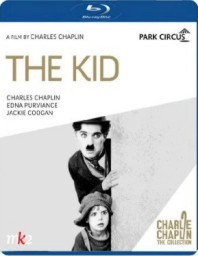
A quick post just to note the latest silent to appear on Blu-Ray. Hot on the heels of The General, Sunrise, City Girl, Battleship Potemkin and the announced future releases of Metropolis, Our Hospitality, Steamboat Bill Jr. and Sherlock Jr., we now have The Kid. Chaplin’s 1921 comic tear-jerker, in which he meets his acting match in the five-year-old Jackie Coogan, is to be released on 10 May by Park Circus, as part of Charlie Chaplin Collection, alongside The Great Dictator. The extras include an introduction by David Robinson; a 26mins documentary Chaplin Today: The Kid; scenes deleted for 1971 release (the Blu-Ray edition is the shorter version which Chaplin prepared in 1971); short items on recording the new score (1971) and Jackie Coogan dancing (1920) (2 mins); and the 1922 home movie Nice and Friendly featuring Lord and Lady Mountbatten, Jackie Coogan and Chaplin.

The Kid seems to be a Region B UK release only. It’s also being made available by the same company on DVD.

Video Jukebox no. 1 – The Battle of the Century

Jack Dempsey centre, Georges Carpentier right, from The Battle of the Century, http://www.europafilmtreasures.eu

Here comes a new series here at Bioscope Towers (though there are number of old series in dire needing of being kept up, I’m aware). There’s not enough done here on single films, beyond the occasional mention of DVD releases, so we’re going to institute Video Jukebox, which will be an occasional series that takes a silent film available online and gives some of the background history – particularly if the site which hosts the film doesn’t tell you that much.

I’m going to start off with The Battle of the Century (1921). I was surprised to see this as an addition to European Film Treasures, as I wouldn’t have suspected that the BFI (which holds the film) would have singled it out as a choice item from its archive – not least because it is not a European film. Nevertheless it is strongly European in theme, Europe v America in fact, and it is certainly a film well worth seeing and with a story behind that is equally worth telling.

It’s 1921, and the jazz age is upon us. It is an age of celebrity fashioned by the newsreel cameras, where to be in the public eye means that you must maintain a constant virtual screen life. The stars to be found in the cinema are not just actors but politicians, royalty, aviators, explorers, artists, socialites and especially sports stars. The barrier between the arena and the cinema was broken down as leading sports events were filmed (with their funding often dependent upon the sale of film rights) and sports stars were pushed into becoming film stars by trying out their acting skills on the screen – generally with painful results.

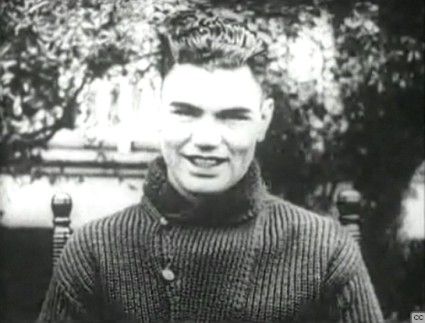
Jack Dempsey, from The Battle of the Century

Jack Dempsey was one of the stars of the age, in the boxing ring, and on the screen. He wasn’t much of an actor – he appeared in several silents including the serial Daredevil Jack (1920), Fight and Win (1924) and Manhattan Madness (1925) – but his screen presence when fighting, sparring, training or just grinning for the ever-present newsreels was utterly compelling. The pinnacle of Dempsey’s career, fistically and cinematically, was his bout with Georges Carpentier, the French world light heavyweight champion, who also enjoyed a modestly successful film career with The Wonder Man (1920) and A Gipsy Cavalier (1922).

The fight was a masterpiece of hype from legendary promoter Tex Rickard, and saw boxing’s first $1,000,000 gate. The fight, held at Boyle’s Thirty Acres, Jersey City on 2 July 1921, was in no way an even match. Jack Dempsey was a far heavier (by 25lbs) and far more powerful fighter. But Rickard cleverly built up a good-versus-evil angle, with Dempsey having been widely accused of draft-dodging, while Carpentier was a war hero, having been awarded the Croix de Guerre. Dempsey’s thick-set, brooding look contrasting with Carpentier’s elegant demeanour helped accentuate these matters, but there was a contrary undercurrent in that Dempsey was the all-American figure while Carpentier was Old World and maybe just a bit too fancy. Either way, it was a contest where no one was going to be allowed to be neutral in their opinions.

Rickard targeted a new female audience for boxing by building up Carpentier’s appeal and improving facilities at the venue. He was rewarded with a crowd of 80,183 and an overall gross of $1,789,238, twice the amount of any previous fight. Rickard knew that money attracts money, so he made sure that everyone was aware of the huge sums being paid to the boxers: $300,000 plus 25% of the movie rights to Dempsey; $200,000 plus 25% of the movie rights to Carpentier.

Georges Carpentier, from The Battle of the Century

The movie rights were an essential feature of these calculations (despite an official ban on interstate commerce in fight films). The film was produced by Fred C. Quimby (who had first signed up Dempsey for Daredevil Jack), with the filming itself overseen by George McLeod Baynes. Entitled The Battle of the Century (Rickard’s own billing for the fight), the film employs all the tricks of the cinema to create one of the very best sporting movies of the silent era. It builds up the fight, far more fluidly than earlier fight films, with scenes of both fighters in training, the special stadium under construction, the crowd arriving, the press at the ready, fingers on the ticker tape machines, dissolves, close-ups and astute camera angles all tensely and rhymically edited until the point where the fighters enter the ring.

The film at this point loses some of its rhythm by inevitably following the action in real time, and by doing so initially with limited, static coverage from a single camera position perched precariously on the top of a tall stand. The fighting is intense but it is sometimes hard to tell the two fighters apart. But as the fight progresses through its four rounds the film picks up once again, close-ups increase, the camera pans with the action and as Dempsey moves in for the kill we watch transfixed as Carpentier is felled, leaps up instantly, is brought down again, and stays down.

Despite the interstate ban, the film was widely shown. Dan Streible, in the essential Fight Films, describes how Quimby organised distribution to twenty different states by employing anonymous couriers who delivered unmarked packages to hired attorneys, “who knowingly received the contraband, then either sold prints with state distribution or exhibition rights or left reels for theater managers to screen”. When even President Warren Harding and Vice-President Calvin Coolidge attending a screening of the film at a private party, then this was a film where public will was always going to override the law, come what may. Quimby made plenty of money, picked up a federal conviction along the way, then went on to join MGM and to pick up a string of Academy Awards as head of its animation unit, featuring in particular a certain battling cat and mouse.

The Battle of the Century is available in its full 34-minute glory from European Film Treasures, complete with a piano score by Antonio Coppola. For more information on the fight, read Randy Roberts’ racy and superbly-written Jack Dempsey: The Manassa Mauler.

(Some of this text comes from an essay I wrote for Griffithiana in 1998 entitled ‘Sport and the Silent Screen’)

Olympic Hitch

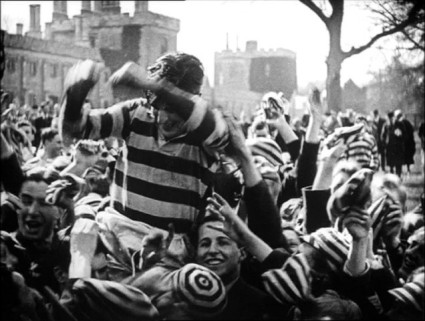
The rugby game from Hitchcock’s Downhill (1927), from 1000 Frames of Hitchcock

Here in the UK we’re shaping up nicely for the Olympic Games in 2012. We’ve moved from being cynical to saying we can’t aford to wanting it to succeed to believing it could actually be fantastic (then after the Games we’ll revert to cynicism again, with is the natural order of things in Blighty). And for those who don’t actually like sport there’s the Cultural Olympiad – a programme of arts and culture events which have little if anything to do with the Olympic Games but, hey, arts organisations will grasp at any straw that goes floating by.

But enough of my own cynicism. We’re going to get a whole range of interesting cultural events grounded in fundamental Olympic themes such as community, regeneration, youth – you know the sort of thing. And silent cinema should get a look in, because what has just been announced by the BFI is a touring retrospective for 2012 of Alfred Hitchcock’s nine surviving silent films.

This is a bold and welcome move, as for most Hitchcock’s silent career remains a closed book, beyond possibly an awareness that he made The Lodger. Strictly speaking the retrospective isn’t formally a part of the Cultural Olympiad as yet, but the BFI is pointing out, rather ingeniously, that Hitchcock was born in Leytonstone, near the Olympic park in East London. A report in The Independent describes the plans, which include an exhibition:

Eddie Berg, artistic director of the BFI, said … “One of the things we are trying to get off the ground is to restore the silent films. Most of the visual tropes in these titles appear in his later works. We want to look at his influence on the contemporary world. The season will look at his huge body of work and his influence in different ways,” said Mr Berg.

The silent titles will form the heart of the retrospective, but the exhibition may also include the music of the American composer Bernard Herrmann, who collaborated with Hitchcock on the scores for Psycho, North by Northwest, The Man Who Knew Too Much and Vertigo. A staging of Douglas Gordon’s 24-Hour Psycho, a 1993 artwork featuring a slowed-down version of the horror film, will also feature.

Amanda Neville, director of the BFI, said the initiative would “resurrect the [Hitchcock] films that are not on the tips of everybody’s tongues”.

Some of the films need critical restoration work, she said, and “three of them cannot go through a film projector – the level of damage to them is phenomenal.”

Robin Baker, the BFI’s head curator, said he was keen to discover the whereabouts of Hitchcock’s silent movie The Mountain Eagle, which he called the “holy grail” of lost British films.

“It was made in 1926 and was his last silent film featuring a sexually vulnerable young woman and a case of miscarriage of justice,” he said. [I think that’s a misquote and what he actually said was “first film featuring…”]

Hitchcock began his career in Britain as a designer of film title cards before directing a dozen silent films, including The Lodger, in 1926 and which the BFI hopes to restore and screen.

His first “talkie” film Blackmail, released in 1929, was shot as a silent feature and later converted to sound.

Well, I don’t expect they were planning to project those three damaged nitrate prints in any case, but the retrospective should also play its part in educating audiences about film restoration, as well as offering new opportunities to see silent films and unfamiliar Hitchcock. And as further indications of Olympic relevance, let’s point out the sporty bits of Hitchcock’s silents – boxing in The Ring, the rugby game in Downhill, the tennis match in Easy Virtue

For an overview of Hitchcock’s extensive silent film career (he began as a title writer for the British Famous Players-Lasky studios in 1920), see this earlier Bioscope post. And let’s hope along with Robin Baker that a print of The Mountain Eagle finally turns up. That really would be an event worthy of any Cultural Olympiad.

Flickers

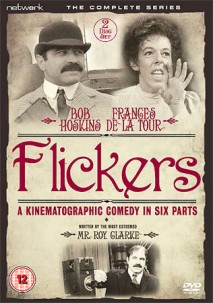
Does anyone remember seeing this? Flickers (“A Kinematographic Comedy in Six Parts”) was a 1980 UK television series set in the early days of the silent film business in Britain, produced by Thames and directed by Cyril Coke.

It was written by Roy Clarke (as in Last of the Summer Wine and Keeping up Appearances) and starred Bob Hoskins and Frances de la Tour. It received a Primetime Emmy nomination for Outstanding Limited Series in 1982. Now it is to be released on DVD (from 7 June) by Network, a two-disc set lasting 300mins. This is the company blurb on the background story:

Forty-year-old Arnie Cole is a movie pioneer, showing films in makeshift cinemas during the first quarter of the twentieth century – a long way ahead of the golden age that will be more glittering than his wildest dreams. But opportunities are opening up all the time, and Arnie’s true ambition is to produce films of his own. Financial backing is, inevitably, the stumbling block. But it comes his way in unexpected form when he is introduced to Maud, the snobbish, rather plain sister of a well-to-do acquaintance; at first, Maud finds Arnie brash and vulgar, and he is equally unimpressed with her – but having discovered that she is pregnant, she makes him an offer that he finds hard to refuse…

I don’t remember seeing it at the time – in 1980 I was at university, barely watched TV, and had no thought for silent films or their social history. It sounds like a soft-edged version of Pennies from Heaven without the songs. The New York Times called it “marvellously wacky”, adding:

one of the daffiest and most hilarious original screenplays written for television. As Arnie and Maud stagger through their unusual relationship, ”Flickers” provides representative samplings of types involved in the motion picture business, from short and alcoholic comedian stars to corrupt lawyers, from aging child stars to lazy cameramen.

I’m intrigued. Anyone out there with long memories?

The complete Metropolis

Frame still from the previously lost Metropolis footage, from http://www.kino.com/metropolis

The Metropolis bandwagon rolls on. After the premiere of the restored version in Berlin on 12 February, it received its North American premiere at the TCM Classic Film Festival at Grauman’s Chinese Theatre, Hollywood on 25 April, with music provided by the Alloy Orchestra.

And then there’s the new Kino Lorber website dedicated to the film, entitled The Complete Metropolis. Kino Lorber is issuing the restoration on DVD and Blu-Ray in November 2010. To whet your appetite it has issued a trailer which includes sequences showing the ‘lost’ footage. The website itself is a lavish affair, with thorough background information on the rediscovery of the missing sequences and the restoration work, an updated synopsis for the film and list of the missing sequences, a history of the film’s production with timeline, details of cast and crew, photo galleries, video clips from the film (including the discovered scenes), information on screenings, plus news, press releases and reviews.

You can also follow the restoration through its own Twitter account, and sign up to its Facebook page. Complete indeed.

The DIY silent film score

A Silent Film, one video in the series 365: No Day is Ordinary 049/365, by owlsongs (real name Wanda). It uses an Incompetech soundtrack, and I like the imaginative combination of webcam vlogging with silent film titles

If you have spent any time browsing through YouTube for silent films (especially silent pastiches), or indeed for a good many other kinds of video requiring a made-to-measure soundtrack, you are bound to have heard the music of Kevin McLeod. He runs Incompetech, a music download site with an extensive range of royalty-free music, including a section on silent film scores.

For anyone with a three-minute video requiring a generic piano acompaniment in traditional silent film style, this is the place to go. Tunes such as ‘Plucky Daisy’, ‘Work is Work’ and ‘Look Busy’ have been used countless times for YouTube videos, for mock silents, animation films, cute animals (lots of cute animals) and more. A typical piece will come with this information:

Gold Rush
Genre: Silent Film Score
Length: 0:47
Instruments: Piano
Tempo: 120

Peppy piano duet. 031 Bouncy, Driving, Humorous 2007

You can play the tune on the site or download it for free as an MP3 file. Other themes include ‘Comic Plodding’, ‘Old Timey’, ‘Friendly Day’ and ‘Hammock Fight’ provide bright, immediate piano scores between thirty seconds and two minutes, sometimes with additional instrumentation coming in as the music progresses. You get music for chases, villains, nostalgia, comic scenes, fanfares, and multi-purpose linking tunes.

Professional silent film accompianists might have a word or two to say about the formulaic nature of the sound clips, but there’s no denying that McLeod is good at conjuring up catchy accompaniments with strong hooks that find use across thousands of online videos – though it needs to be pointed out this include scores produced by McLeod across many other genres. Under Royalty Free he lists African, Blues, Classical, Contemporary, Disco, Electronica, Funk, Holiday, Horror, Jazz, Latin, Modern, Musical, Polka, Pop, Radio Drama, Reggae, Rock, Silent Film Score, Soundtrack, Stings, Unclassifiable and World. Truly something for everyone.

Of course, sites like Incompetech help reinforce the idea of silent films as being inexorably wedded to tinkly piano. Here at the Bioscope we have tried to champion different kinds of silent film scores. So we would hope that Electronica, Modern, Unclassifiable or World might supply equally serviceable soundtracks for the budding silent film producer (but possibly not Polka). Meanwhile, do take a browse – and remember that in the silent era many cinemas installed player pianos (such as the Fotoplayer, illustrated in an earlier post). The automatic score is part of the silent film tradition too.

For the love of celluloid

Two videos have turned up online this week which take us on tours of two enterprising small cinema museums.

This video from Swissinfo.ch reports on the Lichtspiel cinema in Bern, Switzerland, which also operates as an archive and museum. The interviewee is the cinema’s director, David Landorf, who describes the thrill of opening any film can, champions the simplicity of cinema technology, and shows us such treasures as a Scopitone (a sort of video jukebox), a Mutoscope and a cine fader (you stuck it on front of a camera lens and opened or closed it for automatic fades).

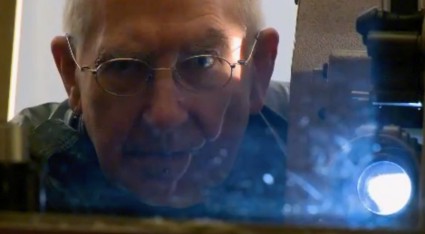
Secondly, The Guardian has produced a behind-the-scenes look at the Cinema Museum in London, based around an interview with its founder Ronald Grant, taking him from his days selling film stills in Portobello Road to guardian of a precious collection of Britain’s cinema heritage, still seeking a secure home. There’s a great selection of photographs of Ronald in years past sporting a fine assortment of hairstyles.

There’s a palpable sense in both videos of cinemas as living things, of something that dies when a cinema closes down. Out of this comes the essential, life-giving task for these museums of maintaining not just the artefacts but the memory of the cinema as something central to twentieth-century lives. Cinema museums must be about people more than they are about projectors.

Doing women’s film history

http://wfh.wikidot.com

Here’s news of an international conference taking place in April 2011 organised by the AHRC-funded Women’s Film History Network – UK/Ireland which is certain to attract some papers covering the silent film era, where there has been so much research activity of late.

Doing Women’s Film History: Reframing Cinema History

13-15 April 2011

Centre for Research in Media and Cultural Studies
University of Sunderland

This international conference will bring together researchers in women’s film history, archivists, collections managers and contemporary women practitioners. It will explore current developments in researching women’s participation in film production, distribution, exhibition, criticism and film-going in different parts of the world and in all periods. It will ask what the discovery and documentation of women’s past activity in and around cinema implies for the writing of film history in general and will consider how the history of post-1970s women’s filmmaking is to be resourced and developed. The conference will seek to address issues such as:

  • women’s film historiography: filling gaps in existing film history or changing film history?
  • impact of gender-oriented research methods & sources for the histories of male and female workers
  • gender in the archives, catalogues and collections
  • impact of women on cinema as audiences, campaigners, fans
  • relationship between feminism, women’s and gender histories
  • crossing the silent/sound history divide
  • women’s film history after second wave feminism
  • national/international/transnational connections and interactions
  • creation of canons, exhibition & programming practices, curricula and teaching
  • relation of women’s film history then and women’s film practice now

The Conference will also report on and seek feedback on three Workshops that will have preceded it in order to involve wider participation in developing the future of the Network.

A call for papers will follow more detailed planning in early June. In the meantime, for more information about the Network please visit the Network wiki and the Conference Development pages where you can post any suggestions and comments via linked page headings.

Memory of the world

Roald Amundsen and his Norwegian team reach the South Pole. From http://unesco.no/generelt/english/norwegian-documentary-heritage

In the report on the British Silent Film Festival I covered the Amundsen polar films. What I didn’t mention is that the films have been included in UNESCO’s Memory of the World programme. It seems worthwhile just taking a look at Memory of the World and identifying those silent films which are registered on it.

UNESCO’s Memory of the World is an ongoing programme of identification and commemoration of key artefacts held in archives that are important to the world’s documentary heritage. The objective of the programme is described thus:

The vision of the Memory of the World Programme is that the world’s documentary heritage belongs to all, should be fully preserved and protected for all and, with due recognition of cultural mores and practicalities, should be permanently accessible to all without hindrance.

It has these three main mission statements:

  • To facilitate preservation, by the most appropriate techniques, of the world’s documentary heritage.
  • To assist universal access to documentary heritage.
  • To increase awareness worldwide of the existence and significance of documentary heritage.

In practice the Memory of the World means a register of the world’s archival gems. Archives, museums and libraries vie with one another for the honour of having their prized items listed on on the register (though nominations are by country, not by institution). There’s no monetary gain involved: merely glory, plus all the strength and worldwide recognition that comes from UNESCO’s backing. Consequently it is quite an achievement for the silent films and film collections that have made it to the register, although together they present a rather uneven picture of what is most precious about the world’s early film heritage.

These are the silent films (with their nomination details) currently on the register, alongside such world treasures as the Bayeux tapestry, the diaries of Anne Frank, Magna Carta and Criminal Court Case No. 253/1963 (State Versus N Mandela and Others).

METROPOLIS – Sicherungsstück Nr. 1: Negative of the restored and reconstructed version 2001

Documentary heritage submitted by Germany and recommended for inclusion in the Memory of the World Register in 2001.

Fritz Lang’s motion picture METROPOLIS (1927) is without doubt famous testimony of German silent film art, a testimony that made history. The combination of motion picture and architecture: this is above all and still METROPOLIS, the film which was shot by Fritz Lang in the Babelsberg Film Studios in 1925/1926, which, due to its immense expenditure, caused the UFA, the largest German film group, to run into financial difficulties, which then had a glittering première in Berlin in January 1927, and an unparalleled success all over the world ever since – and which became the symbol of a (film-) architectural model of the future.

Substantially shortened and changed almost immediately after the première in Berlin, only one (though fragmentary) of the initially three original negatives of METROPOLIS has been left in the possession of the German Federal Archives, as well as master copies of the lost original negatives in a few archives abroad.

As a result of intense investigations on the initiative of the Friedrich Wilhelm Murnau Foundation, a new reconstruction has been produced. It was first shown in February 2001, on the occasion of the Berlin Film Festival. Considering that the result this time is again not the original version of METROPOLIS, but “only” a synthetic version made of the fragments handed down, it comes, however, as close to the original piece of work as possible. With this reconstruction project a new digitized “original” negative has been produced to provide more independence and better copying quality in the future. This reconstructed version of METROPOLIS is proposed for nomination here.

Lumière Films

Documentary heritage submitted by France and recommended for inclusion in the Memory of the World Register in 2005.

The collection nominated for inclusion in the Memory of the World Register comprises all the original films (negatives and positives) known as the Lumière films (i.e. having round perforations) and listed in the catalogue of 1,423 titles produced at the factory of the brothers Louis and Auguste Lumière. Since 18 films have been lost, the collection comprises the original films of the 1,405 Lumière titles that have been identified and restored.

Roald Amundsen’s South Pole Expedition (1910-1912)

Documentary heritage submitted by Norway and recommended for inclusion in the Memory of the World Register in 2005.

Roald Amundsen and his 4-man team reached the South Pole, with the help of polar dogs, on 14 December 1911. The expedition, and particularly the dog-sled journey to the Pole, is described as daring and with an exceptionally good logistic planning and execution.

The Antarctic and the Arctic Polar Regions, for several centuries, were regarded as the final frontiers for mankind to conquer, and the North and South Poles were for a long period of time the great goals to attain within geographic discovery.

The discoveries in the polar areas contributed, not least in Norway but also internationally, to greater consciousness of, and political interest in, questions concerning sovereignty and rights in these sea and land areas.

The original film material of Roald Amundsen’s South Pole Expedition documents a great historic achievement, outside the borders of the civilized world and in an extreme climatic environment.

In his time, Roald Amundsen (1872 – 1928) contributed, through several expeditions and together with his teams, to new knowledge within several aspects of polar research. First and foremost, however, he is remembered as a master of the classic polar expedition’s planning and execution.

The film collection is unique, as it documents the important events of this first expedition to reach the South Pole. Though the material is incomplete, it is made up of original sequences, filmed between 1910 and 1912, consisting of negative film and first and second-generation print material.

The Battle of the Somme

Documentary heritage submitted by United Kingdom and recommended for inclusion in the Memory of the World Register in 2005.

The 1916 film The Battle of the Somme is uniquely significant both as the compelling documentary record of one of the key battles of the First World War (and indeed one which has come to typify many aspects of this landmark in 20th Century history) and as the first feature-length documentary film record of combat produced anywhere in the world. In the latter role, the film played a major part in establishing the methodology of documentary and propaganda film, and initiated debate on a number of issues relating to the ethical treatment of “factual” film which continue to be relevant to this day. Seen by many millions of British civilians within the first month of distribution, The Battle of the Somme was recognized at the time as a phenomenon that allowed the civilian home-front audience to share the experiences of the front-line soldier, thus helping both to create and to reflect the concept of Total War. Seen later by mass audiences in allied and neutral countries, including Russia and the United States, it coloured the way in which the war and British participation in it were perceived around the world at the time and subsequently, and it is the source a number of iconic images of combat on the Western Front in the First World War which remain in almost daily use ninety years later …

Finally, it has importance as one of the foundation stones of the film collection of the Imperial War Museum, an institution that may claim to be among the oldest film archives in the world.

The Story of the Kelly Gang (1906)

Documentary heritage submitted by Australia and recommended for inclusion in the Memory of the World Register in 2007.

Just as Fritz Lang’s Metropolis (1927) is testimony to German silent film art, The Story of the Kelly Gang (1906) symbolises both the birth of the Australian film industry and the emergence of an Australian identity. Even more significantly it heralds the emergence of the feature film format.

The Story of the Kelly Gang, directed by Charles Tait in 1906, is the first full-length narrative feature film produced anywhere in the world. Only fragments of the original production of more than one hour are known to exist and are preserved at the National Film and Sound Archive, Canberra. The original poster and publicity booklet provide confirmation of those fragments’ authenticity and together this material represents the unique and irreplacable beginning of feature film culture.

What is striking is just how much film is represented on the register so far. As well as the above, from the sound era there is Luis Buñuel’s Los Olvidados (1950), Norman McClaren’s animation film Neighbours (1952), The Wizard of Oz (1939), the Ingmar Bergman Archives, and the John Marshall Ju/’hoan Bushman Film and Video Collection – though one might query the documentary value of some of these choices. The prominence of film can be seen by looking an individual countries: there have been five items registered by the UK – the Hereford Mappa Mundi, Magna Carta, the Registry of Slaves of the British Caribbean 1817-1834 (submitted by the UK and Caribbean nations), the Appeal of 18 June 1940 (a radio broadcast, submitted by the UK and France), and The Battle of the Somme.

Not everyone would argue that The Battle of the Somme should be among the UK’s top five archival treasures (though I would), and its presence there is due in part to the strong arguments made in its favour by its host archive, the IWM – but nevertheless film is there on the register, again and again. It is not only heartening, but it adds significant strength to the arguments of archives that need to argue the case for the preservation of film as a medium equal to any other. Celluloid is the equal of vellum.

The individual records for the films listed above are worth checking out because there is a link to the nomination forms, which give much supporting information (in English and French) on the films’ preservation and current status. There are also some photographs.

But if you were picking five examples of silent film heritage to represent the world’s documentary heritage, would you have picked those five – or what would you argue should be included?

Finally, the restored Roald Amundsen’s South Pole Expedition film is to be made available on DVD from the Norwegian Film Institute on May 6th – details here.
The show goes on

Among all the hurdles that the valiant British Silent Film Festival has had to face over the past thirteen years as it has fought to keep going, one that its organisers cannot have imagined would ever be a problem is volcanoes. Quite a few millennia have passed since Leicester was last troubled by volanic eruptions, but perhaps it was appropriate that The Lost World was screened at the festival to remind us of climactic conditions when dinosaurs last ruled the earth.

So yes, the cloud of volanic ash currently spreading itself over Europe and taking us all back to a pre-aeroplane age of clear skies, parochial occupations and holidays at home affected the British Silent Film Festival too. Phil Carli, who flew over from America to play piano ended up stranded in Dublin, and a group of Norwegians intending to present a specially prepared programme of polar films remained firmly in Norway, while the films themselves were uploaded then downloaded to the festival overnight in a process that took several hours. So somehow the show went on, and many congratulations to those who fought to ensure that it did. The theme of the festival was exploration, science and nature, and it took a spirit of adventure and some science to overcome what nature decided to throw at us.

British Silent Film Festival audience settling down to witness With Allenby in Palestine and Lawrence in Arabia

I was only there for the one day, and the event continues until tomorrow, so this isn’t a festival report. I will just note the two main presentations on the Friday, for the record (and if anyone wants to add their impressions of the rest of the festival to the comments, please do). First was the work-in-progress show devised and presented by Neil Brand and myself, a partial recreation of With Allenby in Palestine and Lawrence in Arabia. This was the title of a multimedia show presented by the American journalist Lowell Thomas over 1919-1920 (described in detail in an earlier post) which brought ‘Lawrence of Arabia’ to popular attention.

Thomas’ original show was a mixture of music, photographic slides (many of them coloured) and film clips. We used our edited version of an original script held by Marist College Archives in the USA, original images taken by Thomas’ photographer Harry Chase from the collections of Marist and the Imperial War Museum, and a few clips from Chase’s films – showing Arab forces, T.E. Lawrence himself with Emir Feisal and Lowell Thomas, an scenes of motorised transport in the Arab army camp – also from the IWM. Neil read out Thomas’ original words in an easy-going American accent intended to emulate Thomas’ own delivery, while I introduced and manned the laptop, as the whole show was delivered by that magic lantern de nos jours, PowerPoint.

Did it work? I hope so. It was a 40-minute extract from what was originally a two-hour show, and it was presented in a rough-and-ready low-res manner because it was done in a huge hurry and on a budget of nil – thanks to the kind co-operation of Marist and the IWM. There seem to be two lessons to be drawn here. One is the importance of Thomas’ show in building up the Lawrence legend. All the Lawrence biographies acknowledge the importance of With Allenby in Palestine and Larence in Arabia in creating popular enthusiasm for Lawrence and the Arab revolt. But the chance to experience this key work has never been there before, as its component parts lay scattered. A full-scale restoration of the show would seem to be a more than worthwhile exercise, though some sort of balance in the presentation needs to be struck between the show as it actually was and the need for contextualisation, since much of what Thomas told was factually dubious or least over-romanticised.

The second lesson of the show is to realise the importance of the multimedia show at that time. There were numerous other examples of shows which combined live presenter with film, still images and music, in a form that we might now describe as televisual. The Victorian tradition of the lecturer with his magic lantern carried on long into the silent era, with films simply being added to the mix. Adventurers, propagandists and entertainers could combine multimedia with their own personal charisma to create complex entertainments whose importance as popular entertainments is not always fully recognised. Film archives restore films, other archives collect photographs or documents, but ‘restoration’ seldom entails bringing all these elements together. At the festival we saw the films of Roald Amundsen (covered below), which were originally part of a lecture show that combined these with photographs and Amundsen himself as presenter. Herbert Ponting, Scott’s photographer, did likewise, and Ernest Shackleton was inspired by Lowell Thomas’ example to lecture himself to the films and photographs taken of his 1914-16 Antarctic expedition taken by Frank Hurley. Thomas and Harry Chase went on to produce ‘travelogues’ of India and Afghanistan. The Shackleton expedition film South (1919) was shown during the festival, but were Shackleton’s lecture script ever to turn up there would be a strong imperative for a new kind of restoration, once which combined film, images and someone able to project Shackleton’s commanding personality as presenter, proud of his achievements yet night after night forced to lecture to audiences before images of his expedition’s failure – all so he might recover the expedition’s costs.

An extract from A Dash to the North Pole (1909), a Charles Urban production showing footage taken 1903-04 by Anthony Fiala of the Ziegler North Pole expedition, re-released in 1909 to capitalise on the polar fever of 1909 when Robery Peary supposedly reached the North Pole and Shackleton came within 112 miles of the South Pole

All of which leads us to the other main event of the day, The Race to the Pole – a programme of Arctic and Antarctic film from the so-called heroic age of polar exploration, which was to have been presented by Jan-Anders Diesen from University of Lillehammer in Norway, but thanks to the Eyjafjallajoekull eruption (remember that name) was presented by Festival organiser Bryony Dixon instead. Happily Bryony knows quite a bit about polar film, having overseen the restoration of Herbert Ponting’s The Great White South (1924), due to be premiered at this year’s London Film Festival, and it was a relaxed, assured and informative presentation in trying circumstances.

The Bioscope has been contemplating a series of posts on polar exploration films for some while now, and I won’t go into detail about the films now, but we did see sequences from Anthony Fiala’s expedition to the Arctic of 1903-04 (illustrated above), the Wellman polar expedition of 1906 (sadly without seeing the balloon with which Wellman hoped – and failed – to make it to the North Pole), a sneak preview of the BFI’s restoration of the Scott/Ponting film with quite astonishing colour tinting and toning likely to cause a sensation when it gets unveiled in full in November, and film of Shackleton’s funeral on South Georgia from the expedition film Southwards on the Quest (1922), an expedition sadly curtailed by its leader’s death by heart attack on the journey out.

But the highlight was the sixteen minutes of film taken of Roald Amundsen’s successful Norwegian expedition to the South Pole – the man who won the race. Few know that Amundsen took a cinematograph with him. It was operated by Kristian Prestrud, and the films show Amundsen’s ship the Fram, life on board and at the Framheim base camp, whales and penguins, and some singularly evocative shots of dog teams leading their sledges and drivers away into the distance. As said, the films were presented to audiences (in Britain and Norway) in the form of a lecture show, intercut with photographs and Amundsen’s own commentary. It would have been the next best thing to being there – and considerably warmer.

The show goes on today and tomorrow, and hopefully next year and many years after that. Congratulations to all on keeping things going despite acts of God and man, finding a space not only for British silents but increasingly for other silents from around the world, and with a commendable emphasis on imaginative presentation and unearthing less obvious material. Long may it continue.