Brazilian journey

http://www.cinemateca.gov.br/jornada

Last year we noted for the first time the remarkable festival of silent film in Brazil, the Jornada Brasiliera de Cinema Silencioso or Brazilian Journey of Silent Cinema. The festival returns again 6-15 August and has a strong enough programme to make you think seriously about chaning your holiday plans. The festival is organised by the Cinemateca Brasiliera, São Paulo and is curated by Carlos Roberto de Souza. As the festival press release puts it:

This annual event is dedicated to world cinema produced between the late nineteenth century until about 1930, when the arrival of sound changed the course of the cinematic art. Now in its 4th edition, the Journey has become an important part of the Brazilian cultural calendar, and allows an increasingly larger and more diversified audience to gain access to films from the silent cinema era.

All of the Festival’s scheduled features are to be accompanied by live musical performances in the Cinemateca-BNDES Theater, with ‘silent projections’ (I guess that means silent only) in the Cinemateca-Petrobras Theater.

As in previous festivals, a special feature is made of the production of a national cinema of the silent period and the work of a particular country’s film archive. This year the focus is Swedish silent cinema, and the selected works are restorations from the Swedish Film Archive (Svenska Filminstitutet / Kinemateket). Altogether, there are thirty-five titles, curated into six programmes.

The Nordic countries developed a film industry whose films spread all over the world, until the outbreak of World War I. Although after the war European production had ceded its economic importance to Hollywood movies, Sweden had one of the most brilliant cinemas in film history, with directors like Victor Sjöström and Mauritz Stiller producing great works of artistic expression, not to mention exceptional actors like Lars Hanson and Greta Garbo. The Jornada presents a selection of works that will show a wider panorama of Swedish silent cinema and the film restoration work which has been developed in that country for decades. The opening event will present the film The Blizzard / Gunnar Hedes Saga (Mauritz Stiller, 1923), with live musical performance from Dino Vicente. Alongside the great works of Sjöström and Stiller, to be shown in recent restorations, the festival will present the first film record made in Sweden (Konungens af Siam landstigning vid Logårdstrappan / Arrival of the King of Siam in Logårdstrappan, 1897), and the celebrated Häxan (Benjamin Christensen, 1922), in a print considered by the archive’s curator as the most beautiful of the entire collection.

The Jornada’s inaugural lecture will be given by Jon Wengström, curator of the Swedish Film Institute’s Archival Film Collections; its main themes will be Swedish silent cinema and the conservation work carried out in Sweden. He will speak about the criteria that guided his selection of Swedish Film Treasures, which include two films starring Greta Garbo – Die freudlose Gasse / The Joyless Street (G.W. Pabst, Germany, 1925) and Flesh and the Devil (Clarence Brown, USA, 1926), as well as the single existing fragment of the actress’s collaboration with Sjöström, The Divine Woman (USA, 1928), the scandalous Afgrunden / The Woman Always Pays (Urban Gad, Denmark, 1910), and the extraordinary The Wind (USA, 1928), directed by Sjöström and starring Lillian Gish, which will be presented in the version with musical soundtrack that was released at the time.

The Wind

Other highlights are the films The Dawn of a Tomorrow (James Kirkwood, USA, 1915), starring Mary Pickford, and the audacious Tretya Meshchanskaya / 3 Meshchanskaya Street, or Bed and Sofa (Abram Room, USSR, 1927).

The Jornada has a section which features highlights from Pordenone’s Giornate del Cinema Muto. This year Paolo Cherchi Usai has selected some American productions, the oldest one being the surprising Regeneration (1915), directed by Raoul Walsh; When the Clouds Roll By (1919), directed by Victor Fleming and starring Douglas Fairbanks and Stage Struck (Allan Dwan, 1925), with Gloria Swanson.

Another regular feature is silent films from Brazil. This year the festival will show some documentary feature films restored by the Cinemateca Brasileira in recent years, such as Companhia Paulista de Estrada de Ferro and Companhia Mogyana, portraying industrial labour and the building of the main railways in different cities of the São Paulo region. In the feature drama O Segredo do corcunda (Alberto Traversa, 1924) the train has an important dramatic function, to connect the State’s capital, from the magnificent Estação da Luz, to a small town, with its modest little train station. Turibio Santos, legendary guitarist and the director for many years of the Villa-Lobos Museum, will perform with this film as a special guest of the festival.

The programme “Window to Latin America” will show Wara Wara, made in Bolivia in 1929 by José María Velasco Maidana, which depicts an episode of the Inca civilization during the Spanish invasion. One of the few surviving Bolivian silent films, it was restored at the laboratory L’Immagine Ritrovata in Bologna, Italy, and has been presented at the festival Il Cinema Ritrovato, organized annually by the Cineteca del Comune di Bologna.

To honor the 80th anniversary of Cinédia, the main Brazilian film company in the 1930s, founded by Adhemar Gonzaga, the festival will present Lábios sem beijos, directed by Humberto Mauro, the only silent film the company produced (its subsequent movies were early sound films with musical accompaniment and synchronized dialogue, followed by 100% talkies).

The musicians who will be part of the 4th Jornada Brasiliera de Cinema Silencioso are Zérró dos Santos, Daniel Szafran, Wilson Sukorski, Max de Castro, Ruggero Ruschioni, Ana Fridman, Ricky Villas, Zé Luis Rinaldi, Simone Sou, André Abujamra, Marcio Nigro, Dino Vicente, Laércio de Freitas, Eric Nowinski, Marcelo Poletto, Ricardo Reis, Gustavo Barbosa, Daniel Murray, DUO N1, Basavizi, Dante Pignatari, Ricardo Carioba, Matheus Leston, Turibio Santos, Wandi Doratiotto, Danilo and Livio Tragtenberg.

More details are available (in Portuguese), including titles and full descriptions of all films, on the festival site.

Bonner Sommerkino 2010

Metropolis

Germany’s silent film festival Bonner Sommerkino returns to Bonn 12-22 August. The annual festival is gaining increasing prominence, and the programming is of a really high standard. The restored Metropolis is of course the highlight, as it is for several other festivals this year, but there are plenty of imaginative choices on offer, with intriguing selections from China, Japan, Great Britain, USA, Sweden and Germany. But will it be the last such silent film festival in Bonn? Here’s the outline programme:

Arkadenhof der Universität Bonn

Donnerstag, 12. August 2010
21.00 METROPOLIS
Deutschland 1925/26, Fritz Lang, 147 min

Freitag, 13. August 2010
21.00 SO IST PARIS (So This is Paris)
USA 1926, Ernst Lubitsch, 70 min

22.30 KÖNIGIN DER VAGABUNDEN (The Vagabond Queen)
Großbritannien 1929, Géza von Bolváry, 62 min

Samstag, 14. August 2010
21.00 DER GEISTERZUG (The Ghost Train)
Großbritannien 1927, Géza von Bolváry, 67 min

22.30 DER BLAUE EXPRESS (China Express)
UdSSR 1929, Ilja Trauberg, 76 min

Sonntag, 15. August 2010
21.00 DIE FILMPRIMADONNA (The Film Primadonna)
Deutschland 1913, Asta Nielsen, 17 min

DER KAMERAMANN (The Cameraman)
USA 1928, Buster Keaton, 75 min

Montag, 16. August 2010
21.00 ST. KILDA – ENGLANDS EINSAMSTE INSEL (St Kilda, Britain’s Loneliest Isle)
Großbritannien 1928, Robello /Mann, 18 min

GRASS
USA 1925, Ernest B. Schoedsack, Merian C. Cooper, 70 min

Dienstag, 17. August 2010
21.00 A POET FROM THE SEA (Haikiao Shiren)
China 1927, Hou Yao, 23 min

DAS MÄDCHEN VOM MOORHOF (The Woman He Chose)
Schweden 1917, Victor Sjöström, 82 min

Mittwoch, 18. August 2010
21.00 KLEINE GEHEIMNISSE (Don’t Tell Everything)
USA 1927, Leo McCarey, 20 min

HOTEL STADT LEMBERG (Hotel Imperial)
USA 1927, Mauritz Stiller, 82 min

Donnerstag, 19. August 2010
21.00 MODERN HORROR 100.000.000 (Modern kaidan: 100,000,000 yen)
Japan 1929, Torajiro Saito, 15 min

EIN BEUNRUHIGENDES ABENTEUER (Agonising Adventure)
Frankreich 1920, Jakov Protazanov, 82 min

Freitag, 20. August 2010
21.00 DER GENIALE ERFINDER (So’s Your Old Man)
USA 1926, W.C. Fields, 67 min

22.30 GEFANGENE SEELE
Deutschland 1917, Henny Porten, 75 min

Samstag, 21. August 2010
21.00 DIE HEILSJÄGER (The Salvation Hunters)
USA 1925, Josef von Sternberg, 76 min

22.30 DIE VIER GERECHTEN (The Four Just Men)
Großbritannien 1921, Edgar Wallace, 66 min

Sonntag, 22. August 2010
21.00 BEETHOVENS MONDSCHEINSONATE (the Origin of Beethoven’s Moonlight Sonata)
USA 1909, 9 min

FIAKER NR. 13
Österreich 1926, Mihaly Kertész, 116 min
Gesang: Pien Straesser

LVR-LandesMuseum Bonn

Sonntag, 15. August 2010
15.00 Die Entstehung von »Metropolis«
Vortrag von Werner Sudendorf

17.00 DER BETTLER VOM KÖLNER DOM
Deutschland 1927, Rolf Randolf, 105 min

Sonntag, 22. August 2010
15.00 DER KOMIKER MAX DAVIDSON
Vortrag von Stefan Drößler und Rob Stone

17.00 DER TUNNEL
Deutschland 1915, William Wauer, 95 min

Fuller programme details are on the festival site (in German).

The open-air screenings in the magificent courtyard of Bonn University are free, though the festival blurb warns that this may be the last year that the festival receives its 40,000€ support from the city of Bonn, so the festival itself ma be in peril. The City of Bonn certainly provides the audience with rich offerings – not just the films, but a starry line-up of musicians to accompany the films, including Christian Roderburg, Günter A. Buchwald, Neil Brand, Stephen Horne, Joachim Bärenz, Mark Pogolski, Pien Straesser and Sabrina Zimmermann.

More information (all in German) is on the festival site. And let’s hope that the chill winds of the economic downturn don’t hit silents as well. But one rathers fears that they will.

Singaporean times

http://newspapers.nl.sg

It’s been a while since the Bioscope covered a digitised newspaper collection. Since we wrote about The Times, The Guardian, New York Times, and about collected archival databases such as France’s Gallica, Austrlian Newspapers, New Zealand’s Papers Past and the UK’s 19th Century Newspapers, more digitised newspapers have become available. Our long-promised round-up of these will get produced one of these days, but you can always check the Wikipedia list of online newspapers or the handy International News Archives on the Web.

One resource I’ve not covered previously is NewspaperSG. I stumbled across it quite by accident the other day, and was amazed first to find digitised newspapers from Singapore and Malaya dating from the early years of this century, and then to find such interesting material there that relates to film.

Feature film production only began in Malaysia and Singapore in the mid-1930s, but there was a history of film exhibition that went back to 1896. One of the treasures of the NewspaperSG site is a report on the inaugural exhibition of the Edison Kinetoscope in Singapore, reported on by the Straits Times on 13 July 1896:

EDISON’S KINETOSCOPE: A WONDERFUL MACHINE

Dr. Harley, the entertainer, ventriloquist, illusionist, and electrician, has brought the novelty of which the reading and scientific public have heard and read so much, viz., the novelty that Edison failed to finish in time for the Chicago Exhibition, and which he calls the Kinetoscope. It is in the shape of an upright hardwood pillar letter-box, being square instead of round, having a hooded slit in the top and a magnifier beneath, through which the beholder views the scene to be enacted.

The writer goes on to describe the film Bar Room Scene, then adds:

It should be understood that this is not an imaginary scene from the brush of an artist, but is an accurate photograph of a scene that has taken place … Dr. Harley will lecture and exhibit the machine at Messrs. Robinson’s music store from 10 till 5 to-day and Tuesday. Only a limited number will be able to view it as his accumulators are running low and he will not get them filled in Singapore.

There is so much information here, from the showman Dr. Harley, to the intelligence that Edison did not exhibit the Kinetosope at the 1893 World’s Fair (many a history still states the opposite as a fact, but they knew better in Singapore in 1896) and the revealing information about the lack of an electricity supply in Singapore in 1896.

A quick browse through the site using some likely keywords reveal an advertisement telling buyers to beware of buying bioscope projectors that were not proper Bioscopes (Straits Times, 25 October 1902); notices of the exhibition of Japanese films in 1907 (Eastern Daily Mail and Straits Morning Advertiser, 23 October 1907); an interview with Maurice Bandman, a leading cinema and theatre entrepreneur in India and East Asia, about his Shakespeare productions and connections with Kinemacolor (Weekly Sun, 30 September 1911); many hundreds of cinema programmes, such as that for the Harima Hall Cinematograph, which showed Zigomar v Nick Carter, film of ‘The Balkan Crisis’, Vitagraph’s Justice of the Sage, Edison’s The Living Peach and a Gaumont Graphic newsreel, issue number 41 (Straits Times, 12 November 1912); and opinion pieces on what Singaporean audiences liked and did not like (Straits Times, 22 October 1930). As well as information on screenings in Singapore, then is plenty of information culled from British and American journals, ensuring that local cinema-goers were kept up-to-date with the latest Hollywood gossip.

Many of the reports are quite short (one of the commendable things about the resource is that the search results list tells you how many words are in each article) but the wealth of documentary evidence about what was being seen in Singapore in the silent era is considerable, and practically every search term yields many hits. The resource itself is plain in style but helpfully put together. There is an advanced search option which allows you to narrow down researches by date, newspaper (there are seventeen on offer ranging 1836-2006) and content type (article, advertisement, letters etc.). There is also a fuzzy search option. The results page gives you title (hyperlinked to the article itself), newspaper, date, page, a portion of the OCR text (with plenty of errors, beware), word count and links to a full page view and a table of contents for that issue of the newspaper (a very nice feature). All of the digitised documents are heavily watermarked (though quite legible).

The early cinema in Singapore and Malaya is not going to be of abiding interest to most, but it is further and rich evidence of the rapid spread of motion pictures into every corner of the globe. It’s also a site that’s just a pleasure to browse.

The National Archives goes to the movies

The National Archives

The National Archives is the UK government’s official archive – not to be confused with the National Archives and Records Administration in the USA. In 2003 the UK’s Public Record Office merged with the Historic Manuscripts Commission to become The National Archives (known to its friends as TNA), which pointed to a broader, more inclusive remit, but some still hanker for the reassuring days of the PRO. The location has remained the same – an imposing modernist building in Kew, to the west of London, with ponds and swans in its grounds, and hordes of historians and amateur genealogists within. It holds government and public records from the Domesday Book onwards, which are released to the public generally after thirty years have elapsed from their original production.

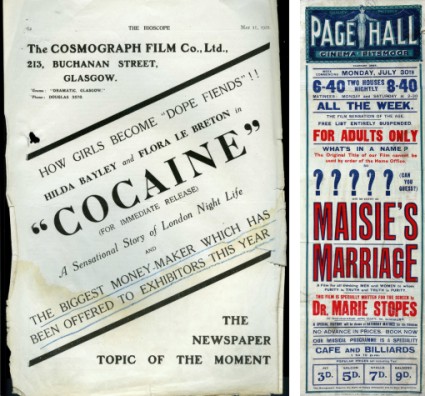
All of which is preamble to the news that TNA has produced a podcast entitled The National Archives Goes to the Movies, and it’s rather good. Written and presented by Joseph Pugh, the podcast is a knowledgeable guide to the history of British cinema through the records of The National Archives. Recorded before an audience, around half of the hour-long talk is about the silent period. Among the subjects he covers are Will Barker’s 1911 film of Shakespeare’s Henry VIII, all copies of which were burned in a publicity stunt; the efforts of the Colonial Office to ban The Birth of a Nation; concern within the Home Office at how Cecil B. De Mille’s The Cheat could offend the Japanese; the production of Maurice Elvey’s ill-fated epic The Life Story of David Lloyd George (1918); the British government-sponsored dramas Hearts of the World (1918) and The Invasion of Britain (1918); Home Office efforts to ban Graham Cutts’ sensationalist Cocaine (1922); and Marie Stopes’ correspondence with the Home Office over her birth control film Married Love (aka Maisie’s Marriage) (1923).

The point of the talk is not only to entertain but to encourage research. Consequently most of the films that Pugh refers to are also listed on Your Archives, TNA’s wiki where researchers can post information on files that they have found. I’m not sure how much the wiki gets used, because researchers tend to be a little wary of giving away all their sources, but the principle is noble.

A trade paper advertisement for Cocaine and a poster for Maisie’s Marriage, taken from The National Archives’ Flickr site, original file references HO 45/11599 and HO 45/11382

The sort of records one find in The National Archives are those which document the day-to-day processes of government departments. There are memos, memos responding to memos, and memos responding to memos responding to memos. There are letters, minutes, briefing papers, personal papers, official papers, diaries, reports, lists, registers, passenger lists, medal rolls, photographs, maps and posters. The contents are generally arranged chronologically, identified by government department and then gathered together by theme into individual numbered folders.

The National Archives can be a daunting place for any newbie researcher. There is no single index, and although they produce an amazing rich online catalogue (helpfully named the Catalogue) they also have to produce a multitude of specialist guides that explain how to pursue particular topics. One of these research guides covers The Arts, Broadcasting and Film, and it’s a very good starting point. As said, The National Archives arranges its records by department, so it is important to know that responsibility for film was held by the Board of Trade’s Industries and Manufactures Department (formed 1918), but information on film is spread widely across particularly all departments. To produce a complete guide to TNA records to silent film would require a blog (or a wiki) all of its own, but here’s an outline guide to some of the key departments to explore. Please note that catalogue references will simply take you to the barest of descriptions online, and to view the documents themselves you will have to visit Kew.

  • AIR (Air Ministry, Royal Air Force etc)
    Records of aerial photography and cinematography during World War One are held in AIR 2 (search under ‘cinematography’).
  • BT (Board of Trade)
    Records of registered companies (since dissolved), including hundreds of film businesses (producers, distributors, cinemas etc), with information on capital and shareholders, are in BT 31; records of liquidated companies 1890-1932 are in BT 34; trade marks (BT 42-53) includes film company trademarks, though there is no overall index so you need to search on-site by date (see the TNA guide on registered designs and trade marks); BT 226 has bankruptcy records for companies and individuals. BT 26 and BT 27 contains lists of ship passengers who arrived in (1878-1960) or left (1890-1960) the UK. The incoming lists themselves can be viewed online (payment required) at Ancestry, and the outgoing list (again payment required) at Ancestors on Board.
  • CAB (Cabinet)
    Papers from the very heart of government. Nicholas Reeves’ Official British Film Propaganda During the First World War has a handy guide to PRO/TNA papers relating to official film, including Cabinet papers in CAB 21, 23-25, 27, 37 and 41.
  • CO (Colonial Office etc)
    Many records relating to the production, distribution and exhibition of films in British colonies and countries of the empire, including records of the Empire Marketing Board (for which John Grierson worked) in CO 758 (correspondence), CO 759 (index cards), CO 760 (minutes, papers) and CO 956 (posters).
  • COPY (Copyright Office, Stationers’ Company)
    Before the 1911 Copyright Act if a UK film producer wanted to copyright a film (usually they did so only if there had been a case of their work being copied) then they had to do so as it if was a photograph; consequently there are numerous records of films 1897-1912 registered under COPY 1. The registration forms were accompanied by single frames, bromide prints, or in a few cases a few frames of film (the originals are now held by the BFI). For a guide to this collection, which comprises a few hundred titles among the many thousands of photographs, see Richard Brown’s essay in Simon Popple and Colin Harding’s In the Kingdom of Shadows. There are also registers and indexes under COPY 3. Some film posters and other promotional material can also be found in the COPY records.
  • ED (Department of Education and Science)
    Disparate documents on film and education, a theme of growing interest throughout the 1920s, including assorted commissions of enquiry.
  • FO (Foreign Office)
    The Foreign Office was concerned with promoting British foreign policy. There are extensive records relating to British propaganda films being shown overseas during World War One, in particular FO 115 on propaganda in the USA and Canada, FO 371 covering general correspondence, and FO 395 which covers war films and American propaganda 1916-17. There is a card index to the FO papers in TNA’s search rooms, making this a particularly fruitful area to explore.
  • HO (Home Office)
    The Home Office oversaw domestic policy. There are extensive records on actual legislation (starting with the 1909 Cinematograph Act) and proposed regulation affecting the British film business, including such issues as censorship, local authority control, unlicensed film exhibitions and the filming of contentious events (political marches etc) are in HO 45. See also HO 158 for relevant general papers and correspondence.
  • INF (Ministry of Information etc)
    A particularly valuable source, with records of the War Propaganda Bureau, the War Office Cinematograph Committee, the Department of Information and the Ministry of Information, all of which were concerned with film production during the First World War (further official papers on war film production are held by the Imperial War Museum). The main section to follow is INF 4. Of particular interest is one chapter from the unpublished memoir by J. Brooke Wilkinson, leading film industry representative and first head of the British Board of Film Censors, at INF 4/2
  • J (Supreme Court of Judicature)
    Covers records of court cases (Chancery), often a rich source of information on how a film company operated. See in particular the winding up orders under J 13.
  • LAB (departments responsible for labour and employment matters and related bodies)
    Includes documents on film industry employees and industrial relations (though relatively little here for the silent era).
  • MEPO (Metropolitan Police)
    The Metropolitan Police conducted surveys of early London cinemas around 1908-09 after they were causing some social concern. The result is a rich record of the early cinema business and audiences, to be found in MEPO 2. They are described in detail in Jon Burrows’ two essays ‘Penny Pleasures: Film exhibition in London during the Nickelodeon era, 1906-1914,’ Film History vol. 16 no. 1 (2004) and ‘Penny Pleasures II: Indecency, anarchy and junk film in London’s “Nickelodeons”, 1906-1914,’ Film History vol. 16 no. 2 (2004), while the London Project database lists the venues covered by files MEPO 2/9172 file 590446/7 and MEPO 2/9172, file 590446 (see also HO 45/10376/16142). There are later surveys of cinemas and screenings of indecent films in the 1920s.
  • RG (General Register Office)
    Has census returns from 1861 onwards (1841-1851 are under HO 107). These can all be found online through various commercial services (see details here), but all are available for free at Kew – see the helpful TNA guide to researching census records.
  • WO (War Office)
    There is relatively little that specifically relates to film here, as most papers relating to the War Office Cinematographic Committee will be found at the Imperial War Museum and the House of Lords Record Office (Beaverbrook Papers). But surviving records of film personnel who served during the War (including Official cameramen) can be found at WO 338 (officers’ service records), WO 363 (service records), WO 364 (pension records) and WO 372 (medal cards). Digitised copies of the actual documents in all four categories can be found online through TNA’s Documents Online or Ancestry (in both cases payment is required for downloads).
  • Other records where information on silent era films can be found include ADM (Admiralty), CUST (Customs and Excise), IR (Inland Revenue), and T (Treasury).

This is a very simplistic overview, and it must be stressed that information on films will be found all over the place. For example, type in the term ‘cinematograph’ in the catalogue and you will get 1,108 records from forty-four separate departments (448 records from twenty-five departments if you narrow the date search to 1896-1930). It is a good idea to look at the bibliographies of books and the end notes of journal articles which have benefited from research at TNA (or PRO before it) to pick up specific references and useful indications of where it would be profitable to search.

The National Archives has produced some substantial publications which explore a subject in depth with copious file references. However, there is no such guide for film (one has been talked about for years but has never been forthcoming). However, there is a classic article by Nicholas Pronay, ‘The “Moving Picture” and Historical Research’, Journal of Contemporary History vol. 18 (1983) (available to higher education users on JSTOR) which describes in details the several kinds of government records which can be used for the study of film, describing why they were created, and giving specific file names. Note also that the above file information relates only to silent films – there is a huge amount of information at The National Archives relating to film (and television) from later periods, particularly govering the GPO Film Unit, film during World War II, the COI Film Unit, the Colonial Film Unit, broadcasting policy, British Council records, and much more besides.

The National Archives is still an underused resource for film history, though we have got beyond the days when Rachael Low could write a multi-volume history of British film apparently without any reference to the Public Record Office. If you’ve not been, and you can get there, then you really should – it’s the most engrossing and rewarding research experience imaginable. Go explore.

By the way, films can be public records too, but the productions of the Ministry of Information, the COI Film Unit and others are preserved on TNA’s behalf by the BFI National Archive and the Imperial War Museum.

My thanks to Brad Scott for alerting me to the podcast.

Loving Louise Brooks

‘Louise Brooks’ is one of the top search terms for people visiting the Bioscope, but so far there hasn’t been much here to satisfy them. Brooks is the silent film star for people who don’t otherwise like silent films. There is such a cult built around her that she seems to lie outside the film world that created her. Her appeal is so modern, so seemingly out of step, that she has ended up a class apart. It takes an effort of will to remember that she was a relatively minor American actress, considered difficult to work with and consequently with a rather patchy American film career, whose fame mostly lies with two German films made by G.W. Pabst, whose genius it was to exploit to the fullest that extraordinary uncompromising sexual quality she undoubtedly possessed.

The cult of Louise Brooks persists, and its latest manifestation is this intriguing French student film, to which Thomas Gladysz has drawn attention in a piece for the Huffington Post. It is made by the 18-year-old Sébastian Pesle, who stars in the 11-minute film as a filmmaker drawn more to the image of Louise Brooks on the screen (in Diary of a Lost Girl) than he is to his girlfriend (Malvina Desmarest), even when she dresses up as Brooks to try and capture his attention. It is shot as a silent film – that is, no one speaks (there are no intertitles), but there is natural sound (including a well-timed slap) and music. It’s a novel, thoughtful piece of work, well worth catching.

For more information on Brooks, there is the very useful Louise Brooks Society site and its accompanying blog, both maintained by Thomas Gladysz; an Italian site with information on all aspects of her career, Louise Brooks, Silent Film Star; her frank and exceptionally well written memoir Lulu in Hollywood (1982); a memorable essay, ‘The Girl With The Black Helmet’, on meeting Brooks towards the end of her life in Kenneth Tynan’s Show People; biographies by Peter Cowie and Barry Paris; and a thoughtful thread on the Nitrateville silent film disussion form commenting on her legacy.

And of course there are films – in particular look out for the Criterion edition of Pandora’s Box (which includes the Kenneth Tynan essay among its copious extras) and the Kino International edition of Diary of a Lost Girl. But catch Brooks in any of her few silent films, even in bit parts, and she lights up the screen in an extraordinary way, somehow aware of people watching her as much in 2010 as 1929. It would be hard to love Louise Brooks – all of the biographical evidence points to someone who was determinedly unlovable – but you cannot take your eyes off her. Which is what Loving Louise Brooks artfully captures.

Silent film and live performance workshop

The AHRC-funded Research Network The Sounds of Early Cinema in Britain has announced a ‘Silent Film and Live Performance’ workshop, to take place at Royal Holloway, University of London, Egham on 27 October 2010.

The workshop will feature:

  • a morning masterclass for students with silent film pianist Neil Brand (for which funding available: see below)
  • an afternoon Research Network workshop to include (1) early cinema session featuring silent film pianist Stephen Horne: exploration of some published accompaniment systems; of ‘film funning’ when accompanying with popular songs; and of ‘voices behind the screen’; (2) early narrative cinema session in which one film will be approached from a variety of perspectives, including the use of live tonal accompaniment (Neil Brand); contemporary laptop mixing; reconstruction of part of original score; reconstruction of original live prologue.
  • an evening screening of Comin’ thro’ the Rye (Cecil Hepworth, 1923), with live accompaniment by Neil Brand.

To apply to participate in the silent film accompaniment master class with Neil Brand, please state your name, university/college affiliation, address, email address, and include a 300-word statement outlining relevant experience and how participating will enhance your music studies or research. Preference will be given to instrumentalists willing to play live, but we will also consider participants who submit a recorded accompaniment. Successful applicants will be supplied with a short section of film to prepare in advance. Email to Dr. Julie Brown (Julie.Brown [at] rhul.ac.uk) by 5pm, Friday 24 September 2010.

At least two RMA Scholarships (towards travel to, and up to 2 nights’ accommodation in, Egham) are available to facilitate a student’s attendance and participation in the master class, or participation in the day as observer. To apply, please state your name, university affiliation, address, email address, estimated cost of travel and whether you will need accommodation, and include a 300-word statement outlining how participating in the day will enhance your music studies or research. If you have applied to participate in the master class, simply state clearly that you would also like to be considered for a scholarship. Email to Dr. Julie Brown (Julie.Brown [at] rhul.ac.uk) by 5pm, Friday 24 September 2010.

Unveiling the secrets of nature

Mould growth, filmed by Percy Smith for The Plants of the Pantry (1927)

To see a world in a grain of sand
And a heaven in a wild flower

Things were not good for British films in the 1920s and 30s. Things seldom have very been good for British films, but in the 1920s in particular the situation was more than particularly desperate. There was too little production finance, too few stars, too few filmmakers of ability, too little appeal for audiences in thrall to Hollywood. Critics were utterly dismissive of the qualities of British film production, damning British producers and British creative talent for – well, a lack of creative talent.

But those critics did make an exception (OK, two exceptions – the other was was Alfred Hitchcock). It was Secrets of Nature. A series of nature films produced by British Instructional Films between 1922 and 1933, filmed by a small band of dedicated but unglamorous naturalists, and produced for in its latter years by one of the few women filmmakers of the 1920s, the Secrets of Nature series was widely acclaimed for its intelligence, inventiveness, dedication to science, and for the extraordinary beauty of some of its images. Paul Rotha, generally scathing of the silent British film in general, wrote in The Film Till Now:

… the numerous Secrets of Nature films … have always been admirable in conception and execution. They are, in fact, the sheet-anchor of the British Film Industry.

While Rachael Low, historian of British cinema, says:

… these outstanding films played a versatile role, as works of art and scientific record to their makers, entertainment to the cinemas, and teaching to the educational film enthusiasts.

They ticked every box. They did what many thought films were there to do – to illuminate the world.

Now the world can be illuminated a little further, because the BFI has shown considerable boldness by putting together a DVD of Secrets of Nature. It is itself an intelligent, inventive and beautiful production, and truly dedicated to science. It contains nineteen films dating 1922-1933, artfully arranged into four sections: The Techniques, The Birds, The Insects and The Plants. An extra film from the Charles Urban Movie Chats series shows filmmaker Percy Smith nursing a pair of herons. The hansomely illustrated thirty-six page booklet has essays by Dr Tim Boon (author of Films of Fact and the driving force behind this DVD), Tim Dee, Charlotte Sleigh and John Agar, each taking on one of the themes, each praising the films for their acute observations and high image quality. Archivist Jan Faull writes on the care of the films, and there is a set of mini-biographies of the filmmakers (one or two penned by your scribe).

Secrets of Nature was launched in 1922 by H. Bruce Woolfe, a former film distributor who set up British Instructional Films in 1919 with the ambition of creating popular informational films. Woolfe enjoyed great success with dramatised documentaries of the First World War, such as Zeebrugge and Mons, but his greatest achievement remains Secrets of Nature. He gathered together a remarkable array of naturalist-filmmakers, encouraging the development of a form of popular scientific filmmaking which had been pioneered by F. Martin Duncan and Percy Smith working for Charles Urban before the First World War.

Percy Smith attending to a pair of young herons, from a Charles Urban Movie Chat, 1921

F. Percy Smith (1880-1945) was one of the greatest filmmakers of the silent film era. Doubt my word? Just take a look at the The Plants of the Pantry (1927). This extraordinary work of art and science, beautifully entwined, shows how mould grows on household food such as cheese. Combining stop motion photography with micro-cinematography and even animation sequences, Smith illustrates the mysteries of the unseen, portraying the reality while unveiling the abstract unreality. His work is as close to that of avant garde animators of the period – Walter Ruttman, Oskar Fischinger, Viktor Eggling or Fernand Leger – as it is to the plain exposition of science lecture. One is continually left open-mouthed in amazement at the quality of his images, which challenge our understanding of nature and reality. It is usual to point to the French filmmaker Jean Painlevé as someone who combined surrealism with science, but Smith was there first and was probably the superior filmmaker. He simply saw more than most.

Percy Smith is the leading filmmaker on the Secrets of Nature set, but he was only one of a team. Others represented on the DVD set (some of whom were BIF employees, others freelancers) are ornithologist and pioneer of natural history cinematography Oliver Pike; Natural History Museum curator W.P. Pycraft; ornithologist Edgar Chance (“a scientist in search of evidence” as Rachael Low writes); bird photographer Walter Higham; naturalist Charles Head, a specialist in recording the everyday life of the countryside; and chemist-turned-documentary filmmaker H.M. Lomas, the only one of the Secrets of Nature team who was not a naturalist first, filmmaker second.

The White Owl (1922), filmed by Oliver Pike

Leading this team from 1929 was Mary Field, a former school teacher who joined British Instructional Films in 1926 as its education manager and rapidly became skilled in all aspects of film production, becoming editor of the Secrets of Nature series in 1929. She went on to enjoy a notable career promoting the educational value of film with the Rank Organisation (where she established the Children’s Film Foundation) and UNESCO. She wrote the book Secrets of Nature (1934) and co-wrote Cine-biology (1941), with Percy Smith and J.V. Durden.

Field was in charge when the series acquired sound, and it is the sound examples from the series which have perhaps caused Secrets of Nature to be looked down upon by later generations. The plummy-voiced commentaries can now sound comically quaint, paronising even, and it does require a degree of sympthatetic understanding of past manners to appreciate films whose photographic and observational qualities remained as high as ever. There is also a degree of anthropomorphism which even at the time caused commentators to complain, but which is really no worse than the typical wildlife documentary of today, where no lion or meerkat can be allowed to pass without our narrator giving them a name and a human outlook on the world.

Interestingly, the silent films on the DVD are presented in silence – no music accompaniment is included. Whether this is through economy or a wish to distinguish the earlier films from the later titles with soundtracks is not explained. The result draws one all the more to look in wonder at the exquisitely composed images, the product of keen observation, much patience, and an understanding of the power of the image to reveal scientific truth. The techniques on display, such as underwater photography, microcinematography (literally filming through a microscope), high-speed cinematography and stop-motion may be familiar to us now (or at least the results are), but here they were being shown to audiences who had never experienced such marvels, and one can only wonder at the astonishment that many must have felt at seeing the life that teemed on a piece of mouldy cheese or in a wine glass into which a wisp of hay has been placed, turning it into a mini-aquarium of micro-organisms (The World in a Wine-glass, 1931). These were films that not only informed but encouraged the cinema audience to think and to look at their world anew.

Secrets of Nature is an important part of British film history, but one that one hardly expected ever to see on DVD. All praise then to the BFI for its commitment to an inclusive film history, to encouraging us to think about that film history, and to see more.

(No one should miss the high quality images on the DVD, but if you are keen to sample some examples of Secrets of Nature beforehand, there are numerous examples in low resolution on the British Pathe website – though all from the sound series, please note).

Keystone and Laila

More good news from the fine people at Flicker Alley. Firstly, they are issuing Chaplin at Keystone, a 4-DVD set of Charlie Chaplin’s work at his first film studio. With the support of the With the support of Association Chaplin (France), Flicker Alley have rounded up 35mm full aperture, early-generation materials (few original negatives survive) through a process of international collaboration, working with the BFI National Archive, L’Immagine Ritrovata in Bologna, Italy, and the UCLA Film and Television Archive, with the results being digitally refurbished by Lobster Films in Paris. They then added muscial accompaniment by Eric Beheim, Neil Brand, Antonio Coppola, Frederick Hodges, Stephen Horne, Robert Israel, Rodney Sauer, The Mont Alto Motion Picture Orchestra, Ethan Uslan, and Ken Winokur with Tillie’s Nightmare, all of which makes this sound the definitive package.

Completely definitive? They haven’t released a title list as yet, but presumably the set can’t include the recently-discovered A Thief Catcher, in which Chaplin makes a bit part appearance as a Keystone Kop. Film history just won’t stand still, not even silent film history.

Part of that not standing still is uncovering new classics so that we constantly refresh the canon and rediscover what is greatest about the silent film. And it is particularly pleasing to see that Flicker Alley have taken note of the great reception the Noregian silent Laila (1929) received at Pordenone a couple of years ago (see the Bioscope’s enthusiastic report on what it declared to be the film of the festival). It’s not given on the Flicker Alley site as yet, but a picture of a DVD cover has appeared on their Twitter page, just to whet our appetite. Laila is a thrillingly dramatic and romantic drama of tribal passions amid the Norwegian snows, and is the sort of film to which you might take a silent sceptic to see and then tell them – there, that’s what I mean, that’s why these films are so good, that’s why you don’t need dialogue and you don’t want a soundtrack. And they will be forced to agree with you. It’s a bold move by Flicker Alley to pick up on a film which doesn’t figure in any of the film histories outside the Scandanavian ones. Don’t miss it when it comes out.

The world remembers more

St Kilda, Britain’s Loneliest Isle (1928)

A little while ago we told you about UNESCO’s Memory of the World programme, which highlights archival objects which best represent the world’s documentary heritage. The intention of Memory of the World is to “to guard against collective amnesia calling upon the preservation of the valuable archive holdings and library collections all over the world ensuring their wide dissemination.” Among the objects on the register so far as a number of films, most of them from the silent era. They are Metropolis (1927), Lumière films, Roald Amundsen’s South Pole Expedition (1910-1912), The Battle of the Somme (1916), The Story of the Kelly Gang (1906), and the non-silent Luis Buñuel’s Los Olvidados (1950), Norman McClaren’s animation film Neighbours (1952), The Wizard of Oz (1939), the Ingmar Bergman Archives, and the John Marshall Ju/’hoan Bushman Film and Video Collection.

Now their number has grown, because today it was announced that St Kilda, Britain’s Loneliest Isle (1928), nominated by the Scottish Screen Archive at the National Library of Scotland, and The Life Story of David Lloyd George (1918), nominated by the National Screen and Sound Archive of Wales, are to be added to the list (to be accurate, the UK Memory of the World Register).

The Life Story of David Lloyd George (1918)

The Lfe Story of David Lloyd George (1918) will be well-known to regular readers, as it was covered in detail by a Bioscope post last year – indeed, I believe that some of the words from the Bioscope account may have helped secure the nomination, in which case we are immensely proud. The film is a biopic of the British prime minister David Lloyd George, whose production and post-production history are fascinating, because the film was suppressed (for reasons that remain mysterious to this day) and never seen by the public until its happy rediscovery in 1994. It is cultural artefact of the highest order, and an excellent film on top of that. If you’ve not had the chance to see it yet, it is available on DVD from the NSSAW, and comes highly recommended. You can view a short clip here.

St Kilda, Britain’s Loneliest Isle has also been mentioned by the Bioscope, when we reported on the Scottish Screen Archive’s outstanding video streaming site. There you can see this exceptional documentary work, which records the last days of human habitation on the remote Scottish island, as the Gaelic speaking community prepares to leave the place where humans had previously existed for 2,000 years. It is a haunting document, forming a bridge between time immemorial and the modern area that the cinematograph itself represents (the film includes a sequence where St Kildans are taken to see their first film show). It runs for 17 minutes – do watch it if you can.

Warm congratulations to both the National Screen and Sound Archive of Wales and the Scottish Screen Archive.