Three Mexican silents

The Cineteca Nacional after the fire

On 24 March 1982 fire broke out in Mexico’s national film archive, the Cineteca Nacional. Smoke was reported as coming out of all four vaults (one of which held nitrate film) and the fire brigade was called. People were told to evacuate the building, but a screening was going on the the archive’s main theatre. The director went to stop the screening:

I was asking the audience to leave at once because there was an emergency: I asked them to do it calmly. The doors were opened and everybody seemed to cooperate … There was a group of youngsters left behind; they were claiming their money back. Then there came the eruption, and a big flame coming out of the screen reached us. I saw the ceiling fall down. I threw myself to the floor …

There were three explosions, and the fire was to rage for fourteen hours. Five people died, maybe more. The effect on Mexican film heritage was devasting: the exact figures are unclear, but perhaps as much as 99% of the archive film collection was lost, some 5,000 films (other sources say 6,500), of which around half were feature films and short subjects. The archive’s library and public records on film production were also lost. Although the fire was apparently caused by overheating of electrical wiring but what made it so devastating was the nitrate cellulose – highly flammable, indeed explosive, and able to continue burning without oxygen, so making it resistant to all the usual means of containing fires.

This sobering tale – the greatest disaster ever to visit a national film archive in terms of percentage of films lost (a greater number of films overall was probably lost in the Cinémathèque Française fire of 1980) – is worth recalling when we consider films from Mexico’s silent era. Feature films got underway in Mexico in 1917 (after the revolution) when a drop in foreign films owing to the First World War encouraged local producers to fill the gap. But after a flurry of activity production was constrained during the 1920s, as Hollywood competition returned. Producers struggled to get films made and shown, and the greatest and most prolific period of Mexican cinema would not come until the 1940s-50s.

Therefore there were few Mexican silent feature films made, and so few survive today. Those that do exist, however, are championed not simply because their fortunate survival, but because of their quality and distinctive style. Some have made it to festivals and retrospectives and it is very pleasing to be able to report that another Mexican archive, the Filmoteca CINE UNAM, has just made three Mexican silent feature films freely available on its website, streamed in high quality.

Tepeyac (1917), from http://www.filmoteca.unam.mx/cinema

Tepeyac was made in 1917 by José Manuel Ramos, Carlos E. González, and Fernando Sáyago. Its subject is the miraculous appearance of the Virgin of Guadalupe to Juan Diego (a Mexican Indian) in 1531. The opening sequences take in the present, where the heroine (played by Pilar Cotta with a touch of the Italian diva about her), distraught at her lover having been drowned at sea, reads a book about the Virgin of Guadalupe whereupon the film takes us back to the sixteenth century and the conflict between the Spaniards and the native peoples. The technique is faltering, but the film’s ambition and distinctive style are noteworthy. It uses national history, myth, location and religion to carve out an idea of a cinema that was distrinctively Mexican. Rudimentary though it may be, its very difference is what appeals. The film is presented in six parts, 47 mins in total, with modern Spanish titles replacing lost originals. It is also shown silent, as with the other two films on the Filmoteca UNAM site.

El tren fantasma (1927), from http://www.filmoteca.unam.mx/cinema

The other two films were made by Mexico’s leading filmmaker of the silent era, Gabriel García Moreno. The first is El tren fantasma (The Ghost Train) (1927), a marvellous thriller about a bandit gang sabotaging a railway line. It is filled with chases, fights (including bullights) and hair’s breadth escapes – and the actors performed all their own stunts. Fast-moving, technically adventurous and ably performed, El tren fantasma is the sort of silent film to which you point people to demonstrate just how much silent films can be. The 70 minute film is presented silent, with Spanish and English intertitles.

The morphine injection scene from El puño de hierro (1927), from http://www.filmoteca.unam.mx/cinema

And then there is El puño de hierro (The Iron Fist) (1927), the most remarkable of the three. Again directed by Gabriel García Moreno, this was a quite different work to the populist adventures of El tren fantasma. It is an extraordinary tale, sadly with striking modern-day resonance, of drug addiction and criminal gangs in Mexico. It portrays in often delirious fashion a dark underside of Mexican life not previously shown on the screen, and is strongly reminiscent of Louis Feuillade’s serials of crime and mystery, Fantomas and Les Vampires, with its Bat gang of hooded criminals and its surrealist imaginings of fantastical happenings in realistic settings. It was all a bit too much for Mexican film audiences, who rejected the film out of hand, bringing about the end of Moreno’s career as a director, alas. But two masterpieces in one year is quite a cinematic legacy, and El puño de hierro is undoubtedly a film to see. It runs for 77 minutes in five parts and is shown silent, with Spanish and English subtitles.

Grateful thanks must go to the Filmoteca CINE UNAM for making the films available to all, and congratulations are to it on its 50th birthday. It had its own fire in 1977, but though some original nitrate films were lost, almost all had been copied onto modern stock, so actual losses were few). Its sister archive, the Cineteca Nacional, was rebuilt in 1984, and flourishes once more under far better management, it is good to report.

Information on the Cineteca Nacional fire comes from Roger Smither, This Film is Dangerous:a Celebration of Nitrate Film (2002). For information on Gabriel García Moreno I recommend the essay ‘El Puño de Hierro, a Mexican Silent Film Classic‘ by William M. Drew and Esperanza Vázquez Bernal (originally published in the FIAF Journal of FIlm Preservation). For information on Mexican silent cinema in general, see Thomas Böhnke’s Der Stummfilm in Lateinamerika, which is in German but is the first place to go for information on Latin American silent cinema. And, just in case you missed the link, the three films can be found at www.filmoteca.unam.mx/cinema.

In a silent way

In our occasional discussions of jazz and silent film, particularly jazz / improvisatory guitar and silent film, we haven’t yet covered Marc Ribot. The guitarist whose edgy sounds are best known through his work with Tom Waits, recently released an album entitled Silent Movies. The album was inspired by his experience of playing live to Chaplin’s The Kid at Merkin Concert Hall in January 2010 as part of the New York Guitar Festival, though he has played to silent films before now (Giovanni Pastrone’s Il Fuoco in 2007, for example). Only one track on the album comes from that score, but all are about the experience of putting music to film. As it says on the record company’s website:

The album reflects Ribot’s fascination with movies and contains pieces intended to function as music for films: some are adaptations of music he has actually written for films, others for classic silent movies that he scored for his personal amusement, still others for films of his own imagination. His goal is to explore, as he says “the strange area between language and spatiality that exists partly in between music and visual image, and partly as a common property of both.”

Contrary to other solo guitar forays by Ribot, where “bracing atonality or studies in texture” prevail, Silent Movies is – we are promised – “replete with beautiful melodies and quietly wistful playing”, with Ribot commenting on the CD liner notes that the project ““did indeed have the feeling of having walked backwards into the beautiful frame of a silent movie.”

All of which sounds rather pleasant, and is still further evidence of the new interest some in the jazz world are finding in silent films. Of course, we who attend silent film shows are used to improvised music where the musician works as much to the themes on the screen as the musical themes. It’s seldom what you would call jazz if you listened to it without watching the screen, but the same spirit – exploratory yet disciplined – pervades.

There’s an article in the current Jazz Times (available online) which rounds up some of the recent comings-together of jazz and silent films, each of which has been covered by the Bioscope. Apart from Marc Ribot, there’s Dave Douglas’ Keystone project (covered here, plus his new work Spark of Being with filmmaker Bill Morrison here), guitarist Bill Frisell’s tributes to Buster Keaton (covered here), and billionaire filmmaker Dan Pritzker’s film Louis, made as a silent film and performed live with a Wynton Marsalis score (covered here). Not covered in the article is the work of Gary Lucas, a guitarist whose works hovers between jazz and the avant garde (covered here).

Trailer for Dan Pritzker’s Louis, with Wyonton Marsalis’ music

What other examples are out there? Trombonist Wycliffe Gordon played his part-composed, part-improvsed score for 16-piece big band for Oscar Micheaux’s Body and Soul (1925) at the National Black Arts Festival in July. Guitarist Alex de Grassi has been playing to Yasujiro Ozu’s A Story of Floating Weeds (1934), while last month saxophonist Javon Jackson premiered his score for Alfred Hitchcock’s The Lodger at the Syracuse International Film Festival. Saxophonist Courtney Pine produced a score for the BFI DVD release of Kenneth Macpherson’s experimental feature Borderline (1930). Clarinettist Louis Sclavis scored Charles Vanel’s Dans la nuit (1929). Another clarinettist Don Byron has scored for another silent film designed for black audiences, Frank Peregini’s The Scar of Shame (1927). And another guitarist, Henry Kaiser, has played to Kinugasa Teinosuke’s A Page of Madness (1926). Finally, avant jazz musician Jan Kopinski has scored and played for a number of silent films, including Nosferatu, Safety Last and The Seashell and the Clergyman.

Any more examples?

Pordenone diary 2010 – complete

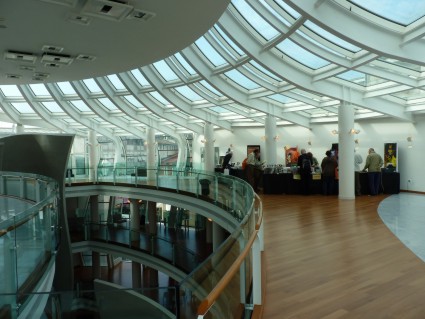
Scenes from the Pordenone silent film festival – clockwise from top left: Kevin Brownlow accepting an award, audience in the Verdi, festival director David Robinson, Pordenone street, festival goers outside the Verdi, theatre seating

The Bioscope has now published its daily diary for all eight days of the 2010 Giornate del Cinema Muto (Pordenone Silent Film Festival). For convenience’s sake, here are the links to each day with the main films covered in each report. The major themes of the festival were Japanese films from the Shochiku studio, three Soviet careers (Abram Room, Lev Push and Mikhail Kalatozov) and French clowns (1907-1914).

Day one (2 October)
Introduction to the festival, Japanese Girls at the Harbour

Day two (3 October)
Seven Seas, Rituaes e festas Bororo, Mutter Krausens Fahrt ins Glück, Striking a New Note, Drifters, Battleship Potemkin

Day three (4 October)
Love Be With Humanity, French Clowns (Boireau), The Nail in the Boot, The Masks of Mer, Le Miracle des Loups

Day four (5 October)
French Clowns (Boireau), Salt for Svanetia, Ginga, A Thief Catcher, Upstream, Chess Fever

Day five (6 October)
Bed and Sofa, Madagascan films of 1898, Corrick Collection, No Rastro do Eldorado, Marizza, Rien Que Les Heures, La Folie des Vaillants

Day six (7 October)
Blind Justice, Shingun, Death Bay, The Great Art of Light and Shadow

Day seven (8 October)
Why Do You Cry Youngsters?, Giuli, Corrick Collection, Die Waffen der Jugend, Robin Hood

Day eight (9 October)
Young Master at University, Moana, A Hero of Tokyo, French Clowns, The Ghost that Never Returns, Wings, final thoughts

Interested in the Bioscope’s reports on the Pordenone silent film festival for 2007-2009? Links to these can be found on the Series page (under Pordenone).

Pordenone diary 2010 – day eight

Verdi theatre, Pordenone, with book fair in the background

And so we come to our final report on the 2010 Pordenone silent film festival. The Bioscope’s editor was on the plane home by this point, but happily our cub reporter The Mysterious X was on the spot to brings this account of day eight’s offering (Saturday, October 9th).


The final day; always a source of mixed feelings. On the one hand, that end-of-a-holiday sensation, saying goodbye to friends both Italian and international that we may not see for another year; on the other that the next day represents a return to normality, the chance of a proper breakfast, your own comfy bed, and more than five hours sleep per night.

But a change of venue this morning – The Verdi being prepared, and the orchestra rehearsed, for the evening show – and we all take the pleasant stroll up the Via Garibaldi to Cinemazero, Pordenone’s arthouse cinema, for the morning. Smaller, more modern, just about enough room for the audience numbers, plenty of legroom if you do get a seat. No pianos this year; we have a morning of silents in their sound versions.

Starting with Daigaku No Wakadama (Young Master at University) (Japan 1933); the notes don’t reveal whether the synchronised music score is from a later reissue print or whether we are already in a transitional period in Japanese terms. The film itself seems transitional though; as in the other Shochiku films we’ve seen this week, there is a tangible sense of a nation sat on the cusp between tradition and modernity, East and West … and not entirely comfortably. The Young Master of the title is a star player of the university rugby team; so we’re western and modern right away; except the rugby club is run along the lines of an officers’ mess in Victorian India; arcane rules of behaviour, regimented discipline, strictly hierarchical … so we’re ripped out of that feeling immediately. The Young Master is also heir to his father’s wholesalery, run on ultra-traditional lines; Father does not approve of rugby, is unsure of the benefits of university versus commercial experience, while the Young Master is not overkeen on inheriting such a rigid existence quite yet; he is, within the constraints of his environment, a practical joker and an apprentice playboy. In such a spirit, he invites young Hoshichuyo, an apprentice Geisha in love with his father’s clerk, to watch a training session incognito … but she is recognised when his sister arrives, goes into hiding in his changing room locker, whereupon she is discovered. She is banished … and so is he, from the rugby club. Further complications ensue (the clerk is betrothed to the sister, and so on) which need to be sorted out before The Young Master can be reinstated in time to play in The Big Game.

So it has the structure of a farce comedy, but is (I assumed anyway) a breezy romantic drama more than a laughfest; it did have comical moments, particularly during the climactic game when we see the legs of a downed player whip out of frame, as he is unceremoniously dragged off while the scrum is being set … it’s possible the political manoeuverings of the rugby club leaders were intended as satirical comedy, if it didn’t register as such with me. It was certainly more light-hearted than other examples we had seen this week, and a good start to the day. Incidentally, the film also featured a nicely anachronistic piece of set-dressing; in the apartment of one of the characters, I think that of the clerk, were a couple of Hollywood talkie posters; a French-language one-sheet for All Quiet on The Western Front, and another for an early Cary Grant film, The Eagle and the Hawk. So, if anyone ever asks you if Cary Grant was ever in a silent film, you can now respond “Only in Japan” …

Moana, from MoMA

The second offering I wasn’t planning on seeing; and as it was getting lively in the Cinemazero I decided to catch five minutes while standing at the edge, before getting some sunshine. Robert Flaherty’s Moana (USA 1926) was being presented with a soundtrack compiled in the ’80’s by Robert’s daughter Monica, who had been in Samoa as a very young girl during the filming; she had taken great pains in recording the sounds of Samoa, and recreating the speech of the on-screen participants, fifty years after the event; the ethics, the anthropological niceties of these efforts I’ll leave to others better qualified, but I can see why she would have wanted to make one of her father’s less well known projects more approachable for modern audiences. This was also being presented as a work-in-progress; I understand no viewable film print exists of this project at the moment; that is, however, the plan; we were watching a DVD being played off a laptop. I understand that this all went horribly wrong for a while after I exited … the feedback I got was not overwhelmingly positive on a number of points.

Back in again for the final film from the Shochiku strand: Tokyo No Eiyu (A Hero Of Tokyo) (Japan 1935), and again, a transitional dialogue-free film with a musical soundtrack. Directed by Shimizu, as were many of the films shown on the first days of the festival, this reverted to the template of a dark, tragedic exploration of the moral codes and hierarchies within Japanese society of the thirties. We meet a widowed businessman with a young son; feeling that he cannot devote enough time to his upbringing he remarries (for convenience, it seems) a widowed mother of two other children. After some initial sibling friction is played out, Father does a bunk; his business was selling shares in dodgy stocks, and he’d been found out. This leaves the mother with no income and no means to support herself, her two children plus this new stepson; she does what a woman has to do in a Shochiku film; she joins the sex trade, surreptitiously, unknown by all her family …

Fast forward fifteen years or so; her daughter is on the point of marrying into a ‘good’ family; they enquire into the family history, and the truth emerges. As does the father, up to his old tricks … at which point SHE feels the need to apologise to HIM for the shame …

At least in this film the outrage of the director towards the status quo is made obvious to a modern audience; this is a sharper critique than the preceding, far longer, films: more pointed, and to the point. The performances, of Mitsuko Yoshikawa as the woman trodden down by the societal rules, debasing herself to keep her family together; and of Yukichi Iwata as the bewildered, then angry son, are superb. While I wouldn’t recommend this film to anyone in terms of entertainment, it
was for me the best of this strand. The bad news is, I’m told, that nearly all of the extant Japanese silents have been shown at Pordenone now; unless there are new discoveries … that’s our lot.

Privideniye, Kotoroye ne Vozvrashchayetsya (The Ghost that Never Returns), from blog.nova-cinema.org

Back down the Via Garibaldi to the Posta for lunch … creature of habit that I am … before the afternoon’s offering, Abram Room’s Privideniye, Kotoroye ne Vozvrashchayetsya (The Ghost that Never Returns) (USSR 1930). It’s a stunning film, a tour de force combination of avant garde elements within an adventure film format – with a more than a dash of revolutionary propaganda, naturally. Our hero is a political prisoner in an unnamed South American country. Sentenced to vegetate in a semi-surrealist prison, a message is got to him that a strike is being planned in the oilfields by his colleagues on the outside; meanwhile his once-a-decade one day’s parole is imminent; the catch is that if the parole’s rules are broken, an armed guard is handily placed to execute summary justice. It becomes a series of battles of wits; between the prison authorities and the prisoner, then individually between the prisoner and his guard, as he jumps a train and treks across a desert wasteland towards home, the oilfields … and freedom ??? It’s utterly unlike any other Soviet film I’ve seen … aside from its politics … it has elements of the Soviet avant garde, but equally hints of Expressionism and Hollywood … a really interesting blend of styles that suited its subject matter, and made it more persuasive than most Soviet propaganda, I would imagine. Certainly more entertaining …

The final presentation of the French Clowns followed; Tartinette to Zizi … I saw a couple, not impressed again, to be honest … a lot of work must have been put into researching these films, and getting the prints here … but the presentation of them in large chunks in alphabetical order chased away all but the most ardent devotee … and lost the films the opportunity of making new converts. A great shame.

So out to the Posta for one last appointment with a Spritz Aperol, to find that the usually milling Saturday evening crowd had been augmented by people admiring a vintage car display, half a dozen beautifully restored thirties vehicles lined up, and, for a fortunate few, giving little joyrides around the town. I don’t think I’ve ever seen so much joy on one man’s face as when Phil Carli returned from his …

Charles ‘Buddy’ Rogers and Clara Bow in Wings (1927), from http://www.nytimes.com

And so to the finale, perhaps even a climax; the full live orchestral presentation of William Wellman’s Wings (USA 1927), featuring the Photoplay print, and the Orchestra Mitteleuropea conducted by Mark Fitz-Gerald playing the Carl Davis score. It’s one of his finest, I think, that great March as the main theme, some nice leitmotifs reappearing throughout as appropriate … very effective.

And, what with all the sound effects of the battle sequences having to come from the orchestra, I would imagine a nightmare to play. Well, Ladies and Gentlemen, they nailed it. It’s a powerful film – not just the legendary flying sequences, or the breathtaking battlefront climax … but the subtle underplaying of emotions, too … sometimes Clara and Buddy go slightly over but Arlen, and particularly Henry B. Walthall convey the suppressed emotion just beneath the surface to great effect.

But it is famous for those war sequences, and deservedly so; on the big screen you get to see so much more of it; on a small screen you don’t see the aircraft growing from the smallest dot to ambush the pontoon bridge, or the staff car … you don’t quite see the battlefield extending right to the horizons … and you’re involved, you’re in the air, or in the mud, with them. And did the shot of the white crosses covering the whole landscape inform the similar shot in Attenborough’s Oh! What A Lovely War? I would just hesitate from calling it the perfect WW1 film; for that we would need a little more Gary Cooper, a little less El Brendel, a good deal fewer animated bubbles in Paris … with the latter, a nice idea that was way overused … actually, that applies to El too. And I struggle to quite see how anyone with Clara living next door would pursue the rather more watery charms of Jobyna Ralston. However much an advantage being from The City conferred. But this is nitpicking; you sit back, let the film and the orchestra take you to a time past; either WWI, or the days in the twenties when such presentations were daily occurrences in the larger cities … it was a terrific way to end the Giornate of 2010.

The Verdi at night

Was it a classic year? Not quite, I feel, though there were, as always, cinematic experiences to cherish, lessons to learn, doors opened to unsuspected areas of interest; films that would surprise, or delight, or shock, but seldom leave without further thought. And certainly films that you will be unlikely to have a second chance of seeing, as here, as they were designed to be seen.

I’m very aware that I haven’t mentioned many of the musicians’ performances; this was entirely down to a happy event chez Sosin (many congratulations, Donald and Joanna) which meant that after his (superb) show with Jean Darling on the Wednesday he hotfooted it back home, and the remainder of the Giornate stalwarts shared out the films between them – and naturally, I failed to take notes as to who ended up playing for which film. Needless to say Messrs Brand, Buchwald, Carli, Horne, and Sweeney were all playing at the top of their game despite there being some challenging films in the programme. The Book Fair was much reduced, perched on the third floor of The Verdi, but I got hold of the one DVD I was after (Cento Anni Fa, the Bologna-compiled set of Suffragette films) so I was happy.

The social side, of course, was as good as ever, new friendships made, old friendships renewed; the Giornate staff and volunteers helpful and patient, the locals as welcoming and understanding (and as amused by our attempts at Italian ) as ever, the food and drink … I look forward to what goodies are to be pulled from the bag for us next year, the 30th renewal of the World’s most important silent film festival. I hope to see you there …


Huge thanks once again to The Mysterious X, who has donned the domino, cast a cloak about their person, and slipped away mysteriously as ever into the inky dark night. I would concur with X’s assessment of the festival – not quite a classic, but funding constraints had their effect upon the programme. We missed the variety that would have been there with another strand of programming (such as the Leo McCarey shorts which were promised early on); with just the one screen available, maybe the Japanese films (some of which were very long) took up a bit too much space. But that’s only by comparison with earlier festivals. The riches on offer were real riches, and there were major discoveries every day. I was particularly encouraged by the new faces I saw the festival – students from Italy and the USA especially – which suggests that the festival is not just showing the same films to the same crowd but continues to reach out to those who need to discover silents for the first time. Tell that to your funders, guys – you are doing the right things.

Pordenone diary 2010 – day one
Pordenone diary 2010 – day two
Pordenone diary 2010 – day three
Pordenone diary 2010 – day four
Pordenone diary 2010 – day five
Pordenone diary 2010 – day six
Pordenone diary 2010 – day seven

Kevin Brownlow honoured

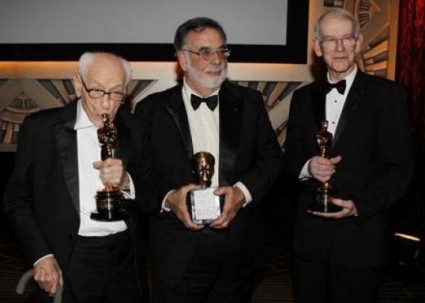
From right to left, Kevin Brownlow, Francis Ford Coppola and Eli Wallach posing after the Governors Awards held by the Academy of Motion Picture Arts & Sciences, 13 November 2010. From Reuters

Warm congratulations to Kevin Brownlow on his receipt last night of an honorary Academy Award for his work in documenting and preserving the films of the silent era.

Brownlow received his award alongside Francis Ford Coppola (receiving the Irving G. Thalberg Award) and actor Eli Wallach at the Academy of Motion Picture Arts & Sciences’ annual annual Governors Awards ceremony. Jean-Luc Godard was also given an honorary award but declined to turn up. Hollywood luminaries such as Clint Eastwood, Warren Beatty, Annette Bening, Oliver Stone, Kevin Spacey and Robert De Niro were in the audience. There are reports on BBC News, Reuters, Entertainment Weekly and the New York Times.

Coppola has gained the all the notices, but Brownlow’s achievement is the real headline news – for silent films, film preservation, the historiography of cinema, and for British cinema – and of course for himself. Kevin took the opportunity to lecture his audience on how American copyright laws had made his work more difficult, while also celebrating the artistry of the filmmakers who made Hollywood the cultural and commercial powerhouse that it remains.

If you are keen to find out more about Brownlow’s career as filmmaker, writer, programme maker and preservationist, I warmly recommend an interview with Brownlow conducted by Ann Harding in 2008, originally published in French but now re-published in English on her excellent blog, Ann Harding’s Treasures:

Update:
AMPAS has published videos of tributes paid to Kevin Brownlow and Kevin’s acceptance speech at the Governors Award ceremony:

There’s also a biography with filmography and a ‘did you know’ on Kevin Brownlow on the AMPAS site.

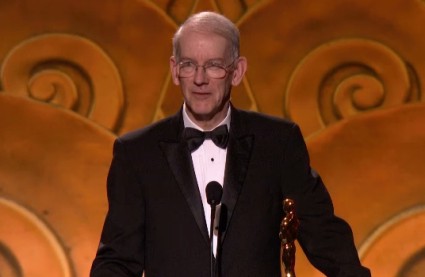
Kevin Brownlow accepting his award, from oscars.org

From Kinetoscope to Kinoscope

70 Oxford Street, London, today (from Google Street View) and in October 1894, from The Westminster Budget, 26 October 1894

If you travel eastwards down London’s Oxford Street, keeping to the north side of the road, you will come across an electronics shop of unprepossessing frontage, currently named McDonald’s. It claims to be the oldest electronics shop in Oxford Street, but it tells you nothing about its place in film history. Because it was here – at 70 Oxford Street – that the first public exhibition of motion picture film took place in the UK. On 17 October 1894 the Continental Commerce Company exhibited the Edison Kinetoscope, a peepshow device showing short films, no more than a minute long, which people could see by peering down through a viewer at a tiny image. No photograph exists of this Kinetoscope parlour (as they were called), but a drawing in a newspaper gives us some idea of the layout and clientele. We know that there were ten machines available, and that among the films on show were Blacksmith’s Shop, Cock Fight, Annabelle Serpentine Dance, The Bar Room, Carmencita, Wrestling Match, and Barber Shop.

Edison’s Carmencita (1894), one of the films featured at the first public film exhibition in the UK

Strictly speaking we’re talking about two different 70 Oxford Streets, since the original building is long gone. Around the time of the centenary of cinema (1995/96) we tried to get a plaque put on the building that now stands there, but the owners weren’t interested, so the plaque was put up nearby at no. 76. Sadly the owners of 76 showed a similar lack of respect for cinema history, and the plaque has now gone. Kinetoscopes themselves didn’t last too long, either. It was obvious to budding film entrepreneurs that films would be a greater attraction on a screen, not least because this would attract a greater number of paying customers, and within fifteen months (in the UK) projected film on a screen was a commercial reality, and the Kinetoscope’s era was over.

Wind forward 116 years and the Kinetoscope is making a sort of a comeback. The biennial Fashion in Film Festival takes place in London 1-12 December and among the side attractions, running 15 November-14 December is Kinoscope Parlour, a project supported by Film London’s Digital Film Archive Fund, which is bringing back something like the Kinetoscope experience to London. Here’s how Film London describes it:

Twelve different locations in the run-up to, and throughout, the festival will host a contemporary re-imagining of the Kinetoscope – presenting a selection of feature films made by the pioneers of early cinema, as well as archive footage that will reveal hidden layers of local cinema history. The six units, specially designed for the project, will be placed in key locations in the capital’s outer boroughs from 15 November, before the Kinoscope Parlour is re-located to London’s central boroughs for the course of the festival. For four weeks, passers-by will be able to transport themselves back to a bygone era through the magic of the moving image.

Between 15-28 November the Kinoscope will be found at these London sites: Castle Green in Dagenham, CREST charity shop in Walthamstow, Kilburn Library, Lewisham Library, Queen’s Market in Upton Park and Wolves Lane Nursery in Wood Green. Between 29 November-14 December it will be located at BFI Southbank, The Horse Hospital in Bloomsbury, Somerset House, the Victoria and Albert Museum, Viktor Wynd’s Little Shop of Horrors (Hackney) and The Wapping Project. Further details including a map are on the Fashion Film Festival site.

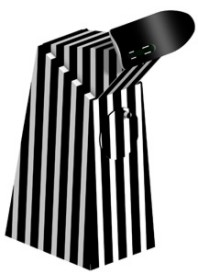
It won’t be too difficult to spot the Kinoscopes as they are strikingly designed in black and white stripes by designer Mark Garside. There are six of them, one for each location, unlike the original parlour idea where ten were arrayed together in rows. The original Kinetoscopes were coin-operated; the Kinoscopes are free and you have to turn a wheel to view the films, which through “cutting-edge digital technology” allows you to control the speed of the films. The films themselves are a mixture of productions from Georges Méliès, the Lumière brothers, Thomas Edison (the only one of the films originally designed for showing in a peepshow), Gaston Velle, Segundo de Chomón, Robert Paul, Ferdinand Zecca and Alice Guy-Blaché, with an emphasis on “dress manipulations and magical transformations” to tie in with the fashion on film theme. Additionally there will be archive film of London’s cinema history up to the 1930s. The full list of films, indicating which ones will be available at which locations (you won’t get to see them all on the one Kinoscope) is also on the festival website.

Silent films also feature heavily in Fashion Film Festival itself, under the thematic title of ‘Birds of Paradise’. Early films are paired with experimental films on Kenneth Anger, Jack Smith, Ron Rice, José Rodriguez-Soltero, Steven Arnold at Tate Modern; the Barbican is showing diva Lyda Borelli in Rapsodia Satanica (1915-17), Germaine Dulac’s La Princesse Mandane (1928); and Michael Curtiz’s Red Heels (Das Speilzeug von Paris / La Poupée de Paris) (1925) and The Golden Butterfly (Der Goldene Schmetterling); while BFI Southbank has a panel event The Gossamer Wings of Early Cinema, and is showing Cecil B. De Mille’s Male and Female (1919) and The Affairs of Anatol (1919), the Nazimova films The Red Lantern (1919) and Salomé (1923), Josephine Baker in La Revue des Revues (1927), E.A. Dupont’s Moulin Rouge (1928), Alexandre Volkoff’s Secrets of the East (Geheimnisse des Orients / Shéhérazade) (1928) and Jean Durand and Berthe Dagmar’s The Island of Love (l’Île d’amour) (1928). Fashion or no fashion, it’s an impressive line-up of silents, most of them rarely shown.

Finally, over 1-12 December, Somerset House is hosting Hemline: the Moving Screen, an artwork by Jason Bruges Studio on belle époque dancer and film performer Loïe Fuller, which they describe as “a light sculpture that uses three-dimensional volume as a ‘moving screen’ to approximate the swirling movements of fabric in a serpentine dance”.

Dates and booking details for all these screenings and events are on the festival website.

The colonial gaze

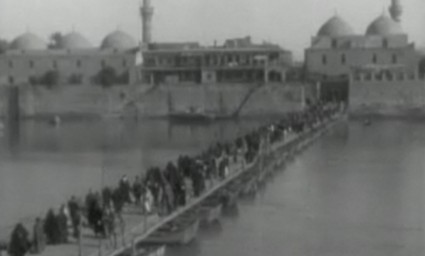
Baghdad (1928), made by British Instructional Films, from http://colonialfilm.org.uk

Colonial Film: Moving Images of the British Empire is a newly-published website supplying information on films about the British colonies. How quaint that sounds. But for a large part of the twentieth-century (and therefore for a large part of the time that there have been motion picture films) the British Empire and its aftermath was assiduously documented on film, dramatised on film, and film traffic between the colonies was much debated and legislated over.

The result is a substantial archive of film about the Empire that is no more which has become a rich source for socio-politcal historians as well as film historians with an interest beyond the familiar. It was to serve such an audience that the Colonial Film project was established, funded by the Arts and Humanities Research Council and organised by Birkbeck College and University College London in partnership with three film archives: the BFI National Archive, the Imperial War Museum, and the British Empire and Commonwealth Museum.

The chief result of this three-year project is the website, at the heart of which is a database of some 6,000 colonial films, taken from the records of the three archives. A lot of these records are available elsewhere i.e. on the databases of the BFI and the IWM, but there is obviously some convenience in bringing them together under this particular subject. The project researchers have added a great deal of background information for some the films, beyond the shotlists that the archives previously produced (some of them typed by these very fingers, a number of moons ago), including ‘context’ and ‘analysis’ sections, which put the films in a modern perspective. The project has also digitised and made available online some 150 titles.

The Stoll Film Company’s Nionga (1925)

The films catalogued range in date from Arrivée d’un train à Melbourne (1896) to RAF Gibraltar Flight Safety Commercials (2005). Our interest, as always, is in the silent film material, and of those 6,000 around 750 are from the silent era, and 32 are available to view online. The films described included actualities, newsreels, drama-documentaries, travelogues, industrial films and fiction films, all evidence of the abiding interest the Empire had for British filmmakers and (to a degree) British audiences.

What I want to highlight here are the films that are available to view, because they are fine collection in themselves. The site comes with some impressive searching tools, including an interactive map of the world for searching by country, and searching by theme (“Empire and Administration, Empire and Development, Empire and Education, Empire and Health, Empire and Independence …”), production company, genre and event. The advanced search option lets you select by date range and narrow searches down to films you can view, so select 1896-1929 and tick the box that says “show only works with videos” and there you are.

Among the treasures to view are three silent feature films, examples of the remarkable (and curiously British) mini-genre of dramas set in far-flung lands (usually Africa) featuring native performers. There is Palaver: A Romance of Northern Nigeria (1928), made by Geoffrey Barkas for British Instructional Films (“Filmed amongst the Sura and Angas people of the Bauchi Plateau in Northern Nigeria, where the rivalry between a British District Officer and a tin miner leads to war”); the Stoll Film Company’s Nionga (1925) (“Nionga, a chieftain’s daughter, is induced by a vindictive witch-doctor to persuade her betrothed lover, Kasari, to plot the destruction of a neighbouring tribe”), for which the filmmaker is not known; and Stampede (1930), made by the adventurers Majour Court Treatt and his wife Stella, filmed in the Sudan (“The film tells the story of Boru, adopted into the ‘Habbania’ tribe after his mother is killed by a lion, who grows up with the Sheikh’s son, Nikitu”).

One watches these curious mixtures of travelogue, ethnography and melodrama with both fascination and bemusement, the latter because to is hard to see how they were ever viewed as commercial propositions. The films attempt to be liberating in how they tell stories of African life with African performers, but the colonialist attitude is revealed in patronising titles, the portrayal of Africans as impressionable and child-like, and the choice presented of good (because paternalist) and bad (because they lead Africans astray) whites in Palaver. Nionga has an all-African cast and so offers the opportunity for a fresh point of view, but titles promising a drama of “a crude life of simple people” and “a glimpse into the minds of Savages” demonstrate that the film is constructed entirely from a Western White point of view. Stampede (which has a music track and commentary) was made by travel filmmakers who added a fictionalised element because it was the only way for them to produce a commercial film. In the end one watches these films not for the dramas imposed upon the performers but for the incidental details of African life that the dramas cannot entirely obscure.

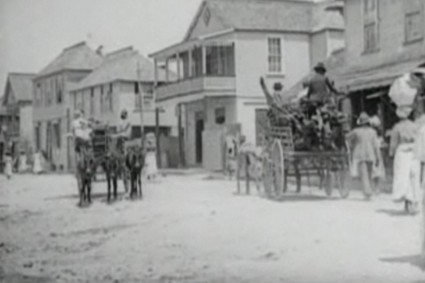
Montego Bay to Williamsfield, Jamaica (1913)

There are other short fiction films: the resoundingly gung-ho How a British Bulldog Saved the Union Jack (1906) and Edison’s drama of the Indian ‘Mutiny’, The Relief of Lucknow (1912). Among the non-fiction films and such gems as the Charles Urban Trading COmpany’s A Trip through British North Borneo (1907); British Instructional Film’s engrossing West Africa Calling (1927); another BIF travelogue of particular interest today, Baghdad (1928); Gaumont’s spectacular record of the 1911 Delhi Durbar ceremonies marking the coronation of King George V; and another Charles Urban production, the Kineto company’s Montego Bay to Williamsfield, Jamaica (1913), a subject apparently filmed in both Kinemacolor and monochrome (alas, only the monochrome survives).

This is an impressive resource, though some are going to find it frustrating to be faced with so many catalogue descriptions that aren’t accompanied by the films themselves. Other might find the contextualisation are little heavy on the political correctness, anxious that we should only interpret these films in the correct way. Ultimately most are not going to be interested in the lessons – either those imparted by the original colonialist filmmakers, or those deduced by modern commentators from a post-colonial point of view. It’s what we are allowed to see of the people, the landscapes, the industries, the townscapes that lingers in the mind. The camera came to observe and report back, but what endures are the individuality and dignity of its subjects and the difference of their cultural milieu. The camera ultimately serves them.

Go explore.

Carl Davis and The Gold Rush

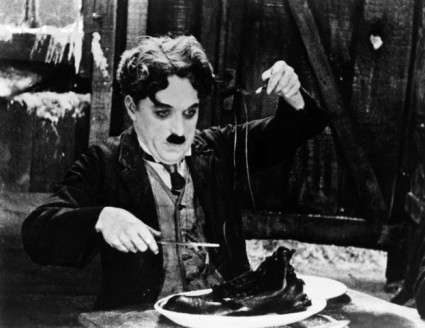
Here’s news of a special screening of Charlie Chaplin’s The Gold Rush on 3 January 2011 at the Royal Festival Hall in London, with Carl Davis conducting the Philharmonia Orchestra in his reconstruction of Chaplin’s own score:

The Philharmonia Orchestra, conducted by Carl Davis, plays a live accompaniment to Charlie Chaplin’s silent film The Gold Rush in this special performance at The Royal Festival Hall on 3 January 2011, as part of the Southbank Centre’s Christmas season.

Featuring Chaplin in his quintessential Little Tramp role, the film was described by The New York Times upon its 1925 release as ‘a comedy with streaks of poetry, pathos, tenderness, linked with brusqueness and boisterousness … the outstanding gem of all Chaplin’s pictures’. The Gold Rush is one of Chaplin’s most perfectly accomplished films. Though he was often changeable in his affections for his own work, he would often declare that of all his films, this was the one by which he would most wish to be remembered.

Chaplin reconstructed the film in 1942 upon the advent of sound to the cinema, removing scenes (most famously eliminating a kiss with the leading lady at the end so as not to upset his wife!) and recording a musical score, which was nominated for Academy Awards.

This concert revisits the original 1925 comic masterpiece, with a score reconstructed and conducted by Carl Davis, who accessed archives of Chaplin’s meticulous notes and found sketches of music for the removed scenes.
It is ten years since The Gold Rush was last performed in London, also at the Royal Festival Hall.

Carl Davis (CBE) was born in New York in 1936 and came to the UK in 1960. Davis is a true music-maker and all-round musician, as both conductor and composer. He has changed the face of concerts as we know them, making classical music both accessible and varied and is a consummate showman and a first rate entertainer. His career has spanned many genres, from silent film performances to his incredible popular themed concerts such as ”An Evening with James Bond” and “Oscar Winners”. He is perhaps most well known for his music for television including the series The World At War, BBC’s Pride & Prejudice and Cranford, ITV’s Goodnight Mr. Tom, and the award winning film, The French Lieutenant’s Woman.

Davis has also been the driving force behind reinventing the silent movie for a new generation. Following his work on Thames Television’s 1980 “Hollywood – A Celebration of the Silent Film” series, he created the classic and much-lauded five hour symphonic score for Abel Gance’s 1927 silent epic “Napoleon”. Since then, he has written or reconstructed scores for some of the most famous pre-talkies such as “The Phantom of the Opera” and “The Iron Mask”, as well as many of Chaplin’s most famous movies such as “The Kid”, “Modern Times” and “The Rink” which have been performed all over the world.

Monday 3 January 2011, Royal Festival Hall, 7pm
Carl Davis, conductor
Philharmonia Orchestra
Charlie Chaplin The Gold Rush
Tickets: £20–£45
Ticket Office: 0871 663 2500
Online booking: www.southbankcentre.co.uk

More information and booking details (including some pricey tickets folks, but heck, it’s near Christmas) on the South Bank Centre site.

Pordenone diary 2010 – day seven

Donald Sosin rehearsing before a screening at the Giornate del Cinema Muto, Pordenone

We’ve reached the penultimate report of the 2010 Giornate del Cinema Muto, and while I was strolling about the streets and blustery sea-front of Trieste, our anonymous reporter, known only as The Mysterious X, was on the spot at Pordenone to provide this account of the goings-on of Friday 8 October:


A quick scurry from the hotel, via the cafe for a quick espresso doppio, and to grab a bottle of mineral water for the cinema; for starting at 9.00am, we had the latest instalment from the Shochiko strand of the Giornate, Wakamono Yo Naze Naku Ka (Japan 1930) (Why Do You Cry Youngsters?).

By this stage of the Giornate we had discerned that Shochiku specialised in contemporary dramas of 30’s Japanese life, and particularly the culture clashes generated by modern western influences, seemingly largely from Hollywood, with the more traditional Japanese moral codes. And with a pacing that could be described as languid … and this film was no exception to the established trend. But intriguingly, the clash here, although along generational lines within a family, does not happen in quite the expected way. We meet the family – widowed father, son and daughter, happy and traditional in
outlook; until the father decides to remarry … his new, somewhat younger bride is a Modern Girl, with Modern Outlook and Modern Interests … a panning shot of the spines of the books she has brought to the house reveal titles of works of sexual psychology, shocking to the late teenaged children … Freudian, indeed. After episodes of increasing friction, the children flee the nest and set up house in a poorer neighbourhood, next to a family whose father is in the process of selling his pretty daughter into the sex trade.

All beautifully staged, and shot (although the picture quality is occasionally marred by print damage; not nitrate decomp I don’t think, but many of the Japanese films this week displayed the same type of damage, the effect it has is of watching a film through a sooty snowstorm) but the themes were becoming familiar; in a way these films were becoming as interesting in the anthropological sense, as we learned through the week how the dress codes worked, the significance of whether a suit or kimono was being worn to work, whether the suited man would change into kimono at home or not, which clothing denoted which level of the strict hierarchy in the Japanese sex trade, from Geisha, to dance hostess, to club
girl, to streetwalker … because representatives from the industry appeared in nearly all the films we saw. Not mentioning the curious – to western eyes of 2010 – 1930’s Japanese ideas of private and public morality. What constituted a happy or just ending in a Shochiku film seldom matched our modern Hollywood sensibilities. But, hey, we come here to learn … and the length and pacing of these films encourages the audience to think as we watch.

Mie Yamashita, who had played exceptionally beautifully to the Japanese films all week, had returned home by this point, so bravely stepping into the pit for this 3¼ hour marathon was our very own Stephen Horne, flute at hand, performing beautifully as ever, his style (and his partial use of the flute) certainly suiting Japanese silents.

Out into the noonday sun; as interested as I am in early cinema, I didn’t fancy half an hour of medical films, recording injuries, conditions and experiments in treatment, just before lunch [shame – Ed.]…

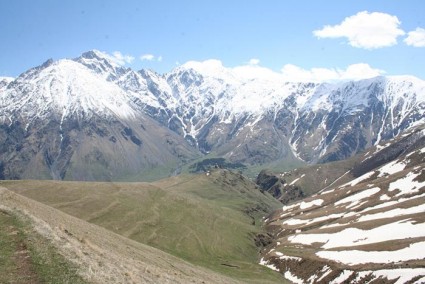
It’s been a bit of a challenge finding illustrations for this post, so I’ve given up looking for film stills and here’s a modern-day photograph of a harsh Caucasian landscape instead …

But back straight after, for Giuli (USSR/Georgia 1927) a Georgian rural drama directed by Lev Push and Nikolai Shengelaya, and set in the wild rocky Caucasus, where semi-nomadic clans survive by sheep-herding, and live with their own strict codes of behaviour, and feuds simmer deeply. Giuli is the daughter of an elderly shepherd, who promises her in marriage to the local (and equally elderly) clan chief … whereas she is in love with a more lowly, but virile, handsome etc. shepherd.

If the plot is hackneyed, and pretty much interchangeable with films about any society and at most times, this film was unmissable due to the spectacular cinematography of director-to-be Kalatazov, the use of the harsh Caucasian landscape, and the equally rocky and craggy
faces of the cast; the elderly males crevassed with wrinkles, the younger men with the most incredible aquiline profiles, spectacular moustaches and jutting chins, but with the humanity of the central performances giving heart to the film. All told a welcome antidote to the propagandistic films of the Soviet era, which personally leave me quite cold.

One of the highlights of the last few Giornates has been the series of films, discovered in Tasmania and preserved by the Australian national film archive, representing the repertoire of the Edwardian-era Corrick family’s touring cinema show, a mixture of self-made films, and those imported from Europe and the US. This latest batch – and we are promised that there is more to come – were every bit as interesting as those shown in previous years.

The programme started with the state funeral of New Zealand Premier Richard Seddon, the man who managed to keep New Zealand politically independent from Australia, and a huge figure in New Zealand’s politics. Shot by a local cameraman in the style of state funeral films everywhere, this also gave a tantalising glimpse of Edwardian Wellington as the cortege passes. Next up was what appeared to be a film recording a vaudeville stage act; Bicyclette Presentee En Liberte (1906) featured, in a proscenium setting, two gentlemen – twins, possibly – and their performing bicycle; that is, the bicycle performed while the men watched, one assumes by wires, but if so, very well hidden. There followed a short moral tale, The Waif and The Statue (UK 1907) directed by Walter Booth; a homeless starving girl is rejected at a church door; she shelters from the snow under a statue of Hope – which magically comes to life and finds her a benefactor to give her a safe home. Similar in style to some Edison films I’ve seen, the special effects are very well handled, and nicely played in a tableau-like manner … I wouldn’t be at all surprised to find that this started life as a lantern-slide series. Back to France, and Chasse De Sanglier (Wild Boar Hunt) (France 1904) a seemingly heavily staged representation of hunting wild boar with dogs … Le Diner Du 9 (Dinner on the Ninth) (France 1909) was more amusing – a comedy of manners – which had the luxury of 10 minutes to develop in – where the confusion over dinner dates combined with the need to keep face, means the lead character (played by Charles Prince) ends up having three dinners that night … and in houses where the host was not expecting a guest. Nicely subtle, and not at all broad, very little that could be described as slapstick; quite sophisticated for an ’09 film comedy, possibly betraying its origins as a stage play of the era. Deux Braves Coeurs (Two Brave Men) (France 1909) was in contrast a less sophisticated mini-melodrama of civil war and self-sacrifice; following that were two similar films of a river-borne procession in Burma, filmed and distributed by Charles Urban; and Edwin S. Porter’s Life of a Cowboy (1906) which, apart from a final sequence that seemed to come from another drama entirely, was seemingly a filmed version of sketches and scenes performed by a Wild West Show of the time; if you read the posters or adverts of the shows from the era, then every little vignette – Rowdies making a greenhorn dance, Indians attacking a stagecoach, lasso tricks … all present and correct, and no interlinking plot whatsoever. Les Fleurs Animées (France 1906) was another extravaganza of hand-colouring and special effects from Pathé and the works of Segundo De Chomon; here anthropomorphic flowers take revenge on a man responsible for the destruction of a flower bed.
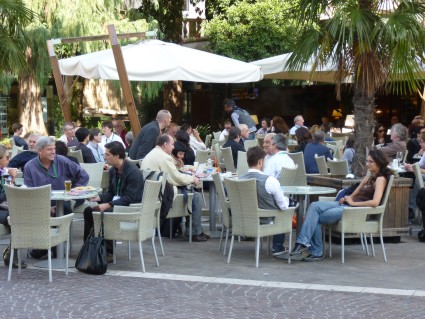
Festival-goers at the Posta café doing what festival-goers like to do best

The programme finished with a film not from The Corrick Collection, but a new discovery by and from a private archive in London; Those Jersey Cowpunchers (US 1911) – or rather, and unfortunately, the first reel of two – is a comedy from Nestor, one of the real Hollywood pioneer outfits, and supposedly based on their experiences in trying to make westerns; in the film, the Billiken company head west from their New Jersey studio to make use of western locations and personnel, only to find there are no real cowboys left … they are all in the movies now; they wire back to base, to send some Eastern actors to play the roles; said actors are just applying their awful ‘Indian’ make ups when reel one finishes … it may just be that we are thus cheated of a delicious satire on early Hollywood racial stereotyping … we may never know …

After a quick break, another new discovery being introduced to the World … Die Waffen der Jugend (Germany 1912), and much anticipated as this three-reel comedy was the directorial debut of Robert ‘Caligari’ Wiene; and it really didn’t disappoint; the youth of the title is a headstrong, tomboyish daughter of a middle-class father who can no longer cope with her; he packs her off to boarding school where she remains a handful; a midnight mandolin recital is one thing, but getting into a fight with a fellow inmate and drawing a clasp knife from her stocking top … is another. Eventually she makes her escape in the traditional sheet-rope manner, and wanders the streets of the local town … wherein she draws the attentions of two criminal beggars, squatting in a dingy basement. They induce her to come with them, and keep her prisoner … which is their big mistake. In a Stockholm-syndrome-in-reverse scenario, in an effort to please her, the criminals smarten themselves up, clean up the basement, and eventually when she is found by the police and reunited with Father, decide to go straight and, much to their own horror, accept a job offer from him. A delightful, energetic and downright funny film; highly accomplished for a directorial debut, and with a superb performance from Gertrud Grabner as the beggars’ teenage nemesis; if IMDb is to be believed, this was the second – and final – film of her career … the internet fails to reveal what became of her. In its small understated way, one of the films of this year’s Giornate.

Skipping a modern documentary on Kalatozov, the director of The Cranes Are Flying but also masterful silent-era cinematographer for an extended dinner break, and brace myself for the evening events; the prizegivings, and sponsors speeches, before the spectacle that is Doug Fairbanks’ Robin Hood. The speeches from the sponsors and local dignitaries were succinct, and made welcome noises about their continued support, financial and moral, for the continuance of the Giornate; times are harder in Italy than in some other countries, and events on the level of Pordenone and Bologna do not come cheaply; I trust these people do actually realise how much they are doing for film culture in Europe and the World, and how grateful we are that they continue to support the events. Inevitably, given the brevity of the above, the presentation of the Prix Jean Mitry did drag on a bit; a shame as the recipients, André Gaudreault and Riccardo Redi are deserved recipients, and made good speeches; it was their introductions to the audience by the presenters that were overlong, and not entirely necessary; surely a written tribute and career overview could have been printed in the catalogue instead? A quick presentation to the Haghefilm/Selznick School Fellowship recipient Karin Carlson, was followed by the two films she had restored; two 1910 Essanay one-reel comedies, Mulcahy’s Raid and A College Chicken; both sprightly films, surviving in excellent picture quality if possibly missing some frames, Mulcahy’s Raid is the tale of a stereotypical Irish American cop enlisting passing actors to round up an illegal gambling den; A College Chicken was the tale of a stolen chicken passing through various hands before ending up as a contraband dorm feast at a co-ed private school. A little amuse-bouche for the main course to follow.
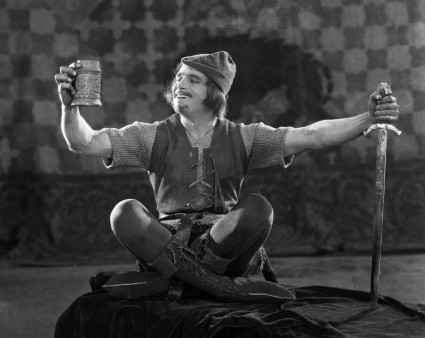
Douglas Fairbanks in Robin Hood (1922)

Robin Hood (USA 1922); starring Douglas Fairbanks. On paper, what could possibly be a greater combination of star and vehicle? And yet … it doesn’t quite live up to its potential. It’s beautifully shot, the grandeur of the sets is stunning, the stunts are phenomenal, Doug is Doug .. .but we do have to wade through some stodge to get to the meat. It’s a full hour before we reach Sherwood Forest; the Merry Men are in place, there is none of the delineations of their characters that we get in the Errol Flynn version … but a load of exposition on how much King Richard and Maid Marian are in love with Robin Hood … honestly, sections could be retitled as a bisexual love triangle. Which would make an interesting film, but it was not what we were as an audience turning up for, in 2010 any more than 1922.

Even the spectacular sets were underutilised; is it me being fanciful speculating that the makers of the later Flynn version saw the former version’s immense spiral staircase and wondered why a duel wasn’t being fought there? The Rathbone/Flynn duel was iconic, the set for it was built in ’22 … but with no fight. If it sounds like I’m criticising a 1922 film for not being a 1938 film, perhaps you’re right; but I do find it surprising that Doug Fairbanks, of all people, could lose sight of what made his earlier films so captivating and so popular, and blow the opportunity the subject afforded. At 2¼ hours, the film is 45 minutes too long, and while in ’22 there could be an excuse for thinking longer = better, it needed someone taking Fairbanks aside – and it must have been him making the artistic decisions – and suggesting heavy cuts. Fairbanks did, I think, learn the lesson … his later adventures are far more taut and packed with action … but the definitive telling of the tale, using lessons learnt from the ’22 film, would be in three-strip
Technicolor and not tinted and toned.

The final show, more French clowns, letters O-S – yes, they were being shown alphabetically by character name all week – started
around an hour after the scheduled time, around ten to midnight; sadly, this was also the showcase for the aspirants from the Piano
Masterclasses that had been running all week. Obviously this was not deliberate, but neither was it fair … I believe some thought has to be
given to avoiding a future repetition, as it was simply too late in the day for most of the potential audience. I know it was for me.


Thanks once again, Mysterious. Some food for thought there. I did actually return from Trieste for the Corrick film show because it included one (not two as billed) of Charles Urban’s films of Burma from 1903, part of a series of films shot by H.M. Lomas for Urban none of which was known to survive before now. Unfortunately it hasn’t proved possible as yet to match the film (which shows a succession of richly-decorated boats, some of them bearing Western tourists, being rowed along a wide river) to any title from the Urban catalogue.

The final day’s report will follow soon.

Pordenone diary 2010 – day one
Pordenone diary 2010 – day two
Pordenone diary 2010 – day three
Pordenone diary 2010 – day four
Pordenone diary 2010 – day five
Pordenone diary 2010 – day six
Pordenone diary 2010 – day eight

Pordenone diary 2010 – day six

Pordenone at night

Thursday 7 October loomed, and your scribe was packing his bags. I had decided that five days in Pordenone at the Giornate del Cinema Muto was enough for me this year, and I was heading off to spend a couple of days in beautiful Trieste. But I could not do so without having set in place plans to ensure that the Bioscope could provide its habitual comprehensive coverage of the festival. You may remember that last year, when I didn’t attend the Giornate, the Bioscope reports were written by an anonymous reporter, subsequently dubbed The Mysterious X. Happily X was at the festival this year and just as keen to pick up the quill pen once again, while just as insistent on maintaining his anonymity. And, by a remarkale coincidence, the first film he reports on is a Benjamin Christensen masterpiece, the film the great director made after producing The Mysterious X … spooky, eh?


Bright and early – well, early – to the Verdi for a film I had anticipated since seeing it had been programmed; Hævnens Nat (Denmark 1916) (Blind Justice) an early feature directed by Benjamin Christensen; Pordenone in the past has given me a taste for Scandinavian silents; on the whole, the lighting and camera techniques seem to me, to have been way in advance of the rest of the world … and one sequence in particular in this thriller demonstrated that to me yet again.

After a strange prologue where we see the director demonstrating an illuminated model of the house where the main action of the film is to take place, we’re into the action; Strongman John is on the run, for a crime he didn’t commit and with his very young son; hiding out in a barn, he decides to try and steal milk from the main house, but is discovered by the young daughter of the family; he explains the situation, and persuades her not to betray him … but the awakened father forces the story out of her, John is captured while vowing revenge, and jailed …

Hævnens Nat (1916), with director Benjamin Christensen playing Strongman John, from http://www.dfi.dk

Fifteen years later, John has suffered physically and psychologically inside the prison, but is now out; naively, even unknowingly, he falls in with a gang of burglars intent on robbing the same house … fifteen years on, the girl is married and now the mistress of the house with a young family … in his confused state, John starts to exact his revenge, not knowing that one of the children is his now-adopted son …

The setting of the film – an ornately reproduced and highly realistic mansion, as introduced proudly at the start – almost becomes a character within it; while light and airy during the day, it seems both claustrophobic and yet flimsily undefendable as night falls and menace lurks. The bravura sequence occurs at the point where the invader spies the young woman through the keyhole; we see it from his point of view, the young girl vignetted, deep focus, within the ornate Edwardian escutcheon, the layers of the lock’s mechanism visible; she senses the viewer’s presence and moves out of shot … seconds later the keyhole cover is slid across our view from her side of the door. We cut to a view of the room’s interior … the woman seemingly
paralysed with fear; the camera slowly tracks back, initially revealing the french windows we are looking through … and then the silhouetted shape of the hulking intruder, seeing the same thing … and those french windows look so fragile now …

It’s a powerful shot now; through the use of imaginative sets, superb lighting and a dramatic camera move, the audience is utterly involved in the menace at work … in the voyeuristic sense, and in the complete powerlessness of our situation as an audience, let alone the situation of the girl in the room … it would be impressive in a film made ten or
twenty years later; stunning in a film of 1916. I won’t reveal the ending; that would spoil things for you if you have yet to see the film; if not screening near you, it’s available on DVD from the Danish Film Institute with a Neil Brand piano score.

Shingun (1930), from http://www.cinetecadelfriuli.org/gcm

Straight on into the next film in the Shochiku strand of Japanese dramas, Shingun (Japan 1930) (Marching On) … in the programme billed as being the Japanese near-equivalent, and inspired by, Wings and The Big Parade … well, up to a point … it starts delightfully; a farmer’s boy, obsessed with his balsa-and-paper flying models and with dreams of real aircraft, develops a friendship with the daughter of the local squire, who introduces the lad to her pilot brother and his flying officer friends; through hard work, and despite the handicap of a lowly class status, he eventually succeeds in qualifying as a pilot and joining the air force. So far, so good, a peacetime Wings story, a cute cross-class nascent love story developing through fine performances by the two leads; Denmei Suzuki and Kinuyo Tanaka were becoming old friends to us by now … the pairing obviously a prized asset to the studio. But right at this point the film takes the most sinister turn, particularly with the hindsight of history. “Is War Likely??” asks a title (I may be paraphrasing, but not wildly) “Yes, Japan has suffered enough indignities” and so we march into the final third of the film …

Well, from here, The Big Parade or Wings, it ain’t. The film-makers might well have seen them, but failed to learn much from them in how to construct either feasible aerial or battlefield sequences. Unlike Wings, the aerial sequences are constructed from a combination of appalling model work – honestly, they look like they were shot using the boy’s balsa models from the start of the film – and laughably bad back projection, as the gunner from a doomed plane passes vital strategic information to another by wing walking and handing it to his opposite number … our farmboy hero. Inevitably, this second plane, piloted by the girl’s brother, is brought down into the battlefield – full of shellfire but little else – but look! A convenient Harley Davidson and sidecar for our hero to requisition, and to load his wounded friend into … after a few minutes bouncing around the field – if the pilot wasn’t seriously injured before, he would be now – they get caught in an explosion, and the bike wrecked … but look!! A convenient horse, grazing in a contented manner, but about to get a rude shock as two airmen clamber on board to complete their getaway … except more shrapnel comes their way, and the horse is abandoned … but look!!! A convenient artillery tractor, abandoned in full working order, it seems, and our heroes complete their escape to safety at around 1½ miles per hour … the strategic information is delivered to the relevant Colonel, the battle is heroically won, etc. Which would be fairly hilarious, except for the nagging thought that the massive amount of military hardware on and personnel on screen, supplied by the Japanese army, are rehearsals for the invasion of Manchuria that would happen within the year. If a silent film with such a nationalistic propaganda theme existed from, say, Germany in 1938, would it be shown with such alacrity? I wonder … anyway, it could have been a great film; it started with real charm, but it did seem as if the film was kidnapped by a propaganda ministry two-thirds of the way through.

The film screened after lunch, Bukhta Merti (USSR 1926) (Death Bay), was an Abram Room-directed film set in the Russian Navy at the time of the Russian Civil War, and described by Ian Christie in the catalogue as a “Propagandist adventure story” … well, I had just sat through one of those, so I gave it a rest, and decided a Spritz Aperol in the Italian sunshine, and a bit of a natter with like-minded people held more appeal. These things happen on the Thursdays, I find … shamingly, I enjoyed the chatting so much that I decided to forego the Jonathan Dennis lecture, given by former Channel Four supremo Jeremy Isaacs, and the man who green-lit Kevin Brownlow’s Hollywood series; for which the world remains grateful; on the basis that he had given a talk locally and recently, so I felt no desire to hear it again; a mistake, as this was a totally different event, and took the form (I was told subsequently) of an extended tribute to Kevin Brownlow, David Gill, and the making of Hollywood; that I would loved to have seen. A mistake on my part … these things, too, happen on Thursdays …

But no missing the night’s big event; the farewell performance of Laura Minici Zotti and her magic lantern show La Grande Arte della Luce e dell’Ombra (The Great Art of Light and Shadow), culled from the enormous collection she has established at her museum in Padua, the Museo del Precinema; the transportation of priceless fragile glass slides no longer being a good idea; Madame Zotti acts as lanternist herself (resplendent in a late-Victorian blue-black shot-silk evening dress, bustle and all) while a lecturer read from the stage; the Verdi had been heavily adapted to enable the lantern to display on the cinema screen, which looked fine from where I was sat, but I did wonder quite how much some people saw from their positions, what with the Verdi’s sightlines.

The show was terrific; the slides spectacular, particularly those examples where, by use of fades, daytime scenes transform to night as we watch; not to mention special slides designed to hold live insects, and live small fish, swimming across the screen … extraordinary. The stalwart of every magic lantern show I’ve ever seen seem to be the kaleidoscopic slides … here they were spellbinding; we really were getting the highlights of the collection. If there was one slight personal disappointment, it was that it was presented very much as a history lecture … which is fine as an approach, obviously; but I was hoping for a recreation of a big magic lantern show of the era, and that wasn’t quite what we saw. But what we saw was unforgettable too.

There was then a fair gap in the programme as the Verdi was turned back into its cinema format, ready for the late screening of more of the 1910’s French comedy shorts … so I took in some air, honestly meaning to take in the second half of the set which included some Max Linder … and possibly the 1hr 37m Shochiku drama Kinkanshoku (Japan 1934) (Eclipse) due to start at 11.20pm … but I failed you. I feel deeply ashamed …


No shame, please, Mysterious. I haven’t made it to a late screening at Pordenone for years now. Many thanks for an attentive and illuminating account. The report on Friday’s offerings will follow soon (hopefully with just as many eye-catching ellipses, semi-colons and classy use of words like ‘escutcheon’).

Pordenone diary 2010 – day one
Pordenone diary 2010 – day two
Pordenone diary 2010 – day three
Pordenone diary 2010 – day four
Pordenone diary 2010 – day five
Pordenone diary 2010 – day seven
Pordenone diary 2010 – day eight