Momentos

When we champion the modern silents here at the Bioscope, we see them fall into two broad categories. Category one is pastiches of the traditional silent film stle (or what is generally imagined to be silent film style). They are shot in black-and-white, with exaggerated mannersisms, playing with the idea of modern themes dressed up in a silent style.

Then there are modern silents which are a mode of filmmaking that doesn’t look back to the 1920s at all, but rather seeks to strip away dialogue because image is all. It is a form that is starting to flourish with the proliferation of video sites and the chances for filmmakers to make their statements with short films that have the potential to reach thousands more than will ever see them on the festival circuit alone. There is also the strong influence of pop videos underlying such films, where the dumbshow complements the song with telling images that speak volumes by themselves.

All of which is preamble to the above film, Momentos, the latest production on Vimeo from Portguese filmmaker Nuno Rocha. It is sentimental but most expertly done, with a subtle plot twist, and comes equipped with an in-joke since the video we see the lead character laughing at is Rocha’s earlier production, the mesmerising 3 x 3, previously highlighted here on the Bioscope. It is well worth seven minutes of your time, I promise you.

The age of colours

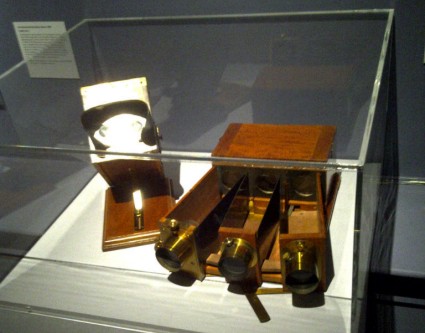
Kinemacolor projector (left) and Kinemacolor camera, on display at the Capturing Colour exhibition at Brighton Museum & Art Gallery. The projector is from the Sarosh Collection at the National Media Museum; the camera is from Hove Museum

This is the age of colours, it is colour everywhere.

So wrote Charles T. Kock, in a 1909 essay surveying the history and philosophy of colour printing in Penrose’s Pictorial Annual. Kock was marvelling at number of forms of colour reproduction – in printing, clothing manufacture, building, household goods, photography and cinematography. The interesting inference to be made is that it would have been within the experience of his readers to remember a time when the world was not filled with colours; a monochrome Victorian age from which the Edwardian era had gratefully escaped.

Of course there had always been colour, but it was the reproducibility of man-made colour that was brightening Kock’s world. The roots of this can be traced back to the 1850s. It was in 1856 that William Henry Perkin, at the tender age of eighteen synthesized an artifical dye, mauveine, which could be applied to clothes to give an intense purplish hue (mauve). Previously clothes had been coloured used natural dyes, which often lacked stability. Now lasting colours through aniline dyes could be created, and the process industrialised. The year before, in 1855, physicist James Clerk Maxwell demonstrated the principle of three-colour photography, showing how bringing together three separate versions of the same image photographed through red, green and blue filters, could, when aligned together, create a colour record (Maxwell was expounding the theory; he did not present a practical demonstration until 1861).

American chromolithograph showing a roadside inn c.1872, from Library of Congress, Prints & Photographs Division, via Wikimedia Commons

The creation of man-made colours acrosss different media and forms continued throughout the latter half of the nineteenth century. Other aniline dyes were created. Colour printing was given a huge boost by the commercial development of chromolithography (lithorgraphy was first invented in 1796 but didn’t properly include colour until 1839), bringing colour reproductions of paintings into millions of homes. Louis Ducos du Hauron, Charles Cros, E. Sanger-Shepherd and Frederic Ives experimented with forms of colour photography, culminating in the hauntingly beautiful Autochrome process in 1907, invented by the Lumière brothers (founding fathers of cinematography, of course).

Colour came to cinematography as well, in the form of artificial colours applied by hand or in mechanised fashion by use of stencils, until the invention of the first natural colour motion picture colour system, Kinemacolor, patented in 1906 and first commercialised in 1908. Kinemacolor, as with the man-made colours to be found enlivening clothes, illustrations, advertisements, popular prints, posters, magic lantern slides, wallpaper designs, photographs and so much more, had a particular dual appeal at this period when colour was a saleable attraction in itself. I note this in my thesis, which I will take the liberty of quoting here:

There are, however, two kinds of colour reproductions to be considered here. There is the colour picture in the purely naturalistic sense, which offers an approximately faithful record of nature (or, as was more accurately the case with chromolithographs, a faithful record of a work of art that reproduced nature), and there is the colour picture where colour itself, to whatever form or degree, is the attraction in itself. These two forms were not mutually exclusive.The attraction, the desirable commodity, was colour. It was seen as something additional to that which had gone before, an enhancement which could denote beauty, superiority, social status or commercial value, according to usage. Colour was truer, better, brighter; colour drew attention to itself. This twin appeal of colour as natural and colour as the subject in itself was central to the exploitation of Kinemacolor. Tom Gunning sets out colour’s ‘contradictory role’ in cinema by stating that on one hand ‘there is the claim, made most explicitly by Bazin’s essay “The Myth of Total Cinema”, that color plays an essential part in the fulfilling of the ideal of cinema’s first inventors, “the reconstruction of a perfect illusion of the outside world in sound, color and relief”’, while on the other, ‘color can also appear in cinema with little reference to reality, as a purely sensuous presence, an element which can even indicate a divergence from reality’. The evidence of chromolithography, Kinemacolor, and other media from this period, however, indicates a more complex situation, a desire for reality and super-reality at the same time, which was to a significant extent created by the very limitations of the technical processes that enabled such colours to be reproduced.

Colour that draws attention to itself while at the same time trying to denote reality (and so by implication striving not to be noticeable at all) is the subject of Capturing Colour: Film, Invention and Wonder, an exhibition at Brighton Museum & Art Gallery. The exhibition positions itself within the history of capturing colour across different forms, but concentrates on film’s part in this history, with a particular emphasis on early film. Brighton is the right location for such an exhibition, because it was here that George Albert Smith discovered that by employing red and green filters only (leaving out blue) he could achieve a satisfactorily realistic colour motion picture effect, which would be named Kinemacolor (patented in 1906, but a letter on display makes it clear that Smith had made his breakthrough in 1904). As well as Smith, the inventor William Norman Lascelles Davidson, Benjamin Jumeaux, Otto Pfenninger and William Friese-Greene were all working on colour photography and cinematography at the same time, each of the Brighton and Hove residents.

Kromskop viewer (left) and projecting Kromskop, on display at the Capturing Colour exhibition

The exhibition takes us from innovations in colour reproduction in the nineteenth century, to the arrival of film and the extensive use of applied colour (hand[ainted, stencil, tinted), the work of Brighton photographers and filmmakers, the three-colour principle established by Maxwell and its exposition by Frederic Ives with his Kromskop camera (which produced fine colour images but which did not solve the problem of how to fix these in a form you could hang on the wall), the first motion picture colour system of 1899 (which failed to work) of Frederick Marshall Lee and Edward Turner, the successes of Kinemacolor and its rival Biocolour (invented by Friese-Greene), later colour processes such as Technicolor, Dufaycolor, Kodachrome and Eastmancolour, colour television, and finally digital colour today – with a fascnating comparison of different digital images of Brighton beach, showing how various and relative our ostensibly ‘perfect’ means of reproducing colour remain. Colour, ultimately, is all in the mind.

I warmly recommend the exhibition, which not only tells of a time when colour could not been taken for granted, but reminds us never to take colour for granted. It includes such treats as stereoscopes, a Kinemacolor camera and projector, a Lee-and-Turner three-colour projector, an Ives Kromskop and projecting Kromskop, a Technicolor camera, and impressive use of film clips throughout which serve as a model of how to integrate moving images with more traditional museum objects. There are also things for children to do in every room.

The Brighton Museum & Art Gallery has produced an online version of the exhibition, which duplicates each of the sections with some lovely colour images (no film clips though, alas).

The Tom Gunning essay referred to above, ‘Colorful Metaphors: the Attraction of Color in Early Silent Cinema‘, is an excellent (and freely-available) guide to the meanings of colour in early cinema, placing films within the wider context of contemporary colour reproduction (particularly book illustrations).

The history of mauve is told by Simon Garfield in Mauve: How One Man Invented a Colour That Changed the World – a first-rate read.

The great book on chromolithography is Peter C. Marzio’s The democratic art: Pictures for a 19th-century America: chromolithography, 1840-1900. It’s well worth hunting down a copy.

You can find links to all of the Bioscope’s posts on colour film in the Colourful Stories series (from Maxwell to Chronochrome) here.

The Capturing Colour exhibition, which has free admission, remains open until 20 March 2011.

Hippodrome Festival of Silent Cinema

http://www.falkirk.gov.uk/silentcinemafest

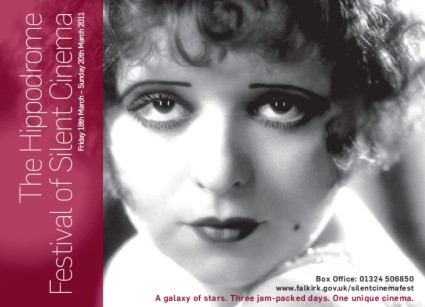
Scotland’s first silent film festival takes place 18-20 March 2011 in Scotland’s first purpose-built cinema (or so it says in their brochure), at the Hippodrome cinema in Bo’ness. The enterprising weekend of silents and silent-related events is clearly directed at a general audience, and brings together classics with Scottish Screen Archive programmes, workshops and live events. There are chances to dress up as flappers or Chaplin, and a great idea of bringing along jamjars (used as currency by children keen to get into early film shows) to the screening of The Kid. At the heart of it all is pianist, raconteur and all round good egg Neil Brand, once again carrying the torch for silent films.

Here’s the main programme, with text taken from the online brochure:

Opening Night Gala: It
Celebrate Festival opening night with a glass of bubbly and an icon of the Roaring Twenties. Clara Bow stars in this sparkling comedy as Betty, a poor shop-girl, who sets her cap at her handsome new boss whilst seeing off moral reformers, inept suitors and upperclass snobs with a wicked smile and a devastating wink. She has ‘it’ by the bucket-load, and knows exactly how to use ‘it’ … Fast, jazzy and funny ‘It’ magnificently demonstrates Bow’s star-appeal (receiving over 45,000 fan letters a week at the time), and why her performance as a guileless flapper came to define an entire decade. Look out for a young Gary Cooper as the dashing cub reporter. We are privileged to present this rare UK screening of a print loaned by the British Film Institute’s National Archive… the perfect start to a very special festival.
Dir. Clarence G. Badger, Josef von Sternberg / US / 1927 / b&w / 1h 12m
With: Clara Bow, Antonio Moreno, William Austin
Live piano accompaniment by Neil Brand
Friday 18 March, 18:30 • screening starts 19:30
Tickets: £8 (£6 conc.) including ‘champagne reception’
Dress: Twenties glamour, flapper

Tam O’Shanter
A unique and immersive workshop for schools and home educators presented by musician Susan Appelbe and Falkirk Council Heritage Learning team. Susan performs her vibrant music to a new, silent animation of Robert Burns’ poem (created by Grangemouth Girls Youth Group with artist Emma Bowen). Susan’s live performance is followed by an improvised music session in which the whole audience becomes the orchestra, composing its own soundtrack for the animation, recorded for pupils to take back to school. All pupils will be supplied with instruments for the duration of the workshop, and are also welcome to bring any acoustic instruments of their own. No prior musical skills required.
Friday 18 March, 10:00 / 2hrs
Tickets: pupils £2.10, accompanying teachers/adults free
Pre-booking essential
Schools workshop – Recommended P6 / People in the Past / Expressive Arts / Literacy

An Escape From Reality
If walls could talk, the Hippodrome could certainly tell a tale or two. Come for a cuppa and hear the stories of Scotland’s first purpose-built cinema or share your own cinema-going memories with your host, local author and scriptwriter Janet Paisley. Following a screening of ‘An Escape from Reality’, a documentary made by Bo’ness Academy students celebrating the Hippodrome through the memories of its patrons, Janet will be joined by local historians and the floor will be open for what promises to be an entertaining afternoon.

This event is sponsored by the Bo’ness Townscape Heritage Initiative (THI). The aim of the THI is to repair and restore historic buildings like the beautifully restored Hippodrome, encouraging town centre regeneration through the distribution of Heritage Lottery Funding.
Fri 18 Mar 14:00 / 1h 30m approx.
Tickets: £5.25 (incl. refreshments)

The Kid + shorts (2-for-1 Jeely Jar Special)
In the Hippodrome’s heyday youngsters could get their cinema ticket in exchange for a jeely (or jam) jar, so we’ve named our regular Saturday morning screenings of well-loved family films in honour of this tradition. Once a season we revive the custom at a Jeely Jar Special, when you can bring a clean jeely jar with matching lid and get two tickets for the price of one. We’ve chosen Chaplin’s first feature film in which the loveable Tramp teams up with an abandoned child showcasing Chaplin’s seemingly effortless combination of pathos and pantomimic comedy. Screening with animated shorts featuring Felix the Cat – celebrated US
predecessor of Mickey Mouse – and his mischievous British equivalent, Bonzo the Dog. Come dressed as the Tramp to be in with a chance to win our Charlie Chaplin fancy dress competition!
Dir. Charles Chaplin / US / 1921 / b&w / pre-recorded orchestral score
‘Felix Wins and Loses’ / dir. Pat Sulllivan / US / 1925 / b&w
‘Bonzo Broadcasted’ / dir. W.A. Ward / UK / 1925 / b&w
Live piano accompaniment by Neil Brand (animation shorts only)
Saturday 19 March, 11:00 • Tickets: £2.10 / 1h 30m approx

Scottish Screen Archive & Cinema Theatres Association Event
Early Cinema in Scotland
Come and find out about the origins of early film and cinema at this enlightening and entertaining illustrated talk including stills and film screenings presented by cinema historian, Gordon Barr and Ruth Washbrook, a curator at the Scottish Screen Archive. Take a journey back in time through celluloid history to discover how and when Scotland’s first purpose-built cinemas were constructed, how cinema architecture and styles changed over time and experience some of the films early audiences would have enjoyed.
Saturday 19 March, 14:00 / 1h 30m approx
Tickets: £5.25 (£4 conc.)

Another Fine Mess with Laurel and Hardy
Laurel and Hardy never age, and these films prove they were at the peak of their careers before sound even arrived – action-packed, terrifying and masterly, these are the boys’ greatest silent films. Liberty, in which the pair are escaped convicts trying to reclaim their trousers. Big Business, where the duo’s business transaction with a customer (played by local Larbert lad James Finlayson), winds up with their trademark outbreak of destruction. Finally You’re Darn Tootin’ which finds Laurel and Hardy dismissed from a band and attempting to make ends meet as street musicians … where, of course, rumpus ensues. Prepare to laugh harder then you ever have before. Oh, and be prepared to ‘play along’!
Dir. Various / US / 1928-29 / b&w
Live piano accompaniment by Neil Brand (assisted by the audience!)
Saturday 19th March, 16:30 / 1h 30m • Tickets: £5.25 (£4 conc.)

Neil Brand – The Silent Pianist Speaks
The Hippodrome is proud to welcome Neil Brand to present his critically acclaimed live show. Using clips from some of the greatest moments in silent cinema to illustrate his 25-year career, Neil hosts a unique and memorable event celebrating the great silent filmmakers and the magic of the accompanists who breathed life and sound into their work. From the earliest, earthiest comedies and thrillers, through a silent cine-verité classic shot by a young Billy Wilder, to the glories of Hollywood glamour and the sublime Laurel and Hardy, Neil provides improv accompaniment and entertaining commentary including notes from his own live cinema disasters. The audience gets a chance to score a scene and the evening culminates in Neil accompanying a clip “sight unseen” whilst simultaneously describing his reactions to it. The result is a hilarious, sharp and ultimately moving show about cinema and music which pays tribute to the musicians of the silent era through the observations of one the world’s finest exponents.
Saturday 19 March, 19:30 / 1h 20m • Tickets: £8 (£6 conc.)

Slapstick with Plutôt la Vie
From Buster Keaton to Mr Bean, follow a comic tradition and learn some slapstick secrets. The early heroes of comedy relied on visual gags for their biggest laughs and this ancient form of comedy came into its own during the silent era, but can still be seen in modern cinema and theatre. The performance of slapstick comedy requires exquisite timing and skilful execution so join Tim Licata of acclaimed Scottish theatre company Plutôt la Vie (literally meaning “above all, is life”) as he teaches you some of the slapstick secrets of the silent stars.
Venue: Bo’ness Town Hall, Stewart Avenue, Bo’ness EH51 9NJ
Wear comfortable clothes/shoes
Sunday 20 March, 10:00 / 2h 30m • Tickets: £8
Age: 12+ pre booking essential
Note: Plutôt la Vie’s will be performing their fast and funny
family show: ‘By the Seat of Your Pants’at FTH on
Sunday 13 March • 14:00 • http://www.falkirk.gov.uk/cultural

The Scottish Screen Archive Presents…
Scottish Comedy Capers
Enjoy a wonderful treat of silent comedy films from the Scottish Screen Archive with a specially curated programme of short films ranging from early comedy favourites to amateur comedy dramas and films made by Cine Societies and Film Clubs. This diverse collection of films will leave you laughing with uncouth Highlanders, pantomime horses, crazed lawnmowers, cantankerous witches, naughty children and husbands causing mischief on a weekend away from their wives. There is something for everyone in this fun-packed programme of Scottish archive film delights.
Live piano accompaniment by Neil Brand
Sunday 20 March, 11:00 / 1h 30m approx
Tickets: £5.25 (£4 conc.)

World Première
New Found Sound
Take four young composers, three talented schools orchestras, a silent film from the Scottish Screen Archive – and you get New Found Sound. A culmination of hard work and creativity, New Found Sound offers a unique opportunity to experience the world première of a silent film soundtrack commissioned by the Hippodrome Festival of Silent Cinema. The music has been composed by pupils from the Falkirk Council area and will be performed by young musicians in the regional school orchestras: the Falkirk Schools Orchestra, the Falkirk Schools Wind Band, and the Falkirk Baroque Ensemble. Involving secondary school pupils currently studying music and receiving instrumental instruction, New Found Sound showcases the outstanding talent and commitment of young people in the region.
Sunday 20 March, 14:00 / 1h approx
Tickets : £4 (£3 conc.)

Sherlock Jr. + Never Weaken
No self-respecting silent film festival could ignore two of the era’s biggest stars, so here’s a double bill that offers twice the genius for more than double the value. Buster Keaton stars as a humble movie projectionist living out his dream as “the world’s greatest detective”: ‘Sherlock Jr’. The film not only brought Keaton to his artistic maturity, it influenced the structure of Monty Python, according to Terry Gilliam. The last twenty minutes is an anarchic firestorm of stunts and physical gags, while the surreal central sequence, in which Buster walks into an onscreen drama which changes around him, is still as breathtaking as it was 85 years ago. Plus, Harold Lloyd, the lovelorn hero of ‘Never Weaken’ and real-life vertigosufferer, goes all-out to show that there is nothing funnier than a man in glasses whose life hangs by a thread thirty storeys up!
‘Sherlock Jr.’: Dir. Buster Keaton / US / 1924 / b&w / 45m
With: Buster Keaton, Kathryn McGuire, Ward Crane
‘Never Weaken’: Dir. Fred C Newmeyer / US / 1921 / b&w / 29m
With: Harold Lloyd, Mildred Davis, Roy Brooks
Live piano accompaniment by Neil Brand
Sunday 20 March, 16:30 / 1h 20m approx • Tickets: £5.25 (£4 conc.)

Closing Night Gala: Nosferatu
This screening of F. W. Murnau’s silent classic horror film with live music accompaniment is the dramatic finale of the Hippodrome Festival of Silent Cinema. Max Schreck is the terrifying Count Orlok, a vampire who thirsts after the body and soul of a young clerk and his beautiful wife. David Allison’s beguiling score reveals a distinctly Celtic twist with its Scottish voice depicting the nineteenth century author Emily Gerard leading us through the narrative. Originally from Airdrie, Gerard is believed to have been a major influence on Bram Stoker’s ‘Dracula’ and Murnau’s celluloid portrayal through her writings on Transylvanian folklore. Fans of the modern slew of on-screen vampires will recognise the sensuality, immortality and suspense in ‘Nosferatu’, the genesis of bloodsucking horror on the big screen. “A stunning presentation.” Edinburgh Evening News
Dir. F. W. Murnau / US / 1922 / b&w / 1h 24m
With: Max Schreck, Gustav von Wangenheim, Greta Schröder
Live musical accompaniment by David Allison of The Island Tapes
Sunday 20 March, 19:30
Tickets: £8 (£6 conc.)

Well, there’s bucket-loads of enthusiasm, and I hope they are rewarded with good audiences. The festival is now open for bookings, and there are full details of how to get there and how to have the best of times once you have done so on the festival site.

Early cinema, early news

http://www.museudelcinema.org

A while ago we announced the call for papers for a two-day seminar to be held in Girona, Spain, entitled The Construction of News in Early Cinema. The event is being co-organised by the Museu del Cinema, the University of Girona, and the Spanish Ministry of Science & Innovation Project, and is one of a series of seminars that have been held on the origins and history of cinema (La construcción de la realidad en el cine de los orígenes). It will be held at the Auditori Narcís de Carreras in Girona, 31 March-1 April 2011. The organisers have produced this overview of the seminar’s rationale:

The film industry emerged at a key moment in the development of the written and graphic press and it would not be too long before it was playing a role in creating the imaginary of current affairs through images. Although these news images did not begin to be gathered together into a specific programme until the year 1908 thanks to Pathé Frères, in the very beginnings of cinema there were already images of current events, royal visits, official openings, sports events or exceptional situations that were to bind the image to its present context and bring it into the territory of what could be deemed as newsworthy. We are interested in images that captured reality, such as the reconstructions of events that are to become news. The seminar will focus on trying to define the relationship between cinema and news, to see how it began to build the news imaginary that presaged many of the questions of the future news images both in the subsequent newsreels and in those that came along with the birth of television. We are also interested in observing film as an area of intermediality, bringing together a variety of forms from other areas such as photography, painting and popular theatrical shows, in which the idea of news began to be presaged. The time period of the study is to be from 1895 up to 1914, since we believe that the newsreels underwent a different development with the outbreak of World War I. The proposal of the seminar is to establish a methodology of research and reflection in the context of news and, eventually, to find out how and if we can talk about a kind of birth of the documentary image.

The event is going be rather more of a conference than a seminar, and there is a strong line-up of speakers in the programme which has now been published, alongside registration details. Here’s the programme:

Thursday, March 31

9:00 – 9:30 Reception

9:30 – 9:45 Introduction and welcome

9:45 – 10:30 Conference: Rafael F. Tranche (Universidad Complutense de Madrid): Atracciones, actualidad y noticiarios: la información como espectáculo

10:30 – 10:45 Debate

10:45 – 11:00 Pause

11:00 – 12:20 Lectures: Archives I

  • The public wanted new. Programming the Biograph, 1896-1901. Paul Spehr
  • L’actualitat al catàleg Pathé Frères (1896-1914): Terminologia, lèxic i estudi quantitatiu. Daniel Pitarch
  • La imatge tòpica d’Espanya als films de Pathé i Gaumont. M. Magdalena Brotons i Capó
  • Creating an event out of nothing happening: the making of the “Death villages” of the zuiderzee region (The Netherlands) and the negotiation of its imagery (1880-1914). Sarah Dellmann

12:20 – 12:30 Pause

12:30 – 14:00 Lectures and debate: Archives II

  • The Vincenzo Neri Medical collection (1908-1928) a visual repertory between cinema, photography, typography. Simone Venturini
  • Antes del discurso, luego la imagen: el comentario de la película de no ficción en Italia en la época del cine mudo. Luca Mazzei

14.00 – 15:00 Lunch

15:00 – 15:45 Conference: Stephen Bottomore: Filming and ‘Faking’ a News Event – The Coronation of Edward VII (1902)

15:45 – 16:00 Debate

16:00 – 16:40 Lectures: Reconstructions

  • Actualidad reconstruida y reconstrucción de la actualidad. El caso de “Asesinato y entierro de Canalejas”. Begoña Soto y Encarni Rus
  • Actualitats reconstruïdes: del museu del cera als fake. El cas de l’erupció volcànica del Mont Pelée (Georges Méliès, 1902) com a punt de confluència. Marta Sureda

16:40 – 17:00 Pause

17:00 – 19:30 Lectures and debate: Newspapers and information

  • The true-crime films of Antonio Leal, 1906-1909: From newspaper reportage to film re-enactments in Brazil’s “Bela Época”. Rielle Navitski
  • How actual was an actualité in early cinema? Time as agency in presenting moving images of news of fairground and variety theatre. Ansje van Veusekom
  • How to tell a catastrophic event. The earthquake of Messina (Italy) in 1908. Luigi Virgolin
  • La mirada cinematogràfica dels primers fotoperiodistes. Lluïsa Suárez
  • The birth of Italy’s newsreel: study of the Italo Turkish War (1911-1912). Sila Berruti i Luca Mazzei

20.30 Presentation of the book-DVD “Segundo de Chomón. The fantasy film”. Next, cinema session, with live piano music, with films from the Filmoteca de Catalunya. Place of the session: Cinema Truffaut

Friday, April 1

9:30 – 10:15 Conference: Charles Musser: Cinema, Newspapers and the US Presidential Election of 1896

10.15-10:30 Debate

10:30 – 11:00 pause

11:00 – 13:30 Lectures and debate: War and politics

  • What’s in a name? The Russo-Japanese/Japanese-Russian War. Dafna Ruppin
  • El cinema d’animació dels primers temps i la reconstrucció de l’actualitat: el cas de l’enfonsament del Lusitània. Núria Nadal i Jaume Duran
  • El último espectáculo de la confederación: la recepción cinematográfica de la Guerra Civil Americana, 1896-1914. Kirby Pringle
  • Les actualitats Edison de la Guerra de Cuba: entre el Wild West show i el western. Ramon Girona

13:30 – 15:30 Lunch

15:30 – 16:15 Conference: Luke McKernan: Links in the chain: early newsreels and newspapers

16:15 – 16:30 Debate

16.30 – 16:45 Pause

16:45 – 18:30 Lectures and debate: Precinema and early cinema

  • El panorama de Waterloo de Charles Verlat i l’escena artística Barcelonesa a la dècada dels 90 del segle XIX. Neus Moyano
  • La llanterna i les seves variants com a antecedents dels diferents gèneres cinematogràfics. Jordi Artigas
  • La fascinació lúdica i participativa: entre Segundo de Chomón i el primer videojoc. Manuel Garin
  • Antonio Ramos i els orígens del cinema a la Xina. David Martínez-Robles i Teresa Iribarren
  • Los reportajes de festividades locales en la región de Murcia a comienzos delsiglo XX: el caso de la restauración de “La Cruz de Mayo” (Caravaca de laCruz, 1924). Ángel Morán
  • L’actualitat tecnocientífica en el cinema dels orígens: els films d’Edison i l’electromagnetisme. Manuel Moreno

18:30 – 18:35 Closing

19:30 Guided tour of the permanent exhibition at the Museu del Cinema (approx. 75’)

Well, it’s certainly going to be an honour to be speaking at such an event, and in such company. I’m delighted to see that there are scholars actively engaged in studying early newsfilm – this certainly wasn’t always the case in times past – and across such rich and pertinent topics.

The Museu del Cinema site has further details on the seminar, including registration details and other such information. The seminar will be multi-lingual, with simultaneous translation into Catalan, Spanish and English.

Silents to see before you die

http://www.princecharlescinema.com

Do silent films ever get seen as cult films? There are some cult silents – Pandora’s Box is an obvious example – but for the most part silent films get billed as classics and tend to attract audiences that are a mixture of cineastes and nostalgists, augmented at specialist festivals by film archivists and academics. Silent films are understood to appeal to a very select taste, though there are some efforts to bill the comedies of the era as being the equal of those today and hence as having appeal for a general audience (of course they are frequently hugely superior to the comedies of today, but that’s not quite my point).

But it seems to be a rare thing to promote silent films as cult viewing – not as something that it would be worthy to experience, but something word-of-mouth cool. I was wondering why this wasn’t attempted more often as I went to the Prince Charles cinema in London’s Leicester Square last Thursday to see The Hunchback of Notre Dame (1923). The Prince Charles is London’s home of cult cinema. It specialises in picking up on films just out of general release which it can offer at cheaper prices to the impoverished students that make up a large part of its audiences. As well as these recently recent releases it has repertory seasons of cult films, retrospectives, ‘films to see before you die’, audience participation singalonga films (Sound of Music, Grease) and the inevitable Rocky Horror Picture Show.

And now it has silent films. On the last Thursday of every month the Prince Charles is showing a silent film, and is attracting the sorts of audiences you just don’t see at any other sort of silent film screening. The initiative has only just started, with The Cameraman shown last month, Hunchback last week, and Aelita in February. So an audience is still being built up, but it looks like word-of-mouth is working already, because the reasonably-sized cinema with its curious reverse raking was nearly full, with those attending being young, enthusiastic, cine-literate to a degree no doubt, but also just keen to have a good time.

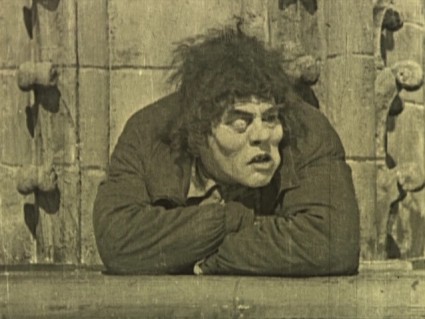
Lon Chaney as Quasimodo in The Hunchback of Notre Dame, from http://www.dvdbeaver.com

It was a great audience to be a part of, with a palpable sense of discovery in the air. Unfortunately, if you are going to build up a cult reputation, films like The Hunchback of Notre Dame are not the way to do it. It looks spectacular, of course. It is the archetypal historical screen romance. It has an iconic performance from Lon Chaney. But the direction (by the obscure Wallace Worsley) is sluggish and uninspired. There is no real human feeling to it (aside from Chaney, of course). Moreover the film looked terrible (I believe only poor elements survive), and I think it was a DVD that they were projecting. If you had prejudices against silent films before you went in, you would have gone out having had them confirmed.

On the plus side there was John Sweeney playing the piano in bravura style, with a marvellous set of dissonant chords mimicking the ringing of bells to open the film, and he brought out the best of what was on the screen. Sometimes the audience laughed at its quaintness, sometimes they laughed with it. Certainly they stayed with it. You got a good sense that they would be coming back for more, and Aelita on February 24th is a good choice for the next screening, with live music acompaniment by Minima.

I hope very much that this experiment continues, and that silents start to be billed as films that you have to see before you die (alas, the Prince Charles lapses into the bad habit shown by others and bills the films as ‘classics’ – we shouldn’t want to see these films just because they are worthy). With Metropolis having broken out of the cinematheques to reach some general theatres, there is something in the air about silent films, which suggests that there are new audiences out there eager to discover the best in them. The films just need to go to where those audiences are. The Prince Charles is showing the way.

Bioscope Newsreel no. 10

I’m going to try and revive a neglected feature, the Bioscope Newsreel. It was an irregularly issued round-up of news stories on silent films that weren’t going to make it into fully-fledged posts, and in bringing it back to life I want to expand the brief a little to include interesting new pieces writing, blog posts etc. on our silent world (and its contexts). If I’m really good I’ll make it a weekly occurence, but I won’t commit myself to that just yet. Anyway, after a gap of just under two years, here’s issue number ten:

Films in concert
Films en Concert is a two-day silent film festival being held at the Salle André Malraux, Lambersart, France 4-5 February 2011. Featuring Chaplin biographer and Pordenone director David Robinson plus Pordenone pianists Neil Brand and Touve R. Ratovondrahety, the festival focusses on Chaplin with talks, screnings and a session for school children, plus Bébé and Bout-de-Zan comedies, Jacques Feyder’s Gribiche (1926) and Chaplin’s The Circus (1928). Read more.

Female Hamlet
John Wyver of the film and video production company Illuminations writes an excellent blog on film, art and culture. His latest post is on the Asta Nielsen Hamlet (1920), recently screened at the BFI Southbank, in which the great Danish actress plays the great Dane. An observant piece from a present-day producer of Shakespeare films (Hamlet, Macbeth). Read more.

Silent and white
Michael Hogan of The Daily Telegraph reviews the TV screening of The Great White Silence, Herbert Ponting’s 1924 documentary record of the doomed Scott Antarctic expedition. Interestingly the review doesn’t look upon the film as historically quaint but simply as a record of those events equivalent to any TV polar documentary. Read more.

Film and European copyright
The EYE Film Institute of the Netherlands has produced some Guidelines for Copyright Clearance and IPR Management for the European Film Gateway project. Viewing things from the European angle, the guidelines consider copyright basics, exploitation rights, moral rights, orphan works, clearing rights in related media (stills, posters), searching for rights holders and a summary of copyright law in various European countries (though not the UK). Read more.

Lost and significant
It’s hard to say what exactly is the appeal in describing films that no one living has seen, but the Shadowlocked site has an entertaining item on ’15 historically significant “lost” films’, most of which are silent, and include Saved from the Titanic (1912), The Werewolf (1913), A Study in Scarlet (1914) and that great Bioscope favourite, Drakula halála (1921). Read more.

‘Til next time!

Things Australian no. 2 – The first motion pictures

Marius Sestier (with beard) and H. Walter Barnett filming the Melbourne Cup horse race, 3 November 1896, from The Bulletin, 14 November 1896, reproduced by Tony Martin-Jones

Yesterday’s post on the Corrick Collection demonstrated the great work done by a national institution, the National Film and Sound Archive of Australia. But great work can come from single scholars, and this second post on things Australian turns to the work of one of those generally referrred to as an ‘independent’ scholars or researchers. Independent scholars and institutions (archives, film institutes, universities etc) don’t always mix too happily, because each operates under different rules and pressures. But without the efforts of those such as John Barnes, Aldo Bernardini, Herbert Birett and Denis Gifford, our historiography of the silent cinema would be very much the poorer. The independent scholar – the good ones, that is – gets things done.

And so we turn to Film History Notes, the plainly designed but richly informative website of Australian film historian Tony Martin-Jones. Bracingly describing his purpose as “getting to the truth after decades of unchecked nonsense”, Martin-Jones writes about the first motion pictures projected and produced in Australia and India.

His mission is to overturn accepted truths about these first motion pictures, of which there are many. Early film history is full of ‘firsts’ of dubious veracity, and myths have been built up which were encouraged at a time when film history was less rigorous and often dominated by sentiment. He re-examines these through detailed use of newspaper accounts, catalogues, state archives, photographic sources and local knowledge, then by applying deductive logic, not trusting to any accepted truth (even if the process sometimes leads to the conclusion that those truths are – probably – correct). He then publishes all of his findings online, with clear descriptions, painstakingly compiled lists of dates, and extensive references. This is research information that is properly shared.

So you can find out about the magician Carl Hertz and the first projected motion pictures in Australia, Lumière operator Marius Sestier and the first projected motion pictures in India (he was on his way to Australia), the meeting of Sestier and photographer H. Walter Barnett and their collaboration over the filming of the 1896 Melbourne Cup, and the 1897-1898 England-Australia test match films ostensibly filmed by Barnett (a long-held story that Martin-Jones vigorously challenges).

An extract from Patineur grotesque

He particularly goes to town over the Lumière film Patineur grotesque, which the National Film and Sound Archive recently announced as being the oldest surviving Australian film (see the Bioscope report from March 2010). Martin-Jones challenges this, basing some of his argument on the length of shadows shown in the film (which he thinks was shot later than the Melbourne Cup films), instead asserting that it is the earliest surviving motion picture taken in Sydney, New South Wales, Australia – which has less of a ring to it. He has fun identifying the location (fun partly at the expense of the NFSA which had said that the location was Melbourne), and even has a go at identifying the skater.

Institutions don’t always have the time to go into individual films with the passionate detail that Martin-Jones portrays, and in any case they are probably by definition homes of accepted truths. I have experience myself of working for a certain British film institution and having my identifcations of a very early film challenged by an independent scholar shocked that said institution could make such a blunder, writing detailed letters and papers about the misdeed (the said independent scholar turned out to be wrong, but that’s another story…) I sympathise with both sides, but I do admire an argument well made and good use of primary sources. And it is always good policy to challenge what you find, if you are going to call yourself a researcher.

Whether the truths of history (film or otherwise) can be determined by the plain accumulation of chronological evidence is another matter. What does it matter who was ‘first’? What do such ‘firsts’ mean? Why do we still persist in considering film history through national eyes? It is difficult to avoid such stuff when considering those years when motion pictures were first produced and projected, but what does it actually tell us? We should always want to get our facts straight, but the real film history – which is the impact of film upon history – lies elsewhere.

Things Australian no. 1: The Marvellous Corricks

Les Fleurs Animées (Pathé, France 1906), from the Corrick Collection in the National Film and Sound Archive of Australia

For the past few years those attending the Pordenone silent film festival have been treated to examples from an extraordinary collection of early films held by the National Film and Sound Archive of Australia. The films are those collected (and in some cases made) by the Corrick Family Entertainers, or The Marvellous Corricks, a performing troupe comprising Albert and Sarah Corrick and their eight children which toured Australia, New Zealand and South-East Asia between 1901 and 1914 and which included film in its act.

The Corricks’ show combined song, comedy, dance, lantern slides, poetry readings and film. Some 135 films survive, chiefly titles the family purchased from France, England, the USA and Italy, plus films that they shot themselves, which includes travel footage, a chase comedy (The Bashful Mr Brown) and film of them on tour. The films they purchased are superb in quality, combining fiction and non-fiction, several films with beautiful colouring (around a quarter of the collection is stencil coloured and another quarter tinted and toned). The Corricks clearly had a fine eye for a good film, favouring particular companies (notably Pathé, Charles Urban Trading Company and Edison). Many of the films are unique to the Corrick collection, and include some real cinematic treasures.

The Corricks c.1898: (Front row) Sarah, Ethel, Alice, Elsie, Albert. (Back row) Amy, Ruby, Leonard (the family’s cinematograph expert), Jessie, Gertrude, from the National Film and Sound Archive

As Leslie Anne Lewis writes in her excellent essay ‘The Corrick Collection: A Case Study in Asia-Pacific Itinerant Film Exhibition (1901-1914)’, Albert and Sarah Corrick planned for a musical family, and trained their children in singing, dancing, bell-ringing and playing a wide variety of musical instruments, among them piano, organ, flute, piccolo, cello, violin, saxophone, mandolin and cornet, with the children often proficient in a number of these. They played in concert halls, town halls and the like, stressing the family-friendly wholesome ness of their show, touring all of the Australian territories up to 1907 before going on an international tour. It was during this tour that they picked up many films, though a projector had been part of their act from the beginning. The family’s cinematograph expert was Leonard Corrick, and his film shows were often billed separately as ‘Leonard’s Beautiful Pictures’. Many people in Australia and South-East Asia saw their first films, and their first views of a world outside their home town, from a Corrick family show. It is evidence of how important variety shows were to early film, how film was integrated within such entertainments to be a part of song, dance and showmanship, and how eventually film outstripped itinerant shows such as those of the Corricks and became the show in itself.

The films began the tortuous process of joining the NFSA collection and gradually being properly preserved in 1968, with the definitive work really only being undertaken recently (see Leslie Anne Lewis’ essay for details). Basic information on all of the films can be found on the NFSA catalogue, with much greater details available for those titles shown at Pordenone by browsing the catalogues of past festivals or using the Pordenone festival’s database (which does not include 2010 screenings as yet). For your convenience (because that is the Bioscope’s mission), here is a list of titles that have been identified and screened so far:

  • “AND A LITTLE CHILD SHALL LEAD THEM” (d. D.W. Griffith p.c. Biograph, USA 1909)
  • THE ARRESTED TRICAR (GB? c.1905)
  • AU JARDIN ZOOLOGIQUE DE PARIS (p.c. Pathé, France 1905)
  • A BABY’S SHOE (d. Charles J. Brabin p.c. Edison, USA 1912)
  • BABYLAS VIENT D’HÉRITER D’UNE PANTHÈRE (d. Alfred Machin p.c. Pathé, France 1911)
  • BAIN DE BÉBÉ (p.c. Pathé, France 1904)
  • BASHFUL MR. BROWN (p.c. Corrick, Australia 1907)
  • LA BELLE AU BOIS DORMANT (d. Lucien Nonguet, Ferdinand Zecca p.c. Pathé, France 1902)
  • BETTINA’S SUBSTITUTE; OR, THERE’S NO FOOL LIKE AN OLD FOOL (d. Albert W. Hale p.c. Vitagraph, USA 1912)
  • BICYCLETTE PRÉSENTÉE EN LIBERTÉ (p.c.. Pathé, France 1906)
  • A CANADIAN WINTER CARNIVAL (p.c. Edison, USA 1909)
  • LE CHAPEAU (p.c. Pathé, France 1906)
  • CHASSE AU PAPILLON (p.c. Pathé, France 1906)
  • CHASSE AU SANGLIER (p.c. Pathé, France 1904)
  • COIFFES ET COIFFURES (d. Gaston Velle p.c. Pathé, France 1905)
  • COME CRETINETTI PAGA DI DEBITI (d. André Deed p.c. Itala, Italy 1909)
  • COMEDY CARTOONS (d. Walter R. Booth p.c. Urban, GB 1907)
  • [CORONATION OF KING EDWARD VII AND QUEEN ALEXANDRA] (GB 1902)
  • CRETINETTI LOTTATORE (p.c. Itala, Italy 1909)
  • [THE DAY-POSTLE MATCH AT BOULDER RACECOURSE, WESTERN AUSTRALIA] (p.c. Corrick, Australia 1907)
  • LES DÉBUTS D’UN CHAUFFEUR (d. Georges Hatot p.c. Pathé, France 1906)
  • DEUX BRAVES COEURS (p.c. Pathé, France 1909)
  • LE DINER AU 9 (p.c. Pathé, France 1909)
  • DON QUICHOTTE (d. Lucien Nonguet, Ferdinand Zecca p.c. Pathé, France 1904)
  • DOWN ON THE FARM (p.c. Edison, USA 1905)
  • DU CAIRE AUX PYRAMIDES (p.c. Pathé, France 1905)
  • FANTASIAS ARABES (p.c. Pathé, France 1902)
  • FIRE! (d. James Williamson p.c. Williamson, GB 1901)
  • LES FLEURS ANIMÉES (d. Gaston Velle p.c. Pathé, France 1906)
  • FUNERAL PROCESSION OF NEW ZEALAND PREMIER R.J. SEDDON (New Zealand 1906)
  • LES GRANDES EAUX DE VERSAILLES (p.c. Pathé, France 1904)
  • GUILLAUME TELL (d. Lucien Nonguet p.c. Pathé, France 1903)
  • THE HAND OF THE ARTIST (d. Walter R. Booth p.c. Paul, GB 1906)
  • HER FIRST CAKE (d. James Williamson p.c. Williamson, GB 1906)
  • HISTOIRE D’UN PANTALON (p.c. Pathé, France 1906)
  • HOW JONES LOST HIS ROLL (d. Edwin S. Porter p.c. Edison, USA 1905)
  • AN INDIAN’S GRATITUDE (p.c. Pathé, USA 1911)
  • LES INVISIBLES (d. Gaston Velle p.c. Pathé, France 1906)
  • J’AI PERDU MON LORGNON (d. Charles Lucien Lépine p.c. Pathé, France 1906)
  • [KING EDWARD VII AND QUEEN ALEXANDRA LEAVE A UNIVERSITY GRADUATION CEREMONY] (GB c.1907)
  • LIFE OF A COWBOY (d. Edwin S. Porter p.c. Edison, USA 1906)
  • LIVING LONDON (p.c. Urban, GB 1904) [note: now identified as THE STREET OF LONDON p.c. Urban, GB 1906)
  • THE LOST CHILD (d. Wallace McCuthcheon p.c. Edison, USA 1904)
  • THE MAGICAL PRESS (d. Walter R. Booth p.c. Urban, GB 1907)
  • MARIE-ANTOINETTE (p.c. Pathé, France 1903)
  • LA MÉTALLURGIE AU CREUSOT (p.c. Pathé, France 1905)
  • THE MINER’S DAUGHTER (d. James Williamson p.c. Williamson, GB 1907)
  • MIRACLE DE NOËL (p.c. Pathé, France 1905)
  • MONSIEUR QUI A MANGÉ DU TAUREAU (p.c. Gaumont, France 1907)
  • NAVAL ATTACK AT PORTSMOUTH (p.c. Urban, GB 1907)
  • NIAGARA IN WINTER 1909 (p.c. Urban, GB 1909)
  • PAUVRES VIEUX (Pathé, France 1907)
  • LES PETITS PIFFERARI (p.c. Pathé, France 1909)
  • LA POUDRE ANTINEURESTHÉNIQUE (p.c. Pathé, France 1909)
  • LA POULE AUX OEUFS D’OR (d. Gaston Velle p.c. Pathé, France 1905)
  • [PROCESSION OF BOATS ON RIVER, BURMA] (GB c.1905)
  • RECEPTION ON, AND INSPECTION OF, H.M.S. “DREADNOUGHT” (p.c. Urban, GB 1907)
  • LE REGNE DE LOUIS XIV (d. V. Lorant Heilbronn p.c. Pathé, France 1904)
  • LA RUCHE MERVEILLEUSE (p.c. Pathé, France 1909)
  • LE SCULPTEUR EXPRESS (p.c. Pathé, France 1907) (p.c. Urban, GB c.1905)
  • [THE SHORT-SIGHTED CYCLIST] (p.c. Eclipse, France 1907)
  • LE SINGE ADAM II (Pathé, France 1909)
  • SPORTS AT SEA ON THE S.S. RUNIC (p.c. Corrick, Australia 1909)
  • [STREET SCENES IN PERTH, WESTERN AUSTRALIA] (p.c. Corrick, Australia 1907)
  • TOTO EXPLOITE LA CURIOSITÉ (p.c. Pathé, France 1909)
  • LE TOUR DU MONDE D’UN POLICIER (d. Charles Lucien Lépine p.c. Pathé, France 1906)
  • [TRAVEL SCENES] (p.c. Urban, GB c.1905)
  • LA VIE INDIGÈNE AU SOUDAN ÉGYPTIEN (p.c. Pathé, France 1908)
  • THE WAIF AND THE STATUE (d. Walter Booth p.c. Urban, GB 1907)
  • WHEN THE WIFE’S AWAY (p.c. Paul, GB 1905)
  • WHO STOLE JONES’ WOOD? (p.c. Lubin, USA 1909)
  • A WINTER STRAW RIDE (d. Wallace McCutcheon, Edwin S. Porter p.c. Edison, USA 1907)

Other films in the collection are still in the process of being identified and preserved – the NFSA catalogue lists these, with such intriguing titles as The Burglar and the Baby, A Canine Arthimetician, Elephants Working in a Burmese Forest, Fée Aux Pigeons, Hallo! Haloo! Grinder, A Japanese Teahouse: Dance of the Geishas, Olympic Games in Athens [1906], and A Trip through Switzerland Engadin Valley.

You can read about the Corrick Collection on the NFSA’s Australian Screen site which includes a number of clips from the films (The Hand of the Artist, La Poule aux Oeufs d’Or and Street Scenes in Perth, Western Australia). There’s another overview on the main NFSA site.

Films from the Corrick Collection are currently featuring in My Bicycle Loves You, a collaboration between the NFSA and physical theatre company Legs on the Wall that combines film footage with live performance to reveal the world of the Corrick Family. It played at the Sydney Festival last week and will be playing at the Perth Festival 22-26 February.

Stage to screen

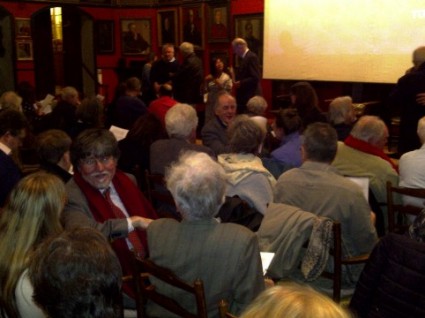
Members of the Society for Theatre Research at the Art Worker’s Guild

A couple of days ago I was fortunate to attend Viewing the Victorian Stage on 20th Century Film, an event organised by the Society for Theatre Research. Held in the quaintly elegant surroundings of the Art Worker’s Guild in London’s Queen’s Square, we saw a programme of rare and remarkable examples of Victorian stage practice preserved in one form or another on film. The programme was an outcome of years of research into the Victorian and Edwardian stage on film by Professor David Mayer and Helen Day-Mayer, and complementary research into its stage film holdings by the BFI’s Bryony Dixon. David introduced, Bryony talked us through the films, Neil Brand played the piano, and an enthusiastic and learned crowd lapped up the films with a mixture of amusement and astonishment.

We began with Georges Méliès’ Faust aux Infers (France 1903), presented as an example of a diablerie or férique film of the kind that was exhibited in British music halls and American vaudeville houses. The point made was that Méliès constructed a glass-roofed facsimile of his Robert Houdin’s theatre as his film studio, so that he could recreate stage effects as part of his films, using an array of ingenious machinery. For Méliès, film was a means to realise his theatrical dreams.

It was so useful to see these films from a theatre historian’s perspective. I have seen Edison’s Japanese Acrobats (USA 1904) before, and marvelled at the great skill on display, but had not known before that it shows an example of a ‘risley act’, named after Richard Risley Carlisle, an American acrobat who juggled with his feet while lying on his back, and act which he took to Japan in the 1860s. Will Evans, The Musical Eccentric (UK 1899) was less dazzling, showing a British variety comedians playing a ukelele and doing somersaults with a chair of the kind which you now see any week in the Premiership when the more acrobatic of footballers has scored a goal. He also had difficulty in keeping in shot, to a degree that you wondered why on earth the film company (Warwick) didn’t retake. But it was an unadorned demonstration of standard fare on a British variety stage on 1899, and that was what many in the audience were hoping to see – film as time machine, showing those who knew their theatre history something of what it was actually like to be there.

Particularly precious to witness was Lil Hawthorne sings ‘Kitty Mahone’ (UK 1900). This is a very early example of a synchronised sound film i.e. a silent film of a singer intended to be synchronised with a cylinder recording of their voice. The synchronisation wasn’t perfect, but it was very moving to hear her voice sing out ‘my pretty Kitty Mahone / I’m tired of living alone’ as she gestured to the audience in what looked like the stage of the Hippodrome in London, but which was actually a stage mock-up and was filmed on the roof of the theatre.
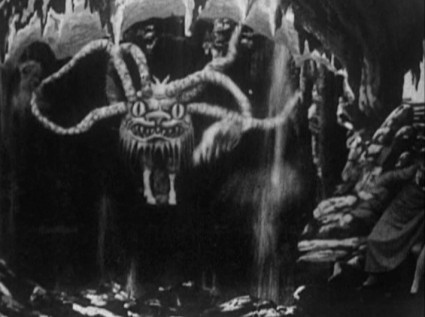
Faust aux Infers (1903)

American Mutoscope & Biograph’s Duel Scene from ‘Macbeth’ (USA 1905) was crude melodrama, Shakespeare reduced to knockabout swordfighting, the kind of rough-and-tumble extracts from plays that existed as popular variety theatre turns. Here We Are Again (UK 1913) was a surviving example of a harlequinade film, of the kind made for child audiences during holidays. It was simple knockabout stuff, but also gave the clearest of echoes to the proto-pantomimes of the early nineteenth century, when every such production had its Columbine and Harlequin.

One of the hits of the evening was Le Pied de Mouton (France 1907), a Pathé féerie or fairy play directed by Albert Capellani. To an audience of early film historians this would have been an interesting example of a fantasy film with two men (brightly stencil-coloured) encountering a giant head in a forest, notable for its staging in depth. For the stage historian, here were precious examples on show of vampire traps and star traps – types of trapdoor enabling performers to disappear and reappear through the floor at astonishing speed. Opinion afterwards was that Pathé had to have followed Georges Méliès’ lead and to have constructed its studio either from a theatre or by importing theatrical machinery. Not for the first time in the evening some argued that the film must show a scene inside a theatre – a holy grail for the theatre historian, again yearning to see what an actual audience member saw. But it was so much easier to recreate the effects in the studio than to go to the huge expense and inconvenience of setting up cameras in a theatre, with the considerable arc lighting that would have been required to illuminate the proceedings sufficiently. All of the films we were shown were filmed in a studio of one sort or another – with one astonishing exception, which we’ll come to.

The Whip (USA 1916) was a feature film version of a renowned Drury Lane drama about the attempts to nobble a horse, which on stage featured a sensational rail crash. What overwhelmed audiences when they saw it in a theatre was par for the course on the screen, and the realistic nature of Maurice Tourneur’s drama – from which we saw the sequence where the locomotive crashes, with the horse (The Whip) saved just in time – seemed worlds away from the theatre. The film could thrill, but it could not astonish. Rather better as a film was Pimple’s The Whip (UK 1917), a cheerfully stupid parody of film and play, in which the rescue of the horse (a pantomime horse) needs to be repeated a number of times because the train driver keeps on getting his cue wrong. As a practitioner of deconstructed comedy Pimple (the nephew of Will Evans, who we had seen earlier) seemed remarkably modern.

And then we found the holy grail. For many years now the BFI National Archive has had a film in its collection given the supplied title of (Collapsing Bridge) and dated c.1902. Here’s the description from the BFI database:

A section opening with an armed attack by men in peasant costume, led by a girl, against an unseen enemy. A painted backcloth represents mountain scenery and a bridge is in the foreground. The men and girl vanish at the aproach of two horse-drawn coaches from opposite directions which endeavour to cross the bridge simultaneously; water suddenly cascades down from the mountains, collapsing the bridge and plunging the horses and coaches into the water.

Described thus, it reads like part of a film scenario which we would expect to be divided up into a number of shots. But we see the entire action in one long shot, clearly filmed inside a hippodrome theatre, and featuring the stock-in-trade of hippodromes, a troupe of horses diving into the water. The effect is jaw-droppingly extraordinary. But what is the show, and who made the film? We don’t yet know. It’s quite likely that the film shows a 1902 show called The Bandits (described here), but no record has been found of any film made of the production. The filmmaker is possibly Walter Gibbons, future owner of the London Palladium, who we know filmed another Hippodrome production, Tally Ho!, around the same time, using an overpowering number of arc lights. But until we know for sure the film remains frustratingly fugitive even while it almost uniquely gives you the sense of truly being in the presence of the Victorian/Edwardian theatre at its maddest and boldest.

Trilby (UK 1914) is a disappointingly stolid piece of work. Its interest for the theatre historian is that it stars Sir Herbert Beerbohm Tree, in all his eye-rolling glory, as Svengali, but it fails to mesmerise. People talking afterwards noted the different acting styles of Tree and Viva Birkett, a florid Victorian manner alongside a subtler, even Ibsenian performance from her. It was good then to see Edison’s parodic Why Girls Leave Home (USA 1909), which cheerfully sends up every convention of the melodrama, including over-the-top acting, malfunctioning stage machinery and plot absurdities. The full film originally included a framing story in which a vicar tries to prevent his daughter from seeing a play, but she does so, and this is what she sees. Unfortunately what survives (held by the CNC archive in France) is in a dreadful state, with the image barely distinct, making us strain all the more to see laughs than would otherwise be the case. But it was clear that the Edwardians knew exactly how to laugh at the Victorians.

We finished with a long sequence (the tribunal scene) from The Only Way (UK 1926), an adaptation of Charles Dickens’ A Tale of Two Cities, and a star vehicle for theatrical great Sir John Martin-Harvey. He first appeared as Sidney Carton in 1899, and twenty-five years later he was still playing the same role, aged sixty-three. The feature film, directed by Herbert Wilcox, tries as far as possible to duplicate the stage production, though it was a film for all that and an engrossing example of the complex interrelationship between the two media. This came out in Martin-Harvey’s performance, which was a mixture of extravagant gestures and fine details that only the camera could pick up. It was pure ham from the theatrical knight, and you saw in his eyes someone who had played the same role a few hundred times too many, but you also saw such star magnetism that his great fame instantly made sense.

Silent film was profoundly indebted to the Victorian theatre. Actors, acting conventions, plays, genres, types of stage effect, its kudos, all had a huge effect on how the silent film grew. We can look at silent films and see endless traces of its Victorian stage origins, not just in films that clearly emulate a stage experience, but more subtly in how films were constructed, what they wanted to be, and then what they reacted against when they felt themselves outgrowing their theatrical inheritance.

But we cannot simply look at silent films for direct evidence of stage practice. Film changes everything it touches. Stage acts were changed to fit the dimensions of film – literally so, when the space in which a film could be made was smaller than stage space. The conventions of theatre were not so much borrowed as adapted for film, and then blended with the conventions of film itself. Also, film was not static, but changed greatly over the twenty-five years that we saw, during which the relationship between the two media grew ever more complex. In the end we witnessed not so much examples of stage practice recorded on film but rather a changing history of performance. Film became another stage for actors, dancers, comedians and magicians. Some adapted more happily than others, but as soon as they put themselves before a camera it changed them. It is that process of adaptation that film records rather than being some sort of literal mirror of what took place upon a stage. We may go looking for the evidence that we seek in a piece of film, but we will always end up finding something else.


Examples of American stage and variety stars from the early 1900s can be found on the Library of Congress’ American Memory site – the American Variety Stage 1870-1920 collection – and the Variety Stage: Vaudeville and Popular Entertainment playlist on its YouTube channel.

The organisers of the event produced a handy bibliography, which I’m going to take the liberty of reproducing, as the aim was to encourage others to engage in research in this area:

  • Richard Abel, French Cinema: The First Wave, 1915-1929 (Princeton University Press) 1984
  • ____,The Ciné Goes to Town: French Cinema, 1896-1914 (California University Press) 1994)
  • ____, (ed.) The Encyclopedia of Early Film (Routledge), 2005
  • Jacky Bratton, Jim Cook & Christine Gledhill (eds), Melodrama: Stage Picture Screen (British Film Institute), 1994
  • Ben Brewster & Lea Jacobs, Theatre to Cinema (Oxford University Press), 1997
  • Judith Buchanan, Shakespeare on Silent Film: An Excellent Dumb Discourse (Cambridge University Press), 2009
  • Jon Burrows, Legitimate Cinema: Theatre Stars in Silent British Films 1908-1918 (University of Exeter Press), 2003
  • Jim Davis (ed) Victorian Pantomime / A Collection of Critical Essays (Palgrave Macmillan), 2010
  • Bryony Dixon, Chaplin-In-Context A Catalogue of Music Hall Related Films 1895 – 1930 held by the bfi National Film and Television Archive, Downloadable as Chaplin-in-context.pdf No date
  • ____, 100 Silent Films (BFI & Palgrave Macmillan) forthcoming 2011
  • Linda Fitzsimmons & Sarah Street (eds), Moving Performance: British Stage and Screen 1890s-1920s (Flicks Books), 2000
  • Dennis Gifford, Books and Plays in Films 1896-1915: Literary, Theatrical and Artistic Sources of the First Twenty Years of Motion Pictures (McFarland & Mansell), 1991
  • Martin Miller Marks, Music and the Silent Film/ Contexts and Case Studies, 1895-1924 (Oxford University Press), 1997
  • David Mayer, Playing Out the Empire: Ben-Hur and other Toga Plays and Films 1883- 1908 (Clarendon Press), 1994
  • ___, Stagestruck Filmmaker: D.W. Griffith and the American Theatre (University of Iowa Press), 2009
  • Charles Musser, Before the Nickelodeon: Edwin S. Porter and the Edison Manufacturing Company (University of California Press), 1991
  • ___, Edison Motion Pictures, 1890-1900 (Smithsonian Institution Press & Le Giornate del Cinema Muto), 1997
  • Kemp R. Niver & Bebe Bergsten (eds) Early Motion Pictures: The Paper Print Collection in the Library of Congress (Library of Congress), 1985
  • David Robinson, Musique et Cinéma Muet (Réunion des Musées Nationaux), 1995
  • ____ From Peep Show to Palace: The Birth of American Film (Columbia University Press), 1996
  • Matthew Solomon, Disappearing Tricks: Silent Film, Houdini, and the New Magic of the Twentieth Century (University of Illinois Press), 2010
  • ____, (ed) Fantastic Voyages of the Cinematic Imagination: Georges Méliès’s Trip to the Moon (SUNY Press) forthcoming 2011

StummFilmMusikTage 2011

Germany’s festival of silent film and music, StummFilmMusikTage, returns once more, but in a somewhat reduced state [nothing to worry about – see comments]. What was previously a three-day event at Erlangen is now three screenings over the one day, 29 January 2011:

4pm
Short Film Programme: Charlie Chaplin’s Adventures
The Rink (USA 1916)
Behind the Screen (USA 1916)
A Night in the Show (USA 1915)
Score and accompaniment: Yogo Pausch

5:30pm
Introduction: All Quiet on the Western Front

6:30pm
All Quiet on the Western Front (USA 1930, 145 min, Dir: Lewis Milestone)
Music: Manfred Knaak; Accompaniment: ensemble KONTRASTE conducted by Christian Schumann

10pm
The End of the World (Verdens Undergang) (DK 1916, 74 min, Dir: August Blom)
Music and accompaniment: Interzone Perceptible

As before, the festival will be held in the Markgrafentheater Erlangen, a baroque theatre built in 1719 and still in use. There’s more information as always on the festival site, and they are now open for bookings.