Triumph! The Bioscope is now listed as a reference source by the Library of Congress in its Film Publications and Resource Guide. Check out the other links on this useful list, and keep reading The Bioscope.
Ah, the Nuts and Bolts
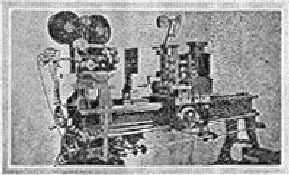
One of the long neglected areas of film scholarship has been the technology developements over time. From the earliest days of the industry, cameramen, etc, had to come up with methods to handle film, shoot at different speeds, film from the air, and on and on. When archives first broached the idea of film preservation, for the most part film itself was the object of our affection. It wasn’t until much later that we realized the importance of this cinemachinery in the industry. From early cameras, lighting, and printers, the developments came fast and furious. Some were monsters in size and shape, like the original Mutoscope Camera of A, M & B. Carl Gregory developed a practical optical printer in 1927-28.
These and devlopments like them were one of the things responsible for the technical improvements in film production that made it to the screen. I have always found this period to be a treasure trove of technological development, and look forward to seeing much more research into this area of the early film industry.
Practical Cinematography and Its Applications
OK, back to the serious stuff, and another key text available for downloading from The Internet Archive. Practical Cinematography and its Applications (London: W. Heinemann, 1913) was written by F.A. Talbot, who wrote various popular science guides, including the much-cited Moving Pictures: How They Are Made and Worked (1912). This plain person’s guide to the practical aspects of cinematography covers operating the camera, film development, scientific applications of cinematography, military uses, education films and (rather oddly) how to write screenplays. Odd, because Talbot’s concern is otherwise about the motion picture as a tool of discovery, not entertainment. There is also an intriguing call for national cinematograph laboratories. It’s available for free download in DjVu (9.6MB), PDF (29MB) and TXT (357KB) formats.
Silent MySpace
A surprising number of silent film figures have pages on MySpace. Here’s some of them, though mostly of interest for the phenomenon rather than the reliable information that they might provide:
- Betty Balfour
- Vilma Banky
- Lionel Barrymore
- Clara Bow
- Charlie Chaplin
- Douglas Fairbanks
- Greta Garbo
- Lilian and Dorothy Gish
- D.W. Griffith
- Buster Keaton
- Barbara La Marr
- Harry Langdon
- Max Linder
- Harold Lloyd
- Colleen Moore
- Nazimova
- Mary Pickford
- Mack Sennett
- Gloria Swanson
- Rudolph Valentino
- Erich von Stroheim
And probably many more.
More silent film blogs
An update on some of the silent film blogs out there. Not a great many.
Cartoons on Films (http://cartoonsonfilm.blogspot.com) (mostly silent animation)
The Crowd Roars (http://silentfilmlegend.blogspot.com/) (“from the earliest silents to the dawn of television”)
Edna’s Place (http://ednapurviance.blogspot.com/) (Edna Purviance, Chaplin and other subjects)
Every Little Breeze (http://everybreeze.blogspot.com/index.html) (Louise Brooks et al)
Ferdinand von Galizien (http://ferdinandvongalitzien.blogspot.com) (silent film reviews, warmly recommended)
Louise Brooks (http://louisebrooks.livejournal.com) (anything and everything on the 1920s screen icon)
Silent Films Fans’ Journal (http://community.livejournal.com/silent_films) (what it says on the film can)
And one for screen entertainments of an earlier age:
The Magic Lantern Show (http://magiclanternshows.blogspot.com)
Ten essential silents
Kevin Brownlow’s “Silents Please” article, published today in The Times, concludes with a list of “ten essential silents” (with his comments):
The Birth of a Nation, 1915 The most influential and controversial of all silents
Broken Blossoms, 1919 Poetry on the screen
The Phantom of the Opera, 1925 Inspired hokum
Variety, 1926 Dazzling sex drama set among trapeze artists
Flesh and the Devil, 1927 Garbo and Gilbert fell in love on this picture – and it shows
Metropolis, 1927 The silliest great film yet made
Napoléon, 1927 The most technically innovative film yet made
Sunrise, 1927 Masterly use of the camera
The Crowd, 1928 A young couple’s fight against poverty
The Wind, 1928 Lillian Gish enduring relentless Texan storms
Those are Kevin’s choices. These are mine:
Satan’s Merry Frolics (Les Quatres Cents Farces du Diable), 1906 Georges Melies’ most dazzling trick film
A Corner in Wheat, 1909 D.W. Griffith’s finest
The Battle of the Somme, 1916 The pity of war
The Rink, 1916 Charlie Chaplin, poetry in motion
Our Hospitality, 1923 Buster Keaton in sweetly nostalgic mood
An Italian Straw Hat (Un Chapeau de Paille d’Italie), 1927 The funniest silent of them all
Hindle Wakes, 1927 Stunning slice of Northern life
The Manxman, 1929 Underrated Hitchcock, technically flawless
Umarete Wa Mita Keredo… (I was Born But…), 1932 Ozu’s wry, sympathetic view of childhood
Tianming (Daybreak), 1933 Chinese emotional masterpiece
Brownlow and the Kelly Gang
There’s a fine article by Kevin Brownlow in today’s edition of The Times, on silent films. It’s called ‘Silents Please‘ and it’s a distillation of Brownlow’s thoughts and feelings about the pre-eminent entertainment medium that is silent film. It focuses more on the technical innovations than the stars, and it is a great piece for waving in front of sceptics to show they why silent films matter. It should certainly make a convert or two.
The piece has been written to coincide with the Silent Film and Live Music series running at the Barbican in London, which today is screening the surviving footage (some 20 minutes) of the world’s first fiction feature film, The Story of the Kelly Gang (1906), made in Australia, with live piano accompaniment by John Sweeney. Also showing is The Life of John Lee: The Man They Could Not Hang (Australia 1921).
The Cinema of Attractions Reloaded

The Cinema of Attractions Reloaded is new publication from Amsterdam University Press, edited by Wanda Strauven. Here’s some blurb:
Twenty years ago, Tom Gunning and André Gaudreault introduced the concept of attraction to define the quintessence of the earliest films made between 1895 and 1906. As ‘cinema of attractions’ this concept has become widely adopted, even outside the field of early cinema. Ranging from the films of the Lumière brothers to The Matrix by Andy and Larry Wachowski, from trains rushing into the audience to bullet time effects, the ‘cinema of attractions’ is a cinema that shocks, astonishes and directly addresses the film spectator.
This anthology traces the history of the ‘cinema of attractions,’ reconstructs its conception and questions its significance for early cinema, avant-garde cinema, (New) Hollywood cinema, up to recent media applications such as virtual reality and computer games. With contributions by Christa Blümlinger, Warren Buckland, Scott Bukatman, Donald Crafton, Nicolas Dulac, Thomas Elsaesser, André Gaudreault, Laurent Guido, Tom Gunning, Malte Hagener, Pierre-Emmanuel Jaques, Charlie Keil, Frank Kessler, Germain Lacasse, Alison McMahan, Charles Musser, Viva Paci, Eivind Røssaak, Vivian Sobchack, Wanda Strauven, Dick Tomasovic.
Unknown Behind the Lens
Having recently spent a day digging through the historic motion picture records of the U.S. Department of Agriculture at the National Archives, I was constantly coming across the name of George R. Goergens. Mr. Goergens began his career as a still photographer and then transitioned into the position of motion picture cameraman when the Moton Picture Division began in 1914. I have found over 80 titles in existence that he lensed from 1914 through 1936. He shot every type of film: industrial, training, and educational films for the Department of Agriculture Federal Extension Service. With titles such as Cotton Manufacturing (1919), Last Days of the Prairie Dog (1920), Dynamite-Concentrated Power (1926), Highways of Peru (1930), his experience in the area of non-fiction film was unparalleled. He was severely injured at least twice in his career, once while filming an explosion at a grain elevator, and once in a biplane crash about the time of WWI. He was not only an accomplished cameraman, but he also held a patent for a high speed motion picture camera. He produced some animation sequences as well as developed time lapse work to show plant and germ growth. He retired in the mid 1940s, and passed away in 1952. George Goergens is another of the pioneering cameramen who while time has long since forgotten, shows us the film industry was developed in many ways, by many people, some famous, some not, but all left their mark.
Silent Shakespeare
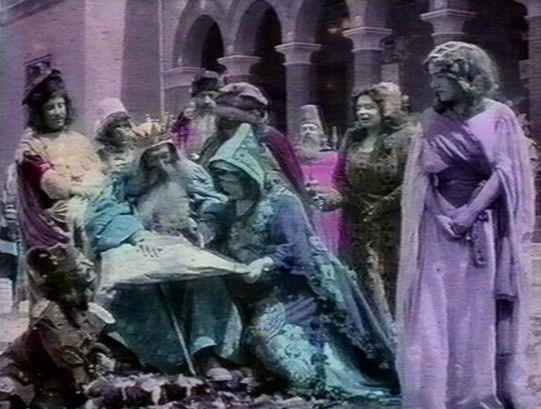
A first of some kind has been announced by the Shakespeare’s Globe theatre on London’s South Bank. On 23 April (Shakespeare’s birthday), the white walls of the Globe will be effectively converted into screens, as a 45-minute programme of silent Shakespeare titles from the BFI National Archive will be projected on the outside of the theatre. The films, already known through the BFI/Milestone Silent Shakespeare DVD, will be accompanied by Laura Rossi and Fourth Dimension string quartet – Rossi composed the score for the DVD. The screenings take place at 7.00 and 8.00 pm.