The Glow in Their Eyes

Some of the most interesting work going on in early film studies (in fact, film studies in general) at the moment is the empirical work being done on audiences. There is an international organisation, HOMER, devoted to the subject, and Cinema Context in Amsterdam (subject of an earlier post) is one only example (albeit a spectacular one) on the work that is going on internationally. This call for papers for a conference is therefore particularly interesting:

The Glow in Their Eyes

Global perspectives on film cultures, film exhibition and cinemagoing

International Conference, Brussels, 15-16 December 2007

The aim of the conference is to review the current state of research in the history of moviegoing and film exhibition and distribution. We seek to bring together scholars dealing with these subjects from all over the globe. The growing number of case studies in local film history increases the need for comparative studies of cities, regions, and nations, while the relationship between micro and macro history(ies) is becoming a major issue for the field. The analysis of patterns and networks in film culture also calls for special attention to methodology. The conference aims to bring European perspectives on cinemagoing and film exhibition into dialogue with British, American and Australian research, and with research elsewhere in the world, in Africa, South America and Asia.

The conference aims to explore and map several crucial tensions arising from the issues of exhibition and cinemagoing, including:

  • The attention given to “top down” forces of industry, commerce and ideology as against “bottom up” forces of experience, consumption and escapism;
  • Contesting concepts of public and private space in media experience;
  • Questions relating to cinema’s integration into to the metropolitan experience of modernity, compared to its role in the construction of community in less urbanised and rural areas.

In line with the ECREA film studies section philosophy (www.ecrea.eu) the conference approaches the phenomenon of cinema in a broad, socio-cultural sense: cinema as content, as cultural artefact, as commercial product, as lived experience, as cultural and economic institution, as a symbolic field of cultural production, and as media technology. On a methodological level, the conference is open to multiple approaches to the study of historical and contemporary cinema: film text, context, production, representation and reception. Cultural studies perspectives, historical approaches, political economy, textual analysis, audience research all find their place within this scope.

The conference also signals the completion of two major interuniversity research projects, one in Belgium (‘The Enlightened City. Screen culture between ideology, economics and experience. A study on the social role of film exhibition and film consumption in Flanders (1895-2004) in interaction with modernity and urbanisation’), and one in Australia (‘Regional Markets and Local Audiences: Case Studies in Australian Cinema Consumption, 1927-1980’). These research projects use a combination of oral histories, archival documentation, demographic data and media reportage and personal papers to examine the audience experiences and business practices of cinemas in Belgium and Australia.

The conference is supported by the International Cinema Audiences Research Group (ICARG), and will be the second international gathering of the Group’s work on the HOMER (History of moviegoing, exhibition and reception) Project, following the successful ‘Cinema in Context’ conference held in Amsterdam in April 2006. The conference will be preceded by an ICARG workshop.

Confirmed Keynote Speakers: Annette Kuhn (University of London); Richard Maltby (Flinders University)

Possible topics for papers are e.g.:

  • Film exhibition, cinemagoing and film experience in relation to theories of imperialism, postcolonialism, etc.
  • Long term tendencies such as the rise of cinemas in rural and urban environments, the boom of cinemagoing, the decay and subsequent closure of many (provincial and neighbourhood) cinemas and the rise of multiplexes
  • Tensions between commercial and/or ‘pillarised’ film exhibition, between urban and rural areas, and between provinces and regions
  • Institutional developments, geographical location and programming trends
  • Audience and film experiences in urban and rural contexts
  • A comparative international perspective on cinemagoing and exhibition
  • Diasporic cinemagoing practices
  • Representations in films of cinemagoing, film exhibition, film culture(s)
  • Reflections on methods: How to reconcile/combine large scale analysis vs in depth case study? How to link up national or regional databases on exhibition and cinemagoing?

A selection of papers presented on the conference will be published in an edited volume in 2008 (publisher to be confirmed). Please submit abstracts (500 words) with short bio to Gert.willems2 [at] ua.ac.be and Liesbeth.vandevijver [at] @ugent.be before 6 July 2007. Speakers will be notified of acceptance by 31 July 2007.

Website (under construction): www.cinemagoingconference.ugent.be
In the Red Velvet Seat

Red Velvet Seat

http://www.amazon.co.uk

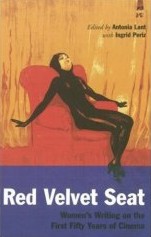
Following on from yesterday’s post on women silent filmmakers in Britain, today I came across Red Velvet Seat: Women’s Writings on the First Fifty Years Of Cinema, edited by Antonia Lant and Ingrid Periz. I really should have noted it before now. It is an excellent, huge (872 pages) compilation of contemporary texts by women on film in the first half of the twentieth century. These come from women filmmakers, actresses, social reformers, journalists, critics, sociologists, poets, and spectators, many from the silent period.

The texts are divided into sections, which demonstrate the range: Seeing or Being Seen; Touring the Audience; Why We Go to the Movies; The Spectatrix; Film Aesthetics and the Other Arts; Futurology; Captive Minds; Enlightment without Tears; Means of Control; Naming the Onject; Reviewing; The Star; Film as the National Barometer; In the Shadow of War; The Limits of Criticism; A Job for Whom?; The Actress and Adventuress; The Screenwriter; The Director; Working in the Autiorium.

Among the more familar names are Virginia Woolf, Djuna Barnes, Dorothy Richardson, C.A. Lejeune, Iris Barry, Lotte Reiniger, Betty Balfour, Sarah Bernhardt, Lillian Gish, H.D., Maya Deren, Marie Stopes, Anita Loos, Germaine Dulac, Rebecca West, Dilys Powell, Zelda Fitzgerald, Winifred Holtby and Elizabeth Bowen. What is so impressive, apart from the range of writers and themes, is the choice of some little-known yet hugely interesting rarities alongside the expected ‘classics’. How did they find the 1918 piece by Marie Stopes on the purpose on cinema in a Tokyo journal? There are two pieces by female spectators of the Corbett-Fitzsimmons boxing film of 1897. There are many riches here for anyone interested in the first decades of cinema, quite apart from the special emphasis on women’s roles in cinema and women’s view of the medium.

It’s a real treasure trove.

Women behind the camera

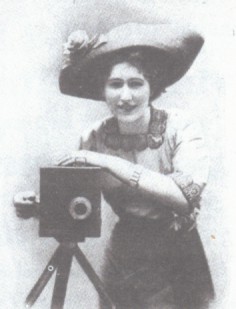
From an advertisement for the Kinora home movie camera

I have been adding texts of my talks, essays, filmographies and other work on to my personal website, www.lukemckernan.com, where I am free to do so. Do take a look at the Publications, Talks, Shows and Research sections for assorted interests of mine in the worlds of early and silent cinema, which I hope may be of use to others.

The latest text to go up is Women Silent Filmmakers in Britain. This is a filmography of films directed, shot, produced, scripted or edited by women in Britain in the silent era – a full filmography in each case, not just the handful of films that survive. It’s something that I first put together some time in the late 1990s, and it’s still very much a work in progress, so any comments, corrections or additions (especially new names) will be most welcome. Among the names listed are scriptwriters Muriel Alleyne, Lydia Hayward, Alma Reville and Blanche McIntosh; directors Ethyle Batley, Frances E. Grant, Dinah Shurey, and Jakidawdra Melford; camera operators Jessica Borthwick and Mrs Aubrey Le Blond; scientific filmmaker Mrs D.H. Scott, editor Adeline Culley, executive Ada Aline Urban, and many more.

It’s an area ripe for more research. British silent cinema itself is still an undervalued and neglected field, and the significant role of women in film production at that time is scarcely known. A pioneering piece of writing is Katherine Newey’s essay ‘Women and Early British Film’ in Linda Fitzsimmons and Sarah Street (eds.), Moving Performance (Trowbridge: Flicks Books, 2000). However, there is much new activity in the field, including an ongoing ‘Women in Silent Britain’ project which was discussed at the recent British Silent Cinema Festival. More news on this work as and when we get it. I’ll also be posting pieces on individual women filmmakers (and not just British) in the future.

(By the way, the image at the top of this post comes from a 1911 booklet, The Golden Book of Motion Photography, advertising the use of home movie cameras. It comes from Barry Anthony’s The Kinora: Motion Pictures for the Home 1896-1914).

Stopping time

The Man Who Stopped Time

http://www.amazon.co.uk

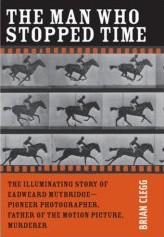
There’s a new book by Brian Clegg, The Man Who Stopped Time: The Illuminating Story of Eadweard Muybridge – Father of the Motion Picture, Pioneer of Photography, Murderer, published by National Academy Press. It’s time we had a good, popular, up-to-date account of Muybridge’s achievements, and Clegg’s book seems to fit the bill. Read the positive review by Stephen Herbert on his Muybridge site, or hear from the author himself via the Popular Science site:

And what a story it is! A passionately-driven man struggling against the odds; dire treachery and shocking betrayal; a cast of larger-than-life characters set against a backdrop of San Francisco and the Far West in its most turbulent and dangerous era; a profusion of technical and artistic advances and discoveries, one hotly following on another; the nervous intensity of two spectacular courtroom dramas (one pitting Muybridge against the richest man in the West and staring ruin in the face, the other sees him fighting for his life) … and for the opening act, a foul murder on a dark and stormy night …

It’s all true.

British Pathe – part two

British Pathe logo

Some while ago I posted an item on the British Pathe website, concentrating on the silent fiction films that unexpectedly can be found there. Now here comes the follow-up post, on the newsreels and other non-fiction films to be found there.

In 2002 British Pathe, owners of the Pathé newsreel library, put up the whole of its collection, thanks to a grant from the New Opportunities Fund‘s NOF-Digitise programme. It was a controversial decision, because a commercial company was being given public money to do what some felt the company might have done for itself, but others welcomed a new kind of public-private initiative. The result for the public was 3,500 hours of newsreel footage from 1896 to 1970, available for free as low resolution downloads. Later 12,000,000 still images were added, key frames generated as part of the digitisation process. It was, and remains, one of the most remarkable resources on the net, and a major source for those interested in silent film.

Charles Pathé established the Société Pathé Frères, for the manufacture of phonographs and cinematographs, in 1896. A British agency was formed in 1902, and its first newsreel (which was the first in Britain), Pathé’s Animated Gazette, was launched in June 1910. This soon became Pathé Gazette, a name it retained until 1946, when it was renamed Pathé News, which continued until 1970. These newsreels were issued twice a week, every week, in British cinemas, and were a standard feature of the cinema programme in silent and sound eras.

Pathé also issued other films. It created the cinemagazine Pathé Pictorial in 1918, which ran until 1969. Eve’s Film Review, a cinemagazine for women, was established in 1921 and ran to 1933, while Pathétone Weekly ran 1930-1941. There were other film series and one-off documentaries.

All of this and more is on the site. Pathé were distributors of others’ films, some of which turn up unexpectedly on the site. For example, there are some of the delightful Secrets of Nature natural history films made by Percy Smith in the 1920s. There are also actuality films from before 1910 which Pathé seems to have picked up along the way, though not all of them are Pathé productions by any means – for example, assorted films from the Anglo-Boer War of 1899-1902.

Page from British Pathe site

For the silent period, researchers should note that the collection is not complete. For the First World War and before (what British Pathe calls Old Negatives) the surviving archive is patchy, and the cataloguing records less certain with dates. For the 1920s, the record is substantially complete – indeed, there is unissued and unused material as well as the standard newsreels. These of course show events great and small throughout the decade, with an emphasis on sport, celebrity, spectacle and human interest. Look out in particular for the women’s magazine Eve’s Film Review, a delightful series with an emphasis on “fashion, fun and fancy”. For silent film fans, there are newsreels of Chaplin, Valentino, Pickford, Fairbanks etc. There are all sorts of surprise film history discoveries to be made, such as a Pathé Pictorial on feature film production in Japan in the 1920s.

You can find the British Pathe collection (the company doesn’t use the accent on the e) at other places online. British Pathe is now managed by ITN Source, one of the world’s major footage libraries, and all of its films can be downloaded from that site in the same manner. You can also find many of them on the British Universities Newsreel Database, which is a database of all British newsreels and has substantial information about each of the Pathé newsreels, the people who worked for them, and histories of newsreels and cinemagazines in Britain in the silent and sound eras.

There are also versions of the Pathe delivery for schools – Beyond Pathe, Teaching & Learning with the British Pathe Archive, and Shapes of Time.

It’s a hugely important resource, and it’s all still free, though it’s now beyond the date British Pathe agreed with the New Opportunities Fund to keep the collection freely available to all. Long may it continue to be so.

Chaplin’s camera

Got £90,000 spare? Charlie Chaplin’s Bell & Howell camera is being auctioned by Christies in London on 25 July, and is expected to fetch a price between £70,000 and £90,000. The silent Bell & Howell 2709 model camera was bought by Chaplin in 1918. It was used by Chaplin throughout the 1920s (The Kid, The Gold Rush, The Circus etc) and into the 1903s for City Lights and Modern Times. It continued in use up to the 1950s for animation work and shooting titles. It’s part of a motion picture equipment sale, and will be on view at Christies’ showrooms from 21 July.

How We Advertised America

George Creel

George Creel, from How We Advertised America

The Prelinger Archive continues to publish public domain texts on the Internet Archive, on all kinds of subjects. Among the latest batch is George Creel’s How We Advertised America, published in 1920. George Creel was a journalist and campaigner on social issues who was put in charge of the Committee on Public Information in 1917. The CPI was America’s official propaganda outfit during the First World War, tasked with ‘selling the war’ to Americans. As such it was responsible for American official films such as Pershing’s Crusaders, America’s Answer, Under Four Flags, and the newsreel Official War Review. The Creel Committee, as the CPI was also known, recognised the importance of film as a medium to persuade the public, but it was mistrustful of the film industry, and the film industry was reluctant to be exhibiting propaganda. It had huge troubles getting its films onto American screens. Nevertheless, it produced a stream of footage from its team of Signal Corps cameramen which was issued in the form of persuasive documentaries and the regular newsreel.

After the war, Creel published the controversial How We Advertised America, which called for the use of the methods in commercial advertising to be used for official promotion of America. It’s an important source for understanding the context in which propaganda films were produced during the First World War, the first time the medium had been used extensively by national governments as a tool of mass persuasion. The book is available as a free download in PDF (65MB), DjVu (21MB), b/w PDF (20MB) and TXT (906KB) formats. See also Kevin Brownlow’s book The War The West and the Wilderness for a good acount of the work of Creel and the CPI.

Musical accompaniment of moving pictures

Rose of the World cue sheet

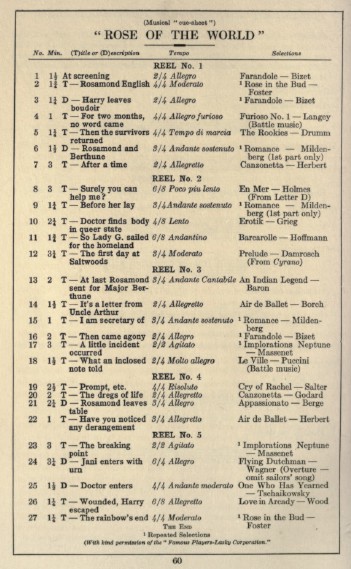
The latest addition to the Bioscope Library is Edith Lang and George West’s Musical Accompaniment of Moving Pictures (1920). This is a guide for pianists and organists in the silent era, with plenty of musical detail (‘Musical Characterisation’, ‘Transition and Modulation’, ‘Improvisation’) and practical advice (“The player will do well, first of all, to ‘size up’ his audience”), with repertoire suggestions. It is also wide-ranging in the kinds of films it advises on – not only feature films, but animation, slapstick comedies, newsreels, travelogues and even educational films. There is particular discussion, with music cue sheet (illustrated), of the Maurice Tourneur five-reel film Rose of the World (1918). The book gives special attention to the theatrical organ. It’s available from the Internet Archive in PDF (27MB), DjVu (2.6MB) and TXT (139KB) formats.

100 years of the Autochrome

Anyone entranced by the Autochrome photographs in the current BBC4 series The Edwardians in Colour: The Wonderful World of Albert Kahn will want to know about an upcoming exhibition at the National Media Museum in Bradford, celebrating the centenary of the Autochrome. It’s not moving pictures, of course, but the Autochrome – the most beautiful of all colour photography systems (it’s all down to the potato starch they used…) – was invented by Auguste and Louis Lumière, inventors of the Cinématographe, and so it gets honourable mention here. The exhibition is called The Dawn of Colour, and runs 25 May-23 September 2007. More news once it’s started.