Times past

There are several large-scale digitisation progammes going on world wide which are starting to make substantial numbers of historic newspapers available online, a God-send for anyone engaged in research into early film. Some are freely available, some restricted to universities, some are commercial operations. There are various ways of getting at all of them, and in any case one shouldn’t shy away from paying a little for access to such treasures, given the huge efforts made to digitise them (something I know a little about).

This survey covers some of the major historic newspaper resources available. For each, I’ve tested them out with the word ‘Kinetoscope’ (i.e. Thomas Edison’s peepshow viewer which first exhiited motion picture films to the public, and which was most commercially active in the 1894-1896 period, but carried on as a common term for a few years after that).

Chronicling America

The Library of Congress is co-ordinating a huge newspaper digitisation programme, entitled Chronicling America. The project is sponsored jointly by the National Endowment for the Humanities and the Library of Congress as part of the National Digital Newspaper Program. So far it has digitised selected newspapers for the period 1900-1910, covering California, District of Columbia, Florida, Kentucky, New York, Utah, and Virginia. That’s thirty-six newspapers, including such key titles as The San Francisco Call, The New York Sun, The Washington Times, The Colored American, and The New York Evening Times.

Chronicling America

Searching across all papers and all dates for the word ‘kinetoscope’ got me 71 hits. Clicking on a result gives me a picture of the full page, then options to view the OCR text (i.e. text derived throgh scanning using Optical Character Recognition, which may bring up some small errors), PDF, or I can download the image as a jp2 file. The term I searched for is highlighted on the image, and I can zoom in or out. Each hits gives you the title of the newspaper, the date of the issue, and the page number. On a quick survey of the texts, I saw the Kinetoscope was being commonly used as a generic term for motion pictures, rather than the Edison machine specifically.

Chronicling America is free to all, easy to use, and is certain to grow as the phased digitisation programme develops. The site has background information, including technical details for those entranced by TIFFs and JPEGs.

Times Digital Archive

Probably the most outstanding of the newspaper digitisation programmes, and the one that has had a great impact on research across any number of disciplines, is the Times Digital Archive. This is a commercial operation, managed by Thomson Gale. It offers every page from the London Times 1785-1985. It is possible to search for a term or phrase across all dates, a specific date or a date range, and across all types of section, or restricted to Advertising, Business, Editorial and Commentary, Featurees, News, People and Picture Gallery – this is a very useful feature for narrowing down searches.

Searching on ‘kinetoscope’ across all fields got me 60 hits. As it covers the 1890s period, the rsults were excellent, tracing the Kinetoscope’s appearance in London, from a first mention on 8 March 1894 of Edison’s latest invention, to the surprise discovery that in 1897 there as a racehorse called Kinetoscope (not a very successful racehorse, it seems). Search results cite the date, page, issue number and page column of the relevant article, with the search term highlighted on the page. You can view the relevant article or page as PNG images, or view the page as PDF.

Times Digital Archive

Such a wonderful resource comes at a price. It isn’t freely available, and instead it is made available to institutions in a variety of subscription packages. In the UK, most universities subscribe to it, under the Athens password system (which restricts online resources to UK academic users), but it can also be found in many public libraries. It is also available through subscribing international institutions as well.

Google News Archive

And then there’s the Google News Archive search. Naturally enough Google has provided us with a search engine which browses historic news resources, both free and subscription-based, so you are offered tantalising glimpses of news stories that can be yours if only you’ll pay. Typing in ‘kinetoscope’ yields 2,210 results. The results seem all over the place, but it is possible to narrow down the search by date or newspaper, as Google assesses which areas are likely to yield the most results from your broad search query. It can also arrange results in a handy ‘timeline’ fashion.

Google News Archive

It’s worth noting that many of the subscription sites, such New York Times, give you at least the first few lines of the requested article. Speaking of the NYT, you can pay $4.95 to view a single page, $7.95 a month (up to 100 articles) or $49.95 per year (up to 1,200 articles). Find out more from its TimesSelect service.

The Google News Archive is a wonderful research tool, not least for showing the sheer range of digitised newspaper collections out there, and as a quick spot-check method of seeing when a subject was being discussed, in what way, and by whom. I certainly want to read more of the Los Angeles Times article of 31 March 1897 entitled ‘Kill the Kinetoscope and its Kindred’, with the tantalising opening lines, “The Senate Judiciary Committee did well in reporting favorably the bill to prohibit the exhibition of prize-fight pictures by means of the kinetoscope and kindred devices in the District of Columbia or the Territories of the…”

British Library Newspapers

The British Library maintains the national collection of newspapers (still housed in quaint conditions at Colindale in North London). It has had had for some while a test online historic newspaper service, using Olive Software, which offers some year-long slices from four sample papers: News of the World, Manchester Guardian, Daily News and The Weekly Dispatch, from which only the News of the World gives a Kinetoscope story – on the racehorse, in 1900.

But now the British Library is engaged on a massive British newspaper digitisation programme, with higher education funding money (the JISC Digitisation Programme). The first stage of this, recently completed, has digitised 2 million pages of 19th century newspapers. Stage two, just begun, will add a further 1.1 million pages from 1690-1900. The results, however, will be accessible to UK higher and further education users only.

The lessons to be learned are simply that, if you want serious access to knowledge, you need to pay or to be a student. The number of precious resources being made available only to universities is a problem for the outside researcher, though that’s where the money is coming from, and in many cases it’s the only way of getting round licensing restrictions.

What else is out there?

There are commercial sites, such as ProQuest, which is a world leader in providing access to digitised resources to institutions, including historic newspapers. Like a number of these services, it offers free trials – but only to institutions. The massive NewspaperARCHIVE.com welcomes individuals. It boasts over 68 million pages, and lets you know your search results for free, so Kinetoscope yielded a tantalising 2,923 hits. Annual membership starts at $8.95 per month.

But there are many smaller initiatives to look out for. A while back, I wrote a post on The Silent Worker, a newspaper for the deaf, which had many articles on the deaf and silent films. I found the information on that from the British Columbia Digital Library, which has a very useful listing of digitised newspaper collections around the world. And if you are frustrated at not being able to get hold of subscription-based collections, I recommend the Godfrey Memorial Library, an American library specialising in genealogy resources which for a very cheap annual subscription (from $35.00) offers access to a large number of newspaper libraries, including the Times Digital Archive.

There’s so much out there. If you know of other collections, or directories of information, do let me know.
Lillian Gish Film Festival

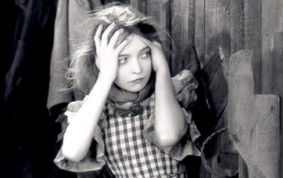
Lillian Gish

Doubtless making up a little for having missed out on hosting The Simpson Movie premiere, Springfield, Ohio plays host to The Lillian Gish Film Festival over 5-8 September. Films to be featured include Broken Blossoms, The Wind (with the Springfield Symphony Orchestra), The Night of the Hunter and The Whales of August. There are lectures, a Gish Wine Tasting (!) with Roundtable discussion, and a Gish Sisters Walking Tour. The Gish family came from Springfield: the father, James Leigh Gish, ran a confectionery business there, though they moved away soon after Lillian was born (1896), to Dayton, where Dorothy was born (1898). And then, of course, they experienced a peripatetic life as child stage performers.

More details from the festival site.

Summer of British Film

Summer of British Film

Today the BBC begins its summer-long season of over 100 British films, divided into seven themes (Thriller, Love & Romance, Social Realism, Costume Drama, Horror, War and Comedy), with seven acompanying documentaries. The selection of films is really quite imaginative – there’s a full list on the BBC site. If I can veer away from silents just for a bit, I strongly recommend Edmond Greville’s Noose (1948), showing this Sunday morning, a corking crime thriller set in Soho, with Nigel Patrick having the time of his life as a sharp-talking spiv; The Scarlet Thread (1950), with Kathleen Byron and Laurence Harvey, on August 3rd, just because I’ve never seen it and it looks intriguing; Victor Saville’s 1931 version of Hindle Wakes – not quite as good as the 1927 silent, but powerful stuff nonetheless, and oddly enough the rarer title these days – on August 10th (the BBC has a still for the 1951 version by mistake); and many many more – Obsession, Young and Innocent, Hell Drivers, I Know Where I’m Going!, Hungry Hill, This Sporting Life, That Hamilton Woman, A Night to Remember, Gregory’s Girl, Witchfinder General

There’s just the one silent, Anthony Asquith’s A Cottage on Dartmoor (1929). Needless to say, it’s being shown in the small hours, Monday morning July 30th at 1.30 am. To be honest, if I had to choose one British silent only to join such a parade, it wouldn’t be the sometimes ponderous A Cottage on Dartmoor, but it’s had some exposure of late, and so I guess it has a modest vogue about it. I’d have gone for the 1927 Hindle Wakes myself. Or The Informer. Or The Manxman. Or The Flag Lieutenant

Dr Plonk

Dr Plonk

Next month sees the release of Dr Plonk, a modern silent comedy written, produced and directed by Australian filmmaker Rolf de Heer (who previously gave the world the film Bad Boy Bubby). It sounds rather engaging. Here’s the synopsis from the official site:

It is the great year of 1907. Dr Plonk, eminent scientist and inventor, calculates that the world will end in exactly 101 years unless immediate action is taken. As befalls visionaries through the ages, Plonk is ridiculed for his beliefs, by politicians, by bureaucrats, even by his faithful manservant Paulus. Being the lateral thinker that he is, Plonk invents a time machine and sets out to collect the necessary proof from the very future that’s ending.

But little about the year of 2007 makes sense to the intrepid doctor. His efforts to alert the appropriate authorities cause him to fall foul of the law and become a hunted man. With the nation’s entire law-enforcement system arrayed against him, a scientific question is posed … can Dr Plonk run fast enough?

According to the director, he made the black-and-white film out of 20,000 feet of unexposed stock that he found in a refrigerator. There’s a QuickTime trailer on the site which indicates that de Heer has seen a lot of Sennett comedies (the lead character looks very much like Ford Sterling) and absorbed the lessons well. There is apparently a strong element of contemporary social satire, with Dr Plonk being mistaken for a terrorist when he visits the madcap world of 2007. The film stars Magda Szubanski, Nigel Lunghi, Paul Blackwell and Reg the dog. It comes with its own music, played by the Stiletto Sisters (violin, piano accordion, double bass) and pianist Samantha White. And it runs for 86 mins.

The film will be released in Australia at the end of August.

No sale for Chaplin

The much-trailed auction at Christies of a Bell & Howell 2709 camera used by Charlie Chaplin resulted in no sale. The price had been put at £70,000-£90,000. The camera was one of four 2709 models used at the Chaplin studios. It was purchased in 1918 and used by Chaplin throughout the 1920s.

Despite the no sale, The Bioscope had one of its reporters on the spot, who returned with some fine pictures. Here’s a close view of the camera mechanism:

Chaplin camera

And here’s a marvellous Chaplin’s-point-of-view shot of the eyepiece:

Chaplin camera

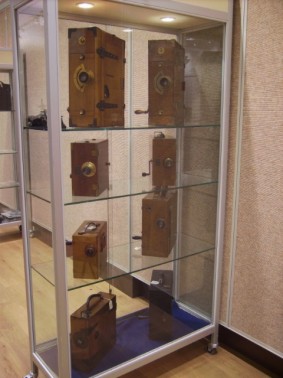
As already reported, the camera sale of which the Chaplin camera was a part is rumoured to have been Christie’s last, the collector’s market not being what it once was. Which is sad, if it means that their glamour is fading. Not that I can usually tell one box from another – I can just about manage to spot a Bell & Howell, given the ‘Mickey Mouse ears’ look of the twin magazines, but thereafter I tend to get a bit stumped. So, don’t ask me which is which among this selection of boxes, which is one for the cognoscenti:

Cinematographs

And, finally, something I can recognise, even without its box, though only because the name is somewhat prominently displayed – an Urban Bioscope, such as graces the header of this blog:

Urban Bioscope

With many thanks to Christian Hayes for the photographs.

Lost and Found no. 1 – Joseph Joye

I wrote a couple of days ago on the Michell and Kenyon film collection of Edwardian actualities, and asked whether such an extraordinary film collection would ever turn up again. Well, not yet, but despite time marching on and nitrate film inevitably decaying, remarkable early film collections do still turn up. While we’re waiting, I’m going to start up a mini-series on previous amazing collections, which should make us hopeful of future such discoveries. To start with, the heartening story of the Abbé Joye…

Joseph Joye

Joseph Joye (1852-1919) was a Swiss Jesuit priest who decided, around 1902-03, to start educating the children in his charge with motion pictures. Like quite a number of clerics around the world, he made the leap from showing scenes on the magic lantern to capturing his young audience’s attention with films. What made Joye different was the scale of his endeavour. He built up a collection of many hundreds of films over the period 1905-1914, purchasing prints on the second-hand market in the German-speaking quarter of Switzerland. It is said that in some cases he smuggled prints across the German-Swiss border by hiding the cans under the folds of his cassock. All were shown to his child and adult audiences, and then retained at his Basle school.

Joye was omnivorous in his tastes, collecting comedies, melodramas, classical adaptations, travelogues, actualities, trick films, histories, science films, fairy tales, industrials, coloured films: the whole rich panoply of early cinema production. His collection remained at the school, until it was discovered by a British filmmaker, David Mingay, in 1975. It was taken in by the National Film Archive in London, which had the best facilities for tackling such a huge collection of nitrate film, in 1976. The collection of 1,200 prints (all with German titles) was eventually restored and extensively catalogued in its entirety, a task completed in the mid-1990s. It was also lovingly researched by Swiss academic Roland Cosandey, who published the book Welcome Home, Joye! Film un 1910 in 1993 (if you find a copy, I took all the frame stills).

Ah! Da fleigt ein Aeroplan

(Ah!… Da fleight ein Aeroplan, a 1910 Gaumont comedy about people’s amazement at seeing aeroplanes, from the Joye collection)

It is one of the richest collections of early films in the world, renowned among the early film studies community but little known outside it. The collection is full of unique gems. Among the star titles are Victor Sjöström’s Havsgamar (Sea Vultures) (1915) and Ranch Life in the Great South-West (1910), which features the first screen appearance of Tom Mix. There is the awe-inspiring S.S. Olympic (1910), a Kineto film about the making of the sister ship to the Titanic (much used in TV documentaries) and L’Inquisition, a surprisingly graphic Pathé film on the Spanish Inquisition, which makes you wonder what was going on in Joye’s mind when he purchased it. There are ravishingly beautiful stencil colour films, and many travel films from around the world providing rare glimpses of peoples probably never filmed before. It is thematically rich in so many ways. And no DVD has ever been published, no catalogue (all of the shotlists can be found on the BFI’s database, though no search will find you all of the Joye titles in one go), no BBC4 television series…

If the BFI is looking for another ‘lost’ film collection to promote to the world, it has one sitting on its shelves.

Pordenone update

More programme information has been published on Le Giornate del Cinema Muto, or the Pordenone Silent Film Festival as it is also known. The festival takes place at Pordenone, Italy, 6-13 October, returning to Pordenone itself after a period of some years in exile at nearby Sacile, and housed in the new Teatro Verdi.

The outline programme was the subject of another post. Now we have more details on some aspects of the programme.

The Griffith Project, now in its eleventh year, moves on iin its chronological survey of D.W. Griffith’s suriviving film output to the years 1921-1924:

  • [PROLOGUE TO DREAM STREET] (US, 1921)
  • DREAM STREET (D.W. Griffith, Inc., US 1921)
  • ORPHANS OF THE STORM (D.W. Griffith, Inc., US 1921)
  • ONE EXCITING NIGHT (D.W. Griffith, Inc., US 1922)
  • THE WHITE ROSE (D.W. Griffith, Inc., US 1923)
  • AMERICA (D.W. Griffith, Inc., US 1924)
  • ISN’T LIFE WONDERFUL (D.W. Griffith, Inc., US 1924)

Then there is the Corrick Collection from Australia’s National Film and Sound Archive. This is a collection of early films originally exhibited around the Pacific and Southern Asia by the Corrick family, touring entertainers from New Zealand.

  • [STREET SCENES IN PERTH, WESTERN AUSTRALIA] (Leonard Corrick, Australia, 9 March 1907)
  • THE MAGICAL PRESS (Charles Urban Trading Co., GB 1907)
  • CHASSE AU PAPILLON (Butterfly Catching) (Pathé, FR 1906)
  • FIRE! (Williamson Kinematograph Co., GB 1901)
  • LA POUDRE ANTINEURESTHÉNIQUE (The Anti-Irritability Powder) (Pathé, FR 1909)
  • LA RUCHE MERVEILLEUSE (The Wonderful Bee-Hive) (Pathé, FR 1905)
  • NAVAL ATTACK AT PORTSMOUTH (Charles Urban Trading Co., GB 1907)
  • AN INDIAN’S GRATITUDE (La Gratitude du chef indien) (Pathé, US 1911)
  • MONSIEUR QUI A MANGÉ DU TAUREAU (The Man-Bull Fight) (Gaumont, FR 1907)
  • WHEN THE WIFE’S AWAY (R.W. Paul, GB 1905)
  • CRETINETTI LOTTATORE (Foolshead’s Wrestling) (Itala Film, IT 1909)

Believe me, it’ll be worth travelling any distance to Italy just to see Urban’s NAVAL ATTACK AT PORTSMOUTH, companion piece to the thrillingly dynamic TORPEDO ATTACK ON H.M.S. DREADNOUGHT, which is held in the BFI National Archive.

There will also be a selection of titles from the National Film Preservation Fund’s Treasures III DVD, already trailed on The Bioscope, a René Clair retrospective, and a programme of sponsored films curated by Rick Prelinger, with these titles:

  • ADMIRAL CIGARETTE (Edison Manufacturing Co., US 1897)
  • AN AMERICAN IN THE MAKING (Thanhouser Co., per/for United States Steel Corp., US 1913)
  • UNHOOKING THE HOOKWORM (Coronet Pictures, per/for International Health Board of the Rockefeller Foundation, US 1920)
  • BEHIND THE SCENES AT HUTZLER’S (Stark Films, per/for Hutzler’s, US 1938)
  • MASTER HANDS (Jam Handy Organization, per/for Chevrolet Motor Company, US 1936)

That’s how it was with silent films – it wan’t just the glamour, you had people trying to deal with hookworm too.

So, all this and much much more. Full programme details here.

More from Mitchell and Kenyon

IrelandSports

Clearly there are people out there who cannot get enough of Sagar Mitchell and James Kenyon. Firstly there was the discovery of the lost haul of their actuality films of life in northern Edwardian Britain, an astonishing collection of 800 films in pristine condition, which were restored by the British Film Institute, with research undertaken by the National Fairground Archive. Then there came the 2005 BBC series The Lost World of Mitchell and Kenyon, which opened people’s eyes to past lives in a way probably never achieved before by a television programme. That was followed by the DVD of the series, then an accompanying book, then a second DVD Electric Edwardians, and then another book of the same title. And there have been public screenings, and countless newspaper articles.

And now there are two more DVDs, and both look amazing. Mitchell and Kenyon in Ireland, narrated by Fiona Shaw, includes twenty-six films taken by Mitchell and Kenyon 1901-1902, and covers Dublin, Wexford, Cork and Belfast. There’s an eighteen-page booklet, and a score by Neil Brand and Günter Buchwald. The second DVD, Mitchell and Kenyon Sports, is the one for me. Narrated by Adrian Chiles (clever choice), this has scenes of football, rugby, athletics, swimming and cricket. There’s film of Liverpool, Everton, Blackburn and Hull Kingston Rovers. A particular highlight is film of Lancashire bowler Arthur Mold demonstrating his action to prove that he didn’t, as was alleged, throw the ball. The camera never lies… Stephen Horne and Martin Pyne provide the musical accompaniment.

How will these sell, and what else lies in the vaults ready for release? It’s still extraordinary the excitement that has been generated by this collection of films. The ‘local topical’ film of the 1900s, in which Mitchell and Kenyon specialised, has long been well-known to film archivists. They are films with particular charm because of their artless style and the way in which the people in the films address the camera. They have always been seen as having largely regional appeal, the sort of films that few would ever see or appreciate. Then along came 800 in one go, negatives, with an underlying history connecting them with town hall showmen and fairground operators who commissioned the films and exhibited them across the country. And one musn’t forget the drive of Vanessa Toulmin, of the National Fairground Archive, in pulling all of this activity together.

Mitchell and Kenyon weren’t the only producers of local topicals at this period, but they were the most important. It has be stressed that we knew nothing of these films before they were discovered. My reaction, when I first saw a list of the films when I was working at the National Film and Television Archive, was disbelief – such a number of previously unknown films simply couldn’t exist. M&K were know for a handful of ‘fake’ newsreels of the Boer War, but none of the actualities films turned up in filmographies – they are completely absent from Denis Gifford’s British Film Catalogue, while Rachael Low’s The History of the British Film barely mentions the company. We know better now.

Will there ever be such a film discovery again?

Frosted yellow willows

Anna May Wong

There’s a website on the Chinese American actress Anna May Wong (1905-1961), with the enticing title Anna May Wong: Frosted Yellow Willows. The title is a translation of her Chinese name, Wong Liu Tsong.

The site accompanies a documentary film of the same name about the actress who starred in a number of notable silents, including The Toll of the Sea (1922, a two-colour Technicolor film), Peter Pan (1924), Douglas Fairbanks’ The Black Pirate (1924), Old San Francisco (1927) and Piccadilly (1929). She generally rose above the ‘exotic’ settings in which she was invariably cast, to give luminous performances which have ensured her a lasting following. Her screen career petered out in shoddy melodramas in the 1930s/40s, but she also had a career on stage, radio and television, as the site makes clear.

The documentary is produced by Elaine Mae Woo and narrated by Nancy Kwan. There’s a trailer on the site plus a rough-cut promo. As befits its elegant and glamorous star, the site is stylishly designed. The documentary has been ten years in the making, but is reportedly close to completion. If you felt like helping it along you could always make a donation.

Iamhist conference report

Amsterdam

Iamhist (International Association for Media and History) is an organisation of filmmakers, broadcasters, archivists and scholars dedicated to historical inquiry into film, radio, television, and related media. It publishes the widely-respected Historical Journal of Film, Radio and Television, and organises biennial conferences. This year’s was held in Amsterdam 18-21 July, on the theme Media and Imperialism: Press, Photography, Film, Radio and Television in the Era of Modern Imperialism. There were several papers given on silent film subjects, and the Bioscope was there with pen and notebook.

A number of the best papers were given on media outside Iamhist’s usual frame of reference. Pascal Lefèvre spoke lucidly and informatively on Imperialist images in French and Belgian children’s broadsheets of the late nineteenth/early twentieth centuries, finding arguably positive or some downright critical images that differed from the usual Western view of African peoples at this time. Andrew Francis was equally entertaining and observant in talking about the use of pro-Empire imagery in New Zealand newspaper advertising during the First World War.

On silent films themselves, James Burns spoke on the distribution (or lack of distribution) of the films of the Jack Johnson-Jim Jeffries boxing match in 1910 and D.W. Griffith’s Birth of a Nation in 1914 to black audiences in Africa and the Caribbean. The Johnson-Jeffries film (the black Johnson defeated ‘white hope’ Jeffries for the world heavyweight title) is well-known for how its images of a black victory alarmed many in America, though Burns pointed out that films of Johnson’s earlier victories over white opponents had not aroused anything like the same rabid reaction. He also pointed out that Birth of a Nation was not exhibited in Africa (until 1931), yet no evidence has yet been found to show why it was withheld. Burns’ has done excellent work on film and black African audiences (see his Flickering Shadows: Cinema and Identity in Colonial Zimbabwe), and his new research promises much, even if evidence of black audience reactions (outside the USA) remain elusive.

Simon Popple spoke on films of the Anglo-Boer War, focussing on the dramatised scenes of the conflict produced by the Mitchell and Kenyon company. M&K are now renowed for their actuality films of life in Northern England in the Edwardian era, after the successful BBC series The Lost World of Mitchell and Kenyon, but they also made dramas, recreating melodramatic scenes from the South African war to feed a public appetite for moving picture scenes of the war which had been disappointed by undramatic newsfilms of the conflict. These crudely histrionic dramas, with titles such as Shelling the Red Cross, A Sneaky Boer, and Hands Off the Flag, raise a laugh now, but presumably had them cheering in the aisles in 1900.

With the unavoidable but unfortunate practice of parallel sessions so that as many speakers as possible can be crammed in, no one could attend everything, and I missed some relevant papers, including Teresa Castro on ‘Imperialism and Early Cinema’s Mapping Impulse’ and Yvonne Zimmermann on ‘Swiss Corporate films 1910-1960’. Too few witnessed Guido Convents‘ excellent presentation on the huge production of Belgian colonial films, from the early years of the century onwards, all designed to remind the world and audiences at home that Belgian had a presence in Africa and an Imperial role to play. He also showed a heartbreaking film of the difficulties faced by the Congo film archive, which put into perspective some of the institutional troubles faced by the world’s larger film archives, described by Ray Edmondson in a plenary session. Edmondson nevertheless made an eloquent case for the ways in which some film archives have come under threat through insensitive political fashions and institutional follies. Archives seem hampered by being archives: politicians do not grasp what it is that they are about in the same way that they do with museums, a far more generously funded sector with a considerably greater public profile.

And there was more. Martin Loiperdinger showed magic lantern slides of British Empire subjects from the nineteenth century and considered their impact upon audiences. Kay Gladstone of the Imperial War Museum showed a two-hour selection of films from its amazing archive for the two world wars (and more), including a live action political ‘cartoon’ from the Anglo-Boer War, and images of Colonial troops in the First World War, though what left the audience stunned was silent, colour home movie footage of India at the time of partition in 1947, showing scenes of the misery caused that the newsreels of the time scrupulously avoided. And there was plenty on post-silent subjects, and me thrilling a small audience with a disquisition on databases and the misuse of thesauri and keywording in describing Imperial and Colonial themes. You should have been there…

These conferences are curious affairs. They are an excellent meeting place and a good way to catch up on the latest ideas, but you do also sit through some truly grim presentations – mumbled monotones, heads bowed down reading from indigestible text, oblivious to the needs of an audience. How some people can still continue to draw salaries as lecturers beats me – you do pity their poor students. And then there are the natural entertainers, who know their audience as well as their subject, and can speak wisely and clearly, in whatever time allotted. It was a well-organised event, the sun shone, the pavement cafés were inviting, and the coffee was fine. I’ll be following up some of the themes (especially silent cinema in Africa) in future posts.