Screen heritage survey

Magic lantern slide from National Media Museum

Magic lantern slide from the National Media Museum, http://www.nationalmediamuseum.org.uk

A online survey was launched today, to uncover collections in the UK with moving image and screen-related artefacts. It is organised by a body called the Screen Heritage Network (of which the organisation I work for, the British Universities Film & Video Council, is a member). The survey is open to any UK collection with artefacts relating to the moving image and screen-related media which may be accessible to the public or researchers. There are ten categories of artefact being sought:

1. Film production equipment
2. Television and video equipment
3. Animation and special effects
4. Sound
5. Sets and costumes
6. Cinema and projection
7. Magic lanterns, slide projectors and viewers
8. Toys and games
9. Installations
10. Documentation

The information gathered will be used to create the first-ever online database of moving image and screen-related objects in UK collections.

Behind this activity lies a definition of ‘screen heritage’ which goes beyond moving picture to encompass the machinery that produces and exhibits them, the culture that supports them, and a notion of ‘screen’ that extends beyond cinema and television back to magic lanterns and forward to video games, consoles and the handheld technologies of today.

So the survey, in looking at artefacts, is concentrating on just a part of this vision of what ‘screen heritage’ comprises. It’s all most appropriate to the study of silent cinema, and where silent cinema fits in within the broader scheme of things. Do take a look at the project site, and if you know of a museum or other heritage organisation within the UK that ought to be taking part, and which we may have missed, let us know.

From 1896 to 1926 – part 1

E.G. Turner

Edward G. Turner, from http://www.victorian-cinema.net

It’s time for a new series. Edward G. Turner was a film exhibitor and distributor from the earliest years of British film, whose company Walturdaw continued for decades thereafter. In 1926 he wrote a series of articles for the Kinematograph Weekly (great rival to The Bioscope) on his memories of the industry. ‘From 1896 to 1926: Recollections of Thirty Years of Kinematography’ (originally published 17 & 24 June, 1 & 15 July 1926) is marvellous source of information on the first years of the British film business, particularly renting (distribution) where Walturdaw were undoubted pioneers. It’s an anecdotal stuff, occasionally homely stuff, but with revealing gems along the way. Anyway, let’s start…

The founders of the Walturdaw Co. Ltd., of whom the successors are the Walturdaw Cinema Supply Co. Ltd., were E.G. Turner and J.D. Walker, and the month of August in the year 1896 saw the beginning of their activities in the kinema industry when they purchased their first machine from John Wrench and Sons, of 50, Gray’s Inn Road.

At this time there were only two other makers of machines in the world’s market: R.W. Paul, of Hatton Garden, and Lumière, of Paris.

Within a short period, Beard, of old Kent Road, Haydon and Urry, of Islington, Hughes, of Kingsland Road, Levy Jones. of Hoxton, Reay, of Bradford, Thomassin, Ottway in St. John Street, Islington. Later the Edisonagraph, Mutoscope American Biograph and Pathé came into existence.

The First Posters
At this period our office was at my private address at 111, Great Eastern Street, E.C., and we started out under the grand title of The North American Animated Picture Company. Our entertainment consisted of animated pictures, and Edison’s phonograph.

Our first poster invited the public to view “The World’s Wonder – THE CINEMATOGRAPH, by which the Public would see Trains in Actual Motion coming to rest at Platforms and Passengers Alighting – Trees Gracefully bending in the Wind – Waves breaking on the Sea-shore, and the Fattest and Thinnest Wrestlers in the World would go through their Performance in Animated Photography – Also Edison’s marvellous invention, the giant Phonograph”. We invited the public to come, and not only hear this instrument, but have their voices recorded and reproduced before the audience.

Takings
For our first display we hired the hall adjoining the Constitutional Club, Guildford, from Monday, November 16, 1896, our takings that night being £8 1s 1d. the intervening days up to Friday, November 20, were used in posting our bills and distributing handbills from door to door at Godalming, ready for the show to be given there on that night.

The display was duly given, our receipts being £7 4s 6d. The show went well and we were told that if we stayed and gave another show on the following night, Saturday, we would do well. We returned to our diggings, and there I found a telegram awaiting me, telling me of the arrival that night of a new addition to my family – a bonny girl – born at 8.30, whilst I was actually showing our films in the Public Hall, Godalming.

I believe the name of Godalming means “The Gift of God,” and so this child of mine makes it impossible for me to forget my entry into the kinema world; and she can truly be described as a child of the kinema. All her life since leaving school has been spent in the industry, and she, with her husband, now are in charge of a very sucessful little kinema in the country.

“Exploitation”
So we thought our luck was in, and we decided to stay anoter night to celebrate the event – but how to let the public know? Mr. Walker, always a man of brains, and being handy with paper and scissors, cut out in white letters the necessary announcement, and I next morning made a frame 3 ft. wide and 12 ft. long, with handles at each end, covered it with turkey red, pasted on the white letters, and there was our advert. ready. I got two lads to carry it about the streets, telling them to go anywhere where people were to be found.

A 2 o’clock, while standing outside the hall, we heard strains of a band playing the “Dead March in Saul” – it was a military funeral; it passed by us – first the band, then the body, the mourners walking behind – and directly behind them as part of the procession were out two lads and out advertisement!

Nothing could be done without creating a scene, so we let them pass on. Later, in very cross tones, I asked them why they had done such a thing, and their reply was “you told us to go where people would see your notice, and everyone in Godalming has seen it now”.

Anyway, we took £7 that night!

Beard is Robert Royou Beard; Reay is Cecil Wray. For a rough equivalent of present day prices, multiply the figures Turner gives by 100. The baby girl’s name was Ethel. Next up, the films that they showed.

RIP Marcel Marceau

Marcel Marceau

Marcel Marceau

So farewell then to Marcel Marceau, the world-renowned French mime artist, who has died aged 84. His inspiration was the great comedians of the silent era, and his several films and many television appearances in a way carried on the art of silent film comedy, even if the art of Chaplin, Keaton, Lloyd and co was about rather more than simple mime. They did not engage with an invisible, imagined world; they faced a very visible reality head on. Their pantomime helped them speak to all, but it was the way they reflected social experience that gave them their true popularity.

Crazy Cinématographe again

Crazy Cinématographe

http://www.edition-filmmuseum.com

The Crazy Cinématographe DVD of the varied and strange kinds of film that featured in the touring fairground shows of Europe in the early years of the 20th century has already been reported on by The Bioscope. It has been doing so well that the first edition of 1,000 copies has sold out in just ten weeks. A second pressing is now available, information on the Edition Filmmuseum site (in English).

Indiana University Sheet Music Collections

Take Your Girlie to the Movies

Sheet music for Take Your Girlie to the Movies, from http://www.letrs.indiana.edu

Indiana University is a specialist provider of digitisation services and digitised resources, among which is Indiana University Sheet Music Collections. This is a database of some 150,000 examples of sheet music in their collection, immaculately presented with sound cataloguing detail and many of the records having digitised cover images and sheet music. There is a simple and advanced search option, and searching on titles and using the option to choose digitised images only brings up records associated with going to the movies from the silent era.

The rise of cinema-going in the 1910s and 1920s was also the great era of recorded popular song, and many tunes were composed which celebrated the stars or were title songs designed to promote particular films. Among those to look out for on the site which have covers and music score available are:

Mary Pickford: The darling of them all (1914) – composers/lyricists: Richard A. Whiting, Dave Radford, Daisy Sullivan.

Poor Pauline (1914) – composer: Raymond W. Walker, lyricist: Charles R. McCarron, a ditty celebrating Pearl White and the Perils of Pauline serial.

Kathleen Mavourneen (1919) – composer: Albert Von Tilzer, lyricist: Will A. Heelan – written to accompany the Theda Bara picture of that name.

Mickey (1919) – composer: Neil Moret, lyricist: Harry Williams, written to promote the Mabel Normand picture.

Smilin’ Through (1920) – music/lyrics by Arthur Penn – written to accompany the Norma Talmadge film.

And the near-legendary Take your girlie to the movies (If you can’t make love at home) (1919) – composer: Pete Wendling, lyricists: Edgar Leslie and Bert Kalmar.

“Take your girlie to the movies,
If you can’t make love at home.
There’s no little brother there who always squeals,
You can say an awful lot in seven reels!

Take your lessons at the movies,
And have love scenes of your own!
When the picture’s over and it’s time to leave,
Don’t forget to brush the powder off your sleeve!”

etc etc

At the Moving Picture Ball

Finally, there’s At the Moving Picture Ball (1920) – composer: Joseph H. Santly, lyricist: Howard Johnson. There’s an MP3 file of this sung by Maurice Burkhardt on Project Gutenberg and the Internet Archive that’s free to download, and here are the name-dropping lyrics should you wish to sing along:

Reel 1
Hip hooray I feel delighted, yesterday I was invited
To a swell affair, all the movie stars were there
Oh what fun, the party lasted till the break of dawn
Famous players turned to cabareters, how they fooled and carried on.

Chorus:
Dancing at the Moving Picture Ball, some scenario
Great big stars paraded ’round the hall, they were merry oh,
Handsome Wallace Reid stepped out full of speed,
And Theda Bara was a terror, she “vamped the little lady”, so did Alice Brady,
Douglas Fairbanks shimmied on one hand, like an acrobat
Mary Pickford did a toe dance grand, and
Charlie Chaplin with his feet
Stepped all over poor Blanche Sweet
Dancing at that Moving Picture Ball.

Reel 2
Ev’ry girl a handsome looker, had a dance with Mr Zukor
Mr Thomas Ince stepped around just like a prince
William Fox and Jesse Lasky both joined in the fun
Big directors mingled with the actors, why the whole bunch seemed like one.

Chorus:
Dancing at the Moving Picture Ball, some scenario
Great big stars paraded ’round the hall, they were merry oh,
Handsome Wallace Reid stepped out full of speed,
And Theda Bara was a terror, she “vamped the little lady”, so did Alice Brady,
Douglas Fairbanks shimmied on one hand, like an acrobat
Mary Pickford did a toe dance grand, and
Sennett’s bathing girls were there, each one was a little ‘bear’
Dancing at that Moving Picture Ball.

Love that rhyming of looker with Zukor…

Peter Pan and the fairy harp

null

Elizabeth-Jane Baldry, from http://www.stgeorgesbristol.co.uk

If you were puzzled by the mention in a recent post of the screening of Peter Pan (1924) as part of the Barbican Silent season being accompanied by the fairy harp, be puzzled no more. There is a short piece on the Music from the Movies site, which introduces up to Elizabeth-Jane Baldry, who plays the instrument:

The fascination with recreating music for silent film goes ever on; Carl Davis is perhaps the best known composer doing this in the UK today, while Michael Nyman has of course dabbled with projects like his re-scoring of Dziga Vertov’s Man With a Movie Camera. The Pet Shop Boys famously applied their musical stylings to Sergei Eisenstein’s legendary Battleship Potemkin a couple of years ago and, as we reported last week, John Scott has written new music for the 1922 film Robin Hood.

Peter Pan is another such character that was of course given ‘the silent treatment’ and the 1924 Hollywood film directed by Herbert Brenon is probably the first celluloid outing for the pesky Neverlander. While the film was given a new score by composer Philip Carli in 1999, the film will receive an interesting musical accompaniment in Bristol in November. Playing live to the film at the City’s delightful ‘St. George’s Bristol’ concert venue, ‘Fairy Harpist’ Elizabeth-Jane Baldry will improvise a score on the Harp. Baldry, whose performances have appeared in numerous stage and screen guises, is well known for her exploration of what has become known as ‘Victorian Fairy Harp Music’ and applies those enchanting refrains to Peter Pan, a fitting accompaniment indeed!

You can find out more about the Victorian fairy harp – indeed hear sound samples, from Baldry’s personal site, www.fairyharp.com. She accompanies Peter Pan at St George’s Bristol on 25 November, and at the Barbican in London on 16 December.

The Film Industry

British film studio

Unidentified British film studio, from The Film Industry

Just arrived in The Bioscope Library is The Film Industry (1921), by Davidson Boughey. This British publication is a relatively short but knowledgeable and helpful account of film production techonology and techniques, from a British perspective. It was much used by Rachael Low in her classic work, The History of the British Film 1918-1929. Boughey covers the history of film production (with an emphasis on British legislation), the manufacture and use of cinematograph film, the cinematograph camera, developing film, printing, tinting and toning, titling, the set-up of a motion-picture studio (particularly useful for the picture of British conditions, which were somewhat behind Hollywood), the production of films (again very informative on British practice), fiction films, travel, topical and scientific films, distribution, publicity, projection and exhibition. Boughey also provides useful figures on cinema attendance, the numbers employed by the cinema industry, and investment in film. It’s available from the Internet Archive in DjVu (3.5MB), PDF (11MB) and TXT (179KB) formats.

London Film Festival

Blind Husbands

Blind Husbands, from http://www.lff.org.uk

The Times BFI 51st London Film Festival (to give it its name in all its full glory) runs 17 October-1 November, and the programme is now out. As usual there’s the ‘Treasures from the Achives’ section, and in keeping with the LFF’s ethos as a festival of festivals, the section presents the best of the archive restorations that have appeared over the past year. The silent selections (made by Clyde Jeavons) are:

Blind Husbands (US 1919). Erich von Stroheim’s first film has been unavailable in its original version since twenty minutes were cut for an American re-release in 1924. This restored version by the Austrian Filmmuseum from a tinted Austrian release version may be the nearest yet to a complete work, bringing back as it does eight minutes to this drama about a callous seducer (von Stroheim, naturally) in the South Tyrol. (90mins. Tue 23 Oct 18:15, NFT1)

The Barker (US 1928). Directed by George Fitzmaurice, this was a silent completed in 1928 which subsequently had Vitaphone talking sequences added to make it a part-talkie. It stars Milton Sills as a carnival barker, Betty Compson as his mistress, with cinematography by Lee Garmes. The print is from the UCLA Film and Television Archive, whose Bob Gitt is the acknowledged master of early sound (especially Vitaphone) restorations. (87mins. Fri 26 Oct 18:15, NFT3)

Everybody’s Business (UK 1917) and The Woman’s Portion (UK 1918). These are two British propaganda films from the First World War, presented by the Imperial War Museum Film & Video Archive. The first is about not wasting the food. The second, extraordinarily, shows (according to the programme) “a woman receiving a telegram saying her husband is ‘missing believed killed’, which turns out to be a government deception to mislead the enemy”. It would be interesting to learn at whom the message was directed. Two other shorts, an animation film The U-Tube (1917 – now there’s a familiar-sounding title) and The Secret (1918) are also featured. (Sun 21 Oct 13:30, NFT3)

Also part of the festival is a screening in Trafalgar Square on 18 October of the silent version of Alfred Hitchcock’s classic Blackmail (192), accompanied by Ivor Montagu’s delightful comic short, Blue Bottles (1928), starring Elsa Lanchester. Neil Brand provides the live piano score. The following day John Sweeney is the pianist in Trafalgar Square for Capital Tales, a selection of 100 years of London on film, with many silents. Both screenings begin at 18.30.

Look out also for a present-day quasi-silent, Guy Maddin’s Brand upon the Brain! (2006), enticingly described as a combination of “teen detective serials and expressionist horror … repression, revelation, sexual neuroses, family conflicts and bad science…” (95mins Sat 20 Oct 18:30, NFT1 / Wed 24 Oct 13:30, Odeon West End)

New York Times

New York Times

http://www.nytimes.com

Here on The Bioscope we’ve had several items on the digitised newspaper collections that are available online, both for free and via assorted subscription options. The latest news on this front promises to be the most significant such resource yet, especially for those of us interested in researching the history of early film.

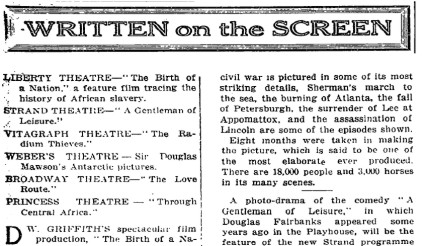
The New York Times has been available in digitial form back to 1851 for some time now, under subscription. Two things have just occured. Firstly, the NYT has dropped its subscription scheme, and now offers free access to its archives back to 1987, and for articles between 1923 and 1980 articles are available for purchase at $3.95 a time, or a ten-article pack of $15.95 (over a period of thirty days). But the sensational change as far as we’re concerned is that everything before 1923 is now held to be in the Public Domain, and hence is being made available for free.

The documents are available in PDF format only, though keyword searches operate across the whole texct, not just headlines. To access the service, go to the New York Times front page at www.nytimes.com and type in your search term in the search box, then select the option NYT Archive 1851-1980. If you are searching for a phrase, put this in inverted commas. You can sort the search results by closest match or date – newest or oldest first. Each result gives you the opening lines of the article, then the option to view the whole piece in PDF format. Articles from 1923 onwards give you a free preview of the opening lines. The first few searches are uninterrupted, but then it seems you have to register (for free), for which for some reason they want to know what you earn, your profession, and the number of people employed in your company. You may deal with such hurdles as you see fit.

It is amazing, and I can’t begin to tell the gems and discoveries I’ve made already in just a couple of hours’ searching. I’m still in shock at coming across a letter from 8 October 1905 which seems in all seriousness to recommend filming lynchings so they can reach a wider audience through the Kinetoscope. I’ve comes across Kinemacolor films I’ve never heard of before. And I’ve found such useful things on when terms first became common (I’d no idea before now that the word nickelodeon was in use before there were motion pictures). Though I suspect the first reference to the word ‘television’ in 1853 may be an OCR error… (but take a look at the article ‘Sending Photographs by Telegraph’ from 24 February 1907)

With this, the Chronicling America resource, and other newspaper collections covered in the Times Past and More Times Past posts, the research opportunities are just huge. How lucky we all are.

(My thanks to David Pierce for alerting me to this and other newspaper resources)

The Irish Times

Latest among historic newspaper collections to be made available online is The Irish Times. Its Digital Archive contains all issues from 1859 onwards, with a Text archive for material from the complementary ireland.com site from 1996 onwards.

Searching is free, and gives you tantalising glimpses of the headlines for the terms requested. Accessing the full newspaper is available at a variety of subscription rates, starting at 10 Euros for twenty-four hours. There is plenty there for the study of early film. ‘Kinetoscope’ brings up thirty records, the earliest 14 May 1895. ‘Bioscope’ brings up 2,797, ‘Kinemacolor’ fifty-six, ‘Charlie Chaplin’ 2,103, ‘Kinematograph’ 155, ‘Douglas Fairbanks’ 938, and ‘Electric Theatre’ 227. Searching is by keyword, with the usual option to search for a phrase by enclosing it in inverted commas. It’s also possible to browse by date. All in all an excellent resource which is bound to open up the study of early film production and exhibition in Ireland.