Domitor on the periphery

Domitor

The 2008 Domitor conference has changed its title and varied somewhat its terms of reference. Previously it was going to be called ‘The Regional Dimension in Early Cinema’. Now it rejoices in the title ‘Peripheral Early Cinemas’. By which they seem to mean early cinema on the edges: geographically, industrially, culturally and temporally. But let them express it in their own words:

Call for Papers: Domitor 2008

The next biannual conference of Domitor will take place from Tuesday 17 June-Saturday 21 June in Catalonia, that is, Girona, Spain, and Perpignan, France. For the first time a Domitor conference will traverse national frontiers. The topic selected, appropriate for this unique setting, is:

PERIPHERAL EARLY CINEMAS

Rationale

The notion of “Peripheral cinemas” is geographical concept: cinema that is made or viewed far from the institutional center (for example, national capitals). But the designation is not only spatial. It also involves cinemas produced on the margins of developing industrial and cultural institutions.

“Peripheral” then, connotes “regional” or “provincial,” but these characterizations are relative to the specific historical period. It was Barcelona, for instance, that was the actual capital of Spanish filmmaking in 1900. Furthermore, the idea of “regional” or “provincial” is not relevant to numerous places (Italy, USA, not to mention non-Western countries).

As a result, the concept of “local cinema” becomes very problematic.

Issues and Questions envisioned

1. Institutional context. The operative conceptual tool of the Center-Periphery antinomy. To identify peripheral early cinemas reflects as well the institutional forms of centrality that were springing up. Where is the institutional “center” in early cinema?

2. Models and types of production. Can we speak of a “central model” —such as the cinema of attractions—and other “peripheral models,” such as travel films, tableaux vivants, publicity, etc…? Amateur films and military films are “peripheral” today in relation to commercial institutional production. Were they in the time of early cinema? Was women’s cinema, to the extent that it existed in the early period, peripheral?

3. The sociological level. Is there a sociological center —“bourgeois” film—for example, an English “working class” cinema? Is this distinction valid at the level of production? Reception? The two combined?

4. Industrial and peripheral exhibition systems. How did exhibition systems develop from a center? Were they aligned with specific ideas of a geographical center? Were there alternative forms of film exhibition not dependent on a center, for example in rural locations or the outskirts of large cities? Examples would be comparisons between Torino/Roma in Italy, Paris/Marseille or Paris/Nice in France or Madrid/Barcelona in Spain. Did this dichotomy function in cinematic environments everywhere, especially outside of Europe?

5. Historiography. Film history traditionally has been written from the center about the center. This is becoming less the case in recent years and relates to early cinema. Has historiography established a certain centrality in early films studies that we should consider revising? Furthermore, was it like that in the writing of the time? Is this centrality the norm in Western countries? At the same time, is the history of non-Western cinemas relegated to the periphery?

6. The study of representation: the “colonial” gaze. One puts in this category all the forms of viewing that emanate from the center to the periphery. How did that function in cinema at its origins? Peripheral and folkloric relationships? How did cinema take into account “minority” cultures at the turn of the 19th and 20th centuries? The relationship of periphery to center would accordingly by first and foremost defined in terms of the gaze.

Included in this examination are “peripheral” cinematographic practices that gaze upon peripheral” cultures from outside as subjects. This would include “tourist,” “ethnographic” and neighboring filmmaking.

In order to avoid over-extending and overflowing the topic, we are not counting scientific, advertising or instructional films. Certainly, this is another issue, since one could maintain that they were “peripheral” in relation to institutional cinema.

Sending Proposals

Those wishing to submit a proposal should send a proposal of no more than one page to the selection committee by 31 December 2007. (The e-mail addresses will be posted on the Domitor website when available.) The papers must be original unpublished research. Languages accepted are English, Catalan, Spanish and French. The papers should be no more than 10 pages (A4) or 12 pages (US letter). The final text must be submitted by 30 April 2008 to allow for translation. The presentation should last no more than 20 minutes.

A selection of papers from the conference will be published in a trilingual volume.

Membership in Domitor is not required to submit a proposal. However, in order to present a paper at the conference, membership in the organization is mandatory.

Why the prejudice against scientific, advertising or instructional films, eh? There’s always something that gets pushed to the margins. And if everything’s on the edge of something else, is there a mainstream or a centre at all? Further information (if not necessarily illumination) can be found on the Domitor website. For those who don’t know, Domitor is the leading international organisation for the study of early cinema, its main activities being a bi-annual conference followed by a volume of published papers. Details of past publications from conferences going back to 1990 can be found here.
Networks of Entertainment

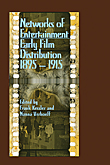
Networks of Entertainment, from http://www.johnlibbey.com

Not on the Domitor site as yet are details of the most recent publication, Networks of Entertainment: Early Film Distribution 1895-1915, edited by Frank Kessler and Nanna Verhoeff, and published by John Libbey, which derives from the 2004 conference. The publisher’s blurb describes the book thus:

This collection of essays explores the complex issue of film distribution from the invention of cinema into the 1910s. From regional distribution networks to international marketing strategies, from the analysis of distribution catalogues to case studies on individual distributors these essays written by well-known specialists in the field discuss the intriguing question of how films came to meet their audiences. As these essays show, distribution is in fact a major force structuring the field in which cinema emerges in the late 19th and early 20th century, a phenomenon with many facets and many dimensions having an impact on production and exhibition, on offer and demand, on film form as well as on film viewing. A phenomenon that continues to play a central role for early films even today, as digital media, the DVD as well as the internet, are but the latest channels of distribution through which they come to us. Among the authors are Richard Abel, André Gaudreault, Viva Paci, Gregory Waller, Wanda Strauven, Martin Loiperdinger, Joseph Garncarz, Charlie Keil, Marta Braun, and François Jost.

I thumbed through it at Pordenone, and it looks well worth getting hold of.

Nosferatu trailer

Eureka Video has released a YouTube trailer for its forthcoming DVD release of Nosferatu. The two-disc set comes with commentary track by Brad Stevens and R. Dixon Smith, and an hour-long German documentary on the film by Luciano Berriatúa. It’s a F.W. Murnau-Stiftung restoration complete with Hans Erdmann’s original score, performed by the Radio Symphony Orchestra Saarbrücken conducted by Berndt Heller. There’s also a 96-page booklet with articles by David Skal, Thomas Elsaesser, Gilberto Perez and Enno Patalas (former director of the Münchner Stadtmuseum/Filmmuseum, where he was responsible for the restoration of many German classics, including Nosferatu). The Region 2 DVD is released on 19 November. Kino Video will be releasing the Region 1 version in the USA. The trailer looks fantastic – we are starting to get spoiled with deluxe DVD presentations of silent classics.

Update: Do take a look at the Kino Video entry for the film, which includes a Flash video on the digital restoration of the film, one of the DVD extras.

Shasta 2nd annual silent film festival

The Son of the Sheik

Rudolph Valentino and Vilma Banky in The Son of the Sheik, from http://www.shastaartscouncil.org

The Shasta Arts Council 2nd Annual Silent Film Festival at Redding, California, takes place 26-27 October. The films showing are The Son of the Sheik (1926), The Mark of Zorro (1920), The Circus (1928) and Stella Dallas (1925), with acompanying shorts, all with musical accompaniment from Frederick Hodges, plus The Cabinet of Doctor Caligari (1919), with live string quartet with music composed by Timothy Brock. More details, as ever, from the festival website.

From 1896 to 1926 – part 4

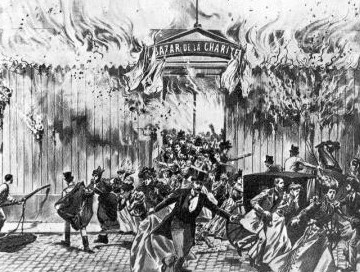
Fire at the Bazar de la charité, in Paris, on May 4, 1897

Fire at the Bazar de la charité, in Paris, on May 4, 1897 © Roger-Viollet. Reproduced from www.parisenimages.fr

We return, after something of a gap, to Edward G. Turner, the pioneer British film distributor, whose reminiscences, written in 1926 for the Kinematograph Weekly, are a rich source of information on early film business practice. Here Turner discusses exhibition in the late 1890s, with particular reference to the effects of the Bazar de la Charité fire:

The First Exhibitors

The earliest exhibitors were fairground showmen, magic lantern lecturers, and men who earned their living by giving private entertainments. The theatres and music-halls took to pictures as a nine-day wonder which would have its day and die.

I remember a time about the end of 1897 when there was not a single music-hall or theatre showing pictures in London. It was only a temporary lull, however, chiefly caused through the lack of subjects. With the advent of the Edisonagraph, Mutoscope, and the American Bioscope, the pictures became a permanent installation in the music-halls in London, but the early showmen and lantern lecturers were the men who were making the pictures popular all over the country.

These were the men who had sunk their little all in the Industry, and they kept pegging away, believing that it must eventually win out, and that the subjects would not be confined to 40 or 50 ft. lengths, but whole stories would be filmed.

The great bar to progress was the difficulty of getting new subjects except by buying them outright, and I think my partner and myself solved the problem for the world by instituting the renting system. Little did we think that that system would spread all over the wide world, and grow to the great business it is to-day.

In those first days we only did it spasmodically, because we had very few customers, but later on when the pictures had caught on, and village halls, churches, and chapels were taking up the pictures and giving regular weekly displays, our hire system grew rapidly. We would buy as many as ten and twelve prints of a film, which was entitled “Landing an Old Lady From a Small Boat.” Our first regular hirer was Ted Lacey, of Barnards M.H. Chatham. My first customer to buy films was Mr. Henderson, of Newcastle.

This is George Henderson, of Stockton, whose surviving film collection is held by British Movietone News and available to view from their website. There’s information on this important early film collection in an earlier post, Movietone and Henderson.

We then extended operations to the entertainment bureaus, such as:- Whiteley’s, Keith Prowse, Harrods, Gamage, Webster and Girling, H.L. Toms, Woods, of Cheapside, Ashton and Mitchell, Army and Navy Stores, the Church Mission Halls, Salvation Army, the Leysian Mission, City Road, and many more whose names at the moment I cannot remember, and after thirty years, we still do business with practically all the above-named firms.

The most disastrous fire that has ever occurred in our Trade took place on May 4, 1897. It is still remembered as the Paris fire. No fewer than 130 people lost their lives in the panic and stampede which occurred, and amongst those killed were the Duchess d’Alençon (sister of the Empress of Austria), Duke d’Aumale, Baron d’Sainte Didier, and General Munier (or Muiner). The Life Assurance losses were paid as to two-thirds American companies and the remaining one-third French – the total being twelve million francs, which, in that day, represented £480,000.

The kinematograph got the blame of this fire, but it actually occurred after the operator had finished giving his display of films, and was showing some slides. He was using an ether saturator, which was giving out, and he started to replenish same by pouring fresh ether in, and, of course, at once the fumes caught fire. The exhibition was being given in a large marquee. It was decorated with inflammable material, and soon the whole was one roaring mass of flame. The tent contained bazaar stalls, etc., and the bazaar was patronised by the principal nobility and well-known people of France – which explains the enormous sums paid by the life insurance companies.

The rubble after the fire at the Bazar de la charité on May 4, 1897, in Paris

The rubble after the fire at the Bazar de la charité on May 4, 1897, in Paris © Roger-Viollet. Reproduced from www.parisenimages.fr

This was the notorious fire of 4 May 1897 at the Bazar de la Charité, Paris, at which a Joly film projector had been used. As Turner correctly recalls, the fire was not caused by the cinematograph but instead by a Molteni ether lamp, but the calamity was swiftly associated with motion pictures, and caused great damage to the reputation of the medium.

Insurance Difficulties

This had the effect of making the Insurance Companies look askance at the kinematograph; and the mere mention of the word sent a shudder through the official minds. The public memory, however, is very short, and the desire for amusement great, and as new subjects arrived on the scene, slowly but surely, we overcame these difficulties.

Within a month of this happening I had an engagement at the St. Martin’s Town Hall. On the afternoon, I presented byself with an apparatus at the hall, and the dismay on the face of the official when he saw it was a kinematograph, accompanied by cylinders of gas, can be well imagined.

He informed the authorities at once, and one official informed me that the display could not be given. After half-an-hour, I got their sanction – they only giving way because they had failed to give notice that they would not permit a kinematograph.

The following week a resolution was passed that no kinematograph should ever be allowed in the hall again, and I believe that this is so even up to the present time. I am the only person who has ever given a display in the Westminster Town Hall, St. Martin’s Lane.

(To be continued)

The memoirs so far have been taken from the Kinematograph Weekly, 17 June 1926, pp. 53-54, and further installments will follow in due course. You can follow the earlier installments here: Part 1; Part 2; Part 3.

The protean Neil Brand

Neil Brand

http://www.neilbrand.com

Those passing through central London early this evening would have heard the unexpected tones of a piano being played in the middle of Trafalgar Square. There, in the chill October air, beneath Nelson’s Column was a huge screen, and beside it beneath a canopy, elegantly accoutred in black tie and pounding said piano for all he was worth, the one and only Neil Brand. He was accompanying screenings of Blue Bottles (1928), a comedy made by Ivor Montagu, starring Elsa Lanchester, and based on an idea by H.G. Wells (allegedly he wrote just the single line: “Elsa blows a whistle”, and the rest of the action just followed), and the silent version of Hitchcock’s Blackmail (1929). Crowds sat on the steps, stood beside the fountains, stopped by on their way home to look this curiousness, or just walked on by, oblivious or bewildered. It was a rather magical experience.

Neil was on top form, naturally, and Neil watchers should be aware that he is going to be seen or heard in the next few days displaying his talents as musician, writer and actor. His tour with Paul Merton for their Silent Clowns show is taking silent comedy films around the UK, from 10 November to 9 December. In a few weeks’ time, his new radio play, Seeing it Through, on the covert First World War British propaganda outfit (whose outputs included film), Wellington House, will be broadcast on BBC Radio 3. More on that nearer the time. And tomorrow, he appears at the Canterbury Festival as Mark Twain, Rudyard Kipling, Kier Hardie, Edward Burne-Jones and several others in Queen Victoria’s Diamond Jubilee, a multi-faceted entertainment written and presented by yours truly.

Now here comes the Guardian and Observer

Regulars will know that we try and keep up with the steady stream of digitised newspapers collections appearing across the world, which are opening up research into silent film (and a few other subjects besides, of course). The latest is the British newspaper The Guardian, along with its Sunday partner The Observer. This article was published recently in The Guardian‘s Media section (with thanks once again to the eagle-eyed David Pierce for alerting The Bioscope):

Every edition of the Guardian and Observer newspapers is to be made available via a newly launched online digital archive.

The first phase of the Guardian News & Media archive, containing the Guardian from 1821 to 1975 and The Observer from 1900 to 1975, launch on November 3.

It will contain exact replicas of the original newspapers, both as full pages and individual articles. and will be fully searchable and viewable at guardian.co.uk/archive.

Readers will be offered free 24-hour access during November, but after this trial period charging will be introduced.

The rest of the archive will launch early in 2008, making more than 1.2m pages of digitised news content available, with Observer content available from its launch as the world’s first Sunday newspaper in 1791.

New reports featured in the archive cover events including the 1793 execution of Louis XVI, the defeat of Napoleon at Waterloo in 1815, and the 1833 abolition of the slave trade, the first and second world wars and the assassination of the US president, John F Kennedy.

“The launch of the archive will revolutionise the way in which users are able to access our historic content, whether for academic research or personal interest,” said Gerard Baines, the head of syndication and rights, GNM.

“The archive will offer historical coverage to both consumers and academics of the most important events recorded during 212 years of publishing history,” GNM added in a statement.

“With microfilm stock and paper copy in danger of degrading beyond repair, the launch of the archive ensures the preservation of the papers’ legacy.”

Silicon Valley firm Olive Software started digitising the archive in December last year.

GNM chose ProQuest CSA to be the exclusive global distribution partner for universities, libraries and corporate accounts.

Rod Gauvin, the ProQuest senior vice-president of publishing, said: “The vivid and fearless reporting by both newspapers has set journalistic standards not only in the UK, but also worldwide.

“Indeed, globally many rely on the Guardian and the Observer for unbiased, thoughtful reporting on events in their own country.”

Fingers at the ready come November 3rd…

Don’t forget Telluride

I was sent the text below about the silents shown at the recent Telluride Film Festival:

Two wonderful silent programs were featured this year at the Telluride Film Festival. The annual “Pordenne Presents” show was the gorgeous restoration from the George Eastman House of King Vidor’s THE BIG PARADE with a wonderful score played by Gabriel Thibaudeau. This powerful war epic is often taken for granted as a classic but rarely actually screens today. It confirms its reputation as a masterpiece and proves to have a contemporary resonance.

Creating equal buzz was PEOPLE ON SUNDAY the early collaboration of Robert Siodmak and Edgar G. Ulmer from a script by Billy Wilder, Kurt and Robert Siodmak. Stunning cinematography by Eugen Schufftan and Fred Zinneman contribute to making this unique non-traditional narrative worth seeking out if the print from the Netherlands Film Museum makes its way to your area. Sadly, you probably won’t have a chance to experience the 6 person Mont Alto Orchestra’s lively score.

Leoanrd Maltin presented a two-hour collection of restored Vitaphone shorts with informative and humorous introductions. Legendary composer Michel Legrand and French director/film buff Bertrand Tavernier were among the audience members who couldn’t get enough.

In the Festival’s newest venue, The Backlot, dedicated to movies about movies, the new documentary THE DAWN OF SOUND was featured as was the found segment of THE STORY OF THE KELLY GANG (1906) with discussion about the restoration process from Paolo Cherchi Usai.

The lobby of The Backlot and the Brigadoon hospitality tent featured the extensive display “A Life Discovered: Unseen Material from the von Stroheim Collection” courtesy of the Academy of Motion Picture Arts and Sciences.

For the complete program, go to www.TellurideFilmFestival.org.

==============

Those living in Northern California are in for a treat on October 26 & 27 when the 2nd Annual Silent Film Festival in Redding will be produced by David Shepard with live music by Frederick Hodges.

More info at: http://www.shastaartscouncil.org/silent.html

Not only divas

Not Only Divas: Women Pioneers of Italian Cinema is an international conference taking place in Bologna, Italy, 14-16 December. The event is being promoted by the University of Bologna, the Biblioteca italiana delle Donne, the Associazione Orlando and the Women’s Film History Association. I haven’t been able to find any information about it online except in Italian, so here’s a translation from a flyer:

Until recently, the issue of women’s contribution to the creation and development of the film industry has been largely ignored in historiographical research, producing an image of silent cinema as a territory exclusively dominated by male agency and desire. In the last few years, however, a new line of international research has revealed a surprsing number of traces of women’s creative and professional participation in the silent film industry, showing clearly that the very few feminine names that have been traditionally credited in official film histories are in fact only the visible part of a much larger iceberg. One of the most interesting results of this research is actually to have revealed that in all national cinemas during the silent period the women working in the film industry in non-acting roles were far more numerous than in any other period of film history.

Though peculiar in many aspects, the case of Italian cinema is no exception. Besides Elvira Notari, pioneer of Neapolitan cinema, who has no doubt to be recalled as one of the most productive women directors of all times (second, perhaps, only to Alice Guy) and Francesca Bertini (the widely celebrated Diva, who in her late years repeatedly claimed for herself the maternity of her films), many others are the women who succeeded in entering as professionals the sphere of a mainly masculine industry. We can think as an example of the nowadays forgotten names of directors like Diana Karenne, Gemma Bellincioni, Giulia Cassini, Elettra Raggio; of screenwriters like Renée de Lion or Nelly Carrère; or even of a film distributor like Fanny Kluge.

The Not Only Divas Conference is the first step in a multiannual research project aimed at producing new knowledge on such pioneering figures by means of an articulated series of events, including film retrospectives, film restorations and publications.

More generally, the International Conference intends to stimulate a reflection on the scope of movement that was available in Italian silent cinema, in a particularly conservative socio-cultural context, for all the forms of feminine expression or women’s representation that are impossible simply to reduce to the tradiditional figure of the Diva.

The following thematic and methological issues will be considered :

  • Reconstruction of Italian women film pioneers’ biographies and production
  • Forms of women’s representation in Italian silent cinema
  • The anti-Divas: comic actresses and muscle-women
  • Women’s professional agency in the Italian socio-cultural context of the silent period
  • Italian silent cinema and female audiences
  • Relationships among women across film, theater and literature
  • Comparative analysis of the women’s role in Italian and foreign cinemas
  • The feminist movement in Italy during the silent period
  • The problem of sources: women’s history in the Italian film history

Conference director: Monica Dall’Asta, Università di Bologna

Please write for information to angelita.fiore [at] unibo.it

Excellent stuff, all part of a major re-investigation of women’s roles in silent cinema which is taking place worldwide at the moment. But I would like to know who it is can say for certain that there were more women working in the film industry in the silent period than at any other time. How has this been determined? If they mean behind-the-scenes roles (office workers, early film processing etc) and not just ‘creative’ roles, perhaps this may be right. But I’d like to see the evidence.

RIP Minoru Inuzuka

The last director to have made a silent film in the 1920s died last month. While Portugal’s Manoel De Oliveira, who made Douro, Faina Fluvial in 1931 is still with us (and still working), Japan’s Minoru Inuzuka directed his first silent feature in 1927, Sunae shibari: Dai-nihen, having previously contributed to the script of Kinugasa’s classic Kurutta ippêji (A Page of Madness) (1926). He was 106 years old.

Where now for the Cinema Museum?

The Cinema Museum, one of London’s hidden cinematic treasures, is under notice to quit from the former Lambeth workhouse building (where Charlie Chaplin’s mother was incarcerated) by March of next year. There’s an article in The Observer with the background story and an affectionate portrait of the museum itself.

Meanwhile, the Cinema Museum has just published its new website, which is delightfully rich in pictures of the collection, its building, and even buildings to which they might move next. There’s also a fascinating video tour of the collection, made in 2000, which can also be found on YouTube.