Seeing it Through

Charles Masterman

Charles Masterman, from http://www.firstworldwar.com

Just a note to folks that this evening on BBC Radio 3 we had Neil Brand’s ninety-minute play, Seeing it Through. The subject of the play is Wellington House, the covert British propaganda outfit from World War One (also known as the War Propaganda Bureau), which under Charles Masterman conducted a would-be civilised campaign of information management, using willing well-known authors (Wells, Bennett, Doyle, Chesterton) to argue Britain’s rightfulness in fighting such a war, and employing other media, including film. There was passing mention of Charles Urban, who produced the documentary feature Britain Prepared (1915) for Masterman, and reference at the end to The Battle of the Somme (1916), made by the British Topical Committee for War Films, with somewhat anachronistic comment on its use of some inauthentic footage. A thoughtful, skillful piece from the prodigious Mr Brand.

You’ll be able to catch the play for the next week on Radio 3’s Listen Again service. I recommend doing so.

From 1896 to 1926 – part 6

Back we go to Edward G. Turner‘s reminiscences, ‘From 1896 to 1926’. Here Turner describes how their exhibition distibution business grew in the early 1900s, and the formation of the company name Walturdaw.

When we moved to High Holborn, a schoolmaster by the name of G.H.J. Dawson, who used to hire films from us, purchased a third interest in our business, and henceforth we were known as Walker, Turner, and Dawson.

It was while we were at this address that one afternoon a Mr. R.W. Watson called to see me; he showed me a paper called the Optical Lantern Journal, just then acquired by E.T. Heron, of Tottenham Street, and told me that he had spent a weary day trying to get our competitors interested in advertising in same. He had been unsuccessful, but one or two had told him that if he succeeded in geting an advertisement from us, they would follow. So, as a bait, he offered us a whole page for £2.

I used his argument against himself, and finally agreed to take a page each month at 30s. a time (what a difference from the pirce to-day!). So we were the first firm to advertise in your paper, and for twenty-three years or so our advert. has never been missing.

The Optical Magic Lantern and Photographic Enlarger, formed around 1890, became The Optical Lantern and Cinematograph Journal in 1904 , then The Kinematograph and Lantern Weekly in 1907. It became simply The Kinematograph Weekly in 1919, the journal which published Turner’s articles, and continued until 1971. The title is now owned by Screen International.

By this time we employed about twenty men, who operated our machines at private parties and other engagements obtained from the bureaus above mentioned, and we, at times, had as many as forty shows going in one night. One one occasion, Walker, Dawson, and myself were engaged in giving three separate displays at the same time to one vast audience at Midsommer Common, Cambridge, for Mr. Haywood of that town.

This is the only instance I know in which three kinematographs have been going at the same time to the same crowd. I wonder if any of the old brigade can beat this?

In two years we had outgrown our offices at 77-78, High Holborn, and removed to 3, Dane Street, taking a seven years’ lease on a new, large building. Here we were joined by Ernest Howard, and as the name of Walker, Turner, Dawson, and Howard was cumbersome, we coined the word “Walturdaw“, taking the first three letters of the names of the first three members of the company. Up to August, 1904, we worked in partnership, but in this month, we formed into a limited liability company, each of the partners agreeing to serve the new company for ten years.

Hiring Developments

Our Hire Dept. had grown to very large proportions – our usual method being that each Monday morning our customers would call and take 1,000 or more feet of film, made up of various lengths and pay in cash, 50s, per 1,000 ft. for same. They did not know what they were getting and there was no picking or choosing – the only stipulation being that the films had not been shown before at the theatre, for which the operator was hiring his films. Those were fine times; cash over the counter, no bad debts, and always plenty of money in the bank.

I find that hard to believe. Were customers really content to buy films unseen and unidentified, obtaining purely on the strength of the fact that they hadn’t been shown at their theatre before? It’s no wonder that other businesses revolted, though it was not the exhibitors (they would not become dominant until the rise of cinemas, a few years ahead), but the manufacturers, who did not want to see any middle man eating into their profits.

Finally, our film hire had reached such proprtions that we became a menace (at least so the manufacturers of films thought) to their side of the business, and at a meeting convened by the K.M.A. [Kinematograph Manufacturers Association] , a decision was arrived at wherein the manufacturers decided that the action of renting films by the firm of Walker, Turner and Dawson was inimical to the interests of the manufacturers and therefore none of the products of such manufacturers would, in future, be supplied to us.

I am not sure as to whether this actually went on the books of the Association, but it was certainly brought into effect, and for a long time they refused to supply us, but the Industry was becoming world-wide, and we were able to get films from all parts of the world, and, in addition, were able to buy the English manufacturers’ products through other people, and eventually the ban was removed.

This is not the first time in history that men who have thought years in advance of their trade have been looked upon an enemies, instead of benefactors. Events have proved how right we were then.

Teaching the World

About this time Chas. Pathé and his Directors came over from Paris to study our system; they spent about a week with us, and a little later they came into the film renting business. After their conversion they ceased to sell us films, but we still put their subjects out, purchasing them through another source.

Before Pathé visited us, however, Miles Bros., of New York, came over and studied the subject pretty carefully; they went back to the States, and started, I believe, the first renting concern in America.

Directors from a concern in Germany also came, and after studying the system, came to the conclusion that they would go back and do likewise.

(To be continued.)

As can be seen, the early film business was a little on the anarchic side, as the emerging elements of the industry – production, distribution, exhibition – each struggled to establish a commercial identity, and control over the other sectors of the business. As Rachael Low explains it, in The History of British Film 1896-1906:

The impulse towards film hire came from the exhibiting side, and it was exhibitors [like Walturdaw] who became renters. They had no power to stop the free sale of films by the producers, in fact their own stocks were built up in the open market. Thus it came about that identical films were both for sale and for hire at the same time. The conception of exclusive entered the industry as exclusive selling rather than exclusive renting rights.

Turner was fighting against the control of the market held by the manufacturers (while at the same time holding absolute power over his exhibitor customers). As it is, in 1905 Walturdaw made the decision to become producers themselves – something to be described in the next installment.

Guardian Digital Archive

As promised, The Guardian (1821-1975) and The Observer (1900-1975) newspapers have been placed online from today. The web address is http://archive.guardian.co.uk.

This is another huge boon for research in our area, and I’ve found and downloaded assorted gems from The Guardian already. A powerful eye-witness account of the Bazar de la charité fire in Paris (6 May 1897, p 8), an enthusiastic report on microcinematography (15 August 1903, p. 7), a leader on the rise of the picture theatre (3 July 1911, p 6), a report on Maurice Elvey filming Hindle Wakes (set in Lancashire) (28 October 1926, p 11), a fascinating article on watching films in Moscow in 1927 (5 January 1927, p 16), and a wonderful piece on ‘Flicker Alley’ (17 October 1911, p 14), the name given for Cecil Court, the short London street near Leicester Square, which was the home of London’s early film businesses before they all moved on to Wardour Street.

Its windows show wild-looking mechanical contrivances that, whatever they may really be, always seems so concentrated that one thinks of them as the very intestines of machinery; and the men who go in and out of the doors (usually in groups of four or five with a voluable one a little ahead) having a hustling, sharp-eyed, yet half-whimsical look … The cinematograph trade is yet too young to have evolved a type, but it seemed to me that the denizens of Flicker Alley (as they call this passage) all have something characteristic that marks them off from ordinary men. Possibly the endless films they look at affects the eye-nerves or teahes the mind to think of the eye as something to switch off and on – a glance, a calculation, another look, a “glad eye,” another calculation, and so on. They flicker. Their conversation flickers too, mainly in rapid Yankee slang jerked at a hard pace, a well-known figure there creating the flicker illusion best with an inimitable stutter. They run about all over Europe and America, these quick, handy, cheery people, and some seek to rival the cosmopolitanism of the cinematograph by making their speech a compote of foreign catchwords. You see no old men. The “father of the trade” looks about forty. With them antiquity was last week, and posterity is coming round to look at their films to-morrow.

I wrote earlier that the service would be free for the first month, but I was wrong – it is half price for this month, which means, for instance, that a twenty-four hour pass will cost you £3.97. Use the Advanced Search, not the Simple Search, as it allows you to sort results in date order, and to search across articles, or picitures, or advertisements. Searching itself is free; you pay to see the article, which can be printed or stored in a MyCollection page.

Some quibbles. I couldn’t make images print using Firefox; use Explorer instead. The search results give you an image of the heading of the item, which does not always indicate when it is relevant to your search, and some time is wasted opening up irrelevant pages. Your search word is underlined in blue on the selected documents, which has the unfortunate effect of sometimes obscuring the words underneath. You only get four or five results per page, which is frustrating and makes searching for the right record more of a chore than it should be. You cannot go from an article you’ve viewed to the rest of the newspaper for that day, though there is an alternative browse option which lets you look at the full newspaper for any one day. But you cannot narrow subject searches by day, or even year.

Minor gripes aside, this is a treasure trove. Remember that for most of this time period, the Guardian was based in Manchester, which gives a different slant to its news coverage. Also, despite The Observer search option saying that covers 1900-1975, there seem to be no records available prior to 1932.

Update: The Guardian is currently offering a free introductory 24-hour pass to its Digital Archive, presumably for a short period only.

Visual archaeology

A couple of items on magic lanterns in America. Firstly, the Museum of Modern Art in New York is currently hosting an exhibition, Panoramas of the Moving Image: Mechanical Slides and Dissolving Views from Nineteenth-Century Magic Lantern Shows. This is a combination of modern and traditional takes on ‘pre-cinema’ technology. At the heart of the exhibition is experimental media artist Ernie Gehr’s Panoramas of the Moving Image (2005), a synchronized five-channel video installation that uses eighty-seven original slides and views selected from Gehr’s personal collection and that of film archivist and magic lantern collector David Francis. This is accompanied by a display of paper Zoetrope strips and Phenakistiscope discs, complementary nineteenth-century moving image technologies. The exhibition runs until 25 February 2008.

Herman Bollaert

Herman Bollaert uses all three lenses of his 19th-century magic lantern to give the “Warehouse in Flames” image added smoke-and-fire effects, from http://www.washingtonpost.com

Meanwhile, in Washington, we have the Belgian Herman Bollaert and his troupe of musicians putting on the The Lanterna Magica Galantee Show at the French embassy. There’s a fine review by Philip Kennicott of this recreation of a nineteenth-century magic lantern show in The Washington Post, which places the lantern within a wider history of visual technologies, following its inheritance through to PowerPoint and the Xbox:

Watching Herman Bollaert and his crew of projectionists manipulate his 19th-century magic lantern is a bit like watching a very old and finicky sailboat being steered into the wind. There is a lot of fussing and fiddling, turning and cranking, all in the service of a charmingly antiquated technology. If you would rather take a powerboat than sail, or watch “The Matrix” on DVD than spend an evening with hand-painted slides of country cottages and windmills, there’s really no point in showing up this evening at the French Embassy, where Bollaert and his Belgian troupe of musicians and lanternists are performing a bit of visual archaeology.

Bollaert’s contraption, a three-lens wooden box from 1880, was made during the great era of magic-lantern shows. Its basic technology was in use during the 17th century, and quite possibly much, much earlier. But in the 19th century, with the growth of all forms of popular entertainment, lanterns became the precursors of the cinema. Slides with moving parts created special effects. Popular novels were presented in narrated slide shows, and science was taught to professionals and amateurs alike through projected images. Musicians often accompanied such popular entertainments, which could include a survey of historic places, short parables and stories, religious spectacles and Gothic horror shows.

The technology was basic – limelight (made by superheated limestone) or kerosene flames were used to project the images onto screens – but its impact was long-lasting. The magic lantern enjoyed popularity well into the 20th century, fading only as cinema took over. It persisted in the form of school slide shows and filmstrips, and is still the animating spirit behind projected PowerPoint presentations. Whole generations of Americans got their first glimpse of human sex organs in health class through a filmstrip projector – a descendant of Bollaert’s machine – which cast lurid pictures into the semi-darkness, into a room of tittering, blushing and sometimes salivating adolescents.

You can read the rest of the article, which brings in Arthur Schopenhauer and Marcel Proust, on the Washington Post site. But here’s the thoughtful final paragraph:

It’s difficult to coax the contemporary mind into the position of someone of two or three centuries ago, who found the basic images projected by lanterns to be amazingly lifelike (aesthetically), emotionally powerful (artistically) and profoundly troubling (philosophically). But like the water wheel set turning by Bollaert’s expert hand, things will come full circle. With the rise of ever more complex virtual realities, once again the philosophical mind is set puzzling over the nature of the real. But now, in our world of Xboxes and Wii consoles, one is hardly aware of the machine that creates the representation, there is no tactile connection between the image and its master, and the boat of illusions sails forth with no hands on deck.

The so-called optical toys of the nineteenth-century, such as the Phenakistiscope, the Zoetrope and the Thaumatrope, were sometimes referred to as philosophical toys. We should always bring a philosophical mind to the moving images placed before us. It is what they are there for.

God’s soldiers

Joseph Perry

Joseph Perry, from http://www.salvationarmy.org.au

While at Pordenone I met with Tony Fletcher, early film researcher extraordinaire, who told me about a DVD made by the Salvation Army, William Booth – God’s Soldier. This includes a substantial amount of film of Booth, the founder of the Army, in the early years of the twentieth century. The Salvation Army site includes a clip from the film, showing Booth’s motor tour through Britain in 1904 (unfortunately with added-on crowd noises and sound effects). It just goes to show how it’s worth looking in odd places to find early film materials.

It’s also a reminder of the great importance played by the Salvation Army in early film history, and I thought I provide a quick survey with links to assorted online resources. Many social interest groups and charities took an interest in using moving pictures to support their work, almost as soon as films were first made widely available on screen in 1896. None was more active in this area than the Salvation Army, particularly in Australia.

Herbert Booth

Herbert Booth, from http://www.victorian-cinema.net

There in 1896 Herbert Booth, rebellious son of William, joined Joseph Perry, who ran the Army’s Limelight Department. Together they added film to the Limelight Department’s multi-media show of Bible stories and uplifting instruction, which combined magic lanterns, photography, choral singing and sermons to create powerful, and hugely popular, narrative spectaculars. One such show, Soldiers of the Cross, first created in 1900, is sometimes cited as being the world’s first feature film, though in fact it was not a single film but rather a combination of slides, film, scripture and song. Moreover, it was preceded by an earlier effort, the two-and-a-half-hour Social Salvation (1898).

Booth and Perry built a glass-walled film studio at 69 Bourke Street, Melbourne in 1898. The room still exists as a archive and museum maintained by the army, with exhibits on the Limelight Department’s work. Initially they filmed with a Lumière Cinématographe, but by 1901 the were using a Warwick Bioscope. Soldiers of the Cross was exhibited across Australia, but Herbert Booth clashed with Salvation Army command in London, and left the Army in 1902, moving to San Francisco and taking Soldiers of the Cross with him. Perry continued in the film industry, increasingly making secular films, and continued as a film distributor into the 1920s.

William Booth himself made good use of film to propagandise for his cause. He had a film cameraman assigned to the Army, Henry Howse, who went with him to the Holy Land in 1905, and filmed many, if not all, of the early films of Booth featured in the God’s Soldier DVD. The original films are now preserved in the BFI National Archive.

There is an excellent site, Limelight, telling the story of the Limelight Department in Australia, based on a 2001 Australian Broadcasting Commission programme and exhibition. This has extensive information on the people behind the Limelight Department, the films they made and used, their tours, and the broader context of Australian early film history.

The Salvation Army in Australia provides its own history of the Limelight Department and its filmmaking activities, plus a history of the making of Soldiers of the Cross.

The National Film and Sound Archive in Australia has a feature on Soldiers of the Cross, which includes selections of the magic lantern slides that were a part of the show (none of the original film is known to survive, but the show did include some Lumière life of Christ films, which do survive).

The Who’s Who of Victorian Cinema site has biographical entries on Herbert Booth and Joseph Perry.

Much research has been done into the Salvation Army and its use of film in these early years by the American scholar Dean Rapp. His essay, ‘The British Salvation Army, the Early Film Industry and Urban Working-Class Adolescents, 1897-1918’, in 20th Century British History 7:2 (1996), is well worth tracking down (it’s available online through some academic subscription services).

Finally, the Salvation Army continues to make use of moving images, and has an active video unit.

The Idea of America

…or, to give it its full title, The Idea of America in Nineteenth-Century British Culture, 1776-1914. The is a conference to be held at the Institute of English Studies, University of London 27-28 June 2008, for which the final call for papers has just been issued. There’s a film potential there, as the conference blurb offers:

The meaning of America to those beyond its borders has rarely been the subject of such passion and global conflict as it has been in the past seven years. If we look to the long nineteenth century, however, the idea of America in British culture suggests that there is a lively pre-history of competing and opposed notions of the emergent republic. From the new world of revolution, individual liberty, democracy and freedom to the home of plutocracy and Philistinism; from avatar of the mechanical city to the last hope of utopias in the wilderness, America emerged, and continued to accrete meanings, as diverse as its landscape.

This interdisciplinary conference invites scholars to reflect on the ideas, representations and transmissions of America in Britain during the period in question. Possible subjects might include: republicanism; liberty; revolution; democracy; populism; utopias; individualism; feminism; transcendentalism; frontiers; landscapes; pioneers; displacement; plutocracy; commerce; art-collection. We encourage papers that might pursue these or other subjects using travel-writing, letters, essays, photography and painting, early film, records of travelling shows and extravaganzas in addition to fiction, poetry and drama.

Abstracts of 250-300 words should be sent to the conference organisers, Dr Ella Dzelzainis, School of English and Humanities, Birkbeck College, University of London (e.dzelzainis [at] bbk.ac.uk) and Dr Ruth Livesey, Department of English, Royal Holloway, University of London (ruth.livese [at] rhul.ac.uk), by November 15th 2007.

Live in Trafalgar Square

Silents in Trafalgar Square

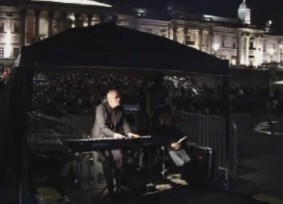
Frame still taken from BBC News video of Capital Tales in Trafalgar Square

Recently, as you’ll know, the London Film Festival hosted two screenings of silents in Trafalgar Square, with live music accompaniment. There’s a BBC video news report on the second screening, Capital Tales, which featured a pot pourri of London footage, much of it silent, with John Sweeney at the piano.

John Sweeney in Trafalgar Square

John Sweeney accompanying Capital Tales in Trafalgar Square, from http://www.bbc.co.uk

The report features short interviews with John, BFI programmer Robin Baker, and assorted members of the public. The general feedback from this event, and the screening of Blackmail the day before, has been very positive, and I think we can expect more screenings of silents in the London open air in the future. I’m entirely in favour of this. Take the films to the people. Let’s have people stumbling upon archive films in unexpected places. Let’s bring the past into the present. Archives should be everywhere.

New York State Archive film scripts

Here’s a good research resource which I hadn’t come across before (and should have). New York State Archives has the largest collection of film scripts in the world, some 53,000. It makes available a database of its script index, covering the period 1921-1965 (it advertises itself as covering 1927-1965, but I’ve found records going back to 1921). This doesn’t give you the script itself, just the bare outlines of the production details, but these are more than valuable enough in themselves.

Each record gives you (and is searchable by) original title (there are many non-American films listed), title in English, country, year, writer’s last name, director’s last name, alternate film title, manufacturer, and exchange. The Motion Picture Commission began its work in 1921, but tragically almost all of the 18,000 scripts for silent films that passed through its hands are now lost. However, the outline records are still there, and form a hugely useful reference source by themselves, and for a lot of these titles the archives have associated documentation, but not the script itself.

The collection exists because, for forty-four years, New York state censorship required distributors to submit scripts for vetting, so anything exhibited theatrically in New York between 1921 and 1965 is going to be there. The archive also contains the apparatus of state film censorship – applications for licences, reviewers’ reports, notices of change in title or length etc., as well as the scripts. Scripts only start to be available from 1927. Frustratingly, there doesn’t seem to be any way to search on extant scripts for silent films. Nor can you combine search requests, so you can’t automatically look for all Walt Disney-produced films in 1924, for example. Minor gripes apart, this is a major gateway into the films of the 1920s.

It’s possible to order copies of scripts, if you are the copyright owner, or have the permission of the copyright owner, or can claim copies under a ‘fair use’ declaration. It may also be that you have to be a United States citizen – it’s unclear.

A Throw of Dice on DVD

Throw of Dice

http://filmstore.bfi.org.uk

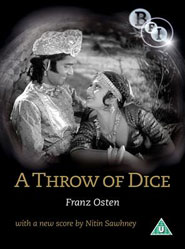
After its outing as a live experience in Trafalgar Square (the home for silent films in London these days) in the summer, the BFI is releasing Franz Osten’s 1928 A Throw of Dice (Prapancha Pash) on DVD. It comes with Nitin Sawhney’s orchestral score which was first played at that open-air screening.

A Throw of Dice is one of three Anglo-German films set in India and directed by Osten, working with Indian actor-producer Himansu Rai. As the blurb tells us:

After the beautiful Sunita nurses Ranjit back to health following dramatic events during a royal tiger hunt, his wicked rival Sohat persuades him to risk his kingdom and his love in a fateful game of dice. Shot on location in Rajasthan, the film features over ten thousand extras and an impressive array of horses, elephants and tigers. Its star actors all had major careers in Indian cinema and remain legendary and much-loved figures. Rai stars in the role of nefarious Sohat, with Charu Roy as Ranjit, and Seeta Devi (the Anglo-Indian actress born Renee Smith) as Sunita.

The BFI contonues to find inventive ways in which to exhibit, promote and contexualise silent films. Here a competent if somewhat ponderous late silent, long thought of as a diverting curiosity of interest mostly to the specialist, is spruced and re-invented as a movie of the moment. It’s all in the marketing.

All at Sea

All at Sea

Frame still from All at Sea, http://film.guardian.co.uk/video

The Guardian has published a short section from the 1993 Alistair Cooke home movie All at Sea, of Charlie Chaplin clowing around on a yacht. The film was featured as a long-lost discovery at this year’s Pordenone silent film festival. Curiously, the Guardian makes no mention of the film’s notable provenance. The thirty-second sequence shows Chaplin impersonating Janet Gaynor, Greta Garbo, and the Prince of Wales. Above shows Janet Gaynor, by the way.