Bioscope Newsreel no. 35

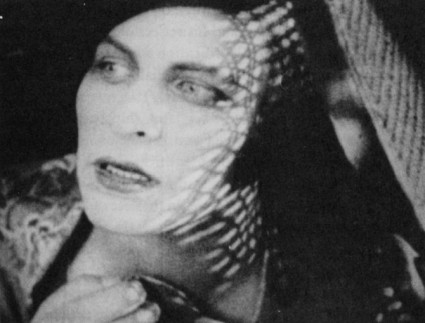
Trailer for the other, not quite so heavily discussed 2011 silent feature film, Silent Life

Well, when we introduced the Bioscope’s Scoop It! news-gathering service for silent film-related subjects, I thought there wouldn’t be the need for our Friday newsreel any more. But such is the quantity of news stories that we are now scopping up, it seems all the more necessary to keep the newsreel going, to note the week’s leading stories, just for the record. So here they are.

The Artist, The Artist, The Artist…
The news-wires have been groaning all week with information on silent films, but it’s been almost all about the one film. The widely-acclaimed The Artist, which recreates the end of the silent filmmaking era as a silent film, has been released in the USA and is delighting critics and audiences alike. It’s even said to be a favourite for the Academy Award next year. Of the many reports on the film, we were especially intrigued by Tom Shone’s essay in Slate, which argues that The Artist, Martin Scorsese’s Hugo and Steven Spielberg’s The Adventures of Tintin (eh?) are all part of a trend to bring back the purer values of silent cinema. Read more.

Valentino’s silent life
So are we going to start seeing more silent or pseudo-silent films produced? It doesn’t seem too likely, but the producers of Silent Life must be wondering whether The Artist‘s success is their lucky break or the worst thing that could have happened to them. For it too is a recreation of the silent film made as a silent film, this time telling the story of Rudolph Valentino. It’s a humbly-produced indie, though it does boast Isabella Rossellini in the cast, and there’s a website where you can find out more on its production (including the teaser trailer above). Read more.

And Hugo too
The Artist isn’t quite having things all its own way, news-wise, becuase Martin Scorsese’s Hugo, in part of homage to the early cinema period of Georges Méliès, is likewise enchanting all who see it. Among the many accounts of the film’s production, there’s a useful piece by Kristopher Tapley on HitFix which rounds up Scorsese’s film, the discovery of the colour version of Voyage dans la lune and its restoration, the music score by Air (due for release in extended form as an album), Méliès’s lasting influence, and the centenary of the first film made in Hollywood (which we all missed). Read more.

The art of the film improviser
Enough of all these 21st century attempts to remake the films of another era, let’s turn to 21st century attempts to provide the music for the films of that era. Moving Image Archive News has an interview with Neil (“doyen of silent film pianists”) Brand, which ranges eloquently and informatively over the many different aspects of Neil’s silent film career. As always with Neil, he makes sure you end up learning as much about the films and their contexts as you do about him. Read more.

Return to the Odessa Steps
Finally, courtesy of the tirelessly useful Silent London, we learn the intriguing news that Battleship Potemkin is to be given the flash mob treatment. Tomorrow, 26 November, the iconic Odessa Steps sequence will be recreated on the Duke of York steps next-door to the Institute of Contemporary Arts in London. A mixture of actors and volunteers will take part in three recreations, which will be filmed on mobile phones (naturally) for the delectation of posterity. Troops with rifles, panicking people and a pram are all promised. Cinema will never look the same again. Read more.

All these stories and more on our new news service.

‘Til next time!

Silent stories

Do you know what? There’s quite a lot being said about the modern silent film at the moment. Some film called The Artist, an affectionate pastiche of the silent era in a silent film style has set the film world’s hearts a-flutter. There’s even talk of it being favourite for the Academy Awards this year. Well, well.

It’s a phenomenon we ought to comment on, perhaps when we’ve had a chance to see the film. But here at the Bioscope we’ve been championing the modern silent film for quite a while now, and what interests us is not so much films that ape the styles of the past but rather those films which think in a silent way about the world today. And there are a great many of these films, not much in the cinemas, but usually turning up in short film festivals and now most likely to be found online. The considerable creativity they often display in by-passing dialogue needs championing, because increasingly they represent a genre all of their own.

One such champion is Lemo (aka Guihelm), filmmaker and creator of Silent Stories, a channel on Vimeo which curates examples of short modern films made wordlessly which are to be found on the Vimeo site. A couple have featured on the Bioscope already, but most are new to me, and each has been selected with care. They are not simply films made without speech as a trick but rather each demonstrates how the discipline of telling a story through images alone sharpens the observation and wit of the best filmmakers.

There are around thirty to view so far, such as the expertly handled Common Practice (shown above), by Marcus Efron, in which a Mexican-American boy’s talent brings together a disparate Latino community in Los Angeles. See how character and situation are subtly delineated through what we are allowed to see – though music plays a key part in the film. This is where the enduring art of silent film lies.

Or try out Jason Wingrove’s Moving Day, only just posted on Vimeo, which comes garlanded with awards from various short film festivals. Be warned, it starts out ever so sweet, but things don’t quite turn out that way.

Silent Stories is a channel to follow, while you can find other examples of modern silents featured on this blog on our own Bioscope Vimeo channel.

Michel Hazanavicius, do take note.

Just a second

A Eye for Details, by Wim Wenders, from The Beauty of a Second

How short can a film be and still be a film? We had a discussion here a little while ago on a seven frame fragment of an 1897 film, and whether it still counted as a lost film or not. Compared to seven frames, a whole second of film may seem practically epic, and one second is the length of the films currently on show at The Beauty of a Second.

This is a competition website, launched by Montblanc, a producer of watches and other fine goods, to mark the invention 190 years ago of the chronograph, a pocket watch accurate to one fifth of a second. The competition invites any interested to film anything, just so long as the subject is precisely one second long (and in 16:9 format).

The competition has been running since September 23rd, and is divided into three rounds, with the current one open from November 16th to December 13th, should you wish to participate. The 20 videos in each round that get the most votes from people visiting the site go through to a final, which is to be judged by none other than Wim Wenders. Wenders is also the judge for a side competition to create a playlist out of the submitted videos (for 2 to 60 seconds long), adding a soundtrack from the Montblanc audio library.

It’s a beautifully designed site, with the videos artfully arranged around a clockface. You can view the videos individually or as a set, which as each one last a second may be preferable. Though some have sounds, even music in one or two cases, most are silent, and I think we can see this as yet another instance of modern silent artistry. Because while most of the videos are essentially snapshots with a wobble, more than a few of the videos do artfully catch the eye in the instant that they have in which to do so.

I warmly recommend browsing through the main competitition entries and the playlists, though if the number of seconds you can spare is few, then you should go to the Inspiration section, where a number of model one-second videos are on show to demonstrate what can be done. Some of these are made by Wenders himself, and are a delight – see for example his film An Eye for Details, in which a woman turns her head, with her eyes coming briefly into focus (literally for a split-second) before going out of focus once more. It is witty, observant, a hymn to the instant.

It would good to see other filmmakers of note presented with such a challenge. I expect it is an idea that someone else will pick up on, in time.

New York, New York

A rare photograph showing the interior of a film business preview theatre, at the offices of American Cinephone Co., 124 East 25th Street, NYC, in 1910, from the MCNY Collections Portal

Now here’s an excellent resource for you. In 2010 the Museum of the City of New York launched its Collections Portal, opening up nearly 100,000 archival images of New York City to the web world. The collection is being added to all the time – a substantial collection of digitised postcards has just been added – and needless to say it offers plenty for the researcher interested in silent films.

The site is simple to use. The front page offers a striking browse option, where you can scroll laterally through images on the themes of Bridges, People, Waterfront, Skylines or Prints for Sale; or else by Borough (Bronx, Brooklyn, Manhattan etc.), or featured photographer. There is a simple search option, with the advanced search giving you the options of keyword, artist/maker, subject term, excluded subject term, or accession number. There is a lightbox facility for registered users. Each image has a title, description, original dimensions given, date, and is subject indexed under a variety of terms, encouraging further browsing as each term is hyperlinked to further search results (though note that, for example, ‘motion pictures’ as a linked term gets 81 hits, but ‘motion pictures’ simply typed into the search box gets 257 hits. Classification is helpful, but always selective). There is powerful zoom function, though paradoxically you have to squint to find it (look out for the mini magnifying glass bottom left of any image).

Interior of the Automatic Vaudeville theatre, 48 East 14th Street, NYC, c.1904. Mutoscope viewers can be seen on the right-hand side

There is plenty on film-related subjects, and a lot of them from the silent period. It is best to keep search terms simple, and using the terms ‘movie’, ‘film’ or ‘motion picture’ yield the best results (our traditional test term, ‘kinetoscope’, brings up four images). The emphasis is not so much on production as on the distribution, sales and exhibition side of things. So there are are some fascinating interiors of New York film businesses, including American Cinephone, Mutual, Empire Film Co., Pathescope and others, plus exteriors of cinemas and other venues – among the earliest film-related images is a set showing an amusement arcade from c.1904, the Automatic Vaudeville, which includes a line-up of peepshow Mutoscopes among its visitor attractions – a handy reminder that not all films of the period were experienced in cinemas. All in all one gets a picture of the early film business somewhat stripped of its glamour, but very much a part of the ebb and flow of the business life of a great city.

What should be especially interesting for researchers is to seek out film-related subjects which the MCNY people have not identified. Among the many street views and postcard images of early 20th century New York City, there are going to be those which show cinemas, nickelodeons, variety theatres which showed film, and so on, which may not be the main subject of the image. It’s an activity worth undertaking, as I know from having searched not unprofitably for similar images of early London film venues in postcards.

A motion picture industry employees’ ball, New York, c.1910. Among the companies whose pennants can be seen are Moving Picture World, Nicholas Power Co., Hog Reisinger, Thanhouser, Great Northern, Lux, Lumiere, Imp, Buffalo and Rex

If you do find anything new, you should tell the people at MCNY. Their website invites interested users to submit new information or corrections, and I can confirm that they reply promptly, and make amendments quickly.

Finally, although the site is partly aimed as the commercial market, with the lightbox and information on rights and reproduction fees, they also say that any image can be reproduced for non-commercial purposes on personal blogs, for research or other academic study. Good for them, and thank you.

Go explore.

Wonderstruck

http://www.wonderstruckthebook.com

Wonderstruck is the new children’s book by Brian Selznick, whose previous novel The Invention of Hugo Cabret, in which Georges Méliès features as a central character, has been filmed as Hugo by Martin Scorsese. In the new novel Selznick (a distant relative of film producers Lewis and David O. Selznick) again brings silent films into his distinctive mix of textual and illustrated narrative.

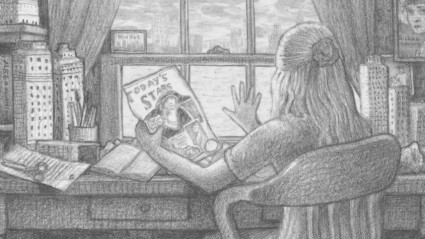
The new novel tells of two children, fifty years apart. One lives in 1977: Ben, a boy from Minnesota missing his dead mother, whose story is told in words. One lives in 1927: Rose, a New York girl fixated on a silent film star, whose story is told entirely in pictures. Silent films play a crucial part in the story, which in part documents the period when films turned to sound, with what looks to be a fascinating emphasis on the impact this had on the deaf community (both Ben and Rose are deaf, or partially deaf). This is a theme that the Bioscope has posted on before now, and it is something with which Selznick empathizes greatly, as this interview with CNN indicates:

It really began when I was working on “Hugo.” I saw a documentary film called “Through Deaf Eyes” and there were a couple things in it I found particularly interesting.

One was an interview with a young deaf man who had been raised in a hearing household and he talked about how it wasn’t until he went away to college and met other deaf people that he realized he was part of this larger community, this larger culture that he had been born into, that was really fascinating to me.

There was also a section about the transition from silent movies to sound and how this was a tragedy for the deaf community because with silent movies deaf audiences and hearing audiences could understand the same movies but after the transition to sound, the deaf audiences couldn’t follow the stories anymore.

When I finished “Hugo,” I wanted to take what I had learned in terms of telling a story with words and pictures and try to do something new with it.

I had the idea to tell two different stories, one with words, one with pictures. In trying to figure out what story would make sense just with pictures, I remembered “Through Deaf Eyes,” and I thought it might be interesting to tell the story of a deaf person in a way that echoes how they experience their own life, so you would get their entire story visually.

The plot just kind of grew from there.

Through Deaf Eyes is a 2007 PBS documentary, features details of which (including videos clips), can be found on the PBS website.

From the illustrations available on the Wonderstruck website it looks to be in the same compelling hand-drawn style as The Invention of Hugo Cabret. Interestingly, the site’s promotional video makes great play with action on different planes, suggesting the 3D influence of Scorsese’s Hugo – they’ll be thinking of the film version already, no doubt.

Wonderstruck has just been published, and Hugo is released in cinemas next week. Advance notices have been enthusiastic, and cinemas seem likely to be filled with an unlikely mix of families with children, modern film buffs checking out why Scorsese has gone down such a route, and early film enthusiasts seeing their world recreated with as much historical authenticity as producers Disney may allow. At any rate, Georges Méliès is due to become a name known and his art appreciated by millions of children across the world. How happy he would be.

There are clips, downloads, images, background information and much more on the official Hugo site.

Early cinema periodicals

http://www.domitor.org/about/mhdl.html

As you may have seen from the illustration in our previous post, the early cinema studies organisation Domitor has announced a fund-raising drive to support the work of the Media History Digital Library, the non-profit initiative digitising out of copyright film periodicals and making them freely available online which has been much mentioned here already.

Domitor’s Early Cinema Periodicals Digitization Project aims to raise $5,000 dollars, from its members or from anyone interested, sufficient to digitise 50,000 pages (that’s an amazing 10 pages for a dollar). They hope to reach this target by 1 January 2012, and have suggested the following scale of donations: Institutions and full or associate professors or the equivalent: $200-250; assistant professors or the equivalent: $100; students or non-waged scholars: $50. They don’t give a suggested figure for waged (or non-waged) ordinary souls who might be keen to help, so you’ll just have to think of whatever sems appropriate, I guess. The first 20 donations of $200 or more will receive a free copy of the Domitor 2006 proceedings, Early Cinema and the National.

We’re so blessed with a vast wealth of free online resources that we can forget that nothing really comes for free. The money has to be found from somewhere, and not only will you be the beneficiary, but even better, you will be giving money to support the endeavours of those who share in your passion for the subject. There’s a donate option c/o PayPal on the Domitor site, and if you do you’ll get your name to appear on a roll of honour.

It’s good also to see Domitor so enthusiastically embrace the opportunities for research in the online world. As we have said already, the Media History Digital Library is a game-changer for research in our area – it is the new research library, free from institutional oversight or single physical location, open to all, free to all. And with just a little extra funding, there will be that much more that is free to all.

For a listing of the MHDL’s early cinema periodicals already available, see here.

Scoop!

http://www.scoop.it/the-bioscope

The Bioscope’s ceaseless quest to inform you of all that matters in the world of early and silent cinema takes a significant step foward – hopefully. We have added a new feature using the ingenious news-gathering tool, Scoop It! This allows you, when you come across a web page, video, image or whatever of interest, to select an image and headline text from the web address and post it in what is effectively your own curated resource. Each new discovery, or scoop, appears at the head of your Scoop It! site. This can then be picked up by those also interested in your subject, either by visiting the site, or following it on Twitter, or by getting an email alert if they so choose.

So we have created The Bioscope on Scoop It! and we will use the service to note each piece of silent film-related news that we come across, plus sites, resources and videos of interest, some of which may then get turned into fully-fldged Bioscope posts in the usual way. So it will be an archive of things Bioscopical – effectively replacing the long list of bookmarks that I currently have on my browser as prompts for future Bioscope posts. As said, you can follow this by visiting the website, also linked on the right-hand column of this site (under Other Bioscope Sites), where each ‘scoop’ gives you the headlines and links to its source; or by following the Bioscope on Twitter where each ‘scoop’ will appear; or by signing up to an email alert (one a day). You can even suggest web pages which the curator (i.e. me) might want to add to the service.

Puzzled? Well, take a quick look at the Bioscope’s Scoop It! site and you’ll get the idea. It looks stylish, it could prove useful, and I think it’s now going to replace the Bioscope Newsreels which have been appearing on Fridays (usually). Or I may still use the Newsreel for news highlights taken from Scoop It! We’ll see. Anyway, do take a peek.

Cinema context, once more

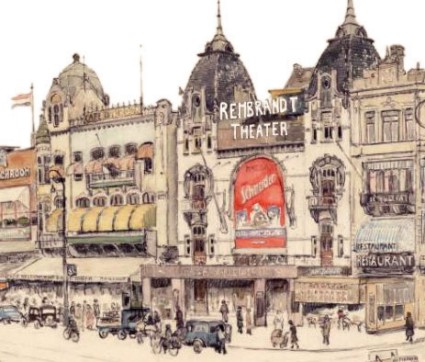
The Rembrandtplein, Amsterdam in 1934, from Cinema Context

In the very early days of the Bioscope, when its total readership could probably have been fitted into a broom cupboard with some comfort, we reviewed Cinema Context, one of the leading film-related resources anywhere. Four years on, the broom cupboard has expanded somewhat, and it’s time we returned the resource, and devoted more attention to it. So let’s do so.

Cinema Context is a database of Dutch film culture. There’s something about the Netherlands that makes it just about the right size for a country when it comes to apportioning things (geographically, demographically, economically), and it’s the case when it comes to film databases. At the heart of Cinema Context is data on all of the Dutch cinemas, including travelling cinemas, that have existed since 1900 – there are 1,615 of them – and so far as I know the Netherlands it the only country to have comprehensively documented its every single film venue. The venues have then been mapped to almost every film shown in a Dutch cinema up to 1960 (45,582 of them), so that one knows not only what was shown, but when it was shown, and where. This information has been taken from a wide variety of film programme information, from which data has been added on musicians, live performers, entry prices and more. There is a whole range of people (4,259) and companies (1,611) listed, from cinema managers to distributors, so one does really get a sense of the depth and extent of Dutch film culture. It is, by the way, a bi-lingual site – Dutch and English.

What Cinema Context does not provide is much in the way of filmographic detail, but it does link every identifiable film to its record on the Internet Movie Database, so it is possible for the dedicated researcher to trace not only which films but which performers very popular in which part of the country, and how such presence changed over time and territory. The site does not exist to give you every answer, but rather to provide a solid basis on which to go looking for answers.

There are simple and advanced search options. The latter invites you to search across five categories: films, cinemas, programmes, people and companies. Under programmes, you can search for programmes showing more than one film, those from travelling cinemas only, and search within particular dates. So, for example, if I look up Alex Benner’s Bioscope, a travelling cinema which appeared at a fair near the town of Roosendal on 24 December 1911, I get its position on a Google map, a list of the films shown (all hyperlinked to their own page and ultimately the IMDb) and a listing of the archival resources used. And the films are (with their Dutch release titles, though there is cross-referencing to original titles):

Kabeljauwvangst op IJsland
De gelofte
Het interessante artikel in de courant
De jonge circusrijders
De meloenen op hol
Door eigen kracht zijn eer gered
Het witte costuum van Nauke
Wil het mij vergeven
Max gaat hoepelen

There’s a browsing option, which is probably the best way into the resource. Here you can look across cinemas by year or by city; films by country, year, title (original or Dutch); by company (exhibitors or distributors, but not production companies); by people (name or function); and by censorship rating, year or file number. This latter element is an exciting development. Every film record between 1928 and 1960 on Cinema Context has been cross-linked to the record of its file from the Netherlands Board of Film Censors, as held by the Nationaal Archief in the Hague. It does just point you to a catalogue entry rather than a digitised document or transcript, but let’s not be greedy. Cinema Context remains a work in progress, and is keen to grow further. Such additional features will be added in time.

And there’s more. The site offers some useful statistics, such as cinema attendances and film production year by year in the Netherlands and selected cities, a listing of all Dutch film magazines, and a map of the country which links you to cinemas on the database.

Back in 2007 I wrote:

What is the finest film reference source on the Web, for all film let alone silent film? With all due respect to the Internet Movie Database, I think it is Cinema Context, a Dutch site created by Karel Dibbets and the University of Amsterdam.

I think I still stand by that, though it may now share first place with Germany’s Filmportal, while resources produced since 2007, notably the University of North Carolina’s more localised and more specialised Going to the Show, demonstrate how to take this sort of data to the next level through the new search tools that are now available. And I see no reason to change my original summing up of the resource: “This is the new film research. Every nation should have the same”.

I don’t know the degree to which these databases of cinemas rather than films have succeeded in opening up cinema history to social and cultural historians in general, and not just a film studies audience, but that has to be the intention. Resources such as Cinema Context must exist to facilitate the fundamental question that should be asked of film history, which is how it related to society. My feeling is that such databases – other examples are the London Project, the Scottish Cinemas and Theatres Project, the Utrecht Project, and the huge American site Cinema Treasures – still direct themselves primarily towards an audience which understands film culture first and foremost. They may seek to answer new questions, but it is unclear if they are sufficiently reaching out to those who are asking those questions. It is when Cinema Context or the London Project map themselves to population figures, transportation data, domestic expenditure, or the competition from alternative attractions, that we may really start to compute the historical position of cinema in society.

Kino and the woman question

Bed and Sofa

The latest volume to be added to the straining virtual shelves of the Bioscope Library is Judith Mayne’s Kino and the woman question: feminism and Soviet silent film, first published in 1989, and now made freely available ponline by Ohio State University Libraries’ Knowledge Bank. The book is a study of Soviet silent films in terms of their understanding of the position of women within socialist culture. The argument is made that the representation of women in such films subverted their ostensibly straightforward ideological and cinematic goals. The films given particular analysis are Strike, Mother, Fragments of an Empire, Bed and Sofa and Man with a Movie Camera. The book is available as a downloadable and word-searchable PDF, and is another welcome example of a university press making some of its back number freely available to all now that their commercial life is over. Nobody loses, and plenty will gain.

Bioscope Newsreel no. 34

http://wedidthis.org.uk

The Bioscope’s occasional news service returns with the usual varied mix of silent films happening here and there which don’t otherwise feature on this blog.

Remembering the Somme
On today, the eleventh day of the eleventh month of the eleventh year, let us draw your attention to the most notable film of the First World War, The Battle of the Somme (1916). As recently reported, the film is about to go on tour in the UK with orchestral accompaniment, the score written by Laura Rossi. Not many silents get to be toured with an orchestra, and though the orchestras invovled are amateurs, the costs are inevitably high, and should you wish to help support such a bold venure financially then you can do so by visting the ‘crowfunding website WeDidThis. The tour opens in Leicester tomorrow. Read more.

3D Charlie
We reported last year on the plans of an Indian TV company to produce an animated 3D Charlie Chaplin series, but there is news of plans by a Turkish company to attempt 3D conversions of some of Chaplin’s original films to form a 90-minute film entitled Chaplin 3D – The Little Tramp’s Adventure. One’s first reaction is to throw up one’s hands in horror; the next reaction is to hope to have a chance to see just what it might look like. Intriguingly, they have gone to the best sources for their footage: Serge Bromberg and David Shepherd, with Robert Israel signed up to provide the music. The results are reported to be impressive. Hmm, we shall have to see. Read more.

Remembering Kristallnacht
Sunday 13 November will see an unusual example of silent film presentation at Belsize Square Synagogue in London. The Zemel Choir (“The UK’s leading mixed voice Jewish choir”), in commeroation of Kristallnacht, will be presenting a 1936 silent film, Hatikvah, shot by a German-Jewish filmmaker, showing pioneering Jewish settlers in Palestine. Intriguingly, the choral and orchestral accompaniment will in part derive from some of the generic silent film music scores recently unearthed at Birmingham Central Library. It’s an unexpected outcome of that exciting discovery, and one wonders to what other ends those scores might be used in time. Read more.

On Irish screens
There seems to be quite a bit of publishing activity on the Irish silent cinema (and pre-cinema) front at the moment. Hot on the heels of Gary Rhodes’ Emerald Illusions: The Irish in Early American Cinema comes two new books by Kevin Rockett and Emer Rockett, shortly to be published by Fourt Courts Press. Magic lantern, panorama and moving picture shows in Ireland, 1786-1909 covers the history of proto-cinematic experiences in Ireland up to the first film shows, while Film exhibition and distribution in Ireland, 1909-2010, “traces in forensic detail the social, cultural and business practices that comprise the Irish cinema phenomenon”. Read more.

Remembering Barbara Kent
The Bioscope neglected to note the passing last month of Barbara Kent, at the age of 103. Kent was perhaps the last of the headline silent film stars, having played leading roles alongside Garbo and Gilbert in Flesh and the Devil, in William Wyler’s terrific The Shakedown, and in Paul Fejos classic late silent Lonesome. Among the many obituaries, Ronald Bergan’s in The Guardian has perhaps the most detail. Read more.

(And just a little extra item – those of you in the UK, should you by some strange chance finding yourself watching The One Show on Tuesday evening, you will see yours truly talking about film star competition winner and Buster Keaton co-star Margaret Leahy, with the redoubtable Gyles Brandreth.)

‘Til next time!