Focus on Film

Focus on Film

The Learning Curve is a free online teaching and learning resource provided by the UK’s National Archives (formerly, and far better known as, the Public Record Office). It brings together a range of archive materials around key historical themes, and this includes film. Its Onfilm resource has recently been revamped and renamed Focus on Film.

This now comes with 150 film clips, all of them downloadable and re-usable, and the site now has its own online editing tools, in The Editor’s Room. The National Archives does not hold film itself (selected British government films are preserved by the BFI National Archive on its behalf), so it uses film from Screen Archive South East, the BFI, the Imperial War Museum, British Pathe and the BBC.

Focus on Film

There are several silent film clips available. There is an absolutely delightful film of Folkestone in 1904, with people just being themselves, parading up and down the streets, having fun at the beach, fooling before the camera, dressed on their Sunday best. It’s long been one of my desert island films (it has no known producer or title, and goes by the supplied title of Edwardian Folkestone), and I strongly recommend it (how drearily the teaching notes on the site describe it: “The roller coaster ride reminds us of the primary aim of early film-makers, profit via entertainment”). Scarcely less delightful nor more absorbing in its social detail is a 1920 tour through the streets of Canterbury, taken from the back of a moving vehicle.

There are newsreel films of the suffragettes, including the infamous film of the 1913 Epsom Derby in which Emily Davison runs on to the race-course and is killed. There are several film clips for the First World War, including key sequences from the great documentary testament The Battle of the Somme (1916). Somewhat peculiarly, there are also clips of a modern actor telling us about the experience of the Somme, which together with clips elsewhere of actors giving us vox pops on life in the Tudor and Stuart periods may end up confusing a few schoolchildren. There’s also footage from Ireland in 1916 (The Easter Rising) and 1920s.

The quality of the downloads is good (QuickTime Pro is needed if you are going to retain a copy), and the suggested activities (for PC or interactive whiteboard) and editing facilities are fascinating. Note that the site states: Teachers and students are granted a limited, non-exclusive licence to use the film clips for non-commercial educational use only and may not re-publish materials without permission of the copyright holder.

Well worth a look.

Frosted yellow willows

Anna May Wong

There’s a website on the Chinese American actress Anna May Wong (1905-1961), with the enticing title Anna May Wong: Frosted Yellow Willows. The title is a translation of her Chinese name, Wong Liu Tsong.

The site accompanies a documentary film of the same name about the actress who starred in a number of notable silents, including The Toll of the Sea (1922, a two-colour Technicolor film), Peter Pan (1924), Douglas Fairbanks’ The Black Pirate (1924), Old San Francisco (1927) and Piccadilly (1929). She generally rose above the ‘exotic’ settings in which she was invariably cast, to give luminous performances which have ensured her a lasting following. Her screen career petered out in shoddy melodramas in the 1930s/40s, but she also had a career on stage, radio and television, as the site makes clear.

The documentary is produced by Elaine Mae Woo and narrated by Nancy Kwan. There’s a trailer on the site plus a rough-cut promo. As befits its elegant and glamorous star, the site is stylishly designed. The documentary has been ten years in the making, but is reportedly close to completion. If you felt like helping it along you could always make a donation.

A Camera Actress in the Wilds of Togoland

The White Goddess of the Wangora

There was a curious sub-genre of silent films which combined exploration with drama. The enthusiasm that there was at the time for exploration films from Africa, South America, Australasia etc, led a number of these ‘explorer’s to make dramatic films, often with ‘native’ performers, which sought to sugar the pill of discovery and anthropology with human interest for the general cinema audience.

Frank Hurley, peerless cinematographer of the Douglas Mawson and Ernest Shackleton expeditions to Antarctica, in the 1920s made dramatised films of life in the Southern seas, The Hound of the Deep aka Pearl of the South Seas (1926) and The Jungle Woman (1926), set in New Guinea. British director M.A. Wetherell made Livingstone (1923) in Africa and Robinson Crusoe (1927) in Tobago. Geofrey Barkas made Palaver (1926) in Nigeria. And of course the Americans Merian C. Cooper and Ernest B. Shoedsack made Chang (1927) in Siam and Robert Flaherty made Moana (1925) in Samoa. All were curious mixes of idealism and colonialism, documentary and drama.

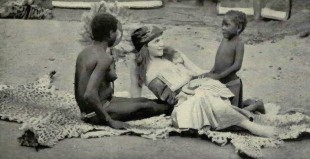
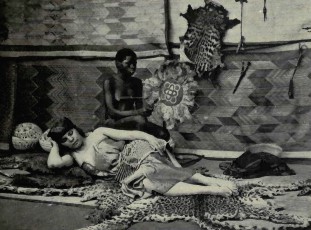
One of the earliest such examples must be The White Goddess of the Wangora (Die weiße Göttin der Wangora). This was made in Togo in 1913/14 by the German explorer and sometime big game hunter Major Hans Schomburgk, and starred his future wife, Meg Gehrts. The reason for this post is that her book on the experience of making this film, along with other dramas and a number of documentaries, is available from the Internet Archive. It has the grand title, A Camera Actress in the Wilds of Togoland (1915).

The White Goddess of the Wangora

Schomburgk, famed for having discovered and captured the pygmy hippopotamus, had made an earlier filming trip to Liberia and Togo, where his negative stock was ruined and the cameraman let him down. A little wiser the second time around, he returned with the intention of making a series of dramas and documentaries of life in Togo, with a white actress in tow to act as the main draw for Western audiences. Obviously he hoped for profits which would offset the expense of the expedition. The White Goddess of Wangora told of a white child washed up on the shore of Togoland, and brought up by the local peoples as a kind of goddess. Years pass. A white hunter (Schomburgk) is captured by the tribe and sentenced to be put to death, but she has fallen in love with him. They escape, an exciting chase ensues, they get away, they live happily ever after.

The book is fascinating in detail, patronising towards the ‘savages’ they work with, but also filled with sympathetic observations, particularly on the drudgery experienced by the Togo women. It also tells us much about the indignities and privations the filmmakers suffered. Four dramatic films were produced in all: The White Goddess of the Wangora, Odd Man Out, The Outlaw of the Sudu Mountains and The Heroes of Paratau. They also made travel and industrial films. All, so far as I am aware, are now lost. It is an observant text, with plenty of interest if you can steer around the period attitudes, and it is well illustrated.

You can find a list of film credits for Hans Schomburgk on the excellent German film encyclopedia www.filmportal.de and, unexpectedly, on Stanford University’s Infolab.

The British cameraman who went with them was James S. Hodgson, who went on to enjoy a long and notable career in newsreels, eventually ending up working for The March of Time in the 1930s. You can read his biography on the British Universities Newsreel Database.

More from the Marchioness

I’ve found more information on Gwladys, Marchioness of Townshend, who wrote some scenarios for the Clarendon Film Company, and an interview with whom was given in an earlier post.

The new source of information is her autobiography, It Was – and It Wasn’t, written in 1937. This tells us a little more about the agreement she made in 1912 with Clarendon to produce scenarios for them, and gives us more film titles than I had listed.

She seems to had always had an interest in films, which included considering investing in cinema buildings, and she had written articles on aspects of film before she made a deal with Clarendon:

I had been keenly interested in the Cinema Theatre and its possibilities at Maidenhead, and in 1912 I entered into an arrangement with the Clarendon Film Company of Charing Cross Road, to produce a series of picture plays; the first play, A Strong Man’s Love, being well received by the public and the Press. The House of Mystery followed. These were the first cinematograph dramas to give the author’s name, and I was the first peeress to write for the Cinema.

Were these the first films to credit the scenarist (as opposed to a playwright)? I don’t know. It might be Anita Loos, whose first film for D.W. Griffith was The New York Hat (1912), or Harriet Quimby, wrote wrote five scenarios for Griffith in 1911, but was either credited on screen? But I think Gwladys is on solid ground when she says she was the first peeress who wrote for the screen. Fascinatingly, she names two others who wrote scenarios after her – the Countess of Warwick and the Countess of Roden. I know nothing of either.

Next she gives interesting information on how much she was paid:

The late Sir George Alexander and I believed in the artistic future of the Cinema. At that time I considered its moral and ethical possibilities limitless, and it is interesting to compare the views of the Gaumont Company in 1913 as to the prices paid for scenarios, with the money of 1935. In 1913 a representative of the Gaumont Company told an interviewer that, “on the whole, the scale of payment is not high, and the picture dramatist does not expect – at any rate, he does not receive – anything like the renumeration of his brother, the real dramatist. The royalty system exists, but it is not general, the plot usually being bought outright. The average price is that of a short magazine story, but many ideas are disposed of for half a guinea apiece.” At that time I was paid £300 for writing six film plays, but, fortunately for authors, prices have increased considerably since then.

After an aside on the importance of the cinema as a force for education, she describes how she used a model theatre in her garden – together with cardboard cut-out nuns for her film The Convent Gate – to work out how scenes should appear. Then, after comments on the need for appropriate music for silent films, she concludes thus:

After my first film play was produced by the Clarendon Film company, the same company produced another – When East meets West. This completed a series of seven film dramas commissioned by the same company during a period of two years – A Strong Man’s Love, At the Convent Gate, The House of Mystery, Wreck and Ruin, The Love of an Actress and The Family Solicitor. All these sound most melodramatic now, but had their little success in those days.

I hadn’t come across some of these titles, but all were produced, so here’s a complete filmography for her, with slightly mocking descriptions taken from Denis Gifford’s British Film Catalogue:

A STRONG MAN’S LOVE (2,095ft)
Released January 1913
p.c: Clarendon
dir: Wilfred Noy
story: Marchioness of Townshend
cast: Dorothy Bellew … Elizabeth
Crime. Vicar’s daughter elopes with actor who kills manager and is acquitted by barrister who loves her.

THE HOUSE OF MYSTERY (2,090ft)
Released April 1913
p.c: Clarendon
dir: Wilfred Noy
story: Marchioness of Townshend
cast: Dorothy Bellew … The Girl
Crime. Fake ghost, gas chamber, and raid on den of 50 coiners by 100 policemen.

THE CONVENT GATE (2,175ft)
Released September 1913
p.c: Clarendon
dir: Wilfred Noy
story: Marchioness of Townshend
cast: Dorothy Bellew … Marie St Clair
Drama. Jilted bride recovers sanity after being saved from fire.

THE LOVE OF AN ACTRESS (3,000ft)
Released August 1914
p.c: Clarendon
dir: Wilfred Noy
story: Marchioness of Townshend
cast: Dorothy Bellew … Actress
Evan Thomas … Peer
Drama. Film actress feigns drunkenness to repel peer but saves him from suicide after he takes to drink.

WRECK AND RUIN (2,755ft)
Released August 1914
p.c: Clarendon
dir: Wilfred Noy
story: Marchioness of Townshend
cast: Dorothy Bellew
Drama. Foreman saves mill owner from flood caused by striking workmen.

THE FAMILY SOLICITOR (2,772ft)
Released September 1914
p.c: Clarendon
dir: Wilfred Noy
story: Marchioness of Townshend
cast: Dorothy Bellew … The Girl
Crime. Lawyer forges earl’s will so that his indebted son may inherit.

WHEN EAST MEETS MEET (3,000ft)
Released February 1915
p.c: Clarendon
dir: Wilfred Noy
story: Marchioness of Townshend
cast: Dorothy Bellew … The Girl
Crime. Indian fakir hypnotises officer’s daughter and explodes gas bulbs from afar with electric rays.

None of these films is known to survive today.

Interview with the Marchioness Townshend

Gwladys, Marchioness of Townshend

Returning to the theme of British women filmmakers in the silent era, meet Gwladys, Marchioness of Townshend. The humble British film industry was more than a little flattered when the Marchioness Townshend (1884-1959), born Gwladys Ethel Gwendolen Eugénie Sutherst, later Mrs Bernard Le Strange, agreed to provide scenarios for the Clarendon Film Company. The films for which she supplied stories were Behind the Scenes, The Convent Gate, The House of Mystery and A Strong Man’s Love, all made in 1913. Sadly, none survives.

The Marchioness of Townshend was a playwright, novelist and poet, as well as a celebrated socialite. Her plays included The Story of an Actress (1914) and The Fold (1920), and her novels Married Life: The Adventures of Herbert and Mariana (1914) and The Widening Circle (1920). She wrote an autobiography, It Was – and it Wasn’t (1937) and a collection, True Ghost Stories (1936), which was still in print in the 1990s.

We can only speculate about the films with which she was involved, but her opinions are interesting. This interview with her, from The Bioscope in July 1914, hints at someone who had possibly turned to the lowly cinema through frustration at not getting her plays produced on the stage, but she was alert to the potential of the medium, and claims to have been inspired by early films of waves breaking on a sea coast, no less. Whatever her actual abilities, it was unusual at this time for a film scenarist to be given any credit at all, and it indicates a new significance which was being given to the craft.

In view of the great interest aroused by the announcement of three new dramas by the Marchioness Townshend, to be shown to the Trade next Friday, we begged her ladyship to favour our readers with a few of her ideas on the subject of writing for the film, and were kindly granted an interview at the offices of the Clarendon Film Company, where Lord and Lady Townshend had called to inspect the recently completed films. Lady Townshend’s views are of partiular interest, not only on account of the great success achieved by “The Convent Gate,” “The House of Mystery,” and “A Strong Man’s Love,” but by reason of the cordial reception given to the one act play now running at the Coliseum.

In answer to our question as to what first turned her thoughts to writing for the cinematograph, Lady Townshend said she had been deeply interested in moving pictures ever since her childhood, when she first saw a picture at the Palace Theatre of waves breaking on the sea-shore.

“As far as I can remember,” said Lady Townshend said, “it must have been quite a bad picture, but I immediately realised the possibilities of this new medium, and fully believed that the time would come when its range would be enormously increased. I have always taken a keen interest in the stage and have written many plays which have been produced for charitable purposes. I felt the fascination of this new form of silent drama, partly because of its great advantages in the way of stage setting and realism, and partly perhaps, because when writing for the stage I always seem to see thesituations as I create them. Another advantage is the extent of its appeal, for although the nature of that appeal is in some respects more restricted than that of the stage, and must necessarily be more simple, it reaches a far greater public, and if nothing can equal the power of human speech, on the other hand, nothing can equal the eloquent silence of the cinematograph.”

“Then you are not in favour of the speaking picture, Lady Townshend?”

“Not of the mechanical speaking picture. I am too fond of the stage to wish for the cinematograph to enter into direct competition with it. For the same reason I do not care to see the stage adaping itself to the film, for neither great plays not great actors can always be represented adequately on the screen. I think that youth has its chance in the film play, and it is better to build up a reputation as a film actor than to give an inadequate record even of a world-renowned success.”

“What do you consider the most suitable subjects for the film play?”

“As far as my own experience goes, I believe that the public requires melodrama, though not that class of melodrama which merely consists in piling up of impossible situations as a test of it’s [sic] author’s ingenuity in evolving a successful happy ending. I think a plot should contain more of a problem than the abstraction of some papers of ambiguous value and the chase over two continents for their recovery. By problem I don’t mean the morbid dissection of some social question which is left involved at the end. In my new play, “The Story of an Actress,” for example, the problem is whether a young peer should marry an actress who is a thoroughly good girl or sacrifice his happiness and hers out of consideration for the feelings of his relatives. The moral is the foundation of the play, but its main object, of course, is to interest the public, and that object, I believe, is best gained with the help of melodrama, which is an ingredient of nearly every great play.”

“Then I believe also in absolute realism. If I write of the doings of the people of the slums, I want them to look and behave like real slum people; just as when I bring in members of the aristocracy, I want them to look and behave like ladies and gentlemen. That is the kind of realism which appeals to the public and also has a certain educational influence.”

“You believe, then, in the educational value of the cinematograph?”

“Most decidely, and have always taken the greatest interest in that branch of the subject. I think the time is certainly coming when much more will be done in that direction, in which, at present, we are rather behind other countries. I heard only yesterday that the Crown Prince of Siam had a private theatre in which he gives his soldiers practical instruction in manoeuvres and military matters, a notable example to come from so small a state. With regard to dramas, I believe that every good play which is true to life has a certain educational influence, and I should like to think that the influence of my plays will be a good one. I have written one or two costume plays, but they have not been produced as yet, as there seems to be not great demand at present for that class of work, though certainly the Clarendon Company has produced some very successful costume dramas.”

“Have you written plays for any other company, Lady Townshend?”

“No, the Clarendon Company produced my first work, and so far I have written exclusively for them. Indeed, I have been so pleased with the result of my first works, that I have no wish to change, and have, in fact, just signed a contract for six new plays. Everybody concerned has worked hard to ensure success, and I hope that the new ones will be received as well as the earlier ones.”

“You find no difficulty in inventing original plots?”

“Is there such a thing as an original plot? I certainly have no difficulty in weaving stories, and I think I have always been in the habit of doing that in dramatic form, but, after all, I think originality of treatment is the main thing, and that is essential in all classes of literary work. I find time to write a good many magazine articles, and have even contributed articles dealing with the cinematograph.”

It is gratifying to learn that the company engaged to play in these new dramas has the advantage of Lady Townshend’s personal supervision and advice.

The Bioscope, 30 July 1914, pp. 430-431.

Nothing seems to have come of the six new ‘plays’ she was to have written for Clarendon, and so far as is known she had nothing further to do with the film business.

A Girl Cinematographer at the Balkan War

Jessica Borthwick

Jessica Borthwick, from The Bioscope

Having promised more on early war films, in recognition of Stephen Bottomore’s recent work, and the posts on British women filmmakers and the collection of women’s writings on cinema, Red Velvet Seat, I’m going to combine these interests by writing something on Jessica Borthwick, cinematographer of the Balkan War of 1913. Red Velvet Seat, in its otherwise excellent author biographies, says of Borthwick “no information found”. Well, I think we can do a little better than that.

Jessica Borthwick was twenty-two years old when she set out to film and photograph the second Balkan War (essentially the Bulgarians were fighting the Turks, Serbians and Greeks) in 1913. She filmed there for a year, not on behalf of any film company, but purely for her own interest, with the aim of exhibiting films and photographs on a lecture tour around Britain on her return.

Good connections enabled her to take this unusual step. She was the daughter of General George Colville Borthwick (1840-1896), who had been commander-in-chief of the army in Eastern Roumelia (part of Bulgaria after 1885). His brother was Sir Algernon Borthwick (1830-1908), 1st Baron Glenesk, a prominent figure in Victorian society as owner of The Morning Post, a position that by 1913 was occupied by his widow, Alice. The Hon. Miss Borthwick therefore found many doors open to her, particularly in Bulgaria, but that does not explain the remarkable determination and enterprise shown in an interview she gave for The Bioscope, published as ‘A Girl Cinematographer at the Balkan War,’ 7 May 1914. Here’s an extract:

… I took out with me to the Balkans one small plate camera and one cinematograph camera, which was made for me by Mr. Arthur Newman, who taught me in three days how to use it. This cinematograph camera of Mr. Newman’s lasted me the whole twelve months, in spite of the fact that it underwent terribly hard usage and received no repairs whatever except for my amateurish effort to mend it with bits of wire …

The difficulties of taking cinematograph pictures on the battlefield, especially when you are alone and unaided by any assistant, are, as you can imagine, tremendous. The use of a tripod is a particular embarrassment. Things happen so quickly in time of war that, unless one can be ready with one’s camera at a few seconds’ notice, the episode one wishes to record will probably be over. During the Servian [sic] war in Macedonia, my tripod was smashed by a shell, and although the camera was intact, the film which I was taking at the time got hopelessly jumbled up and had to be cut away from the mechanism with which it had become entwined.

Another great difficulty was the want of a dark room. One day, while taking films in the Rhodope Mountains, I came to a strange village of wooden huts inhabited by a nomadic race called Vlaques. Something went wrong with my camera, and I tried to make the people understand that I wanted some place which would serve as a dark room. It was impossible to get them to grasp what I meant, however, until eventually I found a man making rugs out of sheep’s wool. After much persuasion, I induced him to cover me up with his rugs, and in this unusual and very stuffy ‘dark room’ I managed to open my camera in safety. Having no film box with me at the moment, I wrapped the negative up in pieces of paper and stowed it away in my pocket, carrying it thus for fifteen days until I returned to Sofia. Occupied with other matters, I forgot the film and handed my coat to a servant who, being of an inquisitive nature, unwrapped the negative, and finding it uninteresting, put it back in the pocket without the paper, afterwards hanging up the coat to air in the sun. Subsequently I developed the film – and found it one of the best I had.

The want of a technical dictionary, combined with the natives’ ignorance of photography, brought about several rather amusing situations. On one occasion, in Adrianople, I lost a screw from my tripod. There were shops of most other kinds, but no ironmongers, and at last, in despair, I tried to explain to an officer what I wanted in dumb show, not knowing the word for ‘screw.’ Having followed my actions for some moments with apparent intelligence, he suddenly hailed a cab and bundled me hastily in. We drove right across the city, until eventually we entered some massive gates and drew up – inside the prison! However, I turned the misconception to advantage by securing some excellent snapshots and having some very interesting talks with the prisoners. One convict – a German of considerable education – invited me to go and see him hanged the next morning. I saw two executions in that prison.

During the cholera rage in Adrianople, everything connected with that terrible disease was painted black. The carts in which the dead bodies were carried away were black, for example, as were the coffins in which cholera victims were buried. While the scourge was at its height, I went down into the gipsy quarter to take a film. The people in this part of the city had never seen a camera before, and when they saw me pointing my black box at various objects they thought I was operating some wonderful new instrument for combating the disease which was destroying them. Quickly surrounding me, they came and knelt upon the ground, kissing my feet and clothing, and begging with dreadful pathos that I should cure them. It was a task as sad as it was difficult to explain that their hopes were mistaken, and that I was impotent to help them …

What are my present and future plans? Well, in a few days time I hope to start a month’s engagement at the Polytechnic to lecture twice daily on the war … With regard to the future, I shall leave England in June next for the Arctic regions, where I want to start a colony for the cure of consumption and other diseases. This is the dream of my life. The great open spaces of the North are God’s sanatorium, and I believe that, when once their possibilities are known, their value will be recognised. I have been in the Arctic regions before. Yes, I shall take two or three cameras with me, induding Mr. Newman’s wonderful new hand cinematograph camera. When shall I return? That I cannot say. Perhaps at the end of a year – perhaps never.

Her lecture ambitions appear to have been thwarted. A court case followed in which she accused her projectionist of incompetence and having ruined her lecture engagements. Nor did she return to the Arctic. The First World War intervened, and she is next heard of as an ambulance worker on the Western Front, where she was wounded by shell and decorated by the Belgians.

Then what happened to her? She appears not to have married, but to have been a society figure, mentioned from time to time as having attended august gatherings of London society, into the 1940s. In 1946 she is recorded as having given a talk to the Sailors’ and Airmen’s Families Association, on the problems of life. She may be the same Jessica Borthwick who is occasionally referred to as a sculptress. We have no record of her death. Her films, alas, are not known to survive. Because they were never commercially released, there does not even seem to be a review of them, or any stills. Nor does it seem that her photographs exist. Perhaps this post will have brought together sufficient information for someone else to go in pursuit of her and discover more. It would be a worthwhile investigation.

By the way, the interview with her from The Bioscope is reproduced in full in Red Velvet Seat, while a lengthy abstract is given in Kevin Brownlow’s The War The West and the Wilderness.

Jackeydawra Melford

Jackeydawra Melford

Continuing with the subject of British women filmmakers of the silent era, one remarkable name – literally – is Jackeydawra Melford. She was almost but not quite the first first women to direct a fiction film in Britain (that honour usually goes to Ethyle Batley). She produced and performed in The Herncrake Witch (1912), The Land of Nursery Rhymes (1912) and The Inn on the Heath (1914), the latter of which she also scripted and directed. None is known to survive. [Update (December 2011): a copy of at least part of The Herncrake Witch exists – see comments]

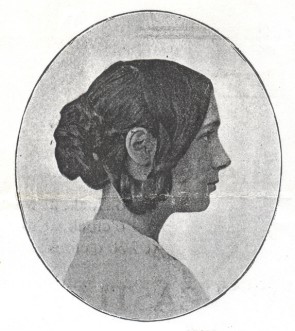
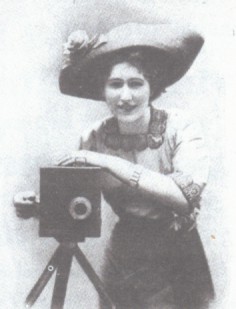
She was the daughter of actor and author Mark Melford (c.1851-1914), who towards the end of his stage career turned to film production. His daughter Jackeydawra was born around 1890 (I haven’t been able to find a birth record), possibly getting her extraordinary name from a comedy opera Jackeydora, or The Last Witch, which toured Britain in 1890. Her name seems to be written differently in every source: Jakidawdra, Jackeydawra, Jackeydora, Jackiedora. She acted in her father’s stage productions from a young age, sometimes billed just under first name. She married Wallace Colegate in London in 1915, and then slips out of history. But we have the above picture of her which accompanied this short profile from The Cinema, 19 March 1913, p. 37:

This young lady, but just out of her teens, is the only daughter of Mark Melford, and, developing an ambition to master the mysteries of the camera, she has acquired that technical knowledge of the art of film-making that, coupled with her artistic gifts in dress, colour, light, &c., has rendered her an invaluable assistant to her able chief. Her clear-cut features and pathetic face are indispensable to the pictures, and her experience of acting from an early age has given her that ease, repose, grace, and power of expression so necessary to ensure good results in this department of her profession.

Miss Jackeydawra Melford has played all the principal parts in her father’s plays and sketches throughout the United Kingdom, and will prove an invaluable addition to the acting staff of this enterprising firm – nay, more, Miss Melford is so admirably adapted to picture work that she will, we think, make a name in the cinema world as she has upon the stage, and Jackeydawra will become a household word.

How much might we want to pursue someone none of whose films are known to survive? Or is the story of lost films and those who made them a special kind of history? Who needs films to write film history anyway?

Modern Gladiators

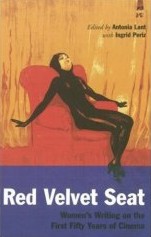
I am poorer but richer. I have forked out for Antonia Lant’s Red Velvet Seat: Women’s Writing on the First Fifty Years of Cinema, as already promoted here. It is full of riches. The notes alone are a map to a marvellous world, with a host of tempting pathways down which to travel.

There’s so much that one could say about the texts in the volume, but the first thing to catch my eye was two pieces written by women who saw the film of the World Heavywieght Championship bout at Carson City, Nevada, between James Corbett and Bob Fitzsimmons, on 17 March 1897. One is a short, anonymous piece, ‘The Matinee Girl’, from the New York Dramatic Mirror, 12 June 1897; the other is a longer piece by Alice Rix, ‘Alice Rix at the Veriscope’, from the San Francisco Examiner, 18 July 1897, which is about women spectators of the film.

Corbett v Fitzsimmons

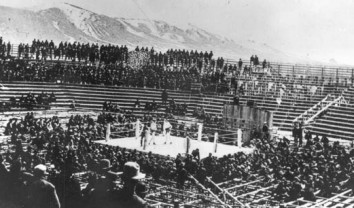
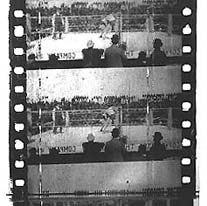
The film was made by the Veriscope Company, which employed three cameras in parallel, housed in a wooden cabin, so that when the film ran out of one the next door camera started (as the picture above shows). The result was a seemingly continuous, single-position record, which ran for well over an hour (there were fourteen rounds). The film was 63mm wide, giving a ‘widescreen’ effect which was shaped to the size of the ring:

Corbett v Fitzsimmons film strip

The film was widely shown and enthusiastically watched by audiences worldwide most of whom had never seen a boxing match (boxing was illegal in every American state except Nevada). There was clearly a number of women who went to see the film. And another of them wrote about the experience. Lady Colin Campbell, who wrote a column in The World, on 20 October 1897 wrote about seeing the film at the Aquarium in London (using the pen name Véra Tsaritsyn), under the title ‘Modern Gladiators’:

In spite of all that the humanitarians may say or the Peace Society may preach, the love of fighting will endure to the end of time … it is with satisfaction that I note the number of people who are crowding into the theatre of the Aquarium to see the cinematograph version of the great fight between Corbett and Fitzsimmons, which took place last March in Carson City, Nevada.

It certainly was an admirable idea to have got up this historic encounter for the sake of the pictures to be obtained of it. It is given to comparatively few to see a real prize-fight; but these pictures put the P.R. ‘on tap,’ as it were, for everybody. It is the real thing: the movements of the men, the surging of the crowd, the attentive ministrations of the backers and seconds, are all faithfull represented; only it is so bowdlerised by the absence of colour and noise that the most super-sensitive person, male or female, can witness every details of the fight without a qualm. Evidently the fair sex appreciate such an opportunity, for there are plenty of those tilted ‘coster-girl’ hats adorned with ostrich feathers that would delight the heart of a ‘donah,’ which are fashion’s decree for the moment, to be seen in the theatre … The five-shilling ‘pit’ (which are the lowest-priced seats for this peep-show) is soon filled up; the half-guinea stalls are not long behindhand; and the only part of the auditorium which remains partially empty is the back row of the stalls, which, for some mysterious reason, is thought to offer such exceptional advantages that the seats are priced at a guinea. The seats being exactly the same as the half-guinea abominations in clinging red velvet, and the point of view being precisely similar to that of the front row of the pit (which is only divided off by a rope), we ponder over the gullible snobbishness of the world, while a well-meaning but maddening lady bangs out ‘The Washington Post’ out of an unwilling and suffering piano in the corner. We have nearly arrived at the point of adding our shrieks of exasperation to those of the tortured instrument when the show begins and the ‘Washington Post’ is mercifully silenced.

We are first gratified with a little slice of statistics; the two miles of films on six reels, containing one hundred and sixty-five thousand pictures; the prize of 7000l. which went to the victor; the names of the referee, the timekeeper, and various other details, to which the audience listens with ill-concealed patience … [T]he first picture is thrown upon the sheet, and, having wobbled about a little to find the centre of the canvas, settles down into an admirably distinct view of the platform, with the two champions wrapped in long ulsters, each surrounded by his backers …

Here she goes on to describe the fight in great detail, commenting on the odd effect of the silence, complaining about clinching, and describing the dramatic end where the defeated Corbett in a rage tried to attack Fitzsimmons, causing mayhem in the ring.

The two miles of pictures have taken an hour and a half to pass before our eyes; but though we leave the theatre with aching heads, we regret that so little that we determine to return as soon as we can, to witness again this combat of modern gladiators.

And though here at the Bioscope we’re wary of pointing people to stuff published illegally on YouTube, you can see edited highlights of the bout from a 16mm print probably dating from the 1960s. The intertitles are an obvious modern addition, as is the use of slow motion where they repeat the shot of the knockout blow, where the original film has been damaged. About a third of the film survives today – disappointingly, the scenes showing the uproar at the end of the fight are missing.

In the Red Velvet Seat

Red Velvet Seat

http://www.amazon.co.uk

Following on from yesterday’s post on women silent filmmakers in Britain, today I came across Red Velvet Seat: Women’s Writings on the First Fifty Years Of Cinema, edited by Antonia Lant and Ingrid Periz. I really should have noted it before now. It is an excellent, huge (872 pages) compilation of contemporary texts by women on film in the first half of the twentieth century. These come from women filmmakers, actresses, social reformers, journalists, critics, sociologists, poets, and spectators, many from the silent period.

The texts are divided into sections, which demonstrate the range: Seeing or Being Seen; Touring the Audience; Why We Go to the Movies; The Spectatrix; Film Aesthetics and the Other Arts; Futurology; Captive Minds; Enlightment without Tears; Means of Control; Naming the Onject; Reviewing; The Star; Film as the National Barometer; In the Shadow of War; The Limits of Criticism; A Job for Whom?; The Actress and Adventuress; The Screenwriter; The Director; Working in the Autiorium.

Among the more familar names are Virginia Woolf, Djuna Barnes, Dorothy Richardson, C.A. Lejeune, Iris Barry, Lotte Reiniger, Betty Balfour, Sarah Bernhardt, Lillian Gish, H.D., Maya Deren, Marie Stopes, Anita Loos, Germaine Dulac, Rebecca West, Dilys Powell, Zelda Fitzgerald, Winifred Holtby and Elizabeth Bowen. What is so impressive, apart from the range of writers and themes, is the choice of some little-known yet hugely interesting rarities alongside the expected ‘classics’. How did they find the 1918 piece by Marie Stopes on the purpose on cinema in a Tokyo journal? There are two pieces by female spectators of the Corbett-Fitzsimmons boxing film of 1897. There are many riches here for anyone interested in the first decades of cinema, quite apart from the special emphasis on women’s roles in cinema and women’s view of the medium.

It’s a real treasure trove.

Women behind the camera

From an advertisement for the Kinora home movie camera

I have been adding texts of my talks, essays, filmographies and other work on to my personal website, www.lukemckernan.com, where I am free to do so. Do take a look at the Publications, Talks, Shows and Research sections for assorted interests of mine in the worlds of early and silent cinema, which I hope may be of use to others.

The latest text to go up is Women Silent Filmmakers in Britain. This is a filmography of films directed, shot, produced, scripted or edited by women in Britain in the silent era – a full filmography in each case, not just the handful of films that survive. It’s something that I first put together some time in the late 1990s, and it’s still very much a work in progress, so any comments, corrections or additions (especially new names) will be most welcome. Among the names listed are scriptwriters Muriel Alleyne, Lydia Hayward, Alma Reville and Blanche McIntosh; directors Ethyle Batley, Frances E. Grant, Dinah Shurey, and Jakidawdra Melford; camera operators Jessica Borthwick and Mrs Aubrey Le Blond; scientific filmmaker Mrs D.H. Scott, editor Adeline Culley, executive Ada Aline Urban, and many more.

It’s an area ripe for more research. British silent cinema itself is still an undervalued and neglected field, and the significant role of women in film production at that time is scarcely known. A pioneering piece of writing is Katherine Newey’s essay ‘Women and Early British Film’ in Linda Fitzsimmons and Sarah Street (eds.), Moving Performance (Trowbridge: Flicks Books, 2000). However, there is much new activity in the field, including an ongoing ‘Women in Silent Britain’ project which was discussed at the recent British Silent Cinema Festival. More news on this work as and when we get it. I’ll also be posting pieces on individual women filmmakers (and not just British) in the future.

(By the way, the image at the top of this post comes from a 1911 booklet, The Golden Book of Motion Photography, advertising the use of home movie cameras. It comes from Barry Anthony’s The Kinora: Motion Pictures for the Home 1896-1914).