Behind the Motion-Picture Screen

cakesofice.jpg

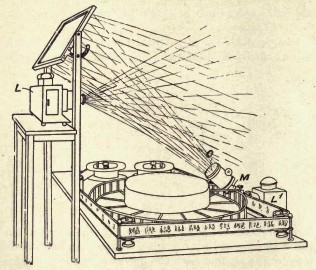
The latest addition to The Bioscope Library is Austin C. Lescarboura’s Behind the Motion-Picture Screen, published by Scientific American in 1921. I know nothing about the author and I’d not even come across the book before. It’s a voluminous history and guide to the production of motion pictures. As the subtitle puts it, it covers ‘how the scenario writer, director, cameraman, scene painter and carpenter, laboratory man, art director, property man, electrician, projector operator and others contribute their share of work toward the realization of the wonderful photoplays of today; and how the motion picture is rapidly extending into many fields aside from that of entertainment’. With some rather fanciful chapter titles it cover the work of the director (‘The Artist Who Paints the Film Subjects’), producer (‘The Generals of Shadowland’), actors, cinematographers, screenplays, camera technology, special effects, newsfilming, scientific cinema, animation, colour, and and a prescient chapter on the coming of sound. There is a huge amount of interesting material in there.

But perhaps the real appeal lies in its illustrations. There are superb photographs of the production process, and though frustratingly the captions do not name the participants, the images are a rich source of information in themselves, and an indication of how useful these Internet Archive copies are as a source of pictures – as demonstrated by the picture above, which comes with the caption, ‘Scenario writers are notoriously cruel. Without a moment’s hesitation they call for a hero struggling with death among cakes of floating ice – and the actor must do it’. It’s available in DjVu (24MB), PDF (62MB), b/w PDF (39MB) and TXT (529KB) formats.

All you need to know about the cinematograph

Pathe Cinematograph

The latest publication on the shelves of The Bioscope Library is Bernard C. Jones, The Cinematograph Book, published in 1915.

This is one of the classic guides to the practicalities of motion pictures in the silent era. It aimed at clarity with usefulness, and achieved it. The chapters cover the history of the ‘invention’ of motion pictures, the operation of a camera and projection equipment, developing and printing films, cinema screens, what to do in case of fire, cleaning and preparing films, producing trick films, and making films for the home. It also has a special section on natural colour cinematograph pictures, focussing on Kinemacolor. Finally there is a guide to the relevant acts and regulations (as they related to the UK). It’s all you needed to know. Once again, it comes from the Internet Archive.

Education, education, education

Some new additions to The Bioscope Library. A prominent theme in the silent era was the use of films in education. It was driven by a mixture of idealism and commerce, but mostly by the evident appeal that motion pictures had for children – a challenge to authorities in every sense. An enthusiastic period in the 1910s, when many advocated the motion picture as an essenial tool for educating the young was followed by a period of experiment and analysis in the 1920s, determining the pedagogic value and the pitfalls. Many specialist producers in educational film then sprang up, exploiting the new 16mm film format for non-theatrical exhibition, riding on the bandwagon of what was labelled Visual Education.

Ernest Dench’s Motion Picture Education (1917) is a rambling but enthusiastic guide, which considers the potential for film to teach history, arithmetic, natural history, domestic science, even handwriting. There is some grasp of the theoretical side, and warnings that film is no substitute for text. Dench reveals how the great passion for films among young audiences was taxing authorities, which sought to master a medium they did not fully understand. It’s available from the Internet Archive in DjVu (5.3MB), PDF (43MB) and TXT (351KB) formats.

Don Carlos Ellis and Laura Thornborough’s Motion Pictures in Education: A Practical Handbook for Users of Visual Aids (1923) is one of the standard guides of the period. It is designed as the essential handbook for the teacher needing to the how and why of using film in the classroom. In good common-sense fashion it covers the history of educational film, the objections raised against its use, the advantages of using the medium, the kinds of films available, the practicalities of exhibiting them, and examples of their successful use. It’s available from the Internet Archive in DjVu (7.2MB), PDF (34MB) and TXT (515KB) formats.

Also in an instructional vein are two further books added to the Library. The year before his book on education, Ernest Dench wrote Advertising by Motion Pictures (1916), a fascinating, if discursive guide to the potential of the motion picture for purposes of advertising. Dench covers the selling of railroads, food products, agricultural machinery, shoes, real estate, newspapers and dry goods through motion pictures. He covers different approaches for different kinds of audience (working classes, farmers), and different media, with particular attention given to the use of advertising slides. Some of it is aimless speculation, like the chapter on naming soda fountain concoctions after movies, but its enthusiasm is appealing and it paints a useful picture of they ways in which the cinema industry engaged with the American audience in the early years of cinema. It’s available from the Internet Archive in DjVu (5.2MB), PDF (23MB) and TXT (207KB) formats.

Lastly, there’s Hugh C. McClung, Camera Knowledge for The Photoplaywright (1920). This pamphlet offers a simple guide to the technology and practice of cinematograph for the would-be writer of screenplays. McClung was a cinematographer himself, with Gaston Méliès, Willian Fox, Triangle, Douglas Fairbanks and Famous Players-Lasky. The chief intent of the booklet is to make writers “think in pictures,” and in between the general pleas for appreciation of the hard work that went behind the making of pictures, there are some interesting anecdotes which bring to life the practicalities of the business. Available from the Internet Archive in DjVu (604KB), PDF (2.2MB) and TXT (37KB) formats.

Chaplin’s camera

Got £90,000 spare? Charlie Chaplin’s Bell & Howell camera is being auctioned by Christies in London on 25 July, and is expected to fetch a price between £70,000 and £90,000. The silent Bell & Howell 2709 model camera was bought by Chaplin in 1918. It was used by Chaplin throughout the 1920s (The Kid, The Gold Rush, The Circus etc) and into the 1903s for City Lights and Modern Times. It continued in use up to the 1950s for animation work and shooting titles. It’s part of a motion picture equipment sale, and will be on view at Christies’ showrooms from 21 July.

Land and Kinemacolor

Edwin Land c/o Wikipedia

As reported earlier, I’ve been reading Simon Ing’s The Eye: A Natural History, which is not only an exceptional, highly-readable account of the mysteries and mechanics of eyesight, but incidentally has information of use to us in the study of early film. I’ve already covered his demolition of the persistence of vision fallacy. A later chapter covers how we see colour.

Silent cinema was filled with colour. From the earliest years selected films were hand-painted, a process that was then mechanised by a system of stencils (and massed ranks of women operatives) by the Pathé and Gaumont companies. Later films were subtly tinted and toned throughout, with colours used to denote emotions as well as settings. Restorations of sophisticated colour effects in silent films are the pride and joy of film archives. There is an excellent essay by Tom Gunning, ‘Colorful Metaphors: The Attraction of Color in Early Silent Cinema’ which places early, artificial colour within the broader context of colour reproduction across other media.

However, there was also ‘natural’ colour in the silent era. The 1920s saw systems such as Prizmacolor and two-colour Technicolor in use for a handful of films, but the first of them, and the colour system with the most romantic history, was Kinemacolor. You can read all about the history of Kinemacolor, which was invented in 1906 and first exhibited in 1908, on my Charles Urban website, Urban being the entrepreneur behind Kinemacolor.

The relevance of Ings’ book here is his account of the work of Edwin H. Land. Land was an American scientist and inventor, best known for having given us the Polaroid camera. In 1959, Land devised an experiment which challenged previous theories of colour vision. This is how Ings describes the initial discovery:

On evening, at the end of a long series of experiments with three projectors [they were experimenting with red, green and blue light], Land and his assistants shut off their blue projector and took the green filter out of the green projector. Then, one of Land’s assistants, Meroe Morse, called their attention to the screen. The red projector was still running, projecting the red record on the screen in red light, and the unfiltered green projector was projecting the green record with white light. That combination of red and white lights should, in Morse’s mind, produce something pinkish. But there was the original image, its every colour still identifiable. How could red and white lights throw blues and greens on the screen?

Answer – because in colour vision, context is everything. The eye perceives colours in relation to other colours, and even though Land and his team ‘removed’ colour filters in assorted combinations, they could still generate a full colour, projected image. The eye filled in the gaps.

This property of vision, however, had been discovered and exploited fifty years earlier by Charles Urban and G.A. Smith, the inventor of Kinemacolor. Kinemacolor (patented 1906) used rotating red and green filters on both camera and projector, with panchromatic black-and-white film being used at double the conventional speed (i.e. around 32 frames per second). The result, despite some colour fringing inevitable given the separation of the red and green records, produced a record that was remarkably close to full colour. Red and green in combination covered a fair bit of the spectrum, and the eye did its best to fill in the rest. Hence eye-witnesses reported seeing blues which, according to pure Newtonian colour theory, could not be there. Ironically, Kinemacolor eventually failed as business after a 1913 court case in which its patent was ruled invalid because it claimed to show all the natural colours, but could not reproduce blue.

Today, few Kinemacolor films survive, and we can in any case only judge (or be fooled by) the colour effect if a true Kinemacolor film is projected using correct equipment. However, it is possible to approximate the effect photo-chemically or electronically, as in these frames from the surviving fragment of the famous Delhi Durbar film of 1912 (‘red’ record, ‘green’ record and composite effect):

The Delhi Durbar

Land knew nothing of Kinemacolor, and Ings makes no mention of it, which is a shame, because its history has much to tell us about perception, the socio-psychological construction of colour, and the wider understanding of the phenomenon of moving pictures.

If you are interested in knowing more about the history of Kinemacolor, why not download the chapter from my thesis on Urban which covers Kinemacolor, available from my personal website.

Find out more about Land’s experiments from Chris Taylor’s site, which plays with generating colour images using just red and white.

If you are heavily into optics and want to know more about Land’s work, see Gerald Huth’s Rethinking the Vision Process blog.

And, if you are in a UK university, college, school or public library, you can see sample Kinemacolor films from the BFI’s Screenonline site, together with other examples of Charles Urban’s remarkable film career.

Hopwood’s Living Pictures

Praxinoscope

Another addition to the Bioscope Library. Henry Hopwood (1866-1919) was Custodian in the Library of the Patent Office in Chancery Lane, London. His Living Pictures is a comprehensive history and handbook on the technology of the new science of motion pictures, published first in 1899 and then in a revised edition by his colleague R.B. Foster in 1915. It is a thorough, knowledgable account of the subject, based around patent applications, but expressed in an engaging and sometimes philosophical style which makes it a pleasure to read today. It still used as a standard reference source.The 1915 revision is available for downloading from the Intenet Archive in DjVu (16MB), PDF (45MB) and TXT (570KB) formats.

Terra Media

chronomedia.jpg

A key aspect of The Bioscope’s mission is to highlight resources for the study of silent film, particularly those not well known or obvious.

A model example is Terra Media. This is a one-man marvel of information on the history of media, beautifully arranged, and filled with riches. Its centrepiece is Chronomedia, a detailed chonology of media history year-by-year. As the site says, “Chronomedia is designed to become the most comprehensive and accurate timeline of developments in communications media ever compiled. By integrating references to all audio-visual media—film and cinema, radio and television, cable and satellite, interactive (multi)media, photography, telegraphy, telephony and even printing and publishing—it becomes easier to see the parallel developments and interactions that have formed the media scene we know today.” The year-search option alone is a joy to see, individual entries are to the point, and it is all very satisfactorily cross-indexed, linked and illustrated.

There are other sections on quotations, the history of television as public performance, the quest for home video, a reference section, and a fascinating section on British media legislation. There are further sections on statistics (including early British cinema circuits) and contemporary documents (none covering the silent era). The site continues to grow, and is just such a pleasure to use. Its editor is David Fisher, whose day job is editor of the media news and market research journal Screen Digest. Take a look.

Researching patents

Hale’s Tours patent diagram

Among the many remarkable research resources available online for those interested in the technical aspects of early and silent cinema, some of the most important are patent records. There are three major sites:

Google Patents

Still in Beta mode, this enables you to search across 7 million US patents, from the 1790s up to last year. The records come from the United States Patgent and Trademark Office (see below), and the information is all in the public domain. You can search for patent number, inventor, assigneee, classification or date. It helps to know something about the patent process to get the best results, and don’t search for a product name – these rarely feature in patent descriptions. Search results provide the patent number etc, plus a copy of the patent document itself – Abstract, Drawing, Description and Claims.

US Patent and Trademark Office (USPTO)

The patent data and images on Google Patents all derive from the USPTO Patent Full-Text and Image Database. This is an alternative search option, better suited for professionals and research experts. As with Google, it only lists US patents.

esp@cenet

For European patents, including British, you have to go to the Europe Patent Office’s esp@cenet service. From the main site you choose your country of interest: Britain is http://gb.espacenet.com. The search options are more or less the same as above, but care should be taken over searching by patent number, for which you need to add a country code and year.

Here are two examples to try out:

George Hale’s 1905 design for a a film show is a mocked-up railway carriage which rocked to and fro, marketed as Hale’s Tours (US patent 800100) [illustrated above]

George Albert Smith’s 1906 patent for a motion picture colour system, later to be called Kinemacolor (Patent no. 26671, or GB190626671)

Ah, the Nuts and Bolts

One of the long neglected areas of film scholarship has been the technology developements over time. From the earliest days of the industry, cameramen, etc, had to come up with methods to handle film, shoot at different speeds, film from the air, and on and on. When archives first broached the idea of film preservation, for the most part film itself was the object of our affection. It wasn’t until much later that we realized the importance of this cinemachinery in the industry. From early cameras, lighting, and printers, the developments came fast and furious. Some were monsters in size and shape, like the original Mutoscope Camera of A, M & B. Carl Gregory developed a practical optical printer in 1927-28.

These and devlopments like them were one of the things responsible for the technical improvements in film production that made it to the screen. I have always found this period to be a treasure trove of technological development, and look forward to seeing much more research into this area of the early film industry.

Practical Cinematography and Its Applications

OK, back to the serious stuff, and another key text available for downloading from The Internet Archive. Practical Cinematography and its Applications (London: W. Heinemann, 1913) was written by F.A. Talbot, who wrote various popular science guides, including the much-cited Moving Pictures: How They Are Made and Worked (1912). This plain person’s guide to the practical aspects of cinematography covers operating the camera, film development, scientific applications of cinematography, military uses, education films and (rather oddly) how to write screenplays. Odd, because Talbot’s concern is otherwise about the motion picture as a tool of discovery, not entertainment. There is also an intriguing call for national cinematograph laboratories. It’s available for free download in DjVu (9.6MB), PDF (29MB) and TXT (357KB) formats.