Nazimova in Leicester Square

salomehandbillco

http://www.cinema-organs.org.uk

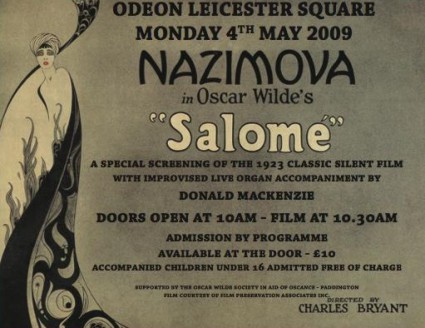
Normally the Bioscope doesn’t advertise single screenings of silents, because other sites perform that service very well, but when a silent film comes to Leicester Square, London’s cinema heartland, then we have to take notice. So, on Monday 4 May there is to be a screening of Salome (1923), starring Nazimova, at the Odeon Leiceste Square, with accompaniment on the cinema’s organ by Donald Mackenzie. The screening is at 10.30am, please note.

There’s information at the Cinema Organs site on the screening here, and the organ itself here.

The music of light

brownlow_gance

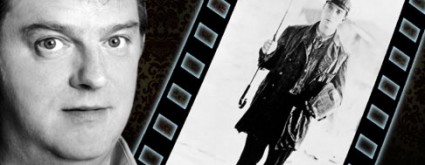
Kevin Brownlow and Abel Gance

Over 23-24 May, as part of the Bristol Ideas Festival, Bristol Silents is organising a special weekend event, ‘The Music of Light’: Abel Gance and Kevin Brownlow. Here are the programme details:

‘The Music of Light’: Abel Gance and Kevin Brownlow

In partnership with Bristol Silents

Special weekend ticket price for all events: £24.00 / £18.00 concs and Bristol Silents members

Bristol Festival of Ideas pays tribute to one of the greatest filmmakers and one of the best film historians. Film historian, Kevin Brownlow, and French pioneer filmmaker, Abel Gance, shared a passion for cinema when they met at the National Film Theatre in 1951. Brownlow was just a 13-year old school boy but the two forged a friendship and creative alliance that lasted until Gance’s death in 1981. Gance regarded film as ‘the Music of Light’. He is best remembered for his masterpiece epic from the silent era, Napoleon (1927). Brownlow painstakingly restored the film over two decades, and the response to its exhibition in the 1970s and 1980s initiated a complete re-evaluation of Gance’s role in cinema history.

Inspired by Gance, Brownlow spent ten years making his first feature It Happened Here with school friend Andrew Mollo. Kevin went on to become one of the foremost experts in silent cinema as a prolific writer, documentary filmmaker and film historian. His written works include the seminal The Parade’s Gone By (1968) and David Lean: a Biography (1991). In this brief season we celebrate the work of two passionate visionary filmmakers, exploring their relationship and inspirations and, most importantly, their films. Musical accompaniment is provided on the piano by Neil Brand, widely considered to be one of the finest exponents of silent film, and on violin by Guenter Buchwald.

Abel Gance: Music of Light
With Kevin Brownlow, Andrew Kelly, Paul McGann
and David Robinson
23 May 2009 11.00-12.30
Price: £6.00 / £4.50 concs and Bristol Silents members
Featuring extracts from his rarest work through to Napoleon, Kevin Brownlow, film historians David Robinson and Andrew Kelly, and actor Paul McGann explore Gance’s formidable, often underrated contribution to cinema.

It Happened Here (PG)
Dirs. Kevin Brownlow & Andrew Mollo 1964
97m
23 May 2009, 13.30-15.05
Price: £6.00 / £4.50 concs and Bristol Silents members
The story of what might have happened had Britain been occupied during World War II.

Winstanley (PG)
Dir. Kevin Brownlow 1975
95m with introduction from Kevin Brownlow
23 May 2009, 15.20-17.00
Price: £6.00 / £4.50 concs and Bristol Silents members
The forgotten story of Winstanley and the Diggers, a Christian Communist settlement, set just after the Civil War and filmed close to the actual locations.

La Roue (PG)
Dir. Abel Gance 1922
270m with introduction from Kevin Brownlow
24 May 2009, 13.00-18.00
(with interval)
Price: £10.00 / £8.00 concs and Bristol Silents members
Filmmaker Jean Cocteau said ‘There is cinema before and after La Roue as there is painting before and after Picasso’. Long considered a cinematic masterpiece, La Roue has been unavailable for 87 years. An epic of the railways, shot among the marshalling yards (the Black Symphony) and the mountains (the White Symphony), La Roue is a powerful drama of life among the railroad workers, rich in psychological characterisation and symbolic imagery.

Details, as always, from the Bristol Silents website or from the Ideas Festival.

Visiting the ancient world

troy

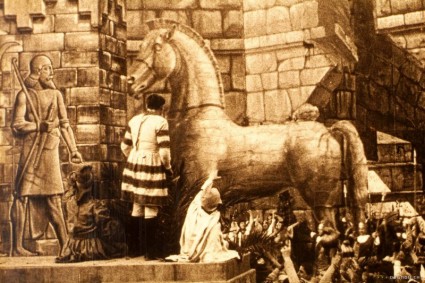
La caduta di troia (Italy 1910), from http://www.mondomostre.it

A few words of praise are in order for a marvellous early cinema event which took place in London this week. The Ancient World in Silent Cinema (which was trailed by the Bioscope a while back) tookplace at the Bloomsbury Theatre on 28 January. It was an afternoon and an evening of films from the silent era on Ancient Greek and Ancient Roman themes, organised by the University College London’s Department of Greek and Latin.

This was a significant part of the interest, that a classical studies department had undertaken to exhibit these films, offering the promise of fresh insights and new angles into material that cannot only be the preserve of we early cinema hacks. Of course, we hacks turned up an occupied the front row, but the theatre was full of some 250 or so new enthusiasts, who had for the most part never seen such films, and who were clearly thrilled at the sense of discovery. Yes there was a giggle or two, but no more giggles than Brad Pitt in Troy got – in fact, probably a good deal fewer. Stephen Horne accompanied the films in bravura style, on piano, electronic keyboard and flute. He didn’t quite manage to play all three at the same time, but he did manage two (and that’s piano and flute, folks, not just piano and second keyboard). A number I spoke to afterward couldn’t believe it was all improvised and that he hadn’t seen the films beforehand.

I only saw the afternoon screening of Ancient Greece on film, alas (if anyone attended the Roman show, do add your comments). But what a well-selected delight it was. All of the films came from the BFI National Archive. Amour d’esclave (France 1907) was an effective pocket melodrama with some poignancy behind the histrionics, as Polymos falls in love with a slave girl and prefers to take poison with her and die rather than return to his wife. In the middle came a delightfully incongruous dream sequence featuring the Pathé dancing girls. La Morte di Socrate (Italy 1909) gave us Socrates’ death by drinking hemlock, fresh from the pages of Plato, so it felt, once you’d allowed for a certain amount of arm-flailing. Elettra (Italy 1909), given an extraordinary jagged piano accompaniment by Horne, portrays the bloody revenges of Greek tragedy with enthusiastic passion.

Louis Feuillade’s La Légende de Midas (France 1910) was just wonderful. In contrast to the high tone of the previous films, here was the humour to be found in Greek myth. King Midas prefers Pan’s music to that of Apollo, so the latter punishes him by giving him asses’ ears. Midas tries desperately to hide the disfigurement under a hat, but his barber discovers the secret and has to tell someone, so he says what he knows into a hole in the ground. Reeds grow up and whisper the secret to couples passing by, who then tease the hapless Midas. It was done in such a spirit of fun, with effects that got across just the right sense of magic.

Then came La caduta di Troia (Italy 1910). What a fine filmmaker Giovanni Pastrone was, a point made all the clearer by L’Odissea (Italy 1911) which followed it, which covered the same territory with some fine special effects but none of the genius for action, spectacle and connection beween scenes that Pastrone displayed. Among the gems were Paris and Helen floating across screen on a giant seashell on their way to Troy, the wooden horse (of course), and expertly orchestrated mayhem as the Greeks pour into the city. Anyone who read Homer (or Homer-based stories) when young and remembers the thrill of character and incident that marks out the myths would have had to thrill at such dedicated attempts to recreate their look and spirit. One also saw the early cinema stretching its boundaries – more space, more people, more movement, boldness in invention,delight in the stimulus to the imagination. L’Odissea had less directorial imagination, but we had a fantastic cyclops, convincingly huge against Odysseus and his men (thanks to superimposition) and graphically blinded, and a startling Scylla and Charybdis.

It was a pity that the show was concluded by showing two fragments from Alexander Korda’s otherise lost The Private Life of Helen of Troy (USA 1927). In other circumstances this mocking burlesque would have been great fun, but here in took us into another world from that of the early cinema productions, which had so earnestly tried to recapture the thrill of the ancient world to the impressionable imagination.

As said, I missed the Ancient Rome half of the day, but for the record the films shown were Julius Caesar (USA 1908), Giulio Cesare (Italy 1909), Cléopatre (France 1910), Lo Schiavo di Cartagine (Italy 1910), Dall’amore al martirio (Italy 1910), Patrizia e Schiava (Italy 1909), A Roman Scandal (USA 1924) and Jone O Gli Ultimi Giorni di Pompei (Italy 1913).

There has been a reasonable amount written about representations of the classic world on film, but little of it devoted to the silent era. The films were being shown as part of a research project on the theme, and one of the academics involved, Maria Wyke, has written Projecting the Past: Ancient Rome, Cinema and History,which covers the silent era. Other relevant titles are David Mayer’s Playing Out the Empire: “Ben-Hur” and Other Toga Plays and Films, 1883-1908, William Uricchio and Roberta E. Pearson’s Reframing Culture: Case of the Vitagraph Quality Films.

The UCL project is to return with a second set of screenings and talks on 22 June at the Bloomsbury Theatre, when the theme will be films set in Biblical or Near Eastern Antiquity. More news on this when I have it. It will be the place to be.
Paul Merton hits the road again

paulmerton2009

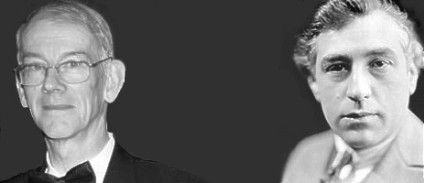
Paul Merton’s Silent Clowns show is touring the UK once more, April-May 2009 (with an extra date in July). As before, Paul Merton is introducing assorted classic clips from the great comedians of American silent film, with piano accompaniment from the peerless Neil Brand. The show features Charlie Chaplin, Laurel and Hardy, Harold Lloyd, Buster Keaton (Steamboat Bill Jr. will be shown in its entirety) and many others.

These are the dates for the tour, with weblinks to the venues.

April
Friday 3 – Belfast – Belfast Film Festival – 02890 330443
Sunday 5 – Bath – Theatre Royal – 01225 448844
Tuesday 7 – York – Grand Opera House – 0844 847 2322
Wednesday 8 – Durham – Gala Theatre – 0191 3324041
Friday 10 – Birmingham – Alexandra Theatre – 0844 847 2294
Saturday 11 – Leicester – De Montfort Hall – 0116 233 3111
Sunday 12 – Buxton – Opera House – 0845 127 2190
Tuesday 14 – Reading – The Hexagon – 0118 960 6060
Wednesday 15 – Canterbury – Shirley Hall, King’s School – 01227 787787
Friday 17 – Perth – Perth Concert Hall – 01738 621 031
Saturday 18 – Aberdeen – Music Hall – 01224 641122
Sunday 19 – Inverness – Eden Court – 01463 234234
Tuesday 21 – Dundee – Caird Hall – 01382 434940
Wednesday 22 – Glasgow – Glasgow Film Theatre – 0141 332 6535
Friday 24 – Cheltenham – Cheltenham Town Hall – 0844 576 2210
Saturday 25 – Huddersfield – Lawrence Batley Theatre – 01484 430 528
Sunday 26 – Lincoln – Drill Hall – 01522 873894
Monday – Harrogate – Harrogate Theatre – 01423 502 116
Tuesday 28 – Preston – Charter Theatre – 01772 258858
Wednesday – Derby – Assembly Rooms – 01332 0255800

May
Friday 1 – Barnstaple – Queens Theatre – 01271 324242
Saturday 2 – Salisbury – City Hall – 01722 434 434
Sunday 3 – Exeter – Northcott Theatre – 01392 493 493
Monday 4 – Bournemouth – Opera House – 08701 989898
Tuesday 5 – Weston Super Mare – Playhouse – 01934 645 544
Wednesday 6 – Yeovil – Octagon Theatre – 01935 422884
Friday 8 – Worthing – Assembly Hall – 01903 206206
Sunday 10 – London – Hackney Empire – 020 8985 2424
Tuesday 12 – St Albans – The Alban Arena – 01727 844488
Friday 15 – Tunbridge Wells – Assembly Hall Theatre – 01892 530613
Saturday 16 – Basingstoke – The Anvil – 01256 844 244
Sunday 17 – High Wycombe – Wycombe Swan – 01494 512 000

July
Sunday 7 – Newbury – Newbury Comedy Festival – 01635 522733

Tour date information taken from www.mickperrin.com.

The tour coincides with the publication in paperback in May of Merton’s widely applauded book Silent Comedy.

Lloyd George in London

lifestoryimage

Norman Page (David Lloyd George) and Alma Reville (Megan Lloyd George) in The Life Story of David Lloyd George (1918), from National Screen and Sound Archive of Wales

I’ll have more to say about this event nearer the time, but here’s a general notice that there is to be a screening of The Life Story of David Lloyd George (1918, d. Maurice Elvey) at the British Library on Sunday, 15 February. This key film in British film history tells the story of the Libreral Prime Minister David Lloyd George, focussing on his engagement with the major issues of the day, from his opposition to the Anglo-Boer War, to the introduction of old age pensions, to his activity as Minister for Munitions in the First World War, leading to his appointment as Prime Minister midway through the war.

Two things are particularly remarkable about the film. The one is mystery surrounding its disappearance – the film was never exhibited before the public, and there seems to have been a government pay-off to prevents its screening, after which the film disappeared for decades until its happy rediscovery in 1994. Secondly, there is its exceptional quality, both as ambitious human/political drama, quite unlike anything one might normally expect of a British film from this period, and then the sheer quality of the print, which is a joy to behold. The film has not been shown in London since its premiere (literally so) in 1996, and if you can get to see it I really recommend doing so. It is an epic without histrionics, prosaic and visionary at the same time.

The film will be accompanied by Neil Brand on the piano, and the screening will be introduced by television historian Dan Snow, who happens to be Lloyd George’s great-grandson. The reason for putting off more information at this stage is the happy news that the National Screen and Sound Archive of Wales is publishing its long-promised DVD of the film next month (with Neil Brand score), coinciding with the screening.

The film is being shown as part of the British Library’s Taking Liberties exhibition (on the history of civil liberties in Britain). The screening runs 14.00-17.00 (with interval) at the Conference Centre, British Library,tickets priced £6 (concessions £4). More information on booking here.

As said, more on the background to the film when the DVD comes out. Meanwhile, David Berry’s book, David Lloyd George: The Movie Mystery gives the full history behind an exceptional film.

It’s silent cinema, but not as we know it

damienbarr

A new kind of silent cinema is in town. The Andaz Hotel in London’s Liverpool Street has been trumpeting a special form of entertainment for its guests. It is offering them silent cinema. Marvellous, you may think, how immensely civilised, and does the lounge pianist provide the musical accompaniment as well? But, no, this is silent cinema of a different kind. The punters sit before the screen (the films are projected on to the wall of the 6-storey atrium), don wireless headphones, and then watch sound movies on screen but with the sounds hidden from all but themselves. Here’s how the hotel describes it:

Silent Cinema is a world first – it’s never been done anywhere else. Ever. Yet it’s beautifully simple: you wear wireless headphones to watch films on a full-size cinema screen. Sit back and relax without the unwelcome soundtrack – no noisy neighbours and no shhhhh! It’s like watching a movie at home only better because you’re in an amazing room full of like-minded people. And there’s a bar. You’re all enjoying an individual experience. Together.

Should you be in London at any time, you can book tickets via Ticketweb. There have been two screenings so far, both festive. They kicked things off with Black Christmas (oh joy) and on December 14th they’re showing It’s a Wonderful Life, with nothing to be heard bar the clink of glasses and the occasional sniffle.

Silent Cinema (of this kind) is not restricting itself to the Andaz. Damien Barr Silent Cinema, to be give its full, trademarked name (yes, Silent Cinema is now a trademarked term) has plans for further exhibition elsewhere, in London and Brighton, including outside screenings. Damien Barr is a journalist and radio playwright. So now you know.

The ancient world

julius_-caesar

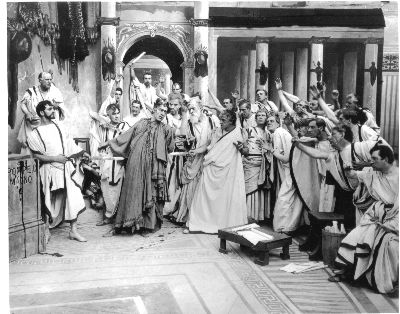
Studio still of the Vitagraph Company of America’s 1908 production of Shakespeare’s Julius Caesar

The classical world has always provided rich material for the cinema (until recent times, where togas are reserved for television and people shudder at the thought of Troy and Alexander), and this was especially true for early cinema. Classical subjects allowed the infant cinema to show how elevated it could be (and hence not deserving of some of the social criticism it was receiving), how it could handle famous texts (usefully out of copyright), and how it could dress up itself and indulge in special effects.

Above all, it could thrill audiences with true-to-life sights of Julius Caesar and Cleopatra, and allow them witness the siege of Troy and the last days of Pompeii. In Italy in particular, a thirst for the classical led to epics on a vast scale, such as Quo Vadis? (1913) and Cabiria (1914), which extended what the cinema could portray – visions of limitless space, populated by thousands, spectacularly arrayed, a vast panorama unfolding a highly romantic conception of history. (For more on such films, see The Bioscope Guide to Italy).

And so to what sounds like a lot of fun. The University College London (UCL) Department of Greek and Latin is presenting The Ancient World in Silent Cinema, an afternoon and evening of silent film screenings with piano accompaniment and related talks on Wednesday 28 January 2009, at UCL Bloomsbury Theatre, 15 Gordon Street, London, WC1H 0AH. The event is open to all and admission is free.

The screenings focus on Ancient Greece and Ancient Rome, with an emphasis on one-reelers rather than the later epics (no doubt because that enables you to squeeze in more titles). There is more information on the UCL site, including detailed, redolent synopses taken from the database of the BFI (which is supplying all the films), but here’s a summary listing:

THE AFTERNOON: ANCIENT GREECE

2-4pm Screenings of silent films set in ancient Greece:

Amour d’esclave (Fr 1907) 7 mins
La Morte di Socrate (IT 1909) 5mins
Elettra (IT 1909) 6 mins
La Légende de Midas (Fr 1910) 8 mins
La Caduta di Troia (IT 1910) 19 mins
L’Odissea (IT 1911) 29 mins
The Private Life of Helen of Troy (US 1927) [presumably an extract only]

4-4.30 pm Tea/Coffee break

4.30-5.45pm Speakers
Pantelis Michelakis (Department of Classics & Ancient History, University of Bristol) and Ian Christie (School of History of Art, Film and Visual Media, Birkbeck, University of London)

THE EVENING: ANCIENT ROME

7.15-7.45pm Speaker
Maria Wyke (Department of Greek & Latin, University College London)

8pm-10pm Screenings of silent films set in ancient Rome:

Julius Caesar (US 1908) 9 mins
Giulio Cesare (IT 1909) 7 mins
Cléopatre (Fr 1910) 9 mins
Lo Schiavo di Cartagine (IT 1910) 8 mins
Dall’amore al martirio (IT 1910) 11 mins
Patrizia e Schiava (IT 1909) 11 min
A Roman Scandal (US 1924) 6 mins
Jone O Gli Ultimi Giorni di Pompei (IT 1913) 43 mins

(Patrizia e Schiava, by the way, is the first film ever acquired by the National Film Archive, as it then was. It was acquired in 1935, under its English title Afra, and was give the vault location number 1A.)

And there will be more. A second afternoon and evening of Ancient World silent film screenings will be held on Monday 22 June 2009, from 2-6 and 7-10 pm at the Bloomsbury Theatre, with the theme this time being films with settings in Biblical or Near Eastern Antiquity.

London loves silents

Trafalgar Square screening, 2007

A reminder to anyone in London on 23 or 24 October of the free open-air evening screenings taking place in Trafalgar Square. On the 23rd, starting at 18.30, you can see the British science fiction silent High Treason (1929) – “the British Metropolis” – directed by Maurice Elvey and starring Basil Gill and Benita Hume, with live piano accompaniment by Neil Brand. A fun film to catch, showing a London where we were to be travelling about the city in helicopters, communicating by television, and wearing dodgy fashions. The accompanying short is Gaston Quiribet’s trick film vision of a future London, The Fugitive Futurist (1924).

On the 24th, also at 18.30, there’s a programme of fifteen archive films under the title ‘London Loves’. Among the silents in the programme are the bizarre The Smallest Car in the Largest City in the World (1913), a long-time favourite of those at the BFI National Archive, in which a miniature Cadillac drives sedately down London’s streets; news footage of Charlie Chaplin’s return to London in 1921, with esctatic greetings from the crowds; and an evocative travelogue, London’s Contrasts (1924). The star attraction, however, is going to be Living London (1904), Charles Urban’s truly dazzling documentary portrait of London life, a 10-minute epic only recently rediscovered by the National Film and Sound Archive of Australia and shown earlier this month at the Pordenone silent film festival. It returns to London after 104 years, and on the big screen, in that location, the impact should be tremendous. Among the sound films, look out especially for John Krish’s masterpiece of poignant regret, The Elephant Will Never Forget (1953), on the last trams in London – until they bring them back again, of course. Music will be provided by three musicians, names as yet unpublicised.

The screenings, organised by Film London and the London Film Festival, follow on from last year’s highly successful showing of Blackmail and a programme of archive shorts. It was a magical experience – not just seeing the films in such an extraordinary yet somehow rightful setting, but for the experience of audience watching. Some settled on the steps of the Square and took in every frame; some stopped by for a while to catch the experience before moving on; some paused briefly, on their way to catch a train, puzzled at what on earth was happening. Neil’s music pounded out, down the streets and over the rooftops, filling the evening air, drawing in people from all around to see what strange activity the capital was up to now. Film was bound up with the life of the city. An experience to savour.

Crazy once more

Crazy Cinématographe has returned, and has a fabulous poster to prove it:

Last year saw the launch of Crazy Cinématographe, a project with multiple outlets based on the programmes of films shows presented in the touring fairground booths of Europe in the early years of the twentieth century. In 2007 it gave us a touring show (mostly in Luxembourg, but it also visited Germany, France and Belgium), a conference (in Luxembourg) and finally a DVD, published by the highly commendable Editions Filmmuseum.

The Crazy Cinématographe tent in 2007

Except that it wasn’t ‘finally’, because Crazy Cinématographe edition 2 has been announced. Taking place 22 August-10 September in Schueberfouer, Luxembourg, the new show opens the tent flaps once more to present a highly variegated programme of bizarre and surprising early cinema subjects taken from fifteen film archives around Europe. There is now a Crazy Cinématographe site, with details of the programme, in German. Among the promised delights are acrobatic sisters, a ‘Cabinet of Crazy Animals’ (including Percy Smith‘s acrobatic fly, Max Skladanowsky‘s boxing kangaroo, monkeys dining in a restaurant, and – according to my translation software – rabbits eating giant snakes, though possibly it may be the other way around), an evening of early erotic films, a ‘Live-Mix Crazystyle’ by DJ Kuston Beater, and a ‘best of 2007’ programme. I’m promised more information in English, and will pass this on in due course.

Behind all the showmanship, Crazy Cinématographe is a bold and interesting attempt to combine scholarship with entertainment, or rather making an entertainment out of a scholarly enthusiasm, both for the archival films themselves and for the renowed ‘cinema of attractions’ concept (a cinema of spectacle that preceded the cinema of narrative), which has proved so fruitful in early cinema studies.

To give you a flavour of the entertainment, here’s the promo video (look out for the acrobatic fly at the end).

There’s also a video report on last year’s show (on YouTube, in French), which gives a good idea of the presentation style.