Digital delights

descriptive_zoopraxography

Eadweard Muybridge’s Descriptive Zoopraxography

You know, there are times when the Internet just spoils us. The Cinémathèque française has just issued an online digital library of some of the key books on early and pre-cinema (and related arts), the Bibliothèque numérique du cinéma. The collection is based on two sources: that collected by pioneering British historian Will Day, which includes many key books from 1895 onwards on the new art and science of cinema, but also going back all the way to Athanasius Kircher’s Ars magna lucis et Umbra of 1646; and a collection of historic works on film and photography amassed by the Cinémathèque itself from 1936 onwards, in particular through the efforts of those greats of film archiving and film historiography, Henri Langlois and Lotte Eisner.

So what have we got? Well, first of all, it’s all free. Every text is available in word-searchable PDF format, and comes with full catalogue record. The site offers the titles by author, title and date. There are 118 titles available. They are in the languages in which they were published, fairly obviously, and so many are in English (while a challenging few are in Latin). Here are some of the highlights:

  • Bayley, R. Child, Modern magic lanterns, a guide to the management of the optical lantern, for the use of entertainers, lecturers, photographers, teachers (1895)
  • Bennett, Colin N., A guide to kinematography, projection section for managers, manager operators, and operators of kinema theatres (1923)
  • Brewster, David, A treatise on new philosophical instruments, for various purposes in the arts and sciences with experiments on light and colours (1813)
  • Dickson, Antonia, The Life and inventions of Thomas Alva Edison (1894)
  • Dickson, William K.L., The Biograph in battle, its story in the South African War related with personal experiences (1901)
  • Ives, Frederic Eugene, Kromskop, color photography (1898)
  • Jenkins, Charles Francis, The Boyhood of an inventor (1931)
  • Marey, Etienne-Jules, Movement (1895)
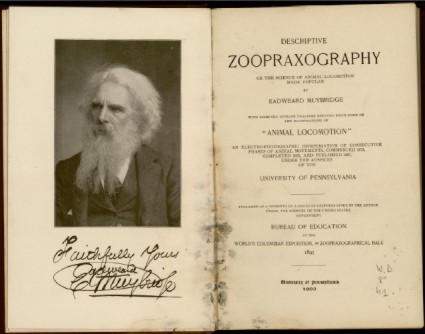
  • Muybridge, Eadweard James, Descriptive zoopraxography, or the science of animal locomotion made popular (1893)
  • Rathbun, John B., Motion picture making and exhibiting, A comprehensive volume treating the principles of motography; the making of motion pictures; the scenario; the motion picture theater; the projector,…etc. (1914)
  • Talbot, Frederick A., Moving pictures, how they are made and worked (1912)
  • Trutat, Eugène, La Photographie appliquée à l’histoire naturelle (1892)

Some of those titles you may recognise as having been covered here already because copies are available in the Internet Archive. Others not listed above will be for the optics specialist or magic lantern historian. But all in all here is a specialist library open to everyone, immaculately digitised and ably presented. I’ll be adding individual titles to the Bioscope Library in due course, plus adding the extra links to those titles already in the Library.

sallyinouralley

Part of a Bamforth lantern slide sequence illustrating ‘Sally in our Alley’, from 1902

And there’s more. The Cinémathèque française has at the same time published La laterna magica, a beautiful and superbly-organised site on magic lantern slides. There are around 1,500 images, chiefly from the Royal Polytechnic Institution collection. The site is French but the titles of the slide series are all in English, and searching is easy – by theme, title or producer. Clicking on each thumbnail yields a larger picutre, then a click again and you get a larger one still. A model presentation, with exemplary catalogue data.

Go explore. We are so lucky.

Who’s Who on the Screen

whoswho

Top row (L-R) June Mathis, Albert Capellani, Ruth Stonehouse; bottom row (L-R) Sessue Hayakawa, Teddy Sampson, Buster Keaton, from Who’s Who on the Screen (1920)

As some may know, while in the small hours I run The Bioscope, in the daylight hours I take occasional care over Screen Research, a social network/information source on moving image research. The latter is mostly devoted to current activity in the online video world, but the photograph section concentrates on older material, simply on acount of rights issues.

So this is just to let Bioscopists know that there is a growing collection of silent film images to be found there. In particular, I have just finished working my way through the Internet Archive copy of Charles Donald Fox and Milton L. Silver’s Who’s Who on the Screen (1920). This is a 400-page biographical guide to Hollywood in 1920, with a photograph and mini-biograph per person per page. I have published each individual on their individual page in four ‘albums’, with actors in Part 1, Part 2, and Part 3, and directors, executives etc. in Part 4. I find the parade of images haunting (the quality of the photography is outstanding, even if the image resolution is low – the photographers are credited in an acknowledgments page on Part 4) and the biographies intriguing for the emphasis placed on how healthy every one was. All the actors stress the sports they follow and their love of the outdoors. The executives feel less need to do so.

There is more silent material to be found under the Photos section. Film historian Deac Rossell has added some gems from his personal collection, including lobby cards, programmes, contemporary collectors’ scrapbooks, and some rare examples of movie star pennants from 1915. Do take a browse.

Taking flight

taube

German aviator Otto Linnekogel with camera operator on a Rumpler Taube, from Flight 15 May 1914

While the growth in digitised historic newspaper collections has proved a huge boon for the silent film researcher, there are specialist journals now being digitised and made available online which hold valuable material that one might not immediately suspect was there. A model example has recently been made available, Flight.

Flightglobal has put up the entirety of Flight magazine, from 1909 to 2005. Every issue has been scanned and is fully searchable in PDF format. There are save and print options, and you can copy and paste the uncorrected OCR text from the PDFs. Searching is by keyword or you can browse by year, and with each search result it is easy to browse back and forth from page to page, handily visible in thumbnail form. The term you have search for is highlighted on the PDF. Search can be limited by date range, so it is easy to narrow things down to our era. It’s a model service, and it’s all free.

And there is plenty there on motion pictures. Film and flight grew up together, with some of the pioneers of sequence photography being closely allied to those experimenting with powered flight towards the end of the nineteenth century, and as each made its appearance on the public stage they fed off each other (an essay I wrote on this subject is available from my personal site, here). For many people, the first sight they had of an aeroplane was not in the sky but on a cinema screen, when newsfilms such as those of the influential Rheims airshow of 1909 (the first gathering of the world’s aviators) amazed audiences everywhere. Films recorded the great aviators of those heroic times, they promoted air races and air meetings, they created exciting dramas in which aviators and their machines served as natural heroes. In return, aviation revelled in the attention the cinema brought to the field, used the cinematograph as demonstration of the feats aviators could achieve, equipped planes with cameras, and planes were used as speedy means of transporting films.

All of this can be traced through the pages of Flight. Useful search terms to use include ‘cinematograph’, ‘cinemato’ (often the fuller word is broken up), ‘bioscope’, ‘kinematograph’, ‘cinema’, ‘films’ and ‘Pathe’. For example, searching under ‘bioscope’ gives you this report from 25 April 1914 of aviator B.C. Hucks and unnamed newsreel operator filming the Royal Yacht in the English channel:

On Tuesday morning after a trial flight with the operator to get him used to his peculiar position—he faced towards the tail—I started off across the Channel at exactly 11 a.m. in brilliant sunshine and very little wind, exactly half an hour after the departure of the Royal Yacht from Dover. It took me some time to pick up the Royal Yacht as there was a considerable mist on the surface of the sea, but after about fifteen minutes’ flying, I noticed a haze of smoke and as this was the only sign of activity in the neighbourhood I made for it and discovered my quarry. The French cruisers had already joined the escort, and to give my operator every facility I dived down to about 400 ft. and enabled him to get a fine picture of the mid-Channel scene.

I circled the fleet completely on three occasions, being then right out of sight of land. As we were nearing Calais I hovered about and flew over Calais Harbour at the precise moment of the entry of Their Majesties’ Yacht, when my photographer obtained what turned out to be a most magnificent and novel film. I then made direct for the Calais Aerodrome, flying over the town at 800 ft, I landed at 12 noon, when I was presented with a bouquet from the Mayor of Calais and also learnt that I was the first English airman to land at Calais.

The operator then extracted the exposed film which I fixed in the passenger seat of my machine together with the bouquet, and at 1.45 I started off for Hendon. I struck the English coast at the exact point of my departure, followed the railway line to Ashford, and on reaching the outskirts of London, I took last year’s Aerial Derby course to Hendon, where I arrived at 2.35. I had covered the 125 miles in 110 minutes. The journey overland was a very bumpy one, there being a terrible lot of remous owing to the extreme heat of the sun.

On landing, the film was handed to a representative of the Warwick Bioscope Chronicle Film, and rushed off to Charing Cross Road, where it was developed, a print made, and a complete record of the King’s journey from London to Calais was shown at the matinee performance at the Coliseum at 5.20. Actually, the film was delivered to the Coliseum at 4.45.

Flight and film were both equated with speed and modernity – the one recorded the instant moment, the other could deliver it to you before it had lost any freshness. Aviation clearly revelled in its association with film. It enjoyed asserting its superiority by telling tales of nervous cameramen filming stunts while on board, but also emphasised the cinematograph’s value as documentary record. There was commercial sense involved as well, as some of the long-distance flights such as those undertaken by Alan Cobham in the 1920s were part-financed by the filming rights. There is also interest in aviation as the subject of film drama, as in this report from 18 December 1914, which concerns British aviator Claude Grahame-White:

I was greatly interested in a “trial run” of a new Imp cinematograph drama produced for the Trans-Atlantic Film Co. Ltd., entitled, “The Secret of the Air.” It will be “released” on January 21st, 1915, and should appeal to a number of FLIGHT readers, since it shows, incidentally to the “story,” several scenes from Hendon at its best in bright sunlight as we all like to remember it. It would not be fair to reveal the plot, but it is sufficient to state that the airman’s part is played by Claude Grahame-White, who, in those days, before the war claimed his services in a more serious capacity, revealed himself as an amateur film actor of no mean order. Among the other scenes witnessed on this film, and only indirectly connected with the “story,” is a very exciting start by the late Gustav Hamel on his 50 h.p. Bleriot in a nasty side wind, and an equally fine landing showing Hamel in his best form. As a reminiscence of Hendon’s great days, “The Secret of the Air” is well worth seeing, apart from the interest attached to the “plot.”

There is much to be discovered, though little that I have found so far in the way of handy illustration – just the one photograph, reproduced above, of a camera on board a plane, plus several images from the air taken from films. Anyway, a very welcome new resource, and my thanks to Nick Hiley for drawing it to my attention. Go explore.

Making of America

moa_cornell

The recent piece on ‘The Kinetoscope of Time‘ alerted me to Making of America, an online library of digitised primary sources on America social history “from the antebellum period through reconstruction”. This project, managed jointly by Cornell University Library and the University of Michigan, with funding from the Andrew W. Mellon Foundation, began in 1995. The current digital libraries are available on two websites, and they contain a number of documents on pre-cinema and early motion pictures.

The Cornell University Library site is based upon 109 monographs (267 volumes) and 22 journals (955 volumes) dating primarily between 1840-1900. The twenty-two journals used include The Atlantic Monthly, Harper’s New Monthly Magazine, The North American Review and Scribner’s Magazine. There are also numerous digitsed books. With the 1900 cut-off date, we are looking at the earliest years of motion pictures, along with the so-called pre-cinema era, and profitable keywords to employ include Kinetoscope, Cinematograph, and Magic Lantern. Here are some of the stand-out texts available:

The University of Michigan’s site boasts an amazing 10,000 books and 50,000 journal articles from 19th century imprints. The subject browsing option appears to contain no keywords for motion pictures or their precursors, and I have found nothing of any consequence in our field – others may be able to say otherwise.

Silents in Latin America

latinamerica

Clockwise from top left: La Venus de nácar (Venezuela 1932), Braza dormida (Brazil 1928), Del pingo al volante (Uruguay 1928); El húsar de la muerte (Chile 1925), Luis Prado (Peru 1927), El automóvil gris (Mexico 1919), from Der Stummfilm in Lateinamerika

Now that we have such marvellous tools as BabelFish and Google Translate to assist the stubbornly monolingual amongst us, there is no excuse for not looking out for sites beyond those in English that offer valuable information on silent film.

A fine example is Der Stummfilm in Lateinamerika, which though it is in German, has as it subject the silent film in Latin America. Were you to read any of the general histories of silent cinema, you would probably not realise that there was any film production going on at that time in Latin America at all. When I worked on a book called Who’s Who of Victorian Cinema many moons ago, examining the lives of the earliest film pioneers worldwide, investigating what had gone on in South America and environs felt like the deepest archaeology. Spanish and Portuguese books were hard to find, and the major source turned out to be in French, Guy Hennebelle and Alfonso Gumucio-Dagron, Les Cinémas de l’Amérique Latine: Pays Par Pays, l’Historie, l’Economie, les Structures, les Auteurs, les Oeuvres (1981).

More has been published since then (some of it in English), and a small amount has come out on DVD, though there is still a sense of discovery of litle-known lands (at least for the non-Latin American), which is where Der Stummfilm in Lateinamerika is so good. The main part of the site is potted histories of film production and exhibition during the silent era in Mexico, Venezuela, Peru, Columbia, Chile, Bolivia, Brazil, Uruguay, Puerto Rico, Cuba, Argentina, the Dominican Republic, Paraguay, Ecuador, Guatemala, El Salvador, and Costa Rica. For some the history is a little thin, but one gets an overall picture of great vitality and creativity, with the strongest production centres being Brazil, Argentina and Mexico.

Other sections cover stars and directors (generally their dates, a photograph and a filmography), including such notable names as Enrique Rosas, Carlos Gardel, José Agustín ‘Negro’ Ferreyra, Lupe Vélez and Dolores del Río; descriptions of some key films, posters, examples of lost films, book on silent film in Latin America (divided up by country but surprisingly not citing any studies of Latin/South American film generally), and documents. Crucially there is a welcome section on the handful of Latin American silents available on DVD and VHS, and those that survive in film archives (pitifully few).

Der Stummfilm in Lateinamerika is put together by Thomas Böhnke, to whom all praise for shining such a light on a neglected corner of world film history.

Investigating 1911

1911census

http://www.1911census.co.uk

Apparently two years ahead of schedule, the 1911 census for the United Kingdom has been released to the public. The reason given is that the 1920 Census Act, which ruled that 100 years had to elapse before information could be released on any one census, did not cover the 1911 census. At any rate, it’s here, and as has been argued here before, family history sources are a precious source of information for the early film historian. So let’s investigate.

The 1911 census is being made available through a commercial genealogy service, www.findmypast.com. So far as I know, the information is only available online through this one source i.e. it hasn’t been made a part of subscription genealogy services such as Ancestry. It is a record of everyone living in the United Kingdom on Sunday 2 April 1911 (bar those few who avoided the census takers or engaged in boycotts – as some suffragettes did). Consequently one can find anyone who was working in the film business in Britain at that time, provided they weren’t abroad that day. Generally they will be found at home rather than at the workplace.

Searching is free. Under person you can search by first name, last name (this is required for all searches, though wildcards can be used), year of birth, place of birth, county, residential place, and if you use the advanced search option there are additional fields such as occupation, keywords and place of birth. Under place there is a range of search options, but you have to include street name, which is very limiting.

Search results for a person will give you schedule type (e.g. Household), first and last name, sex, birth year, age in 1911, district, county and the option either to see a transcript of the census form or an image of the original document. This is where the pricing comes in. A credit system is used: you can by 60 credits for £6.95, 280 credits for £24.95 or 600 credits for £49.95, with different expiry dates. To see a transcript costs 10 credits; to see a facsimile document costs 30 credits. Payment is online, through WorldPay.

So it can be a bit pricey, and it’s worth knowing what exactly you are looking for before launching in. But there is plenty to be uncovered – and a fair bit of it you can glean without payment. Obviously there are the notable names in the industry at that time – I’ve found Charles Urban, Cecil Hepworth, Alfred Bromhead, George Albert Smith, Montagu Pyke and several more, though a number of names remain elusive or just too common (Will Barker, for example).

But the interesting option to test is searching under Occupation. Frustratingly you cannot do this alone, but seach under Smith as a surname and Cinematograph as occupation, and you get 19 hits; under Bioscope and Smith you get 5; under Kinematograph and Smith you get 2 (including George Albert Smith); under Cinematographer and Smith there is 1, ditto for Cinema. However, word truncation comes to the rescue – search under A* in surname (wildcard option) and Cinematograph as profession, and you get 25 hits, with surnames from Adams to Avery; 103 under B*; 77 under C*, and so on. More will be found searching under Film (a term that probably would not have been considered a year or so earlier).

For the patient, lateral-thinking researcher, a lot could be uncovered, and one could get a picture say of the number of women in the cinema profession at this time (very few, to judge by initial searches). Note, by the way, that most of the people will be working in cinemas, not in film production. And of course not everyone described themselves so helpfully (so will simply be Manager, for example). Be on the look out for anomalies – I wonder what Master Herbert Clarke of Wandsworth, aged five months, was doing being classified under Cinematograph as his occupation. Child star…?

if you fork out for a transcript or a facsimile document, you get everyone else included in that household, which reveals all sorts of interesting information, not least social standing or wealth (Charles Urban, for instance, had three servants – his profession he gives as ‘Kinematograph Specialist’). For most purposes, the transcripts will do and will therefore save you money, but do be aware that errors creep into the transcriptions (which can affect searching, of course) and that only the original document (or its facsimile) counts as a primary source.

The 1911 census goes alongside an exciting range of genealogy online sources which I’ve certainly used for film history research, and would encourage others to investigate. The 1901 census gave us a snapshot of the industry just emerging; in 1911 film has become a mature business, and there is a vast exhibition sector that has opened up that could not have been envisaged in 1901. For some of the other resources, see the Bioscope’s earlier post Family History for Film Historians.

And go explore.

Turn up the gramophone

phonofilm

Projecting with the De Forest Phonofilm system, from The Gramophone, March 1927

It’s been a while since we’ve been able to bring you news of digitised newspapers or journals accessible online, but here’s a treat for the new year. The Gramophone, the esteemed classical music journal, has just put up in its entire archive since 1923.

It’s searchable by keyword, date range and type of item, with results refinable by decade. So searches can be narrowed to the 1920s, and there is plenty on silent cinema for us to investigate. Search results give you the item title, the first few lines, date and page number. Individual items then give you a PDF of the page (though it is necessary to register first to access these), with the option to browse further through that issue, and the OCRed text (with the occasional wobble in the character recognition). It is very easy to use,with an array of handy extras you can explore for yourselves. How it was paid for, it doesn’t say, but the service is free.

So, what will we find on silent films in The Gramophone? A surprising amount, if sometimes tangentially expressed. A good example is this piece by J.B. Hastings, from April 1925, entitled ‘The Gramophone and Film Music’, on how cue sheets were put together:

The average person will be astonished to find how much time and trouble are spent in fitting suitable music to film plays. But the big film companies have come to realise that a really good picture play can be ruined by the accompaniment of inappropriate music, and, incidentally let me whisper, they have found that even a feeble production can be made fairly, tolerable by the ingenious use of the orchestra. So, with each super film, is issued a list of ” musical suggestions,” complete with the cues and signs necessary to fit the various selections to the screen action. In many cases the actual full music score, timed to a note, is hired out with the film. Since I have had the experience of compiling a large number of such lists—I forget whether the exact number runs into millions or merely thousands—perhaps I may be permitted to indicate here how it is done.

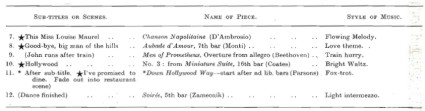
The film is projected in the cinema company’s private theatre and there I see the film with an assistant—and a stop watch. From the moment the first scene starts I am literally thinking in music. With a love scene I try to imagine just that type of sentimental melody that will exactly fit the picture, and move on in sympathy with it. A fight—then I endeavour to find an “agitato” of a tempo that will synchronise as near as possible with the speed and tensity of the film. Dramatic situations, storms, fires, sea scenes—all call for special treatment. As the film goes through, the “changes” are noted either by the sub-titles that precede them, or action on screen. In illustration of this I reproduce here a fragment of a typical “musical suggestions” sheet.
cuesheet_gramophone

The first column contains the cues, column 2 the music and composer, column 3 the style of the piece. Those cues marked with a (*) are the opening words of the sub-titles. Brackets indicate action on screen. Both types of cue indicate a change in the action or tempo. No. 9, for instance, shows a quick change from a quiet appealing melody to a pulsating allegro. It will be easily seen that a cinema orchestral leader must be on the alert the whole time. It might almost be said that he must work with one eye on the screen and the other on his music.

Many big photoplays call for a great number of “changes”—absolutely essential if the resultant entertainment is to be perfect. One of the most difficult films I have ever had to “fit” is Captain Blood, which is now showing throughout the country.

Mr. Rafael Sabatini’s story is so full of action and varying moods, and has been filmed with such faithfulness that no less than seventy changes are necessary, though this does. not mean seventy different selections. The chief “themes” in this story are (a) love; (b) dramatic; (e) sea battles and (ci) the “Captain Blood” theme itself. All these are there in various shades and emphasis.

As an introduction we start with the Captain Blood song, specially written as an overture or prologue. This is followed by Admirals All (Hubert Bath) and is used, in all, in eight different places.. For the love theme I have chosen The World is a Beautiful Song (Vane), and the principal seafighting scenes, Beethoven’s King Stephen overture from “presto,” varying this with various “incidental symphonies” specially written for film use.

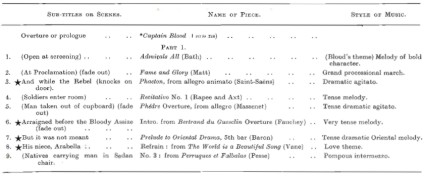
Here is an extract from the music which I have fitted to the comparatively quiet first reel of Captain Blood:
cuesheet_gramophone2

Compare this with the smashing character of the music towards the end, when the terrific battle of Port Royal, Jamaica, is introduced. Here you will notice indication of “effects”.

cuesheet_gramophone3

Naturally, many cinemas cannot, for various reasons, follow the “official” musical suggestions in their entirety, especially as it is only in cases of exceptional films like Captain Blood that the complete score, correctly numbered and marked, can be hired from the film company.

No orchestra library under the sun can hope to contain every composition that may be wanted; and no musical director knows off-hand the exact nature of every composition in existence. It is here that the gramophone is so useful. When he finds himself “stuck” for a suitable number the musical director can always turn to the gramophone for guidance as to the style and tempo of any selection, the title of which seems to indicate possibilities. Moreover, many cinema orchestral leaders, to my knowledge, gain valuable hints from the reviews of records and music published in THE GRAMOPHONE.

In conclusion, I would say that the modern super-cinema, with its often excellent orchestra, together with the great study given to the musical side of films by cinema companies, is having a marked effect upon the musical taste of the British public.

What with this and broadcasting—both tending to familiarise the “Man in the Street” with all that is best in music—it is not surprising that the gramophone firms are experiencing what can most aptly be termed “a record boom.”

And, briefly, an editorial from April 1929 casts an interesting light on payment for musical accompaniment in cinemas, in this case involving the future composer of many a British film score, Malcolm Sargent:

Dr. Malcolm Sargent, at the age of thirty-three, has just refused to play the cinema organ for half an hour every day at 12s. 9d. a minute. This shows a more genuine horror of the instrument than even I could have fancied possible in these days of hard struggling for economic existence. What puzzles me, however, even more than Dr. Sargent’s devotion to art is why it should be worth while for a West End cinema theatre to pay £7,000 a year to any man, whatever his acrobatic and musical ability, to play their organ three times daily throughout the year for ten minutes at a session. I really should very much like to know the name of the cinema theatre which was prepared to offer this price, and I think Dr. Sargent owes it to his professional brethren with lower ideals than himself to reveal the name…

And there’s much more to discover, including some fascinating material on the coming of sound, as the illustration of the De Forest Phonofilm system at the top of this post indicates. Just type in ‘cinema’ or ‘film’ as a keyword, and start browsing.
The compleat Muybridge

compleat

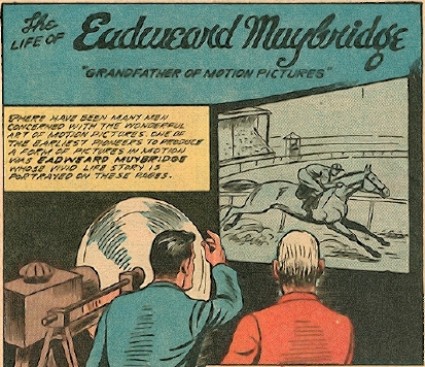
Some artistic licence employed for ‘The Life of Eadweard Muybridge “Grandfather of Motion Pictures”‘, Camera Comics No. 4, Spring 1945, from The Compleat Muybridge

The Bioscope has complained before now that the Web lacks a definitive resource for the ‘Father of the Movies’ Eadweard Muybridge. At last it looks like we have one. Over the past couple of years Stephen Herbert has been building up two essential Muybridge research tools – a blog (Muy Blog) and a detailed chronology. Gradually extra bits of essential information have been tacked on to these, and now he has brought the two resources together with a whole range of new information, and created – The Compleat Muybridge.

It’s a great title, and ideal for one such as Muybridge who appreciated the effect of a grand word. And though the author pleads that the title is ironic, since there never will be a complete life of the protean and often mysterious Mr Muybridge, there is more than enough here to satisfy the most demanding expert in the field of nineteenth century proto-motion photography.

muybridgestrip

Eadweard Muybridge, Sallie Gardner at a Gallop (1878)

There is, to begin with, a short biography with all the salient details. There is the chronology 1830-1904, available in both detailed (and annotated) and ‘lite’ versions. There is the blog (more a set of news alerts), with much valuable information on new discoveries, publications and events (note that the blog is in three parts: 2007, 2008 and 2009 now underway).

And then comes the new material. The Compleat Muybridge offers a comparative timeline of events in the life and work of Eadweard Muybridge, and his world, in photography, chronophotography and motion pictures, science and technology, and world events. The texts section provides transcriptions or scans of various original texts and articles from the author’s own or private collections, plus links to downloadable documents from the Internet Archive and the University of Pennsylvania Archives.

Kingston in a New Light, a projection project held over two nights in September 2008 using new film and Muybridge images shown on buildings in the centre of Muybridge’s home town of Kingston

The references section complements the chronology, but the citations come with illuminating personal comments on the key texts. And then there are animations of Muybridge photographic sequences (i.e. links to these on other resources) with links to YouTube videos which either animate Muybridge or which are inspired by him in one form or another, as in the Kingston video above.

Added to all that there is a bibliography (a work in progress), a colourful section on modern exhibitions of Muybridge’s work, links, and finally a section on the Zoopraxiscope, the machine by which Muybridge was able to project animated versions of his sequences in silhouette form, on glass discs. Happily there’s a search option to bind it all together.

It’s a fabulous resource already, but the author warns us to revisit regularly as new material is certain to be added (weekly, we’re promised). Muybridge scholarship is evolving all the time, and Herbert would argue that we still haven’t really understood Eadweard Muybridge as yet. His achievement has been so often obscured by an insistence that he should be seen as inventor of motion pictures(when he was working to other ends), and latterly that he was a pure artist, with none of the scientific rigour that he claimed for himself (which is to misunderstand what ‘science’ means). He has time and time again served as a reflection of the concerns of others, rather than being understood for what he achieved, or dreamed of achieving.

It is a complex story, but as Herbert points out, with Muybridge nothing is easy. Go explore.

The Researcher’s Guide to Screen Heritage

screenheritage

UK Screen Heritage Network

Today saw the launch at the British Library of the Researcher’s Guide to Screen Heritage. This is the the result of a project, led by the UK Screen Heritage Network, to map artefacts held in UK museums and archvies which relate to screen history. So this isn’t the films, or television programmes, but rather the costumes, sets, cameras, projectors, toys, documents, scripts, sheet music etc, and embracing a broader idea of screen history to inlcude magic lanterns, other kinds of slide presentation, digital media artefacts of today, and even art installations.

The resultant directory has been combined with an existing directory of moving image collections in the UK and Ireland, so that you can now search across the full range of moving image-related collections which are open to researchers. It a collection-level database, so you’ll find information on collections rather than individual titles; and it’s not everything, but it’s a strong start in attempting to map what what has generally lain scattered across the museums and seldom known about by film (or screen) historians.

So you are encouraged to explore for yourselves, but some of the gems from our area that you may learn about are:

  • the Black Country Living Museum in Dudley, which includes a complete 1920s cinema reconstructed and placed within the museum, plus a complete cinema percussionist’s kit used at the Picture House, Willenhall from 1923-27;
  • a collection of cinema slides dating from the First World War, consisting mainly of hand painted film publicity/advertising subjects, at the Clevedon Curzon Community Centre for the Arts;
  • the Barnes Collection of material relating to early film production in the South East, including Brighton and Hove pioneers George Albert Smith, James Williamson, William Friese-Greene, Esme Collings, Alfred Darling and Charles Urban, held by Hove Museum & Art Gallery;
  • early trade catalogues, oral history interviews on cinema-going and working in cinemas held by Beamish, The North of England Open Air Museum;
  • the collection of magic lantern slides used by the Congo Reform Association in their campaign to raise awareness about the abuses taking place under King Leopold II of Belgium’s regime in the Belgian Congo c.1880 to c.1909, held by Anti-Slavery International;
  • record of the Hepworth and Nettlefold studios at Elmbridge Museum.

As well as collections tucked away in unexpected corners, there are the leading museums in the field in the UK: the National Media Museum, Kingston Museum, the Cinema Museum, and the University of Exeter’s Bill Douglas Centre. The Researcher’s Guide to Screen Heritage is hosted by the British Universities Film & Video Council, and was developed for the UK Screen Heritage Network by the BUFVC, the National Media Museum and Screen Archive South East. Go explore.

Welcome to Screen Research

screenresearch

http://screenresearch.ning.com

Apologies, first of all, for somehat erratic service from the Bioscope of late. I have been waylaid by the most terrible cold, and can barely think straight, let alone type straight.

But in my lucid moments I have been at work on a new resource. Screen Research is a social network and information resource for anyone interested in moving image research. Where the Bioscope is a personal project which is devoted to early and silent cinema, Screen Research is intended to cover everything from pre-cinema to Internet TV.

It’s only been active for a very short while, but there is a blog, calendar of events, a directory (work-in-progress), loads of newsfeeds, and options for members to start up special interest groups or general discussions. It’s open to anyone who wants to sign up, though you can just browse what’s there. Its focus is activity in the UK, but it should have something for anyone. And, although it ranges far beyond silents, Buster Keaton in Sherlock Junior is the network’s icon.

Please do take a look, and sign up if interested: http://screenresearch.ning.com