Going to the show

bijou

Postcard of the Bijou, Wilmington, N.C., 1914, from Going to the Show

Though there are some who would deny it, cinema history involves the history of cinemas. The study of a medium that ignores the social form in which it has been consumed is a blinkered one, yet sadly so much of film studies exists in just such state of denial. Happily there has been a concerted effort by a dedicated band of academics in recent years to investigate cinema-going as an integral part of cinema history. Inspired in the first place by Douglas Gomery’s Shared Pleasures: A History of Movie in the United States (1992), the school uses socio-historial tools to analyse the experience of movie-going through patterns of audience types (age, gender, race, class), venue locations, social mobility, transportation links, purchasing power, leisure time and competing attractions. The significant output from such investigations has become the database which maps and documents particular territories. We’ve already had Cinema Context for the Netherlands and the London Project for the early film business in London. Now we have Going to the Show for North Carolina, 1896-1930.

This is a fabulous resource. It is going to make many other places wish that they had something much the same. Going to the Show “documents and illuminates the experience of movies and moviegoing in North Carolina from the introduction of projected motion pictures (1896) to the end of the silent film era (circa 1930)”. At its heart are 750 Sanborn Fire Insurance maps of forty-five towns and cities in North Carolina between 1896 and 1922 that locate film venues within general urban life. All of these are mapped to a database (a welcome feature for the specialist is that not only are all the database fields explained but the database relationship diagram is given) to which have been added photographs, postcards, newspaper clippings, architectural drawings, advertisements and more. It totals over 1,300 film venues across two hundred communities.
burlington

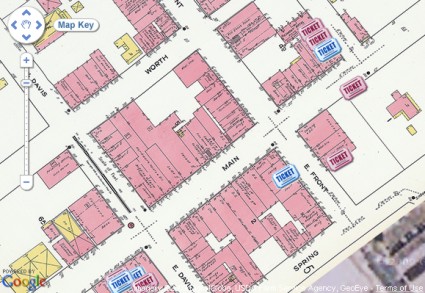
Film venues marked on Sanborn fire insurance map for Burlington, N.C.

As said, Going to the Show is based around fire insurance maps, and gives this explanation of their provenance and use:

From 1867 to 1977, the Sanborn® Map Company of Pelham, New York, produced large-scale (usually 50 feet to the inch) color maps of commercial and industrial districts of some 12,000 towns and cities in North America to assist fire insurance companies in setting rates and terms. Each set of maps represented each built structure in those districts, its use, dimensions, height, building material, and other relevant features (fire alarms, water mains and hydrants, for example). The intervals between new map editions for a given town or city in the early decades of the twentieth century varied according to the pace and scale of urban growth — from a few years to more than five years. In all, Sanborn® produced 50,000 editions comprising some 700,000 individual map pages. Because almost all early movie theaters were repurposed from an existing retail space located in the commercial heart of a town or city, they appear on thousands of Sanborn® map pages after 1906. Larger, purpose-built theaters were included in later Sanborn® maps.

Going to the Show takes these precise records of film venues and marries them to Google Maps, with all the familiar tools of zoom-in, zoom-out, scan across and marking of venues with hyperlinks to further information. But it is the range of extra information that makes Going to the Show so powerful. Map searches can be refined by year, venues and period in which the venue was active, while you can select whether to view modern or historical map with an opacity slider, and bring in current street names. Each venue is marked with a Ticket icon, which links you to additional information.

dixie

New Bern, N.C. shown through modern Google map and Sanborn fire insurance map, pinpointng the Dixie Theatre 1913-1918 catering for African American audiences only

A major aspect of the research has been the racial division of film venues. Keen to demonstrate how race conditioned the experience of movie-going for all North Carolinians – white, African American and American Indian – the resource extends beyond the silent era to document every known African American film venue in North Carolina operational between 1908 and 1963.

What distinguishes Going to the Show is its attention to database searching and presentation. The faceted browse option shows how you can refine searches by item type (Architectural Drawing, City Directory, Commentary, Illustration, Newspaper, Organization, Overlay Map, Periodical, Person, Photograph, Postcard, Typescript, Venue),
location (by City, County or Region), venue name, date (allowing for searching by decade), and keyword or tag (including such useful terms as admission price, boxing films, children, fire, influenza, penny arcade, racial policy, religious objection and separate entrance). The tag ‘notable’ leads you to some of the choice items, such as this 1897 press notice saying that owing to the popularity of the Edison Projectoscope at the Wilmington Opera House that the dress circle will be reserved for “colored citizens”:

projectoscope

Wilmington Star, 20 March 1897

And there’s more. Robert C. Allen, James Logan Godfrey Distinguished Professor of American Studies, History, and Communications Studies at the University of North Carolina at Chapel Hill, and the presiding genius behind Going to the Show, has produced an eye-catching timeline for Wilmington, N.C., chronicling and commenting upon twenty-six venues from 1897 to the end of racial segregation in 1954. Business papers from this period are a rarity, and another very welcome feature is the Joyland Theatre Ledger, the manager’s ledger from 28 September 1910, to 14 January 1911, including expenses and ticket receipts.

searle

Going to the Show is handsomely and sensibly presented. It merits detailed study. It has been produced as one of a number of University of North Carolina digital resources under the title Documenting the South. It ought to be the springboard for much further research, not simply within film/cinema studies, but as part of that general social history of which film history needs to be a part. This is the point – that so much of film history speaks only to those who know about film. It constricts itself to a narrow field by not speaking the language that is natural to other disciplines. I’ve mentioned at a couple of conferences what for me is the shocking case of G.R. Searle’s A New England? Peace and War 1886-1918 (2005), part of the New Oxford History of England. This 951-page magisterial history builds on new research in the areas of social, cultural, ecnomic and political history, yet among all those 951 pages just one throwaway paragraph is devoted to cinema. The bibliographic essay notes the extensive work done in music hall and sport history, but has nothing on cinema at all. Film historians – and in this case particularly British film historians – simply aren’t writing in a language than anyone else recognises, or cares about. The situation is better in America, as the work of Gomery, Allen, Garth Jowett and others indicates, but much much more remains to be done. Moreover, such moviegoing studies as there are often tend to get subsumed within concerns about spectatorship – handy enough in itself, but still making the audience subservient to the film. For discussion on this issues, read Richard Maltby’s essay for Screening the Past, ‘How Can Cinema History Matter More?‘, the title of which rather sums it up. To read about some of the other projects worldwide which are investigating cinema-going, see the HOMER website (History of Moviegoing, Exhibition, and Reception).

To understand the phenomenon of film, of course we need to appreciate it as an art form, but we must ask those basic questions how, where and when motion pictures were consumed, and to see their world as integral to a wider social world. Datasets and databases don’t answer everything by themselves, but they provide the foundations for thinking about the right answers. Going to the Show points the way.

Note

Robert C. Allen would welcome any feedback from Bioscope readers. You can email him at rallen [at] email.unc.edu.

The Italian scene

al_cinema

Francesca Bertini and Mario Parpagnoli in L’ultimo Sogno, from Al Cinema, January 1923

From Brazil to Italy. Our second non-English language online resource with digitised silent film era journals is Teca Digitale piemontese. This is a collection of digitised resources from Italian libraries and archives. To find the film journals, select ‘Selezionare la tipologia del materiale che si intende consultare’ from the top menu, and ‘Museo Nazionle del Cinema’ from the second menu. Click on ‘Ricerca per Ente’. You will get this list of digitised journals:

  • Bollettino di informazioni cinematografiche – 1924-1925
  • Bollettino edizioni Pittaluga – 1928-1929
  • Bollettino staffetta dell’ufficio stampa della anonima pittaluga – 1929-1931
  • Cine Mondo: rivista quindicinale illustrata de cinema – 1927-1931
  • Al cinema: settimanale di cinematografia e varietà – 1922-1930
  • Eco film: periodico quindicinale cinematografico – 1913
  • Figure mute: rivista cinematografica – 1919
  • Films Pittaluga: rivista di notizie cinematografiche: pubblicazione quindicinale – 1923-1925
  • Il Maggese cinematografico: periodico quindicinale – 1913-1915
  • Rassegna delle programmazioni – 1925-1926

There are two icons beside each title. Clicking on that on the far left gives information on the publication. The adjacent icon leads to a list of years for that journal, then click on the blue circle to find the issues within that year (this part of the site requires Java to be installed). Double-clicking on a title opens up the full issue with a menu of pages. There is a suite of tools to resize, rotate or otherwise interrogate the individual pages. There is also a word-search facility, though I had limited success finding things that way (no results for the search term ‘maciste’? Surely not).

The journals are all, of course, in Italian. Content-wise the bias seems to be strongly towards Italian production, though there is plenty of coverage of American production. Photographs are thin on the ground, though do check out Figure mute: rivista cinematografica for a succession of striking colour advertisements. As a range of written resources for the study of silent film on one site, this may well have no equal, even if it’s a bit of a business drilling down to any one page. As indicated, all the journals come from the collection of the Museo Nazionale del Cinema in Turin.

My thanks once again to Teresa Antolin for alerting me to this site. Any other non-English silent film journal sites out there (or English ones for that matter)? Do let me know.

The Brazilian scene

a_scena_muda

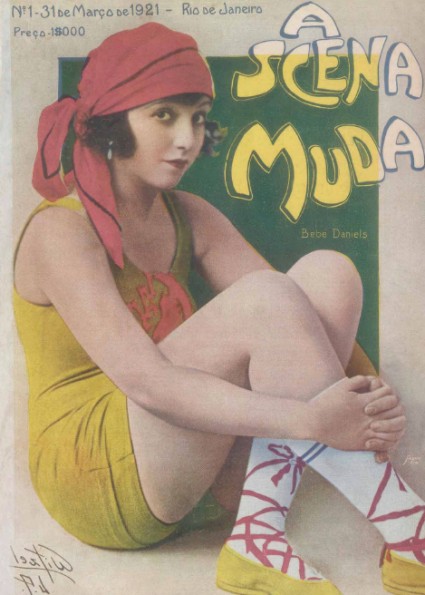
Bebe Daniels on the front cover of A Scena Muda, 1921 no. 1

It is frustrating for the silent film researcher that, while there are some excellent online resources which provide with extensive acess to digitised newspaper collections, there are all too few film journals from our period that have digitised. Specialist resources are always going to be that much more difficult to finance. But look beyond the English language, and there are treasures to be found. In the first of two posts covering non-English digitised collections, let me introduce you to Brazil’s Biblioteca Digital das Artes do Espetaculo. This site makes available the runs of two Brazilian film journals, A Scena Muda (1921-1955) and Cinearte (1926-1942), digitised by the Biblioteca Jenny Klabin Segall. While it’s certainly going to help if you know Portuguese, the colour front covers (mostly of Hollywood stars) are a design delight all by themselves. Within you will find news, reviews, photographs, gossip, advertisements, and regular features on the Brazilian feature film.

cinearte

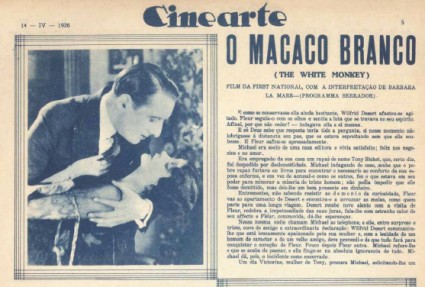
A page from Cinearte, 1926 no. 7

The sites are easy to navigate. From the front page, click on As Revistas. You will then be presented with three drop-down boxes, from which you can choose which of the two journals you want to see, then select whether you want to browse by year or number, and then select from the range offered. Searching by year you get a row of thumbnails of the front covers. The documents themselves are in PDF format, of good quality, though they don’t appear to be word-searchable. However, there is an advanced search option, to be found under Pesquisa, where you can search across both journals for individual words (handy for name searches, for example). So well worth browsing even if Portuguese is one of those languages you’ve never quite grasped fully, and for judging the balance between Hollywood and the native industry in the Brazilian mind.

My thanks to Teresa Antolin for bringing this to my attention. Part two tomorrow.

Update (August 2011): The link for the site has now changed to http://www.bjksdigital.museusegall.org.br/busca_revistas.html

Filmographie Pathé

fondation

A while ago we reported on the marvellous Fondation Jérôme Seydoux Pathé site which documents the rich heritage of the Pathé film company. At that time it was noted that a Pathé filmography was not on the site, but was promised. Well, it’s there now.

Based on a number of sources, most notably the seven-volume Pathé filmography produced by Henri Bousquet, the filmography – which is a work-in-progress – will eventually document the entire Pathé output from 1896 to the present day. The available information comes chiefly from original Pathé catalogues and trade paper reviews, and varies from title to title. So some records are little more than a title, while others have detailed descriptions. The catalogue is arranged by year, and so far records have been entered up to 1913. From 1907 the years are broken down further into months. Each year/month brings up a list of titles, and clicking on each one brings up the catalogue record. This for example is the record for a famous Pathé title of 1908, Le cheval emballé (The Runaway Horse):

Cheval emballé (Le)
Numéro du film: 2027
Code tél.: Délire
Métrage: 135 m
Genre: scène comique

Réalisateur: Louis Gasnier
Scénario: André Heuzé

Résumé:
Un livreur et sa charrette s’arrêtent devant un marchand de graines. Pendant que le livreur monte dans les étages pour déposer du linge chez un client, le cheval mange un sac d’avoine. Le livreur s’en aperçoit et, grimpant dans sa voiture, s’enfuit. Le grainetier leur court après. Après maintes péripéties, poursuivi par une foule sans cesse ac­crue, le cheval rentre à l’écurie. Son propriétaire disperse les poursuivants en les arrosant copieusement.

Note de fin:
Sortie: Le Cirque d’Hiver, Paris, du 3 au 9.1.1908 Dans son numéro 69 du 1.2.1908 Phono-Ciné-Gazette sous la rubrique “ Le danger au Cinématographe” contait que… le collaborateur qui dirigeait la voiture a risqué sa vie car le véhicule a fait un panache auquel on ne s’at­tendait pas au moment où elle arrive en plein marché! Et dans The Moving Picture World du 9.4.1910 l’annonce de l’arrivée de Louis J. Gasnier à la direction du studio Pathé de Bound Brook était suivie d’une anecdote concernant le tournage du Cheval emballé  : Mr Gasnier is a man of great resource and has had many trilling adventures in the production of films. One notable instance of this was during the photographing of the almost classic film The Runaway Horse much comment was heard as to how it was possible to secure a horse with such intelligence as this one seemed to have. The secret of the matter lay in the fact that underneath the body of the wagon which was a two-wheeled vehicle, there was attached a coffin with the end knocked out. This was chosen because of its interior padding. In this, Mr. Gasnier took his position, face downward, and dressed entirely in black, with black gloves and a mask similar to those used on the days of the Inquisition, over his face, and from here he drove the spirited cavalry horse by means of two steel wires of the ends of which were fastened sticks for him to bold in his hands. The shafts of the wagon were fastened to the body by steels bands but in spite of this arrangement Mr. Gasnier was nearly killed. Just after the scene which shows the wagon knocking down the scaffold, the steel bands broke and Mr. Gasnier, as the wagon pitched forward and turned a complete somersault, was so badly injured that he was unconscious for more than half an hour and spent fifteen days in the hospital. The horse, at the time of this accident, was really running away, and having rid himself of the cart, dashed ahead, and finally ran into the river. Mr. Gasnier’s nerve is shown by the fact that after his release from the hospital he got back into the repaired vehicle and finished the picture.

Date de la publication électronique: 13 October 2008

So the catalogue is in French, but with smatterings of English where English or American trade paper sources are quoted. Not all records are so detailed, but here you get title, catalogue number, telegraphic code (used for ordering titles), length, category, credits, synopsis and notes.

The Pathé catalogues were divided up into categories or genres, and you can use the online filmography by such original terms as ballet pantomime, comédie, comédie dramatique, comédie policière, drame historique, scène biblique, scène d’acrobaties, scène d’actualité, scène d’industrie, scène de féerie, scène de mythologie, scène de plein air, scène de sport, scène de vulgarisation scientifique, scène grivoise, scène historique, scène militaire and vue panoramique. You can also browse by title and by credit, which includes authors of adapted works (Balzac, Tolstoy, Shakespeare, Zola etc) as well as directors, scriptwriters and performers.

This is a huge boon for early cinema researchers. It is worth noting that the intention is the document the entirety of the Pathé output (exlcusing newsreels and the like), so there are the films issued by the company’s Italian (Film d’Arte Italiana), Russian (Film d’Art Russe) and British (Britannia Films) offshoots, as well as Pathé’s own French variants such as Société cinématographique des auteurs et gens de lettres (SCAGL). And don’t forget to explore the rest of the Fondation’s site, in particular its extensive and illustrated database.

From the regions

scrapofpaper

The over-the-top sequence from A Scrap of Paper, from http://www.yfaonline.com

If most people think of film archives, then they think of the national collections such as the BFI National Archive, Cinémathèque Française, Library of Congress etc, or else broadcasters such as the BBC. What few consider, even within the film business, is the next tier down of collection, the regional film archives which represent a particular and special part of a country’s moving image heritage. In the UK we are fortunate in having a vibrant regional film archive network, operating (with measly funding) within the public sector, each representing one or other of the English political regions. So there is the East Anglian Film Archive, the Northern Region Film and Television Archive, the South West Film and Television Archive, the North West Film Archive, and so on. What is also seldom appreciated is that these archives generally have unique silent film holdings.

One of these archives, the Yorkshire Film Archive, is the immediate reason for this post, because it has just launched Yorkshire Film Archive Online, a really first-rate showcase of regional film. There are documentaries, amateur films, industrials, newsreels, advertising films, educational films, and dramas, all devoted to the Yorkshire region, all freely available and contained within an expertly designed site brim for of background information, all the search options you could wish for, options to add comments, and a really fine selection of films. This includes a number of silents (aside from those amateur films of later decades which were shot silent). The earliest shows Queen Victoria visiting Sheffield in 1897, the truly heroic Egg Harvest – Cliff Climbing at Flamborough (1908), the joyous local celebration that is Easter at Shipley Glen (1912) and a touching and surprisingly downbeat A Scrap of Paper, made in Hull to support those who had lost loved ones during the War,or who had been disabled. The film shows a father writing his last letter home, before he goes over the top and is seen lying dead in no-man’s land in the film’s final shot. (The site dates the film as 1914-18 but the tone of the titles suggest it was made just after the war).

Yorkshire Film Archive Online demonstrates what a dynamic film culture existed from the earliest years outside London. It is a model resource, but the YFA is not the only English regional archive with silent film on show. The Media Archive for Central England, based in Leicester, lists sixty-three titles between 1899 and 1930 in its catalogue, starting with an Anglo-Boer War recreation, and continuing with a rich variety of mostly local newsreels, some with online clips, such as The Meet of the Quorn Hounds, at Kirby Gate (1912) and Leicester Poor Boys’ and Girls’ Summer Camp at Mablethorpe (c.1920).

littledorrit

Joan Morgan and Langhorn Burton in Little Dorrit (1920), from http://sasesearch.brighton.ac.uk

Screen Archive South East, based in Brighton, is strongly aware of the part its region played in the early years of filmmaking in Britain. Its Screen Search catalogue describes over 900 films, many of them viewable online, and several from the silent era. under the theme ‘Early film in the South East‘ you can find Speer Films’ dynamic bank robbery thriller, The Motor Bandits (1912), a clip from the twenty minutes that survive of the Progress Film Company of Shoreham’s Little Dorrit (1920), starring the late Joan Morgan, and the illustrator and occasional filmmaker Harry Furniss in Winchelsea and its Surroundings. A Day with Harry Furniss and his Sketchbook (c.1920).

Screen Search also has travel films, home movies, documentaries, newsreels and productions by local cine-clubs. Look out too for films made in the 1930s by the twins John and William Barnes, the former of whom went on to become the author of the five-volume The Beginnings of the Cinema in England series of film histories.

The Wessex Film and Sound Archive, a partner archive to Screen Archive South East, cover the middle southern region of England. It has an online catalogue and a few sample clips, notably a 1905 example from Portsmouth filmmaker Alfred West‘s famous patriotic programme, Our Navy.

matinee

Children’s Matinee, showing children outside the Vaudeville cinema in Colchester, 3 October 1914, part of the East Anglian Film Archive collection, from http://www.movinghistory.ac.uk

There is more to be seen and learned about the regional archives on the Moving History site, which is a guide to the national and regional public sector film archives of the UK, and has a wide selection of sample clips, arranged by theme and by archive. Films from the English regional archives can also be found as part of the BBC’s Nation on Film website. There is a lot more to these archives than silents, of course, and the majority of clips to be found on their sites will be of later periods, particularly from when the home movie boom took off in the 1930s.

Finally, if you want to learn more about the operations and ethos of the RFAs, visit the Film Archive Forum site, the body that represents the interests of the UK’s public sector moving image archives (see its map of the UK’s archives here). Film is so much more than many think it is – beyond the entertainment cinema there is a whole culture of films made locally, for reasons both personal and professional, which document twentieth century lives in uniquely resonant form. What the films sometimes lack in polish they gain in their powerful connection to the people, for in seeing them we see ourselves. Do explore.

Digital 19th Century Britain

newsbycine

Headline from Penny Illustrated Newspaper, Saturday, 8 July 1911, from http://newspapers.bl.uk/blcs

There has been much fuss this week about the Digital Britain report, a blueprint for the country’s broadband future in which services, entertainment, knowledge and the health of the economy to come are pinned to the hope that everyone will be linked up to a frankly measly 2Mbps connection by 2012. The report has come in for much criticism, chiefly because it poses more questions than answers, but it does also cover important areas such a digital literacy (so everyone is able to navigate their way through this new world and enjoy a common level of benefits) and points out innovative models which have made digitised collections available to all.

A model example, highlighted in the report, is the British Library’s 1800-1900 Newspapers project. I must admit to a vested interest here, as the BL helps pay the rent that keeps up the tottering edifice that is Bioscope Towers. But by any measure this is a marvellous resource, exceptional in its content and presentation, but also a model of how a major digitised collection can be created that brings benefit to all.

Digitisation costs money. We know that are billions of pages in the world’s libraries, we know we’d like to have them all at our fingertips, and we know we’d rather not pay for it. The BL’s newspaper collection represents some 750 million pages. The new resource present 2 million of these. The money has come from a UK educational body which funds resources for higher education, the Joint Information Systems Committee, and a commercial partner, Gale Cengage. The JISC paid for the digitised newspapers to be made available for free to UK universities, while the public had to visit the British Library physical site to see the resource.

nineteenth

That was the case for the past year or so, but from today the commercial side of the deal kicks in. Gale Cengage co-funded the project on the understanding that it could make the newspaper resource available to the online public, under a subscription model. You can buy a 24-hour pass for £6.99 which allows you to view up to 100 articles, or you can buy a seven-day pass with 200 article views for £9.99. There is plenty, however, that is available for free – two newspapers, The Graphic and Penny Illustrated Paper, are free (the search page has a tick box where you can search for free content only), you can search and browse the database, see thumbnails of any article, and even call up a window which shows your chosen term in context – as in the example above, which gives us the heartening information that Trewman’s Exeter Flying Post or Plymouth and Cornish Advertiser was able to tell its audience about the Edison Kinetoscope on 10 March 1894. There are also a number of freely available PDF examples tied to some excellent background histories.

The sheer range of newspapers is eye-opening, including such titles (just to start from the top) as the Aberdeen Journal, Baner Cymru, Belfast News-Letter, Birmingham Daily Post and Brighton Patriot (along with forty-four others). The major papers that carried on into the 20th and 21st centuries, such as The Times and The Guardian are not there, both because they are ongoing businesses and because they have developed their own commercial digital archives. And although the title says 1800-1900, the actual range is 1800-1913 – ideal for early cinema studies.

So, using our regular search term of ‘kinetoscope’, there are 433 hits overall, and five available for free. So there is a huge amount you can discover about the spread nationally of the first motion picture film device, even if some of those articles will not lead you to Edison’s invention but rather to a not very successful racehorse given that name (an early example of product sponsorship or simply the whim of a technologically-savvy owner? Someone should be researching this). ‘Cinematograph’ yields 1990 hits, sixty-one of them free. You can either view the article, the full page, or browse that issue. One other handy feature – each thumbnail says whether what you have looked for comes under News, Arts & Entertainment, Advertising, Business News or People, depending on the section from which it comes.

The model of a commercial body paying for the digitisation of out-of-copyright material like this, making it available to all through (relatively) low-cost subscription, while the host library gets its collection digitised and can make the results freely available onsite, is hopefully one that may lead to still greater access to newspaper content from this era. 2 million pages done; just 748 million left to do. While you’re waiting, go explore.

Medical matters

capillaries

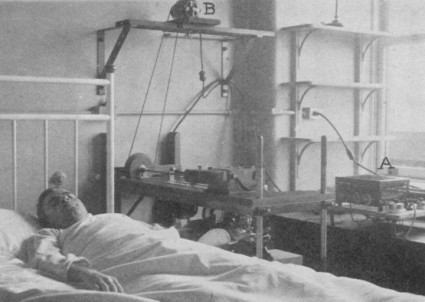
Fig 1: Photograph of the apparatus for cinematographic photomicrography of the capillaries of the nail fold in human subjects. A = an adjustable resistance; B = a motor, operated by a foot switch. From J. Hamilton Crawford and Heinz Rosenberger,’An Apparatus for Studies of Human Capillaries’, Journal of Clinical Investigation, 26 April 1926

Here at the Bioscope we like to keep an eye on online resources for the study of silent cinema, in particular digitised journals and newspapers. Few such resources exist online which are dedicated solely towards silent film, but there are plenty of a general or of a specialism other than film which contain material of great value to us. Plenty has been written here about newspapers, which you would expect to have worthwhile material, but our subject now is something a little more off the beaten track – medical journals.

It could be argued – in fact it has been argued – that it was scientific and medical investigation that brought about the invention of cinema. Chronophotographers in the 1880s and 90s, such as Etienne-Jules Marey, Georges Demeny, Ernst Kohlrausch and Albert Londe, used the emerging technology of motion picture film to record and analyse movement (chiefly human movement), generally with a medical or therapeutic aim in view. When motion pictures properly appeared on the scene, although they flourished as an entertainment, there were a number of medical investigators who took advantage of the new technology, such as Eugène-Louis Doyen (who filmed his operations in the late 1890s/early1900s) and Jean Comandon, who used microcinematographic film in completing his 1909 doctoral thesis De l’usage clinique de l’ultra-microscope en particulier pour la recherche et l’étude des spirochètes, and who went on to make films for Pathé. Other early explorers with a camera on the science/medicine border included Lucien Bull, Pierre Noguès, Gheorge Marinescu, Alejandro Posadas, Osvaldo Polimanti and Joachim-Léon Carvallo.

capillaries2

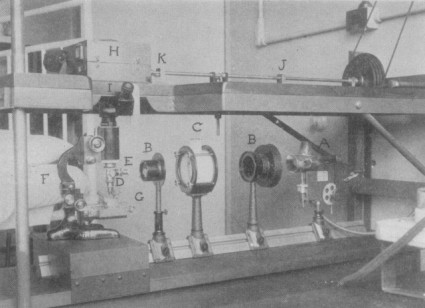
Fig. 2: Photograph showing details of the apparatus for cinematography of the capillaries. A = arc lamp; B = condensing system; C = heat filter; D = system for direct illumination; E = polarizer; F = microscope; G = stand for finger; H = camera; I = observation side piece; J = shaft; K = clutch

So it may not come as a surprise to find the cinematograph included among medical papers of the period, though the extent to which it is, and the number of people engaged in using motion pictures for medical investigation throughout the silent period, is nevertheless remarkable. Evidence of this can be found in digitised medical journals of the period, of which the major source is PubMed Central, the U.S. National Institutes of Health free digital archive of biomedical and life sciences journal literature. PMC is a digital library for a worldwide scientific and biomedical community, dedicated to the preservation and free access. It began operating in 2000, and in 2007 a UK offshoot, UK PubMed Central was launched. What is of interest to us is that its archive includes many runs of historical journals, covering (for our purposes) the 1890s to the 1920s, among them the British Medical Journal, The Journal of Medical Research, The Proceedings of the Royal Society of Medicine etc.

And there is plenty to discover. Just type in ‘cinematograph’ or ‘kinematograph’ (the most productive terms) and you will uncover a world of pioneering investigation. There is a 1918 article ‘Cinematograph Demonstration of War Neuroses’, on the renowned film of shell shock victims at Netley (previously covered by the Bioscope here), ‘The Rôle of the Cinematograph in the Teaching of Obstetrics’ (1920), ‘Kinematograph Film illustrating Anastomosis of Facial Nerve in Cases of Facial Palsy’ (1925), ‘The Cinematograph in Medical Education’ (1928) and ‘Cinematograph Demonstration of Methods of Bone-grafting’ (116). There is a number of pieces on the question whether going to the cinema was bad for your eyesight. There are references to key investigators such as Marey, Comandon, Marinescu and Doyen. And there are incidental references that intrigue, such as the British Medical Journal noting with some interest its receipt of a booklet on Kinemacolor (“With the motion of the picture and the natural colour representation, together with a certain amount of stereoscopic relief, all rolled into one, it is difficult to see what further conquests in this direction realism has to make”).

capillaries3

Fig. 3: Print of part of a cinematographic film taken by the method described

All of the documents are available in word-searchable PDF format, immaculately ordered and referenced, as one would expect. One can also find articles and reviews from more recent times that cover our area. Of course, the number of film enthusiasts keen to read a paper entiteld ‘An Apparatus for Motion Photography of the Growth of Bacteria’ is likely to be outnumbered to some considerable degree by those who would rather seek their entertainment elsewhere. But for those of an enquiring mind, PMC is an absolute treasure trove for anyone keen to explore how the motion picture developed in its earliest years as a tool of discovery, and gives evidence that the medical community was, from the outset, welcoming of the new medium where it could advance understanding.

There are other such medical journal databases. The British Medical Journal has puts its whole archive online, searchable by year or by subject terms. It appears that the content is the same as that to be found on PMC, but one should never assume. Next, there is the archive of historical nursing journals made available by the Royal College of Nursing. This does have material which is not on PMC, and the terms ‘cinematograph’, ‘kinematograph’ and even ‘kinetoscope’ all yield interesting results. Here, for example, is an account from The British Journal of Nursing, 15 November 1919, on a screening of the film The End of the Road:

By the courteous invitation of the National Council for Combating Venereal Diseases (London and Home Counties Branch), we attended a private exhibition of an Educational Cinematograph Production. bearing the above title. This powerful film is authorised by the Council, and produced With the approval of the Ministry of Health at the Alhambra Theatre, It is scarcely necessary to state that the splendid endeavours of the N.C.C.V.D. are bearing abundant fruit. Only a few years ago the production of a play handling social and sex questions with such frankness would not have been possible on our English stage. To-day a mixed audience watches it with the reverent silence of a Church congregation, a proof that the senseless prudery which has been so largely responsible in the past for an enormous amount of preventable disease, misery and degradation is breaking down, and giving place to a more sane, enlightened, and wholesome attitude of mind.

In the case of both the BMJ archive and that of the RCN, the article are available for free, as word-searchable and downloadable PDFs.

The history of early medical film can be traced in Virgilio Tosi’s Cinema Before Cinema: The Origins of Scientific Cinematography (first published in Italian 1984 and in English in 2005) which is accompanied by a DVD, The Origins of Scientific Cinematography, which demonstrates the work of chronophotographers, ethnographers, scientists and doctors who used film at the turn of the last century. The DVD contains some beautiful and occasionally eye-popping images (my favourite is a German doctor, Ernst von Bergmann, from 1903, who swiftly amputates a leg and then makes a bow to the camera).

Other studies around this area include Marta Braun, Picturing Time: Work of Etienne-Jules Marey (1830-1904) (one of the most beautiful books I know, as well as brimming over with intelligence) and Lisa Cartwright, Screening the Body: Tracing Medicine’s Visual Culture, a thought-provoking study of the meaning and intentions of the medical film, boldly arguing for its alliance with the avant garde and popular culture. Not published yet, but allied to Cartwright’s preoccupations, will be Hannah Landecker’s book which has the working title Cellular Features: A History of Biological Film in Science and Culture, information on which can be found here. As Landecker notes, while many medical films were shown only to specialists, or were used for instructional purposes, others made it into the popular cinema – notably the films of Jean Comandon.

One of the interesting things is that people didn’t draw the line between science and entertainment … It was all seen as film — something new. People were really excited that they could see something they’d never seen before — films of far-away places and of small things inside the body.

Has that line been drawn since? Dr Doyen’s 1902 film of the separation of Siamese twins ended up being shown on fairgrounds (and can be found on YouTube, if you know where to look), and only last month Channel 4 gave us The Operation: Surgery Live. Medical film is popular film, because we are drawn to watch it. It is certainly a part of film history that it would be wrong to ignore.

Lobster catalogue online

lobster

http://www.lobsterfilms.com

For some while now we have all admired hugely the work of Lobster Films of Paris in discovering and restoring early films, many of them fascinatingly obscure and bizarre. But what exactly have they got? There have festival screenings, some DVD releases, and selected examples available on the Europa Film Treasures site, but in the absence of an available catalogue all we could do was speculate, and dream.

Well, we dream no more, because Lobster has published its full catalogue online. The catalogue covers over sixty years of cinema, from the 1890s to the 1960s, with its great speciality being early cinema. The main page describes those areas where the collection is strongest – early film, slapstick, jazz, cartoons, features, documentaries, erotic films, and detective stories. Click on ‘search’, and that takes you to a simple search page, where you can search from terms across either title or within a summary.

To the top right of the page, however, are two further search options, alphabetical or multicriteria. This is where the real discovery can take place. The alphabetical search is the browse option, so you may find the full range of titles per letter of the alphabet – 132 results under A, 180 results under B, 196 results under C, and so on. Clicking on any record gives you full descriptive details (variable across the collection, and a number have no plot description, so searches across summary are therefore going to produce erratic results). Several have a frame still illustration.

The multicriteria search option enables to specify search by title, director, actor, music, year, summary, category, keyword, sound, country, colour, version and format. So, very quickly, you may discover that Lobster has 173 films made by Georges Méliès, 16 titles featuring Douglas Fairbanks, and 20 titles from the year 1909. However, beware of uneven categorisation – I put in ‘France’ as country and ‘silent’ as sound type, and came up with only 138 titles, which is clearly wrong. Other instances of incomplete or inconsistent categorisation mean that the better option is to use the simple or alphabetical search options. Minor quibbles aside, this is a privileged glimpse into Aladdin’s cave. Go explore.

Discovering Australia (and beyond)

sbds

http://sbdsproto.nla.gov.au

There are some key developments underway in information services and how libraries – and in particular national libraries – deliver to their public in an online digital future. Firstly, catalogues and content are coming together, so that when you search for a title a book, film, journal, object or whatever, the item itself – in digital form – turns up and not just a record describing it. The Fondation Jérôme Seydoux Pathé is a good example of a catalogue on a film subject some of whose records include digitised resources (images).

Secondly, there is the promise of the purely digital library. Examples of these exist in the academic and commercial sectors, where a target audience expects immediate access to tailored content, while Project Gutenberg and the Internet Archive have pioneered the notion of general access to a wide range of digital artefacts in the public domain. The Bibliothèque nationale de France’s Gallica is an example of a national collection’s digital initiative, and internationally UNESCO recently launched the World Digital Library. A significant new step is the Korea’s National Digital Library, which will acquire, hold and deliver purely digital content.

Third, and the subject of this post, is the integration of these elements with content beyond that held by any one institution. In a purely digital and online environment, users are going to be less and less concerned about what any one library, archive or other information organisation has on its shelves, except as a hallmark of quality, and far more interested in finding all that they want in one place. Union catalogues exist which perform this function (for example, Worldcat, or Copac for UK university libraries), but add the content as well and it is not about attracting users to your doors but about delivering the content to wherever those users may be – at home, on the road, at your library, at another library.

This represents a fundamental shift in how knowledge is managed and how major institutions with national responsibility for preserving, describing and making accessible content do so in an environment where they are not necessarily the portal through which the user discovers and makes use of such content.

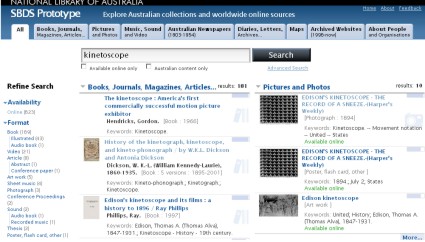
What do I mean by this? Well, the example to consider is the recently-launched ‘discovery service’ from the National Library of Australia, the SBDS Prototype. It’s unclear what SBDS stands for, but in practice the model is a simple one. It enables you to search across a number of collections, in Australia and beyond it, across books, journals, pictures, photographs, films, music, sound, newspapers, manuscripts, maps and archived websites. At its heart are several services provied by the NLA, including Australian Newspapers, the Pandora web archive and Picture Australia, but there are also general Australian services such as Australian Research Online, and world resources such as OAIster (a union catalogue of digital resources), Hathi Trust (digital books in the public domain), the Library of Congress, the Internet Archive and Wikipedia.

This isn’t a tool for discovering everything about everything. It is “focussed on Australia, Australians, and items found in Australian collecting institutions”. Also it is a work in progress and some elements are not yet functioning, such as Advanced Search. Nor does every record comes with the content in digital form, but it tells you where the content is available online and allows to to restrict searches to online content. So, if we narrow things down to silent cinema, and use our habitual search term for testing out new resource, what do we get when typing in ‘kinetoscope’? These are the results by format:

* Book (169)
o Illustrated (43)
o Audio book (1)
* Video (21)
* Article (8)
o Abstract (1)
o Conference paper (1)
* Art work (5)
* Sheet music (4)
* Photograph (3)
* Conference Proceedings (2)
* Sound (2)
o Audio book (1)
o Recorded music (1)
* Thesis (2)
* Poster, flash card, other (1)

And this is how it looks:

sbdssearch

I have to admit to some confusion here, as the number of search results (761) does not match the number of formats supposedly represented (chiefly, it seems, because formats does not include archived webpages, of which ‘kinetoscope’ brings up 462, mostly from Russell Naughton’s Adventures in Cybersound site). But, fine detail aside, the results are plentiful, and can be narrowed down to content available online, or by decade, keyword, author/contributor, language, or from solely Australian sources. Click on any one record, and you are taken to a full catalogue record, which indicates from which participating resource the information came, and a second click takes you to that site directly (click on ‘available online’ and it takes you to the external site directly), though be warned that not everything that is described as being online turns out to be the artefact itself. There is a great deal to be found beyond material of purely Australian interest. Very quickly I found production photographs from Greed at the Online Archive of California, a 1915 song sheet ‘Those Chaplin Feet‘ from John Hopkins University’s JScholarship, and a 2006 lecture on video by Hal S. Barron, ‘Screening the rural: the American countryside in silent film‘, from Claremont Colleges Digital Library.

It’s all a bit bewildering, as well as exciting. It’s a portal designed for Australian interests, but the implications are huge, once all national institutions start to go down this route – and once supra-national resources start opening up valued resources to researchers. Where will ownership then lie? Will anyone care? How will standards be maintained? What competing systems will there be? Who will visit a research library again, except when they fancy a nice day out? Interesting times lie ahead.

The Stage

thestage

New (at least to me) among the digitised historical journals now available online by subscription is The Stage. This is well worth taking note of. The Stage Directory (A London and Provincial Theatrical Advertiser) was founded in February 1880 as a monthly newspaper, and continues (as a weekly) to this day. Its entire archive 1880-2007 has been digitised and put online, covering over 6,500 issues or above 170,000 individual pages reporting on the goings on of the British stage and beyond.

The importance for us is that The Stage has always kept an eye on the motion picture business, and for the silent era it was assiduous in recording the activities of this new strand of showbusiness. A series of articles from 1907 entitled “Cinematograph Notes” records new businesses, film releases, licensing issues and so forth, “Latest Films” is very handy in giving titles of new releases, and another series “Film Facts & Fancies” starting in 1919, written by ‘Figaro’, reports on the cinema world with a knowing eye.

The Stage documented the engagements of actors, and one can trace their travels across the British provincial theatres, seeing also where the variety shows were starting to introduce the cinematograph. Here one can spot names that were later to be famous: in a notice from 30 July 1903 of a performance of Sherlock Holmes at the London Pavilion, the writer notes:

A faithful portrait of Billy is given by Master Charles Chaplin, who shows considerable ability, and bids fair to develop into a clever and capable actor.

Once can follow Chaplin many performances as Billy, and then later with the Karno troupe, up and down the country, before he found his fortune on the screen.

The Stage Archive is available by subscription. There is a timed pass system, with twenty-four hours’ access costing £5, one week £15, one month £30, three months £60, six months £100 and one year £150. Once you have subscribed, you have options to browse by date, so you can scroll through an entire issue (I recommend this to start with, as it gives you an idea of layout and the contents of the regular sections), or you can search by word (or phrase in quotation marks) across all types of ‘clippings’ (i.e. sections), or by article, picture or advertisement. You can search by the time periods 1880-1900, 1901-1950 or 1914-1918 (and later periods, of course), and can order search results chronologically or by relevance.

Those familiar with digitised newspaper collections will soon recognise that The Stage Archive has been produced by Olive Software‘s ActivePaper system. Search results give you the date and page number of the issue and a snippet of the article itself (usually a headline), which you click on to open up the full article. This can be a little frustrating when you have many search results, as there is little way of telling one article from another (many of the Chaplin notices are simply titled ‘Provinces’, for instance), so it may be a little laborious investigating the more popular subjects. You get the full article in facsimile form, with your search term highlighted, and you can print these or file them away in a ‘My Collection’ facility, but there is no way to get at the underlying OCR text, unfortunately.

If you don’t subscribe, you can still use The Stage Archive to search material, you just won’t have access to the articles themselves. But there is more from The Stage that you can access without paying any subscription. The Stage produced an annual yearbook which for the silent era is another rich source of information, particularly for its directory listing of film associations, its advertisements, and especially its reports on legal cases, always fascinating for the realism they provide behind the tinsel of so much cinema reportage. The Internet Archive has the volumes for 1908-1919. The PDFs are a large size (30-50MB), but don’t forget that they are word-searchable. Look out in particular for Arthur Coles Armstrong’s long article in the 1914 volume, “My Lady Kinema – The Eleventh Muse”. And from the 1916 volume, this report on a court case caught my eye:

ELINOR GLYN v. WESTERN FEATURE FILM CO. AND G. BLACK.- ALLEGED CINEMATOGRAPHIC INFRINGEMENT OF NOVEL.

In the Chancery Division, before Mr. Justice Younger, Mrs. Elinor Glyn, the author of and owner of the copyright in “Three Weeks,” brought an action against the defendants for an injunction restraining the defendants from making or authorising the public exhibition of kinematograph films under the title of Pimple’s Three Weeks (without the option).

The defendants pleaded that their film Pimple’s Three Weeks (without the option) was an original dramatic work within the meaning of the Copyright Act, 1911, and that they were entitled to use their film.

The action against the defendant George Black was settled before the case came into Court.

And the reason it was settled is that the judge decided that Three Weeks was an immoral work, and so did not merit any copyright protection, irrespective of whether a parody could be seen as infringing in the first case.

Plenty to discover, whether paid for or free (and acknowledgments to Bioscope regular Penfold for bringing The Stage Archive to my attention).