The Irish Times

Latest among historic newspaper collections to be made available online is The Irish Times. Its Digital Archive contains all issues from 1859 onwards, with a Text archive for material from the complementary ireland.com site from 1996 onwards.

Searching is free, and gives you tantalising glimpses of the headlines for the terms requested. Accessing the full newspaper is available at a variety of subscription rates, starting at 10 Euros for twenty-four hours. There is plenty there for the study of early film. ‘Kinetoscope’ brings up thirty records, the earliest 14 May 1895. ‘Bioscope’ brings up 2,797, ‘Kinemacolor’ fifty-six, ‘Charlie Chaplin’ 2,103, ‘Kinematograph’ 155, ‘Douglas Fairbanks’ 938, and ‘Electric Theatre’ 227. Searching is by keyword, with the usual option to search for a phrase by enclosing it in inverted commas. It’s also possible to browse by date. All in all an excellent resource which is bound to open up the study of early film production and exhibition in Ireland.

More times past

Colorado newspapers

More information on digitised newspaper collections. Colorado’s Historic Newspaper Collection covers newspapers published in Colorado 1859-1923, an amazing 120 titles being available. The site uses the ingenious Olive Software programmes has been adopted by a number of digitised newspaper collections. Just type in your search term, make sure to tick the box marked Search All Publications, then there are various options for refining your search query. Search result provide you with an image of the article in question, which you click to view full size. Results for silent cinema subjects vary. There is plenty to be found searching on Charlie Chaplin and Mary Pickford, precious little on D.W. Griffith or Kinemacolor. Note also that the site works best with Internet Explorer.

Some other American historic newspaper sites out there (which are freely available) include Utah Digital Newspapers (1850-1950) and the Brooklyn Daily Eagle (1841-1902). Many more such collections are described in the earlier Times past post.

Films on video and DVD worldwide

This is worth knowing about – the Film Search page of the BuechereiWiki site (the site’s in German but the Film Search section is available in English). The site itself appears to be a wiki for library resources.

It’s a remarkable listing of video and DVD sources worldwide, put together by Peter Delin of the Central and Regional Library, Berlin. The list covers Europe, Western Europe, Eastern Europe, Scandanavia, Asia, Africa, Latin America, Middle East, South Asia, South-East Asia, East Asia, North America, Australia and New Zealand – plus special areas, including film footage, amateur film, documentaries, experimental films, shorts, and … silents. There are some extraordinary individual resources there, particularly search engines which look across European library collections, which I’ll investigate further and report back. Meanwhile, it’s certainly a page to bookmark.

Times past

There are several large-scale digitisation progammes going on world wide which are starting to make substantial numbers of historic newspapers available online, a God-send for anyone engaged in research into early film. Some are freely available, some restricted to universities, some are commercial operations. There are various ways of getting at all of them, and in any case one shouldn’t shy away from paying a little for access to such treasures, given the huge efforts made to digitise them (something I know a little about).

This survey covers some of the major historic newspaper resources available. For each, I’ve tested them out with the word ‘Kinetoscope’ (i.e. Thomas Edison’s peepshow viewer which first exhiited motion picture films to the public, and which was most commercially active in the 1894-1896 period, but carried on as a common term for a few years after that).

Chronicling America

The Library of Congress is co-ordinating a huge newspaper digitisation programme, entitled Chronicling America. The project is sponsored jointly by the National Endowment for the Humanities and the Library of Congress as part of the National Digital Newspaper Program. So far it has digitised selected newspapers for the period 1900-1910, covering California, District of Columbia, Florida, Kentucky, New York, Utah, and Virginia. That’s thirty-six newspapers, including such key titles as The San Francisco Call, The New York Sun, The Washington Times, The Colored American, and The New York Evening Times.
Chronicling America

Searching across all papers and all dates for the word ‘kinetoscope’ got me 71 hits. Clicking on a result gives me a picture of the full page, then options to view the OCR text (i.e. text derived throgh scanning using Optical Character Recognition, which may bring up some small errors), PDF, or I can download the image as a jp2 file. The term I searched for is highlighted on the image, and I can zoom in or out. Each hits gives you the title of the newspaper, the date of the issue, and the page number. On a quick survey of the texts, I saw the Kinetoscope was being commonly used as a generic term for motion pictures, rather than the Edison machine specifically.

Chronicling America is free to all, easy to use, and is certain to grow as the phased digitisation programme develops. The site has background information, including technical details for those entranced by TIFFs and JPEGs.

Times Digital Archive

Probably the most outstanding of the newspaper digitisation programmes, and the one that has had a great impact on research across any number of disciplines, is the Times Digital Archive. This is a commercial operation, managed by Thomson Gale. It offers every page from the London Times 1785-1985. It is possible to search for a term or phrase across all dates, a specific date or a date range, and across all types of section, or restricted to Advertising, Business, Editorial and Commentary, Featurees, News, People and Picture Gallery – this is a very useful feature for narrowing down searches.

Searching on ‘kinetoscope’ across all fields got me 60 hits. As it covers the 1890s period, the rsults were excellent, tracing the Kinetoscope’s appearance in London, from a first mention on 8 March 1894 of Edison’s latest invention, to the surprise discovery that in 1897 there as a racehorse called Kinetoscope (not a very successful racehorse, it seems). Search results cite the date, page, issue number and page column of the relevant article, with the search term highlighted on the page. You can view the relevant article or page as PNG images, or view the page as PDF.

Times Digital Archive

Such a wonderful resource comes at a price. It isn’t freely available, and instead it is made available to institutions in a variety of subscription packages. In the UK, most universities subscribe to it, under the Athens password system (which restricts online resources to UK academic users), but it can also be found in many public libraries. It is also available through subscribing international institutions as well.

Google News Archive

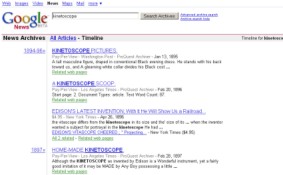
And then there’s the Google News Archive search. Naturally enough Google has provided us with a search engine which browses historic news resources, both free and subscription-based, so you are offered tantalising glimpses of news stories that can be yours if only you’ll pay. Typing in ‘kinetoscope’ yields 2,210 results. The results seem all over the place, but it is possible to narrow down the search by date or newspaper, as Google assesses which areas are likely to yield the most results from your broad search query. It can also arrange results in a handy ‘timeline’ fashion.
Google News Archive

It’s worth noting that many of the subscription sites, such New York Times, give you at least the first few lines of the requested article. Speaking of the NYT, you can pay $4.95 to view a single page, $7.95 a month (up to 100 articles) or $49.95 per year (up to 1,200 articles). Find out more from its TimesSelect service.

The Google News Archive is a wonderful research tool, not least for showing the sheer range of digitised newspaper collections out there, and as a quick spot-check method of seeing when a subject was being discussed, in what way, and by whom. I certainly want to read more of the Los Angeles Times article of 31 March 1897 entitled ‘Kill the Kinetoscope and its Kindred’, with the tantalising opening lines, “The Senate Judiciary Committee did well in reporting favorably the bill to prohibit the exhibition of prize-fight pictures by means of the kinetoscope and kindred devices in the District of Columbia or the Territories of the…”

British Library Newspapers

The British Library maintains the national collection of newspapers (still housed in quaint conditions at Colindale in North London). It has had had for some while a test online historic newspaper service, using Olive Software, which offers some year-long slices from four sample papers: News of the World, Manchester Guardian, Daily News and The Weekly Dispatch, from which only the News of the World gives a Kinetoscope story – on the racehorse, in 1900.

But now the British Library is engaged on a massive British newspaper digitisation programme, with higher education funding money (the JISC Digitisation Programme). The first stage of this, recently completed, has digitised 2 million pages of 19th century newspapers. Stage two, just begun, will add a further 1.1 million pages from 1690-1900. The results, however, will be accessible to UK higher and further education users only.

The lessons to be learned are simply that, if you want serious access to knowledge, you need to pay or to be a student. The number of precious resources being made available only to universities is a problem for the outside researcher, though that’s where the money is coming from, and in many cases it’s the only way of getting round licensing restrictions.

What else is out there?

There are commercial sites, such as ProQuest, which is a world leader in providing access to digitised resources to institutions, including historic newspapers. Like a number of these services, it offers free trials – but only to institutions. The massive NewspaperARCHIVE.com welcomes individuals. It boasts over 68 million pages, and lets you know your search results for free, so Kinetoscope yielded a tantalising 2,923 hits. Annual membership starts at $8.95 per month.

But there are many smaller initiatives to look out for. A while back, I wrote a post on The Silent Worker, a newspaper for the deaf, which had many articles on the deaf and silent films. I found the information on that from the British Columbia Digital Library, which has a very useful listing of digitised newspaper collections around the world. And if you are frustrated at not being able to get hold of subscription-based collections, I recommend the Godfrey Memorial Library, an American library specialising in genealogy resources which for a very cheap annual subscription (from $35.00) offers access to a large number of newspaper libraries, including the Times Digital Archive.

There’s so much out there. If you know of other collections, or directories of information, do let me know.

Infax and Open Archive

Infax is the BBC’s own programme catalogue, and as many will know a public version of this has been made available on the web for a year or so now. A revamped version has just been published, with a touch more design and in a fetching shade of pink, and it’s more than worth noting here for the details it has of television and radio programmes on silent cinema.

Given that it has 900,000 records (maybe half of the entire BBC output, but it predominantly records programmes that survive in the BBC archives), it’s a bit disappointing to find just 63 listed under the category ‘silent films’, but what’s there is fascinating enough, especially the records of older programmes with interviewees no longer with us.

For example, there’s the 1969 Yesterday’s Witness programme interviewing the 93-year-old British film director George Pearson, who directed his first film in 1914.

Or Michael Bentine’s 1969-70 television series Golden Silents, from the days when you could get thirty-part series on the history of silent films.

Or diverting magazine entertainment, such as Bob Langley chating to silent film pianists Florence de Jong and Ena Baga (doyennes of the National Film Theatre) for Saturday Night at the Mill in 1979.

It’s also worth seaching under the names of individuals who may not have been indexed under ‘silent films’, e.g. Georges Melies being discussed in a Horizon programme on special effects in 1974.

It’s mostly recent programmes that are recorded, and then usually items in arts programmes. Of course, its just the catalogue and not the programmes themselves. Those remain in the vaults, though the BBC has ambitious plans for substantial amounts of archive content to be released online, what’s called its Open Archive project. Closed trials of this are underway, and version one of a full service (subject to Public Value tests) could come in Spring 2008.

Paimann’s Filmlisten

Let us move away from all this star-laden stuff, and get back to the nuts and bolts of silent film research. I don’t know how many English-speaking researchers will know about Paimann’s Filmlisten. It was an Austrian film review journal, which ran 1916-1956 (founded by Franz Paimann), listing all new film releases with synopsis and credit details for films shown in Austria. Clearly, it will be known to German and Austrian researchers, but a quick Google search found no English language references.

The reason for mentioning here is that there is an index to the entire run, made available online by the Vienna Bibliothek. It arranges all the films by original release title, followed by Austrian release title, date, and reference number for the issue of Paimann’s Filmlisten. Here’s a section from the letter B, to give you an idea of what’s there:

Biarritz und seine Umgebung 1922-105, Nr. 331
Bibel, Die 1925-45
Biberpelz, Der 1929-105
Bibi la purée (Francsfälscher) 1926-91
Bid to love – Gaby, das Königsliebchen (Der Autoprinz) 1927-137
Biene Maja und ihre Abenteuer, Die 1926-81
Biene und ihre Zucht, Die 1918/19-57, Nr.131
Big adventures (Der kleine Landstreicher) 1923-39, Nr. 360
Big City, The (Das unsichtbare New-York) 1928-94
Big Dan – Entfesselte Leidenschaft (Eine verhängnisvolle Nacht) 1926-1
Big Killing, The (Riff und Raff als Scharfschützen) 1929-89
Big Parade, The (Die Parade des Todes) 1926-173
Big Pond – La grande mare (Über’n großen Teich) 1931-63
Big timber – Der Kampf im Urwald (Urwaldriesen) 1925-120
Big Trail, The (Die große Fahrt) 1931-39, 69

There are no digitised copies of the reviews, alas, nor any credits, but as a check list of titles and evidence of their distribution it’s an invaluable resource – all the more invaluable for those with access to the journal itself (the Austrian Film Archive has a set) It appears to go up to 1931 so far, so ideal for investigating silents.

Update (August 2016)

The indexes to Paimann’s Filmlisten are no longer avaiable on the Vienna Bibliothek site, and cannot be traced via the Internet Archive. However, a digitised run of the Filmlisten itself is available via the European Film Gateway, http://www.europeanfilmgateway.eu/de/content/filmarchiv-austria-paimann%E2%80%99s-film-lists

Mander and Mitchenson

The world famous collection of theatre memorabilia gathered together by Raymond Mander and Joe Mitchenson has now published an online catalogue. The collection comprises over two thousand archive boxes containing playbills, posters, programmes, engravings, cuttings and production photographs of London and British regional theatres. There are files on every actor and actress of note in the British theatre, and sections on circus, dance, opera, music-hall, variety, dramatists, singers and composers, together with many engravings and pictures.

Inevitably, there is much that relates to the cinema, especially the early years of cinema. There are few documents themselves available online, but judicious use of the catalogue fields yields gems. There is a Search Everything option, and individuals fields for Names, Titles, Subjects, Dates and Keywords. Each search result provides a Brief Details and a Full Description. This is where the useful stuff lies – some thorough catalogue descriptions, such as this for the Palace Theatre in London’s Cambridge Circus, an important venue for Biograph films in the late 1890s/early 1900s, and host to occasional film shows thereafter:

Palace Theatre (Cambridge Circus, London) Collection

Resource code: GB2649-MM-TL-PLC
Title: Palace Theatre (Cambridge Circus, London) Collection
Format: Set plans and designs; Documents (production); Ephemera eg. daybills and flyers; Programmes; Drawings; Prints; Photographs (production); Photographs (venue); Photographs (miscellaneous); Negatives; Postcards; Music scores; Song sheets; Libretti; Autographs; Ephemera eg. tickets; Published material; Scrapbooks; Periodicals; Press cuttings; Correspondence; Manuscripts; Ephemera; Photocopies

Description: The Palace Theatre opened on 31 January 1891 as the Royal English Opera House under Richard D’Oyly Carte. It changed its name to the Palace Theatre of Varieties in 1892, and specialised in music hall/variety productions, hosting the Royal Command Variety Performance in 1912. From c1914 it began staging revues, as well as the occasional cinema shows in the 1920s and 1930s. In recent decades it has produced a large number of musicals.

Description: The papers include depictions of the exterior of the theatre as it was, 1896-c1989, and of the interior, c1903-1912, articles, press cuttings, notes, etc. relating to its history, 1891-20th century, theatre tickets, 1954-1968, a list of productions from 1891 to 1985, an information pack on the completion of exterior refurbishments, 1989, the Summer 1997 edition of Picture House, containing an article, Pictures at the Palace, by Graeme Cruickshank, a booklet, The Royal English Opera House and The Palace Theatre – 100 Glorious Years, An Illustrated Chronology, by George Cruickshank, 1991, programmes relating to charity and Sunday events, 1900-1994, and papers relating to the Royal Command performance of 1 July 1912.

Description: The majority of the material relates to performances and is arranged in chronological order from 1891 to 1999, although a number of items are copies or later reprints of original documents; the earliest original document is dated 1891. It includes a pen and ink sketch of Esther Palliser and David Bispham in La Basoche, 1891, a souvenir booklet issued by the theatre entitled The War by Biograph, 1900, set plans, etc. for The Gay Divorce, 1932, correspondence, set plans, wardrobe lists, technical specifications, etc. relating to a proposed performance of Carissima in South Africa, 1952, and an introductory booklet to the Théâtre Nationale Populaire, 1956. Coverage is particularly good for the following productions: Ivanhoe (1891), The Passing Show (1914-1915), Bric-à-Brac (1915), Vanity Fair (1916-1917), No No Nanette (1925), Heads Up! (1930), Dinner at Eight (1933), Streamline (1934), On Your Toes (1937) including a large number of stage plans, Under Your Hat (1938), Song of Norway (1946), Carissima (1948), King’s Rhapsody (1949), The Love Match (1953), Glorious Days (1953-1954), the Shakespeare Memorial Company’s touring production of King Lear (1955) including typed transcripts of revues, The Sound of Music (1961), Cabaret (1968), Mr. Mrs. (1968), Jesus Christ Superstar (1972) and Les Miserables (c1985-1999).

Language: eng
Conditions of access: By appointment
Acquisitions policy: Possible future additions
Owner: The Raymond Mander and Joe Mitchenson Theatre Collection
Copyright status: Contact Administrator for permissions
Collection located: Jerwood Library of the Performing Arts
Trinity College of Music
King Charles Court
Old Royal Naval College
Greenwich
London SE10 9JF
Keyword: Variety
Keyword: Revue
Keyword: Stage setting and scenery
Keyword: Technical information
Associated name: Palace Theatre, Cambridge Circus, London
Associated name: Royal English Opera House, Cambridge Circus, London
Associated name: Palace Theatre of Varieties, Cambridge Circus, London
Associated name: Théâtre Nationale Populaire
Geographic coverage: London
Collection time span: 1891-1999
Accumulated: 1938 –
Principal collector: Raymond Mander and Joe Mitchenson
Parent Collection: The Raymond Mander and Joe Mitchenson Theatre Collection

The collection itself is located at Trinity College of Music, Greenwich – contact details from the website.

When the Movies Began…

Kinetoscope

The latest feature to be added to the Who’s Who of Victorian Cinema web site is When the Movies Began. This is a chronology of the world’s film productions and film shows before May 1896. It was originally compiled by Stephen Herbert and published as a booklet by The Projection Box in 1994. This updated and redesigned version incorporates new research, in particular the work of Deac Rossell, and it will be regularly revised and updated. There is also a full introduction and list of references.

Who’s Who of Victorian Cinema is a biographical reference guide to 300 or so people involved in the production of motion pictures before 1901, both behind and in front of the camera. It includes a wealth of supporting resources on the subject of Victorian film (i.e. film during the time of Queen Victoria’s reign), with a growing number of special features, such as When the Movies Began.

Terra Media

chronomedia.jpg

A key aspect of The Bioscope’s mission is to highlight resources for the study of silent film, particularly those not well known or obvious.

A model example is Terra Media. This is a one-man marvel of information on the history of media, beautifully arranged, and filled with riches. Its centrepiece is Chronomedia, a detailed chonology of media history year-by-year. As the site says, “Chronomedia is designed to become the most comprehensive and accurate timeline of developments in communications media ever compiled. By integrating references to all audio-visual media—film and cinema, radio and television, cable and satellite, interactive (multi)media, photography, telegraphy, telephony and even printing and publishing—it becomes easier to see the parallel developments and interactions that have formed the media scene we know today.” The year-search option alone is a joy to see, individual entries are to the point, and it is all very satisfactorily cross-indexed, linked and illustrated.

There are other sections on quotations, the history of television as public performance, the quest for home video, a reference section, and a fascinating section on British media legislation. There are further sections on statistics (including early British cinema circuits) and contemporary documents (none covering the silent era). The site continues to grow, and is just such a pleasure to use. Its editor is David Fisher, whose day job is editor of the media news and market research journal Screen Digest. Take a look.