The Kinetoscope of Time

kinetoscopeoftime

Title of ‘The Kinetoscope of Time’, from Cornell University Library

Tales of Fantasy and Fact is an 1896 collection of short stories by James Brander Matthews. He was Professor of Literature at Columbia University, subsequently America’s first professor of drama, among whose achievements was his own theatre museum. The collection includes a remarkable story, ‘The Kinetoscope of Time’, which is the reason for adding the collection to the Bioscope Library.

‘The Kinetoscope of Time’ was originally published in Scribner’s Magazine, December 1895. It takes the form of a Gothic horror story. The narrator finds himself at midnight in a large hall, the walls furnished with dark velvet. He comes across “four curiously shaped narrow stands”, about one foot wide and four feet high, each equipped with eye-pieces inviting the beholder to look within.

So of course he does, and he sees a succession of visions which, though they are not immediately identified as such, are the dance of Salomé, Hester Prynne and Little Pearl from The Scarlet Letter, Topsy dancing in Uncle Tom’s Cabin, Nora in A Doll’s House, the fight between Achilles and Hector, Don Quixote and Sancho Panza, the duel of Faust and Valentine, and Custer’s Last Stand. The narrator raises his head from these visions and is approached by a man who, though middle-aged, says that he had witnessed all these scenes, even though they mingle fact with fiction. He may or may not represent Time itself. He invites the narrator to behold two further visions, for which there will be a charge, one to witness his past, the other his future. The narrator refuses, and exists the hall to find himself in the outside world, “in a broad street”, with an electric light flashing and a train clattering by. He sees a shop window, and in it there is a portrait of the man he has just met, who is revealsed to be Cagliostro, the 18th century Italian occultist and adventurer.
kinetoscope_parlour

Kinetoscope parlour in San Francisco

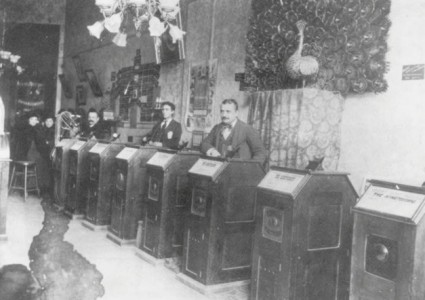
This is a remarkable tale in a number of ways. Firstly, its Poe-like fantasy clearly takes place somewhere akin to a Kinetoscope parlour, where the Edison peepshow viewers that preceded projected film shows were placed side by side, offering a view of one film per machine. But the velvet walls, the dark of the hall and that disorienting exit into what Matthews calls “the world of actuality” seem to be a premonition of the cinemas that were to come, while the subjects are remarkably prescient, almost all of them soon to become iconic scenes in motion pictures.

But the story’s real subject is the Kinetoscope’s relationship with time. The great fascination that motion pictures held for many observers when they first appeared was their quality as a time machine. The Kinetoscope turned one, potentially, into the observer of all time – able to witness the continuum of time as events passed before one’s eye on a ribbon of film. As Mary Ann Doane writes in The Emergence of Cinematic Time:

The story conjoins many of the motifs associated with the emerging cinema and its technological promise to capture time: immortality, the denial of the radical finitude of the human body, access to other temporalities, and the issue of the archivability of time … Its rhetoric echoes that which accompanied the reception of the early cinema, with its hyperbolic recourse to the figures of life, death, immortality, and infinity. The cinema would be capable of recording permanently a fleeting moment, the duration of an ephemeral smile or glance. It would preserve the lifelike movements of loved ones after their death and constitute itself as a grand archive of time.

The story provides a metaphor for the fundamental mysteries of the moving image, in what it shows, in what it supposes it shows, and in what it supposes it is able to capture. What does it mean to represent time in any case? The cinema is a mechanical thing, a conjuror’s illusion, a Cagliostro trick. It does not portray time but rather an idea of time. The narrator does not realise this, but maybe Matthews did.

‘The Kinetocope of Time’ has been much cited down the years, and the full text is reproduced in George C. Pratt’s classic compilation of original texts about the silent cinema, Spellbound in Darkness.

Tales of Fantasy and Fact is available from the Internet Archive in PDF (17MB), b/w PDF (6.2MB), full text (219KB) and DjVu (5.2MB) formats. It is available as a single story from a number of sources – Cornell University Library‘s version reproduces the look of the individual pages from the Scribner’s Magazine original, each page (GIF image) with an illustration of the appropriate vision.

Turn up the gramophone

phonofilm

Projecting with the De Forest Phonofilm system, from The Gramophone, March 1927

It’s been a while since we’ve been able to bring you news of digitised newspapers or journals accessible online, but here’s a treat for the new year. The Gramophone, the esteemed classical music journal, has just put up in its entire archive since 1923.

It’s searchable by keyword, date range and type of item, with results refinable by decade. So searches can be narrowed to the 1920s, and there is plenty on silent cinema for us to investigate. Search results give you the item title, the first few lines, date and page number. Individual items then give you a PDF of the page (though it is necessary to register first to access these), with the option to browse further through that issue, and the OCRed text (with the occasional wobble in the character recognition). It is very easy to use,with an array of handy extras you can explore for yourselves. How it was paid for, it doesn’t say, but the service is free.

So, what will we find on silent films in The Gramophone? A surprising amount, if sometimes tangentially expressed. A good example is this piece by J.B. Hastings, from April 1925, entitled ‘The Gramophone and Film Music’, on how cue sheets were put together:

The average person will be astonished to find how much time and trouble are spent in fitting suitable music to film plays. But the big film companies have come to realise that a really good picture play can be ruined by the accompaniment of inappropriate music, and, incidentally let me whisper, they have found that even a feeble production can be made fairly, tolerable by the ingenious use of the orchestra. So, with each super film, is issued a list of ” musical suggestions,” complete with the cues and signs necessary to fit the various selections to the screen action. In many cases the actual full music score, timed to a note, is hired out with the film. Since I have had the experience of compiling a large number of such lists—I forget whether the exact number runs into millions or merely thousands—perhaps I may be permitted to indicate here how it is done.

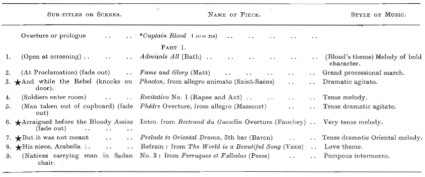
The film is projected in the cinema company’s private theatre and there I see the film with an assistant—and a stop watch. From the moment the first scene starts I am literally thinking in music. With a love scene I try to imagine just that type of sentimental melody that will exactly fit the picture, and move on in sympathy with it. A fight—then I endeavour to find an “agitato” of a tempo that will synchronise as near as possible with the speed and tensity of the film. Dramatic situations, storms, fires, sea scenes—all call for special treatment. As the film goes through, the “changes” are noted either by the sub-titles that precede them, or action on screen. In illustration of this I reproduce here a fragment of a typical “musical suggestions” sheet.

cuesheet_gramophone

The first column contains the cues, column 2 the music and composer, column 3 the style of the piece. Those cues marked with a (*) are the opening words of the sub-titles. Brackets indicate action on screen. Both types of cue indicate a change in the action or tempo. No. 9, for instance, shows a quick change from a quiet appealing melody to a pulsating allegro. It will be easily seen that a cinema orchestral leader must be on the alert the whole time. It might almost be said that he must work with one eye on the screen and the other on his music.

Many big photoplays call for a great number of “changes”—absolutely essential if the resultant entertainment is to be perfect. One of the most difficult films I have ever had to “fit” is Captain Blood, which is now showing throughout the country.

Mr. Rafael Sabatini’s story is so full of action and varying moods, and has been filmed with such faithfulness that no less than seventy changes are necessary, though this does. not mean seventy different selections. The chief “themes” in this story are (a) love; (b) dramatic; (e) sea battles and (ci) the “Captain Blood” theme itself. All these are there in various shades and emphasis.

As an introduction we start with the Captain Blood song, specially written as an overture or prologue. This is followed by Admirals All (Hubert Bath) and is used, in all, in eight different places.. For the love theme I have chosen The World is a Beautiful Song (Vane), and the principal seafighting scenes, Beethoven’s King Stephen overture from “presto,” varying this with various “incidental symphonies” specially written for film use.

Here is an extract from the music which I have fitted to the comparatively quiet first reel of Captain Blood:

cuesheet_gramophone2

Compare this with the smashing character of the music towards the end, when the terrific battle of Port Royal, Jamaica, is introduced. Here you will notice indication of “effects”.

cuesheet_gramophone3

Naturally, many cinemas cannot, for various reasons, follow the “official” musical suggestions in their entirety, especially as it is only in cases of exceptional films like Captain Blood that the complete score, correctly numbered and marked, can be hired from the film company.

No orchestra library under the sun can hope to contain every composition that may be wanted; and no musical director knows off-hand the exact nature of every composition in existence. It is here that the gramophone is so useful. When he finds himself “stuck” for a suitable number the musical director can always turn to the gramophone for guidance as to the style and tempo of any selection, the title of which seems to indicate possibilities. Moreover, many cinema orchestral leaders, to my knowledge, gain valuable hints from the reviews of records and music published in THE GRAMOPHONE.

In conclusion, I would say that the modern super-cinema, with its often excellent orchestra, together with the great study given to the musical side of films by cinema companies, is having a marked effect upon the musical taste of the British public.

What with this and broadcasting—both tending to familiarise the “Man in the Street” with all that is best in music—it is not surprising that the gramophone firms are experiencing what can most aptly be termed “a record boom.”

And, briefly, an editorial from April 1929 casts an interesting light on payment for musical accompaniment in cinemas, in this case involving the future composer of many a British film score, Malcolm Sargent:

Dr. Malcolm Sargent, at the age of thirty-three, has just refused to play the cinema organ for half an hour every day at 12s. 9d. a minute. This shows a more genuine horror of the instrument than even I could have fancied possible in these days of hard struggling for economic existence. What puzzles me, however, even more than Dr. Sargent’s devotion to art is why it should be worth while for a West End cinema theatre to pay £7,000 a year to any man, whatever his acrobatic and musical ability, to play their organ three times daily throughout the year for ten minutes at a session. I really should very much like to know the name of the cinema theatre which was prepared to offer this price, and I think Dr. Sargent owes it to his professional brethren with lower ideals than himself to reveal the name…

And there’s much more to discover, including some fascinating material on the coming of sound, as the illustration of the De Forest Phonofilm system at the top of this post indicates. Just type in ‘cinema’ or ‘film’ as a keyword, and start browsing.

Cecil B. DeMille and American Culture

demille

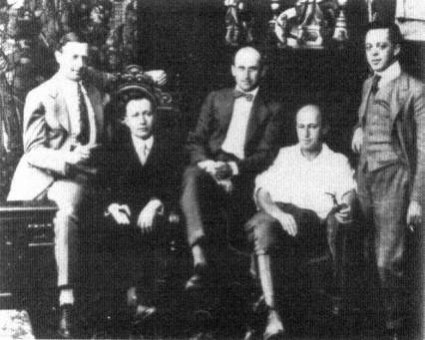
Cecil B. DeMille (second from right) poses with Jesse L. Lasky, Adolph Zukor, Samuel (Goldfish) Goldwyn, and Albert Kaufman after the Famous Players-Lasky merger, from Cecil B.DeMille and American Culture

Not all of the e-books that are freely available online are titles that have been out of print for decades. The University of California Press is one publisher that has boldly made the decision to make some of its relatively recent books available online to all, as part of its general eScholarship Editions initiative. Among the titles available are some silent cinema subjects. We’ve already mentioned Charles Musser’s Before the Nickelodeon. Now we have Sumiko Higashi’s Cecil B. DeMille and American Culture: The Silent Era.

This is an acclaimed study of the films of Cecil B. DeMille as they reflected American culture of the 1910s and 1920s. It is not a film history as such, but rather a social history, with a body of films as evidence. Higashi demonstrates how DeMille integrated cinema into what she calls ‘genteel culture’ by making the spectacle that it provided reflect middle-class ideology. DeMille took his subjects for films from texts – plays, novels, short stories – that were familiar to a middle-class audience, reflecting their world and its concerns. The DeMille we think of today was the producer of gargantuan Biblical epics, but the DeMille of the silent era was first a filmmaker artfully attuned to ‘genteel’ tastes, and then a trendsetter, whose 1920s films influenced advertising and consumer culture. The varied films discussed include Carmen, What’s His Name, Chimmie Fadden, Kindling, The Dream Girl, The Golden Chance, The Cheat, Joan the Woman, Old Wives for New, Don’t Change Your Husband, Why Change Your Wife?, The Affairs of Anatol and The Ten Commandments.

Cecil B. DeMille and American Culture, as with other UCP eScholarship Editions, is commendably well presented in chapterised form, with hyperlinked notes and index making it eminently searchable. There is also a filmography, and the welcome presence of all of the book’s illustrations (something not always offered with ebook editions). All in all, a stimulating read and a most helpful reference source, which now goes into the Bioscope Library.

Japanese Cinema: Film Style and National Character

richie

Back we go to the Bioscope Library, and fresh on its shelves is Donald Richie’s Japanese Cinema: Film Style and National Character (1971). Richie’s classic study of Japanese cinema history (itself a revision of his original 1961 book Japanese Movies) has been reprinted online as is by the University of Michigan’s Center for Japanese Studies. Richie has this to say about the exercise:

For this online edition of my 1971 Japanese Cinema: Film Style and National Character, I have decided to leave the book as it is. It contains no major errors that I know of and its methodology represents its time – thirty-three years ago. I would write it differently now – in fact, I have, in A Hundred Years of Japanese Films (2001). Now, my ideas of film style have broadened and I am no longer so confident that such a thing as national character can be said to exist. Nonetheless, this book still has its uses.

Indeed it does. For our purposes, it provides a clear, cogent and thorough account of Japanese cinema in its silent era, which of course extended for longer than silents in the West, as Japanese films continued to be silent well into the 1930s. The book covers the arrival of the film in Japan in 1896; the first native entrepreneur showmen and producers; the rise of distinctive national cinema traits, notably the benshi narrators who elevated the presentation of film to a high art; and emerging artistry of filmmakers orking in genres such as the samurai historical dramas.

There have been fuller accounts since of the earliest years of Japanese film, and Richie cuts quite quickly to the 1920s/early 30s and the early masterpieces of Mizoguchi, Gosho and Ozu. But while one will want to look elsewhere for historical detail, Richie excels at binding together the medium with the nation that produced it and in delineating trends in the art of the film. The parallels drawn between Japanese cinema and contemporary achievements in Western art cinema perhaps show their age, but overall the opening section of this book is a fine way for anyone to begin their discovery of silent Japanese film.

Japanese Cinema is available as downloadable PDF or as individual page images. Do note that all illustrations have been removed from this online edition.

A modern musketeer

modernmusketeer

Released next month is the latest mouth-watering, connoisseur-pleasing release from Flicker Alley, Douglas Fairbanks: A Modern Musketeer. This is a five-DVD set covering Fairbanks’ career 1916-1921, as he worked his way through the genres and ever-increasing stardom, before the series of great costume dramas that marked the peak of his fame in the 1920s. It’s officially released on 2 December, with a discount offer for advance orders.

The eleven titles featured on the set are:

  • His Picture in the Papers (1916)
  • The Mystery of the Leaping Fish (1916)
  • Flirting With Fate (1916)
  • The Matrimaniac (1916)
  • Wild and Woolly (1917)
  • Reaching for the Moon (1917)
  • A Modern Musketeer (1918)
  • When the Clouds Roll By (1919)
  • The Mollycoddle (1920)
  • The Mark of Zorro (1920)
  • The Nut (1921)

vance_fairbanks

It’s a sensational package, not just for the instrinc value of the films, but for the portrait it provides of the ‘all-American’ character leaping out of a pre-war world into post-war opportunity. The release of the set is complemented by the publication of Jeffrey Vance’s new biography, Douglas Fairbanks. This, we are told, is

the first critical analysis of Fairbanks’s body of work in over twenty-five years as well as the first full scale biography in over a half century. This extensively researched, engagingly written and sumptuously designed book goes behind Fairbanks’s public persona to thoroughly explore his art and far-reaching influence. Utilizing access to Fairbanks’s personal and professional papers, Douglas Fairbanks is a superb portrait of a true pioneer, critically important to the creation of cinema as the defining art form of the 20th-century.

The DVD set takes its apposite name from the title of the recently rediscovered 1917 A Modern Musketeer, which the curmudgeonly Bioscope didn’t much care for when it was shown this year at Pordenone. For a more generous view, within an illuminating critique of the Fairbanks persona, read David Bordwell’s latest post.

Travellin’ on

There has been steadily increasing interest in the ambulatory nature of much of early cinema. Before films were fixed to a venue, they were frequently to be found on the move. Fairgrounds, a form of entertainment continually on the move, became a regular home for film shows in the late 1890s to early 1900s, and travelling showmen to film shows from town to town. Recent research work has uncovered extensive information on the early ‘travelling cinema’, as the term seems to be. Most notable in this field has been the body of work that followed the discovery of the Mitchell & Kenyon collection of non-fiction films from the Edwardian era, films commissioned by town hall showmen and fairground operators, generally located in the north of England.

A second body of work has looked at what was happening on the European mainland. A conference on travelling cinema in Europe took place in Luxembourg in September 2007, accompanied by the Crazy Cinématographe shows (revived for this year) and DVD release. Now we have the proceedings of the conference published as Travelling Cinema in Europe, edited by Martin Loiperdinger and published by KINtop. Though it has a German publisher, the book is in English. The book provides a diverse look at the commercial heyday of the travelling cinema in the first decade of the twentieth century, with a particular focus on Luxembourg and the Greater Region, with another section looking at non-commercial travelling cinemas from the 1920s onwards. Here’s a chapter listing:

Martin Loiperdinger – Introduction

Travelling Cinema in Europe before the First World War

Vanessa Toulmin – ‘Within the Reach of All’: Tavelling Cinematograph Shows on British Fairgrounds 1896–1914

Matthew Solomon – Fairground Illusions and the Magic of Méliès

Mustafa Özen – Travelling Cinema in Istanbul

Ralf Forster – Easy to Handle and Part of the Novelty: Equipment for Travelling Cinemas in Early Trade Catalogues

Daniel Fritsch – The Paradoxical Austrian Travelling Showmen’s Magazine Die Schwalbe

Joseph Garncarz – The Fairground Cinema: A European Institution

Travelling Cinema in Luxembourg and the Greater Region before the First World War

Uli Jung – Travelling Cinematograph Shows in the Greater Region of Luxembourg: An Overview

Paul Lesch – Travelling Cinematograph Shows in Luxembourg

Brigitte Braun – Marzen’s Travelling Town Hall Cinematograph in the Greater Region of Luxembourg

Non-commercial Travelling Cinema in Europe from the 1890s to the 1960s

Torsten Gärtner – The Church on Wheels: Travelling Magic Lantern Mission in late Victorian England

Thomas Tode – Agit-trains, Agit-steamers, Cinema Trucks: Dziga Vertov and Travelling Cinema in the early 1920s in the Soviet Union

Urszula Biel – German and Polish Agitation through Travelling Cinemas in the 1920s in Upper Silesia

Yvonne Zimmermann – Training and Entertaining Consumers: Travelling Corporate Film Shows in Switzerland

Christian Kuchler – Catholic Travelling Film Shows in West Germany after the Second World War

Epilogue

Claude Bertemes – Cinématographe Reloaded: Notes on the Fairground Cinema Project Crazy Cinématographe

The travelling cinema work can in turn be seen as part of a wider investigation of the relationship of early cinema to society, which is at last taking place. It was not just what they saw, but how they saw it, that matters. There is a growing body of work that is looking the composition of the programme, the location and strategies of venues, the composition of audiences, the location of audiences and their relationship to the entertainments offered to them, the time that they had to devote to such diversions and the value that could be placed on that time, the role of the audience in contributing to the early cinema experience – all of this informs us of early film’s social significance. Without such knowledge, our understanding of the films is barren.

Flicking through the magazines

A new publication, Emily Crosby and Linda Kaye’s Projecting Britain: The Guide to British Cinemagzines, opens up a hidden corner of film history, a corner in which the silent cinema played its part. The book’s subject is the cinemagazines, or screen magazines, or just plain magazine films, those unconsidered programme fillers that were a mainstay of cinema shows for decades and out of which sprang the television magazine format. Overlooked by practically all film histories, the cinemagazine has a rich tale to tell, not simply for its form and content, but for the diverse audiences that it reached and the various bodies – entertainment, governmental, industrial – that used the magazine film format to hook audiences to their purposes.

The richest history of the cinemagazine, as indicated by that title Projecting Britain, comes from the sound era, when the British government in particular latched onto the form in the post-World War II era as means to further its strategic aim of ‘national projection’ (i.e. we may have lost an empire and it may be a post-war world, but we still have our part to play in it). But the cinemagazine was an invention of the silent cinema, and it was not the sole preserve of Britain.

The first person to come up with a magazine film series (as opposed to the newsreel – a related form, but tied much more to topicality) was Charles Urban (have I mentioned him before?). Late in 1913 Urban devised the Kinemacolor Fashion Gazette, directed by Abby Meehan, a magazine series highlighting women’s fashions, filmed naturally in colour using the Kinemacolor process. It probably did not extend far beyond Kinemacolor’s London theatre, the Scala, and only lasted a couple of months, but a new film form was born. The next pioneer was the naturalist and filmmaker Cherry Kearton, who devised The Whirlpool of War, a behind-the-scenes war magazine presenting footage from Belgium and France in the first few months of the First World War.

Title design from Around the Town no. 105, 1921 (BUFVC)

But the cinemagazine as a regular entertainment in the cinemas really began in 1918 with Pathe Pictorial. This offshoot of the Pathe newseel in Britain amazingly ran uninterruptedly until 1969, bringing together light stories of fashion, personalities, travel, customs, sport, hobbies, innovations, animals, quirky events – anything that didn’t quite define itself as news. The idea swiftly caught on. In Britain, though the 1920s, there was Around the Town (1919-1923), created by Aron Hambuger, distributed by Gaumont, concentrating on London goings-on, especially theatrical; Eve’s Film Review (1921-1933), Pathe’s iconic magazine series for women; Vanity Fair (1922), produced by Walturdaw; Gaumont Mirror (1927-1932), sister series to the newsreel Gaumont Graphic; and British Screen Tatler (1928-1931), sister series to the newsreel British Screen News. Ideal Cinemagazine (1926-1932), produced for Ideal by Andrew Buchanan, gave the form its name, and introduced a (limited) educational element that was to characterise later developments of the cinemagazine.

Also throughout the 1920s the cinemagazine was becoming a staple of American screens, with Charles Urban once again the pioneer. When Urban established an American film business after government service during the First World War, he based much of his hopes on two cinemagazine series, Movie Chats (1919-1923) and Kineto Review (1921-1923). A typical Movie Chats issue (no. 4) contained the stories ‘View of the River Thames at Henley on Regatta Day’, ‘Experiments in Static Electricity’, ‘Visting the Sacred Monkey Temple at Benares India’, ‘Camel Fight in Desert of Turkey’, and ‘Three Views of the River Seine with Cloud Effects’. Ever the one to make good use of library material, much of Urban’s cinemagazine content came from films his companies shot in Britain before the First World War (and in turn Movie Chats footage was sold to Britain and used by Andrew Buchanan in his Ideal Cinemagazine).

Other American cinemagazines of the 1920s were Screen Snapshots (1920-1958), which focussed on Hollywood stars; Grantland Rice’s Sportlights (from 1924 at least), a mainstay of American cinemas for decades; and several series from James A. Fitzpatrick, an Urban protégé, whose Fitzpatrick Traveltalks (begin 1931) were an equally enduring feature of American screens (with the legendary closing lines “… and so we say farewell to …”). Undoubtedly the form spread to other countries, though information on these seemingly inconsequential components of the cinema programme is particularly difficult to find.

Light the cinemagazine may have been, but inconsequential it was not. An enduringly popular form, it spoke to audiences in an engaging, comforting manner, sometimes quaintly, sometimes with a degree of sly subversiveness. The use of the cinemagazine form in the 1920s to attract women audiences, through a mixture of knowingness and unknowingness, is covered by Emily Crosby in Projecting Britain and by Jenny Hammerton in one of the few other publication to consider the genre, For Ladies Only? Eve’s Film Review: Pathe Cinemagazine 1921-33. There’s also a German thesis available commercially, Nicola Gölzhäuser-Newman’s Eve’s Film Review: Genre und Gender im britischen screen magazine der 1920er Jahre. Some information on the American cinemagazine at this time (though the term is not used) can be found in Leonard Maltin’s The Great Movie Shorts. The use of the cinemagazine in the 1920s to tackle educational subjects remains under-researched, and I know of no publication that I can point you to (though I have some unpublished writing myself…).

You can find plenty of examples of Pathe Pictorial and Eve’s Film Review on the British Pathe site (same content also available through ITN Source). Examples from issues of Around the Town are available on the British Universities Film & Video Council’s Video Showcase (look out in particular for H. Grindell Matthews demonstrating his sound-on-film invention in 1921). It was the BUFVC which hosted the ‘Cinemagazines and the Projection of Britain‘ project which resulted in this book, a project in which I played a small part (mostly obstructive). The BUFVC’s newsreel database now included records of some 19,000 British cinemagazines.

There’s still so much to be discovered in film history, particularly early film history, if we will only start looking in the right places. Projecting Britain (a collection of essays, original documents and reference guide) opens another door.

Hollywood in Berlin

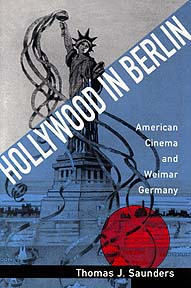
The latest addition to the Bioscope Library is a welcome example of a modern film scholarship text made freely available online. Thomas J. Saunders’ study, Hollywood in Berlin: American Cinema and Weimar Germany, looks at the American film in Germany during the Weimar period. German films of the 1920s have been much championed and studied, in part as alternatives to American films of the period, but the focus here is on the considerable impact American comedies, serials, society dramas and historical epics had in Germany, and the debates they occasioned on the influence of cinema and the perils of Americanisation. Films covered include The Ten Comandments, The Hunchback of Notre Dame, Ben Hur and Greed, and the image and impact of Jackie Coogan, Mary Pickford, Harold Lloyd, Rudolph Valentino, Chaplin, Keaton and ‘slapstick’ in general. The book therefore looks at cultural and industrial relations between Germany and America in 1920s, through the prism of popular cinema, bringing together economic history, reception studies, film studies and social history.

The book has been published online in chapterised, word-searchable, web form as one of the California Digital Library’s eScholarship Editions, a welcome initiative to make sample scholarly text freely available online to demonstrate its range of publications. Another example from the same source, already in the Library, is Charles Musser’s Before the Nickelodeon. Academic publishers, where they are rich enough to do so, are increasingly experimenting with multi-platform strategies, making texts available in print, online by subscription or to a restricted group (many of the eScholarship Editions are available only to University of California staff and students), and a few titles (or sample chapters) available free to the public. It breaks down barriers, demonstrates the flexibility of text, encourages discovery. More such forward-thinking initiatives, please.

Bioscope Newsreel no. 5

Merton on the road again
Following its hugely successful tour of the UK in 2008, Paul Merton’s Silent Clowns show, with accompanist Neil Brand, will be hitting the road again in Spring 2009. Merton and Brand will be giving eight shows at the Edinburgh fringe festival 8-16 August. Read more.

Silents in Shasta County
The Shasta County Arts Council of Redding, California, is holding its annual silent film festival, 24-25 October. Highlights include Metropolis, Blackmail and Peter Pan with actors reading out the intertitles to make the show more child-friendly. Read more.

A course in slapstick
The Museum of Modern Art, New York, is holding a course over five Wednesday, November-December on slapstick, entitled ‘Cruel and Unusual Comedy: Social Commentary in the American Slapstick Film’. The instructors are Ron Magliozzi, Steve Massa and Ben Model, who also provides the music. Read more.

Singing the silents
Published in paperback this month is Ken Wlaschin’s The Silent Cinema in Song, 1896-1929: An Illustrated History and Catalog of Songs Inspired by the Movies and Stars, with a List of Recordings. It is the history of the response of popular song to the silent cinema, with information on availability of recordings. Read more.

‘Til next time!

Emile Cohl encore

http://www.amazon.fr

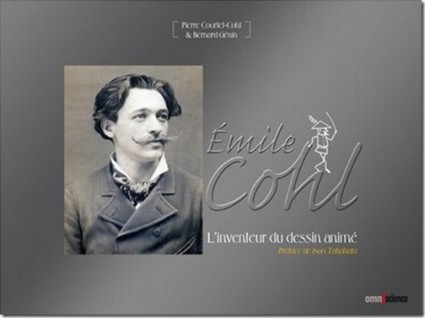
A new book on the master French animator, Emile Cohl, is due to be published in France on 20 August. The publication of Emile Cohl: L’inventeur du dessin animé, written by Pierre-Courtet Cohl (the filmmaker’s grandson) and Bernard Génin, coincides with the centenary of Cohl’s best-known film, Fantasmagorie, generally held to be the first fully animated film. The book is both a biography and a comprehensive study of his films, but what is most exciting is that it will come with a two-disc DVD, produced by Gaumont-Pathé Archives, which is said to include almost all of his surviving films (around thirty-seven are thought to survive).

One cannot judge as yet whether the book will surpass the exceptional 1990 biography by Donald Crafton, which for the multi-lingually-challenged such as myself holds the inestimable advantage of being in English, but the DVDs will bring a great number of Cohl’s films out of the archives and into the public consciousness for the first time in nigh on a century (as an earlier post notes, very few Cohl films are currently publicly available). The book also has 600 illustrations, which should be more than an attraction in itself.

Book and DVDs are to be published by Omniscience, which has information on book, author and subject on its site (in French), but not on the DVD’s precise contents.

Update: See comments for more DVD information.