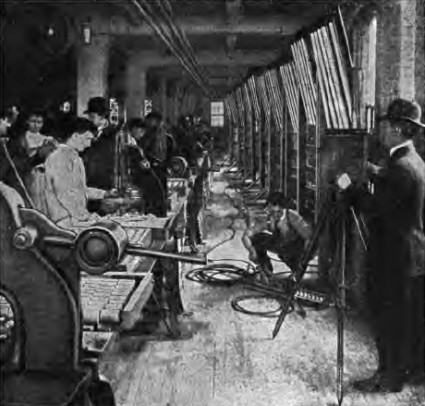
Paul’s Animatograph Works

And the good things just keep on coming. A while ago the Bioscope wrote about the Cinémathèque française’s Bibliothèque numérique du cinéma, a collection of digitised books on early cinema and pre-cinema. We are slowly making our way through these to put some of them in the Bioscope Library, but now many extra titles have been added by the Cinémathèque’s distinguished historian Laurent Mannoni which demand special attention. They include film catalogues, equipment catalogues and programmes. There are 170 documents all told.

The first of these that we’re going to highlight is something quite special – a 1903 catalogue for Paul’s Animatograph Works. It is a catalogue covering the films and equipment sold by one of the leading British film producers of the period, and it is an absolute treasure trove.

The catalogue is fifty-one pages long, and it begins with an introduction to the company and its founder, Robert W. Paul. There is a short company history and photographs of the offices, laboratories, studio, dark rooms, drying rooms and more. There are details of the services provided by the company, then a special feature on their star offering, the Animatograph projector. Other equipment described includes arc lamps, lenses, limelight jets, perforators and of course cameras, with prices given.

Then come the films. These are described in some detail, and most come with frame stills, plus details of length, price and telegraph code for ordering. The catalogues includes such gems as The Automatic Machine; or, What a Surprise!, Garters versus Braces; or, Algy in a Fix and Thrilling Fight on a Scaffold:

BRICKLAYERS, labourers and carpenters are seen busily engaged on different portions of the building of PAUL’S ANIMATOGRAPH WORKS. On a high scaffold, two men are carrying hods of mortar. A quarrel arises between them, and, throwing down their hods, they fight their way along the scaffold until they reach the portion nearest the spectator. The struggle goes on until one of the two throws his mate, who falls with a fearful crash, about 30 feet to the ground. As he lies helpless, his faithful dog runs towards him, and his mates hurry up from all directions, some sliding down the poles. On examination, he proves to be seriously injured, and is only able to rise slightly. His mates help him on to a stretcher and carry him off. A thoroughly exciting picture, well appreciated by country audiences. Code word—Scaffold. Length 100 feet. Price 75s.

Now that’s product placement. Other films described include the recruiting series Army Life, a series of films of the Epsom Derby, music hall acts (including Fregoli, Chirgwin and David Devant), trick films, comedies, actuality subjects, Boer War films and ‘sensational films’, including The Last Days of Pompeii (all 65 feet of it). The volume is available as a 17MB word-searchable PDF, and makes available the kind of precious volume that researchers previously had to travels miles at great expense to find. Now it’s yours (for you can download it, of course) at the click of a mouse.

Pages from the 1903 Paul’s Animatograph Works catalogue, advertising Sensational Films

The Mannoni collection has more on Paul alone. There is a separate Army Life catalogue, a series of films of the West of Ireland and his main catalogue for 1906-07 (17MB), another forty-three pages covering Paul’s later films – without the equipment this time, but with ample details about the films (so many of them lost, of course, with this catalogue providing the only available descriptions), including wonderful illustrations and an index as well. It will have to be the subject of another post.

There are all too few early or silent film catalogues available online as yet, though the Mannoni collection has already changed that quite a little. We’ve championed the digitisation of books, newspapers and journals – now the call needs to go out for catalogues to follow. And to encourage this, we are going to introduce a new section in the Bioscope Library, for silent film catalogues and databases. This section will include the few digitised print catalogues that are out there, but it will also cover online databases.

So welcome to Catalogue Month. Yes, August (we’ve started a bit late so it’ll probably have to run into September for a bit too) is going to see the Bioscope publishing a series of posts that highlight catalogues and electronic databases freely available to all that will help you locate and identify silent films. We will describe how to find them (fairly obviously), what they contain, what they don’t contain, things to look out for, searching tips, and whatever else might come to mind. It won;t cover equipment catalogue, because I just can’t get that excited about cameras and projectors, sorry. As each one is described, a shortened account will go into the Bioscope Library under the new Catalogues and Databases section, so it’ll build up into a collection to treasure. I hope you are going to find it useful.

Kinematograph Year Book

Here’s some really welcome news from those sterling people at the British Film Institute. The BFI National Library has started digitising some key reference works that either are BFI-produced or sufficiently ancient enough to be out of copyright. They are being made available as PDFs and are free for anyone to download. Top of the pile and particularly pleasing to see is the Kinematograph Year Book for 1914. The Kine Year Book (The Kinematograph Year Book Diary and Directory, to give it its full name) was one of two British film trade annuals established before the First World War, the other being the Bioscope Annual and Trades Directory, first published in 1910. The Kine Year Book was established in 1914 to accompany the Kinematograph & Lantern Weekly trade journal and is an invaluable directory of the British film business, listing every producer, distributor, equipment manufacturer, cinema, representative body and much more, in the country. It’s necessary to qualify that a little, because the existence of two film trade year books meant that some businesses registered with one and not the other, but you are not going to miss much. It also supplied a detailed account of the previous year’s activity in British film (in this case 1913). Here’s a list of the book’s contents:

A Retrospect Of The Year
Kinematograph Finance in 1913
Survey of the Year’s Technical Progress
Important Film Subjects of the Year
Picture Theatre Music during 1913
The Law and the Kinematograph
Interesting Social Functions
New Theatres Opened in 1913
New Companies Registered in 1913
Review of Decisions made under the
Cinematograph Act 1909
Important Law Cases of the Year
Personalities
Pictorial Reminiscences extending
over 40 years – 1873-1914
Exhibitions during 1913
Trade Associations
Useful Tables and Recipes

Directory
Film Manufacturers and Agents
Film Renters
Apparatus and Accessory
Manufacturers
Picture Theatres in Great Britain
– London
– Provincial
Supplementary List of Provincial
Picture Theatres
Picture Companies and Theatre
Proprietors

A slight downside is that the book has been digitised as plain images i.e. without any word-searchability, which is a great shame. it is to be hoped that the BFI can revisit the digitisation with fresh software to make the ebook all the more useful to researchers – and to do the same for any other silent era books is has in the pipeline. However the individual section are bookmarked in the PDF, which is a help.

Among the other publications the BFI has made available, do look out for Linda Wood’s British Films 1927-1939, a key catalogue and statistical information source for the period, originally published in 1986 (and much used by me ever since). The other books and booklets that have been made available this way are:

  • The Stats: an overview of the film, television, video and DVD industries 1990-2003
  • Producing the Goods? British Film Production since 1991
  • Back to the Future; the Fall and Rise of the British Film Industry in the 1980s
  • British Films 1971-1981
  • British Film Industry (1980)
  • At a cinema near you: strategies for sustainable local cinema development (2002)
  • A Filmmakers’ Guide to Distribution and Exhibition (2001)
  • How to Set Up a Film Festival (2001)
  • Lowdown: the low budget funding guide (1999)

The Kinematograph Year Book 1914 is available in PDF format, size 30MB, and has been lovingly placed in the Bioscope Library.

Lifting the curtain

A Throw of Dice (Prapancha Pash)

I had an idea to devote August to a particular theme here at the Bioscope, namely catalogues and databases, but problems with some resources I’ve been testing have put that on the back-burner for the time being. Instead, it looks like Asian cinema is becoming our hot topic. If you follow the comments to the recent post on digitised newspapers from Singapore you will find a rich array of information on early Asian cinema studies from two expert scholars in the field, Stephen Bottomore and Stephen Hughes.

It is Stephen Hughes who has alerted us to the existence of BioScope: South Asian Screen Studies, a new journal which will be including early film subjects within its remit, as an essay in its first number indicates, Sudhir Mahadevan’s “Traveling Showmen, Makeshift Cinemas: The Bioscopewallah and Early Cinema History in India”. If you follow the Asian cinema category here at this Bioscope you will find a number of posts which cover bioscopewallahs or Indian touring film showmen, some of whom are still operating original silent-era projectors. The term comes from the Bioscope projector first marketed in the USA and the the UK by Charles Urban in the late 1890s/early 1900s, which proved so popular that it spread worldwide not just as a projector but as the name of where you saw films (the term is still common as a place where you see films in South Africa). UK fairground film shows were called bioscopes, many of the first UK cinemas were referred to as bioscopes, and one of the leading British film trade journals of the period was called The Bioscope. Anyway, a warm welcome to a well-named journal, which is operating in a grand tradition.

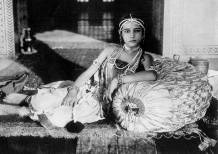
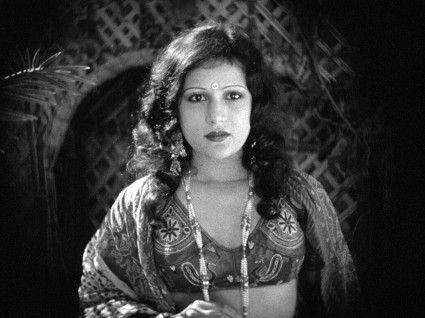
And then there’s more. On 25 August, at the Nehru Centre in London, there is a launch event for a year-long project (funded by the Heritage Lottery Fund) on the linkages between silent cinema in India and Britain, entitled Lifting the Curtain: Niranjan Pal & Indo-British Collaboration in Cinema in the UK (1902-29). This project is being managed by the South Asian Cinema Foundation (SACF) and began this May. The project main subject is screenwriter, director and playwright Niranjan Pal, who wrote the Anglo-Indo-German silent features The Light of Asia (1925), Shiraz (1928) and A Throw of Dice (1929, now available on DVD), before becoming chief scenarist at Bombay Talkies in 1934.

The Nehru Centre event will feature film clips and presentations on early cinema, filmmakers, filmmaking and film exhibition in Britain and India, together with information the various film sources that are available for students keen to conduct research in this area – a key aim of the project. The project is supported by the British Film Institute and the British Library, and among the speakers is the BL’s moving image curator, Luke McKernan i.e. me, talking about Charles Urban and the filming in Kinemacolor of the 1911 Delhi Durbar.

More information from the Nehru Centre (scroll down to 25 August) and the SACF site.

Lives in film no. 3 – Dan Leno

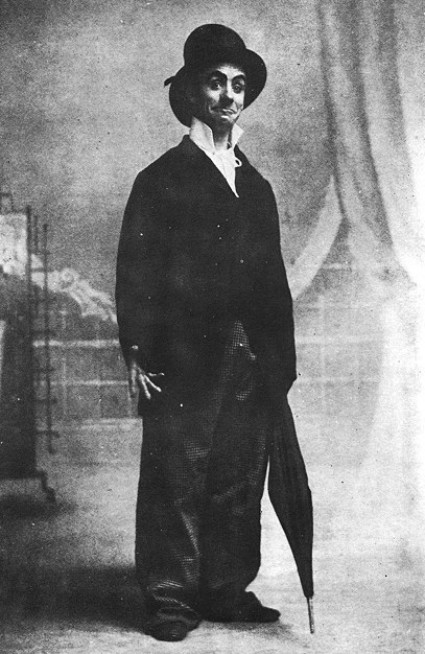
Dan Leno, from http://www.rfwilmut.clara.net/musichll/xleno.html

In 1921 Charlie Chaplin returned home to Britain to an ecstatic welcome. Touring his old London haunts, however, he found one shop-owner less than overawed by his worldwide fame. Chaplin went to a photographer’s shop on Westminster Bridge Road where he recalled seeing a framed picture of his comic idol, Dan Leno. It was still there. This conversation then followed:

My name is Chaplin … You photographed me fifteen years ago. I want to buy some copies.

Oh, we destroyed the negative long ago.

Have you destroyed Mr. Leno’s negative?

No, but Mr. Leno is a famous comedian.

Such is fame, as Chaplin notes. The man in the picture, Dan Leno, was for anyone of Chaplin’s generation the epitome of comedy. He was among the funniest and the most loved of comedians of the Victorian age, one whose career formed a bridge between the pantomime clowning of the Joe Grimaldi early-19th century era and the era of motion pictures that was to bring about the unprecedented fame of Leno’s successor as public favourite, Chaplin himself.

Dan Leno (1860-1904) was one of the greatest of all comedians. Born George Wild Galvin, the child of entertainers (as was Chaplin), he was raised in poverty in London, first trod the boards aged just four, and first rose to prominence by winning a world clog-dancing competition in Leeds in 1880. He made it to the main London stages by 1885, immediately acclaimed as a comic master, and soon established as a national favourite, particularly on account of his peformances in Drury Lane pantomimes. His artistry was built around an uncanny ability to mimic the trials and absurdities of everyday living. Leno excelled in making his comic characters as realistic as they were comic, products of an acute sense of human characteristics. As a railway guard, waiter, shop-walker, lodger, recruiting sergeant, swimming instructor or Widow Twankey (he was the archetypal pantomime dame), Leno’s befuddled demeanour reflected life’s puzzlements in a form that all could recognise and delight in. Max Beerbohm wrote of him:

Dan Leno’s was not one of those personalities which dominate us by awe, subjugating us against our will. His was of that other, finer kind — the lovable kind. He had, in a higher degree than any other actor I have ever seen, the indefinable quality of being sympathetic. I defy anyone not to have loved Dan Leno at first sight. The moment he capered on, with that air of wild determination, squirming in every limb with some deep grievance that must be outpoured, all hearts were his.

Leno’s humour was grounded in character observation and word-play, but as with all great comedians it was a shared understanding with his audience that made him special. He pinpointed what Beerbohm identified as “the sordidness of the lower middle class, seen from within” while making that “trite and unlovely material … new and beautiful”. How we laugh at ourselves is how Dan Leno made us laugh.

Dan Leno is now the subject of a new biography, the first since 1977. Barry Anthony’s The King’s Jester: The Life of Dan Leno, Victorian Comic Genius is published by I.B. Tauris and it is a delight from start to finish. Anthony (previously co-author with Richard Brown of A Victorian Film Enterprise: The History of the British Mutoscope and Biograph Company and a fine booklet on the Kinora) is well-known among a small coterie of music hall historians for his meticulous research and encyclopaedic knowledge. He also writes beautifully. The research is worn lightly, the observations are acute, the characters stand out vividly, and the material is handled in an engaging style that makes the Victorian music hall era come alive. There is much on the Victorian music hall in general, so that the book serves as a valuable general history as well as biography. It is particularly good at giving you the essence of Leno’s performances (and those of others), as if a motion picture camera had been there.

But, as Anthony points out, towards the end of Leno’s career, the motion picture cameras were there. Leno’s later career coincided with the rise of mass media as means to package and spread fame, and Leno was filmed on several occasions. Interestingly, the films that were made of Leno for the most part did not attempt to record his performances but rather focussed on his celebrity. There was a surprising number of films made of Leno – at least a dozen. But the reason why he seldom turns up in film histories is that only one of these films survives, and that in a non-film state.

Leno was first filmed on 23 June 1899 on a trip by the music hall society the ‘Water Rats’ to Box Hill in Surrey. Impresario A.D. Thomas had them filmed on the road to Mitcham travelling in coaches (‘The Rats’ off on a Picnic), at play befor a crowd of spectators (‘The Rats’ at Play) and picnicing (‘The Rats’ at Dinner). Alongside Leno were such notables as Herbert Campbell, Joe Elvin, George Robey, Will Evans and Harry Randall. A few days later Thomas filmed the Music Hall Sports at Herne Hill in London, the sports being interspersed with comic performances intended to raise money for the Music Hall Benevolent Fund. Dan Leno featured in Burlesque Indian Attack on Settlers’ Cabin, Dan Leno’s Attempt to Master the Wheel (in the character of his famous role of Mrs Kelly) and Burlesque Fox Hunt. All titles were subsequently included in the Warwick Trading Company catalogue.

Leno was filmed at other charity events. Birt Acres filmed Dan Leno’s Cricket Match in July 1900 at another mix of charity and sports, where Leno again took a turn on a bicycle. A year later, in September 1901, he was back on the cricket field (at Stamford Bridge) for Warwick’s Dan Leno’s Day Out, paired with Dan Leno, Musical Director, where he mock-conducted the Metropolitan Police Band in ‘A Little Bit Off the Top’. A few days later he appeared before the 70mm camera of the British Mutoscope and Biograph Company for Dan Leno’s Record Score, which showed him in comic argument with a wicket-keeper (for photographs from the day in Black and White Budget see the excellent Arthur Lloyd website). Anthony records that the film was exhibited alongside genuine cricket film of C.B. Fry and Ranjisinhji. Another Biograph film was Mr Dan Leno, Assisted by Mr Herbert Campbell, Editing ‘The Sun’ (1902) in which Leno and the frequent partner in pantomime, a comic promotional film for a journal run by the notorious Horatio Bottomley. This was the only film to show an acted peformance from Leno, apart from Bluebeard (1902), an extract from a Drury Lane pantomime in which Leno played Sister Anne, produced by Warwick.

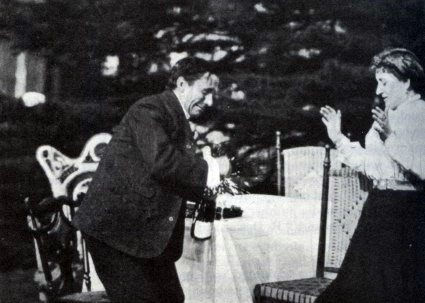
Dan Leno and his wife Lydia in The Obstinate Cork (1902), from The King’s Jester: The Life of Dan Leno, Victorian Comic Genius

Biograph produced the only film of Leno that exists today. Its 70mm products were often issued in flip-card or flip-book form through a variety of devices for viewing at seaside arcades (through the Mutoscope) or in the home (through the Kinora). Biograph made two films in 1902 of Leno with his family in the garden at their home in Clapham, one of which showed Leno and his wife Lydia struggling to open a bottle of champagne and eventually resorting to a giant property axe to do so. The Obstinate Cork survives – in private hands – as a Kinora reel (i.e. a set of flip-cards for exhibiting in a Kinora) and forms the only moving image that exists of the great comedian.

As said, most of these films did not present Leno in performance but rather Leno the celebrity, seen clowning in public, playing up to his popular persona. They crossed the barrier between fiction and non-fiction. If any were to be discovered they wouldn’t so much show us Leno’s art as his popularity, and that would be so precious in itself. Leno the comic giant belonged to his time. Nothing dates so remorsely as humour. What makes one generation roll in the aisles makes the succeeding generation shrug its shoulders or wince with embarassment. What matters for our understanding of the history of comedy is not whether we would find Grimaldi, Leno or Chaplin funny today (though we might) but that we appreciate just what they meant to the people of their time. This is what Barry Anthony’s book achieves so well. It tell us enough to give a good idea of Leno’s comedy, but still more it shows us how key he was to his times, how people identified with his humour, how much he was of his times and yet transcended his times. The films that were made of him were not intended to replicate his act but to reflect the profound affection with which he was held by millions.

Dan Leno suffered throughout his professional life from a series of mental and physical breakdowns, brought on by the pressures of huge popularity. He died in 1904, aged just 43.

Finding out more
Leno made a number of sound recordings, and unlike his motion picture legacy, all of these survive. Recordings from 1901 and 1903 can be heard Music Hall Perfomers site, while his famous number ‘The Grass Widower’ can be heard on YouTube. Peter Preston has written an interesting piece in The Guardian comparing Leno’s passing fame to that which endures for Marlon Brando – as unlikely a pairing as one could imagine. Paul Morris’ essay on the English Music Hall site evocatively sums up Leno’s art. Finally, Leno’s comical pseudo-autobiography, Dan Leno Hys Booke (1899) is available online from the Internet Archive.

Exporting entertainment

Scholarly works in the silent cinema field – indeed in most fields – don’t last long. They catch the latest academic wave for a time, surf along for a while, then sink beneath the waves as the next key text comes along. For a while it is important to cite them in your own work; then it ceases to be a necessity; finally it becomes an embarassment. You are writing an essay in 2010 and you are citing a book published in 1985? Think again.

But then just a handful of books break through academic fashion and turn out to have lasting value. You have always to refer back to them, because they are one of the signposts. They point the way. In the silent (and early sound) cinema field, one such book is Kristin Thompson’s Exporting Entertainment: America in the World Film Market 1907-1934, published in 1985 and a book that I have referred back to time and time again ever since, and one which has had a strong influence on our corner of film studies.

In part that influence is due to the unusual nature of its theme. Its subject is mechanics of the early Hollywood film industry and how it gained world dominance from the First World War inwards. But it is not so much the thesis as the method, as Thompson looks at such previously overlooked data as import and export records, industrial data and market reports – data which had scarcely been considered the stuff of film history before then, but which turned out to be essential in understanding the intracacies of production, distribution and exhibition on a worldwide scale. The information could then underpin an understanding of why, as the book’s blurb puts it, “Hollywood has become practically synonymous with cinema”.

Exporting Entertainment has inspired other works, notably Ruth Vasey’s The World According to Hollywood: 1918–1939 (1997) and Andrew Higson and Richard Maltby’s Film Europe and Film America: Cinema, Commerce and Cultural Exchange, 1920–39 (1999). It was also pioneering in its emphasis on empirical data, a trend which has been picked up in recent years by exhibition studies. Some of its arguments may have been superseded by economist Gerben Bakker’s recent Entertainment Industrialised: The Emergence of the International Film Industry, 1890-1940 (discussed in detail in an earlier post), but those steeped in film history will find Thompson’s book easier to navigate, even if it is not a light read that you are going to polish off in one sitting. But it should be read, because it sees the industry not through the starry eyes of the fan journals of the period but through the hard-bitten minds of the trade papers, who saw things in so many pounds or dollars per foot of film. The detail is amazing (as is the research behind it), and you really do see cinema on a global scale (Panama, Peru, Siam, the Malay States, Romania and Estonia all end up in the subject index). The book makes you recognise why national cinema is such a suspect way of going about investigating film history when the business was so deeply bound up by the ebbs and flows of a world market.

The reasons for all this now is to announce the happy news that Exporting Entertainment is now freely available online from David Bordwell and Kristin Thompson’s website. As Thompson explains in her useful introduction on the book’s web page, the book has been long out of print and was never distributed in the United States (it was published by the BFI). The book has been made available in PDF form, though be warned that it is a simple scanning job and consequently the file size is large (87MB) and there is no underlying OCR so the text is not word-searchable. This is a shame, and one wonders whether Thompson might take advice from those who regularly produce e-books and re-issue the text in word-searchable format. It would certainly open up the text anew for researchers. But setting that petty point aside, this is a very welcome means of re-introducing an important but rare text to the research community, and it has gone into the Bioscope Library.

Disappearing tricks

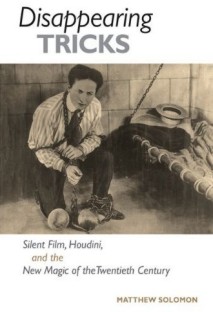
Published this month by the University of Illinois Press is Disappearing Tricks: Silent Film, Houdini, and the New Magic of the Twentieth Century, by Matthew Solomon. It revisits the golden age of both theatrical magic and silent film to reveal how professional magicians shaped the early history of cinema. This is a subject which is often referred to but seldom give book-length treatment. The classic study for years now has been Erik Barnouw’s The Magician and the Cinema, while Dan North’s Performing Illusions ties together the illusions of the pre-cinema and early cinema worlds to the CGI and SFX of today. Matthew Solomon focuses on the work of those professional illusionists who transferred from stage to screen between 1895 and 1929, looking in particular at the work of Georges Méliès and Harry Houdini. The book also investigates “anti-spiritualism and presentational performance in silent film … highlighting early cinema’s relationship to the performing body, visual deception, storytelling, and the occult”.

So, who were those illusionists? The Who’s Who of Victorian Cinema site has biographies of the leading figures from the 1890s, which was the main period in which magicians made their mark on the new medium:

  • ‘Professor’ Phillip Anderson – magician who toured India and South Asia, ading films to his act in 1898
  • Billy Bitzer – D.W. Griffith’s cinematographer started out pursuing his interest in magic and developing novelty toys before branching out into film
  • J. Stuart Blackton – the co-founder of Vitagraph had a cartooning and conjuring act with Albert Smith before they established one of the leading early American film companies
  • Walter Booth – British conjurer who turned trick filmmaker for Robert Paul and Charles Urban
  • David Devant – famous British magician who made film a part of his act in 1896
  • John C. Green (‘Belsaz’) – magician who tourned Canada and the USA, adding film to his act in 1896
  • Carl Hertz – American magician who introduced films to South Africa
  • Emile and Vincent Isola – Franch magicians who added film to their Paris act at the Théatre Isola and were rivals to Georges Méliès
  • John Maskelyne – famous British magaixian who re-invented the art as theatrical performance and who became interested in film as exhibition and on the invention side
  • George Méliès – French magician turned cinema illusionist of the highest order
  • John Schuberg (‘Johnny Nash’) – Swedish magician and film showman who operated in Canada
  • William Selig – American magician and minstrel show operator turned film producer
  • Albert Smith – British conjuror whose double act with J. Stuart Blackton led to their forming the Vitagraph Company of America
  • G.A. Smith – Started out with a ‘second sight’ act which led to his being used as a subject by the Society for Psychical Research, before he became innovative filmmaker and inventor
  • Félicien Trewey – French shadowgrapher (hand shadows), entertainer and friend of the Lumières, he introduced their films to Britain
  • Alexander Victor – Swedish magician who exhibited films in the USA from 1897, founded the Victor Animatograph Co. and invented successful devices for amateur film production

Just outside the Victorian period was Gaston Velle, magician and the son of a magician who directed fantasy films for Pathé in the early 1900s.

Harry Houdini was unusual in being a magician/illusionist from a later era who made a strong impact upon cinema (or else it made a strong impact upon him). He was a one-man thesis on the boundaries between illusion and reality, being magician, escapologist, actor, film producer and someone dedicated to exposing frauds such as spiritualism. He included films as part of his vaudeville act from the mid 1900s, then starred in a serial which showed off his skills in escaping from impossible perils: The Master Mystery (1919, in 15 parts), followed by two feature films for Paramount, The Grim Game (1919) and Terror Island (1920). He formed the Houdini Picture Corporation to make The Man From Beyond (1921) and Haldane of the Secret Service (1923), but cheap production and a lack of real film presence in Houdini himself meant that his film career petered out. His stunts also featured in newsreels of the period. Kino Video has a 3-DVD set Houdini: The Movie Star, which includes The Master Mystery, Terror Island, The Man From Beyond, Haldane of the Secret Service, a five minute section from The Grim Game, and assorted archival films of Houdini in action.

In 2006 Matthew Solomon curated a section of the Pordenone silent film festival programme on magic and film. You can find the list of films and his notes on the festival catalogue, here.

Image

Production still from Georges Méliès’ Eclipse de soleil en pleine lune (1907), from Image vol. 34 (1991)

The number of digitised film journals on the Web remains very few, the number dedicated to silent film miniscule, and the number of those in English nanoscopically small. So it is terrific to be able to report that George Eastman House has published online most of Image, 1952-1997.

Image was the journal of George Eastman House, International Museum of Photography and Film, for forty-seven years. It reported on and documented scholarship in photography and motion pictures, with particular reference to its own collections. Its distinguished contributors included photography historian and GEH’s first curator Beaumont Newhall, GEH’s first motion picture curator, James Card, George Pratt, author of one of the essential silent film books, Spellbound in Darkness, and more recently GEH curators Jan-Christopher Horak and Paolo Cherchi Usai. Today the name of Image lives on in part through Marshall Deutelbaum’s fine collection ‘Image’ on the Art and Evolution of the Film (1979).

Image covered photographic and motion picture history, so only a part of the journal run relates to silent film, but what is there is excellent, often with key historical or filmographic data published for the first time, and gorgeously illustrated. Below is a selection of some of the articles with links to web page for the individual issues (many of which are also reproduced in Deutelbaum’s book). Please note that the journal has been digitised volume-by-volume and each PDF file is 30MB or more in size. Be aware also that the journals are not arranged in complete chronological order, so one can find oneself jumping from the 1950s to the 1970s then back to the 50s in places. There do not seem to be many issues for the 1960s, for reasons that are not explained (it appears it just wasn;t published too often that decade).

  • Collecting Old Films: Article stressing the importance of motion picture archives and the need for a collective effort to preserve film history. IMAGE (1952. vol 1. issue 7.)
  • The Kammatograph: Description of the apparatus developed and patented by Leo Kramm in England, 1897. The Kammatograph, a camera and projector in one unit, recorded up to 550 images in a spiral pattern on a circular glass plate that could then be projected. IMAGE (1952. vol 1. issue 8.)
  • Silent Film Speed, by James Card. Discusses the factors in trying to determine correct projection speeds for silent films, as the speeds vary, sometimes even from scene to scene within a single film. The end of the article provides a list of 29 silent films and their correct projection speeds. IMAGE (1955. vol 4. issue 7.)
  • Eadweard Muybridge and the Motion Picture, by Beaumont Newhall. IMAGE (1956. vol 5. issue 1.)
  • Out of Pandora’s Box: New light on G. W. Pabst from his lost star, Louise Brooks, by James Card, and Mr. Pabst, by Louise Brooks. IMAGE (1956. vol 5. issue 7.)
  • The George K. Spoor Collection. Equipment and film recently given to the museum, by James Card. IMAGE (1956. vol 5. issue 8.)
  • Early Days of Movie Comedies: Reminiscences by a director in the early silent comedy days, by Clarence G. Badger. IMAGE (1957. vol 6. issue 5.)
  • Film Archives: Historians of the future might have had the rare privilege of consulting filmed documents of all the world events from the year 1898, by James Card. IMAGE (1958. vol 7. issue 6.)
  • The Posse is Ridin’ Like Mad: An account of Westerns and Western stars from 1907 through 1914, by George Pratt. IMAGE (1958. vol 7. issue 4.). Part II IMAGE (1958. vol 7. issue 7.)
  • The Films of Mary Pickford: On early screen legend Mary Pickford and her enduring appeal. With An Index to the Films of Mary Pickford. IMAGE (1959. vol 8. issue 4.)
  • The Jack-Rabbits of the Movie Business: On the prolific and profitable nickelodeon theatres of the early 1900s. IMAGE (1961. vol 10. issue 3.)
  • Firsting the Firsts. George Pratt posits that film projection on the Eidoloscope in America pre-dated the first public screenings by Lumière in France and Skladanowsky in Germany. IMAGE (1971. vol 14. issue 5–6.)
  • “”If You Beat Me, I Wept””: Alice Terry Reminisces About Silent Films. Excerpts from a taped interview with actress Alice Terry and veteran cameraman John Seitz conducted by George Pratt in 1958. IMAGE (1973. vol 16. issue 1.)
  • “”It’s Just Wonderful How Fate Works””: Ramon Novarro on his Film Career. Ramon Novarro, who played the title role in Ben Hur (1925), reminisces about his film career in this taped interview conducted by George Pratt. IMAGE (1973. vol 16. issue 4.)
  • The Most Important Factor was the ‘Spirit’: Leni Riefenstahl During the Filming of The Blue Light. IMAGE (1974. vol 17. issue 1.)
  • “Anything Can Happen—and Generally Did”. Buster Keaton gives a detailed account of his silent film career during a talk with an unnamed interviewer in Los Angeles in 1958. IMAGE (1974. vol 17. issue 4.)
  • “She Banked in her Stocking; or, Robbed of her All”: Mutoscopes Old and New. IMAGE (1976. vol 19. issue 1.)
  • Early Film Activities of William Fox. Excerpt from Paul C. Spehr’s book The Movies Begin: Making Movies in New Jersey. IMAGE (1977. vol 20. issue 3–4.)
  • Cue Sheets for Silent Films: On Theodore Huff’s collection of thematic cue sheets for silent films presented to George Eastman House in 1953. IMAGE (1982. vol 25. issue 1.)
  • The Color of Nitrate: Some Factual Observations on Tinting and Toning Manuals for Silent Films, by Paolo Cherchi Usai. IMAGE (1991. vol 34. issue 1–2.)
  • A Trip to the Movies: Georges Méliès, Filmmaker and Magician (1861-1938) by Paolo Cherchi Usai. IMAGE (1991. vol 34. issue 3–4.)

And that’s just a selection on what’s available on silent film. It’s such a treasure trove, and all word-searchable – do note, by the way, that once you have searched for a keyword, you must uncheck the box on the left which says ‘Search within results’, or else further keyword searches will only be within the results of the previous search. Also, search under More Options for browing by author, keyword, volume number and year.

Warm praise is due to George Eastman House for making the journal available in this way. Go explore.

Motography

‘An odd type of theatre front’: illustration from Motion Picture Making and Exhibiting

One of the indications of the speculative, exploratory nature of early cinema is the uncertainty felt at the time over what it or its products were to be called. Living pictures? Animated photography? Cinema? Kinema? Kinematography? Motion pictures? Moving pictures? Photoplays? Bioscope? It’s worth bearing in mind such terms when searching for early cinema subjects in digitised book and newspaper sources (alongside such other handy terms as kinetoscope, biograph, electric theatre etc.). One term you might not think to use is ‘motography’. I’m not sure how long the lifespan was of this word, but for a short period it was used by some seeking for a distinctive, all-encompassing term for the new art – indeed it was the title of an American film journal of this period (it ran 1909-1918 and was originally called The Nickelodeon).

The term was certainly favoured by John B. Rathbun, author of Motion Picture Making and Exhibiting: A comprehensive volume treating the principles of motography; the making of motion pictures; the scenario; the motion picture theater; the projector; the conduct of film exhibiting; methods of coloring films; talking pictures, etc. (1914), the latest volume to go into the Bioscope Library.

John B. Rathbun was a technical writer (and an associate editor of Motography, which helps explains his attachment to the term). His book is yet another of those all-purpose guides to the new industry of motion pictures, a blend of potted history, social history, technical explanation and marvelment at the rise of this extraordinary business and the huge sums that it was starting to earn. As indicated by its subtitle, Rathbun’s book takes us through the principles, production processes and exhibition of motion pictures up to 1914. It is addressed to a reader with a general interest in the phenomenon, though it sometimes forgets this.

The book starts with the familiar pre-history of the medium, from Zoetropes to Muybridge to Edison to motion picture projection. The principles of the taking and projecting of films are covered, with practical information on film stock itself, including development, printing and colour tinting. Film production follows, covering both studio and non-fiction work, then the almost obligatory chapter on the mysteries of scenario writing with suggestions on how to sell your scenario to the studios. If the lay reader did not fancy his or her chances as a scriptwriter, then they might consider opening a motion picture theatre as the best way to make money out of this new business, and advice follows on setting up a cinema, putting together the programme (with handy advice on dealing with different ages of film reels), advertising the show, an interesting discussion on whether to include vaudeville acts or not, and operating profitable sidelines.

The filming of an ‘industrial’, with Cooper-Hewitt mercury vapour lamps on the right, from Motion Picture Making and Exhibiting

A long chapter on the technicalities of projection seems to belong to another book, and might have been enough to scare off one or two would-be speculators. Rathbun follows this with guidelines on local censorship laws and regulations, then rounds off matters with an interesting chapter on colour (covering stencil colour, the Friese-Greene process, Kinemacolor and Gaumont Chronochrome), stereoscopy and synchronised sound films.

Motion Picture Making and Exhibiting is rather muddled in the guidelines it provides, as it is unsure at what level or precisely to whom it is directing its advice. Buyers at the time might have been less than satisfied, but for us now it has plenty of handy information on how the industry was perceived and some useful data and social observations relating to the exhibition sector. There are illustrations of studio interiors, laboratories, wardrobe rooms, camera operators, cinema floor plans, projection booths and so on, to add to its value as a reference source. It’s available from the Internet Archive, and into the Bioscope Library it goes.

They thought it was a marvel

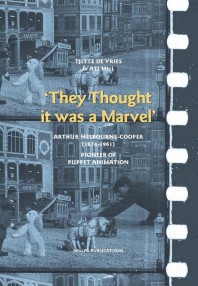
Amsterdam University Press has published “They Thought it was a Marvel”: Arthur Melbourne-Cooper (1874-1961), Pioneer of Puppet Animation, by Tjitte de Vries and Ati Mul. Melbourne-Cooper is an interesting minor figure in early British film history, an assistant to Birt Acres (the first person to take a 35mm film in Britain) in the 1890s, then a pioneer of the animation film – some delightful examples survive, such as Dreams of Toyland (1908) and Noah’s Ark (1909) – as well as a being a producer of some rough-and-ready comedy films, typical of some of the low-grade British production of the time. He opened a cinema in his home town of St Albans in 1908 (an intriguingly rare example of an early filmmaker turning to film exhibition), made some industrial films, and generally had a diverting if small-scale career in the first years of British film.

What has made Melbourne-Cooper an unusual case has been the way that his cause has been advocated by a handful of dedicated souls. His daughter Audrey Wadowska was indomitable in championing her father’s cause as a film pioneer. She was a regular visitor to the National Film Archive, tirelessly holding the BFI to account for not sufficiently appreciating her father’s achievement. She collected a vast archive of documentation in support of her cause, and the Dutch researcher Tjitte de Vries took up that cause and has dedicated much of a lifetime to uncovering Arthur Melbourne-Cooper’s history.

This has led to some extraordinary battles. One has raged over a film held in the BFI National Archive (as it is now called) with the supplied titles of Matches Appeal, which features animated matches used in as a military recruiting aid while advertising Bryant & May matches. The claim is that the film relates to the Anglo-Boer war and therefore dates from 1899, making it years ahead of its time as a piece of animation. Others have denied that this could be possibly so and that the film could date as late as the First World War, but the 35mm original is lost, so the contention remains.

Arthur Melbourne-Cooper’s Dreams of Toyland (1908), from the BFI’s YouTube channel

A second battle has raged over the authorship of the films of Brighton filmmaker G.A. Smith, some of which Melbourne-Cooper’s advocates have claimed were made by him. I am not going into the minutiae of this particular argument. If you are at all interested, the arguments for and against are aired in the following:

  • Tjitte de Vries, ‘Arthur Melbourne-Cooper, Film Pioneer Wronged by Film History’, KINtop-4, 1994
  • Frank Gray, ‘Smith versus Melbourne-Cooper: History and Counter-History, Film History, vol. 11, 1999
  • Tjitte de Vries, ‘Letter to the editor: The case for Melbourne-Cooper’, Film History, vol. 12, 2002
  • Stephen Bottomore, ‘Smith Versus Melbourne-Cooper: An End to the Dispute’, Film History, Vol. 14, No. 1, 2002

All of which shows how important the little films at the dawn of filmmaking are to some, and the huge attraction that there is for the idea of authorship and the artistry of the individual. Some would argue that we should have no more biographies of filmmakers if we are to have a proper early film history, but it would be a cold history without character. The Melbourne-Cooper saga pits two different kinds of history against one another – one based on family history, reminiscence, and single-minded advocacy; the other based on primary evidence and comparative analysis. It raises interesting issues about authorship – ‘father’s’ films might have been his not because he filmed them but because he owned and exhibited them. It also shows the glamour of early film technique, with films such as G.A. Smith’s Grandma’s Reading Glass (1900), with its pioneering use of close-ups and point-of-view shots, a glamour that Melbourne-Cooper’s advocates yearn to see assigned to him (read the decidely partial Wikipedia entry on AMC and judge for yourselves).

Anyway, They Thought it was A Marvel argues its case over 576 pages, and comes with a DVD with six of Melbourne-Cooper’s animation films. Melbourne-Cooper deserves his small place in film history, not for the dubious claim to another man’s films and creativity, but as a genuine pioneer of the animation film, perhaps the first person to make such films with a child audience in mind. The book is priced €39,50, it is written in English, and it is available from the Amsterdam University Press website, while it is listed on Amazon as being available in the UK from Pallas Publications in December 2010.

(Arthur Melbourne-Cooper has a MySpace page, by the way. He currently has 74 friends. Including the BFI.)

Encyclopedia of Early Cinema

Now here’s some really good news. The Encyclopedia of Early Cinema is now available in paperback. Originally published in 2005, the hardback is priced at a challenging £128.25. But such has been the success of the book, edited by Richard Abel, that publishers Routledge have assented to the publication of a paperback edition, at the considerably less eye-watering price (from Amazon) of £28.49 ($54.83 in the USA) – and that’s 832 pages you get for your money.

This is one of the best reference books yet published for the silent film era. Its subject is the first twenty-five years of cinema (from the early 1890s to the mid-1910s, the early cinema period having flexible boundaries). Over 950 entries written by nearly 140 contributors cover not just names, companies and countries, but significant themes, genres and critical concepts. This is the main list of headings for the thematic entries:

Archive sources, sites and policies; Audiences/spectatorship; Cultural contexts (e.g.comic strips, department stores, magicians, world’s fairs); Developments in film style (colour, lighting, set design etc.); Film companies; Industry developments; Key figures; Kinds of film; Law and the cinema; Multiple-reel films; National cinemas; Social contexts (e.g. colonialism, modernity, urbanisation); Technology and material; and Trade press.

It is a particularly well-ordered reference work. Entries feature extensive cross-referencing (through use of bold text) and the longer entries come with a further reading list. There are See also references to related entries, a useful classified guide to the thematic entries, a lengthly bibliography and a thorough index. It is clearly laid out and handsomely illustrated. It is also properly international in scope, covering not just the USA and major Western countries but filmmaking in Africa, Asia, the Middle East and South and Central America.

It works both for those who require plain information efficiently set out, and those who need guides to critical concepts. Not sure what the ‘Cinema of attractions’ means? Tom Gunning tells you all you need to know in just over two pages. Need to know about ‘Staging and depth’? Ben Brewster comes to the rescue. But dip into the book and you come across such gems of succinct and practical information – cameras, education, advertising, intermittent movement, biblical films, projectionists, phantom train rides, illustrated lectures, Shakespeare, fairs and fairgrounds, programme formats, sound effects, and so many more. Some of the entries are mini-classics – I particularly recommend Nick Hiley’s entry on Great Britain, a model national film history in miniature.

And then there are the people. Just to pick some names at random, you’ll find W. Stephen Bush, Charles Urban, Evgenii Bauer, Mauritz Stiller, Tom Mix, Max Mack, Komada Koyo, Cherry Kearton, Eleonora Duse, Adolph Zukor and King Baggot. Likewise the film companies: Clarendon, Lubin, Khanzhonkov, Milano, SCAGL, Messter, Phalke, Hollandia, Nikkatsu, Nordisk, Saturn, Kosmofilm, Hispano, even the Salvation Army (in Australia).

This is such a useful book – indeed I would have struggled with quite few Bioscope entries had I not got a copy by my side. The paperback edition updates the 2005 edition without radically altering it, because the editor was obliged to keep as far as possible to the original typesetting. So there have been minor amendments (small errors of fact, dates, new snippets of information), some additions to the Further Reading lists, and the bibliography at the back has grown considerably. Abel notes the absence of a list of DVDs and of web resources, which is a shame, but it is a minor loss.

Though the book does not have every single person nor every single film company from the early cinema period, it has most of those you might possibly want to look up. You might also quibble at the restriction to the early cinema period and yearn for the encyclopedia of silent film overall. Now that would be a good idea – but the early cinema period has been well established as a distinctive period in its own right by two or three decades of dedicated research and critical investigation. The Encyclopedia of Early Cinema crowns the achievement.